 Скачать презентацию Human Genetics Mutations Genetics-Unit 3 -Part B
c9a2cacfd52fdb67f90dcc6204918698.ppt
- Количество слайдов: 13



Human Genetics. Mutations Genetics-Unit 3 -Part B
Mutations Mutation – any change in the genetic make -up of an organism – Mutations may lead to organisms making different proteins, expressing or not expressing a trait or traits, or even death – Mutations have been called the driving force of evolution because they change organisms and may lead to the formation of new species – Although slightly more than 99% of mutations are deleterious (death causing), some actually increase the survivability of the organism – If the mutation occurs in a somatic body cell, it is not passed on, if it occurs in a gamete, then that change will be passed on
continuing Two types of mutations: 1. ) spontaneous – caused by errors during replication 2. ) induced – caused by outside agents (mutagens) Mutagens cause mutations. Examples of mutagens include: – – – x-rays ultraviolet light chemicals (Carbon Tetrachloride) (DDT) other genes viruses sunlight (etc. )
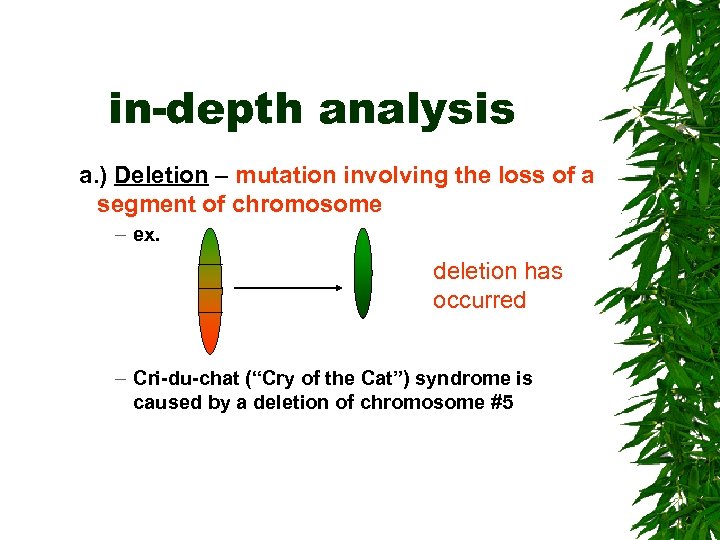
in-depth analysis a. ) Deletion – mutation involving the loss of a segment of chromosome – ex. deletion has occurred – Cri-du-chat (“Cry of the Cat”) syndrome is caused by a deletion of chromosome #5
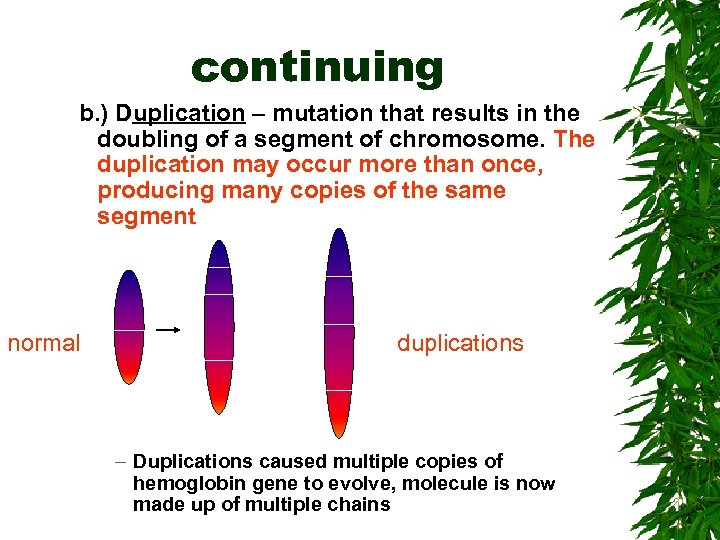
continuing b. ) Duplication – mutation that results in the doubling of a segment of chromosome. The duplication may occur more than once, producing many copies of the same segment normal duplications – Duplications caused multiple copies of hemoglobin gene to evolve, molecule is now made up of multiple chains
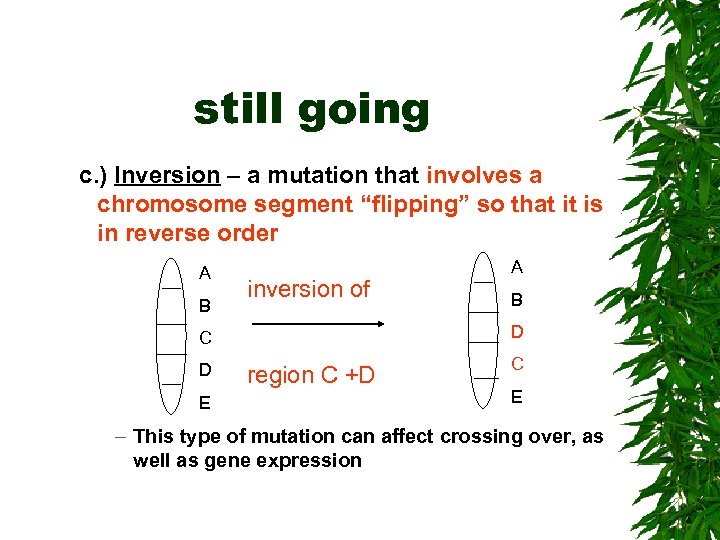
still going c. ) Inversion – a mutation that involves a chromosome segment “flipping” so that it is in reverse order A B inversion of E B D C D A region C +D C E – This type of mutation can affect crossing over, as well as gene expression
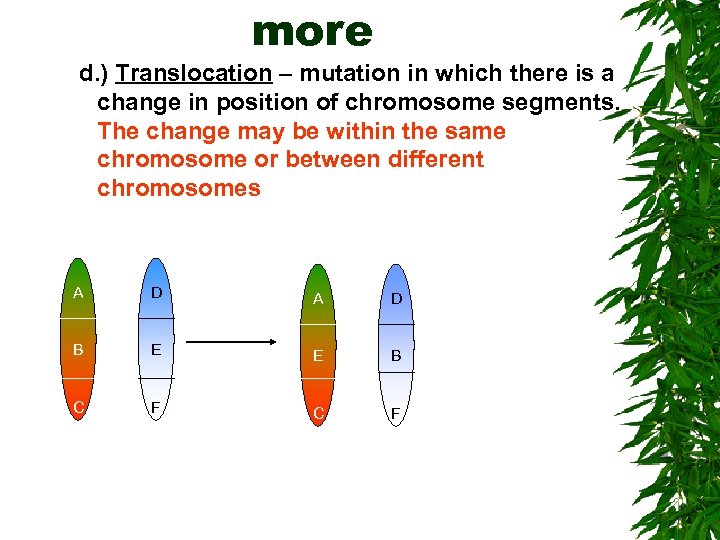
more d. ) Translocation – mutation in which there is a change in position of chromosome segments. The change may be within the same chromosome or between different chromosomes A D B E E B C F
Finishing this example – Translocations are a known cause of an assortment of human tumors • ex. Chronic myelogenous leukemia patients show a translocation between chromosomes 22 + 9, known as the Philadelphia chromosome
more e. ) Position effect – other mutations such as inversions or translocations put gene sequences in different spots, this change in position may cause a change in expression f. ) Fragile sites – narrowings or gaps found in chromosomes, the most famous is fragile XSyndrome, a break in the X-chromosome, may cause retardation g. ) Change in number – normal organisms are said to be euploid, organisms that have different #’s of chromosomes are said to be aneuploid – examples of aneuploidy: 1. ) nullisomy – one pair of chromosomes is missing (2 n-2) 2. ) monosomy – loss of a single chromosome (2 n-1) 3. ) trisomy – getting a single extra chromosome (2 n+1) 4. ) tetrasomy – getting an extra chromosome pair (2 n+2)
genetic diseases Examples of genetic diseases involving chromosome number changes: A. ) Autosomal 1. ) trisomy 21 (Down Syndrome) 2. ) trisomy 13 (Patau Syndrome) 3. ) trisomy 18 (Edwards Syndrome) B. ) Sex chromosomes: 1. ) monosomic X – Turner Syndrome 2. ) XYY Trisomy – normal male (acne) 3. ) XXY Trisomy – Klinefelter Syndrome – XXYY also has Klinefelter-like symptoms
Gene mutations 2. ) Gene mutation – the process by which a DNA base pair change is produced and not repaired. Most times gene mutations are repaired. – these types of mutations can also be spontaneous or induced Types of gene mutations: a. ) point mutation (base-pair substitution) – one base pair is replaced by another b. ) transition mutation – specific base pair substitution of one purine/pyrimidine to another – four types: (AT to GC) (GC to AT) (TA to CG) (CG to TA)
more mutations c. ) Transverse mutation – another specific base-pair substitution. Includes AT to TA, GC to CG d. ) Missense mutation – a base pair change causes a change in m. RNA, so a different amino acid is placed in a protein (ex. sickle cell anemia) e. ) Nonsense mutation – change in a base pair that will produce a stop codon where it shouldn’t be f. ) Frameshift mutation – addition or deletion of one or more base pairs in a gene, causing different amino acids to be produced
last slide Examples of genetic diseases caused by gene mutations I. Inborn errors of metabolism – caused by point mutations which lead to lack of/or overproduction of certain enzymes: most are inherited recessively examples: – – maple syrup urine disease alkaptonuria albinism PKU II. ) Diseases related to defective DNA repair – caused when mutated DNA is not repaired examples: – Xeroderma pigmentosum – Bloom’s Syndrome
Скачать презентацию Human Genetics Mutations Genetics-Unit 3 -Part B
c9a2cacfd52fdb67f90dcc6204918698.ppt