


 Скачать презентацию Human Gene Therapy Risk Assessment and Regulatory Requirements
81d128ead118c3f7b3af87a82baf1bd7.ppt
- Количество слайдов: 60
 Human Gene Therapy: Risk Assessment and Regulatory Requirements And Overview of the NIH r. DNA Guidelines EMD 545 b Lecture #10
 NIH Guidelines for Research Involving r. DNA Molecules (April, 2002)
 NIH Guidelines - April 2002 • NIH - OBA (Office of Biotechnology Activities) • Outline scope of regulated r. DNA work and required containment levels (changes approved by NIH-OBA) • Applicability – NIH Sponsored Institutions – NIH Supported projects (US & Abroad)
 Responsibilities: Institution • • Ensure full conformity with Guidelines Establish an IBC Appoint a BSO (if necessary) Ensure adequate expertise for protocol review (plant, animal, human gene transfer) • Training (IBC/BSO/PI’s/Lab staff) • Health Surveillance (BL 3/Large scale)
 Responsibilities - IBC • 5 members (2 from community) • Expertise (r. DNA, biosafety, containment, legal) • Annual report to NIH-OBA (roster/CV’s) • Assess – Containment level, facilities, procedures – Develop emergency plans, report violations
 Responsibilities: Biosafety Officer • • • IBC Member Inspections Report problems to IBC Develop emergency plans Advise on lab security
 Responsibilities: Principal Investigator • Full compliance with Guidelines • Can’t start/modify non-exempt work w/out approval • Report violations w/in 30 days • Make initial determination of containment • Instruct/train lab staff • Supervise safety performance
 Section III: Experiments covered by the NIH Guidelines • Require approval before initiation – III-A: Transfer significant drug-resistant trait (IBC/RAC review/NIH Director) – III-B: Cloning toxins (IBC/NIH-OBA) – III-C: Human gene transfer (IBC/IRB/FDA NIH-OBA registration) – III-D: Risk group 2 -4 & restricted, defective virus in cell culture, animals, plants, large scale
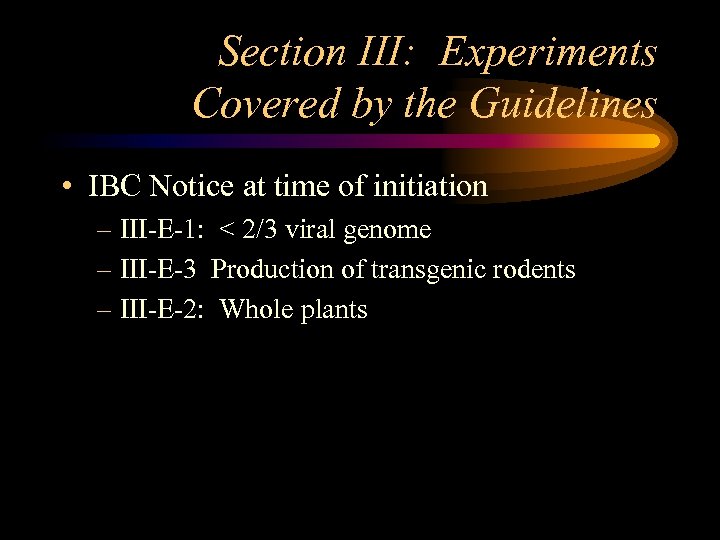 Section III: Experiments Covered by the Guidelines • IBC Notice at time of initiation – III-E-1: < 2/3 viral genome – III-E-3 Production of transgenic rodents – III-E-2: Whole plants
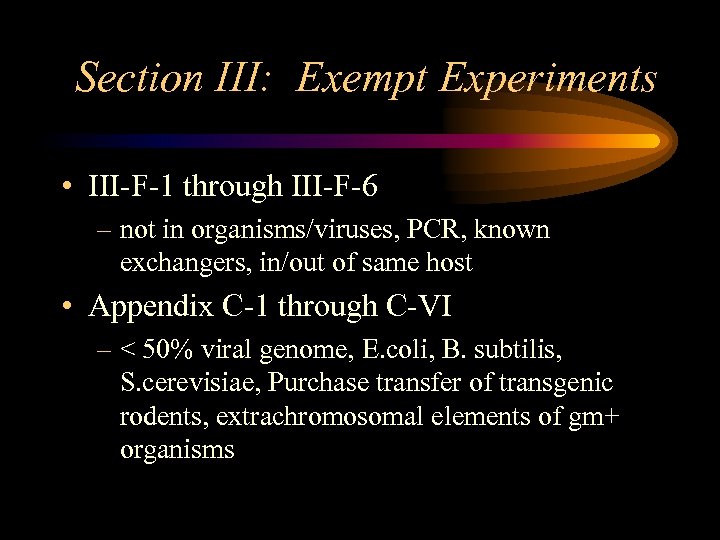 Section III: Exempt Experiments • III-F-1 through III-F-6 – not in organisms/viruses, PCR, known exchangers, in/out of same host • Appendix C-1 through C-VI – < 50% viral genome, E. coli, B. subtilis, S. cerevisiae, Purchase transfer of transgenic rodents, extrachromosomal elements of gm+ organisms
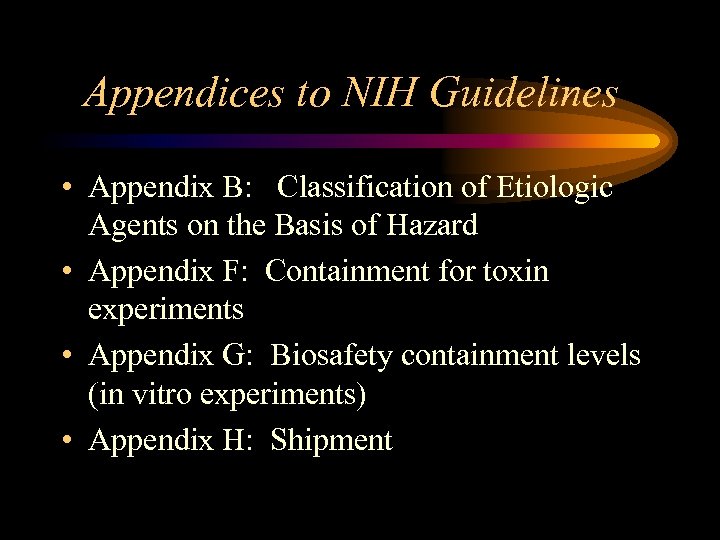 Appendices to NIH Guidelines • Appendix B: Classification of Etiologic Agents on the Basis of Hazard • Appendix F: Containment for toxin experiments • Appendix G: Biosafety containment levels (in vitro experiments) • Appendix H: Shipment
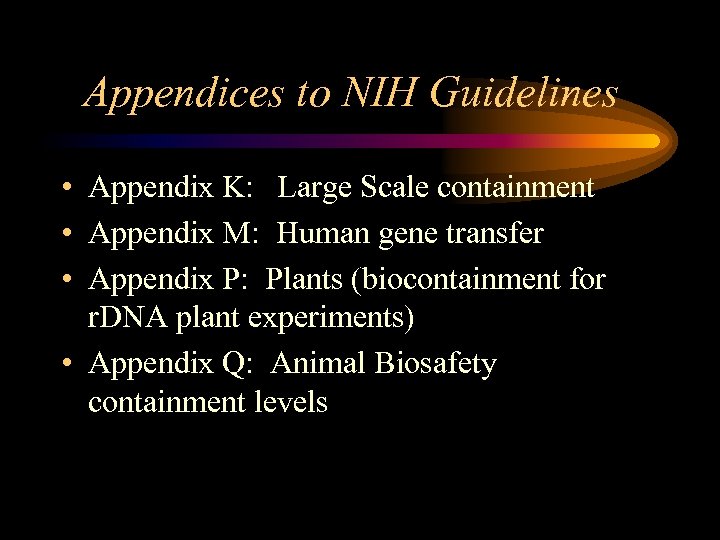 Appendices to NIH Guidelines • Appendix K: Large Scale containment • Appendix M: Human gene transfer • Appendix P: Plants (biocontainment for r. DNA plant experiments) • Appendix Q: Animal Biosafety containment levels
 Human Gene Therapy • Gene Therapy: Any clinical therapeutic procedure in which genes are intentionally introduced into human somatic cells • Gene transfer: The deliberate transfer of recombinant DNA, or DNA or RNA derived from r. DNA into human subjects. NIH
 Notable Quotes • “Gene therapy has clearly matured from the point of Gee-Whiz to getting down to hard work. • “Putting genes into people is no longer a worry. We know there are no ill effects. Now we can think of genes as drugs, and that is quite remarkable. ” • Dr. Ronald Crystal, Cornell Medical School • USA Today, 6/10/99
 Notable Quotes • “The conclusions from these trials are that gene therapy has the potential for treating a broad array of human diseases and that the procedure appears to carry a very low risk of adverse reactions. ” • Dr. W. French Anderson • Nature, April 30, 1998
 September 17, 1999 • 1 st reported death attributed to a HGT Protocol: UPENN OTC Trial – subject may have not been properly informed of risk – not a suitable candidate for the trial • NIH OBA request for unreported adverse and serious adverse events (11/99) • 650 previously unreported AE and SAE received by NIH, including unexplained deaths
 Lack of Oversight • Insufficient monitoring once HGT protocols begin • Beth Israel Hospital (Boston): 7 subjects: 3 unreported deaths and 1 SAE • Tufts Univ. (Boston): 2 deaths, 1 unexplained, but PI claim unrelated to study
 Fox Guarding the Hen House
 Rationale for Delayed Reporting • Reports to FDA (private), not to NIH (public) • PI decision: “SAE unrelated to study drug” • Competition between companies • Financial implications of negative news (stock value) • Financial conflict of interest (those with shares in parent company)
 FDA Response • FDA request for detailed monitoring plans from institutions and site visits • Shutdowns – Duke – LA VA Hospitals – Oklahoma State – Univ. Colorado Health Sciences Center – Others
 Additional Adverse Events • Vector associated leukemia - France – 2002 - HGT Trials suspended after 2 nd case of leukemia caused by integration of “defective” retroviral vector in host chromosome
 Cellular HGT • Somatic cells – non-reproductive – genetic information not passed to next generation • Germ line cells – sperm/egg cells – currently not allowed
 Categories of HGT Research • ex vivo – cells removed from patient – incubated with vector – altered cells returned to patient • in vivo – direct injection into affected tissues – systemic delivery
 HGT Protocols • 1 st U. S. trial 1990: ADA • 400 trials in past 10 years (3, 000+ patients) worldwide – 62% – 13% – 9% Cancer single gene disorders AIDS
 Delivery Vehicles for HGT • Viruses – murine retroviruses (46%) – adenoviruses (22%) – Other vectors • adeno-associated virus, vaccinia virus, herpesvirus • Cationic liposomes (non-viral delivery) • naked plasmid DNA or RNA (gene guns)
 Murine Retroviruses • Advantages – stable infection – long-term expression – will infect dividing cells only • Disadvantages – insertional mutagenesis – activate an oncogene/shut off tumor suppressor – recombine with host retrovirus
 Murine Retroviruses • Before 2002 adverse events: • 10+ year experience – no adverse events (800 patients) – no malignancies – no replication competent retroviruses – FDA has dropped requirement for lifetime monitoring of patients
 Adenoviruses • Advantages – capacity for large genetic insert – high level of expression – can also infect non-dividing cells – does not integrate into host genome • Disadvantages – potential recombination with host adenovirus – inflammation, immune response
 Adenoviruses • Last decade – minimal viral shedding from subjects – standard precautions adequate (replace isolation practices) – consideration of using replication competent vectors with adequate isolation and monitoring of subjects
 Liposomal Vectors • Positive charged lipid particle – Advantages • capacity for very large genetic insert • safe • ease of mass production – Disadvantages • low efficiency • poor specificity
 Other Vectors • Lentiviral vectors (HIV) can infect nondividing cells • Vaccinia (HGT vaccines) • Baculovirus (insect virus) • Salmonella • No bounds on imagination of investigators
 Oversight of HGT Research • Food and Drug Administration (FDA) – Sole authority of approval of HGT protocols – Center for Biologics Evaluation & Research (CBER) • drugs/biological products intended for use in human subjects – Investigational New Drug application (IND) • 21 CFR Part 312 Subpart B
 Oversight of HGT Research • Objectives of the FDA – ensure safety/rights of research subjects – ensure scientific quality of clinical investigations – safeguard public health while promoting novel therapies
 Oversight of HGT Research • National Institutes of Health (NIH) • applicable to entities that receive NIH funding – DHHS Office of Human Research Protection (OHRP) • regulations that protect human subjects/control research risks – Office of Biotechnology Activities • mandatory registration of HGT Protocols • national repository
 Oversight of HGT Research • NIH – Recombinant DNA Activities Committee (RAC) • public notification/participation in discussion • review 10% of submitted HGT protocols • NIH Guidelines for Research Involving r. DNA, Appendix M • Points to Consider for Human Gene Therapy
 Oversight of HGT Research • History of NIH RAC Involvement – 1990 - 1996: Approval authority – 1996 - 2000: can recommend RAC review to FDA – October, 2000: RAC review prior to local institutional approval to ensure public notification and adequate risk assessment
 Local Oversight for HGT • Institutional Review Board (IRB) – Ensure compliance with FDA and NIH OHRP requirements to protect human subjects. Federally mandated for any work with humans. – Informed Consent • • risk/benefit evaluation on behalf of subject conflict of interest (financial implications) ethical issues (false hope) review of adverse effects
 Local Oversight for HGT • Institutional Biosafety Committee (IBC) – NIH Requirement (funded locales) – safety – acute/chronic effects – risk to patient, contacts – exclusion criteria – adverse effects (stopping rules)
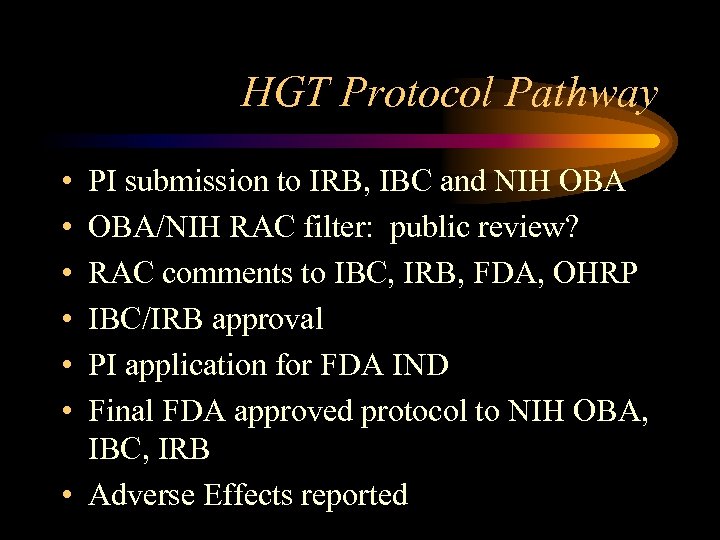 HGT Protocol Pathway • • • PI submission to IRB, IBC and NIH OBA/NIH RAC filter: public review? RAC comments to IBC, IRB, FDA, OHRP IBC/IRB approval PI application for FDA IND Final FDA approved protocol to NIH OBA, IBC, IRB • Adverse Effects reported
 HGT Risk Assessment • IBC Review Process – NIH Guidelines, Appendix M – Composition of IBC • • • molecular biologists infectious disease experts immunologists, relevant expertise as needed biosafety/containment representation occupational health community representation
 HGT Risk Assessment • Can your existing IBC efficiently review the HGT protocol? – @ Yale - HGT Subcommittee • Melanoma Trial – oncologists, hematologists, immunobiologists • Canavan’s Disease – pediatric neurologists – neurosurgeons – ethicists
 HGT Risk Assessment • IBC HGT Review Team should also include: – IRB members – hospital pharmacy – infection control representatives – clinical virologists – legal – ethicists
 HGT Risk Assessment • IBC Questions to the PI: – why is disease a good candidate for HGT? – objective/quantitative disease measures present? – alternative therapies? – what cells have been targeted for HGT? – describe methods, reagents, full sequence of inserted DNA, steps to derive construct
 HGT Risk Assessment • IBC Questions for the PI: – preparation of the vector in compliance with FDA 21 CFR Part 211 (Good Manufacturing Practices)? – clean room facility requirements met? – Trained personnel? – Documented/validated SOP’s and equipment? – QA/QC program in place? – Sterility testing (RCV/adventitious agents)?
 HGT Risk Assessment • IBC Questions for the PI: – adequacy of pre-clinical studies (best animal or cellular model)? – observed toxicity/efficacy? – chronic effects (time followed after treatment)? – accuracy/efficiency of delivery system? • affect target cells only (spread to reproductive cells) • transient of stable infection
 HGT Risk Assessment • IBC Questions to PI: – determination that sequences have been expressed? – expected benefits or adverse effects – length of follow-up for subjects – post-mortem studies?
 HGT Risk Assessment • IBC Questions for PI: – can DNA spread from subject to contacts or environment? – required precautions to prevent dissemination? – safety protocols for pharmacy, healthcare staff? – adequacy of clinical facilities? – informed consent/clear communication of risks to subjects
 HGT Risk Assessment • IRB Considerations: – risk/benefit of protocol – protect subjects from coercion/undue influence – confidentiality/disclosure of information – verification or informed consent process – verify eligibility/withdrawal criteria – ongoing monitoring of subjects – annual renewal of protocol
 Adverse Effects • Serious Adverse Effect (SAE) – FDA • report immediately if related to study drug – NIH • ANY SAE reportable immediately to all related compliance groups – Annual Data Report • includes SAE’s and AE’s to related compliance groups
 Approval of HGT Protocols • IRB/IBC Coordination – NIH OBA registration/FDA IND approved • PI sign-off/acceptance of responsibilities – contingencies outlined on approval letter • oversight/monitoring – informed consent/eligibility, adverse events, stopping criteria
 HGT Report Card • “The efficiency of gene transfer and expression in human patients is, however, still disappointingly low. ” • W. French Anderson, Nature, 1998
 HGT Report Card • Not really therapy (treatment) • Few clinically significant results • Don’t sell false hope – Human Gene Transfer RESEARCH – SUBJECTS not patients – may or may not gain information
 Success Stories • • • US ADA 1990 (Anderson) French ADA 1999 Cancer (marker gene) Deisseroth, 1993 Herpes TK, brain tumor, 1993 (Blaise) SHH (activator), heart disease, hair growth (Crystal)
 Conclusion • • HGT a promising field Human genome project will feed fire build on successes, share information Goal – cost-effective approach – improved delivery and expression of gene – sustained expression of therapeutic gene
 Conclusion • Responsibility of Regulators: – ensure adequate process of review – approve only sensible, valid projects – ensure the ethical conduct of research – protect human subjects, healthcare workers, and public
 2007 Investigation of Serious Adverse Event • Death of patient enrolled in study involving an AAV vector (Adeno-Associated Virus) – Focus of NIH OBA Meeting – AAV not a known human pathogen? – Dose? – AAV as cause of event indeterminable
 Institutional Approval of HGT Protocols • Review of location, personnel • Infection control • SAE notification
 Institutional Approval of HGT Protocols • Certificate of Analysis to institution from sponsor or designated lab • GMP Compliance statement from sponsor • FDA approval letter on file • Copy of final FDA authorized protocol
 Institutional Approval of HGT Protocols • Data Safety Management Board • Periodic review of patient safety information • Report to IRB and IBC • Annual Renewal of HGT Protocol • Report changes in protocol
 Additional NIH Requirements • < 20 days post initiation of HGT Protocol – copy of final protocol – NIH Grant # (if applicable) – copy of IRB and IBC approvals – written response to RAC recommendations – date of initiation of trial