


 Скачать презентацию Human Error or System Error Click to edit
e7f2445d14b44f8905557a8cc6995c5f.ppt
- Количество слайдов: 38
 Human Error or System Error: Click to edit Master title style Are We Committed to • Click to edit Master text styles Managing It? • • Second level Third level Key Dismukes, Ph. D. Fourth level for Aerospace Human Factors Chief Scientist Fifth level NASA Ames Research Center Aviation Human Factors Conference 31 March--1 April 2009 Dallas, TX 3/15/2018 Human Systems Integration Division 1
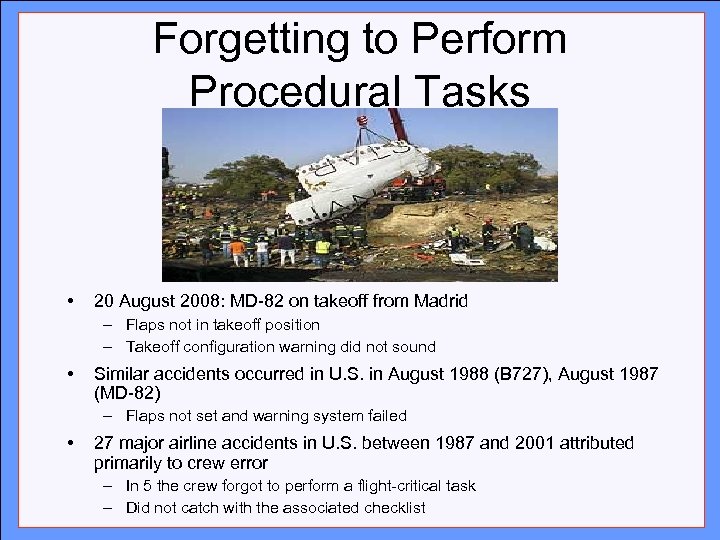 Forgetting to Perform Click. Procedural Tasks style to edit Master title • • • • Click to edit Master text styles Second level Third level 20 August 2008: MD-82 on takeoff from Madrid Fourthnot in takeoff position – Flaps level – Takeoff configuration warning did not sound Fifth accidents occurred in U. S. in August 1988 (B 727), August 1987 Similar level (MD-82) – Flaps not set and warning system failed • 27 major airline accidents in U. S. between 1987 and 2001 attributed primarily to crew error – In 5 the crew forgot to perform a flight-critical task 3/15/2018 Did not catch with the associated checklist – 2
 Most Accidents Attributed to Pilot Error Click to editof. Master title style • How should we think this? • • Why doto edit Master text styles make Click experienced professional pilots mistakes performing routine tasks? • Second the right stuff? level - Lack - Not conscientious or not vigilant? • Third level - Some other answer? • Fourth level • • How we answer these questions is the foundation of Fifth level aviation safety 3/15/2018 Human Systems Integration Division 3
 Overview of Talk Click to edit Master title style • Research community’s perspective on why experienced pilots are vulnerable to error • • Click to specific situations in stylesvulnerability to Describe edit Master text which error is high • Second level Practical countermeasures for pilots, companies, and • • Third level the industry • Fourth level Derived from • • Fifth level series of NASA studies of airline operations – Applicable to military and other flight operations – Private flying has special issues not discussed today 3/15/2018 4
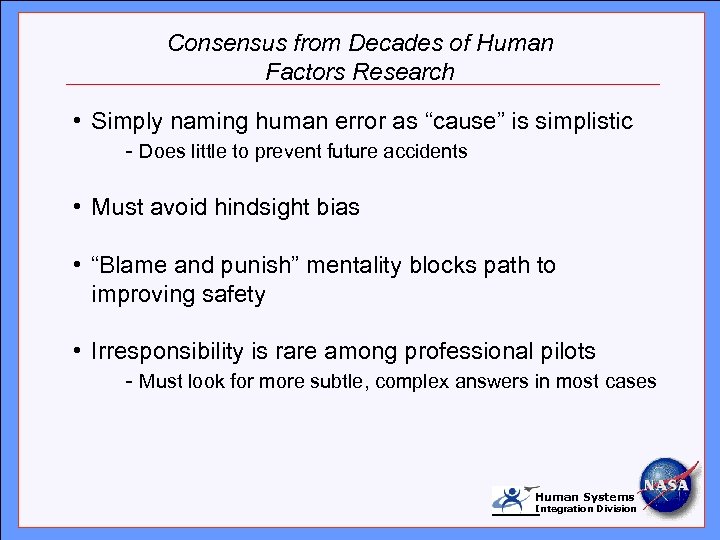 Consensus from Decades of Human Factors Research Click to edit Master title simplistic style • Simply naming human error as “cause” is - Does little to prevent future accidents • Click to edit Master text styles • Must avoid hindsight bias • Second level “Blame and punish” mentality blocks path to • • Third level improving safety • Fourth level • Irresponsibility is rare among professional pilots • Fifth level for more subtle, complex answers in most cases - Must look 3/15/2018 Human Systems Integration Division 5
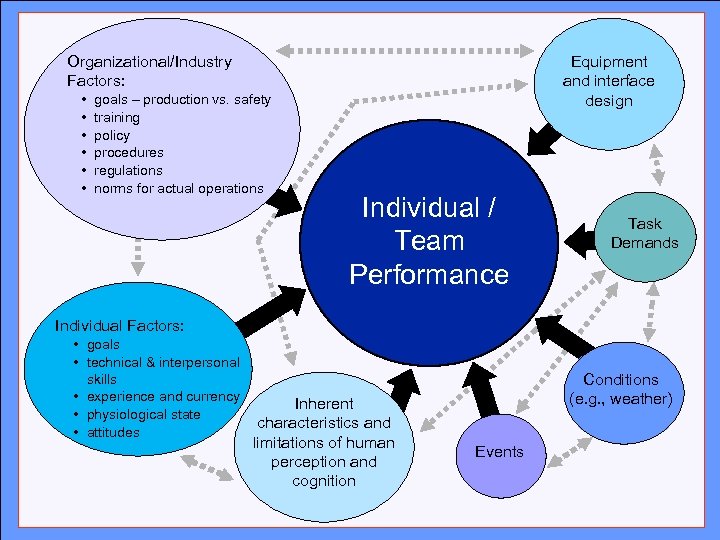 Organizational/Industry Factors: • • • Equipment and interface design Click to edit Master title style goals – production vs. safety training policy procedures regulations norms for actual operations • Click to edit Master text styles Individual / • Second level Team • Third level Performance • Fourth level Individual Factors: • goals • • technical & level Fifth interpersonal skills • experience and currency • physiological state • attitudes 3/15/2018 Inherent characteristics and limitations of human perception and cognition Task Demands Conditions (e. g. , weather) Events 6
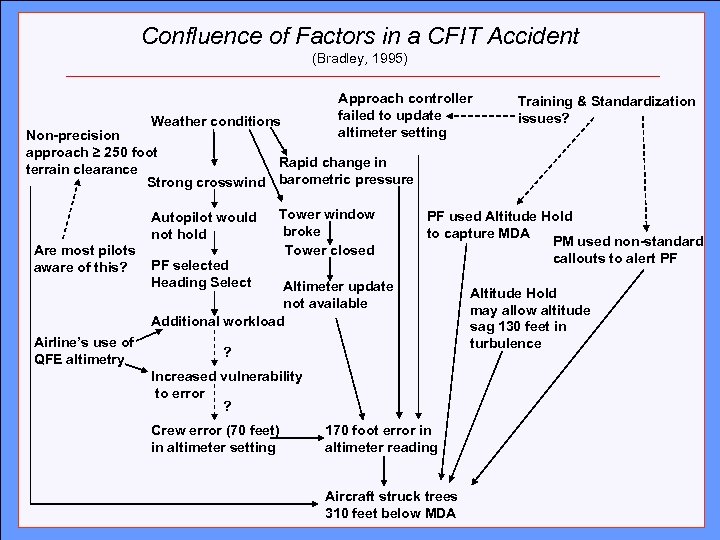 Confluence of Factors in a CFIT Accident (Bradley, 1995) Click to edit Master title style Approach controller failed to update altimeter setting Weather conditions Non-precision approach ≥ 250 foot Rapid change in terrain clearance Strong crosswind barometric pressure Training & Standardization issues? • Click to edit Master text styles Tower window PF used Altitude Hold Autopilot would broke • Secondhold to capture MDA not level PM used non-standard Are most pilots Tower closed callouts to alert PF PF selected aware of this? • Third level Heading Select Altimeter update Altitude Hold not available may allow altitude Additional workload • Fourth level sag 130 feet in Airline’s use of turbulence ? QFE altimetry • Fifth. Increased vulnerability level to error ? Crew error (70 feet) in altimeter setting 3/15/2018 170 foot error in altimeter reading Aircraft struck trees 310 feet below MDA 7
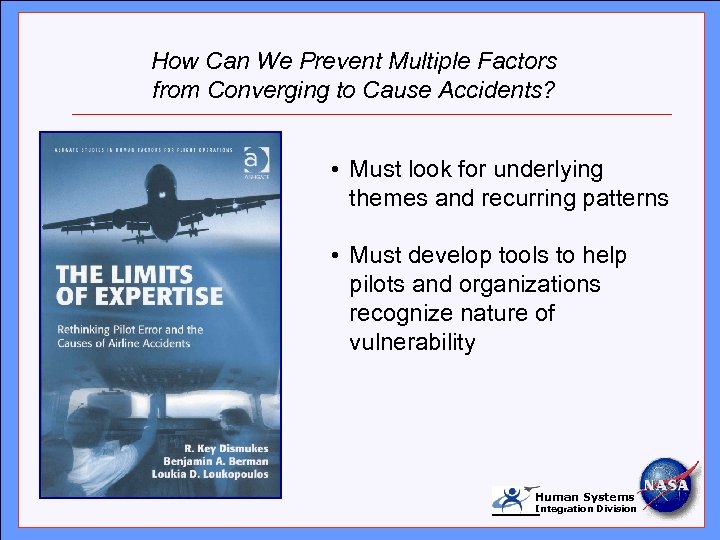 How Can We Prevent Multiple Factors from Converging to Cause Accidents? Click to edit Master title style • • • Click to edit Master Must styles recurring patterns text look for underlying themes and Second level • Must develop tools to help Third level pilots and organizations recognize nature of Fourth level vulnerability Fifth level 3/15/2018 Human Systems Integration Division 8
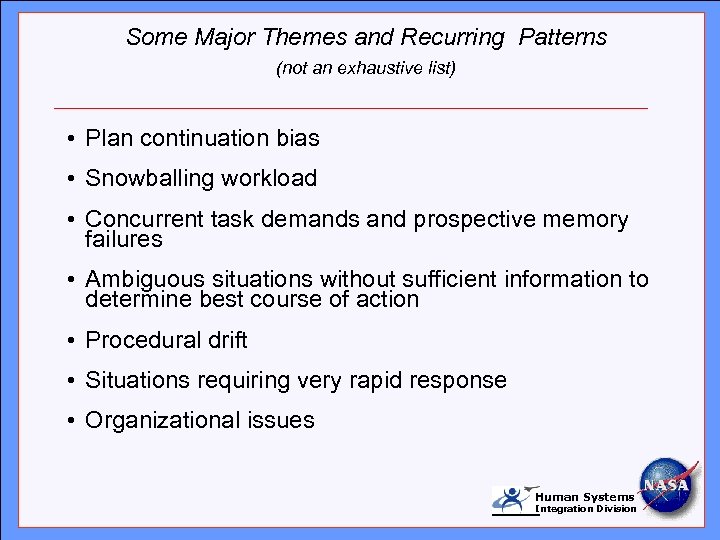 Some Major Themes and Recurring Patterns (not an exhaustive list) Click to edit Master title style • Plan continuation bias • • Snowballing workload text styles Click to edit Master • • Concurrent task demands and prospective memory Second failures level • • Ambiguous situations without sufficient information to Third level determine best course of action • Fourth level • Procedural drift • • Situations requiring very rapid response Fifth level • Organizational issues 3/15/2018 Human Systems Integration Division 9
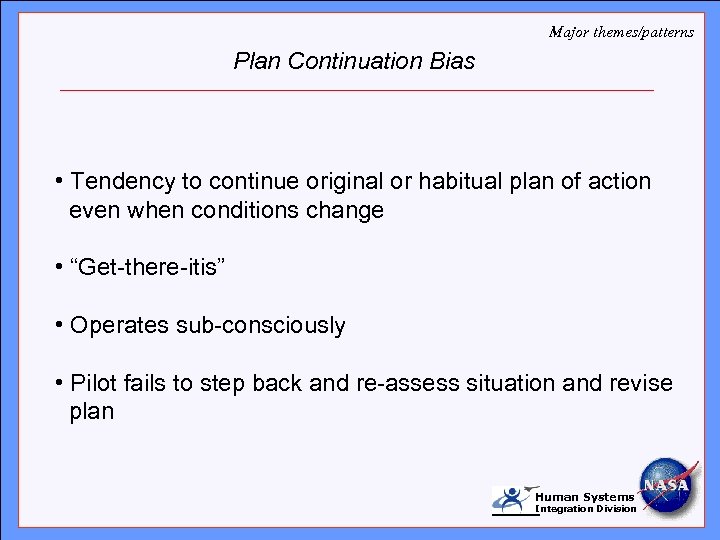 Major themes/patterns Plan Continuation Bias Click to edit Master title style • • Tendency toedit Master text styles plan of action Click to continue original or habitual even when conditions change • Second level • • “Get-there-itis” Third level Fourth level • • Operates sub-consciously • Pilot fails to step back and re-assess situation and revise Fifth level • plan 3/15/2018 Human Systems Integration Division 10
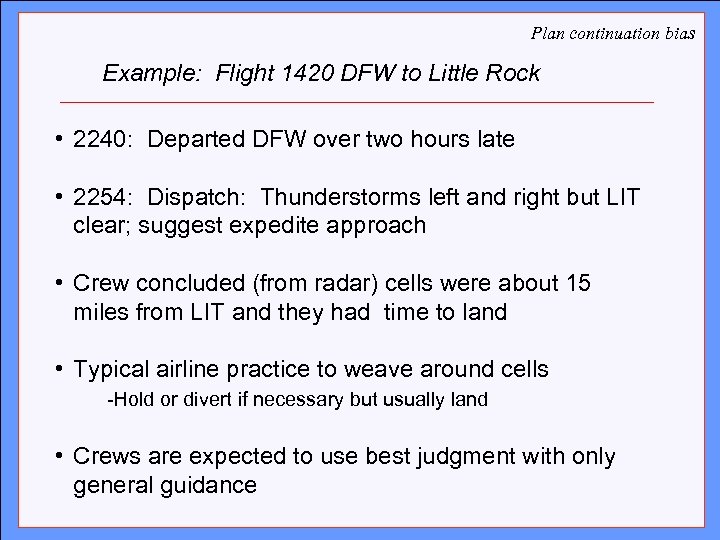 Plan continuation bias Example: Flight 1420 DFW to Little Rock Click to edit Master title style • 2240: Departed DFW over two hours late • 2254: Dispatch: Master text styles right but LIT Click to edit Thunderstorms left and • • clear; suggest expedite approach Second level Third level • • Crew concluded (from radar) cells were about 15 • miles fromlevel they had time to land Fourth LIT and Fifth level • • Typical airline practice to weave around cells -Hold or divert if necessary but usually land • Crews are expected to use best judgment with only general guidance 3/15/2018 11
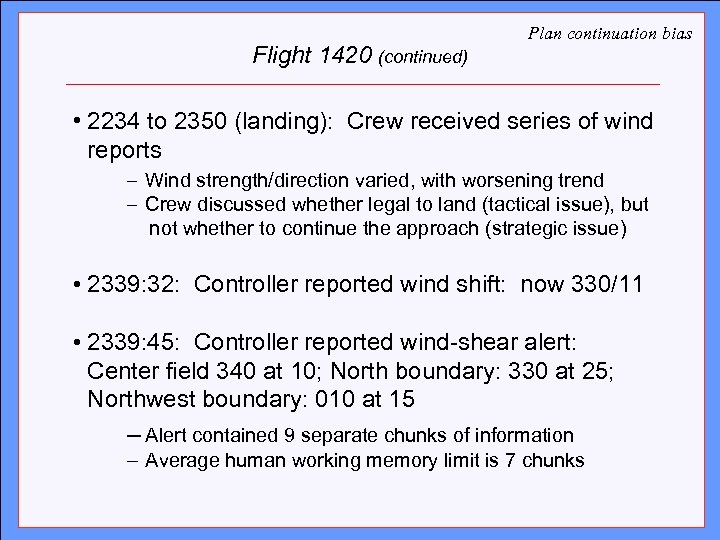 Flight 1420 (continued) Plan continuation bias Click to(landing): Master title style edit Crew received series of wind • 2234 to 2350 reports – Wind edit Master varied, with worsening trend • Click to strength/direction text styles – Crew discussed whether legal to land (tactical issue), but not level • Secondwhether to continue the approach (strategic issue) • • 2339: 32: Controller reported wind shift: now 330/11 Third level • Fourth level • 2339: 45: Controller reported wind-shear alert: • Centerlevel 340 at 10; North boundary: 330 at 25; Fifth field Northwest boundary: 010 at 15 – Alert contained 9 separate chunks of information – Average human working memory limit is 7 chunks 3/15/2018 12
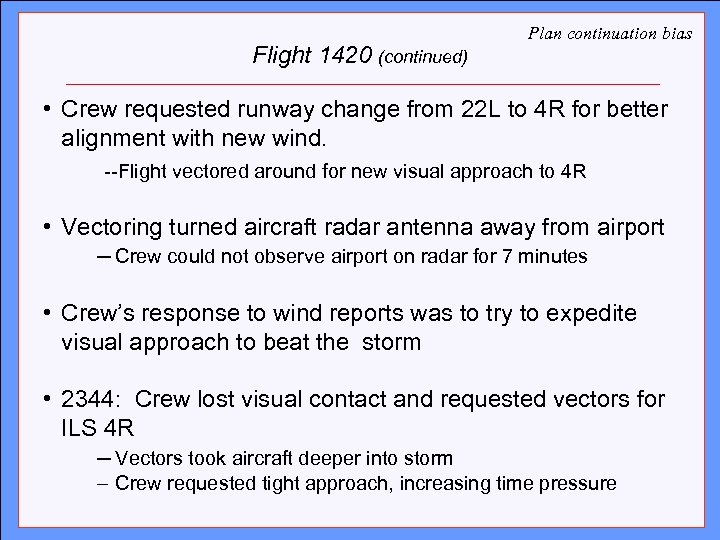 Flight 1420 (continued) Plan continuation bias Click to edit Master title style • Crew requested runway change from 22 L to 4 R for better alignment with new wind. --Flight vectored around for • Click to edit Master new visual approach to 4 R text styles • Vectoring turned aircraft radar antenna away from airport • Second level – Crew could not observe airport on radar for 7 minutes • Third level • Crew’s response to wind reports was to try to expedite • Fourth level visual approach to beat the storm • Fifth level • 2344: Crew lost visual contact and requested vectors for ILS 4 R – Vectors took aircraft deeper into storm – Crew requested tight approach, increasing time pressure 3/15/2018 13
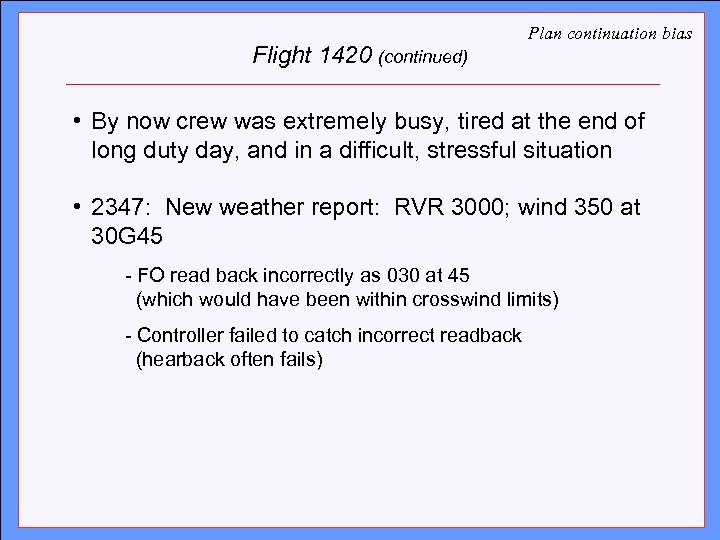 Flight 1420 (continued) Plan continuation bias Click towas extremely busy, tired at the end of edit Master title style • By now crew long duty day, and in a difficult, stressful situation • Click to edit Master text styles • 2347: New weather report: RVR 3000; wind 350 at • Second level 30 G 45 - FO read back • Third level incorrectly as 030 at 45 (which would have been within crosswind limits) • Fourth level to catch incorrect readback - Controller failed (hearback • Fifth level often fails) 3/15/2018 14
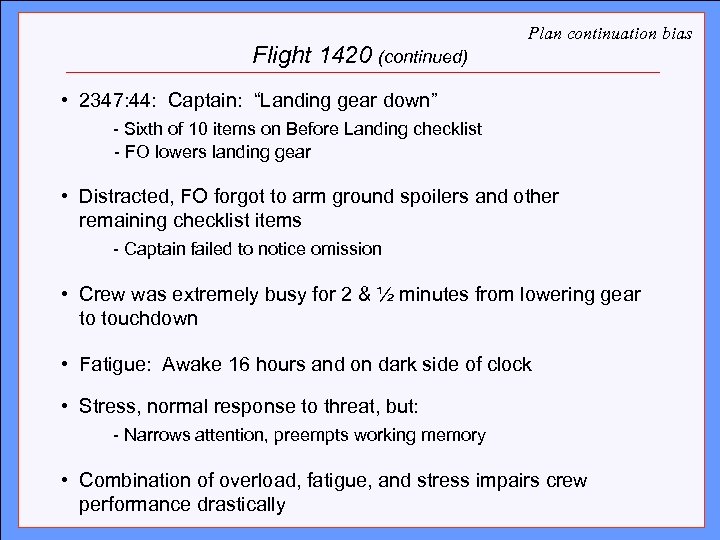 Flight 1420 (continued) Plan continuation bias Click to edit Master title style • 2347: 44: Captain: “Landing gear down” - Sixth of 10 items on Before Landing checklist - FO lowers landing gear • Distracted, FO forgot to arm ground spoilers and other Click to edit Master text styles • • remaining checklist items Second level - Captain failed to notice omission • Third level • Crew was extremely busy for 2 & ½ minutes from lowering gear • to touchdown Fourth level • Fatigue: level 16 hours and on dark side of clock • Fifth Awake • Stress, normal response to threat, but: - Narrows attention, preempts working memory • Combination of overload, fatigue, and stress impairs crew 3/15/2018 performance drastically 15
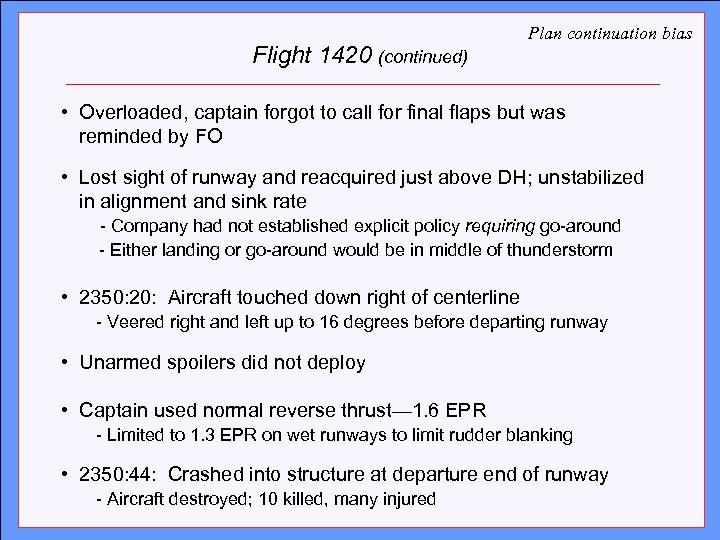 Flight 1420 (continued) Plan continuation bias Click to edit Master title style • Overloaded, captain forgot to call for final flaps but was reminded by FO • Lost sight to runway. Master text just above DH; unstabilized • Click of edit and reacquired styles in alignment and sink rate - Company had not • Second level established explicit policy requiring go-around - Either landing or go-around would be in middle of thunderstorm • Third level • 2350: 20: Aircraft touched down right of centerline - Veered level • Fourthright and left up to 16 degrees before departing runway • Unarmedlevel did not deploy • Fifth spoilers • Captain used normal reverse thrust— 1. 6 EPR - Limited to 1. 3 EPR on wet runways to limit rudder blanking • 2350: 44: Crashed into structure at departure end of runway - Aircraft 3/15/2018 destroyed; 10 killed, many injured 16
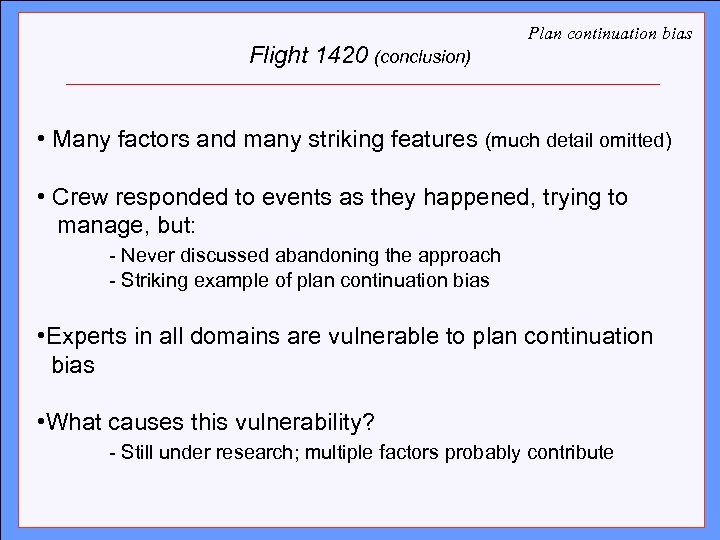 Flight 1420 (conclusion) Plan continuation bias Click to edit Master title style • Many factors and many striking features (much detail omitted) • Click to edit Masteras they happened, trying to text styles • Crew responded to events manage, but: • Second level - Never discussed abandoning the approach • Third level of plan continuation bias - Striking example • Fourth level • Experts in all domains are vulnerable to plan continuation bias • Fifth level • What causes this vulnerability? - Still under research; multiple factors probably contribute 3/15/2018 17
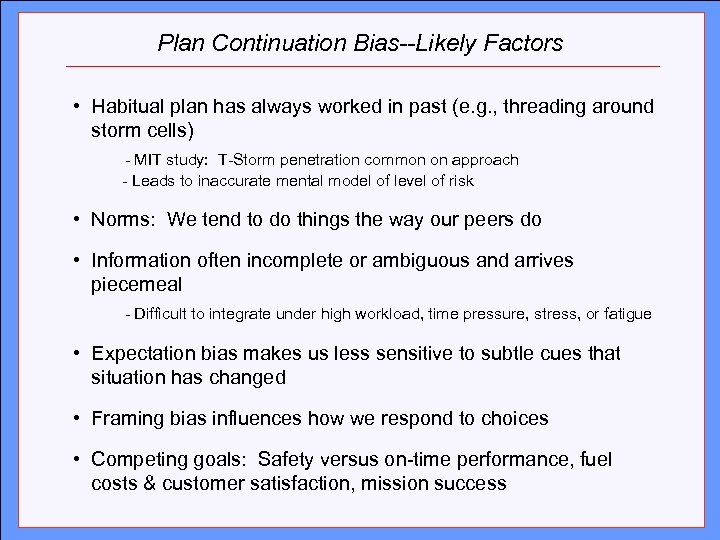 Plan Continuation Bias--Likely Factors Click to edit Master title style • Habitual plan has always worked in past (e. g. , threading around storm cells) - MIT study: T-Storm penetration common on approach - Leads to inaccurate mental model of level of risk • Click to edit Master text styles Norms: We tend • • Second levelto do things the way our peers do • Information often incomplete or ambiguous and arrives • Third level piecemeal - Difficult to integrate • Fourth level under high workload, time pressure, stress, or fatigue Expectation bias • • Fifth level makes us less sensitive to subtle cues that situation has changed • Framing bias influences how we respond to choices • Competing goals: Safety versus on-time performance, fuel costs & customer satisfaction, mission success 3/15/2018 18
 Plan Continuation Bias--Likely Factors Click to edit Master title style • Habitual plan has always worked in past (e. g. , threading around storm cells) - MIT study: T-Storm penetration common on approach - Leads to inaccurate mental model of level of risk • Click to edit Master text styles Norms: We tend • • Second levelto do things the way our peers do • Information often incomplete or ambiguous and arrives • Third level piecemeal - Difficult to integrate • Fourth level under high workload, time pressure, stress, or fatigue Expectation bias • • Fifth level makes us less sensitive to subtle cues that situation has changed • Framing bias influences how we respond to choices • Competing goals: Safety versus on-time performance, fuel costs & customer satisfaction, mission success 3/15/2018 19
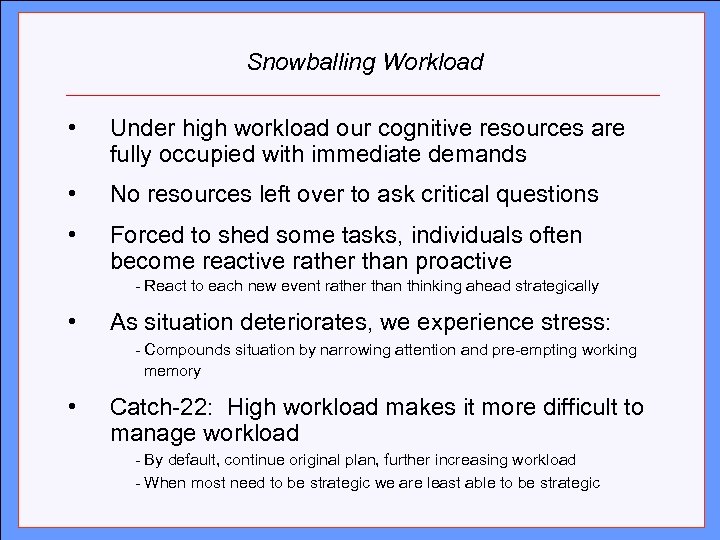 Snowballing Workload • Click to edit Master title style Under high workload our cognitive resources are fully occupied with immediate demands • • • • Click to edit Master to ask critical questions No resources left over text styles Second level some tasks, individuals often Forced to shed become reactive rather proactive Third level new event ratherthanthinking ahead strategically - React to each than Fourth leveldeteriorates, we experience stress: As situation - Compounds situation by narrowing attention and pre-empting working Fifth level memory • Catch-22: High workload makes it more difficult to manage workload - By default, continue original plan, further increasing workload - When most need to be strategic we are least able to be strategic 3/15/2018 20
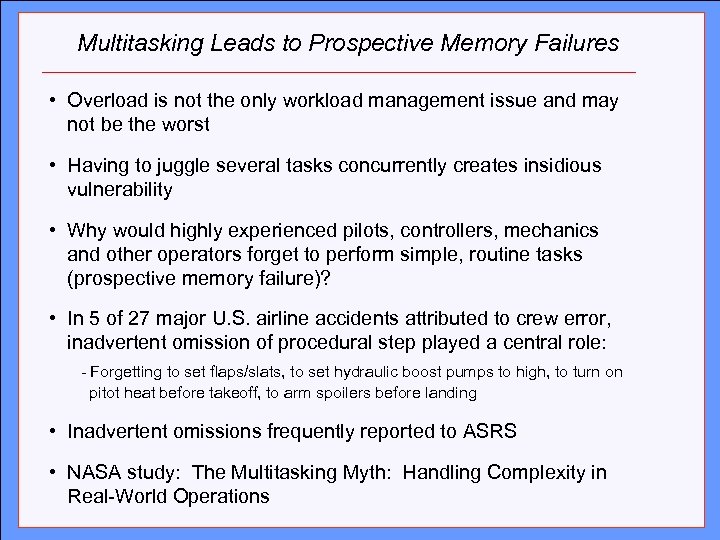 Multitasking Leads to Prospective Memory Failures Click to edit Master title style • Overload is not the only workload management issue and may not be the worst • Having to juggle several tasks concurrently creates insidious • vulnerability edit Master text styles Click to • • Second level Why would highly experienced pilots, controllers, mechanics and other operators forget to perform simple, routine tasks • (prospective memory failure)? Third level • • Fourth level airline accidents attributed to crew error, In 5 of 27 major U. S. inadvertent omission of procedural step played a central role: • - Fifth level Forgetting to set flaps/slats, to set hydraulic boost pumps to high, to turn on pitot heat before takeoff, to arm spoilers before landing • Inadvertent omissions frequently reported to ASRS • NASA study: The Multitasking Myth: Handling Complexity in Real-World Operations 3/15/2018 21
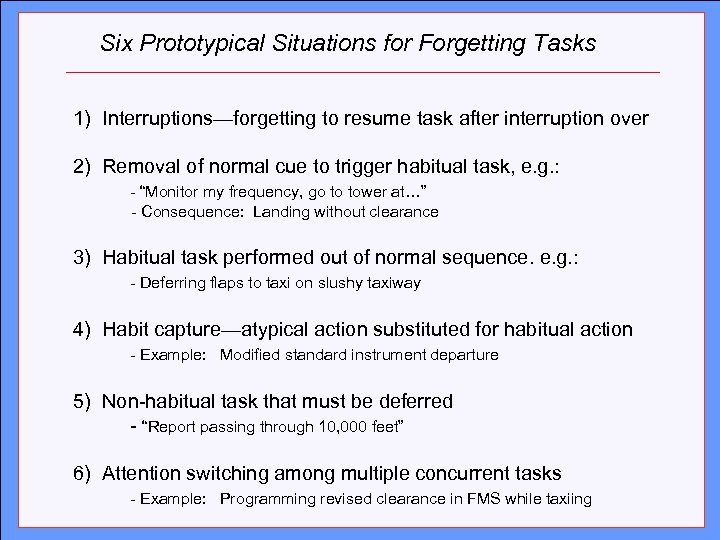 Six Prototypical Situations for Forgetting Tasks Click to edit to resume task after interruption over Master title style 1) Interruptions—forgetting 2) Removal of normal cue to trigger habitual task, e. g. : • Click to edit Master tower at…” - “Monitor my frequency, go to text styles - Consequence: Landing without clearance • Second level 3) Habitual task performed out of normal sequence. e. g. : • Third level to taxi on slushy taxiway - Deferring flaps • 4)Fourth level Habit capture—atypical action substituted for habitual action - Example: • Fifth level. Modified standard instrument departure 5) Non-habitual task that must be deferred - “Report passing through 10, 000 feet” 6) Attention switching among multiple concurrent tasks 3/15/2018 - Example: Programming revised clearance in FMS while taxiing 22
 Six Prototypical Situations for Forgetting Tasks Click to edit to resume task after interruption over Master title style 1) Interruptions—forgetting 2) Removal of normal cue to trigger habitual task, e. g. : • Click to edit Master tower at…” - “Monitor my frequency, go to text styles - Consequence: Landing without clearance • Second level 3) Habitual task performed out of normal sequence. e. g. : • Third level to taxi on slushy taxiway - Deferring flaps • 4)Fourth level Habit capture—atypical action substituted for habitual action - Example: • Fifth level. Modified standard instrument departure 5) Non-habitual task that must be deferred - “Report passing through 10, 000 feet” 6) Attention switching among multiple concurrent tasks 3/15/2018 - Example: Programming revised clearance in FMS while taxiing 23
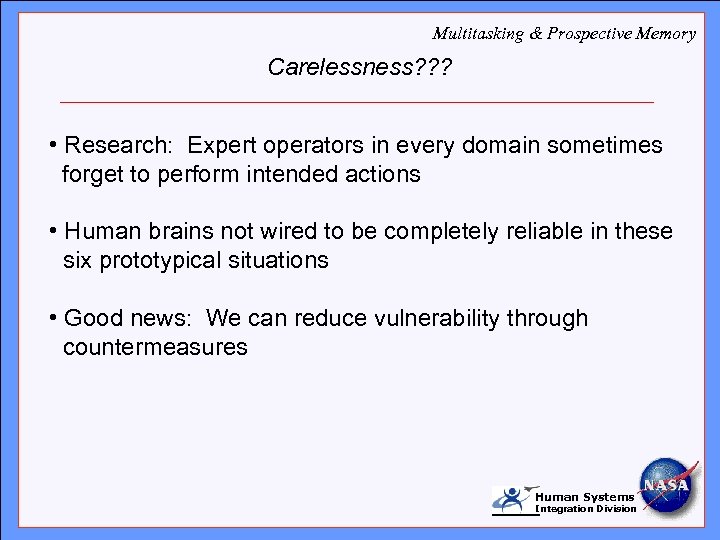 Multitasking & Prospective Memory Carelessness? ? ? Click to edit Master title style • Research: Expert operators in every domain sometimes forget to to edit Master text styles • Clickperform intended actions • • Second level wired to be completely reliable in these Human brains not six prototypical situations • Third level • • Fourth level can reduce vulnerability through Good news: We countermeasures • Fifth level 3/15/2018 Human Systems Integration Division 24
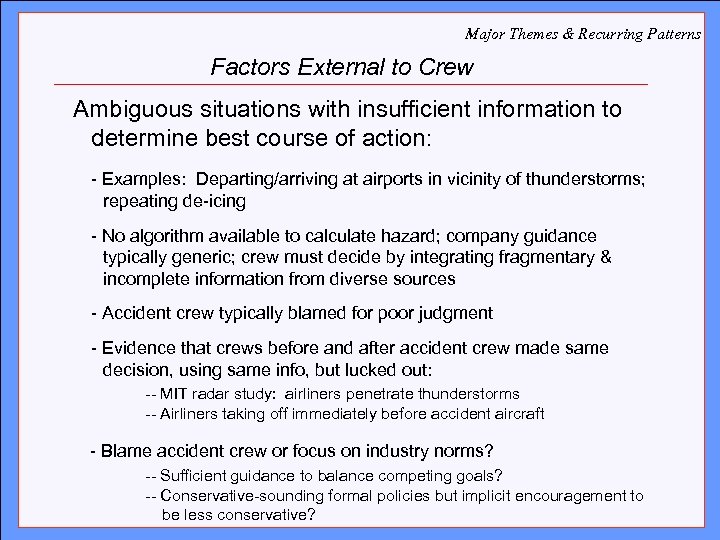 Major Themes & Recurring Patterns Factors External to Crew Click to edit Master title style Ambiguous situations with insufficient information to determine best course of action: • • • - Examples: edit Master text styles Click to Departing/arriving at airports in vicinity of thunderstorms; repeating de-icing Second level to calculate hazard; company guidance - No algorithm available typically generic; crew must decide by integrating fragmentary & Third level incomplete information from diverse sources - Accident Fourth crew typically blamed for poor judgment level - Evidence that crews before and after accident crew made same Fifth level same info, but lucked out: decision, using -- MIT radar study: airliners penetrate thunderstorms -- Airliners taking off immediately before accident aircraft - Blame accident crew or focus on industry norms? 3/15/2018 -- Sufficient guidance to balance competing goals? -- Conservative-sounding formal policies but implicit encouragement to 25 be less conservative?
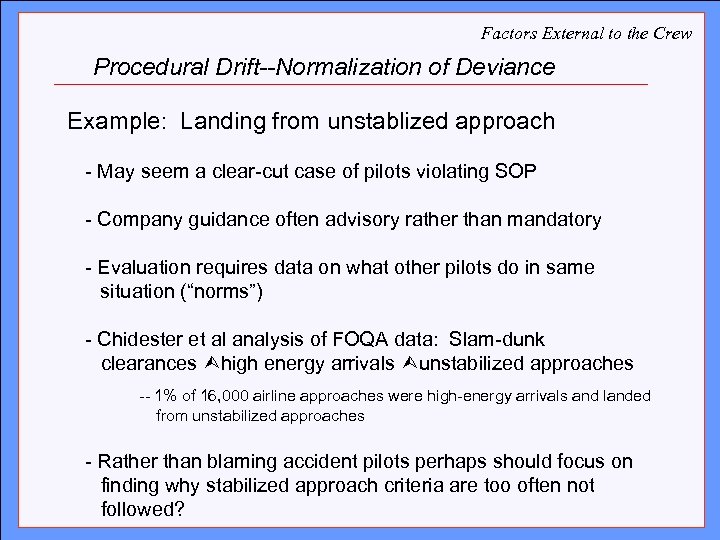 Factors External to the Crew Procedural Drift--Normalization of Deviance Click to edit Master approach title style Example: Landing from unstablized • • • - May seem a clear-cut case of pilots violating SOP Click to edit Master text styles - Company guidance often advisory rather than mandatory Second level -Third level Evaluation requires data on what other pilots do in same situation (“norms”) Fourth level - Chidester et al analysis of FOQA data: Slam-dunk clearances high Fifth level energy arrivals unstabilized approaches -- 1% of 16, 000 airline approaches were high-energy arrivals and landed from unstabilized approaches - Rather than blaming accident pilots perhaps should focus on finding why stabilized approach criteria are too often not 3/15/2018 followed? 26
 Factors External to the Crew Organizational Factors Click to edit Master title style • • • Click to edit Master text styles • Will not discuss as a separate theme Second level • Centrally involved in all themes and recurring Third level patterns already discussed Fourth level • SMS Fifth level 3/15/2018 Human Systems Integration Division 27
 Help is on the Way! Countermeasures Click to edit Master title style • • • Click to edit Master Can substantially reduce risk • text styles in these situations Second level Third level • Countermeasures individual pilots, companies, and the Fourth level industry can take Fifth level 3/15/2018 Human Systems Integration Division 28
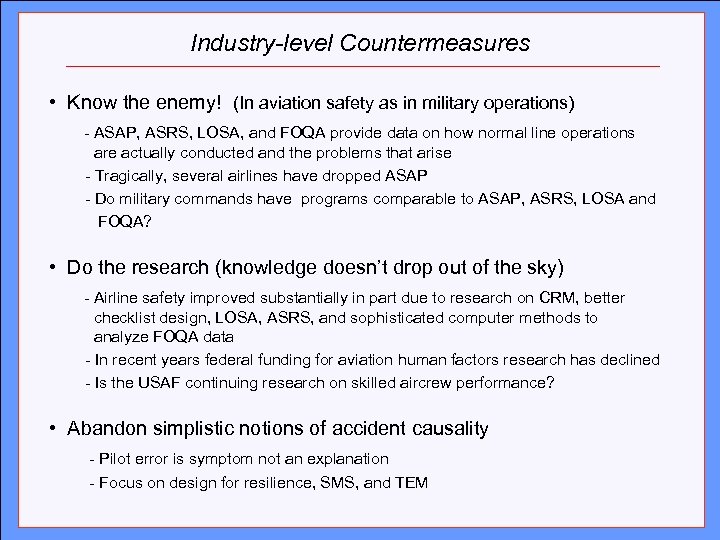 Industry-level Countermeasures Click to edit Master title style • Know the enemy! (In aviation safety as in military operations) - ASAP, ASRS, LOSA, and FOQA provide data on how normal line operations are actually conducted and the problems that arise - Tragically, several airlines have dropped ASAP - Do military commands have programs comparable to ASAP, ASRS, LOSA and FOQA? • Click to edit Master text styles • Second level • • Third level Do the research (knowledge doesn’t drop out of the sky) - Airline safety improved substantially in part due to research on CRM, better checklist design, LOSA, • Fourth level ASRS, and sophisticated computer methods to analyze FOQA data In recent years federal aviation • --Fifth level funding foron skilled human factors research has declined Is the USAF continuing research aircrew performance? • Abandon simplistic notions of accident causality - Pilot error is symptom not an explanation - Focus on design for resilience, SMS, and TEM 3/15/2018 29
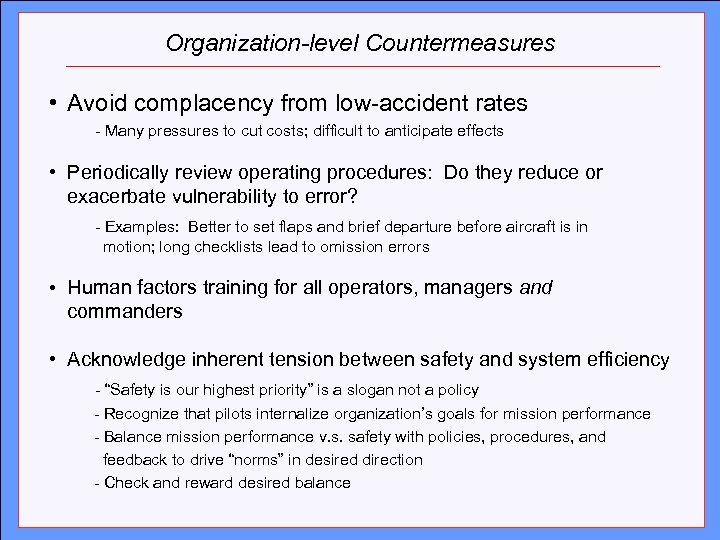 Organization-level Countermeasures Click to edit Master title style • Avoid complacency from low-accident rates - Many pressures to cut costs; difficult to anticipate effects • Periodically review operating procedures: Do they reduce or • exacerbateto edit Master text styles Click vulnerability to error? - Examples: level • Second Better to set flaps and brief departure before aircraft is in motion; long checklists lead to omission errors • Third level • Human factors training for all operators, managers and • commanderslevel Fourth • • Fifth level Acknowledge inherent tension between safety and system efficiency - “Safety is our highest priority” is a slogan not a policy - Recognize that pilots internalize organization’s goals for mission performance - Balance mission performance v. s. safety with policies, procedures, and feedback to drive “norms” in desired direction - Check and reward desired balance 3/15/2018 30
 Organization-level Countermeasures Click to edit Master title style • Avoid complacency from low-accident rates - Many pressures to cut costs; difficult to anticipate effects • Periodically review operating procedures: Do they reduce or • exacerbateto edit Master text styles Click vulnerability to error? - Examples: • Second Better to set flaps and brief departure before aircraft is in level motion; long checklists lead to omission errors • • Third level Human factors training for all operators, managers and commanders • Fourth level • Acknowledge inherent tension between safety and system efficiency • Fifth level priority” is a slogan not a policy - “Safety is our highest - Recognize that pilots internalize organization’s goals for mission performance - Balance mission performance v. s. safety with policies, procedures, and feedback to drive “norms” in desired direction - Check and reward desired balance 3/15/2018 31
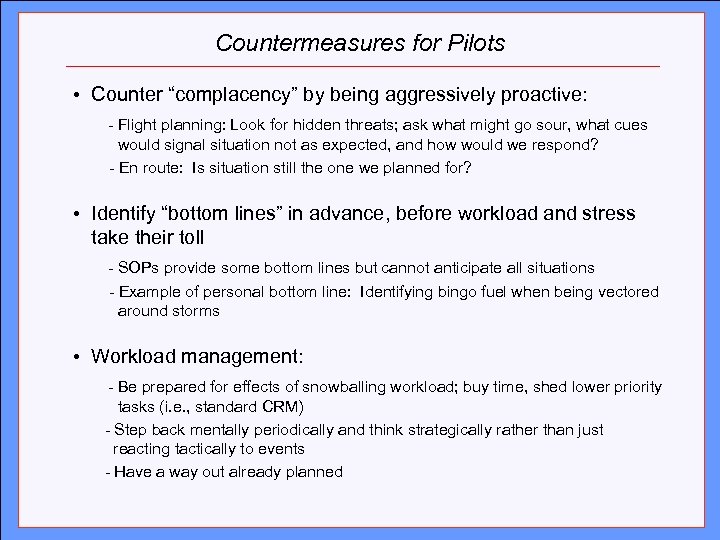 Countermeasures for Pilots Click to edit Master title style • Counter “complacency” by being aggressively proactive: - Flight planning: Look for hidden threats; ask what might go sour, what cues would signal situation not as expected, and how would we respond? - En route: Is situation still the one we planned for? • Click to edit Master text styles • Identify “bottom lines” in advance, before workload and stress • Secondtoll take their level - SOPs • Third provide some bottom lines but cannot anticipate all situations vectored level bottom line: Identifying bingo fuel when being - Example of personal around • Fourthstorms level Workload management: • • Fifth level - Be prepared for effects of snowballing workload; buy time, shed lower priority tasks (i. e. , standard CRM) - Step back mentally periodically and think strategically rather than just reacting tactically to events - Have a way out already planned 3/15/2018 32
 Countermeasures for Pilots Click to edit Master title style • Counter “complacency” by being aggressively proactive: - Flight planning: Look for hidden threats; ask what might go sour, what cues would signal situation not as expected, and how would we respond? - En route: Is situation still the one we planned for? • Click to edit Master text styles • Identify “bottom lines” in advance, before workload and stress take • Second level their toll - SOPs • Third provide some bottom lines but cannot anticipate all situations vectored level bottom line: Identifying bingo fuel when being - Example of personal around • Fourthstorms level Workload management: • • Fifth level - Be prepared for effects of snowballing workload; buy time, shed lower priority tasks (i. e. , standard CRM) - Step back mentally periodically and think strategically rather than just reacting tactically to events - Have a way out already planned 3/15/2018 33
 Countermeasures for Pilots (continued) Click to edit Master title style Not just overload: Recognize vulnerable to forgetting tasks when: - Interrupted, • Click to editperforming tasks out of normal sequence, Master text styles deferring tasks • Second level Ways to avoid prospective memory failures: • Third level - Explicitly identify when and where you will complete task - Say level • Fourth it aloud to encode in memory - Ask co-pilot to help remember • Fifth level next phase of flight to review actions - Pause before - Create distinctive, unusual, and physically intrusive reminder cues 3/15/2018 34
 Countermeasures for Pilots (continued) Click to edit Master title style • Checklists and monitoring are crucial defenses but sometimes fail • • Ongoing NASA Master text as Berman): Click to edit study (with Ben prescribed styles - Checklists often not performed - Repetitive nature • Second level leads to automatic execution, lack of full attention: - “Looking without • Third level seeing”; automatic response to challenge • • Protect checklist and monitoring performance: Fourth level - Slow down; • Fifth level be deliberate; point and touch; delay verbal response • Rushing is always problematic - Natural human response to time pressure and threat, but. . - Saves at most a few seconds 3/15/2018 Drastically increases probability of error 35 -
 A Pithy Summary Click to edit Master title style Chief of USMC Aviation Safety: • • • Click to edit Master text styles Fly Smart, Stay Half-Scared, and Always Have Second level a Way Out Third level Fourth level Fifth level 3/15/2018 Human Systems Integration Division 36
 More Information Click to edit Master title style • Click to edit Master text styles § Dismukes, Berman, & Loukopoulos (2007). The Limits of Expertise: • Second level Rethinking Pilot Error and the Causes of Airline Accidents (Ashgate Publishing) • Third level § Loukopoulos, Dismukes, & Barshi (2009). The Myth of Multitasking: Managing Complexity in Real-World Operations (Ashgate Publishing) • Fourth level § Berman, B. A. & Dismukes, R. K. (2006). Pressing the Approach: A NASA • Fifth level Study of 19 Recent Accidents Yields a New Perspective on Pilot Error. Aviation Safety World, 28 -33. § Can download papers from: http: //human-factors. arc. nasa. gov/ihs/flightcognition/ § This research funded by the NASA Aviation Safety Program and the FAA 3/15/2018 37
 Click to edit Master title style • • • Click to edit Master text styles Second level Third level Fourth level Fifth level 3/15/2018 38