


 Скачать презентацию Human Annotation the JGI Astrid Terry Automated
88a50f9a0f73d7dc5dd0393bfe34bfcb.ppt
- Количество слайдов: 23
 Human Annotation @ the JGI Astrid Terry Automated annotation & Manual Curation 1 US DOE Joint Genome Institute
 Mandate Responsible for human chromosomes 5, 16, and 19 • Strategy: seek best automated models using a hierarchy of evidence. Manually review high quality evidence (human m. RNAs) for which no faithful models can be created automatically • As fast as possible! Roughly 4500 gene loci 2 US DOE Joint Genome Institute
 Automated Pipeline Hardware can run multiple non-dependent steps in parallel broken into commands of varying length ~ 100000 s-1, 000 cmds/jobs issued 3 US DOE Joint Genome Institute
 Automated Pipeline Analysis 4 US DOE Joint Genome Institute
 Methods • Map all human m. RNAs in Genbank with BLAT against sequence scaffold. — Attempt to turn these m. RNAs into faithful gene models — Respect coding sequence declared in Genbank, or use longest ORF. — allow canonical splices • GT…AG 99. 6% • GC…AG 0. 4% • AT…AC 0. 01% — Flag for review evidence for any single base indels (helps correct finishing errors) • Blastx alignments of known protein Dbs, seed Gene. Wise models • Ab inito model predictions using Fgenes. H++ and Genscan 5 US DOE Joint Genome Institute
 useful datasets & analysis • Ref. Seq & Human c. DNA • Mouse c. DNA set is large, and more Rat data every day • Mouse & Rat IPI — Build model using blastx alignments to seed Gene. Wise • Extend with partial human m. RNAs (ESTs) • Vertebrate m. RNA is also a useful dataset for validation/confirmation but not essential (Primate data until recently has not been available in useful quantities) • First EF: First Exon Finder (M Zhang) vs Cp. G Islands • Evolutionary conservation (Vista, dcode, in-house tools) 6 US DOE Joint Genome Institute
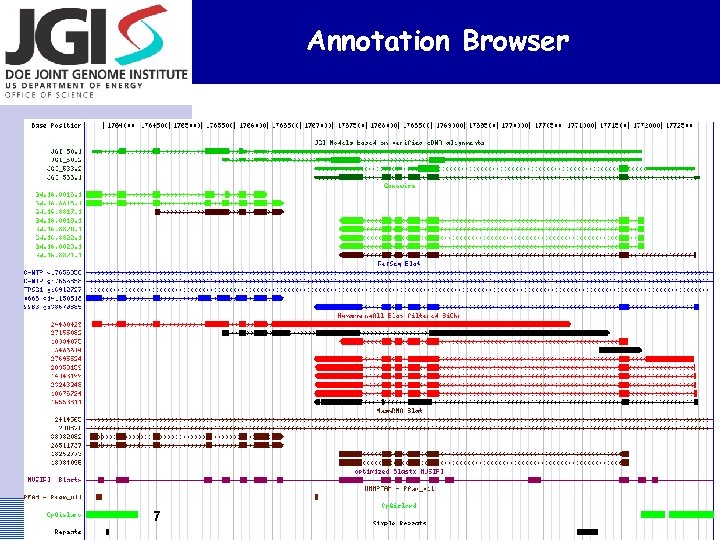 Annotation Browser 7 US DOE Joint Genome Institute
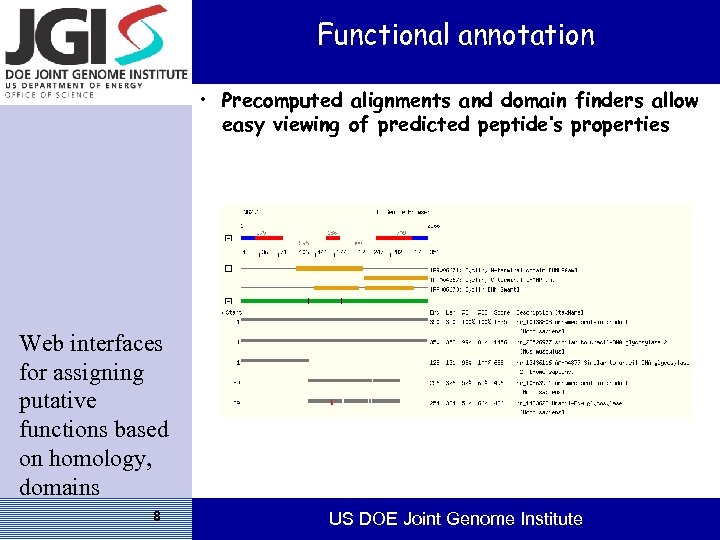 Functional annotation • Precomputed alignments and domain finders allow easy viewing of predicted peptide’s properties Web interfaces for assigning putative functions based on homology, domains 8 US DOE Joint Genome Institute
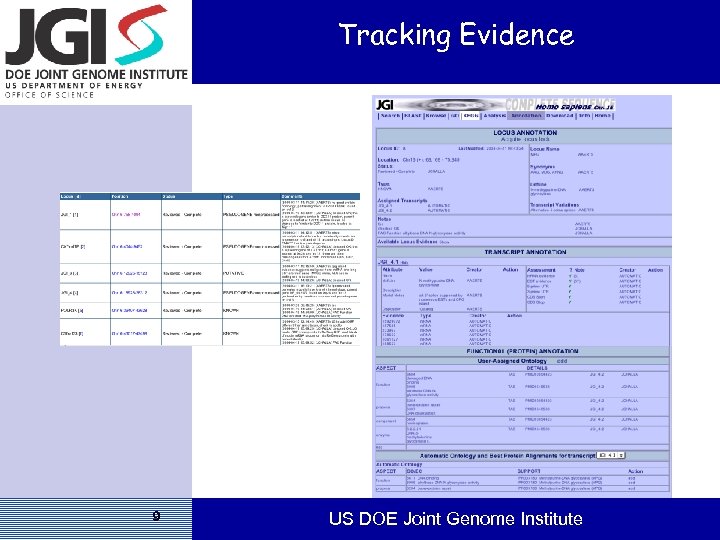 Tracking Evidence 9 US DOE Joint Genome Institute
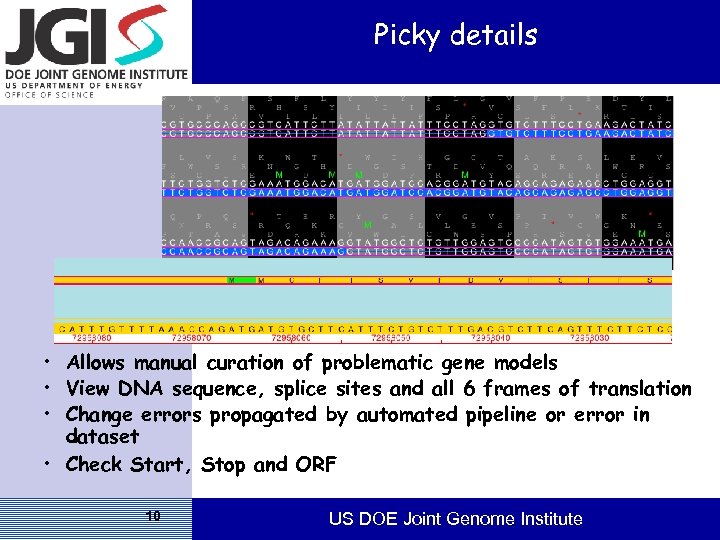 Picky details • Allows manual curation of problematic gene models • View DNA sequence, splice sites and all 6 frames of translation • Change errors propagated by automated pipeline or error in dataset • Check Start, Stop and ORF 10 US DOE Joint Genome Institute
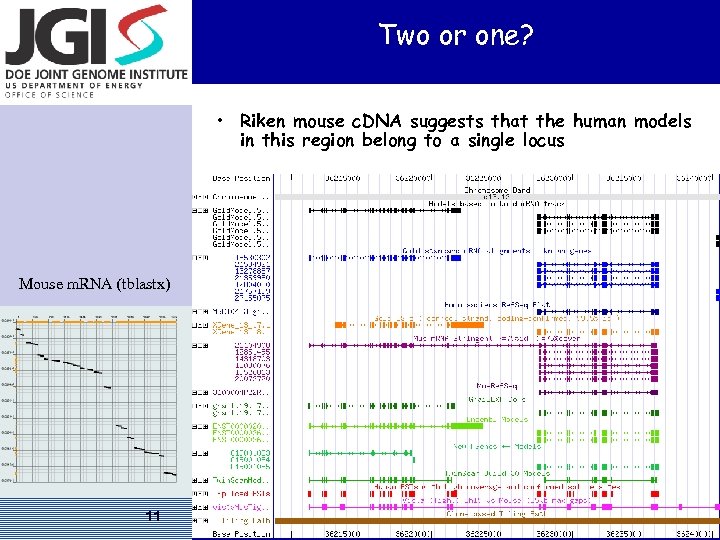 Two or one? • Riken mouse c. DNA suggests that the human models in this region belong to a single locus Mouse m. RNA (tblastx) 11 US DOE Joint Genome Institute
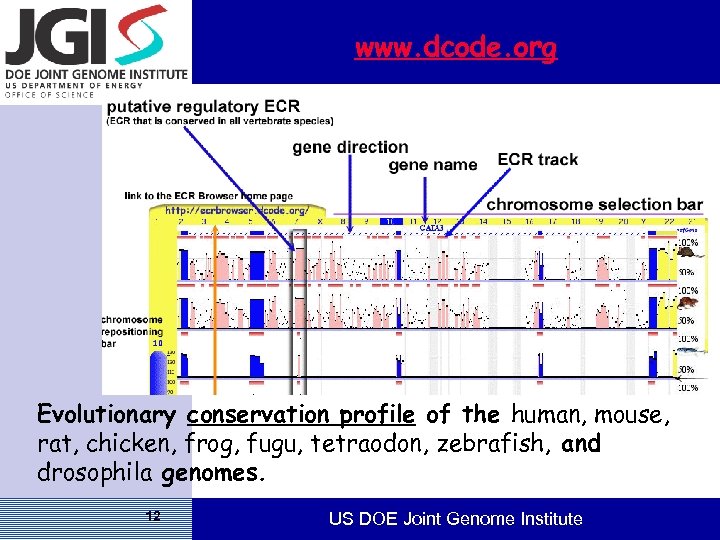 www. dcode. org Evolutionary conservation profile of the human, mouse, rat, chicken, frog, fugu, tetraodon, zebrafish, and drosophila genomes. 12 US DOE Joint Genome Institute
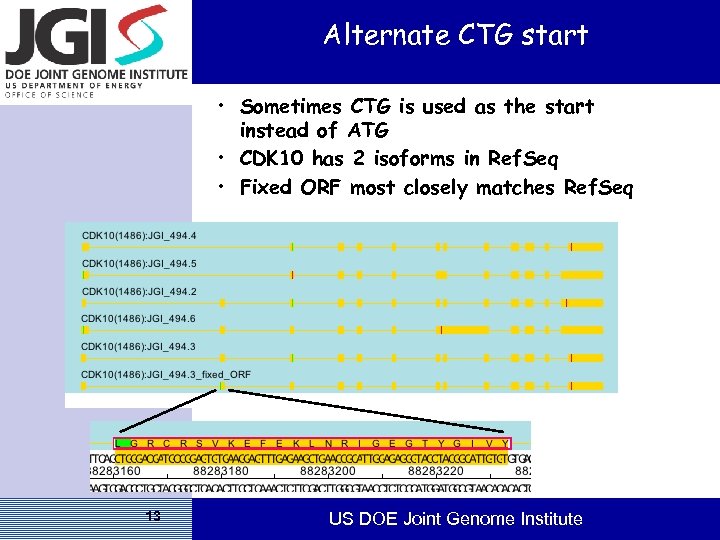 Alternate CTG start • Sometimes CTG is used as the start instead of ATG • CDK 10 has 2 isoforms in Ref. Seq • Fixed ORF most closely matches Ref. Seq 13 US DOE Joint Genome Institute
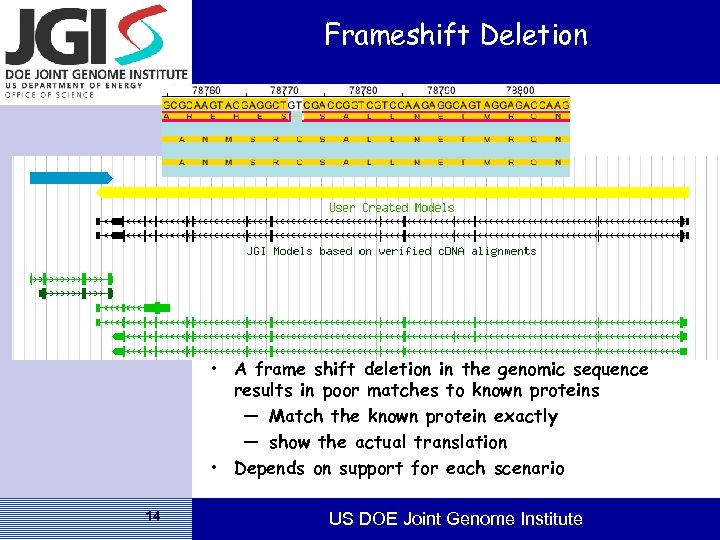 Frameshift Deletion • A frame shift deletion in the genomic sequence results in poor matches to known proteins — Match the known protein exactly — show the actual translation • Depends on support for each scenario 14 US DOE Joint Genome Institute
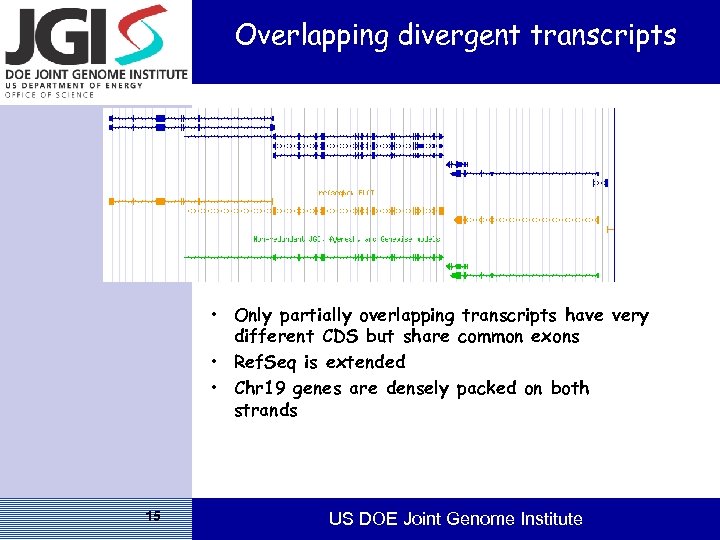 Overlapping divergent transcripts • Only partially overlapping transcripts have very different CDS but share common exons • Ref. Seq is extended • Chr 19 genes are densely packed on both strands 15 US DOE Joint Genome Institute
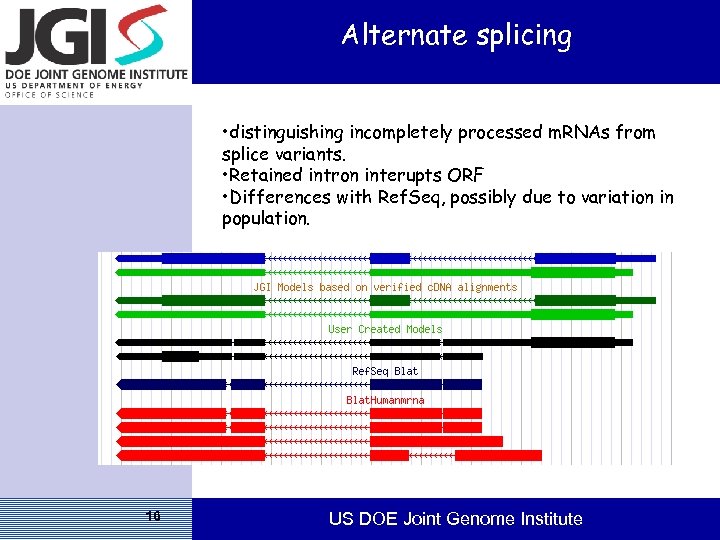 Alternate splicing • distinguishing incompletely processed m. RNAs from splice variants. • Retained intron interupts ORF • Differences with Ref. Seq, possibly due to variation in population. 16 US DOE Joint Genome Institute
 Pseudogenes • Disabled gene that has an insult- stop or frameshift that interrupts or changes the ORF from the parent gene • Polymorphic sites or transcripts indicate that locus activity may vary between individuals • Processed — Due to retro transposition of RNA into genomic DNA. — Single exon, poly. A, lacks promotor/Cp. G, degraded condition • Non-processed — Due to duplication, subsequently disabled, possible to find parent region — Generally multi exon, promotor/Cp. G present 17 US DOE Joint Genome Institute
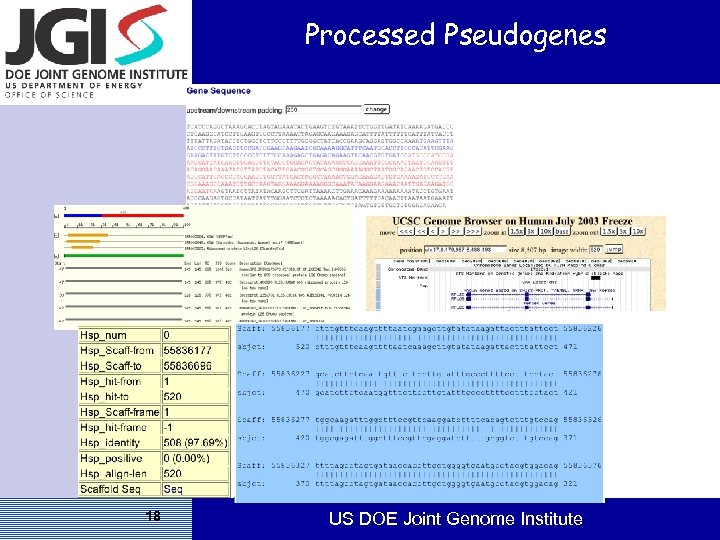 Processed Pseudogenes 18 US DOE Joint Genome Institute
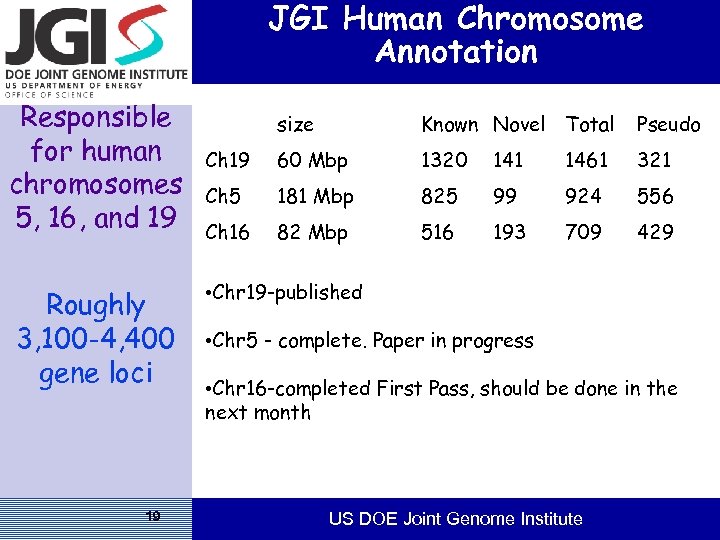 JGI Human Chromosome Annotation Responsible for human chromosomes 5, 16, and 19 Roughly 3, 100 -4, 400 gene loci 19 size Known Novel Total Pseudo Ch 19 60 Mbp 1320 141 1461 321 Ch 5 181 Mbp 825 99 924 556 Ch 16 82 Mbp 516 193 709 429 • Chr 19 -published • Chr 5 - complete. Paper in progress • Chr 16 -completed First Pass, should be done in the next month US DOE Joint Genome Institute
 Acknowledgements Annotators • Andrea Aerts • Steve Lowry • Joel Martin • Laurie Gordon • Mary Tran-Gyamfi • Gary Xie • Michael Altherr • Jean Challacombe • Cathy Cleland • Nina Thayer • Jeremy Schmutz • Yee Man Chan 20 • Uffe Helsten, • Wayne Huang, • David Goodstein, • Igor Grigoriev • Sam Rash, • Sean Caenapeel • Asaf Salamov • Isaac Ho, • Leila Hornick • Annette Greiner • Victor Solovyev, • Ivan Ovcharenko • Olivier Couronne, • Paramvir Dehal, • Inna Dubchak, • Lisa Stubbs, and Dan Rokhsar US DOE Joint Genome Institute
 Gene families • Many gene families have known gene structures but lack extensive m. RNA/EST evidence in human — Olfactory receptors (approximately 40 genes, as many as 150 pseudogenes) -- single exon, seven transmembrane receptors — KRAB-containing Zn fingers -- single KRAB domain near amino terminal, followed by typically one exon with multiple zinc fingers — and several other families • Build custom models using expected gene structure using automated methods. • Automatically identify pseudogenes, which are common in tandem gene families. • Such tandem families are hard to model ab initio, easy to run genes together. 21 US DOE Joint Genome Institute
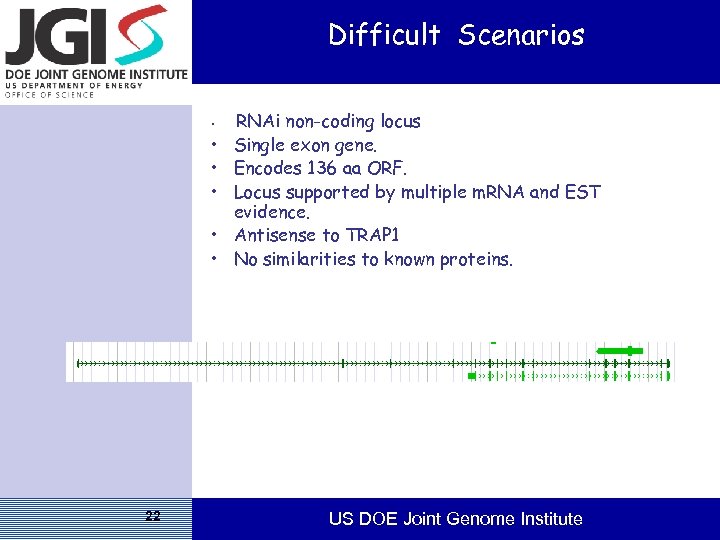 Difficult Scenarios • • • 22 RNAi non-coding locus Single exon gene. Encodes 136 aa ORF. Locus supported by multiple m. RNA and EST evidence. Antisense to TRAP 1 No similarities to known proteins. US DOE Joint Genome Institute
 Human Annotation @ the JGI Astrid Terry Automated annotation & Manual Curation 23 US DOE Joint Genome Institute