


 Скачать презентацию Human Adaptation of Land Management Mark Stafford Smith
0cc32b3befe1470c6ce77570a5fe94ad.ppt
- Количество слайдов: 17
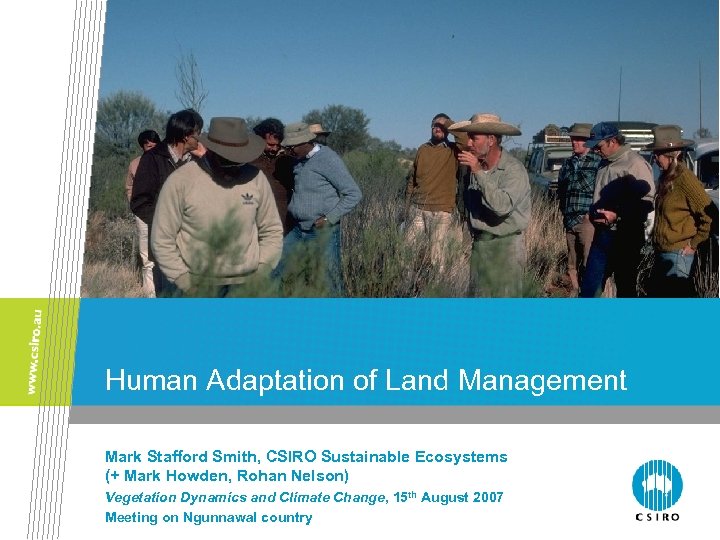 Human Adaptation of Land Management Mark Stafford Smith, CSIRO Sustainable Ecosystems (+ Mark Howden, Rohan Nelson) Vegetation Dynamics and Climate Change, 15 th August 2007 Meeting on Ngunnawal country
 Outline • “Are changes in land management practice likely or able to be changed in ways that will affect changes in vegetation distribution? ” • Yes…! • but… • Deconstructing… • ‘land management practice’ • Drivers of ‘change’ • Can people adapt? • Significance of ‘change’ • ‘vegetation distribution’ and • Do we want to model these things? CSIRO. Vegetation Dynamics and Climate Change Workshop, AAS 14 -15 Aug 2007
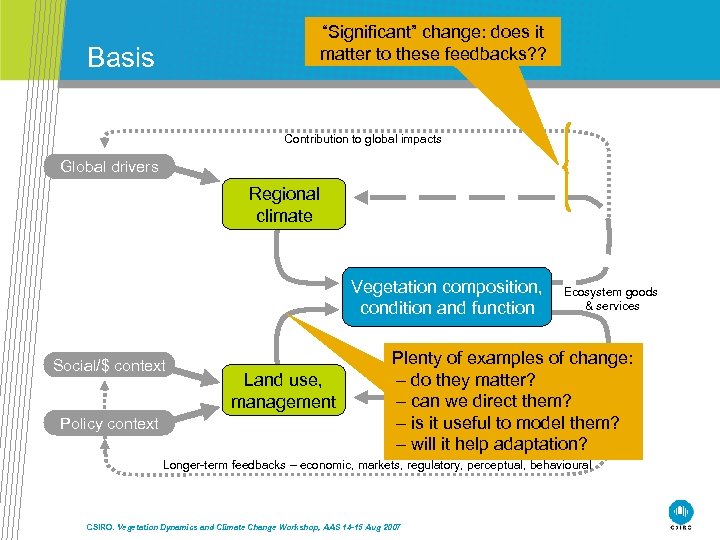 “Significant” change: does it matter to these feedbacks? ? Basis Contribution to global impacts Global drivers Regional climate Vegetation composition, condition and function Social/$ context Policy context Land use, management Ecosystem goods & services Plenty of examples of change: – do they matter? – can we direct them? – is it useful to model them? – will it help adaptation? Longer-term feedbacks – economic, markets, regulatory, perceptual, behavioural CSIRO. Vegetation Dynamics and Climate Change Workshop, AAS 14 -15 Aug 2007
 Types of change • Management • Land use, land cover, land condition, etc • ‘Land use’ overall vegetation structure: major, long-term • ‘Land management’ vegetation condition: capability of this vegetation structure to deliver desired EGSs – can be major but usually insidious, can be long-term or rapid • Types of drivers • Economic (markets, costs, incentives) • Regulatory • direct – land conservation, clearing, etc, • indirect – water trading, wool board, FTAs, procurement, etc • Behavioural (societal change + awareness, options & skills) • Ability to respond appropriately = adaptive capacity • Different for different styles of decisions under different drivers CSIRO. Vegetation Dynamics and Climate Change Workshop, AAS 14 -15 Aug 2007
 Land use/management that could matter • Examples abound • • Legislation to stop land clearing in Australia Woody thickening in response to grazing/fire management US’s Conservation Reserve Program (14. 6 m ha enrolled, $1. 7 bn) Implication of EU CAP Forest clearance in Asia and South America (~1/5 th fossil fuel flux) Salinisation in the MDB/WA wheatbelt, effects on water and albedo Dust fertilisation of oceans off China, Sahara etc • Characterised in Australia by: • Emergent effects of lots of small decisions in response to market forces, diffusion of innovations, changing preferences, etc, OR, • Impacts of major centralised ‘policies’ or low probability events • Predictability dependent on target scale and type CSIRO. Vegetation Dynamics and Climate Change Workshop, AAS 14 -15 Aug 2007
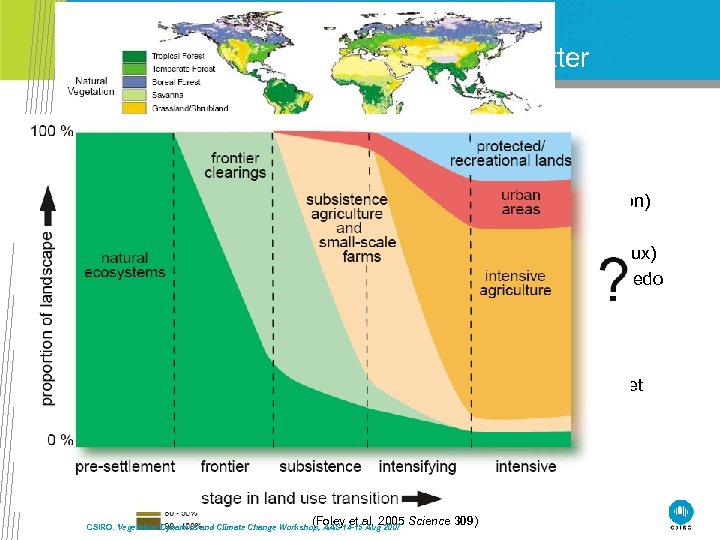 Land use/management that could matter • Examples abound • • Legislation to stop land clearing in Australia Woody thickening in response to grazing/fire management US’s Conservation Reserve Program (14. 6 m ha enrolled, $1. 7 bn) Implication of EU CAP Forest clearance in Asia and South America (~1/5 th fossil fuel flux) Salinisation in the MDB/WA wheatbelt, effects on water and albedo Dust fertilisation of oceans off China, Sahara etc • Characterised in Australia by: • Emergent effects of lots of small decisions in response to market forces, diffusion of innovations, changing preferences, etc, OR, • Impacts of major centralised ‘policies’ or low probability events • Predictability dependent on target scale and type (Foley et al, 2005 Science 309) CSIRO. Vegetation Dynamics and Climate Change Workshop, AAS 14 -15 Aug 2007
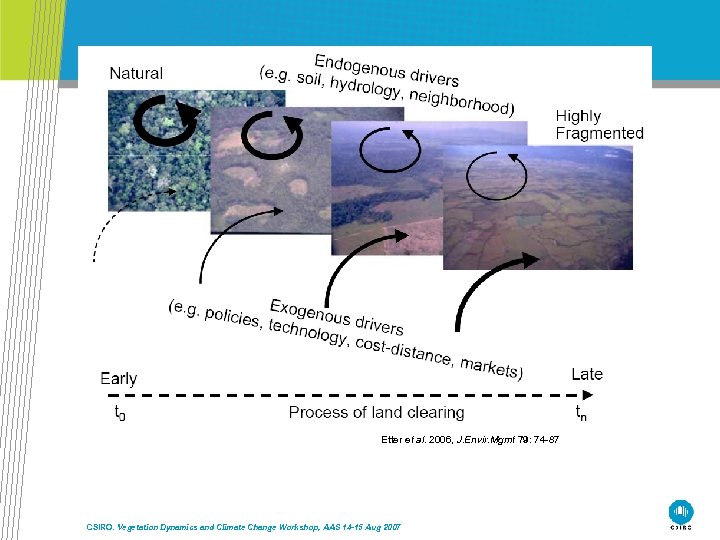 James et al, 1999: J. Arid Environments Etter et al. 2006, J. Envir. Mgmt 79: 74 -87 CSIRO. Vegetation Dynamics and Climate Change Workshop, AAS 14 -15 Aug 2007
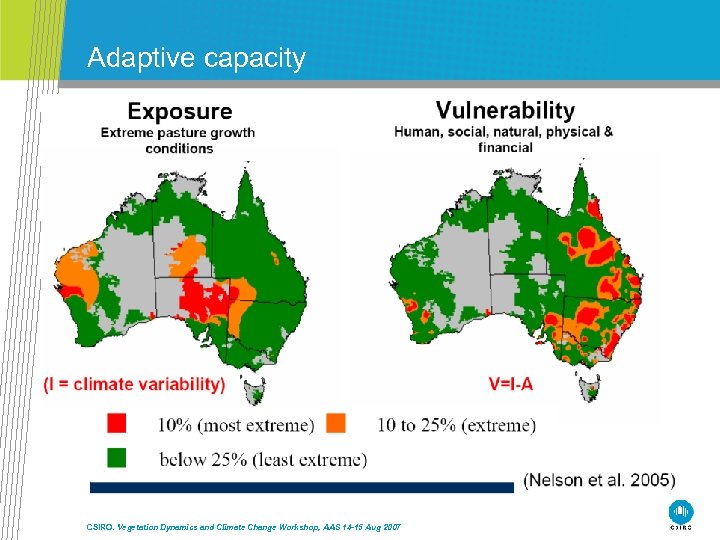 Adaptive capacity • At multiple scales • In individual farmers, conservation managers, traditional owners • In regional communities, land care groups, land councils, NGOs, local government • In state and national government, industry bodies (eg. NFF), transborder institutions (eg. MDBC), research capability and focus • Internationally • Not correlated well with impacts… CSIRO. Vegetation Dynamics and Climate Change Workshop, AAS 14 -15 Aug 2007
 Adaptive capacity • At multiple scales • In individual farmers, conservation managers, traditional owners • In regional communities, land care groups, land councils, NGOs, local government • In state and national government, industry bodies (eg. NFF), transborder institutions (eg. MDBC), research capability and focus • Internationally • Not correlated well with impacts… • Major focus now needed on adaptive capacity, adaptive management, adaptive governance • These represent a shift to a different paradigm or scenario which itself would result in different futures for predicting other things CSIRO. Vegetation Dynamics and Climate Change Workshop, AAS 14 -15 Aug 2007
 Classifying where to model adaptation • Too easy to get overloaded with options… CSIRO. Vegetation Dynamics and Climate Change Workshop, AAS 14 -15 Aug 2007
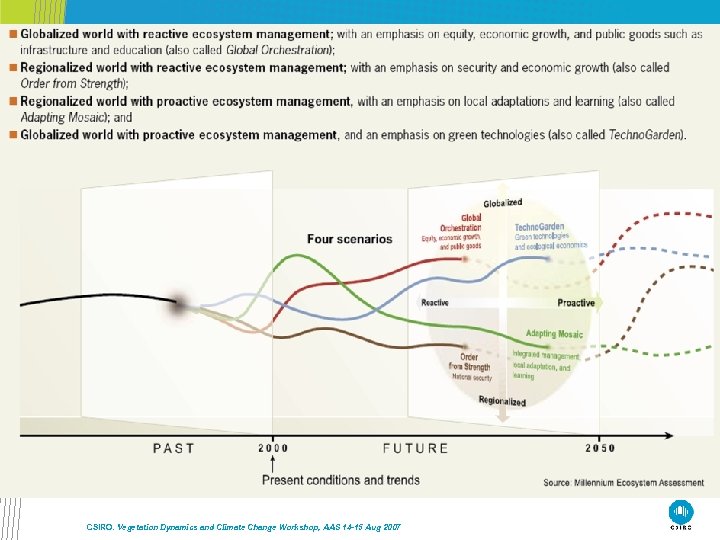
 Classifying where to model adaptation • What types of decisions are we quite good at? • Short run, rapid feedback/attribution, multiple players experimenting, especially reversible impacts • …and bad? • Long run, slow (discounted) or hard to detect feedback/ attribution, central monolithic decisions, irreversible impacts • Continuum, but susceptibility to predictive modelling? • Short-run – potential, with quasi-statistical/process models • Long-run – no, use futuring and scenarios instead • NB form of model to use for the ‘short-run’ (even feasibility) may depend on the scenario • e. g. economic driver for land use change may work well in a free market future; may fail in a regionalised, conservation-oriented scenario CSIRO. Vegetation Dynamics and Climate Change Workshop, AAS 14 -15 Aug 2007
 Classifying where to model adaptation • What types of decisions are we quite good at? • Short run, rapid feedback/attribution, multiple players experimenting, especially reversible impacts • …and bad? • Long run, slow (discounted) or hard to detect feedback/ attribution, central monolithic decisions, irreversible impacts • Continuum, but susceptibility to predictive modelling? • ‘good’ – potential, with quasi-statistical/process models • ‘bad’ – no, use futuring and scenarios instead • NB form of model to use for the ‘good’ (even feasibility) may depend on the scenario • e. g. economic driver for land use change may work well in a free market future; may fail in a regionalised, conservation-oriented scenario CSIRO. Vegetation Dynamics and Climate Change Workshop, AAS 14 -15 Aug 2007
 Classifying ctd • What would you include in a vegetation model? • ‘Significant’ vegetation change caused by management • YES (big enough challenge) • Endogenous feedbacks from veg change to human management that create further ‘significant’ vegetation change • ONLY IF short-run, multi-actor type of feedback, eg. through economics • Even then – is there a credible context of adaptive capacity? • NOT long-run, monolithic, policy-driven responses – use scenarios • Caveats • Time, space and institutional scale-dependent • Predictable driver globally may be unpredictable locally • eg. global aging – predictable types of labour shortages globally, but uncertain regional implications given possible migration, etc CSIRO. Vegetation Dynamics and Climate Change Workshop, AAS 14 -15 Aug 2007
 Examples • Fire • At broad level of human influence – at regional scales: suppress >> big hot, or not >> ‘natural regime” = scenario? • Land use change • Rainforests, marginal lands – at regional+ scales: driven by markets, so predictable in some scenarios • Conservation instruments – driven by central policies: >>? ? • Tree planting, biofuels due to C pricing? • NB serious emergent implications for land use and food security • Changes in crops, cultivars, timber species, etc • Strong economic/market drivers – at regional scales: predictable in some scenarios (efficiency gain responses probably predictable in all, though wildcards eg. GM etc) CSIRO. Vegetation Dynamics and Climate Change Workshop, AAS 14 -15 Aug 2007
 Conclusions • Does human adaptation matter for vegetation change? • Yes, at certain times and scales • Should management effects be included in DGVMs? • Yes, at scales and for processes where they matter • Should causal agency be modelled? • Major increase in complexity and potential uncertainty, so only where this is worthwhile • ie. What’s the purpose of the model? Is the effect significant? • Even then, some types of decisions amenable at some scales, others are not: • Long-run, singular (unpredictable) decisions better handled in scenarios • Emergent properties of many small, short-run decisions may be modelled well under some scenarios, possibly different driver according to scenario • Does human adaptation matter for humans? ! • Yes – but a focus on resilience and adaptive capacity crucial for this CSIRO. Vegetation Dynamics and Climate Change Workshop, AAS 14 -15 Aug 2007
 Priorities • Clarify what management/land use effects need to be included in DGVMs • Current land use change and management that significantly affects feedbacks • Assess significance at key scales and purposes • Determine whether causal agency is usefully incorporated • Focus on major endogenous feedbacks with significant impact on primary purposes of DGVM • Climate change itself having 1 st order effect on economic/social/policy system which drives major changes in land use/management? • Filter these by pathways through ‘amenable’ decision types, else use scenarios • Key developmental pathways maybe worth considering also • For adaptation, put major investment in other areas • Targeted at adaptive capacity and resilience (esp. hearing Graham!) • Underinvested at present CSIRO. Vegetation Dynamics and Climate Change Workshop, AAS 14 -15 Aug 2007
 Thank you Contact Us Phone: 1300 363 400 or +61 3 9545 2176 Email: enquiries@csiro. au Web: www. csiro. au CSIRO. Vegetation Dynamics and Climate Change Workshop, AAS 14 -15 Aug 2007