 Скачать презентацию HUA 出好成绩 上饶县教研室 王建华 2012 -03 -16 Do
5fe32aafddede0ce31cadf91842bea13.ppt
- Количество слайдов: 77




“HUA”出好成绩 上饶县教研室 王建华 2012 -03 -16
Do you know? 2
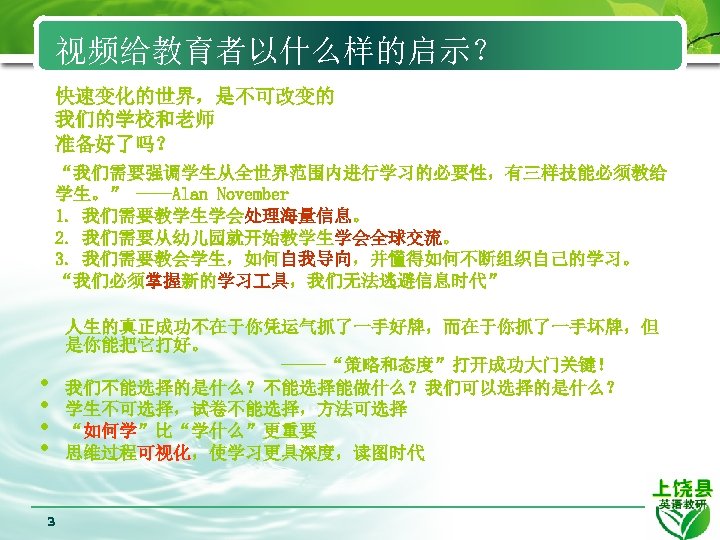
视频给教育者以什么样的启示? 快速变化的世界,是不可改变的 我们的学校和老师 准备好了吗? “我们需要强调学生从全世界范围内进行学习的必要性,有三样技能必须教给 学生。” ——Alan November 1. 我们需要教学生学会处理海量信息。 2. 我们需要从幼儿园就开始教学生学会全球交流。 3. 我们需要教会学生,如何自我导向,并懂得如何不断组织自己的学习。 “我们必须掌握新的学习 具,我们无法逃避信息时代” • • 3 人生的真正成功不在于你凭运气抓了一手好牌,而在于你抓了一手坏牌,但 是你能把它打好。 -----“策略和态度”打开成功大门关键! 我们不能选择的是什么?不能选择能做什么?我们可以选择的是什么? 学生不可选择,试卷不能选择,方法可选择 “如何学”比“学什么”更重要 思维过程可视化,使学习更具深度,读图时代
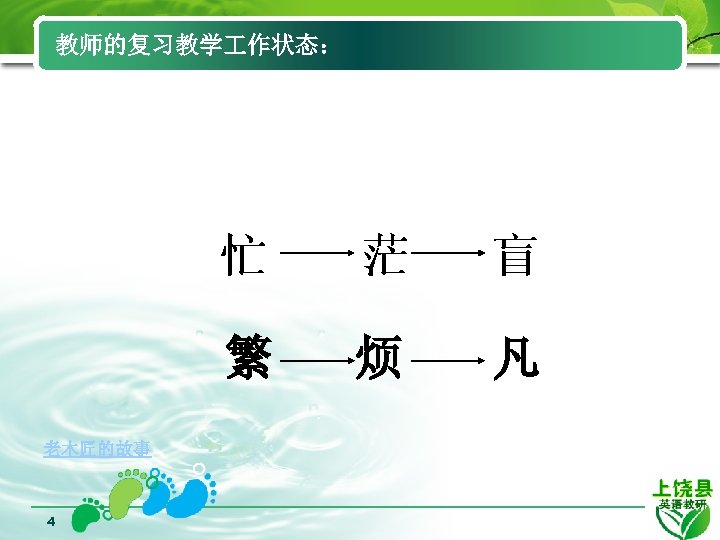
教师的复习教学 作状态: 忙 4 盲 繁 老木匠的故事 茫 烦 凡
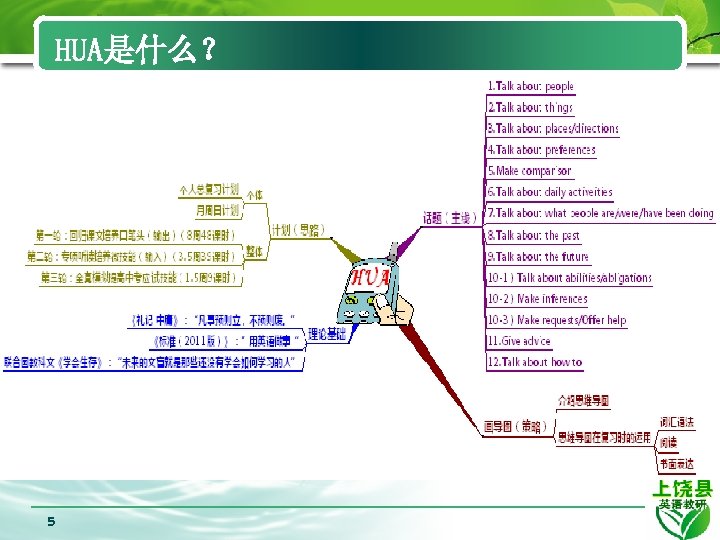
HUA是什么? 5
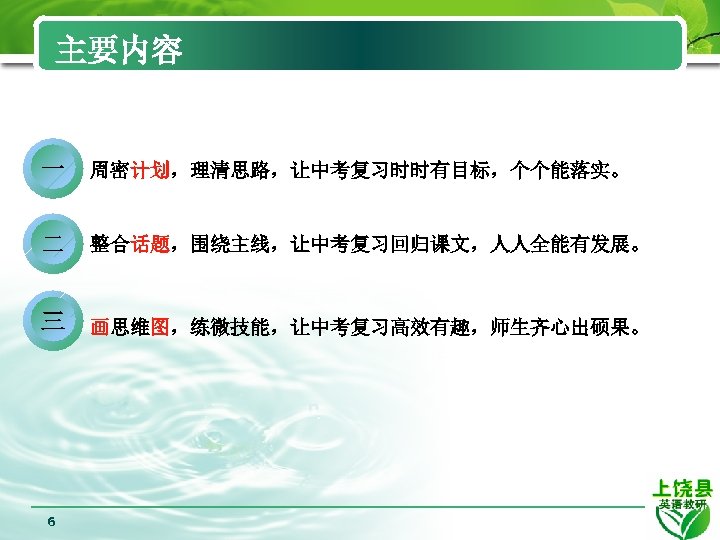
主要内容 一 周密计划,理清思路,让中考复习时时有目标,个个能落实。 二 整合话题,围绕主线,让中考复习回归课文,人人全能有发展。 三 画思维图,练微技能,让中考复习高效有趣,师生齐心出硕果。 6
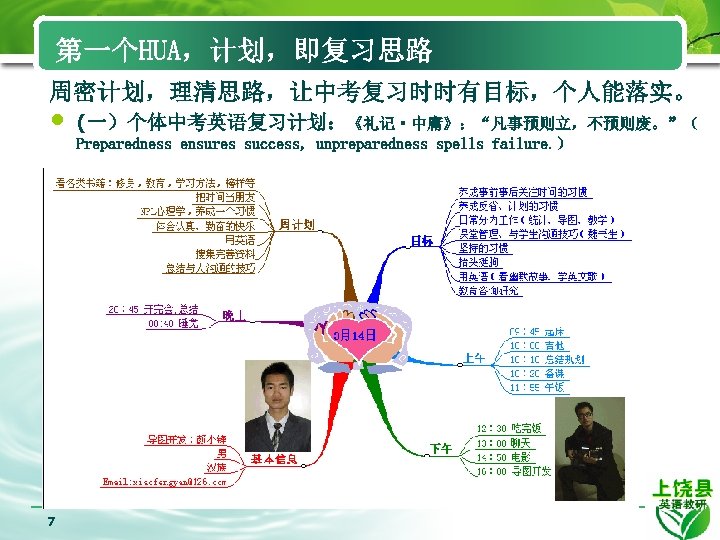
第一个HUA,计划,即复习思路 周密计划,理清思路,让中考复习时时有目标,个人能落实。 • (一)个体中考英语复习计划:《礼记·中庸》:“凡事预则立,不预则废。”( Preparedness ensures success, unpreparedness spells failure. ) 7
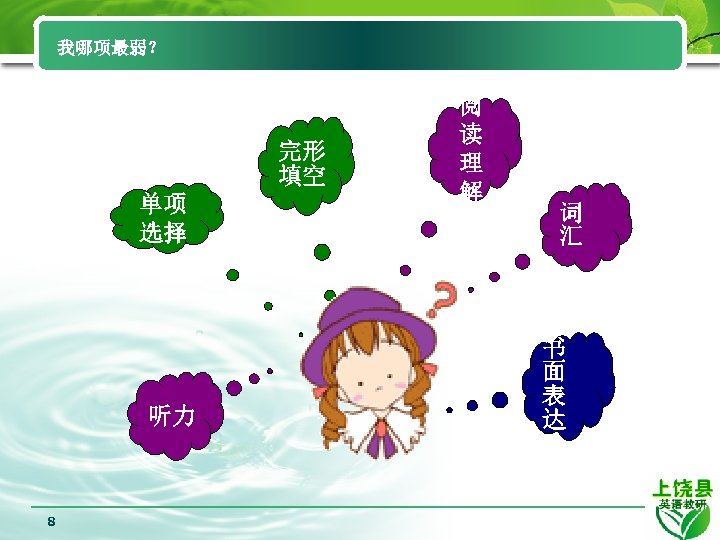
我哪项最弱? 完形 填空 单项 选择 听力 8 阅 读 理 解 词 汇 书 面 表 达
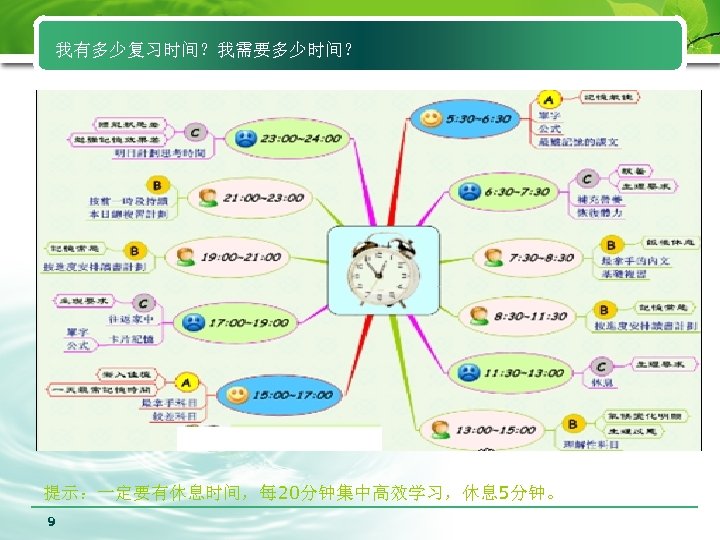
我有多少复习时间?我需要多少时间? 提示:一定要有休息时间,每 20分钟集中高效学习,休息 5分钟。 9
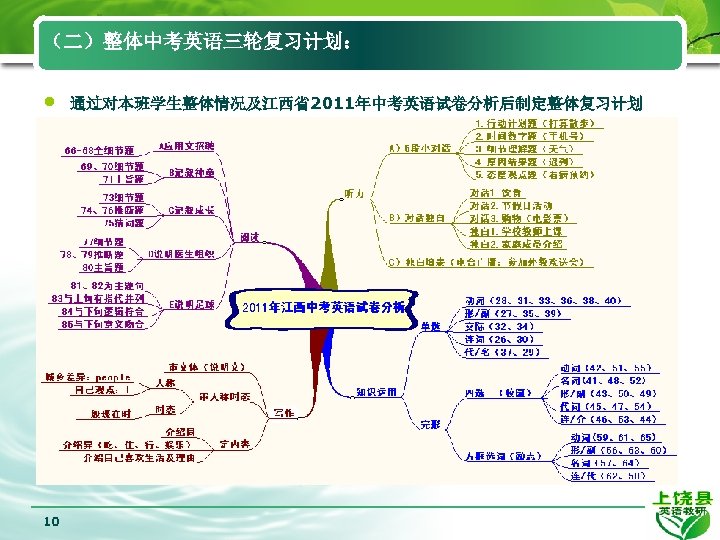
(二)整体中考英语三轮复习计划: • 10 通过对本班学生整体情况及江西省2011年中考英语试卷分析后制定整体复习计划
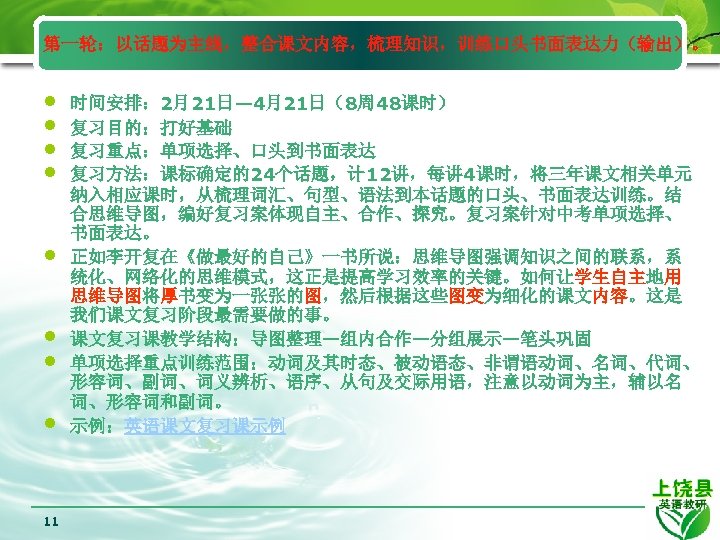
第一轮:以话题为主线,整合课文内容,梳理知识,训练口头书面表达力(输出)。 • • 11 时间安排: 2月21日— 4月21日(8周 48课时) 复习目的:打好基础 复习重点:单项选择、口头到书面表达 复习方法:课标确定的24个话题,计 12讲,每讲 4课时,将三年课文相关单元 纳入相应课时,从梳理词汇、句型、语法到本话题的口头、书面表达训练。结 合思维导图,编好复习案体现自主、合作、探究。复习案针对中考单项选择、 书面表达。 正如李开复在《做最好的自己》一书所说:思维导图强调知识之间的联系,系 统化、网络化的思维模式,这正是提高学习效率的关键。如何让学生自主地用 思维导图将厚书变为一张张的图,然后根据这些图变为细化的课文内容。这是 我们课文复习阶段最需要做的事。 课文复习课教学结构:导图整理—组内合作—分组展示—笔头巩固 单项选择重点训练范围:动词及其时态、被动语态、非谓语动词、名词、代词、 形容词、副词、词义辨析、语序、从句及交际用语,注意以动词为主,辅以名 词、形容词和副词。 示例:英语课文复习课示例
第二轮:以微技能培养为中心,结合中考题型,分项突破听读技能(输入)。 • • 时间安排: 4月21日— 6月3日(6. 5周 39课时) 复习目的:根据题型突破微技能,形成听读技能 复习重点:听力、完形与阅读理解 复习方法: 1. 教师系统讲解—专项训练,以教师总结为辅,学生复习为主 2. 专项训练课教学结构: 自主分析—感知体验—导图归纳—巩固训练 12
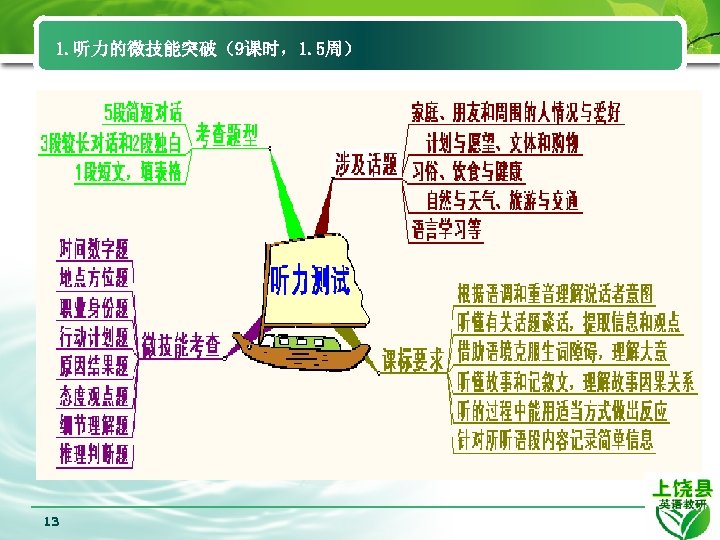
1. 听力的微技能突破(9课时,1. 5周) 13
![A)短对话( 2课时) 1)时间数字题 • [ 2010,江西] • 6. How long has the man waited](https://present5.com/presentation/5fe32aafddede0ce31cadf91842bea13/image-14.jpg "A)短对话( 2课时) 1)时间数字题 • [ 2010,江西] • 6. How long has the man waited")
A)短对话( 2课时) 1)时间数字题 • [ 2010,江西] • 6. How long has the man waited for the bus? A. Ten minutes. B. Thirty minutes C. Forty minutes. • 7. What time does the man’s class start on Fridays? A. At 10: 00. B. At 9: 30. C. At 9: 00 • 听力材料: • 6. W: The bus is always late. M: Yes. I have been waiting for half an hour. If it doesn’t come in another 10 minutes(干扰,A、C), I’ll have to take a taxi. 7. W: Does your class start at 9: 00 o’clock every morning? M: No, not every morning. On Wednesdays it doesn’t start until 9: 30 and on Fridays not until 10 o’clock. W: Then you don’t have to go to school too early at least two days a week. M: You’re right. 听力技巧提示: • 时间数字题在大部分情况下要进行简单的计算,并进行简单的推理和判断。听时要及时记 下关键数字。听的过程中,尤其注意根据表示时间的关联词。如: before, after, until, later等,还要注意一些经常会出现时间、数字变化的关键词: more, less, early, fast, slow, but, only, miss, leave, times, twice, half, double, quarter等。 • 常见提问方式有:What time…? When…? How much…? How many…? 14
![2)地点方位题 • [ 2009,江西] • 5. Where does the conversation probably happen? • A.](https://present5.com/presentation/5fe32aafddede0ce31cadf91842bea13/image-15.jpg "2)地点方位题 • [ 2009,江西] • 5. Where does the conversation probably happen? • A.")
2)地点方位题 • [ 2009,江西] • 5. Where does the conversation probably happen? • A. At the airport. B. In a hotel. C. In a shop. • 听力材料: • W: Can I help you? • M: Yes. My flight number is CA 7492. Which gate should I go to? • W: Gate 14. • 技巧点拨: • 解答此类题目,首先要通过预先读题,进行预测;听材料时注意哪些是考查的 内容,科学分配注意力,此类题目一般不可能从原文中直接听到答案,考生要 注意抓关键词,产生相应的联想,根据暗示和关键词进行判断推理。这些场景 地点多数都是学生所熟悉的,一般难度不大,如听到doctor, patient, cold 等词,就想到谈话可能是in the hospital;听到borrow, return books 等词,就想到谈话可能in the library;听到letter, stamp, envelope 等 词,就想到谈话可能是in the post office。 15
![3)职业身份题 • [ 2004,江西] • 1. What does Bill do now? • A, A](https://present5.com/presentation/5fe32aafddede0ce31cadf91842bea13/image-16.jpg "3)职业身份题 • [ 2004,江西] • 1. What does Bill do now? • A, A")
3)职业身份题 • [ 2004,江西] • 1. What does Bill do now? • A, A teacher. B. A student. C. A journalist. • 听力材料: • 1. W: What's your plan after your graduating, Bill? • M: Well, my parents want me to be a teacher, while I'd prefer to be a journalist. • 听力技巧提示: 1. 注意捕捉称谓等关键词及句型,如Dr, job, work ,Can I help you? 等。 • 2. 判断说话地点,从而判断出说话人职业。如: bus— conductor/driver,hospital—doctor/nurse, restaurant— waiter/waitress等。 16
![4)行动计划题 • [ 2011,江西] • 1. What does the woman want to do? •](https://present5.com/presentation/5fe32aafddede0ce31cadf91842bea13/image-17.jpg "4)行动计划题 • [ 2011,江西] • 1. What does the woman want to do? •")
4)行动计划题 • [ 2011,江西] • 1. What does the woman want to do? • A. To go for a walk. B. To watch TV. C. To go to a movie. • 听力材料: • W: Hello! Kevin! What are you doing now? • M: Not much. Do you have any plans? • W: I want to take a walk. (无刻意干扰项) • 听力技巧提示: • 根据题干确定计划行动的对象,听时根据题干要求集中注意重点理解计划内容或原因。 17
![5)原因结果题 • • • 18 [ 2011,江西] 4. Why is the girl late? A.](https://present5.com/presentation/5fe32aafddede0ce31cadf91842bea13/image-18.jpg "5)原因结果题 • • • 18 [ 2011,江西] 4. Why is the girl late? A.")
5)原因结果题 • • • 18 [ 2011,江西] 4. Why is the girl late? A. Because she had to do her homework at home. B. Because she visited her grandma this morning. C. Because she had to stay with her grandma at home. 听力材料: M: Hey, Sally. You’re late. The museum is closed. W: Sorry. My grandma visited us this morning, so I stayed at home and talked with her. M: That’s OK. 听力技巧提示:关键要注意一些表因果关系的词或短语,如: because, since, for, so, as等。
![6)态度观点题 • [ 2011,江西] • 5. What does the woman mean? • A. The](https://present5.com/presentation/5fe32aafddede0ce31cadf91842bea13/image-19.jpg "6)态度观点题 • [ 2011,江西] • 5. What does the woman mean? • A. The")
6)态度观点题 • [ 2011,江西] • 5. What does the woman mean? • A. The man phoned the dentist earlier before that. • B. The man may not see the dentist right now. • C. She is sorry that she is too busy to help him. • 听力材料 • 5. M: Oh, please. I have to see the dentist right now. I have a terrible toothache. • W: Sorry(选B), he is busy now(排除C). Let me see, have you phoned before? • M: Sorry, I haven’t. (排除A) • 听力技巧提示: • 注意一些含转折意谓的词语,如: prefer, but等,还可从谈话者的语气及语调中领 会其真实语意,如happy, sad, sorry, disappointed等,可推断出谈话者的高兴、伤 心、失望等情绪。 19
![7)细节理解题 • [ 2010,江西] • 5. Who cleans the house at weekends? A. The](https://present5.com/presentation/5fe32aafddede0ce31cadf91842bea13/image-20.jpg "7)细节理解题 • [ 2010,江西] • 5. Who cleans the house at weekends? A. The")
7)细节理解题 • [ 2010,江西] • 5. Who cleans the house at weekends? A. The woman. B. The woman’s husband. C. The woman’s children. • 听力材料: • W: I often clean my house at weekends. M: Do your husband your children help you clean? W: They’d like to, but they have other things to do. 听力技巧提示: • 关键听清一些具体信息,如:时间、地点、人物、事件(5 W 1 H)等。 20
![8)推理判断题 • [ 2008,江西] • 10. What does the woman mean ? • A.](https://present5.com/presentation/5fe32aafddede0ce31cadf91842bea13/image-21.jpg "8)推理判断题 • [ 2008,江西] • 10. What does the woman mean ? • A.")
8)推理判断题 • [ 2008,江西] • 10. What does the woman mean ? • A. The exam will be easy for her. • B. The exam is not important for her. • C. She hasn’t prepared for the exam yet. • W:Good luck in your exam ! • M:I don’t need good luck. I need another week to study. • 听力技巧提示: • 推理判断题包括对前面几种类型题的考查的推理判断。对考生的要求最高,需考生在听懂 材料的基础上对说话人的意图进行推理判断才能答对题。建议考生加强训练。 21
![B)长对话与独白(3课时) • • • • • 22 家庭、朋友和周围的人情况与爱好 [ 2011,江西] 请听第 2段独白,回答第 17至第 20小题。](https://present5.com/presentation/5fe32aafddede0ce31cadf91842bea13/image-22.jpg "B)长对话与独白(3课时) • • • • • 22 家庭、朋友和周围的人情况与爱好 [ 2011,江西] 请听第 2段独白,回答第 17至第 20小题。")
B)长对话与独白(3课时) • • • • • 22 家庭、朋友和周围的人情况与爱好 [ 2011,江西] 请听第 2段独白,回答第 17至第 20小题。 17. Where was the picture taken? A. At my birthday party. B. At my mum’s birthday party. C. At my sister’s birthday party. 18. Who is an engineer ? A. My father. B. My mother. C. Uncle Simon. 19. What is Aunt Liz good at ? A. Speaking Chinese. B. Singing. C. Playing the piano. 20. Which of the following is true? A. My father can play football(原文未曾提过). B. My uncle is 45 years old. C. My parents are in the front of the picture. 请听第 2段独白,回答第 17至第 20小题。 Hello! Everyone! Let me show you a nice picture. This is my family 17)at my mum’s birthday party last year. These are my parents. 18)My father is 42, and he’s an engineer. He rides a horse very well. My mother is a nurse. She is 38. She works very hard. Uncle Simon is behind my parents. 20)He’s 45 years old(选B) and he’s a doctor at a hospital. He can play football. My aunt Liz is next to Uncle Simon. She’s my mum’s sister. She’s 31 years old. She’s a music teacher. 19)She plays the piano very well and she can speak a little Chinese. 20)My sister and I are in front of my parents(排除C). We are both students. That’s all. Thanks a lot!
![计划与愿望、文体和购物 • • • • • • 23 [ 2011,江西] 请听第 3段对话,回答第 11至第 13小题。](https://present5.com/presentation/5fe32aafddede0ce31cadf91842bea13/image-23.jpg "计划与愿望、文体和购物 • • • • • • 23 [ 2011,江西] 请听第 3段对话,回答第 11至第 13小题。")
计划与愿望、文体和购物 • • • • • • 23 [ 2011,江西] 请听第 3段对话,回答第 11至第 13小题。 11. When does the boy want to see a movie? A. This Friday. B. This Saturday. C. This Sunday. 12. Which movie can the boy watch? A. The Sound of Music. B. My Father’s Birthday. C. Black September. 13. What can we get from this conversation? A. The tickets are 15 dollars each. B. The movie starts at 8: 00 in the morning. C. The boy thinks the tickets are too expensive. 请听第 3段对话,回答第 11至第 13小题。 W: Hello, People’s Cinema. Can I help you? M: Hello, I’m phoning about 11)tickets for this Saturday. W: Which movie would you like to watch? M: Have you got tickets for 12)“My Father’s Birthday”? W: Sorry. There aren’t any tickets left for it. M: What about “ The Sound of Music”? W: Oh, yes. We have some tickets. M: Oh, right. What time does the movie start? W: 13)It starts at eight o’clock in the evening. (排除B) M: OK. How much do the tickets cost? W: 13)They’re 50 dollars each. (排除A) M: 13)50 dollars? ! (考查语气—表太贵了)Can I phone back later? I’ll ask my mum. W: Oh, that’s OK.
![习俗、饮食与健康 • [ 2011,江西] • 请听第 1段对话,回答第 6至第 7小题。 • 6. What would the](https://present5.com/presentation/5fe32aafddede0ce31cadf91842bea13/image-24.jpg "习俗、饮食与健康 • [ 2011,江西] • 请听第 1段对话,回答第 6至第 7小题。 • 6. What would the")
习俗、饮食与健康 • [ 2011,江西] • 请听第 1段对话,回答第 6至第 7小题。 • 6. What would the man like to eat? • A. Noodles. B. Dumplings. C. Hamburgers. • 7. Why didn’t the man eat breakfast? • A. Because he got up too late this morning. • B. Because his aunt didn’t make it for him. • C. Because he was not feeling well this morning. • 请听第 1段对话,回答第 6至第 7小题。 • W: Hi, Jason. How are you? • M: I’m hungry. • W: I can bring you some food. What would you like? • M: 6)Noodles, please. • W: I’ll go and get some for you. Did you eat breakfast? • M: No. • W: Why didn’t you eat breakfast? • M: 7)My aunt was not at home. She didn’t make breakfast for me. • 24
![自然与天气、旅游与交通 [ 2011,江西] • 请听第 2段对话,回答第 8至第 10小题。 • 8. Where did the woman](https://present5.com/presentation/5fe32aafddede0ce31cadf91842bea13/image-25.jpg "自然与天气、旅游与交通 [ 2011,江西] • 请听第 2段对话,回答第 8至第 10小题。 • 8. Where did the woman")
自然与天气、旅游与交通 [ 2011,江西] • 请听第 2段对话,回答第 8至第 10小题。 • 8. Where did the woman go two months ago? • A. Paris. B. New York. C. Sydney. • 9. How did the woman go there? • A. By train. B. By car. C. By plane. • 10. How long did the woman stay in Disneyland? • A. For two days. B. For three days. C. For four days. • 请听第 2段对话,回答第 8至第 10小题。 • W: What are you going to do on holiday, Tony? • M: We’re going to 8)Sydney. • W: You’ll love it! I went there two months ago. We had a great time. • M: How long did it take to get there? • W: It took about 12 hours. • M: And who was with you? • W: My aunt and uncle met me 9)at the airport. • M: And where did you go? • W: Well, first, we went to Disneyland. • M: How long did you spend there? • W: We spent 10)two days there. And then we went hopping. (选择项无干扰) 25
![C)听取信息题(1课时) • • 26 [2011,江西] C)请听下面一段短文,根据短文内容完成表格,每个空格不超过3个单词。将答案填写到答题卷的相 应位置。听短文前你将有50秒钟的时间阅读表格内容。短文读两遍。(每小题 1分) Good morning, here is Sunshine High](https://present5.com/presentation/5fe32aafddede0ce31cadf91842bea13/image-26.jpg "C)听取信息题(1课时) • • 26 [2011,江西] C)请听下面一段短文,根据短文内容完成表格,每个空格不超过3个单词。将答案填写到答题卷的相 应位置。听短文前你将有50秒钟的时间阅读表格内容。短文读两遍。(每小题 1分) Good morning, here is Sunshine High")
C)听取信息题(1课时) • • 26 [2011,江西] C)请听下面一段短文,根据短文内容完成表格,每个空格不超过3个单词。将答案填写到答题卷的相 应位置。听短文前你将有50秒钟的时间阅读表格内容。短文读两遍。(每小题 1分) Good morning, here is Sunshine High School on the radio. There’s a wonderful party 22) in our school meeting room tonight. It starts 21)at 7: 30. It’s for 23)our foreign teacher –Mr Green. He has been teaching here for 2 years. He teaches so well that everyone likes him. But he’s going back to London next week. We’ll have to say goodbye to him. To show our thanks, everyone can bring 24)a small present for him. The Beach Boys will play all their new songs. They’re our favourite band. Everyone will dance to the music. We’ll be enjoying ourselves here. Come and join us! See you at 7: 30 tonight. 21. 7: 30/seven thirty/half past seven 22. meeting room 23. Mr Green/our foreign teacher 24. a (small) present/gift 25. dancing
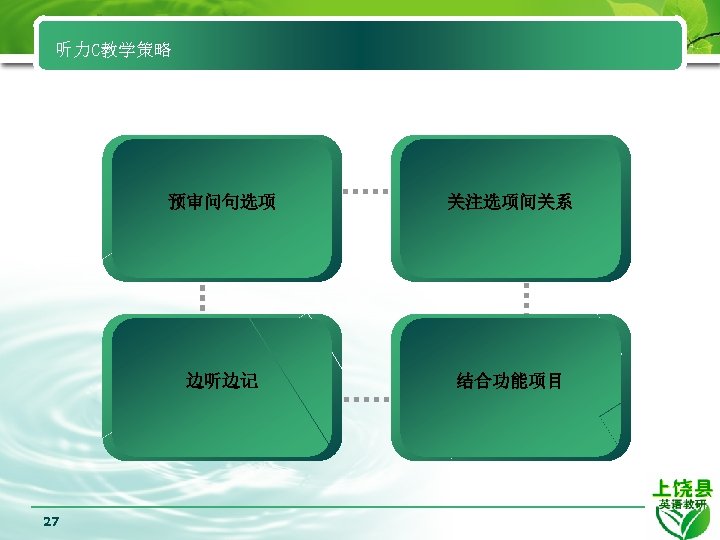
听力C教学策略 预审问句选项 边听边记 27 关注选项间关系 结合功能项目
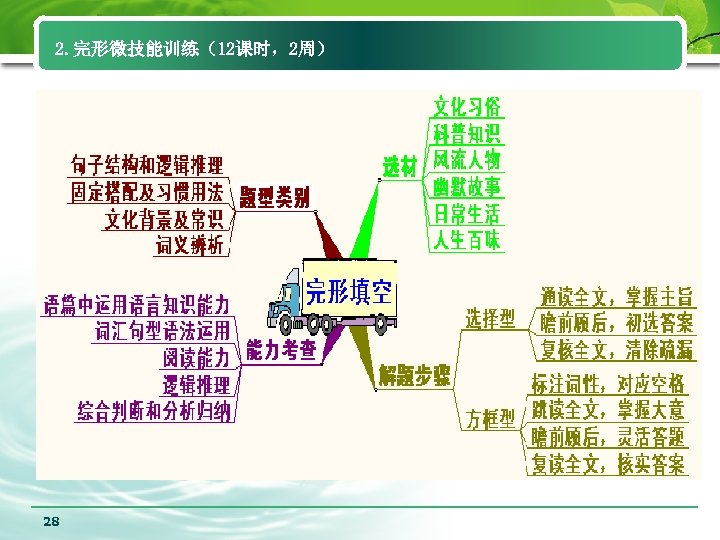
2. 完形微技能训练(12课时,2周) 28
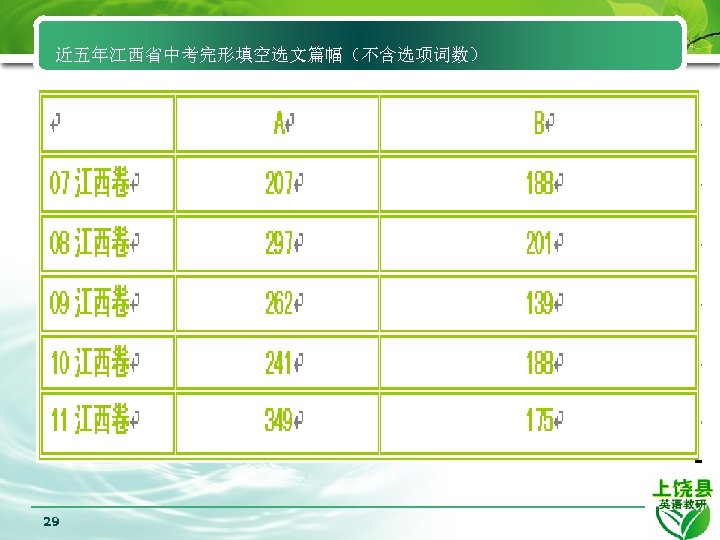
近五年江西省中考完形填空选文篇幅(不含选项词数) 29
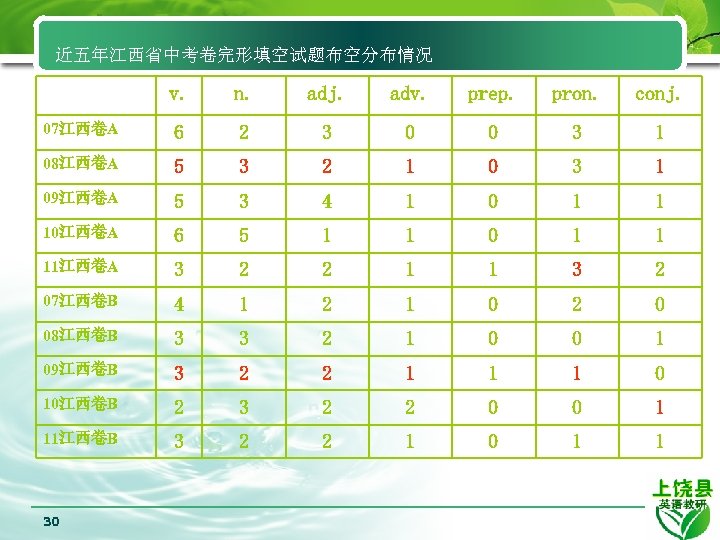
近五年江西省中考卷完形填空试题布空分布情况 v. n. adj. adv. prep. pron. conj. 07江西卷A 6 2 3 0 0 3 1 08江西卷A 5 3 2 1 0 3 1 09江西卷A 5 3 4 1 0 1 1 10江西卷A 6 5 1 1 0 1 1 11江西卷A 3 2 2 1 1 3 2 07江西卷B 4 1 2 1 0 2 0 08江西卷B 3 3 2 1 0 0 1 09江西卷B 3 2 2 1 1 1 0 10江西卷B 2 3 2 2 0 0 1 11江西卷B 3 2 2 1 0 1 1 30
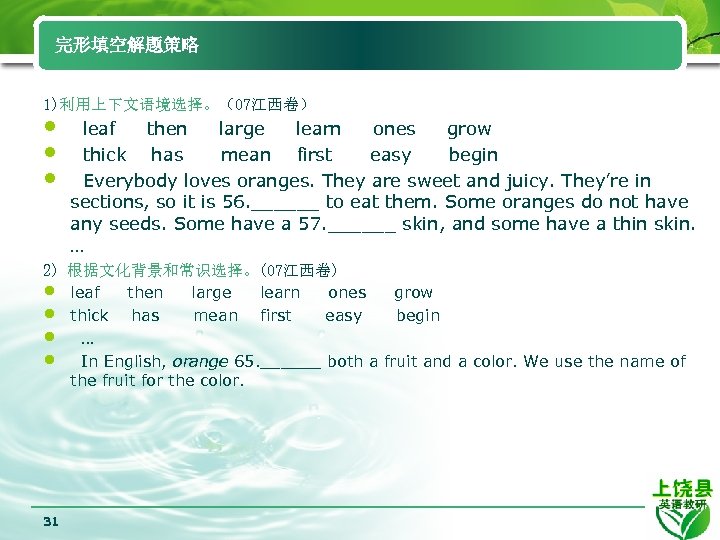
完形填空解题策略 1)利用上下文语境选择。(07江西卷) • • • leaf then large learn ones grow thick has mean first easy begin Everybody loves oranges. They are sweet and juicy. They’re in sections, so it is 56. ______ to eat them. Some oranges do not have any seeds. Some have a 57. ______ skin, and some have a thin skin. … 2) 根据文化背景和常识选择。(07江西卷) • leaf then large learn ones grow • thick has mean first easy begin • … • In English, orange 65. ______ both a fruit and a color. We use the name of the fruit for the color. 31
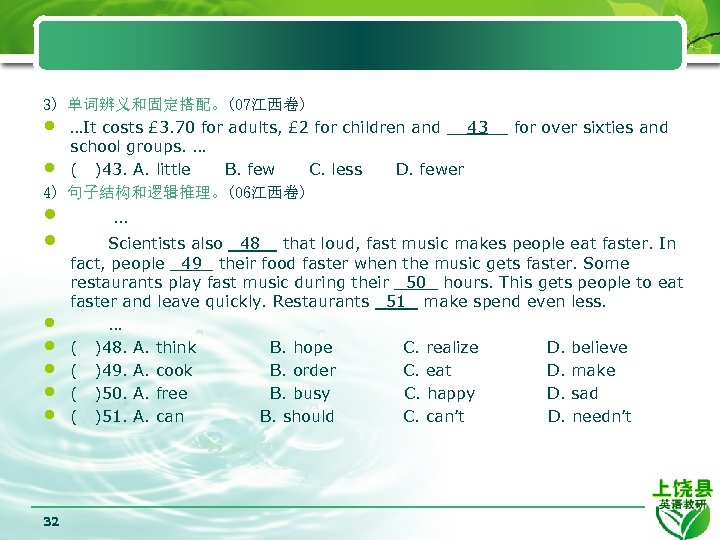
3) 单词辨义和固定搭配。(07江西卷) • …It costs £ 3. 70 for adults, £ 2 for children and __43__ for over sixties and school groups. … • ( )43. A. little B. few C. less D. fewer 4) 句子结构和逻辑推理。(06江西卷) • • 32 … Scientists also 48 that loud, fast music makes people eat faster. In fact, people 49 their food faster when the music gets faster. Some restaurants play fast music during their 50 hours. This gets people to eat faster and leave quickly. Restaurants 51 make spend even less. … ( )48. A. think B. hope C. realize D. believe ( )49. A. cook B. order C. eat D. make ( )50. A. free B. busy C. happy D. sad ( )51. A. can B. should C. can’t D. needn’t
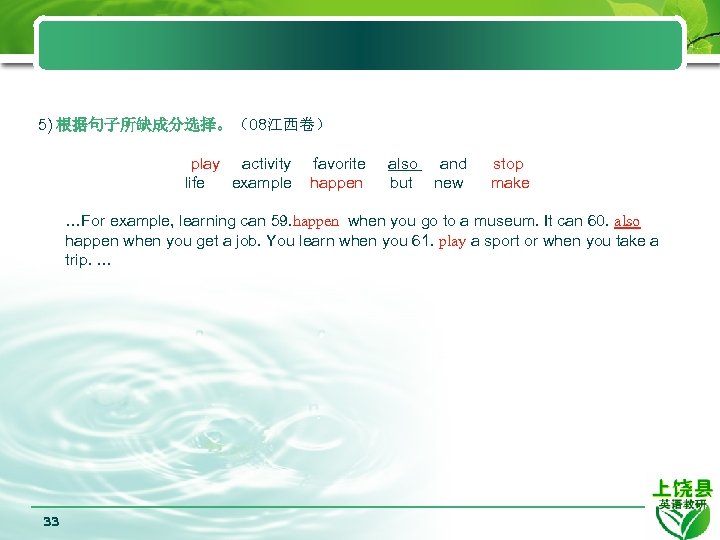
5) 根据句子所缺成分选择。(08江西卷) play activity life example favorite happen also but and new stop make …For example, learning can 59. happen when you go to a museum. It can 60. also happen when you get a job. You learn when you 61. play a sport or when you take a trip. … 33
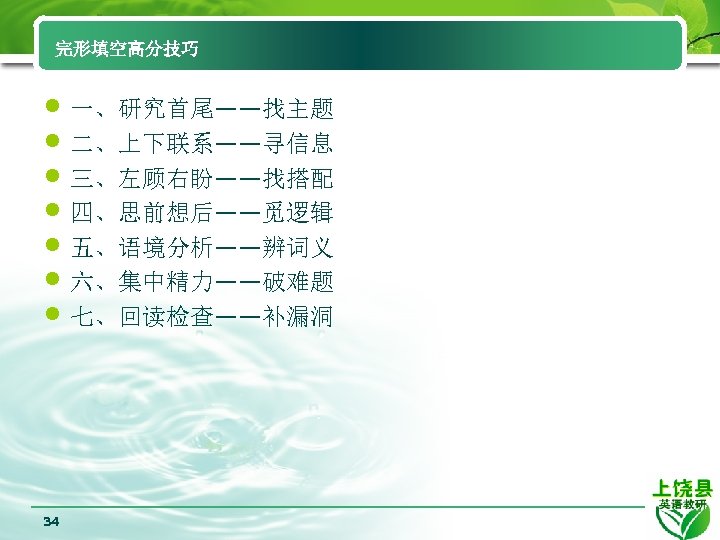
完形填空高分技巧 • 一、研究首尾——找主题 • 二、上下联系——寻信息 • 三、左顾右盼——找搭配 • 四、思前想后——觅逻辑 • 五、语境分析——辨词义 • 六、集中精力——破难题 • 七、回读检查——补漏洞 34
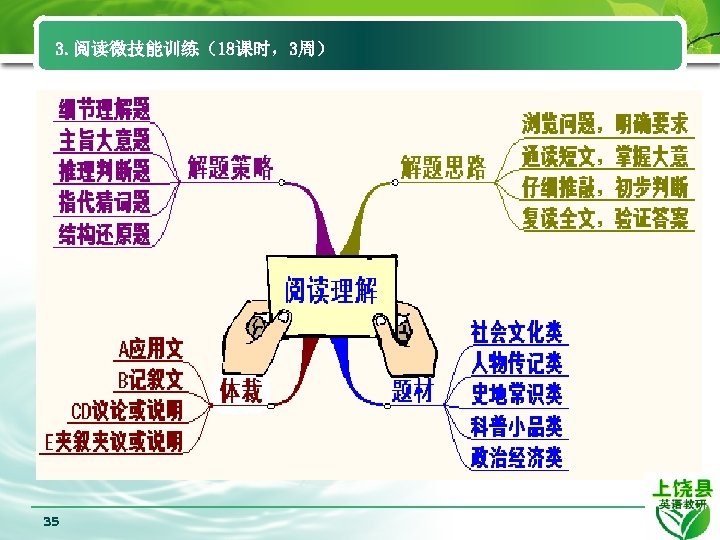
3. 阅读微技能训练(18课时,3周) 35
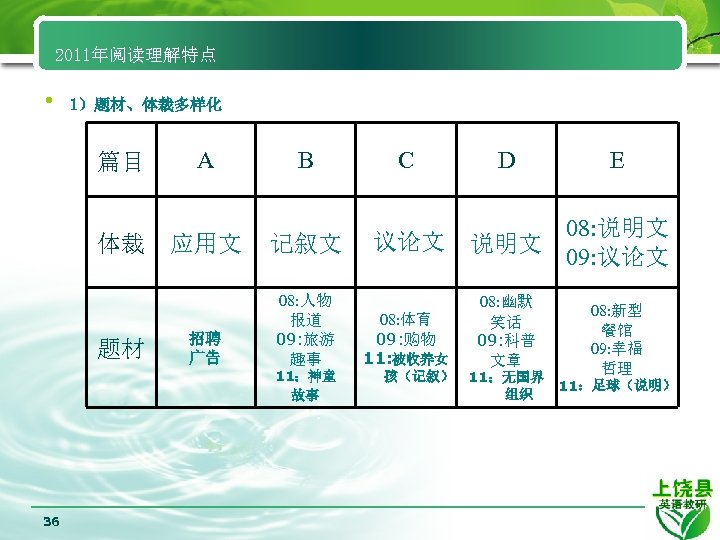
2011年阅读理解特点 • 1)题材、体裁多样化 篇目 体裁 题材 A B 应用文 记叙文 招聘 广告 08: 人物 报道 09: 旅游 趣事 11:神童 故事 36 C 议论文 08: 体育 09: 购物 11: 被收养女 D E 08: 说明文 09: 议论文 08: 幽默 笑话 09: 科普 文章 08: 新型 餐馆 09: 幸福 哲理 孩(记叙) 11:无国界 11:足球(说明) 组织
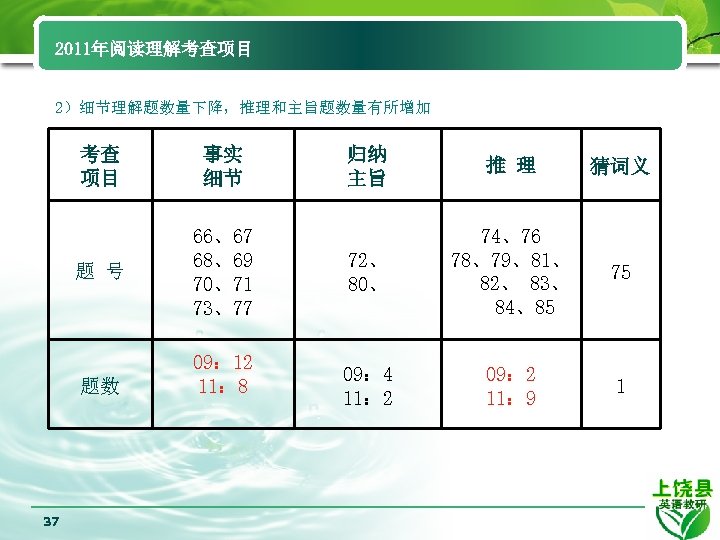
2011年阅读理解考查项目 2)细节理解题数量下降,推理和主旨题数量有所增加 考查 项目 事实 细节 题 号 66、67 68、69 70、71 73、77 题数 37 09: 12 11: 8 归纳 主旨 推 理 猜词义 72、 80、 74、76 78、79、81、 82、 83、 84、85 75 09: 4 11: 2 09: 2 11: 9 1
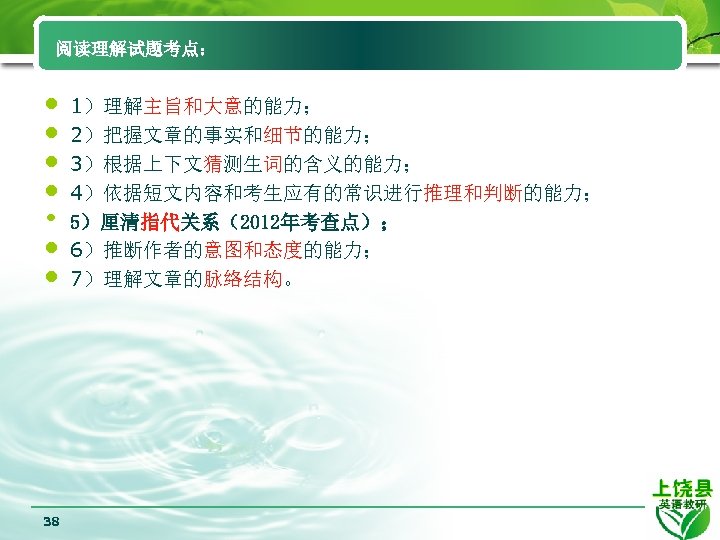
阅读理解试题考点: • • 38 1)理解主旨和大意的能力; 2)把握文章的事实和细节的能力; 3)根据上下文猜测生词的含义的能力; 4)依据短文内容和考生应有的常识进行推理和判断的能力; 5)厘清指代关系(2012年考查点); 6)推断作者的意图和态度的能力; 7)理解文章的脉络结构。
![1. 事实细节题: • [ 2011,江西阅读A原文省略] • 66. If you want to find a job](https://present5.com/presentation/5fe32aafddede0ce31cadf91842bea13/image-39.jpg "1. 事实细节题: • [ 2011,江西阅读A原文省略] • 66. If you want to find a job")
1. 事实细节题: • [ 2011,江西阅读A原文省略] • 66. If you want to find a job as a waiter, you can _______ to apply for it. • A. go to 6756 Main St. Southgate B. go to 224 West Rose Ave. Richmond • C. fax resume to 555 -0001 D. email resume: lewisnclark@dot. org • 67. If you do office work at Francisco’s Shoe Shop, you should _______. • A. be trained B. have experience • C. speak English D. know Spanish • 68. If you work as a guide, you can get ____ an hour. • A. $ 8 B. $ 10 C. $ 12 D. $ 13 • 答案分析: • 此 3小题均为事实细节题,较易找到正确答案,不再具体分析。 • 技巧点拨: • 事实细节题主要测试学生是否读懂了文章所描述的内容。这种题属于文章浅层理解。 学生应该仔细研读题干内容,找准文中相应的信息点,就很容易得出正确答案。 39
![2. 主旨大意题 • [ 2011,江西] • 72. Which would be the best title for](https://present5.com/presentation/5fe32aafddede0ce31cadf91842bea13/image-40.jpg "2. 主旨大意题 • [ 2011,江西] • 72. Which would be the best title for")
2. 主旨大意题 • [ 2011,江西] • 72. Which would be the best title for the passage? • A. Amazing Kids, Special Abilities B. How to Be a Good Student • C. Different People, Different Ideas D. How to Get Living Skills • 技巧点拨: • 这一类主旨大意题通常不能在文章中直接找到主题句,而要求学生在理解全文大意的基 础上,对短文做出总结或概括性的评价。该类题目要求学生不仅能确切把握文中的事实 和细节,而且更要透彻理解短文主旨,在阅读过程中概括文中所叙述的事实或提供的线 索来归纳总结文章主题。 • [ 2011,江西] • 80. What is the main idea of this passage? • A. Chris is a doctor who has organized programs to help people. • B. MSF received the Nobel Peace Prize for helping poor countries. • C. Volunteer doctors make a real difference to their own lives in MSF. • D. MSF offers medical help to people who have suffered from disasters. • 技巧点拨: • 做这一类主旨大意题时要注意去寻找文章中的主题句,文章的主题句往往在第一段或最 后一段,某一段的主题句也出现在段首或段尾,在做题时一定要注意语篇特点。 40
![3. 词义猜测题 • • • 41 [ 2011,江西阅读理解C篇节选] As she grew older, she accepted(接受)who](https://present5.com/presentation/5fe32aafddede0ce31cadf91842bea13/image-41.jpg "3. 词义猜测题 • • • 41 [ 2011,江西阅读理解C篇节选] As she grew older, she accepted(接受)who")
3. 词义猜测题 • • • 41 [ 2011,江西阅读理解C篇节选] As she grew older, she accepted(接受)who she was. Still, she wanted to find the missing piece of the puzzle (困惑). After finding out the place of her birthparents, Ida went to Korea in 2008. When she first arrived, she was surprised to see so many people who looked like her. However, apart from her looks, not much could be shared(分享)with others. She knew little about the culture, food, especially the language. Being in Korea wasn’t always easy for her. 75. What does the phrase “apart from” in Paragraph 3 mean? A. except B. as for C. as well as D. besides 答案分析:本题是词义猜测题。根据However…not much. could be shared with others. 这句子可知apart from是“除了…之外”之意,所以选A 技巧点拨: 词义猜测题主要考查学生对所读材料中单词或短语的含义的理解。在阅读过程中根据选材、背 景及上下文等线索推测出生词词义也是真实语言活动中的一项重要技巧。 1)定义法 一般通过定义、定语从句、同位语短语或同位语从句等来确定词义。 2)对比法 寻找文中相互对比、相互对照的线索来确定单词意义。在这类文章中通常会出现一些意 义转折的词语,如:however, but, on the other hand, on the contrary, instead of, while等,读者可以分析这些信息,从而推测出生词的正确含义。 3)语境线索法 在出现生词的文中,有时需要根据上下文中某些关键的单词或短语,推断出生词的 含义,也应注意分析前后间的逻辑关系,是递进、转折还是并列。
![4. 推理判断题 • • • 42 [ 2010,江西阅读理解B篇节选] In 1975, Junko Tabei became the](https://present5.com/presentation/5fe32aafddede0ce31cadf91842bea13/image-42.jpg "4. 推理判断题 • • • 42 [ 2010,江西阅读理解B篇节选] In 1975, Junko Tabei became the")
4. 推理判断题 • • • 42 [ 2010,江西阅读理解B篇节选] In 1975, Junko Tabei became the first woman to reach the top of Mount Everest in the Himalaya Mountains, the highest mountain in the world at 29, 035 feet. After Junko graduated from university in 1962, she joined several climbing clubs. But they had mostly men members…. Meanwhile Junko started a woman’s climbing club. By 1972, she was chosen to lead a team of women to climb Mount Everest. It took three years for the 15 women to train and raise money for their climb. Finally in 1975, the team went to climb the mountain. They found nine guides to help them climb up the mountain. Everything went well until the morning of May 4. Suddenly a huge amount of snow and ice fell on them. One guide saved Junko. She rushed to help others. Everyone was alive but they had injuries, including Junko. However, the team decided to continue their climb. About two weeks later, on May 16, Junko reached the top of Mount Everest. Later she said, “I can’t understand why men make all his fuss (过于关注)about Everest – it’s only a mountain. 72. What does the author mainly want to tell us? A. Junko was the greatest climber in the world B. Women can do the same things as men C. Mountain climbing is dangerous D. Junko had a very hard time before she succeeded 答案分析:本题是推理判断题。根据文章的最后一句话和文意可知应选B. 技巧点拨: 推理判断题主要考查学生对文章思维言外之意的理解,但并不能主观臆断,凭空想象,更不能以自己 的观点代替作者的观点,而要忠于原文,以文章所提供的事实和线索为依据进行推理。要注意把握句 段之间的逻辑关系,了解语篇结构,体会文章的基调,悟出作者的弦外之音。
![5. 结构还原题 • • • • 43 请先阅读下面短文,掌握其大意,然后根据短文内容从下面方框内的七个选项中,选择五个还原到文中,使短文 意思通顺、结构完整,并在答题卷上将其序号涂黑。(每小题 2分) [ 2011,江西] 81. _________](https://present5.com/presentation/5fe32aafddede0ce31cadf91842bea13/image-43.jpg "5. 结构还原题 • • • • 43 请先阅读下面短文,掌握其大意,然后根据短文内容从下面方框内的七个选项中,选择五个还原到文中,使短文 意思通顺、结构完整,并在答题卷上将其序号涂黑。(每小题 2分) [ 2011,江西] 81. _________")
5. 结构还原题 • • • • 43 请先阅读下面短文,掌握其大意,然后根据短文内容从下面方框内的七个选项中,选择五个还原到文中,使短文 意思通顺、结构完整,并在答题卷上将其序号涂黑。(每小题 2分) [ 2011,江西] 81. _________ It has around 3 billion fans—nearly half the world’s population! And about 300 million people play this game. That’s 4 percent of the world’s population! 82. _________ Many people in old days played early forms(形式)of this modern game. Cu ju (蹴踘), a ball-kicking game in China, was reported as early as 2, 500 B. C. Around the same time in Greece, people were also playing a similar ball game without using their hands. But modern soccer didn’t become official (官方的) until 1863. An Englishman called Cobb Morley introduced the idea of a football association(联盟). 83. _________ From then on, other associations in countries were set up. They came together to make up the FIFA, which organizes the World Cup. It’s not easy to tell what makes soccer so popular. 84. _________ Soccer needs only two feet and a ball. This makes it a sport that developing countries can easily play. Some of the sport’s best players come from these poor nations. 85. _________ The sport’s no-hands rule makes beautiful dance-like movements on the field. What’s more, this sport excites the heart. Teams might score only a few times each match, so matches can turn around suddenly. No one knows who will win at the next World Cup. But one thing is certain: The world will be watching. A. He also wrote the sport’s official rules. B. Soccer is the world’s favorite sport. C. Playing soccer is good for your health. D. But one reason is how simple the sport is. E. People love soccer as well as their countries. F. It’s hard to say where soccer’s birthplace is. G. Soccer performances are pleasing to the eyes. 答案分析: 81、82小题均在所在自然段的句首,根据英语文章行文方式,可初定为本自然段的主题句,分别选B 与F,83小题与上一句关系密切,应选A,84小题与其所在位置的下一句逻辑关系完全符合,故选D,85小题与 下一句意义吻合,选G。 技巧点拨: 这种选择适当的句子还原到短文中的题目主要考查学生通篇理解全文、使上下句之间连贯通顺的能力。在解答时 首先要去寻找选项与原文是否有意思一样或连贯的词;如果空格在段首或段尾时,所填入的句子有可能是该段的 中心句。
第三轮:全真模拟,查漏补缺,调整心态,提高中考应试技能。 • • 时间安排: 6月4日-6月16日中考前 (9课时,1. 5周) 复习目的:适应中考要求 复习重点:临场应变能力和应考的心理素质的培养 复习资料: 针对本班学生易错题的拼题及中考样卷 复习方法: 1. 教师对学生强调答题注意事项,避免常规失分。基础知识回扣、疑 难解析、考前应试心理科学训练等, 确保学生以最佳的精神状态来迎接中考 。 2. 模拟训练课教学结构:导--练 3. 试题讲评课教学结构:自主纠正—合作探究—巩固练习 每个学生用导图分类整理出自己易错题导图,然后有针对性地复习巩固 视频:永不放弃 44
第二个HUA,话题,即复习主线 整合话题,围绕主线,让中考复习回归课文,人人全能有发展。 • • • 45 采用话题复习法。根据教材中出现的话题,围绕话题进行口头和书面 表达。针对每一个话题,教师可以概括基本的句型,让学生熟记;教 师还可以帮助学生列出从哪几个方面来谈论该话题。 以第一轮中的第一讲复习Book 8 Unit 9为例,说明如何进行话题课 文复习。 第一讲 Talk about people(4课时) 1. 谈论人现在的状态(Book 7 A Unit 1, 3, 8 Book 7 B Unit 1, 4, 7) 2. 谈论人过去的状态(Book 8 A Unit 9; Book 9 Unit 2, 13)
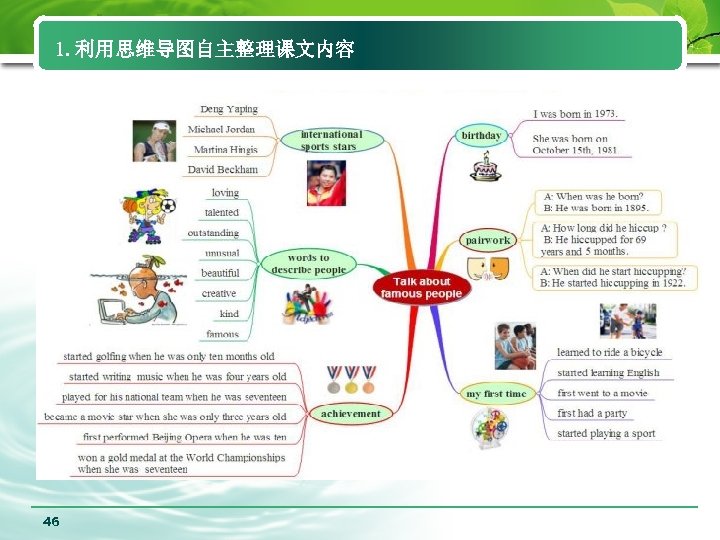
1. 利用思维导图自主整理课文内容 46
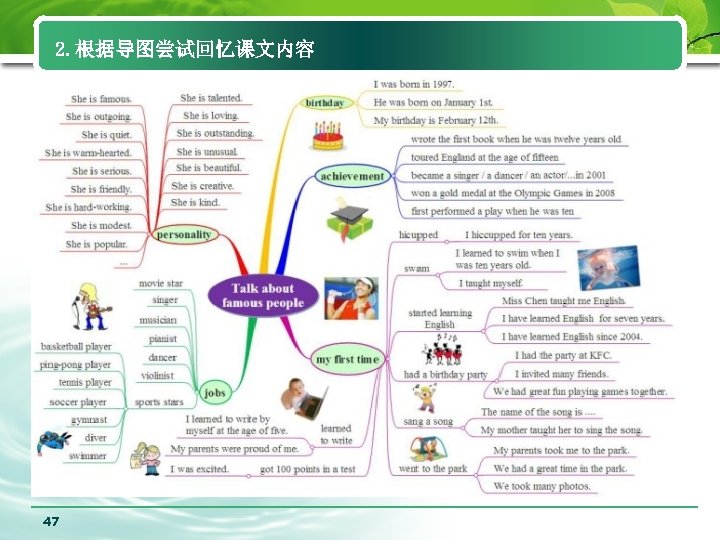
2. 根据导图尝试回忆课文内容 47
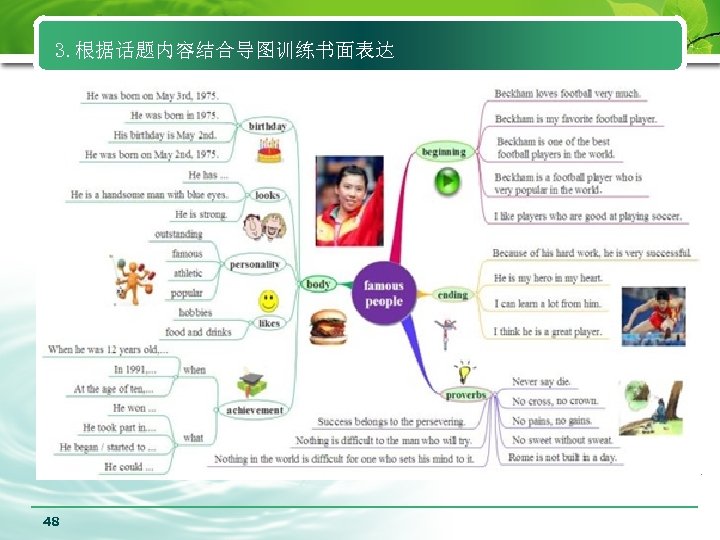
3. 根据话题内容结合导图训练书面表达 48
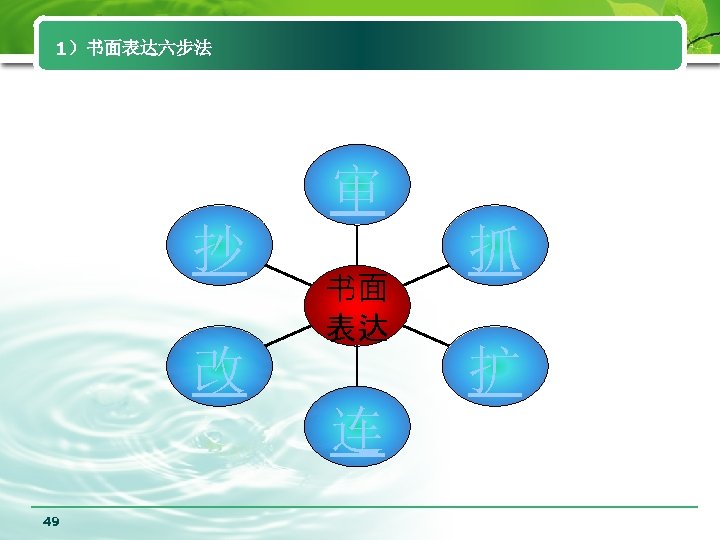
1)书面表达六步法 审 抄 改 书面 表达 连 49 抓 扩
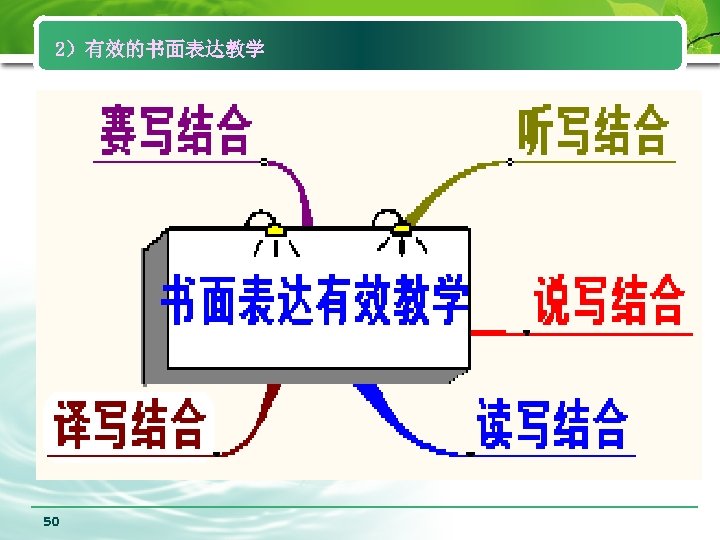
2)有效的书面表达教学 50
3)书面表达批改的有效策略 小组合作互批法 先组建 4人互批小组,按1优 2中 1差的层次合理搭配,每两周进行 一次课内互批。 具体流程: 写作前热身 5分钟(师生共同讨论确定作文的体裁、题材、纲要、 主要时态和主要人称)——写作 15分钟——批改 20分钟——点评5分钟。 学生在批改之前,教师先给出评分标准,满分15分。 51
第三个HUA, 画图,即复习方法 画思维图,练微技能,让中考复习高效有趣,师生齐心出硕果。 • • • 52 “授人以鱼, 不如授人以渔”—中国古训 It is far better to teach fishing skills than to give the fish. — Chinese proverb 故事:一个小孩,有人会叫他神童,但有人却说他自作聪明。一天,小孩 来到河边,看到一个老翁在细柳下垂钓,在老翁的鱼箩里已经是满满的一 箩,小孩很是喜欢,老翁看见小孩也很喜爱,决定将这箩鱼送给小孩,可 是让我们想不到的是:小孩不要这箩鱼,那么你知道小孩对老翁说了什么 吗?他对老翁说:“把你的鱼竿送我吧!”.
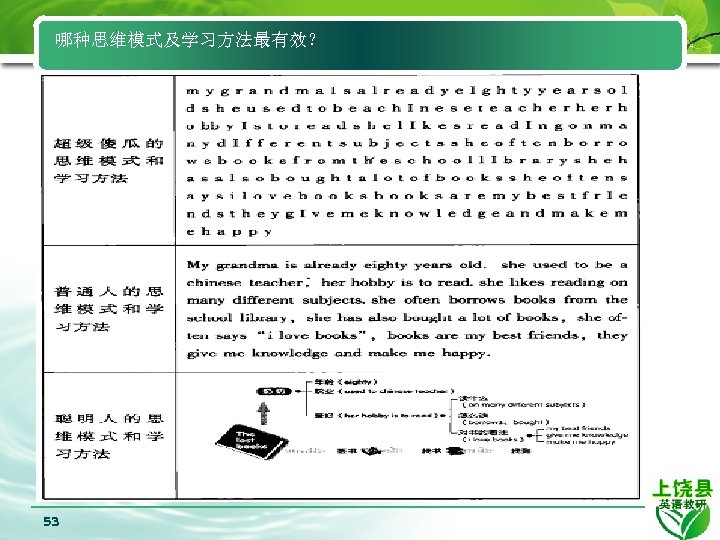
哪种思维模式及学习方法最有效? 53
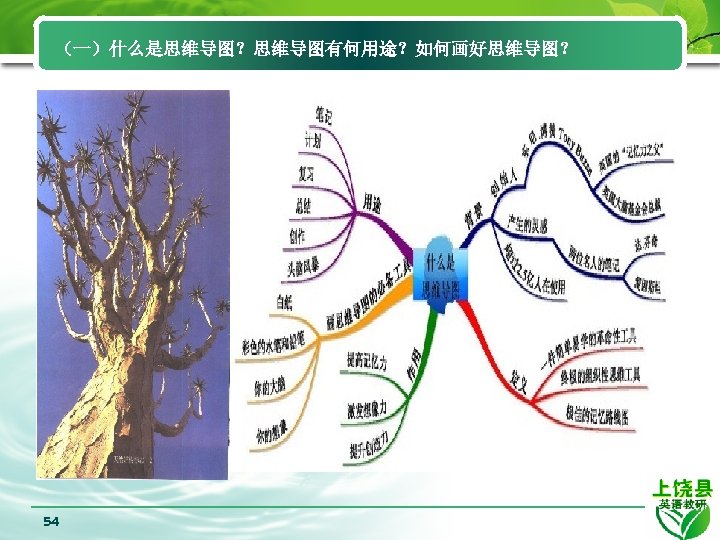
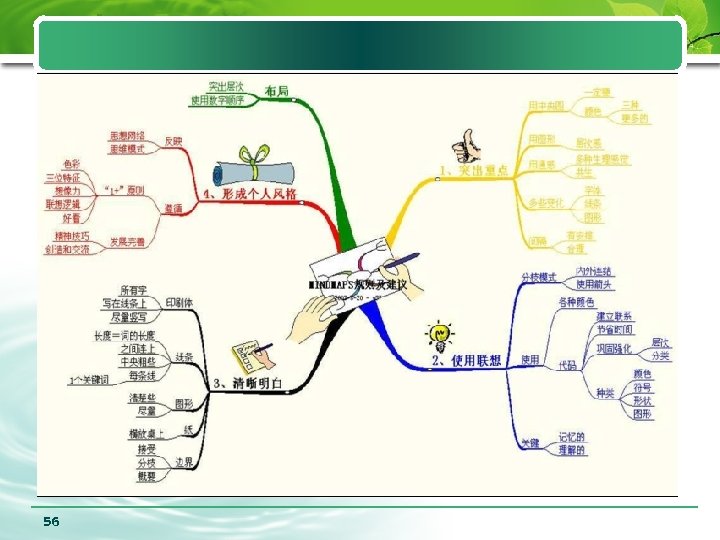
(一)什么是思维导图?思维导图有何用途?如何画好思维导图? 54
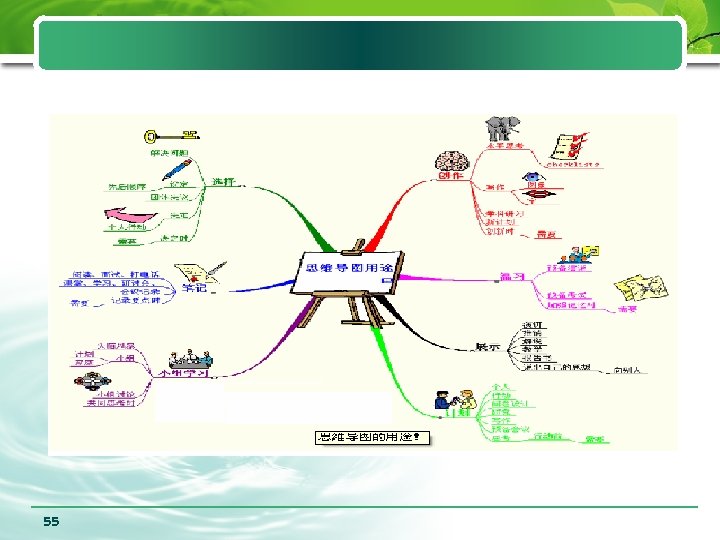
55
56
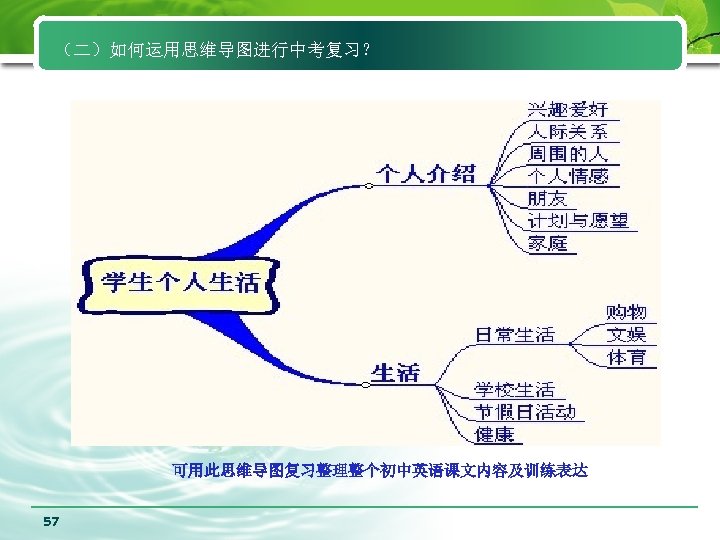
(二)如何运用思维导图进行中考复习? 可用此思维导图复习整理整个初中英语课文内容及训练表达 57
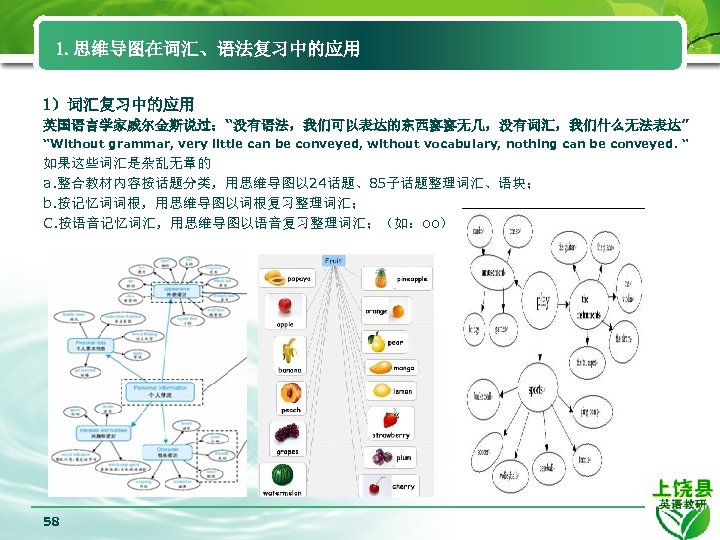
1. 思维导图在词汇、语法复习中的应用 1)词汇复习中的应用 英国语言学家威尔金斯说过:“没有语法,我们可以表达的东西寥寥无几,没有词汇,我们什么无法表达” “Without grammar, very little can be conveyed, without vocabulary, nothing can be conveyed. “ 如果这些词汇是杂乱无章的 a. 整合教材内容按话题分类,用思维导图以 24话题、85子话题整理词汇、语块; b. 按记忆词词根,用思维导图以词根复习整理词汇; C. 按语音记忆词汇,用思维导图以语音复习整理词汇;(如:oo) 58
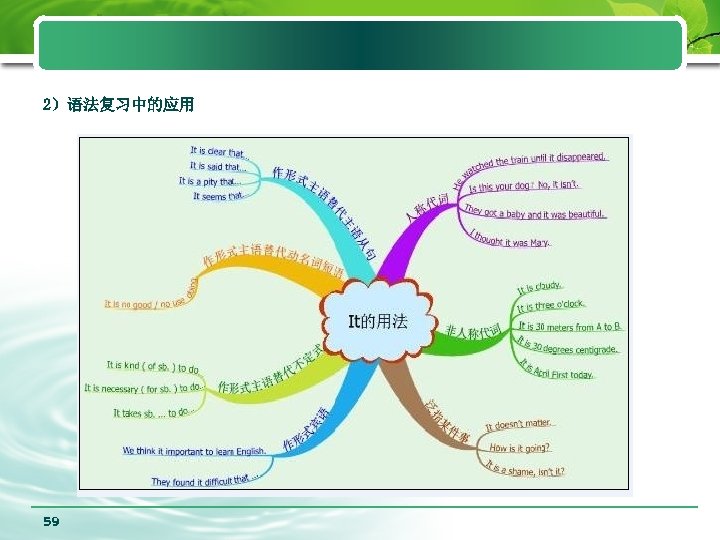
2)语法复习中的应用 59
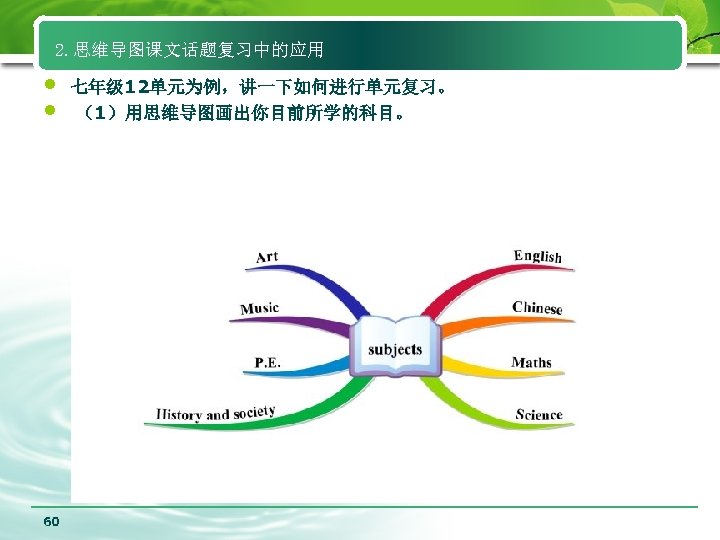
2. 思维导图课文话题复习中的应用 • • 60 七年级 12单元为例,讲一下如何进行单元复习。 (1)用思维导图画出你目前所学的科目。
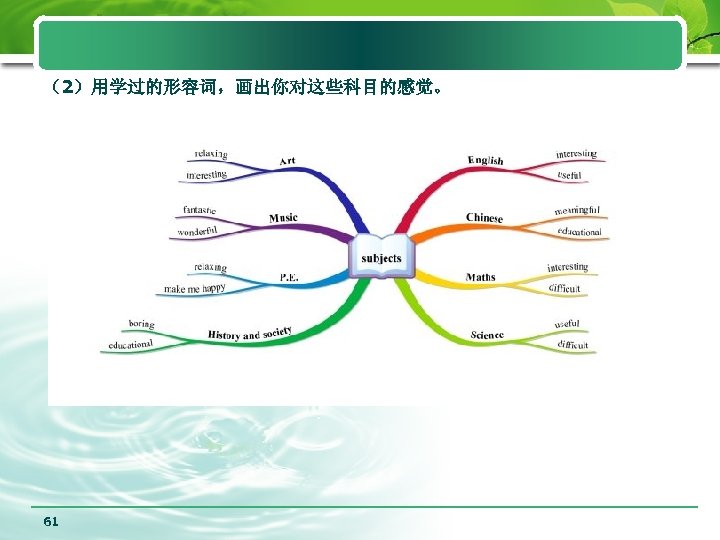
(2)用学过的形容词,画出你对这些科目的感觉。 61
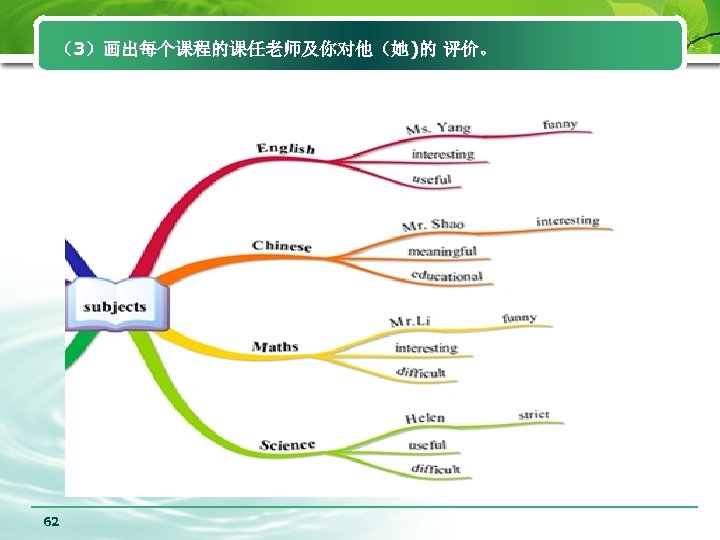
(3)画出每个课程的课任老师及你对他(她)的 评价。 62
(4)根据以上思维导图,用what, why, who, 小组合作一段谈论科目喜好的 对话。 • • • A:What subject do you like best? B: I like English best. A: Why do you like it? B: Because it's interesting and useful. A: Who teaches you English? B: Ms. Yang. She is very funny. (5)将学校课程表翻译成英语。(略) • 根据课程表,用when编辑一段谈论科目所在星期的对话。 • A:When do you have English? • B: We have English on Mondy, Tuesday, Thursday and Friday. 63
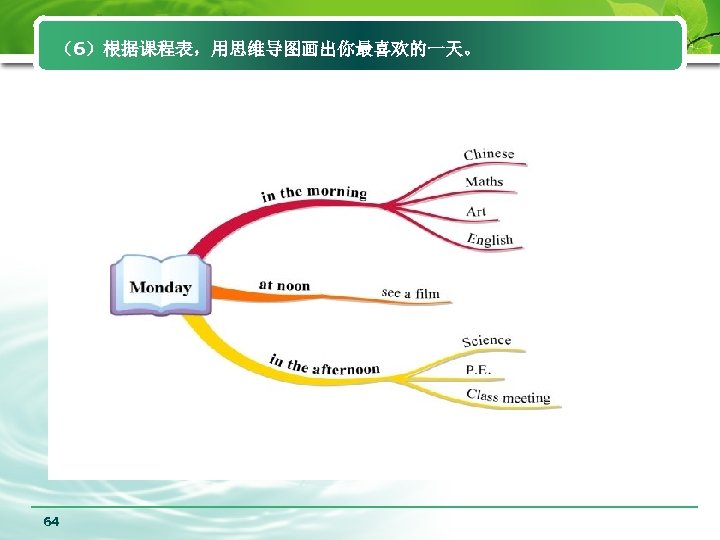
(6)根据课程表,用思维导图画出你最喜欢的一天。 64
• • • 65 (7)根据思维导图与思维导图册里的作文框架,写一篇短文:My favourite day. (8)请自我评价以上的每一个步骤,用ABC三个等级评价,写一段话总结你 画这个单元的体会。 经过八个步骤,学生以话题为中心,将整个单元重点内容做了整理。也体验了 如何用思维导图进行复习与整理,建议学生自己用彩笔画,效果更好。
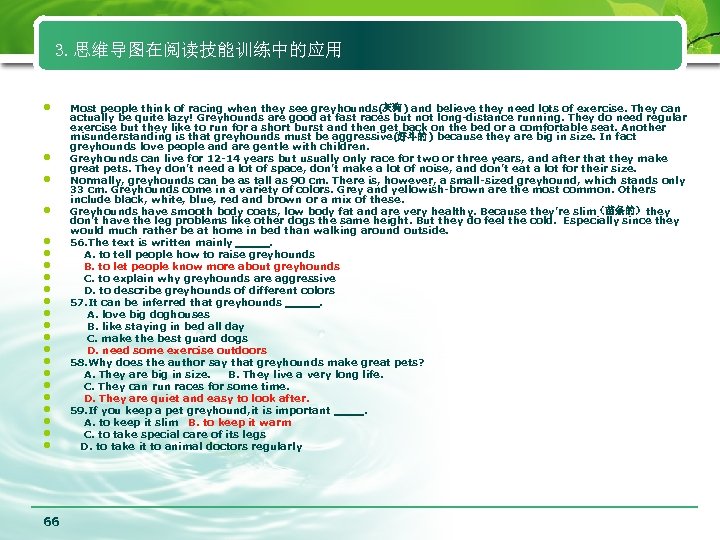
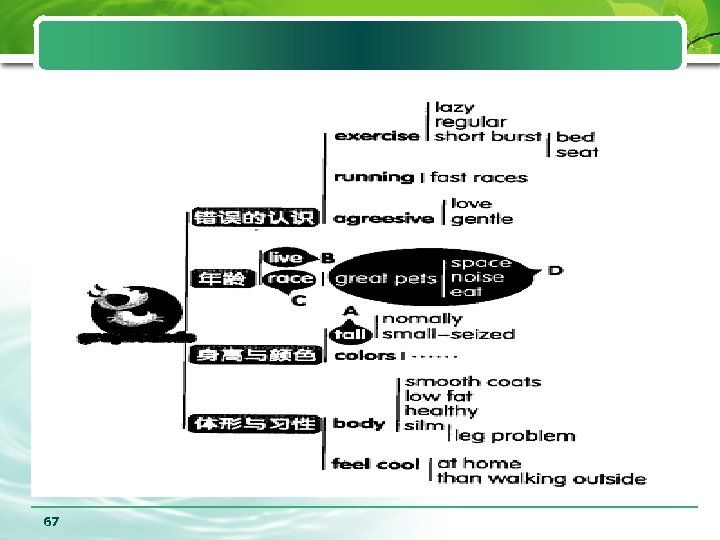
3. 思维导图在阅读技能训练中的应用 • • • • • • 66 Most people think of racing when they see greyhounds(灰狗) and believe they need lots of exercise. They can actually be quite lazy! Greyhounds are good at fast races but not long-distance running. They do need regular exercise but they like to run for a short burst and then get back on the bed or a comfortable seat. Another misunderstanding is that greyhounds must be aggressive(好斗的) because they are big in size. In fact greyhounds love people and are gentle with children. Greyhounds can live for 12 -14 years but usually only race for two or three years, and after that they make great pets. They don’t need a lot of space, don’t make a lot of noise, and don’t eat a lot for their size. Normally, greyhounds can be as tall as 90 cm. There is, however, a small-sized greyhound, which stands only 33 cm. Greyhounds come in a variety of colors. Grey and yellowish-brown are the most common. Others include black, white, blue, red and brown or a mix of these. Greyhounds have smooth body coats, low body fat and are very healthy. Because they’re slim(苗条的)they don’t have the leg problems like other dogs the same height. But they do feel the cold. Especially since they would much rather be at home in bed than walking around outside. 56. The text is written mainly . A. to tell people how to raise greyhounds B. to let people know more about greyhounds C. to explain why greyhounds are aggressive D. to describe greyhounds of different colors 57. It can be inferred that greyhounds . A. love big doghouses B. like staying in bed all day C. make the best guard dogs D. need some exercise outdoors 58. Why does the author say that greyhounds make great pets? A. They are big in size. B. They live a very long life. C. They can run races for some time. D. They are quiet and easy to look after. 59. If you keep a pet greyhound, it is important . A. to keep it slim B. to keep it warm C. to take special care of its legs D. to take it to animal doctors regularly
67
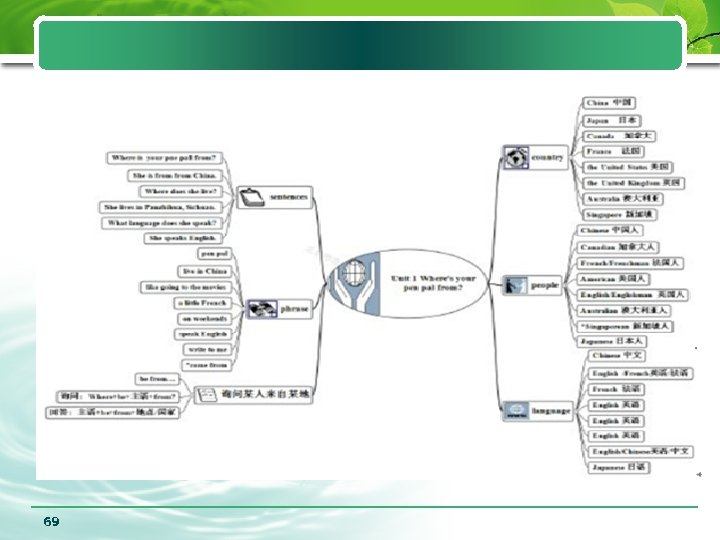
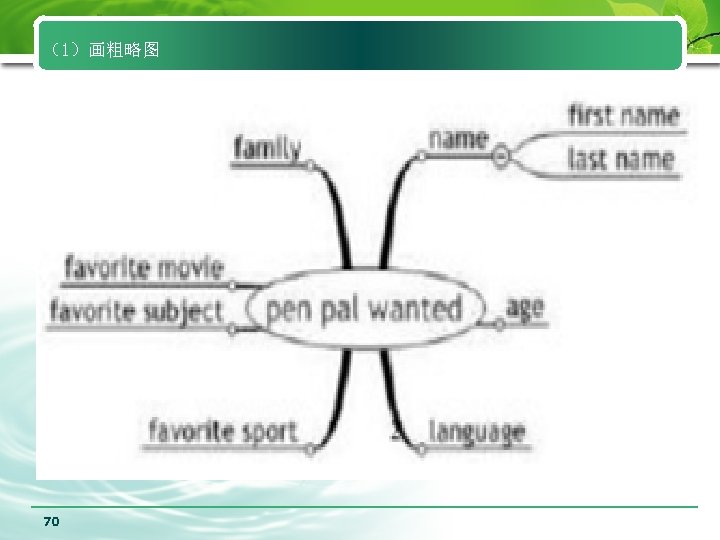
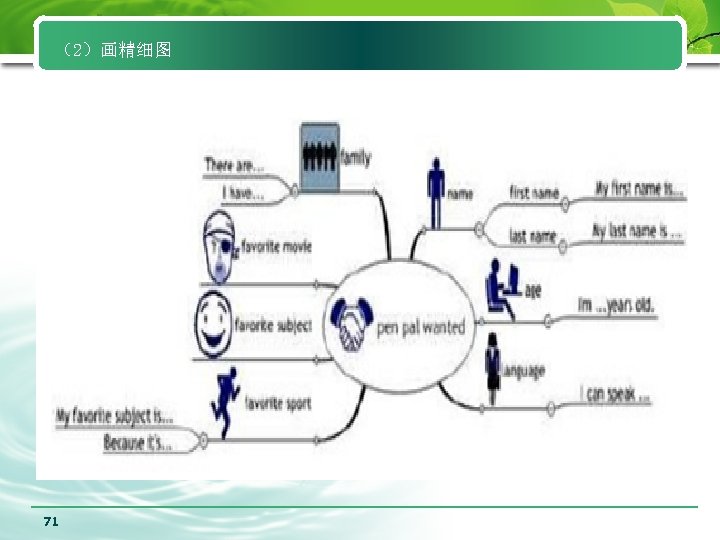
4. 思维导图在书面表达训练中的应用 • • 68 孩子们通常看到题目,不知道从何下笔,不会依照作文要求在草稿纸上 迅速搭建写作框架(列提纲),也没有这个习惯。其原因是在课堂上老 师虽然很关注作文课堂教学中的框架搭建引领,但却没有搭建足够的平 台让学生把这一技能加以内化。而思维导图的特性之一就是它可以成为 学生思考的线路图。 首先我们要想想学生写作时需考虑哪些方面的因素? (1)本话题所需要的词块、语块。 (2)本话题的写作模板结构等。 (3)本话题所涉及到的经典名句、谚语等。 思维导图英语作文写作的思考流程: 看到题目----考虑写什么(挑选关键词,搭建作文框架)------根据话题和作 文框架在思维导图里寻找所需要的语料(词块和语块)------记熟词块、语块、 作文框架(能画出自己的作文思维导图)------根据框架中的关键词说作文( 可以是相互对话、也可以是相互说自己的作文),说熟了才能写的顺手-----根据自己的思维导图写作文、修改润色作文------根据思维导图迁移同类作文, 依然是先说,再写。
69
(1)画粗略图 70
(2)画精细图 71
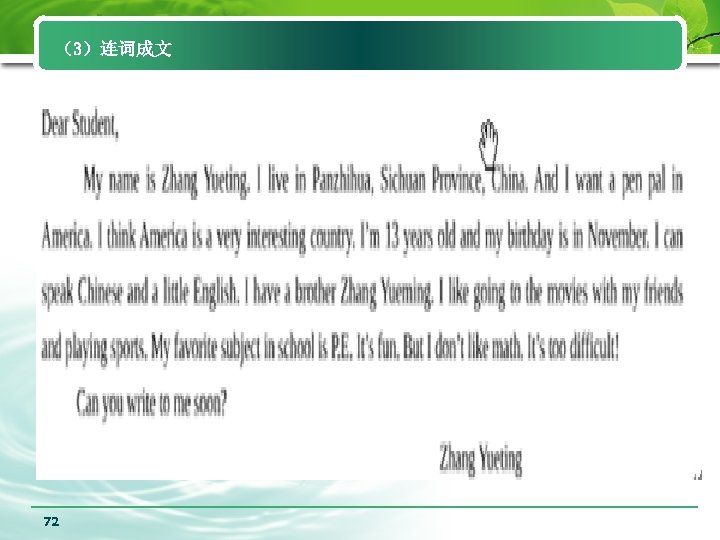
(3)连词成文 72
(三)学生如何运用思维导图进行复习 • • • 73 借助思维导图辅助学生的自主学习力培养 1、课前,你可以将思维导图用作预习的 具。学生可以分以下步骤预 习: (1)借助英语的思维导图说中文,检测自己的原有知识体系。 (2)看着中文思维导图说英语、听写英语、并自批自改。 (3)看着英语的思维导图自问、自答,练习口语。 2、课中:你可以将思维导图用作课内教具,组织学生合作学习。 (1)借助思维导图与同桌练习对话、与小组合作完成对话。 (2)借助思维导图训练英语写作的框架搭建、词块和语块的收集与整理。 3、课后:你可以将思维导图用作复习的 具,引导学生学会整理、扩 展所学知识。 (1)借助思维导图,学生可以进行再创造,用彩笔画个性化的、图文 并茂的思维导图手抄报。 (2)借助思维导图,学生可以进行循环听写、自主整理、扩展写作等。
• • • 74 记忆要达到有效,就要不断地循环,所以你一定要照着我们的循环记忆 法,反复的复习: 1、周末利用导图进行下周要教的新单元的首次预习。 2、课前利用导图,对老师要教的内容进行二次预习。 3、课中利用导图与同学一起进行口语操练。 4、口语操练熟了,然后利用导图进行作文写作训练。 5、课后利用导图做复习、整理、扩展,你可以修改书里的导图,添加 更好的内容,你也可以画属于你自己的英语话题思维导图。 6、期中利用导图做二次复习,最好是能亲手画出每个单元的重点学习 内容。 7、大考的时候你可以利用导图做再次的复习、归纳。 (7次循环使用导图,正好符合艾宾诺斯遗忘曲线)
本讲座我了解了什么?还关心什么? • 关键词:计划、话题、画图 • 次关键词:微技能训练课时化、自主学习学案式 • 两个改变: • 由先讲后练改为先练后讲(学习方式变化,复习课堂生动) • 由以左脑为主的线性思维改为右脑为主的发散性图式思维 (思维方式变化,复习效率提高) 对 2012年中考英语的期待: 1. 在保持2011年中考难度的基础上再易一点,师生尽欢颜; 2. 对应新课标,加强语篇中对祖国及本区域优秀文化的内容渗 透。 3. 对应新方法,将运用思维导图教学思想渗透在读写考查中。 75

HUA是什么? 推荐看印度喜剧电影《三傻大闹宝来坞》 76

对本讲座中所使用到的书籍、教辅及网络中的相关资料作者在此一并表示感谢! Thank you
Скачать презентацию HUA 出好成绩 上饶县教研室 王建华 2012 -03 -16 Do
5fe32aafddede0ce31cadf91842bea13.ppt