




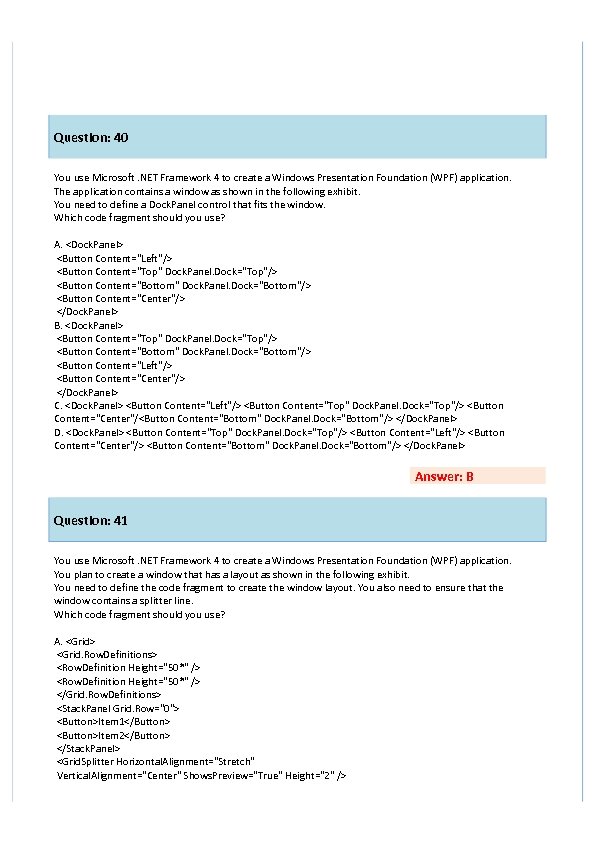
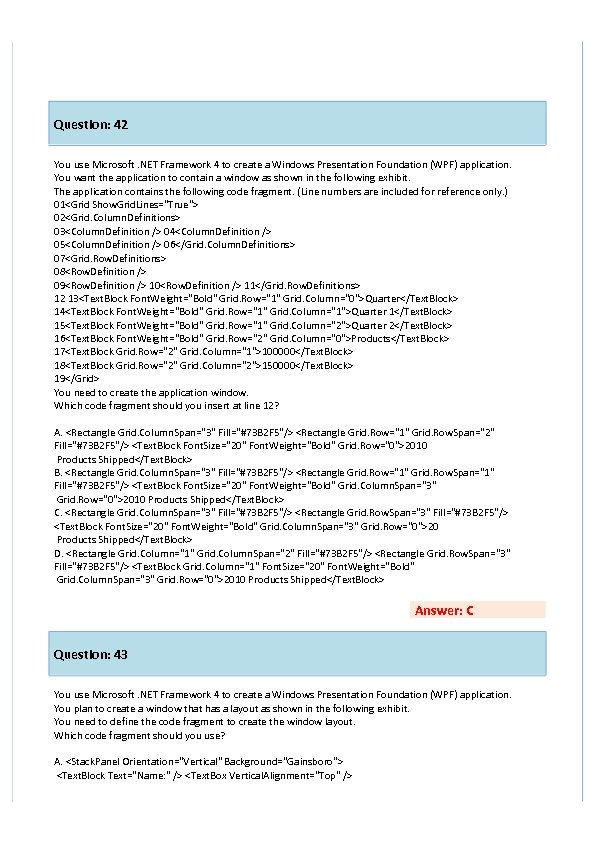
Cancel You need to ensure that the Button." src="https://present5.com/presentation/c98679d8abeb21d557c6306574778d41/image-11.jpg" alt=" You need to ensure that the Button." />
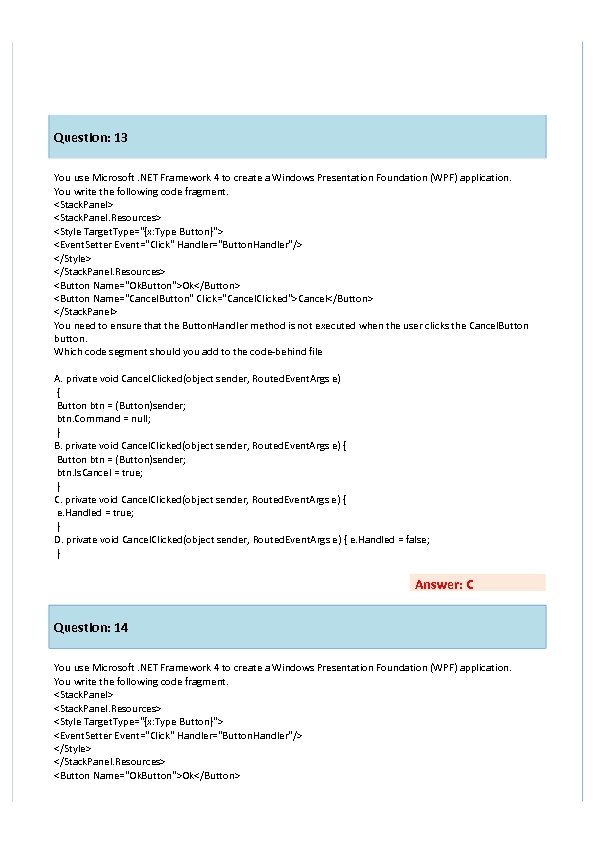
You need to ensure that the Button. Handler method is not executed when the user clicks the Cancel. Button button. Which code segment should you add to the code-behind file A. Private Sub Cancel. Clicked(sender As Object, e As Routed. Event. Args) Dim btn As Button = Direct. Cast(sender, Button) btn. Command = Nothing End Sub B. Private Sub Cancel. Clicked(sender As Object, e As Routed. Event. Args) Dim btn As Button = Direct. Cast(sender, Button) btn. Is. Cancel = True End Sub C. Private Sub Cancel. Clicked(sender As Object, e As Routed. Event. Args) e. Handled = True End Sub D. Private Sub Cancel. Clicked(sender As Object, e As Routed. Event. Args) e. Handled = False End Sub Answer: C Question: 15 You use Microsoft Visual Studio 2010 and Microsoft. NET Framework 4 to create a Windows Presentation Foundation (WPF) application. You create a WPF window in the application. You add the following code segment to the application. public class View. Model { public Collection. View Data { get; set; } } public class Business. Object { public string Name { get; set; } } The Data. Context property of the window is set to an instance of the View. Model class. The Data property of the View. Model instance is initialized with a collection of Business. Object objects. You add a Text. Box control to the Window. You need to bind the Text property of the Text. Box control to the Name property of the current item of the Collection. View of the Data. Context object. You also need to ensure that when a binding error occurs, the Text property of the Text. Box control is set to N/A. Which binding expression should you use A. { Binding Path=Data/Name, Fallback. Value='N/A' } B. { Binding Path=Data. Name, Fallback. Value='N/A' } C. { Binding Path=Data/Name, Target. Null. Value='N/A' } D. { Binding Path=Data. Name, Target. Null. Value='N/A' } Answer: A
Question: 16 You use Microsoft Visual Studio 2010 and Microsoft. NET Framework 4 to create a Windows Presentation Foundation (WPF) application. You create a WPF window in the application. You add the following code segment to the application. Public Class View. Model Public Property Data() As Collection. View Get End Get Set End Property End Class Public Class Business. Object Public Property Name() As String Get End Get Set End Property End Class The Data. Context property of the window is set to an instance of the View. Model class. The Data property of the View. Model instance is initialized with a collection of Business. Object objects. You add a Text. Box control to the window. You need to bind the Text property of the Text. Box control to the Name property of the current item of the Collection. View of the Data. Context object. You also need to ensure that when a binding error occurs, the Text property of the Text. Box control is set to N/A. Which binding expression should you use A. { Binding Path=Data/Name, Fallback. Value='N/A' } B. { Binding Path=Data. Name, Fallback. Value='N/A' } C. { Binding Path=Data/Name, Target. Null. Value='N/A' } D. { Binding Path=Data. Name, Target. Null. Value='N/A' } Answer: A Question: 17 You use Microsoft. NET Framework 4 to create a Windows Forms application. You add a new class named Customer to the application. You select the Customer class to create a new object data source. You add the following components to a Windows Form: "A Binding. Source component named customer. Binding. Source that is data-bound to the Customer object data source.
"A set of Text. Box controls to display and edit the Customer object properties. Each Text. Box control is databound to a property of the customer. Binding. Source component. "An Error. Provider component named error. Provider that validates the input values for each Text. Box control. You need to ensure that the input data for each Text. Box control is automatically validated by using the Error. Provider component. Which two actions should you perform (Each correct answer presents part of the solution. Choose two. ) A. Implement the validation rules inside the Validating event handler of each Text. Box control by throwing an exception when the value is invalid. B. Implement the validation rules inside the Text. Changed event handler of each Text. Box control by throwing an exception when the value is invalid. C. Implement the validation rules inside the setter of each property of the Customer class by throwing an exception when the value is invalid. D. Add the following code segment to the Initialize. Component method of the Windows Form. this. error. Provider. Data. Source = this. customer. Binding. Source; E. Add the following code segment to the Initialize. Component method of the Windows Form. this. error. Provider. Data. Source = this. customer. Binding. Source. Data. Source; this. error. Provider. Data. Member = this. customer. Binding. Source. Data. Member; Answer: C D Question: 18 You use Microsoft. NET Framework 4 to create a Windows Presentation Foundation (WPF) application. You write the following code segment. (Line numbers are included for reference only. ) 01 public class Contact 02{ 03 private string _contact. Name; 04 05 public string Contact. Name { 06 get { return _contact. Name; } 07 set { _contact. Name = value; } 08} 09 10} You add the following code fragment within a WPF window control.
You also need to ensure that the Text. Box control validates the input dat a. Which two actions should you perform (Each correct answer presents part of the solution. Choose two). A. Replace line 01 with the following code segment. public class Contact : IData. Error. Info B. Replace line 01 with the following code segment. public class Contact : Validation. Rule C. Replace line 01 with the following code segment. public class Contact : INotify. Property. Changing D. Add the following code segment at line 04. public event Property. Changing. Event. Handler Property. Changing; E. Modify line 07 with the following code segment: set { if (this. Property. Changing != null) Property. Changing(this, new Property. Changing. Event. Args("Contact. Name")); if (string. Is. Null. Or. Empty(value)) throw new Application. Exception("Contact name is required"); _contact. Name = value; } F. Add the following code segment at line 09. public string Error { public string this[string column. Name] { get { if (column. Name == "Contact. Name" && string. Is. Null. Or. Empty(this. Contact. Name)) return "Contact name is required"; return null; } } Answer: A E Question: 19 You use Microsoft. NET Framework 4 to create a Windows Presentation Foundation (WPF) application. You write the following code segment. (Line numbers are included for reference only. ) 01 Public Class Contact 02 Private _contact. Name As String 03 04 Public Property Contact. Name() As String 05 Get 06 Return _contact. Name 07 End Get 08 Set 09_contact. Name = value 10 End Set 11 End Property 12 13 End Class
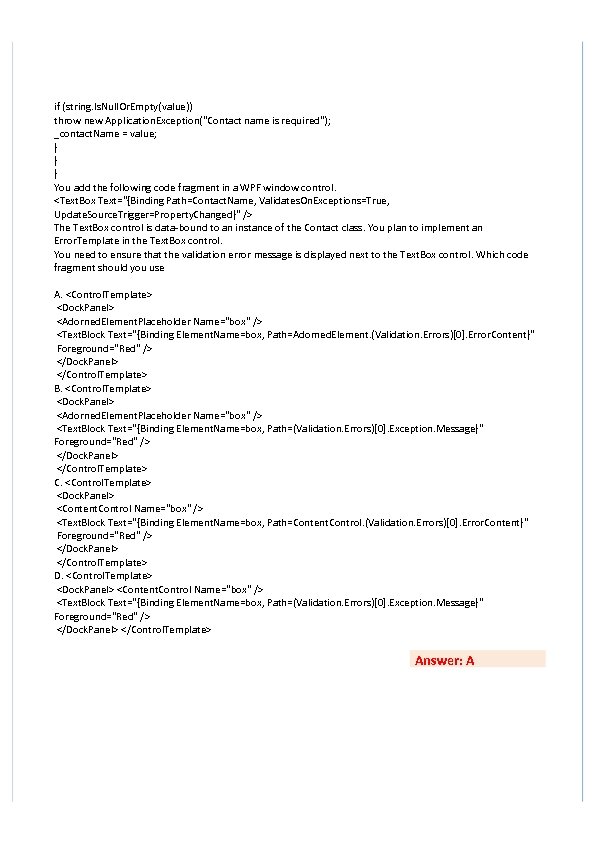
You add the following code fragment within a WPF window control.
if (string. Is. Null. Or. Empty(value)) throw new Application. Exception("Contact name is required"); _contact. Name = value; } } } You add the following code fragment in a WPF window control.
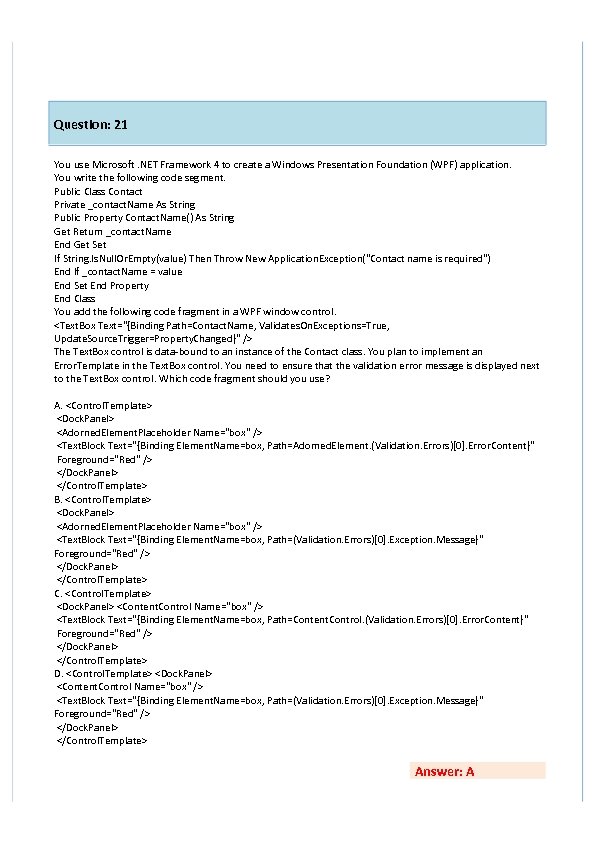
Question: 21 You use Microsoft. NET Framework 4 to create a Windows Presentation Foundation (WPF) application. You write the following code segment. Public Class Contact Private _contact. Name As String Public Property Contact. Name() As String Get Return _contact. Name End Get Set If String. Is. Null. Or. Empty(value) Then Throw New Application. Exception("Contact name is required") End If _contact. Name = value End Set End Property End Class You add the following code fragment in a WPF window control.
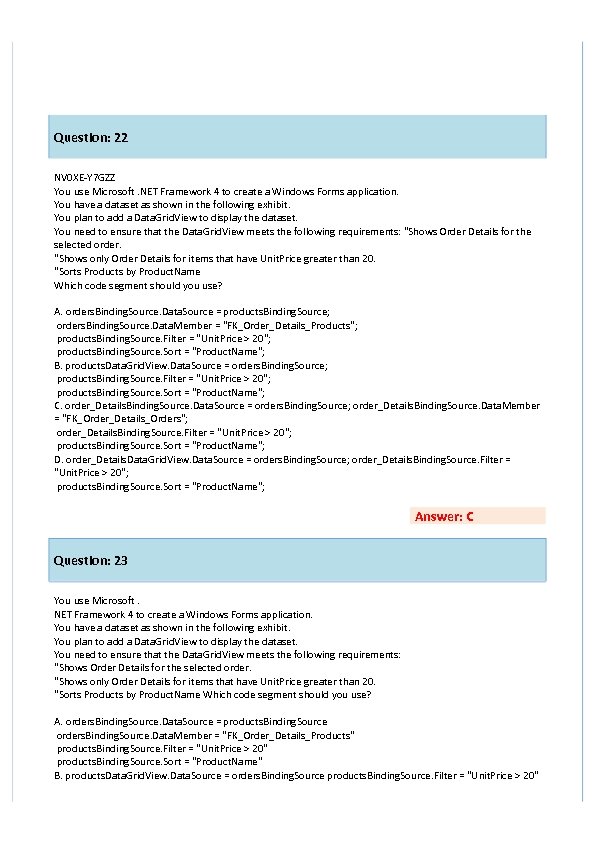
Question: 22 NV 0 XE-Y 7 GZZ You use Microsoft. NET Framework 4 to create a Windows Forms application. You have a dataset as shown in the following exhibit. You plan to add a Data. Grid. View to display the dataset. You need to ensure that the Data. Grid. View meets the following requirements: "Shows Order Details for the selected order. "Shows only Order Details for items that have Unit. Price greater than 20. "Sorts Products by Product. Name Which code segment should you use? A. orders. Binding. Source. Data. Source = products. Binding. Source; orders. Binding. Source. Data. Member = "FK_Order_Details_Products"; products. Binding. Source. Filter = "Unit. Price > 20"; products. Binding. Source. Sort = "Product. Name"; B. products. Data. Grid. View. Data. Source = orders. Binding. Source; products. Binding. Source. Filter = "Unit. Price > 20"; products. Binding. Source. Sort = "Product. Name"; C. order_Details. Binding. Source. Data. Source = orders. Binding. Source; order_Details. Binding. Source. Data. Member = "FK_Order_Details_Orders"; order_Details. Binding. Source. Filter = "Unit. Price > 20"; products. Binding. Source. Sort = "Product. Name"; D. order_Details. Data. Grid. View. Data. Source = orders. Binding. Source; order_Details. Binding. Source. Filter = "Unit. Price > 20"; products. Binding. Source. Sort = "Product. Name"; Answer: C Question: 23 You use Microsoft. NET Framework 4 to create a Windows Forms application. You have a dataset as shown in the following exhibit. You plan to add a Data. Grid. View to display the dataset. You need to ensure that the Data. Grid. View meets the following requirements: "Shows Order Details for the selected order. "Shows only Order Details for items that have Unit. Price greater than 20. "Sorts Products by Product. Name Which code segment should you use? A. orders. Binding. Source. Data. Source = products. Binding. Source orders. Binding. Source. Data. Member = "FK_Order_Details_Products" products. Binding. Source. Filter = "Unit. Price > 20" products. Binding. Source. Sort = "Product. Name" B. products. Data. Grid. View. Data. Source = orders. Binding. Source products. Binding. Source. Filter = "Unit. Price > 20"
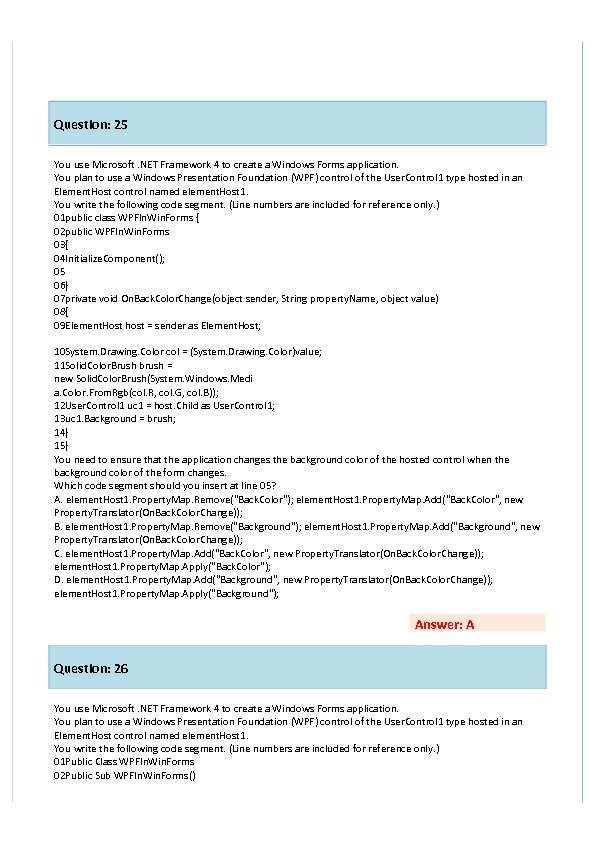
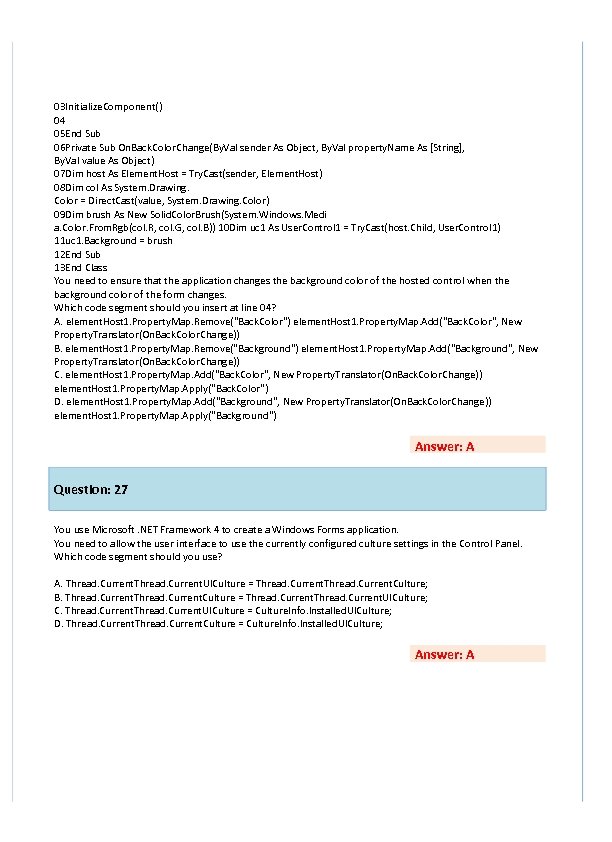
Question: 25 You use Microsoft. NET Framework 4 to create a Windows Forms application. You plan to use a Windows Presentation Foundation (WPF) control of the User. Control 1 type hosted in an Element. Host control named element. Host 1. You write the following code segment. (Line numbers are included for reference only. ) 01 public class WPFIn. Win. Forms { 02 public WPFIn. Win. Forms 03{ 04 Initialize. Component(); 05 06} 07 private void On. Back. Color. Change(object sender, String property. Name, object value) 08{ 09 Element. Host host = sender as Element. Host; 10 System. Drawing. Color col = (System. Drawing. Color)value; 11 Solid. Color. Brush brush = new Solid. Color. Brush(System. Windows. Medi a. Color. From. Rgb(col. R, col. G, col. B)); 12 User. Control 1 uc 1 = host. Child as User. Control 1; 13 uc 1. Background = brush; 14} 15} You need to ensure that the application changes the background color of the hosted control when the background color of the form changes. Which code segment should you insert at line 05? A. element. Host 1. Property. Map. Remove("Back. Color"); element. Host 1. Property. Map. Add("Back. Color", new Property. Translator(On. Back. Color. Change)); B. element. Host 1. Property. Map. Remove("Background"); element. Host 1. Property. Map. Add("Background", new Property. Translator(On. Back. Color. Change)); C. element. Host 1. Property. Map. Add("Back. Color", new Property. Translator(On. Back. Color. Change)); element. Host 1. Property. Map. Apply("Back. Color"); D. element. Host 1. Property. Map. Add("Background", new Property. Translator(On. Back. Color. Change)); element. Host 1. Property. Map. Apply("Background"); Answer: A Question: 26 You use Microsoft. NET Framework 4 to create a Windows Forms application. You plan to use a Windows Presentation Foundation (WPF) control of the User. Control 1 type hosted in an Element. Host control named element. Host 1. You write the following code segment. (Line numbers are included for reference only. ) 01 Public Class WPFIn. Win. Forms 02 Public Sub WPFIn. Win. Forms()
03 Initialize. Component() 04 05 End Sub 06 Private Sub On. Back. Color. Change(By. Val sender As Object, By. Val property. Name As [String], By. Val value As Object) 07 Dim host As Element. Host = Try. Cast(sender, Element. Host) 08 Dim col As System. Drawing. Color = Direct. Cast(value, System. Drawing. Color) 09 Dim brush As New Solid. Color. Brush(System. Windows. Medi a. Color. From. Rgb(col. R, col. G, col. B)) 10 Dim uc 1 As User. Control 1 = Try. Cast(host. Child, User. Control 1) 11 uc 1. Background = brush 12 End Sub 13 End Class You need to ensure that the application changes the background color of the hosted control when the background color of the form changes. Which code segment should you insert at line 04? A. element. Host 1. Property. Map. Remove("Back. Color") element. Host 1. Property. Map. Add("Back. Color", New Property. Translator(On. Back. Color. Change)) B. element. Host 1. Property. Map. Remove("Background") element. Host 1. Property. Map. Add("Background", New Property. Translator(On. Back. Color. Change)) C. element. Host 1. Property. Map. Add("Back. Color", New Property. Translator(On. Back. Color. Change)) element. Host 1. Property. Map. Apply("Back. Color") D. element. Host 1. Property. Map. Add("Background", New Property. Translator(On. Back. Color. Change)) element. Host 1. Property. Map. Apply("Background") Answer: A Question: 27 You use Microsoft. NET Framework 4 to create a Windows Forms application. You need to allow the user interface to use the currently configured culture settings in the Control Panel. Which code segment should you use? A. Thread. Current. UICulture = Thread. Current. Culture; B. Thread. Current. Culture = Thread. Current. UICulture; C. Thread. Current. UICulture = Culture. Info. Installed. UICulture; D. Thread. Current. Culture = Culture. Info. Installed. UICulture; Answer: A
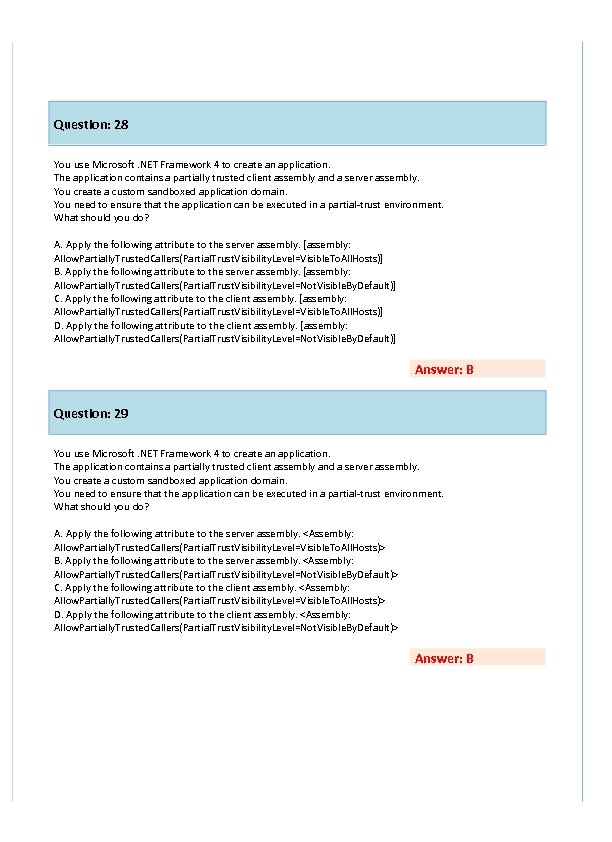
Question: 28 You use Microsoft. NET Framework 4 to create an application. The application contains a partially trusted client assembly and a server assembly. You create a custom sandboxed application domain. You need to ensure that the application can be executed in a partial-trust environment. What should you do? A. Apply the following attribute to the server assembly. [assembly: Allow. Partially. Trusted. Callers(Partial. Trust. Visibility. Level=Visible. To. All. Hosts)] B. Apply the following attribute to the server assembly. [assembly: Allow. Partially. Trusted. Callers(Partial. Trust. Visibility. Level=Not. Visible. By. Default)] C. Apply the following attribute to the client assembly. [assembly: Allow. Partially. Trusted. Callers(Partial. Trust. Visibility. Level=Visible. To. All. Hosts)] D. Apply the following attribute to the client assembly. [assembly: Allow. Partially. Trusted. Callers(Partial. Trust. Visibility. Level=Not. Visible. By. Default)] Answer: B Question: 29 You use Microsoft. NET Framework 4 to create an application. The application contains a partially trusted client assembly and a server assembly. You create a custom sandboxed application domain. You need to ensure that the application can be executed in a partial-trust environment. What should you do? A. Apply the following attribute to the server assembly.
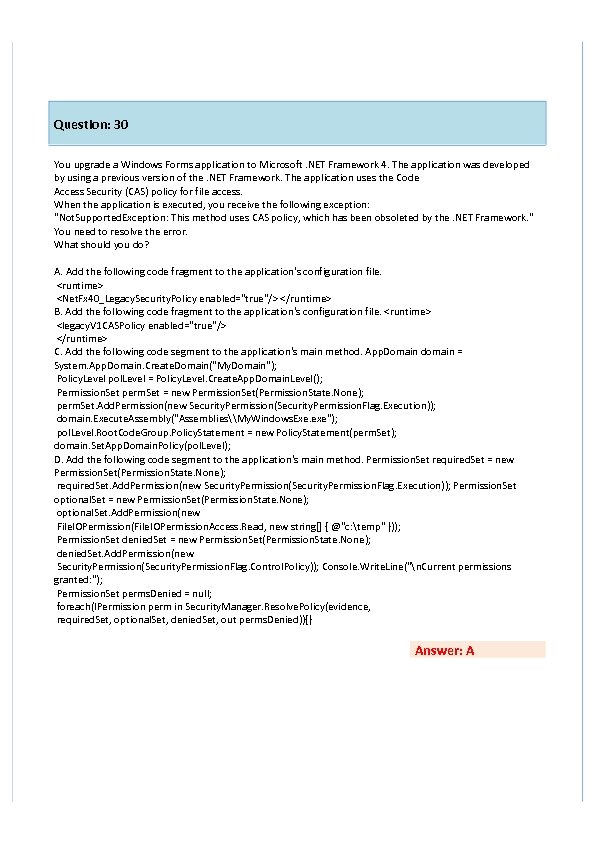
Question: 30 You upgrade a Windows Forms application to Microsoft. NET Framework 4. The application was developed by using a previous version of the. NET Framework. The application uses the Code Access Security (CAS) policy for file access. When the application is executed, you receive the following exception: "Not. Supported. Exception: This method uses CAS policy, which has been obsoleted by the. NET Framework. " You need to resolve the error. What should you do? A. Add the following code fragment to the application's configuration file.
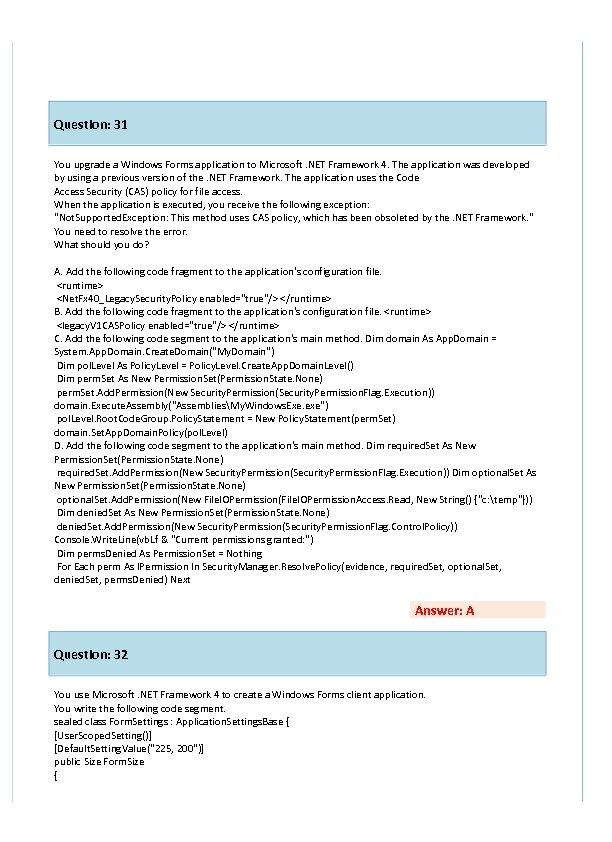
Question: 31 You upgrade a Windows Forms application to Microsoft. NET Framework 4. The application was developed by using a previous version of the. NET Framework. The application uses the Code Access Security (CAS) policy for file access. When the application is executed, you receive the following exception: "Not. Supported. Exception: This method uses CAS policy, which has been obsoleted by the. NET Framework. " You need to resolve the error. What should you do? A. Add the following code fragment to the application's configuration file.
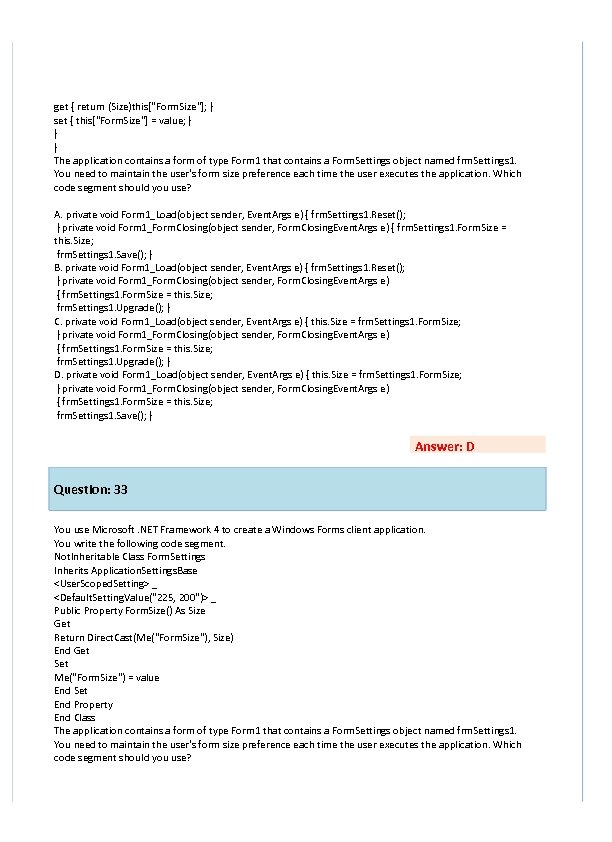
get { return (Size)this["Form. Size"]; } set { this["Form. Size"] = value; } } } The application contains a form of type Form 1 that contains a Form. Settings object named frm. Settings 1. You need to maintain the user's form size preference each time the user executes the application. Which code segment should you use? A. private void Form 1_Load(object sender, Event. Args e) { frm. Settings 1. Reset(); } private void Form 1_Form. Closing(object sender, Form. Closing. Event. Args e) { frm. Settings 1. Form. Size = this. Size; frm. Settings 1. Save(); } B. private void Form 1_Load(object sender, Event. Args e) { frm. Settings 1. Reset(); } private void Form 1_Form. Closing(object sender, Form. Closing. Event. Args e) { frm. Settings 1. Form. Size = this. Size; frm. Settings 1. Upgrade(); } C. private void Form 1_Load(object sender, Event. Args e) { this. Size = frm. Settings 1. Form. Size; } private void Form 1_Form. Closing(object sender, Form. Closing. Event. Args e) { frm. Settings 1. Form. Size = this. Size; frm. Settings 1. Upgrade(); } D. private void Form 1_Load(object sender, Event. Args e) { this. Size = frm. Settings 1. Form. Size; } private void Form 1_Form. Closing(object sender, Form. Closing. Event. Args e) { frm. Settings 1. Form. Size = this. Size; frm. Settings 1. Save(); } Answer: D Question: 33 You use Microsoft. NET Framework 4 to create a Windows Forms client application. You write the following code segment. Not. Inheritable Class Form. Settings Inherits Application. Settings. Base
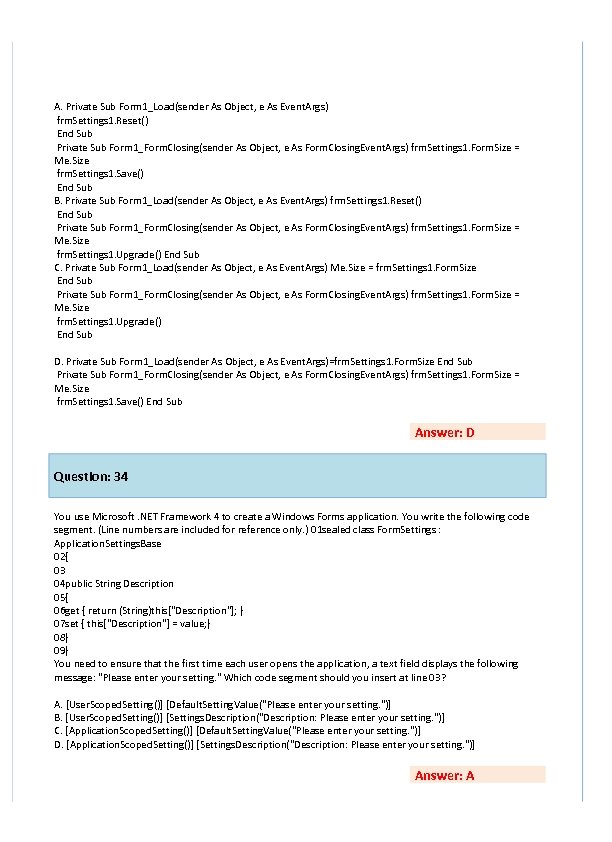
A. Private Sub Form 1_Load(sender As Object, e As Event. Args) frm. Settings 1. Reset() End Sub Private Sub Form 1_Form. Closing(sender As Object, e As Form. Closing. Event. Args) frm. Settings 1. Form. Size = Me. Size frm. Settings 1. Save() End Sub B. Private Sub Form 1_Load(sender As Object, e As Event. Args) frm. Settings 1. Reset() End Sub Private Sub Form 1_Form. Closing(sender As Object, e As Form. Closing. Event. Args) frm. Settings 1. Form. Size = Me. Size frm. Settings 1. Upgrade() End Sub C. Private Sub Form 1_Load(sender As Object, e As Event. Args) Me. Size = frm. Settings 1. Form. Size End Sub Private Sub Form 1_Form. Closing(sender As Object, e As Form. Closing. Event. Args) frm. Settings 1. Form. Size = Me. Size frm. Settings 1. Upgrade() End Sub D. Private Sub Form 1_Load(sender As Object, e As Event. Args)=frm. Settings 1. Form. Size End Sub Private Sub Form 1_Form. Closing(sender As Object, e As Form. Closing. Event. Args) frm. Settings 1. Form. Size = Me. Size frm. Settings 1. Save() End Sub Answer: D Question: 34 You use Microsoft. NET Framework 4 to create a Windows Forms application. You write the following code segment. (Line numbers are included for reference only. ) 01 sealed class Form. Settings : Application. Settings. Base 02{ 03 04 public String Description 05{ 06 get { return (String)this["Description"]; } 07 set { this["Description"] = value; } 08} 09} You need to ensure that the first time each user opens the application, a text field displays the following message: "Please enter your setting. " Which code segment should you insert at line 03? A. [User. Scoped. Setting()] [Default. Setting. Value("Please enter your setting. ")] B. [User. Scoped. Setting()] [Settings. Description("Description: Please enter your setting. ")] C. [Application. Scoped. Setting()] [Default. Setting. Value("Please enter your setting. ")] D. [Application. Scoped. Setting()] [Settings. Description("Description: Please enter your setting. ")] Answer: A
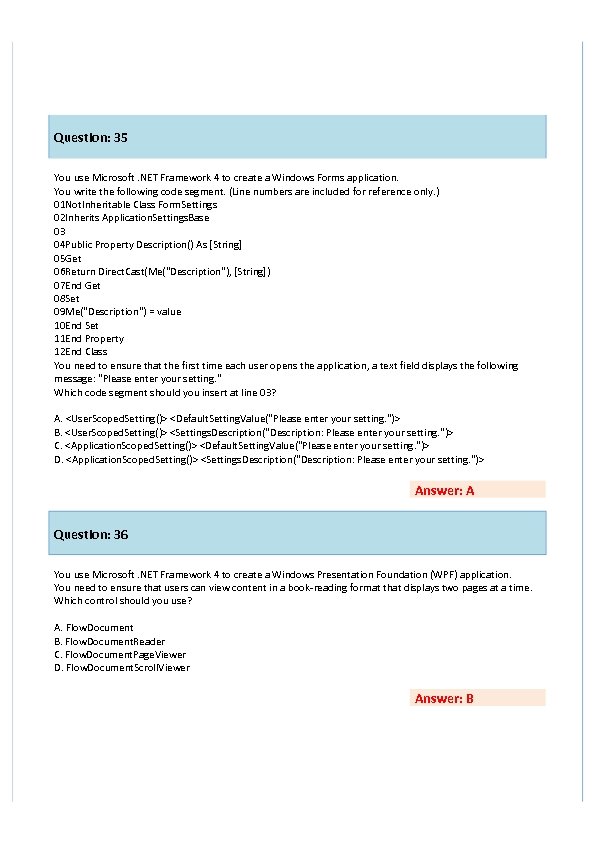
Question: 35 You use Microsoft. NET Framework 4 to create a Windows Forms application. You write the following code segment. (Line numbers are included for reference only. ) 01 Not. Inheritable Class Form. Settings 02 Inherits Application. Settings. Base 03 04 Public Property Description() As [String] 05 Get 06 Return Direct. Cast(Me("Description"), [String]) 07 End Get 08 Set 09 Me("Description") = value 10 End Set 11 End Property 12 End Class You need to ensure that the first time each user opens the application, a text field displays the following message: "Please enter your setting. " Which code segment should you insert at line 03? A.
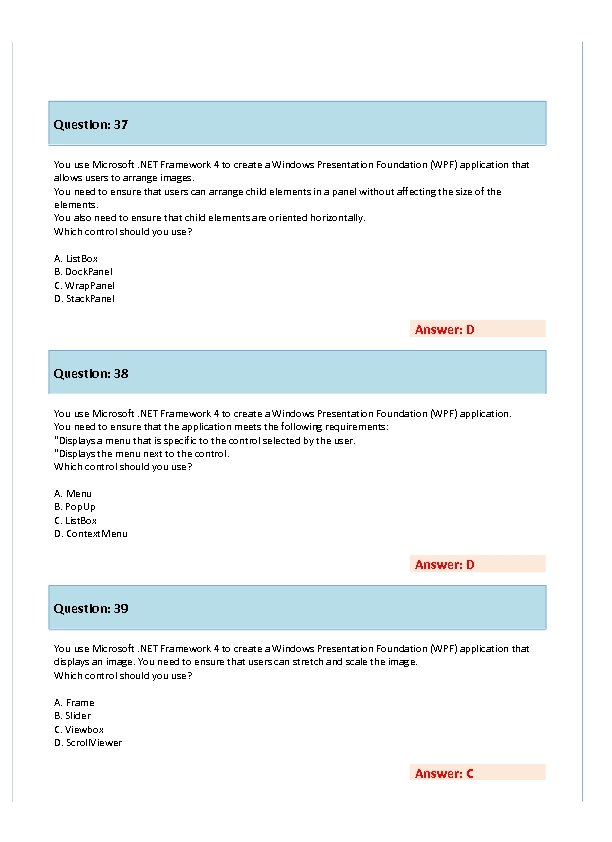
Question: 37 You use Microsoft. NET Framework 4 to create a Windows Presentation Foundation (WPF) application that allows users to arrange images. You need to ensure that users can arrange child elements in a panel without affecting the size of the elements. You also need to ensure that child elements are oriented horizontally. Which control should you use? A. List. Box B. Dock. Panel C. Wrap. Panel D. Stack. Panel Answer: D Question: 38 You use Microsoft. NET Framework 4 to create a Windows Presentation Foundation (WPF) application. You need to ensure that the application meets the following requirements: "Displays a menu that is specific to the control selected by the user. "Displays the menu next to the control. Which control should you use? A. Menu B. Pop. Up C. List. Box D. Context. Menu Answer: D Question: 39 You use Microsoft. NET Framework 4 to create a Windows Presentation Foundation (WPF) application that displays an image. You need to ensure that users can stretch and scale the image. Which control should you use? A. Frame B. Slider C. Viewbox D. Scroll. Viewer Answer: C
Question: 40 You use Microsoft. NET Framework 4 to create a Windows Presentation Foundation (WPF) application. The application contains a window as shown in the following exhibit. You need to define a Dock. Panel control that fits the window. Which code fragment should you use? A.
Please, select an item B.
Question: 42 You use Microsoft. NET Framework 4 to create a Windows Presentation Foundation (WPF) application. You want the application to contain a window as shown in the following exhibit. The application contains the following code fragment. (Line numbers are included for reference only. ) 01
 Question: 46 You use Microsoft. NET Framework 4 to create a Windows Presentation Foundation (WPF) application. The application contains the following code fragment.
 Answer: A Question: 48 You use Microsoft. NET Framework 4 to create a custom Windows Presentation Foundation (WPF) application. Your environment includes several WPF applications. The applications use the same logo and style configuration as part of a corporate standard. You need to ensure that the existing applications can be updated to use the same logo and style settings without recompiling. Which two actions should you perform? (Each correct answer presents part of the solution. Choose two. ) A. Mark the resource as an embedded resource in each application. B. Create a resource in an XAML file that contains the logo and style configurations. C. Create a resource in a custom control that contains the logo and style configurations. D. Add the resource as a Resource. Dictionary in the Merged. Dictionaries collection of each application. E. Use Resource. Manager to read the content of the resource. Manually assign the style configurations included in the resource file to the appropriate control in each application. Answer: BD Question: 49 You use Microsoft Visual Studio 2010 and Microsoft. NET Framework 4 to create a Windows Presentation Framework (WPF) application. You have a company logo that must appear on multiple forms in the application. The logo design changes frequently. You need to ensure that when the logo image is changed, you only need to update a single location. What should you do? A. Define the image as a page resource. B. Define the image as an application resource. C. Save the image on a network drive. D. Include the image as an embedded resource. Answer: B Question: 50 You use Microsoft. NET Framework 4 to create a Windows Presentation Foundation (WPF) application. You create a window named Manage. Orders that contains a Button control named show. Other. Side. You add an animation named Flip. Sides as a resource of Manage. Orders. You need to ensure that the following requirements are met:
 "Flip. Sides runs each time a user clicks show. Other. Side. "Flip. Sides runs only when a user clicks show. Other. Side. What should you do? A. Add a property trigger to the Triggers collection of Manage. Orders. Configure the property trigger to be based on the Is. Pressed property of show. Other. Side. B. Add an event trigger to the Triggers collection of Manage. Orders. Configure the event trigger to be based on the Click event of show. Other. Side. C. Call the Begin. Animation method of show. Other. Side. Pass Flip. Sides as a parameter of the Begin. Animation method. D. Call the Begin. Animation method of Manage. Orders. Pass Flip. Sides as a parameter of the Begin. Animation method. Answer: B Question: 51 You use Microsoft. NET Framework 4 to create a Windows Presentation Foundation (WPF) application. The application contains a form named frm. Main that contains a button named btn. Save. You create a Progress. Bar control named save. Progress. Initially, save. Progress is not displayed on frm. Main. When a user clicks btn. Save, you have the following requirements: "save. Progress is slightly visible after 0. 2 seconds "save. Progress is fully visible after 1 second You need to declare the corresponding storyboard. You write the following code fragment. (Line numbers are included for reference only. ) 01
 Question: 52 You use Microsoft. NET Framework 4 to create a Windows Presentation Foundation (WPF) application. You create a game where a ball drops from the top to the bottom of a window. You plan to create a single animation for the game. You need to ensure that the animation shows the ball bounce. What should you do? A. Use the Key. Spline property of a Spline. Double. Key. Frame object. B. Use the Easing. Function property of an Easing. Double. Key. Frame object. C. Use the Deceleration. Ratio and Auto. Reverse properties of a Story. Board object. D. Use the Deceleration. Ratio and Acceleration. Ratio properties of a Story. Board object. Answer: B Question: 53 You use Microsoft. NET Framework 4 to create a Windows Presentation Foundation (WPF) application. You add a custom command as a resource. The key of the command is save. Command. You write the following code fragment. (Line numbers are included for reference only. ) 01 You need to ensure that save. Command is executed when the user clicks the Button control. What should you do? A. Insert the following code fragment at line 04.
 Question: 54 You use Microsoft. NET Framework 4 to create a Windows Presentation Framework (WPF) application. You plan to create a custom control that contains four text input fields. Each of the text input fields within the control will contain a label. You need to ensure that the text input fields within the control can be validated by using a regular expression validator. Which class should you inherit from? A. Text. Box B. Text. Element C. UIElement D. User. Control Answer: D Question: 55 You use Microsoft. NET Framework 4 to create a Windows Presentation Foundation (WPF) application. The application has multiple data entry windows. Each window contains controls that allow the user to type different addresses for shipping and mailing. All addresses have the same format. You need to ensure that you can reuse the controls. What should you create? A. a user control B. a data template C. a control template D. a control that inherits the Canvas class Answer: A Question: 56 You use Microsoft. NET Framework 4 to create a Windows Presentation Foundation (WPF) application. You write the following code fragment. (Line numbers are included for reference only. ) 01 You need to rotate the rectangle by 45 degrees by using its upper-left corner as the axis. Which code fragment should you insert at line 04? A.
 B.
B.
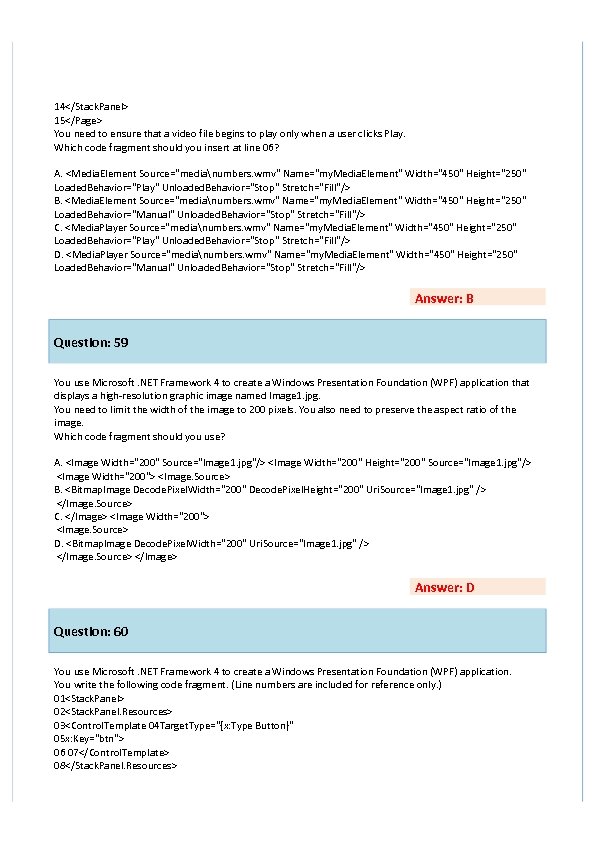 14 15 You need to ensure that a video file begins to play only when a user clicks Play. Which code fragment should you insert at line 06? A.
11
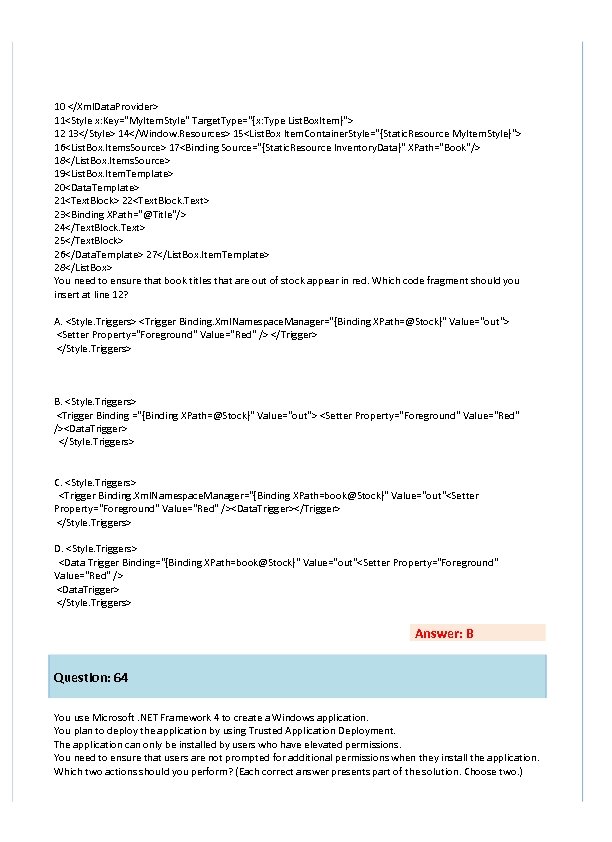 10 11 14 15
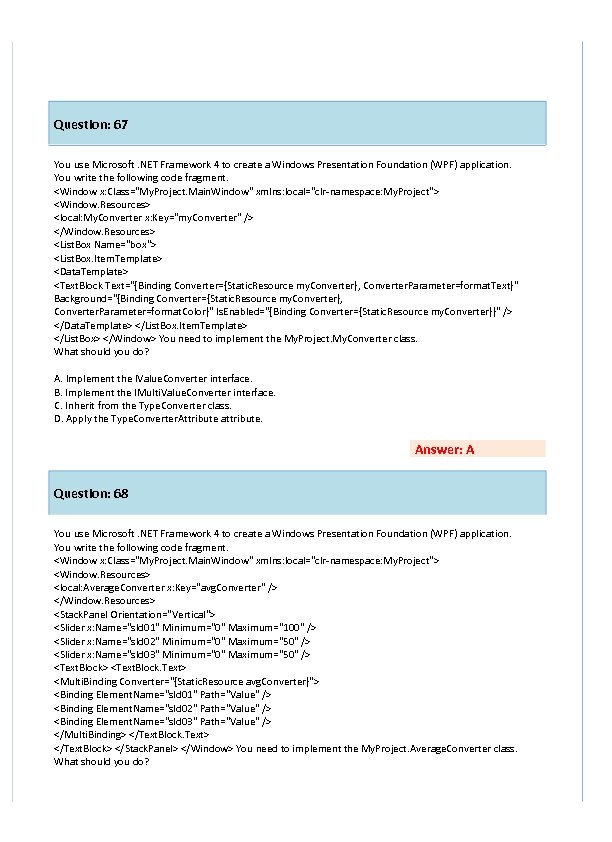
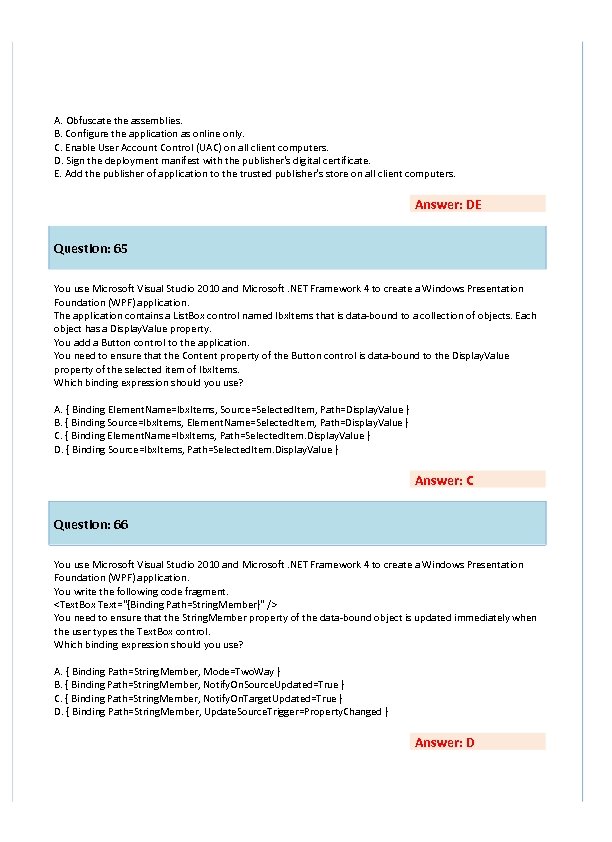 A. Obfuscate the assemblies. B. Configure the application as online only. C. Enable User Account Control (UAC) on all client computers. D. Sign the deployment manifest with the publisher's digital certificate. E. Add the publisher of application to the trusted publisher's store on all client computers. Answer: DE Question: 65 You use Microsoft Visual Studio 2010 and Microsoft. NET Framework 4 to create a Windows Presentation Foundation (WPF) application. The application contains a List. Box control named lbx. Items that is data-bound to a collection of objects. Each object has a Display. Value property. You add a Button control to the application. You need to ensure that the Content property of the Button control is data-bound to the Display. Value property of the selected item of lbx. Items. Which binding expression should you use? A. { Binding Element. Name=lbx. Items, Source=Selected. Item, Path=Display. Value } B. { Binding Source=lbx. Items, Element. Name=Selected. Item, Path=Display. Value } C. { Binding Element. Name=lbx. Items, Path=Selected. Item. Display. Value } D. { Binding Source=lbx. Items, Path=Selected. Item. Display. Value } Answer: C Question: 66 You use Microsoft Visual Studio 2010 and Microsoft. NET Framework 4 to create a Windows Presentation Foundation (WPF) application. You write the following code fragment.
 Question: 67 You use Microsoft. NET Framework 4 to create a Windows Presentation Foundation (WPF) application. You write the following code fragment.
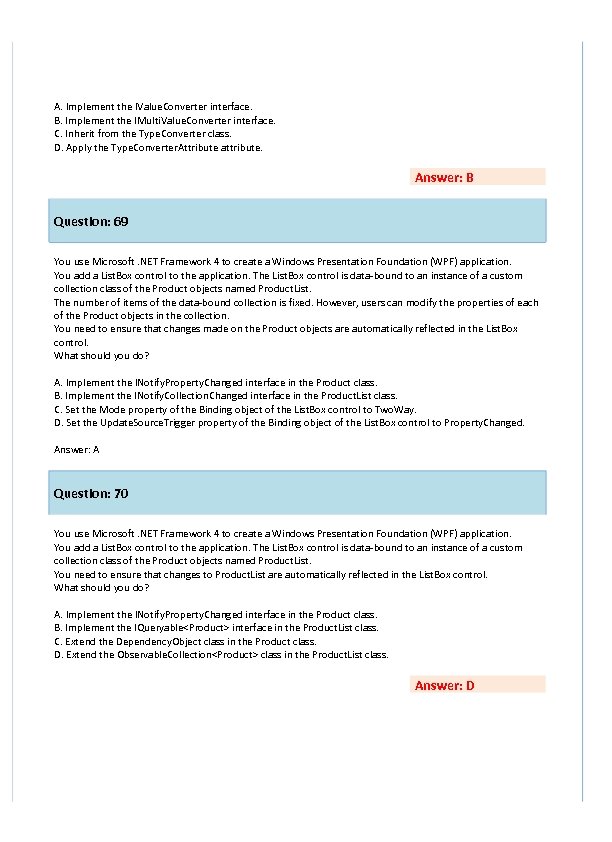 A. Implement the IValue. Converter interface. B. Implement the IMulti. Value. Converter interface. C. Inherit from the Type. Converter class. D. Apply the Type. Converter. Attribute attribute. Answer: B Question: 69 You use Microsoft. NET Framework 4 to create a Windows Presentation Foundation (WPF) application. You add a List. Box control to the application. The List. Box control is data-bound to an instance of a custom collection class of the Product objects named Product. List. The number of items of the data-bound collection is fixed. However, users can modify the properties of each of the Product objects in the collection. You need to ensure that changes made on the Product objects are automatically reflected in the List. Box control. What should you do? A. Implement the INotify. Property. Changed interface in the Product class. B. Implement the INotify. Collection. Changed interface in the Product. List class. C. Set the Mode property of the Binding object of the List. Box control to Two. Way. D. Set the Update. Source. Trigger property of the Binding object of the List. Box control to Property. Changed. Answer: A Question: 70 You use Microsoft. NET Framework 4 to create a Windows Presentation Foundation (WPF) application. You add a List. Box control to the application. The List. Box control is data-bound to an instance of a custom collection class of the Product objects named Product. List. You need to ensure that changes to Product. List are automatically reflected in the List. Box control. What should you do? A. Implement the INotify. Property. Changed interface in the Product class. B. Implement the IQueryable
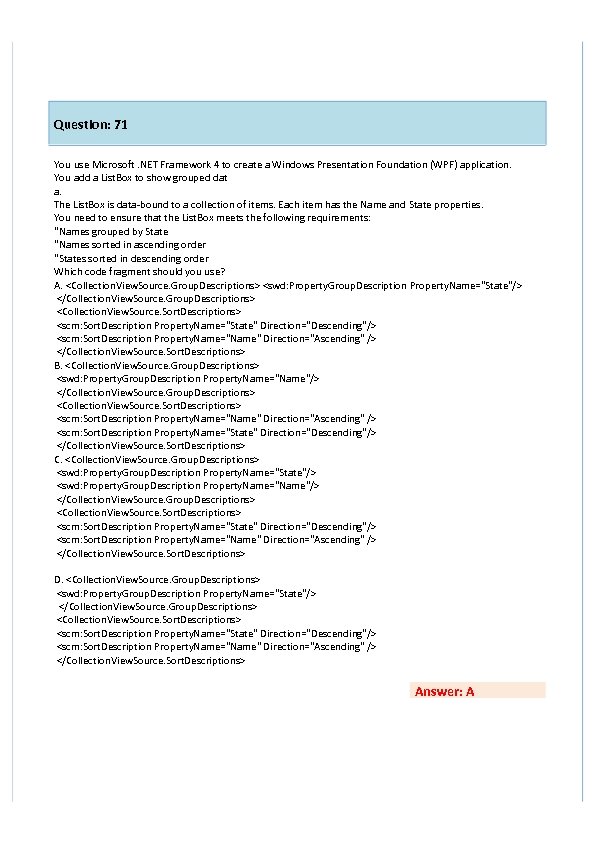 Question: 71 You use Microsoft. NET Framework 4 to create a Windows Presentation Foundation (WPF) application. You add a List. Box to show grouped dat a. The List. Box is data-bound to a collection of items. Each item has the Name and State properties. You need to ensure that the List. Box meets the following requirements: "Names grouped by State "Names sorted in ascending order "States sorted in descending order Which code fragment should you use? A.
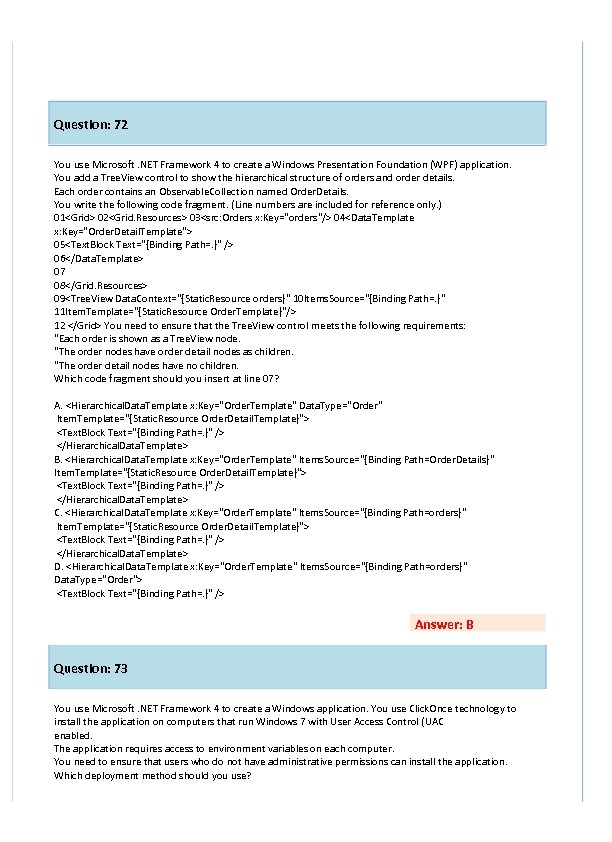 Question: 72 You use Microsoft. NET Framework 4 to create a Windows Presentation Foundation (WPF) application. You add a Tree. View control to show the hierarchical structure of orders and order details. Each order contains an Observable. Collection named Order. Details. You write the following code fragment. (Line numbers are included for reference only. ) 01
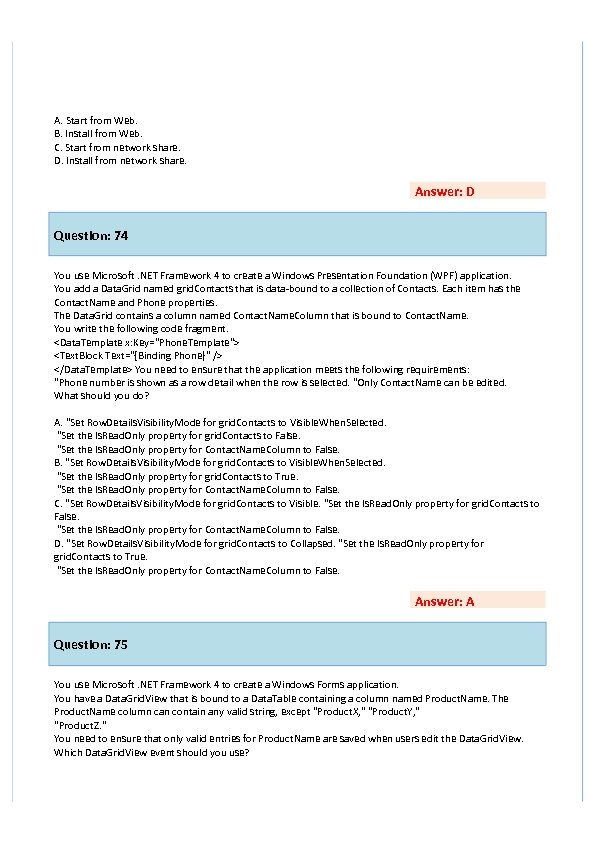 A. Start from Web. B. Install from Web. C. Start from network share. D. Install from network share. Answer: D Question: 74 You use Microsoft. NET Framework 4 to create a Windows Presentation Foundation (WPF) application. You add a Data. Grid named grid. Contacts that is data-bound to a collection of Contacts. Each item has the Contact. Name and Phone properties. The Data. Grid contains a column named Contact. Name. Column that is bound to Contact. Name. You write the following code fragment.
 A. Cell. Begin. Edit B. Invalidated C. Validated D. Validating Answer: D Question: 76 You use Microsoft. NET Framework 4 to create a Windows Presentation Foundation (WPF) application. The application contains three text boxes named txt. Address, txt. City, and txt. State. You need to ensure that the postal code is automatically set based on the information typed by users in the text boxes. You also need to ensure that the complete address is displayed in a Text. Block control. Which code fragment should you use? A.
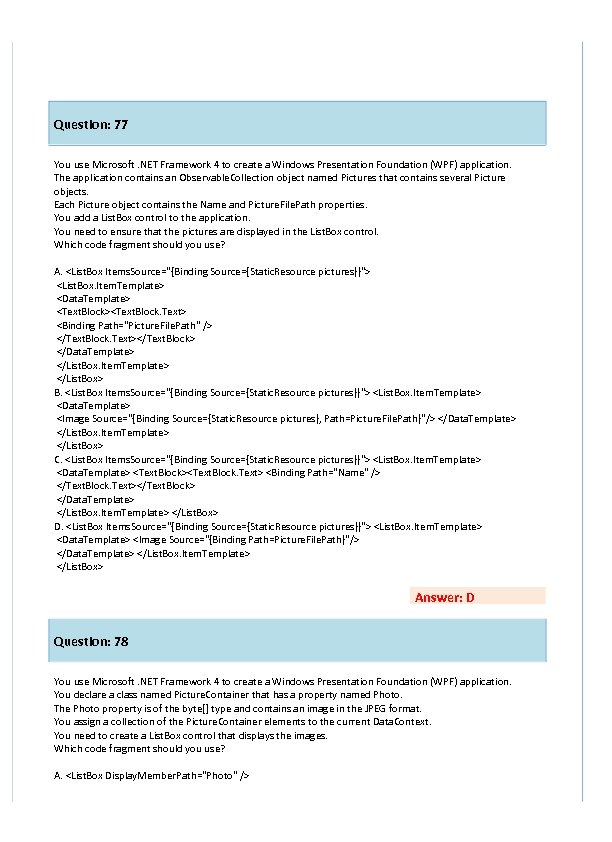 Question: 77 You use Microsoft. NET Framework 4 to create a Windows Presentation Foundation (WPF) application. The application contains an Observable. Collection object named Pictures that contains several Picture objects. Each Picture object contains the Name and Picture. File. Path properties. You add a List. Box control to the application. You need to ensure that the pictures are displayed in the List. Box control. Which code fragment should you use? A.
C.
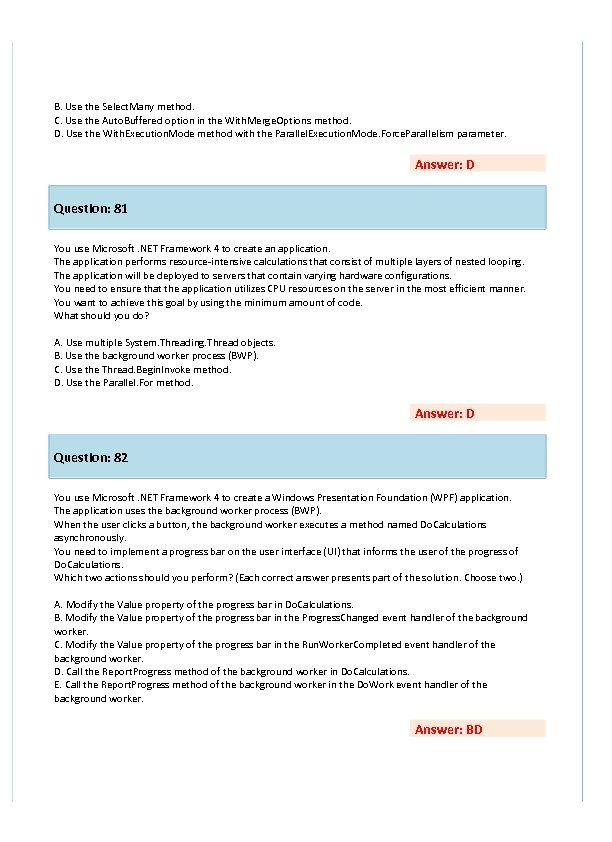 B. Use the Select. Many method. C. Use the Auto. Buffered option in the With. Merge. Options method. D. Use the With. Execution. Mode method with the Parallel. Execution. Mode. Force. Parallelism parameter. Answer: D Question: 81 You use Microsoft. NET Framework 4 to create an application. The application performs resource-intensive calculations that consist of multiple layers of nested looping. The application will be deployed to servers that contain varying hardware configurations. You need to ensure that the application utilizes CPU resources on the server in the most efficient manner. You want to achieve this goal by using the minimum amount of code. What should you do? A. Use multiple System. Threading. Thread objects. B. Use the background worker process (BWP). C. Use the Thread. Begin. Invoke method. D. Use the Parallel. For method. Answer: D Question: 82 You use Microsoft. NET Framework 4 to create a Windows Presentation Foundation (WPF) application. The application uses the background worker process (BWP). When the user clicks a button, the background worker executes a method named Do. Calculations asynchronously. You need to implement a progress bar on the user interface (UI) that informs the user of the progress of Do. Calculations. Which two actions should you perform? (Each correct answer presents part of the solution. Choose two. ) A. Modify the Value property of the progress bar in Do. Calculations. B. Modify the Value property of the progress bar in the Progress. Changed event handler of the background worker. C. Modify the Value property of the progress bar in the Run. Worker. Completed event handler of the background worker. D. Call the Report. Progress method of the background worker in Do. Calculations. E. Call the Report. Progress method of the background worker in the Do. Work event handler of the background worker. Answer: BD
 Question: 83 You use Microsoft. NET Framework 4 to create a Windows Presentation Foundation (WPF) application. You want to localize the application to use the German locale settings. You need to allow the Resource. Manager class to retrieve a neutral German locale version of the text to be displayed in the user interface (UI). Which file should you add to the project? A. Resources. de. xml B. Resources. de-DE. xml C. Resources. de. resx D. Resources. de-DE. resx Answer: C Question: 84 You use Microsoft. NET Framework 4 to create a Windows Presentation Foundation (WPF) application. The application uses the drag-and-drop functionality. You need to ensure that the drag-and-drop operation is stopped when a user moves the cursor outside the boundaries of the application form. Which enumeration member should you use? A. Drag. Action. Cancel B. Drag. Action. Drop C. Drag. Drop. Effects. None D. Drag. Drop. Effects. All Answer: A Question: 85 You use Microsoft. NET Framework 4 to create a Windows Forms application. The application includes a Rich. Text. Box control and a List. Box control. The List. Box control is populated with a list of valid file names. The application allows users to drag a List. Box item to the Rich. Text. Box control. You need to provide a visual indication that a file that is dragged can be dropped on the Rich. Text. Box control. What should you do? A. Use a Double. Animation class. B. Use a Storyboard animation class. C. Use the Drag. Drop. Effects enumeration. D. Use the Drag. Action enumeration.
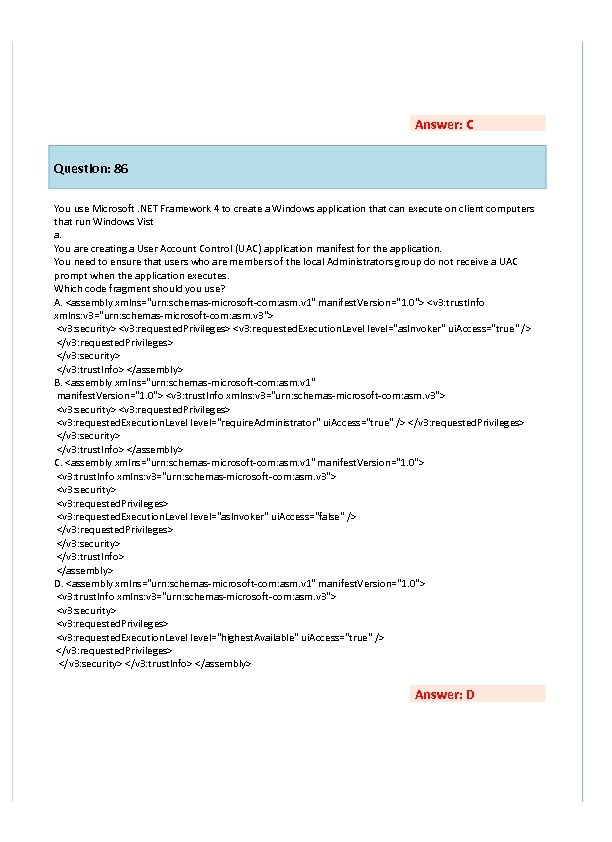 Answer: C Question: 86 You use Microsoft. NET Framework 4 to create a Windows application that can execute on client computers that run Windows Vist a. You are creating a User Account Control (UAC) application manifest for the application. You need to ensure that users who are members of the local Administrators group do not receive a UAC prompt when the application executes. Which code fragment should you use? A.
 Question: 87 You use Microsoft. NET Framework 4 to create a Windows Presentation Foundation (WPF) application. You create a custom control named Wheel. You need to ensure that the Speed property of Wheel can be animated. What should you do? A. Inherit the Dependency. Object class. B. Declare the Speed property as a dependency property. C. Declare an animation of the Speed property from within the code-behind file. D. Implement the System. Windows. Media. Animation. IAnimatable interface with the Wheel class. Answer: B Question: 88 You use Microsoft. NET Framework 4 to create a Windows Presentation Foundation (WPF) application. You add a property named Service. Context to a control. You need the value of Service. Context to flow to the child controls exactly like the value of the Data. Context property of the Framework. Element class. What should you do? A. "Inherit the control class from the Dependency. Object class. B. "Register a dependency property. "In the options settings of the property metadata, specify the Inherits option. C. "Declare a new property. "In the get and set methods of the new property, create an instance of the Traversal. Request class. D. "Declare a new property. "In the get method of the new property call Visual. Tree. Helper. Get. Parent. "In the set method of the new property, call Visual. Tree. Helper. Get. Child. Answer: B Question: 89 You use Microsoft Visual Studio 2010 and Microsoft. NET Framework 4 to create a Windows Presentation Foundation (WPF) application. You plan to implement a test strategy for the application. You need to ensure that the test strategy meets the following requirements: "Test data can be added to the test project without recompiling. "Multiple variations of a test can be executed at run time. What should you do? A. Use Intelli. Trace.
 B. Use data-driven tests. C. Create a single test class. D. Create a test method for each data variation. Answer: B Question: 90 You use Microsoft Visual Studio 2010 and Microsoft. NET Framework 4 to create a Windows Presentation Foundation (WPF) application. The application includes a function that is triggered by filling out a form and by clicking a button. Currently, the application is tested manually. You need to create an automated and iterative process to test the application. What should you do? A. Use Intelli. Trace. B. Use UISpy. exe to extract the user interface (UI) information. Then, use MSTest. exe. C. Use classes in the System. Windows. Automation and System. Windows. Automation. Text namespaces. D. Use the Action Recording methodology to record the user interface (UI) actions. E. Then, use MSTest. exe. Answer: C Question: 91 You use Microsoft Visual Studio 2010 and Microsoft. NET Framework 4 to create a Windows Presentation Foundation (WPF) application. You discover that when the application runs, a user control is not rendered correctly. You need to find out the user interface (UI) element of the window that is causing the rendering problem. What should you do? A. Use the Local Window. B. Use the WPF Visualizer. C. Generate a trace log by using Intelli. Trace. D. Set a breakpoint at the control. Run the application. Answer: B
 Question: 92 You use Microsoft Visual Studio 2010 and Microsoft. NET Framework 4 to create a Windows Presentation Foundation (WPF) application. The application contains a custom control that is used to display customer information. You discover that the custom control is not rendering correctly. You need to identify the WPF element that is causing the issue. You want to achieve this goal by using the minimum amount of administrative effort. What should you do? A. "Start the application in debug mode. "Place a breakpoint at the main entry point of the application. "Use the debugger to step through the application code. B. "Start the application in debug mode. "Place a breakpoint at the main entry point of the application. "Use the WPF Tree Visualizer tool. C. "Enable Intelli. Trace and configure Visual Studio to generate a trace log. "Start the application in debug mode. D. "Enable Intelli. Trace and configure Visual Studio to generate a trace log. "Start the application by doubleclicking the executable file (. exe). Answer: B Question: 93 You use Microsoft Visual Studio 2010 and Microsoft. NET Framework 4 to create a Windows Presentation Foundation (WPF) application. The application uses data-bound controls. You discover that when the application is executed by users, one of the controls is not displayed properly. You need to view the property values assigned to the controls. What should you do? A. Use Intelli. Trace. B. Use Presentation. Trace. Source. C. Run the application in debug mode with Visual Studio 2010. Use the Auto window while you step through the application code. D. Run the application in debug mode with Visual Studio 2010. Use the WPF Visualizer while you step through the application code. Answer: D
 Question: 94 You use Microsoft Visual Studio 2010 and Microsoft. NET Framework 4 to create a Windows Presentation Foundation (WPF) application. You write the following code fragment to bind a customer object to several controls in a window.
 Question: 96 You use Microsoft. NET Framework 4 to create a Windows Presentation Foundation (WPF) application. The application requires frequent updates. You want to use the Click. Once technology to distribute the application to Internet users. You need to ensure that the application is automatically updated without requiring user intervention. You also need to ensure that the users execute the most recent version of the application. What should you do when you publish the application? A. Use Install the application from a file share. Select the Application is available online and offline option. B. Use Install the application from CD-ROM or a DVD-ROM. Select the Application will not check for updates option. C. Use Install the application from a Web site. Select the Application is available online only option. D. Use Install the application from a Web site. Select the Application is available online and offline option. Answer: C Question: 97 You use Microsoft. NET Framework 4 to create a Windows Presentation Foundation (WPF) application. You use the Click. Once deployment methodology to distribute the application. You need to store application-specific data along with read/write permissions without requiring elevated permissions for the application. Where should you store the application data? A. In isolated storage. B. On the database server. C. In the Click. Once data directory. D. In the App. config file of the application. Answer: A Question: 98 You use Microsoft. NET Framework 4 to create a Windows Presentation Foundation (WPF) application named My. App. exe. You use Microsoft Windows Installer to package the application. You create an icon file named Application. ico. You need to associate Application. ico with My. App. exe when it is deployed. What should you do? A. Use the File Types Editor tool. B. Rename the icon file to My. App. exe. ico.
 C. Set the Add. Remove. Programs. Icon property to Application. ico. D. Use the File System Editor tool to set the Icon property to Application. ico. Answer: D Question: 99 You create a Microsoft Windows Installer file for a Windows Presentation Foundation (WPF) application that requires Microsoft. NET Framework 4. You need to ensure that the installation starts only if. NET Framework 4 is already installed on the computer. What should you do? A. Use a custom action. B. Set the Min. Version property to. NET Framework 4. C. Set the Version property of Windows Installer to. NET Framework 4. D. Set the Version property of the Launch Condition to. NET Framework 4. Answer: D Question: 100 You use Microsoft. NET Framework 4 to create a Windows application. You want to use the Click. Once technology to deploy the application on computers that run Windows Vista with User Access Control (UAC) enabled. You need to ensure that the application can be installed in a secure manner. Which setting should you use in the application manifest? A.
 Pass 4 Sure. Official. com Lifetime Membership Features; - Pass 4 Sure. Official Lifetime Membership Package includes over 2500 Exams. All exams Questions and Answers are included in package. All Audio Guides are included free in package. All Study Guides are included free in package. Lifetime login access. Unlimited download, no account expiry, no hidden charges, just one time $99 payment. Free updates for Lifetime. Free Download Access to All new exams added in future. Accurate answers with explanations (If applicable). Verified answers researched by industry experts. Study Material updated on regular basis. Questions, Answers and Study Guides are downloadable in PDF format. Audio Exams are downloadable in MP 3 format. No authorization code required to open exam. Portable anywhere. 100% success Guarantee. Fast, helpful support 24 x 7. View list of All exams (Q&A) downloads http: //www. pass 4 sureofficial. com/allexams. asp View list of All Study Guides (SG) downloads http: //www. pass 4 sureofficial. com/study-guides. asp View list of All Audio Exams (AE) downloads http: //www. pass 4 sureofficial. com/audio-exams. asp Download All Exams Samples http: //www. pass 4 sureofficial. com/samples. asp To purchase $99 Lifetime Full Access Membership click here http: //www. pass 4 sureofficial. com/purchase. asp 3 COM ADOBE APC Apple BEA BICSI Check. Point Cisco Citrix CIW Comp. TIA Computer. Associates CWNP DELL ECCouncil EMC Enterasys Exam. Express Exin Extreme. Networks Filemaker Fortinet Foundry Fujitsu Guidance. Software HDI Hitachi HP Huawei Hyperion IBM IISFA Intel ISACA ISC 2 ISEB ISM Juniper Legato Lotus LPI Mc. Afee Mc. Data Microsoft Mile 2 Network. Appliance Network-General Nokia Nortel Novell OMG Oracle PMI Polycom Red. Hat Sair SASInstitute SCP See-Beyond SNIA Sun Sybase Symantec Tera. Data TIA Tibco Tru. Secure Veritas Vmware