


 Скачать презентацию http www faqs org photo-dict phrase 3962629 sunflower jpg Colour Images
c0bb5ec84054ec1229b0b02b26ba7387.ppt
- Количество слайдов: 28
 http: //www. faqs. org/photo-dict/phrase/3962629/sunflower. jpg Colour & Images COMPSCI 345 / SOFTENG 350 Jim Warren Adapted from slides by Safurah Abdul Jalil and Beryl Plimmer Based on Heim Chapter 9
 Learning outcomes n Describe colour properties n Value n Hue n Saturation n Describe and identify colour schemes n Monochromatic n Analogous & Complimentary n Ready made colour schemes n Explain how colour is used for branding n Explain how images contribute to the colour scheme of a UI n Apply colour principles to a UI design
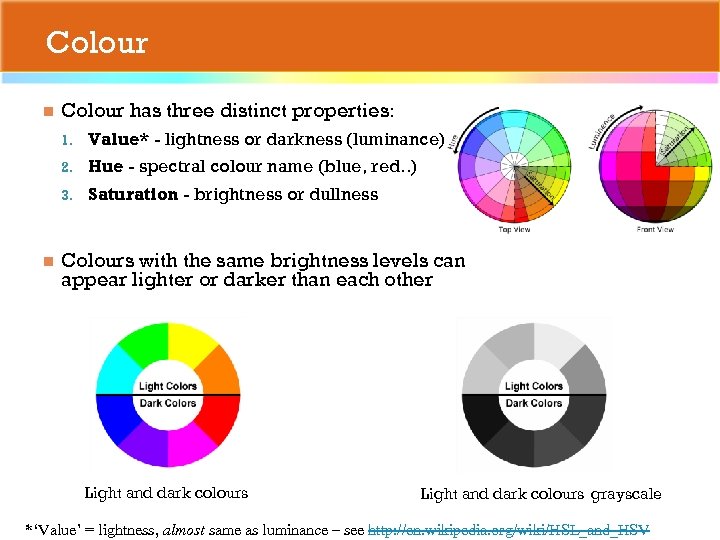 Colour n Colour has three distinct properties: 1. 2. Hue - spectral colour name (blue, red. . ) 3. n Value* - lightness or darkness (luminance) Saturation - brightness or dullness Colours with the same brightness levels can appear lighter or darker than each other Light and dark colours grayscale *‘Value’ = lightness, almost same as luminance – see http: //en. wikipedia. org/wiki/HSL_and_HSV
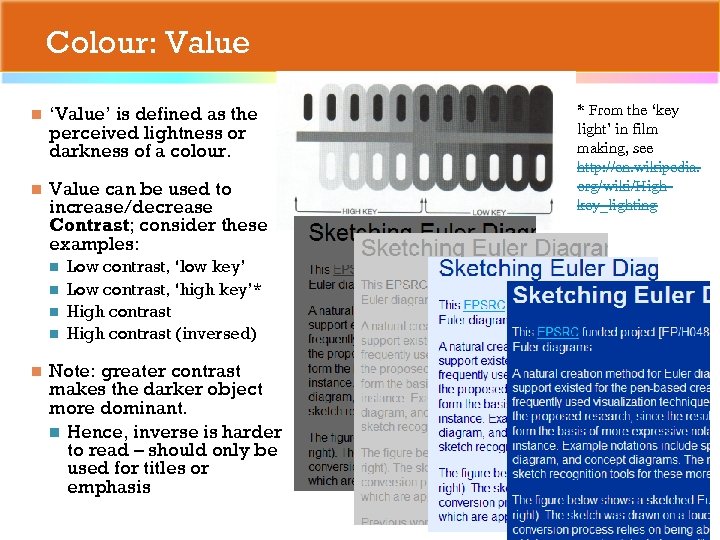 Colour: Value n ‘Value’ is defined as the perceived lightness or darkness of a colour. n Value can be used to increase/decrease Contrast; consider these examples: n n n Low contrast, ‘low key’ Low contrast, ‘high key’* High contrast (inversed) Note: greater contrast makes the darker object more dominant. n Hence, inverse is harder to read – should only be used for titles or emphasis * From the ‘key light’ in film making, see http: //en. wikipedia. org/wiki/Highkey_lighting
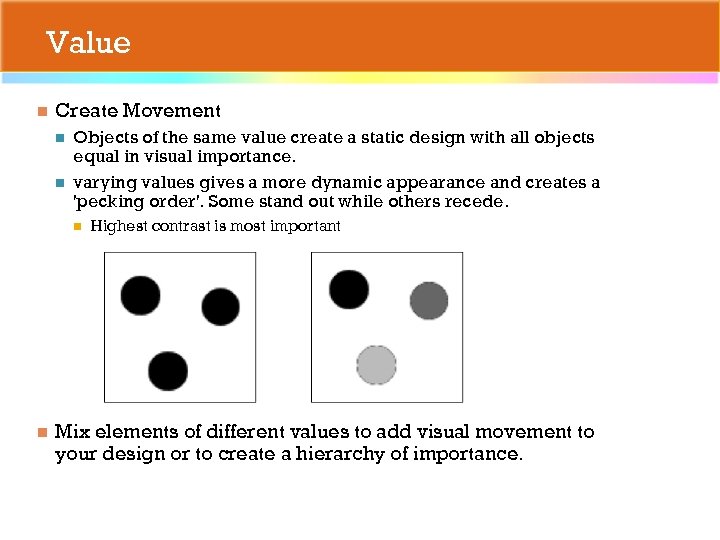 Value n Create Movement n n Objects of the same value create a static design with all objects equal in visual importance. varying values gives a more dynamic appearance and creates a 'pecking order'. Some stand out while others recede. n n Highest contrast is most important Mix elements of different values to add visual movement to your design or to create a hierarchy of importance.
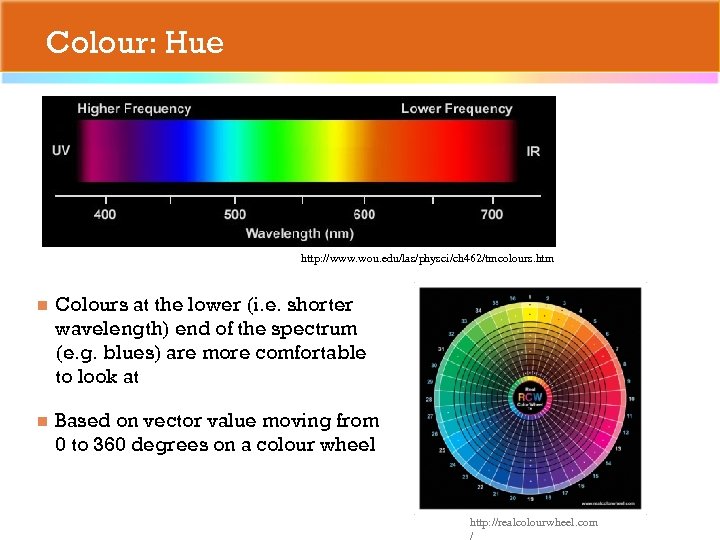 Colour: Hue http: //www. wou. edu/las/physci/ch 462/tmcolours. htm n Colours at the lower (i. e. shorter wavelength) end of the spectrum (e. g. blues) are more comfortable to look at n Based on vector value moving from 0 to 360 degrees on a colour wheel http: //realcolourwheel. com
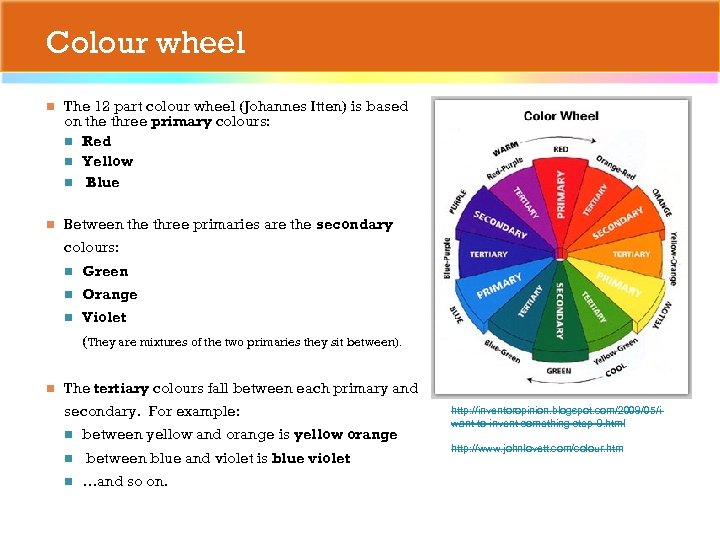 Colour wheel n The 12 part colour wheel (Johannes Itten) is based on the three primary colours: n Red n Yellow n Blue n Between the three primaries are the secondary colours: n Green n Orange n Violet (They are mixtures of the two primaries they sit between). n The tertiary colours fall between each primary and secondary. For example: n n n between yellow and orange is yellow orange between blue and violet is blue violet …and so on. http: //inventoropinion. blogspot. com/2009/05/iwant-to-invent-something-step-9. html http: //www. johnlovett. com/colour. htm
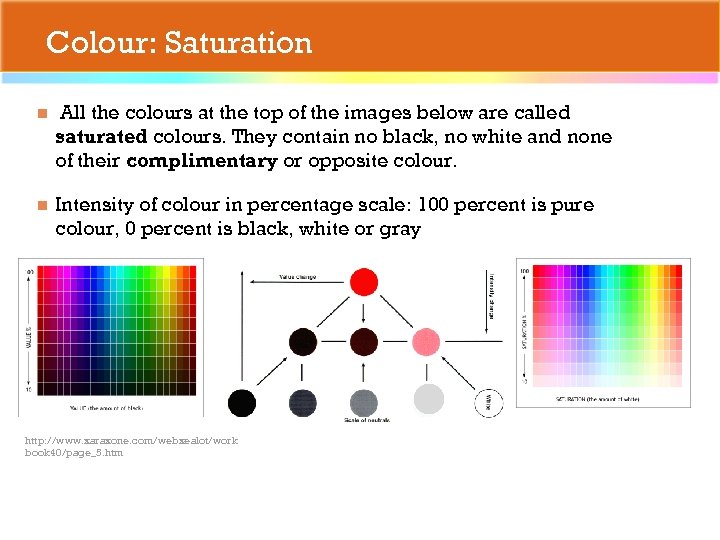 Colour: Saturation n All the colours at the top of the images below are called saturated colours. They contain no black, no white and none of their complimentary or opposite colour. n Intensity of colour in percentage scale: 100 percent is pure colour, 0 percent is black, white or gray http: //www. xaraxone. com/webxealot/work book 40/page_5. htm
 Colour: Saturation n Highly saturated, or pure, colours n E. g. brilliant yellows, reds, and greens, … n Advantages: n Evoke energy, vividness, brightness, and warmth. n They are daring; they have character. n Disadvantages: n When overused, they can tire the eyes. n Most UI designers use them sparingly. n Muted colours make up the bulk of most colour palettes n Tints: adding white n Shades: adding black n Tones: adding some of both (i. e. adding grey – most ‘real’ colours!) (see http: //www. color-wheel-artist. com/hue. html)
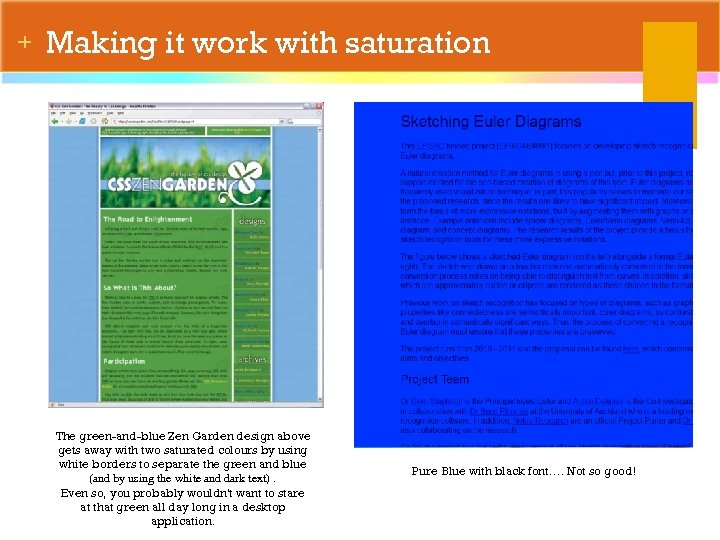 + Making it work with saturation The green-and-blue Zen Garden design above gets away with two saturated colours by using white borders to separate the green and blue (and by using the white and dark text). Even so, you probably wouldn't want to stare at that green all day long in a desktop application. Pure Blue with black font…. Not so good!
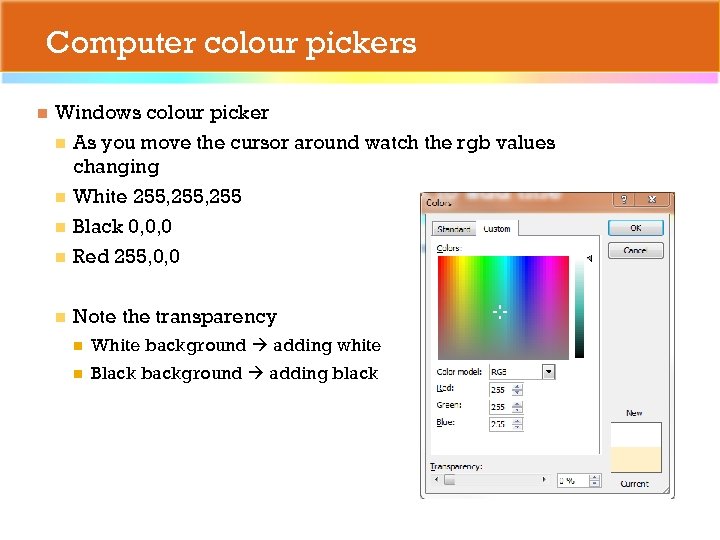 Computer colour pickers n Windows colour picker n As you move the cursor around watch the rgb values changing n White 255, 255 n Black 0, 0, 0 n Red 255, 0, 0 n Note the transparency n White background adding white n Black background adding black
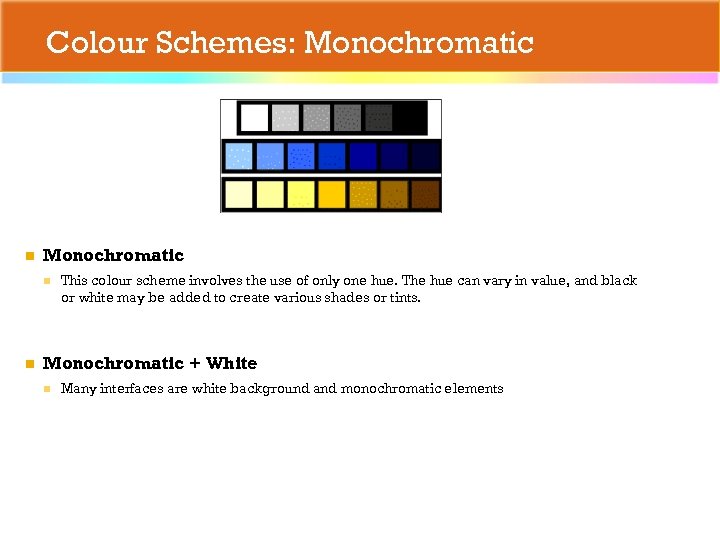 Colour Schemes: Monochromatic n n This colour scheme involves the use of only one hue. The hue can vary in value, and black or white may be added to create various shades or tints. Monochromatic + White n Many interfaces are white background and monochromatic elements
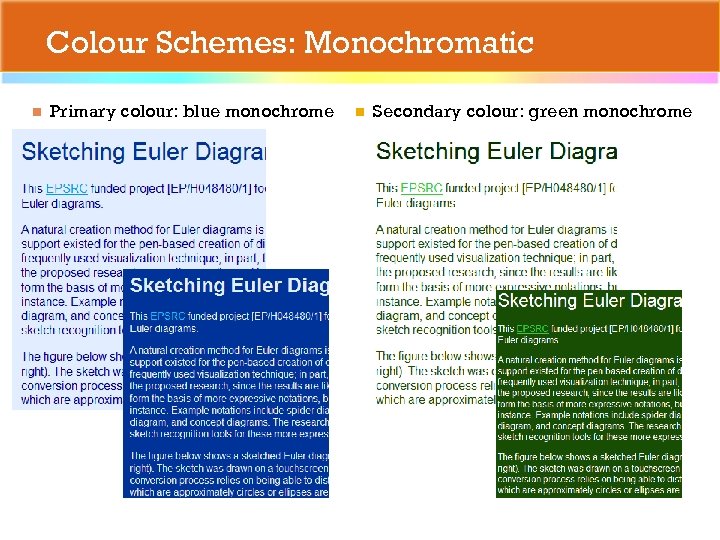 Colour Schemes: Monochromatic n Primary colour: blue monochrome n Secondary colour: green monochrome
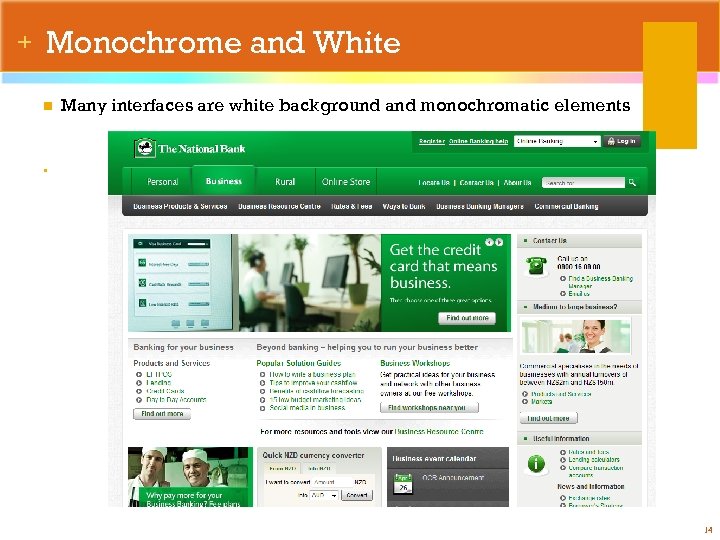 + Monochrome and White n Many interfaces are white background and monochromatic elements • 14
 And now it is Blue 15
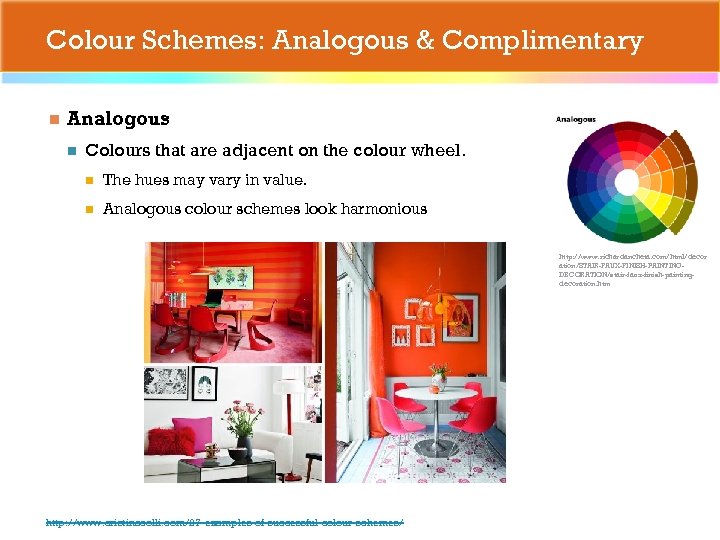 Colour Schemes: Analogous & Complimentary n Analogous n Colours that are adjacent on the colour wheel. n The hues may vary in value. n Analogous colour schemes look harmonious http: //www. richardancheta. com/html/decor ation/STAIR-FAUX-FINISH-PAINTINGDECORATION/stair-faux-finish-paintingdecoration. htm http: //www. cristinacolli. com/27 -examples-of-successful-colour-schemes/
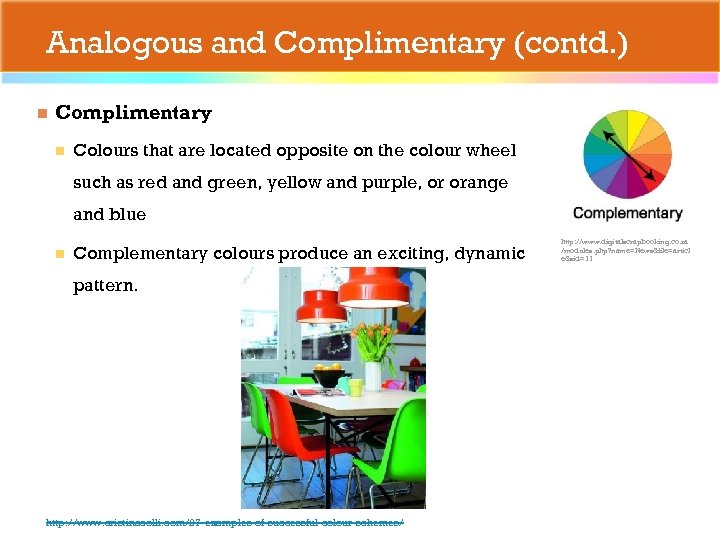 Analogous and Complimentary (contd. ) n Complimentary n Colours that are located opposite on the colour wheel such as red and green, yellow and purple, or orange and blue n Complementary colours produce an exciting, dynamic pattern. http: //www. cristinacolli. com/27 -examples-of-successful-colour-schemes/ http: //www. digitalscrapbooking. co. za /modules. php? name=News&file=articl e&sid=11
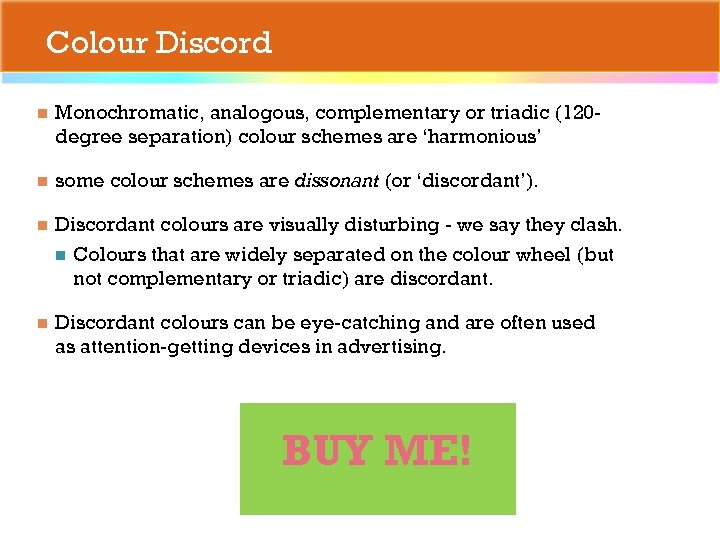 Colour Discord n Monochromatic, analogous, complementary or triadic (120 degree separation) colour schemes are ‘harmonious’ n some colour schemes are dissonant (or ‘discordant’). n Discordant colours are visually disturbing - we say they clash. n Colours that are widely separated on the colour wheel (but not complementary or triadic) are discordant. n Discordant colours can be eye-catching and are often used as attention-getting devices in advertising. BUY ME!
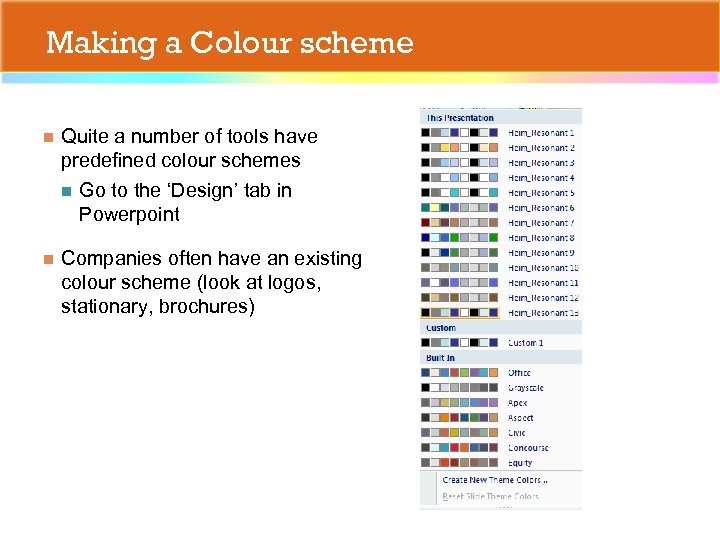 Making a Colour scheme n Quite a number of tools have predefined colour schemes n n Go to the ‘Design’ tab in Powerpoint Companies often have an existing colour scheme (look at logos, stationary, brochures)
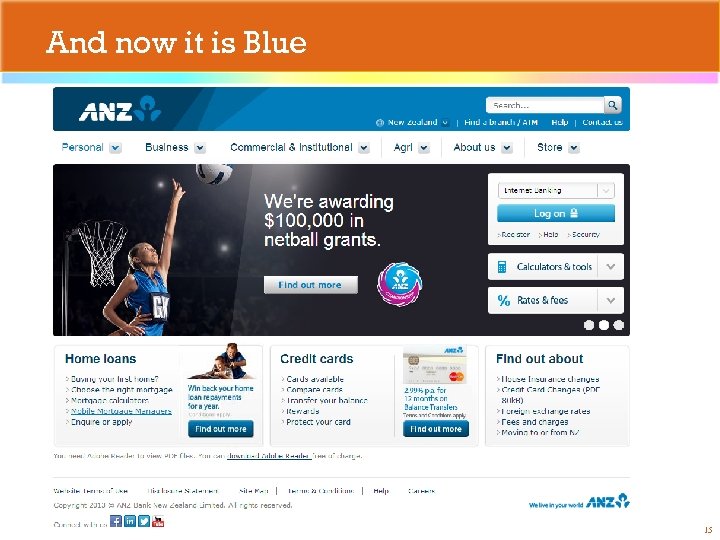
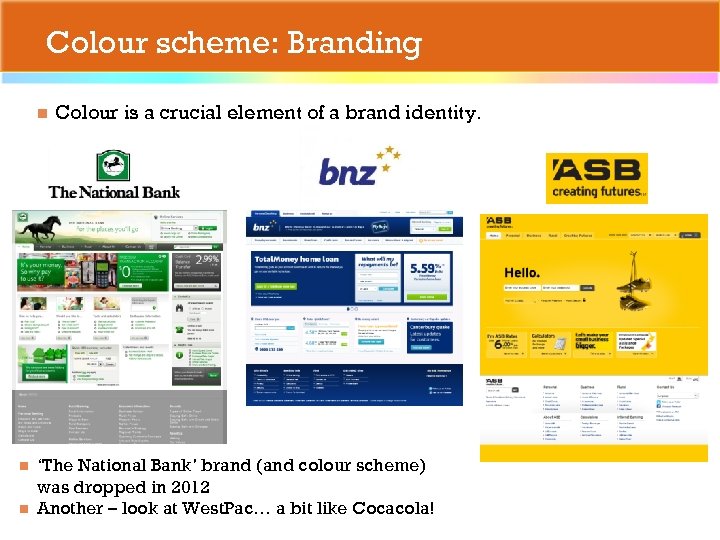 Colour scheme: Branding n n n Colour is a crucial element of a brand identity. ‘The National Bank’ brand (and colour scheme) was dropped in 2012 Another – look at West. Pac… a bit like Cocacola!
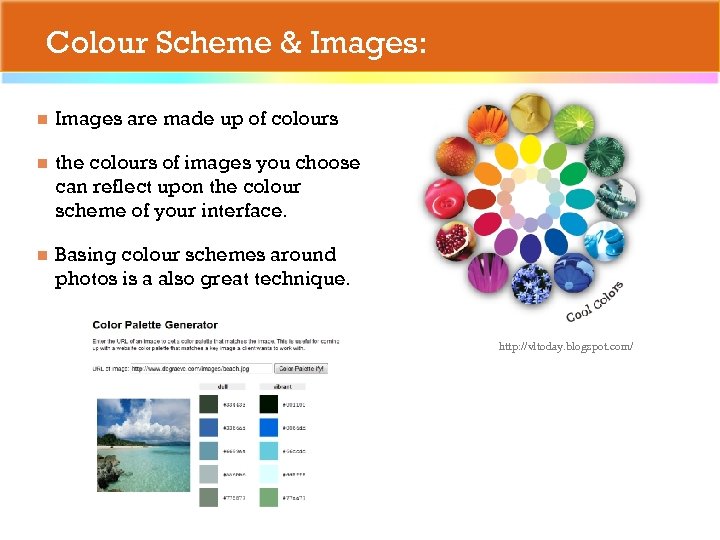 Colour Scheme & Images: n Images are made up of colours n the colours of images you choose can reflect upon the colour scheme of your interface. n Basing colour schemes around photos is a also great technique. http: //vltoday. blogspot. com/
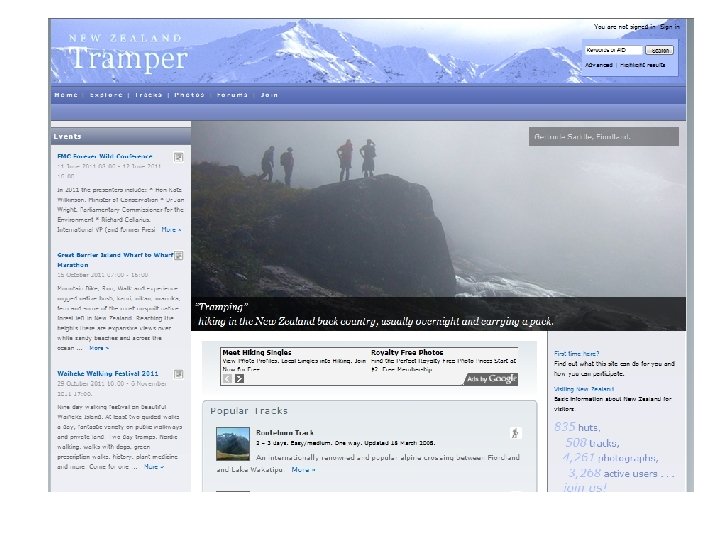 colour Scheme & Images:
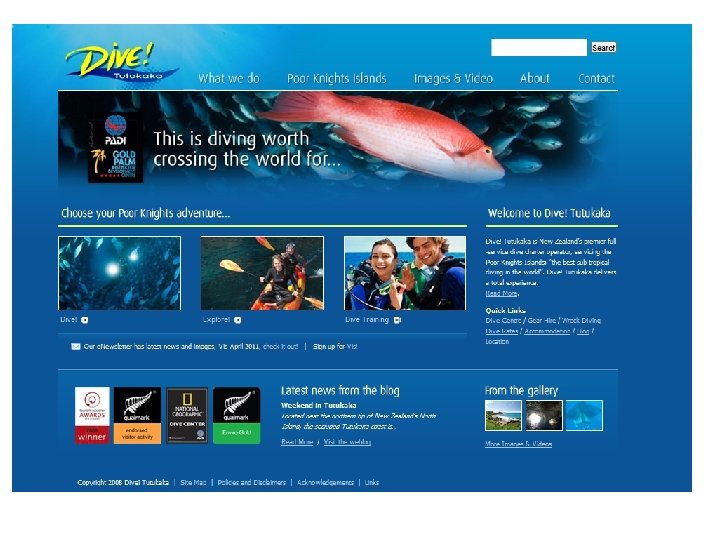 colour Scheme & Images:
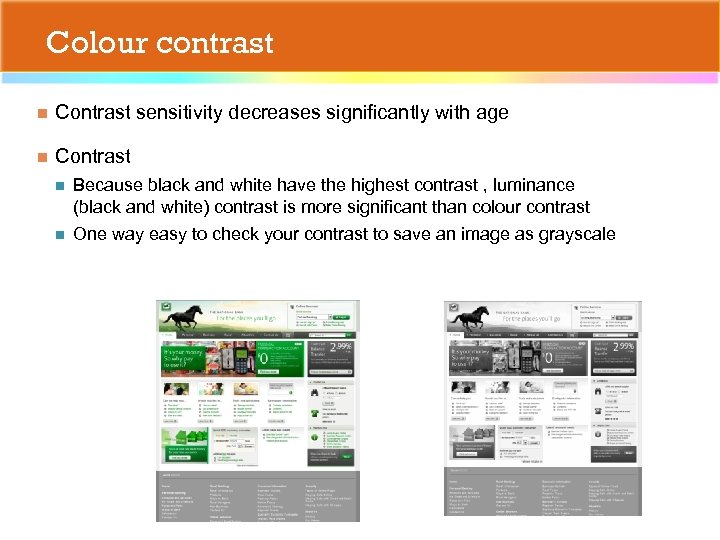 Colour contrast n Contrast sensitivity decreases significantly with age n Contrast n Because black and white have the highest contrast , luminance (black and white) contrast is more significant than colour contrast n One way easy to check your contrast to save an image as grayscale
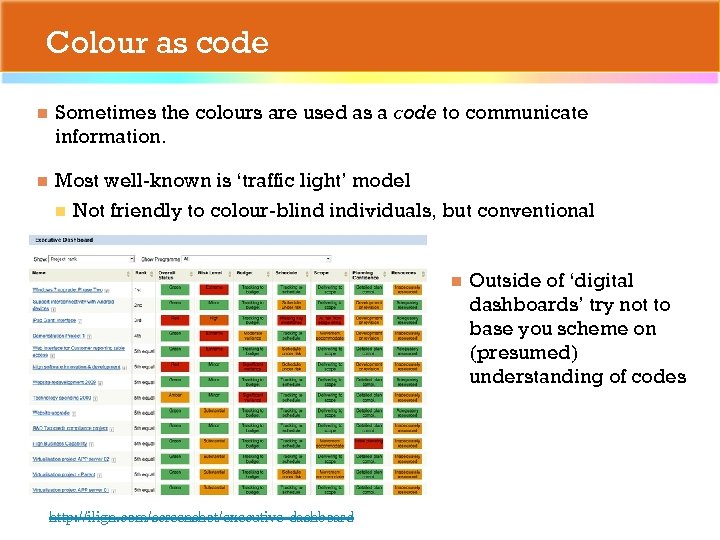 Colour as code n Sometimes the colours are used as a code to communicate information. n Most well-known is ‘traffic light’ model n Not friendly to colour-blind individuals, but conventional n http: //ilign. com/screenshot/executive-dashboard Outside of ‘digital dashboards’ try not to base you scheme on (presumed) understanding of codes
 Summary n Colour is a fundamental element of aesthetics n High contrast is important for readability n Monotone colour schemes are the easiest to ‘get right’ n More complex colour schemes can be ‘borrowed’ from colour palettes or company branding n Images are a part of the colour scheme n Use colour as a code sparingly
 Learning outcomes n The colour properties n V. . n H. . n S… n Colour schemes n M… n A… & C… n Colour and branding n Images and the colour scheme of a UI n Design a UI colour scheme (in your assignment)
 References n Heim, The Resonant Interface, chapter 9 n Further reading: n http: //daphne. palomar. edu/design/Default. htm n http: //www. leonardo. info/isast/articles/behrens. html n n http: //www. digitalweb. com/articles/principles_of_design/ http: //www. colormatters. com/color-and-marketing/color -and-branding