


 Скачать презентацию http accahc org http optimalintegration org ACCAHC
d4f5b56eb3425a238fbfeac0bb7e06ae.ppt
- Количество слайдов: 25
 http: //accahc. org http: //optimalintegration. org
 ACCAHC Mission Advance patient care through fostering mutual understanding and respect among the healthcare professions.
 An organization and a project built to Practice Collaboration in Order to Create Optimal Access & Integration
 Context: Policy & Health System Change • Policy: Specific inclusion in federal healthcare overhaul legislation Workforce inclusion Delivery (medical homes, community health) Payment (non-discrimination) Research (comparative effectiveness) Health promotion & prevention • Policy: “Real world” focus at NCCAM New strategic plan focuses on health, outcomes, disciplines & integration • Health systems 25% with some form of CAM Major initiatives: VA, Allina, Beth Israel NY, Swedish, Duke plus Patient choice • Employers/payers/public health Cost, over-treatment, pain Primary care potential
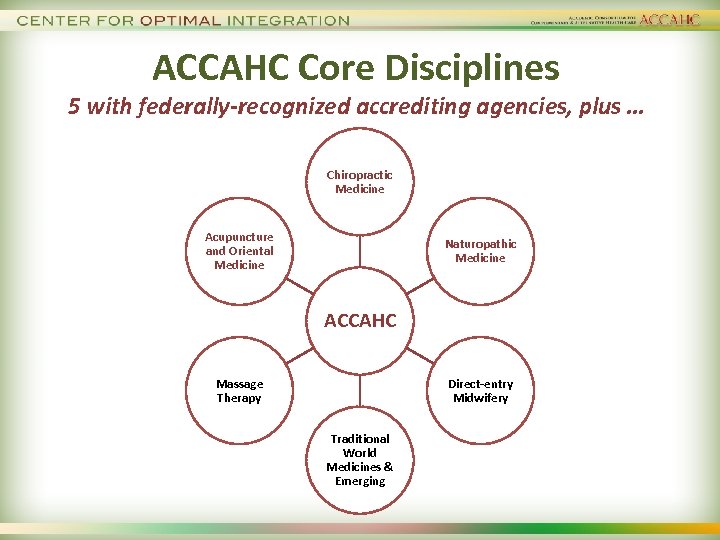 ACCAHC Core Disciplines 5 with federally-recognized accrediting agencies, plus … Chiropractic Medicine Acupuncture and Oriental Medicine Naturopathic Medicine ACCAHC Massage Therapy Direct-entry Midwifery Traditional World Medicines & Emerging
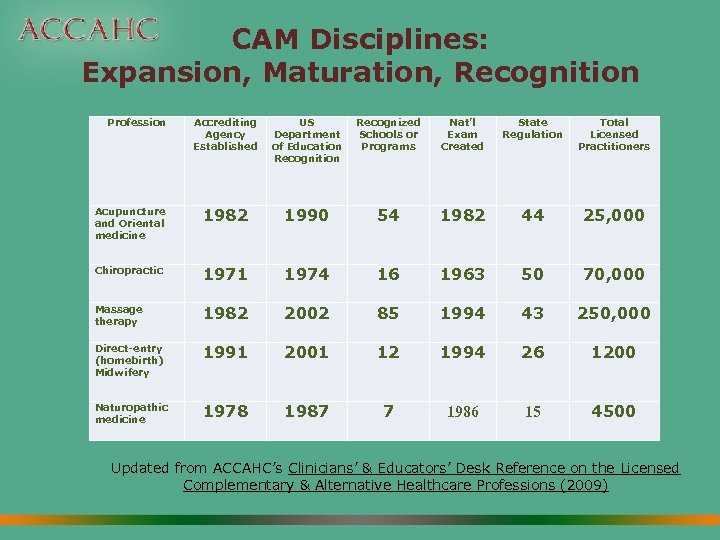 CAM Disciplines: Expansion, Maturation, Recognition Profession Accrediting Agency Established US Department of Education Recognized Schools or Programs Nat’l Exam Created State Regulation Total Licensed Practitioners Acupuncture and Oriental medicine 1982 1990 54 1982 44 25, 000 Chiropractic 1971 1974 16 1963 50 70, 000 Massage therapy 1982 2002 85 1994 43 250, 000 Direct-entry (homebirth) Midwifery 1991 2001 12 1994 26 1200 Naturopathic medicine 1978 1987 7 1986 15 4500 Updated from ACCAHC’s Clinicians’ & Educators’ Desk Reference on the Licensed Complementary & Alternative Healthcare Professions (2009)
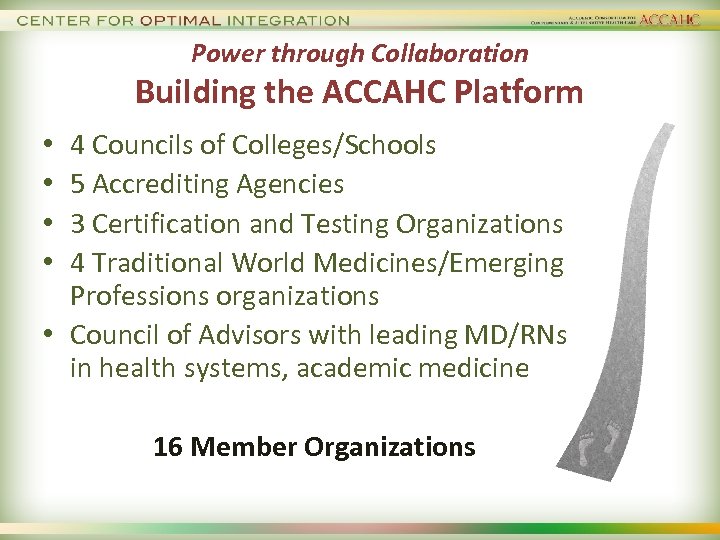 Power through Collaboration Building the ACCAHC Platform 4 Councils of Colleges/Schools 5 Accrediting Agencies 3 Certification and Testing Organizations 4 Traditional World Medicines/Emerging Professions organizations • Council of Advisors with leading MD/RNs in health systems, academic medicine • • 16 Member Organizations
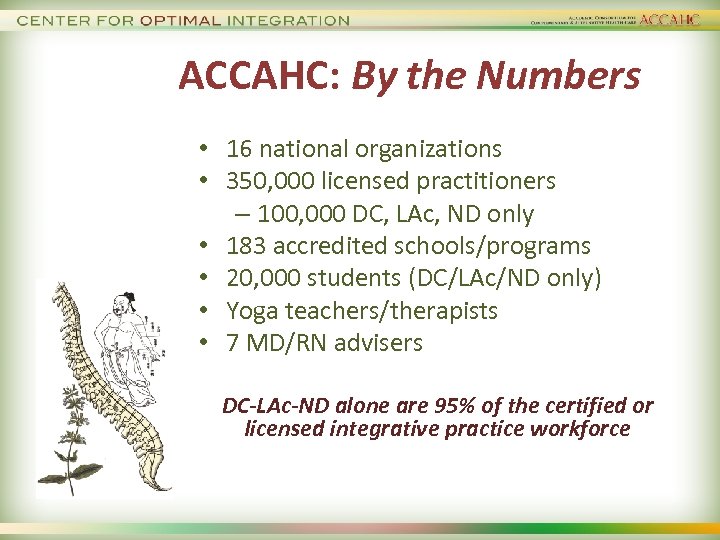 ACCAHC: By the Numbers • 16 national organizations • 350, 000 licensed practitioners – 100, 000 DC, LAc, ND only • 183 accredited schools/programs • 20, 000 students (DC/LAc/ND only) • Yoga teachers/therapists • 7 MD/RN advisers DC-LAc-ND alone are 95% of the certified or licensed integrative practice workforce
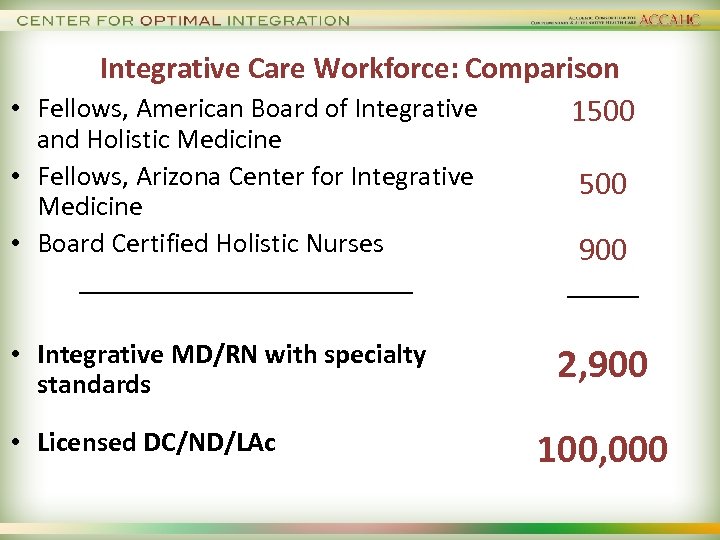 Integrative Care Workforce: Comparison • Fellows, American Board of Integrative 1500 and Holistic Medicine • Fellows, Arizona Center for Integrative Medicine • Board Certified Holistic Nurses ____________ • Integrative MD/RN with specialty standards • Licensed DC/ND/LAc 500 900 ______ 2, 900 100, 000
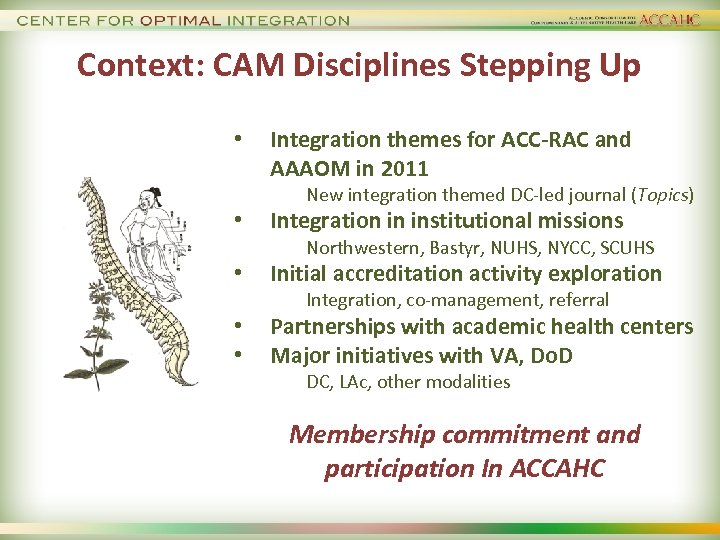 Context: CAM Disciplines Stepping Up • Integration themes for ACC-RAC and AAAOM in 2011 New integration themed DC-led journal (Topics) • Integration in institutional missions Northwestern, Bastyr, NUHS, NYCC, SCUHS • Initial accreditation activity exploration Integration, co-management, referral • • Partnerships with academic health centers Major initiatives with VA, Do. D DC, LAc, other modalities Membership commitment and participation In ACCAHC
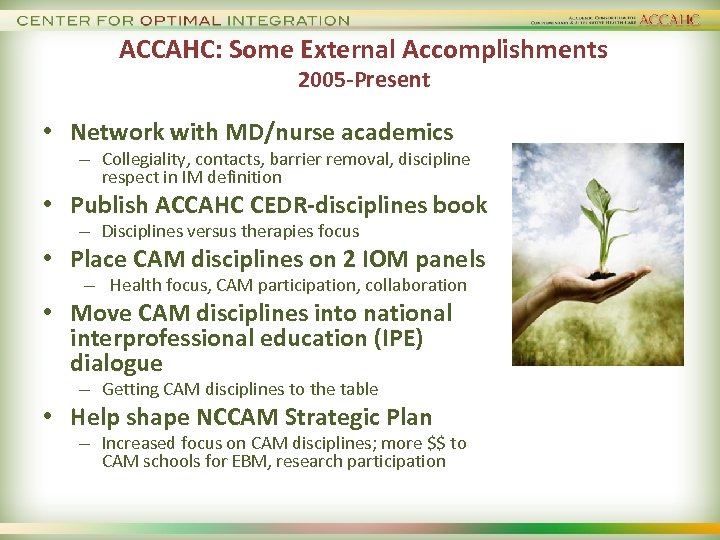 ACCAHC: Some External Accomplishments 2005 -Present • Network with MD/nurse academics – Collegiality, contacts, barrier removal, discipline respect in IM definition • Publish ACCAHC CEDR-disciplines book – Disciplines versus therapies focus • Place CAM disciplines on 2 IOM panels – Health focus, CAM participation, collaboration • Move CAM disciplines into national interprofessional education (IPE) dialogue – Getting CAM disciplines to the table • Help shape NCCAM Strategic Plan – Increased focus on CAM disciplines; more $$ to CAM schools for EBM, research participation
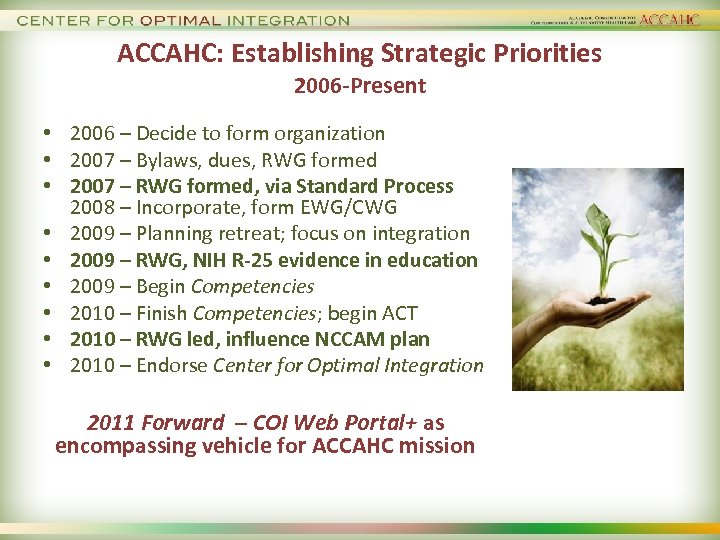 ACCAHC: Establishing Strategic Priorities 2006 -Present • 2006 – Decide to form organization • 2007 – Bylaws, dues, RWG formed • 2007 – RWG formed, via Standard Process 2008 – Incorporate, form EWG/CWG • 2009 – Planning retreat; focus on integration • 2009 – RWG, NIH R-25 evidence in education • 2009 – Begin Competencies • 2010 – Finish Competencies; begin ACT • 2010 – RWG led, influence NCCAM plan • 2010 – Endorse Center for Optimal Integration 2011 Forward – COI Web Portal+ as encompassing vehicle for ACCAHC mission
 Identified Self-Care for the CAM Disciplines to Foster System Inclusion • Competencies • Evidence (as language of integration and as practice improvement )
 • Forge optimal care that respects patient choice • Activate & support educators, students, researchers, clinicians & administrators • Influence other stakeholders • Create access Become accepted parts of care teams
 COI: Methods • Aggregate useful information – Templates, tools, models, how-to, curricular components • Organize activity – Newsletters, communities of interest – Educate on key policy issues • Online course(s) – Competencies, possible certification • Stimulate leadership
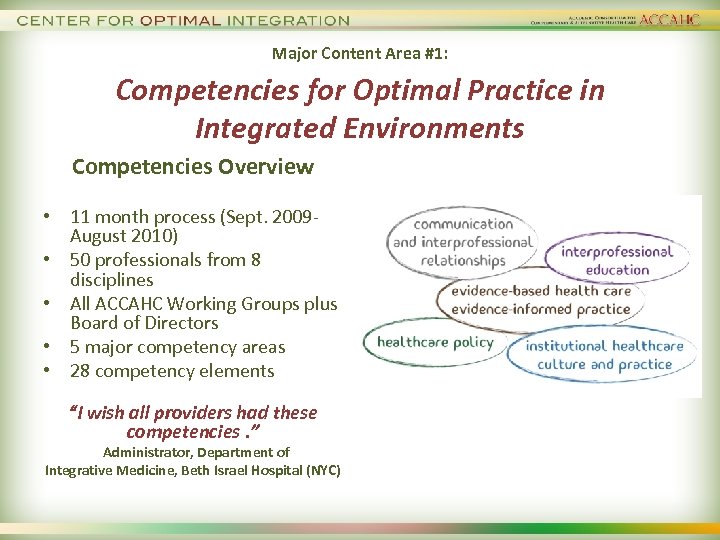 Major Content Area #1: Competencies for Optimal Practice in Integrated Environments Competencies Overview • 11 month process (Sept. 2009 August 2010) • 50 professionals from 8 disciplines • All ACCAHC Working Groups plus Board of Directors • 5 major competency areas • 28 competency elements “I wish all providers had these competencies. ” Administrator, Department of Integrative Medicine, Beth Israel Hospital (NYC)
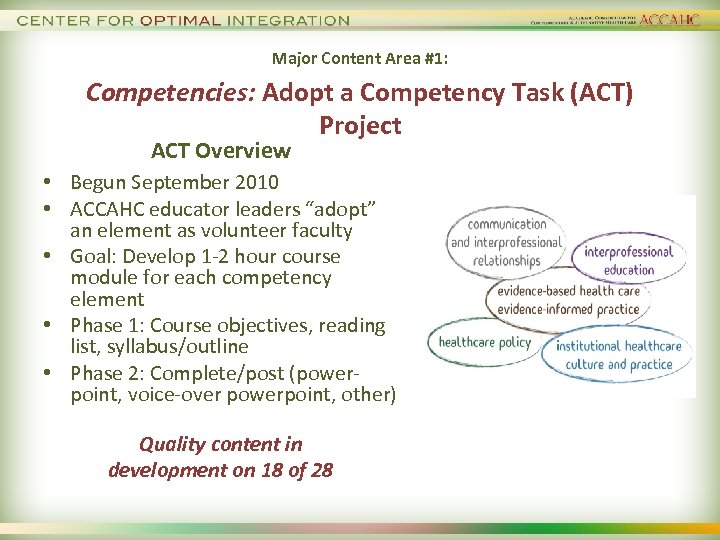 Major Content Area #1: Competencies: Adopt a Competency Task (ACT) Project ACT Overview • Begun September 2010 • ACCAHC educator leaders “adopt” an element as volunteer faculty • Goal: Develop 1 -2 hour course module for each competency element • Phase 1: Course objectives, reading list, syllabus/outline • Phase 2: Complete/post (powerpoint, voice-over powerpoint, other) Quality content in development on 18 of 28
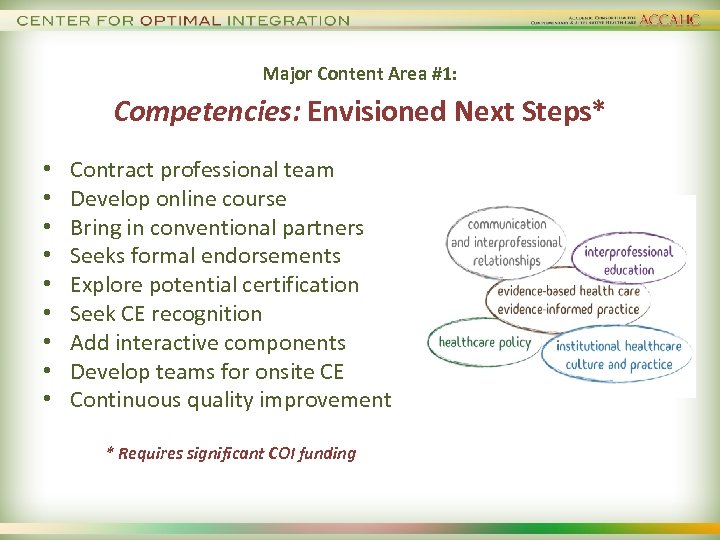 Major Content Area #1: Competencies: Envisioned Next Steps* • • • Contract professional team Develop online course Bring in conventional partners Seeks formal endorsements Explore potential certification Seek CE recognition Add interactive components Develop teams for onsite CE Continuous quality improvement * Requires significant COI funding
 Major Content Area #2: Evidence: The Language of Integration • • • Key Audiences Door opener Medical directors In-service presentations Grand rounds One-on-one referrals Key Attitudes/Skills Research literacy Comfort with science Non-defensive Articulate about strengths and weaknesses Evidence-Based Healthcare and Evidence Informed Practice: Key ACCAHC Competency Domain
 Major Content Area #2: Evidence Opportunity: Partnership for Dissemination of Exceptional Learning from NIH-Funded Programs Overview of “R-25 s” Programs Funded by NIH to: • Expand role of evidence in education in CAM schools • Foster research literacy • Stimulate research interests • 5 DC schools, 2 ND schools with NIH funded programs – All are represented in ACCAHC • Requirement to disseminate 185 ACCAHC-affiliated, accredited programs have never had educational support in this areas.
 Major Content Area #2: Partnership for Dissemination: Sample Content Areas • Defining evidence-related competencies – Clarity on what EBM is* • Strategies to engage institutional leaders in culture change – Faculty – Board/Trustees • Share best practices/proven strategies • Role of librarians • Engage dialogue on challenges of evidence & research in whole practice fields
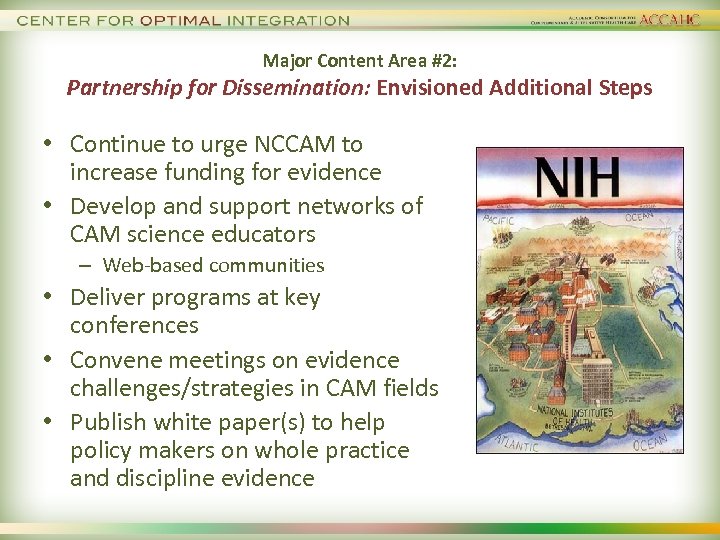 Major Content Area #2: Partnership for Dissemination: Envisioned Additional Steps • Continue to urge NCCAM to increase funding for evidence • Develop and support networks of CAM science educators – Web-based communities • Deliver programs at key conferences • Convene meetings on evidence challenges/strategies in CAM fields • Publish white paper(s) to help policy makers on whole practice and discipline evidence
 COI: Additional Envisioned Programs Training Leadership in Optimal Integration • • Use experts in leadership Use experts on team care Train individuals Train local teams Top interest of ACCAHC Board Create Communities in Optimal Integration • • Accrediting agency issues Delivery issues Payment issues Policy issues Convening/white papers
 • ACCAHC strategy is an organizer’s – Make plans based on resources available • Basic requirements: $105, 000 over 3 years ($315, 000) – Fundamental level of 2 key projects – Some staffing, web, consulting, writing, organizing, content development • Resources for excellence: Numerous major project opportunities Societal value of optimal integration is tremendous. What we achieve will rest on what we can bring to the work.
 An organization and a project built to practice collaboration in order to create optimal access and integration. Thank-you!