 Скачать презентацию HSERV 526 Qualitative Research in Public Health Stephen
daa1911611eef999855b2cdc73014f3b.ppt
- Количество слайдов: 44




HSERV 526 Qualitative Research in Public Health Stephen Bezruchka TA: Anthony Sok-Heng Tessandori
Qualitative Research in Public Health Understanding a culture by getting to know it personally, rather than counting/measuring aspects of it Leads to hypotheses that can be investigated by quantitative techniques Rigor and validity in qualitative research Cultural familiarity respect for adherents respecting you
Qualitative Research: soft science?

Health Services Department Social and Behavioral Sciences track COMPETENCIES
Qualitative Competencies document review, qualitative research, bias: how the researcher’s sociocultural position affects the instrument development, direct questions asked, methods of data observation, informant interviews, collection, interpretation and focus groups, formal methods dissemination describe complementary features and ways to increase trustworthiness of appropriate integration of qualitative the qualitative process and findings and quantitative approaches to write a methods section for a proposal research regarding health problems methods: of a population • content analysis epistemological toolbox to view social • thematic description phenomena & gain insight into • grounded theory meanings and actions • Phenomenology subjectivity, reflexivity, ethnography, • Hermeneutics epistemology, deconstruction, • Discourse analysis position and voice • Narrative analysis classify the types of findings produced • Ethnography by different levels of data synthesis and interpretation
Other Qualitative Research Courses Seminar in Advanced Qualitative Methods James Pfeiffer, Autumn 2006, Hserv 590 – Theoretical foundations, in-depth analysis and use of computers (ATLAS ti) Interpretive methods (phenomenology, narrative analysis, and grounded theory) Helene Starks, Winter 2006, Medical History Ethics MHE 497
Learning Objectives for this session review syllabus describe the terms emic and etic list methods of qualitative investigations discuss possible research questions and choosing teams recount the attributes of a cultural domain Examples of qualitative research and relationship to quantitative work
Handouts • Course schedule with exercise due dates • Syllabus with readings • Exercises

SIGN THE SHEET BEING HANDED OUT – Those taking course for credit only
WORK of course Overview of many methods Attending lectures Rapid pace, INTERRUPT Exercises in class Group project Individual exercises Group presentation and report Extra session needed as a group
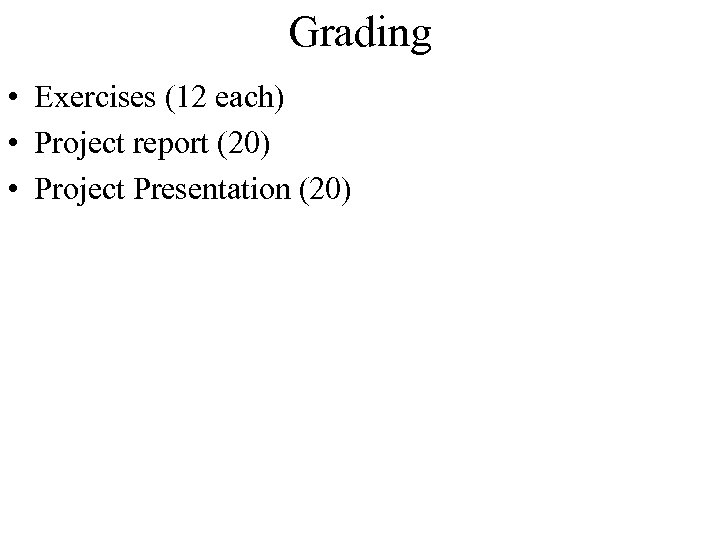
Grading • Exercises (12 each) • Project report (20) • Project Presentation (20)
Lecture notes http: //courses. washington. edu/hserv 526/ Course readings Course Packet Rams Copy Center 4144 Univ Way NE Recording of lectures
Textbooks Required: -Bernard Research methods in Anthropology (2006) or 2002 Third Edition – Ulin, P. R. , E. T. Robinson, et al. (2005). Qualitative Methods: A field guide for applied research. San Francisco, Jossey-Bass. Recommended – Krueger, Focus Groups – Le. Compte Ethnographer's Toolkit – Morse Qual. Res Methods for Health Prof. – Scrimshaw RAP – Spradley Ethnographic Interview

TODAY’S READING Body Ritual Among the Nacirema In course packet
Past Students suggest • Focus on techniques in exercises, not research question • Coding is important • Much of material is "common sense" • Why do it? See flaws in outsiders programs • when you listen to what someone says or watch what they do, you learn much about that setting that you won’t see from counting how many people came to the health center
PROJECTS • PAST YEAR'S Titles in today' syllabus • PAST YEAR'S Reports on reserve in library • Guidelines: no sensitive topics, receptive population, everyone mentally competent, adult, easily accessible, 5 minute rule, focused topic • Groups with non-native English speakers to have one native English speaker
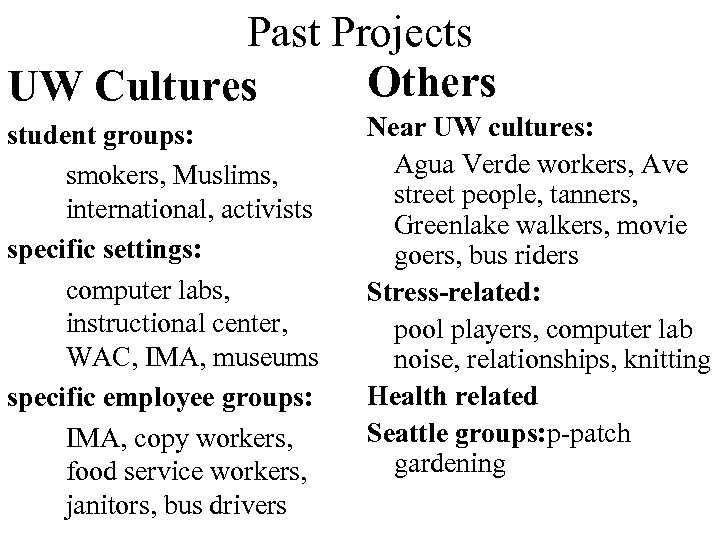
Past Projects Others UW Cultures student groups: smokers, Muslims, international, activists specific settings: computer labs, instructional center, WAC, IMA, museums specific employee groups: IMA, copy workers, food service workers, janitors, bus drivers Near UW cultures: Agua Verde workers, Ave street people, tanners, Greenlake walkers, movie goers, bus riders Stress-related: pool players, computer lab noise, relationships, knitting Health related Seattle groups: p-patch gardening
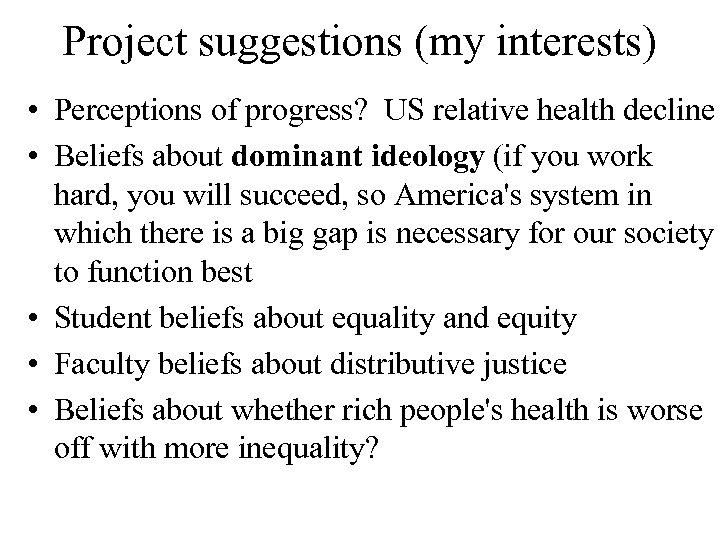
Project suggestions (my interests) • Perceptions of progress? US relative health decline • Beliefs about dominant ideology (if you work hard, you will succeed, so America's system in which there is a big gap is necessary for our society to function best • Student beliefs about equality and equity • Faculty beliefs about distributive justice • Beliefs about whether rich people's health is worse off with more inequality?
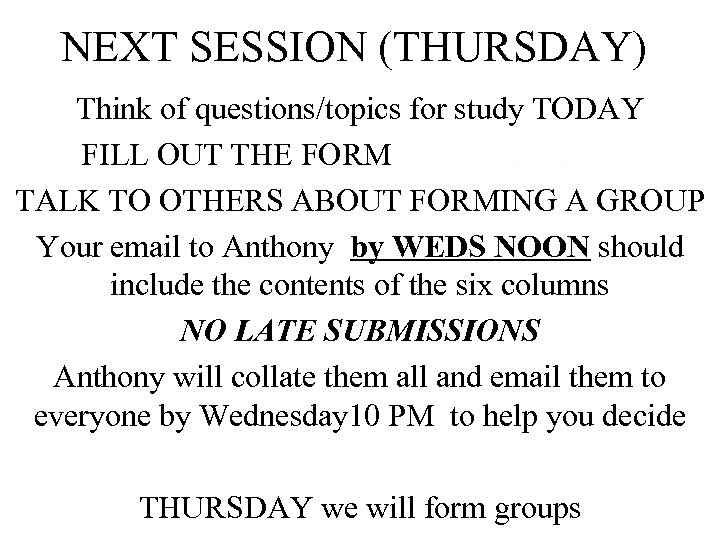
NEXT SESSION (THURSDAY) Think of questions/topics for study TODAY FILL OUT THE FORM including TIMES TALK TO OTHERS ABOUT FORMING A GROUP Your email to Anthony by WEDS NOON should include the contents of the six columns NO LATE SUBMISSIONS Anthony will collate them all and email them to everyone by Wednesday 10 PM to help you decide THURSDAY we will form groups
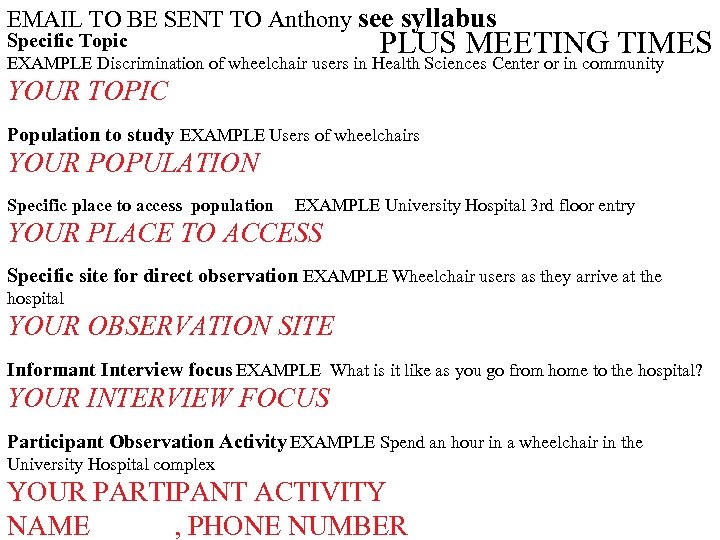
EMAIL TO BE SENT TO Anthony see syllabus PLUS MEETING TIMES Specific Topic EXAMPLE Discrimination of wheelchair users in Health Sciences Center or in community YOUR TOPIC Population to study EXAMPLE Users of wheelchairs YOUR POPULATION Specific place to access population EXAMPLE University Hospital 3 rd floor entry YOUR PLACE TO ACCESS Specific site for direct observation EXAMPLE Wheelchair users as they arrive at the hospital YOUR OBSERVATION SITE Informant Interview focus EXAMPLE What is it like as you go from home to the hospital? YOUR INTERVIEW FOCUS Participant Observation Activity EXAMPLE Spend an hour in a wheelchair in the University Hospital complex YOUR PARTIPANT ACTIVITY NAME______, PHONE NUMBER _____
CRUCIAL STEP BEFORE THURSDAY (AFTER SENDING YOUR EMAILED EXERCISE PROBLEM • Study the email Anthony sends with the projects people have thought of, serial numbered to identify them (Wednesday 10 pm) • Rank the ones you are interested in working in, and bring the top three to Thursday's class – Look at the times for possible meeting on that project, and don't rank them if the meeting time suggested is not possible for you.
Qualitative Research try to understand how communities perceive a concept that is a part of their culture - INHERENTLY POLITICAL
QUALITATIVE RESEARCH • • OBSERVATION, INFORMANT INTERVIEWS, formal methods (free list, pile sort) FOCUS GROUPS PARTICIPATORY METHODS RAP (similar to fast food) CODING, ANALYSIS
Qualitative Research • • • Iterative Cyclical Refinement of focus Flexible Triangulation
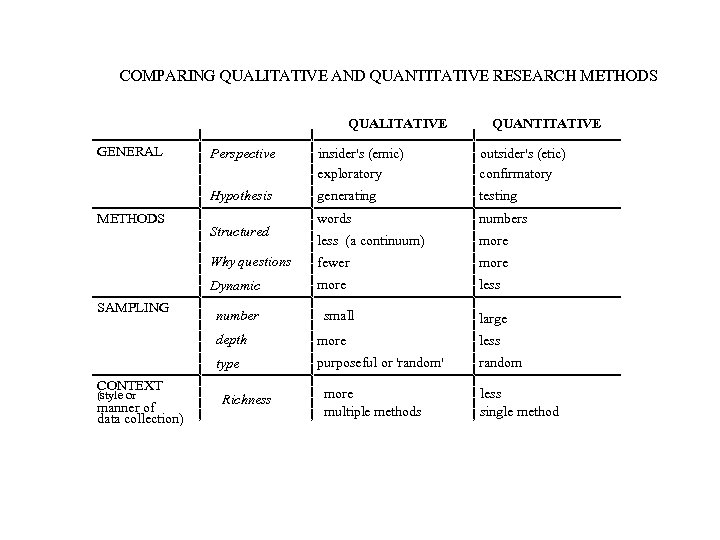
COMPARING QUALITATIVE AND QUANTITATIVE RESEARCH METHODS QUALITATIVE GENERAL QUANTITATIVE outsider's (etic) confirmatory generating testing words numbers less (a continuum) more Why questions fewer more Dynamic SAMPLING insider's (emic) exploratory Hypothesis METHODS Perspective more less Structured number small large depth (style or manner of data collection) less type CONTEXT more purposeful or 'random' random Richness more multiple methods less single method
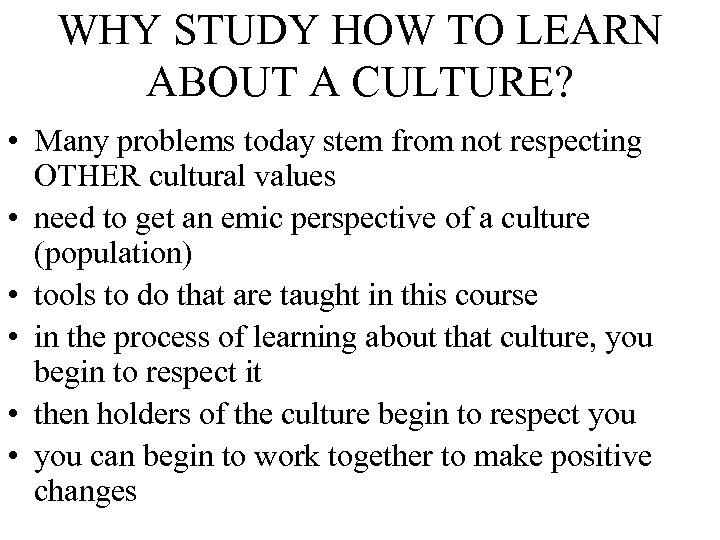
WHY STUDY HOW TO LEARN ABOUT A CULTURE? • Many problems today stem from not respecting OTHER cultural values • need to get an emic perspective of a culture (population) • tools to do that are taught in this course • in the process of learning about that culture, you begin to respect it • then holders of the culture begin to respect you • you can begin to work together to make positive changes
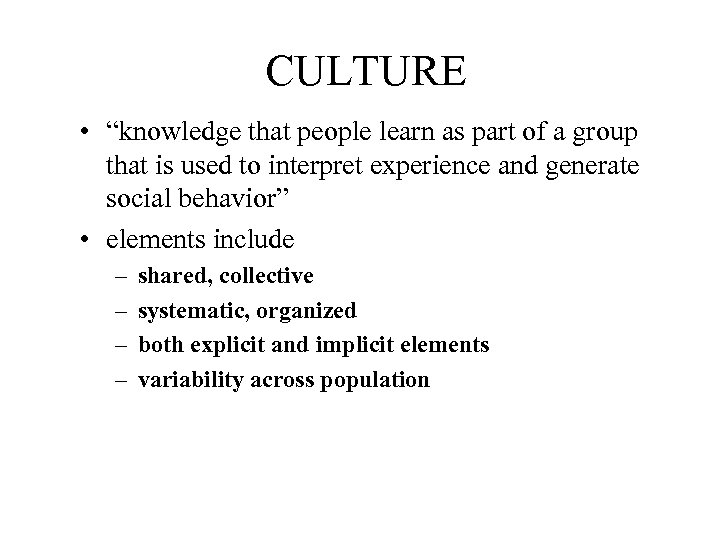
CULTURE • “knowledge that people learn as part of a group that is used to interpret experience and generate social behavior” • elements include – – shared, collective systematic, organized both explicit and implicit elements variability across population
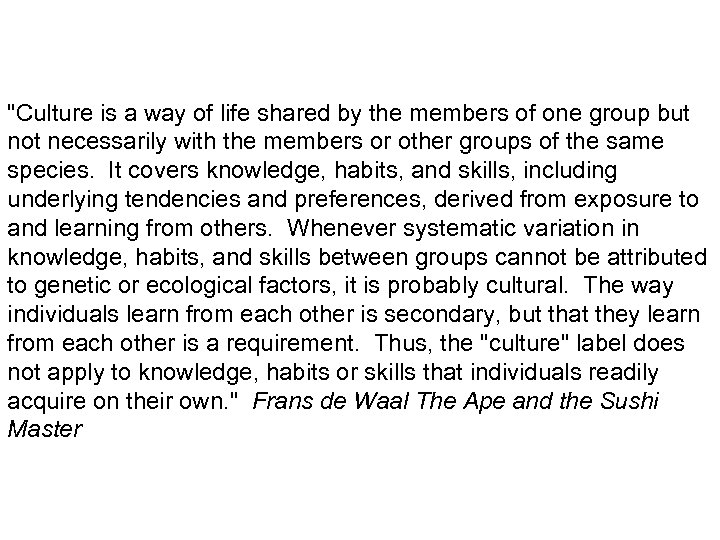
"Culture is a way of life shared by the members of one group but not necessarily with the members or other groups of the same species. It covers knowledge, habits, and skills, including underlying tendencies and preferences, derived from exposure to and learning from others. Whenever systematic variation in knowledge, habits, and skills between groups cannot be attributed to genetic or ecological factors, it is probably cultural. The way individuals learn from each other is secondary, but that they learn from each other is a requirement. Thus, the "culture" label does not apply to knowledge, habits or skills that individuals readily acquire on their own. " Frans de Waal The Ape and the Sushi Master
Cultural attributes • “cultural consensus”, shared among people in the same group • holistic, interconnected, usually studied by long intensive field studies, seeing how things relate in broad patterns • aspects are overt or covert – people within the culture may not want to tell you, or can’t generate the answer – differences in way behavior is organized and characterized
Cultural differences • Man in hospital with ventricular tachycardia • Baby massaged with ghee in cold after delivery • bikas
emic etic Insider’s perspective
CULTURE • Hard to describe one's culture • Understanding another culture is difficult • How do you learn about cultures?
CULTURAL DOMAINS • defined as category of cultural meaning that includes other cultural categories, (from an emic perspective), – domain can be related to a place/location (e. g. school or clinic), a concept (diarrhea, food flexibility), material things (medicines, cars), or people (shamans, gypsies, nuns) • Cognitive Anthropology (semantic distinctions) • Componential analysis (building blocks of meaning in semantics)
Domain attributes • cover term (that indicates a category of cultural knowledge) words used in plural – tree – illnesses that women get in a village in Nepal • included terms (at least 2, that are the elements that comprise a domain) – oak, yew, pine, maple – mutu khane
Domain attributes • semantic relationship where all included terms are related to cover term in same way – pine and maple are “kinds of trees” – mutu khane is an illness that women get in Nepal • DOMAINS ARE NOT THEMES – (Spradley reading on themes in packet) – comes out in Analysis later
Domain attributes • boundaries: certain things are not part of that domain – a tulip is not within the domain of a tree – e. g. sunburn is not an illness that women in a village get in Nepal • OFTEN/USUALLY, domains are not found in many qualitative studies
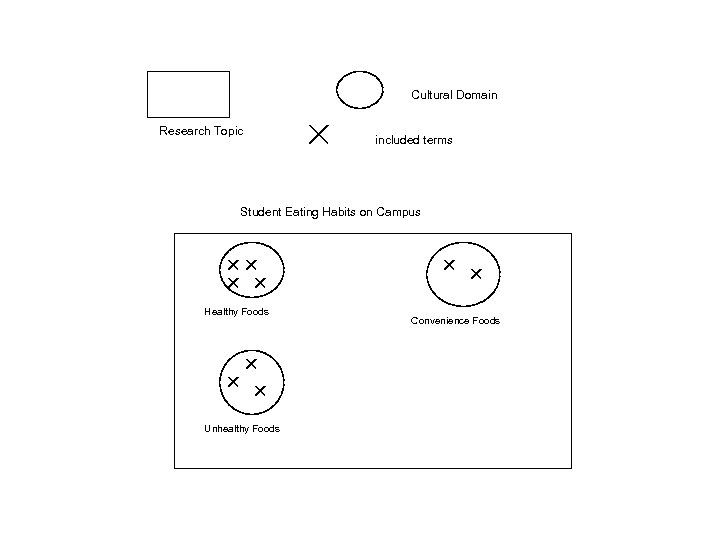
Cultural Domain Research Topic included terms Student Eating Habits on Campus Healthy Foods Unhealthy Foods Convenience Foods
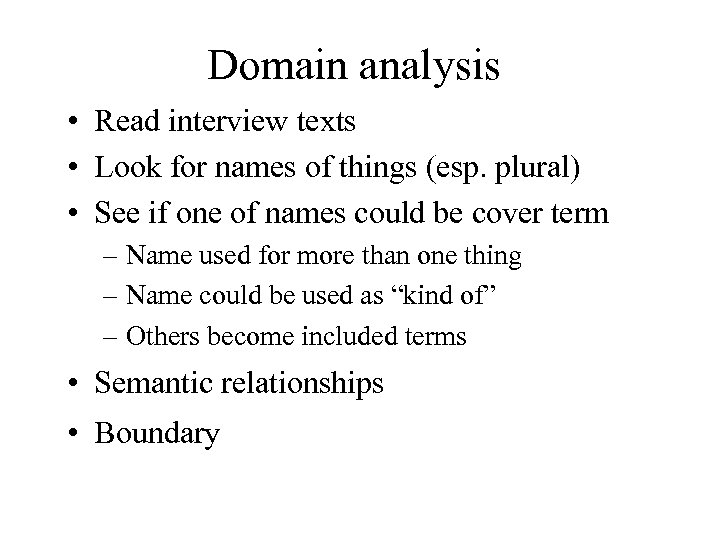
Domain analysis • Read interview texts • Look for names of things (esp. plural) • See if one of names could be cover term – Name used for more than one thing – Name could be used as “kind of” – Others become included terms • Semantic relationships • Boundary
Class exercise • Take notes on interview of TA by instructor • Look for included terms – Cover term – Semantic relationship – Boundary
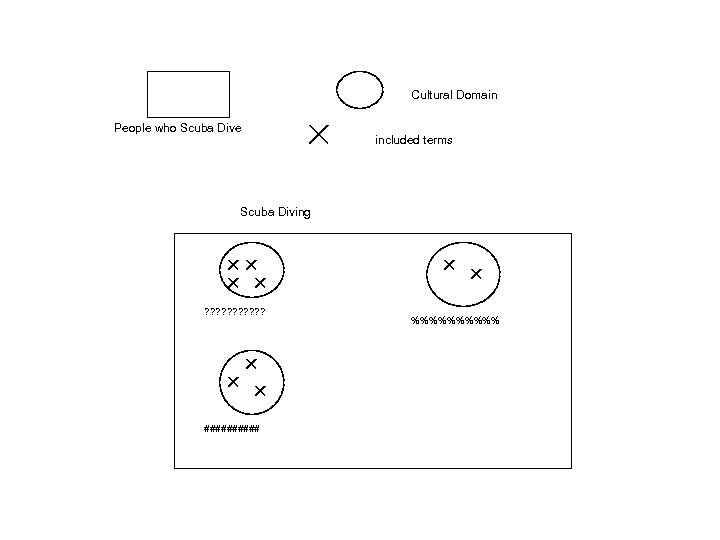
Cultural Domain People who Scuba Dive included terms Scuba Diving ? ? ? ##### %%%%%
EXAMPLES: Qualitative studies STD’s in minority women prevention trial (reading packet) – Behavioral intervention based on knowledge of cultural beliefs produced large decline in re-infection rate
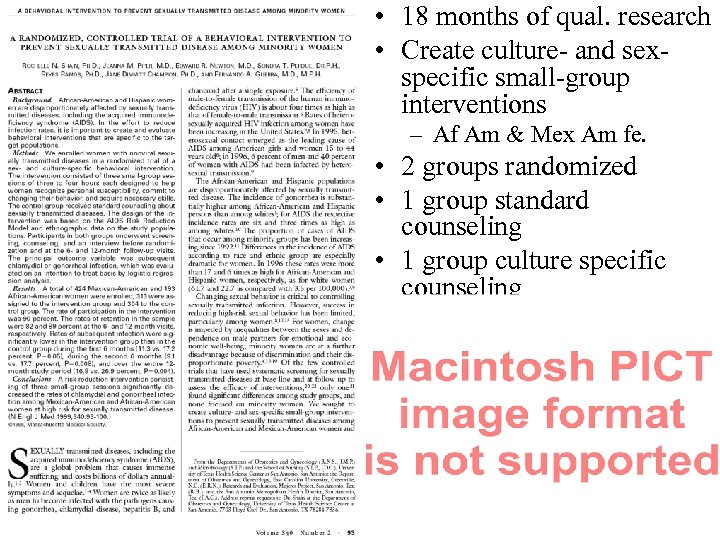
• 18 months of qual. research • Create culture- and sexspecific small-group interventions – Af Am & Mex Am fe. • 2 groups randomized • 1 group standard counseling • 1 group culture specific counseling
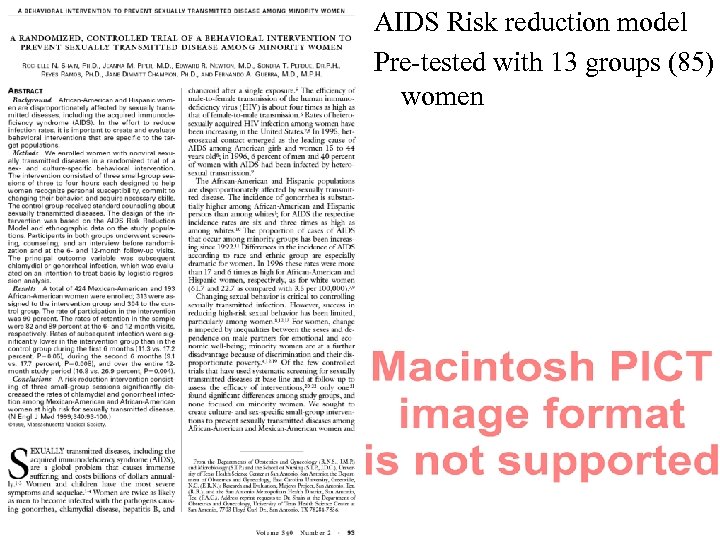
AIDS Risk reduction model Pre-tested with 13 groups (85) women
Summary of session • Qualitative and quantitative methods are complementary • Cultural domains are a useful way to understand how groups organize words
Скачать презентацию HSERV 526 Qualitative Research in Public Health Stephen
daa1911611eef999855b2cdc73014f3b.ppt