


 Скачать презентацию HSARPA and Chemical Countermeasures for Homeland Security May
8cf4f22d0c6469c4aa09d9efed9ddc4d.ppt
- Количество слайдов: 18
 HSARPA and Chemical Countermeasures for Homeland Security May 25 -27, 2004 “NDIA Homeland Security Symposium”, Arlington, VA Dr. William S. Rees, Jr. Dr. Steven B. Buchsbaum Program Managers HSARPA William. Rees@dhs. gov Steven. Buchsbaum@dhs. gov NDIA Homeland Security Symposium May 26, 2004
 HSARPA Chemical Countermeasures Solicitations • Past Solicitations – RA 03 -01 – SBIR FY 04. 1 • Present Solicitations – Water Study (CLOSED) – SBIR FY 04. 2 • Future Solicitation – BAA 04 -10 NDIA Homeland Security Symposium May 26, 2004 2
 PAST SOLICITATIONS NDIA Homeland Security Symposium May 26, 2004 3
 RA 03 -01: Detection Systems for Biological and Chemical Countermeasures • TTA-1: Bioagent Autonomous Networked Detectors (BAND) • TTA-2: Rapid Automated Biological Identification System (RABIS) • TTA-3: Autonomous Rapid Facility Chemical Agent Monitor (ARFCAM) • TTA-4: Lightweight Autonomous Chemical Identification System (LACIS) • TTA-5: Portable High-throughput Integrated Laboratory Identification System (PHILIS) NDIA Homeland Security Symposium May 26, 2004 4
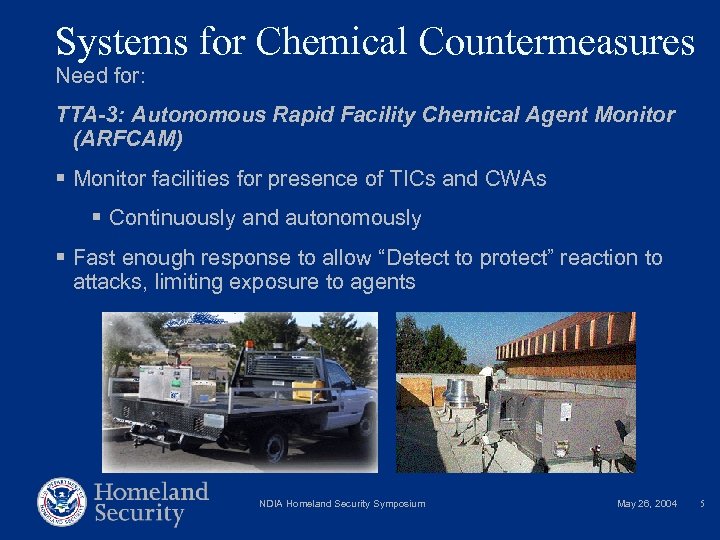 Systems for Chemical Countermeasures Need for: TTA-3: Autonomous Rapid Facility Chemical Agent Monitor (ARFCAM) § Monitor facilities for presence of TICs and CWAs § Continuously and autonomously § Fast enough response to allow “Detect to protect” reaction to attacks, limiting exposure to agents NDIA Homeland Security Symposium May 26, 2004 5
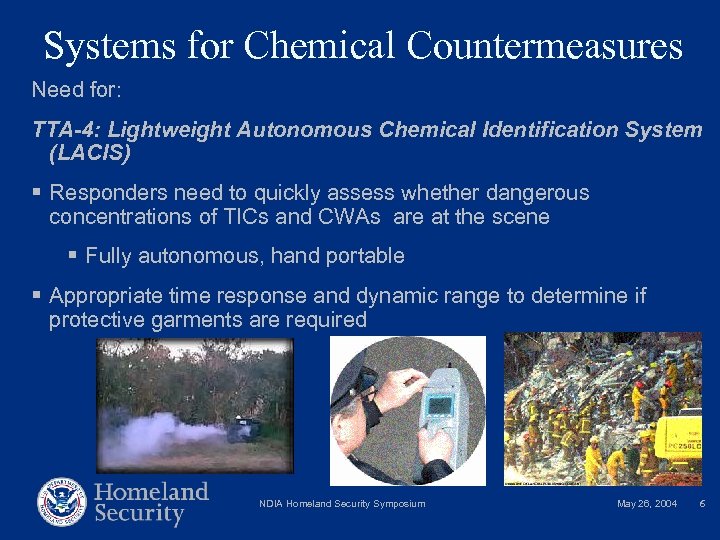 Systems for Chemical Countermeasures Need for: TTA-4: Lightweight Autonomous Chemical Identification System (LACIS) § Responders need to quickly assess whether dangerous concentrations of TICs and CWAs are at the scene § Fully autonomous, hand portable § Appropriate time response and dynamic range to determine if protective garments are required NDIA Homeland Security Symposium May 26, 2004 6
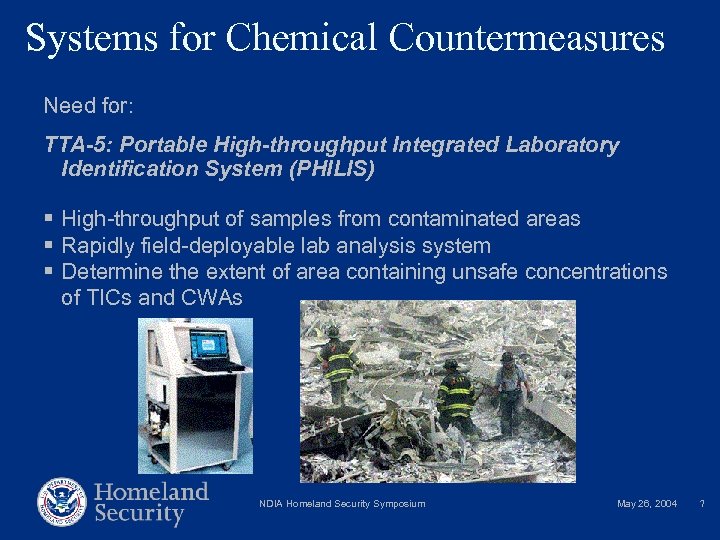 Systems for Chemical Countermeasures Need for: TTA-5: Portable High-throughput Integrated Laboratory Identification System (PHILIS) § High-throughput of samples from contaminated areas § Rapidly field-deployable lab analysis system § Determine the extent of area containing unsafe concentrations of TICs and CWAs NDIA Homeland Security Symposium May 26, 2004 7
 Small Business Innovation Research (SBIR) Program FY 04. 1 SBIR Topic Number H-SB 04. 1 -001 • New System/Technologies to Detect Low Vapor Pressure Chemicals (e. g. TICs) • Objective: Develop a new system for rapid and accurate detection of low vapor pressure chemicals, particularly TICs NDIA Homeland Security Symposium May 26, 2004 8
 Small Business Innovation Research (SBIR) Program FY 04. 1 SBIR Topic Number H-SB 04. 1 -001 • Three Phase effort: – Phase I – Develop a concept for an LVP detector – Phase II – Formalize concept from Phase I (all engineering and validation testing performed) – Phase III – Commercial Applications • 48 Submissions received • 8 awards NDIA Homeland Security Symposium May 26, 2004 9
 PRESENT SOLICITATIONS NDIA Homeland Security Symposium May 26, 2004 10
 HSARPA Contributions to Critical Infrastructure Protection Portfolio • System Study for Municipal Domestic Water Security - Cross-cutting project involving multiple portfolios. Concerns include: • CIP: Damage to the physical components of the purification and distribution system or resulting from the trusted insider threat. • Biological countermeasures: The near-end-user distribution components of the system involving a hydrolytically robust threat with sufficient toxicity / morbidity to impact even in highly diluted concentrations. • Radiological / nuclear countermeasures: Potential for having to decontaminate significant portions of the distribution system. • Chemical countermeasures: Post-event system re-certification challenge. NDIA Homeland Security Symposium May 26, 2004 11
 Small Business Innovation Research (SBIR) Program FY 04. 2 SBIR Topic Number H-SB 04. 2 -003 • Alternatives to Cl 2 in Municipal Water Purification • Objective: Identify and produce large quantities of an alternative to Chlorine for the purpose of disinfecting municipal water supplies in a more cost effective and safer manner than currently exists • Alternate focus: Ultimately decrease the amount of disinfection byproducts associated with the use of Chlorine NDIA Homeland Security Symposium May 26, 2004 12
 Small Business Innovation Research (SBIR) Program FY 04. 2 SBIR Topic Number H-SB 04. 2 -003 • Three Phase effort: – Phase I – Identify and demonstrate the ability of an alternative that inactivates microbial pathogens and prevents re-growth in representative samples – Phase II – Demonstrate the cost effectiveness and safety of identified alternatives and demonstrate the reduced amount of secondary disinfectants required to ensure adequate residual disinfection – Phase III – Commercial Applications NDIA Homeland Security Symposium May 26, 2004 13
 Small Business Innovation Research (SBIR) Program FY 04. 2 SBIR Topic Number H-SB 04. 2 -004 • Wide-Area TIC Neutralization • Objective: Identify and demonstrate safer and more cost effective alternatives to using typical techniques for wide area TIC neutralization • Current methods have deployment shortcomings – Cost of Storage – PPE requirements – Clean-up costs – Substrate damage NDIA Homeland Security Symposium May 26, 2004 14
 Small Business Innovation Research (SBIR) Program FY 04. 2 SBIR Topic Number H-SB 04. 2 -004 • Three Phase effort: – Phase I - Demonstrate broad spectrum utility and economic advantage of alternatives when applied to acids, bases, oxidizing and reducing agents, and hydrolytically stable TICs – Phase II – Develop and conduct laboratory scale demonstration of ≥ 2 wide area TIC neutralization protocols – Phase III – Commercial Applications NDIA Homeland Security Symposium May 26, 2004 15
 FUTURE SOLICITATIONS NDIA Homeland Security Symposium May 26, 2004 16
 BAA 04 -10: Low Vapor Pressure Chemical Detection System (LVPCDS) • Objective: Develop, field-test, and transition to commercialization state-of-the-art components and systems required to effectively detect toxic low vapor pressure compounds • The LVPCDS Program will facilitate a number of HSARPA’s goals, including: – Enabling future enhancements to existing detection components and systems; – Enabling new types of detection components and systems; – Creating next generation components and systems which are robust against novel and engineered threats NDIA Homeland Security Symposium May 26, 2004 17
 BAA 04 -10: Low Vapor Pressure Chemical Detection System (LVPCDS) • BAA addresses several separate Technical Topic Areas (TTAs) – Each TTA solicits a specific approach or tool to augment the Nation’s detection and analysis capabilities – Some TTAs are for component development – Some TTAs are for detection system development • BAA to be released end of May http: //www. hsarpabaa. com NDIA Homeland Security Symposium May 26, 2004 18