


 Скачать презентацию HRM 501 Introduction To IR HRM Topic
67812bc0be7db33d8e4a65647a210278.ppt
- Количество слайдов: 65
 HRM 501: Introduction To IR & HRM Topic 6: Employment Legislation (ERP 2007) – Part 2 3/19/2018 1
 Learning Objectives o Discuss and understand Employment Relations Promulgation – key changes from Fiji’s context o Identify salient features, principles and spirit of the ER Promulgation o Outline the paradigm shift in the labour Reform i. e. , from ‘Adversarial’ to ‘Good faith’. o Identify and discuss provisions on employment contract o Understand how employment can be terminated 3/19/2018 2
 Continued from Part 1 3/19/2018 3
 Part 10 – CHILDREN (s 90 – 99) A ‘child’is defined as a person under the age of eighteen (18) years Prohibited forms of child labour (ILO C. 182) n Slavery, sale and trafficking of children, debt bondage n Forced or compulsory labour or recruitment in armed conflict n Production and trafficking of illicit drugs n Prostitution or pornography performance Minimum age for employment (ILO C. 138) n n 4 15 years or over Under 15 years must not be employed except 13 to 15 years in workplaces which are owned by the same family or other communal or religious groups. Must not be harmful to health
 Part 10 – CHILDREN (cont’d) o Trade union rights – join & vote in trade union elections o Hours of work - Maximum 8 hrs a day with 30 mins paid rest after 4 hours continuous work o Other restrictions - Must not be employed underground in mines - Against the wishes of parent and night work - Employers must keep a register of all children employed in their workplaces 5
 Part 10 – CHILDREN (s 90 – 99) Adopts ILO Conventions: o o 6 C 138 - Minimum Age C 182 – Worst forms of Child Labour
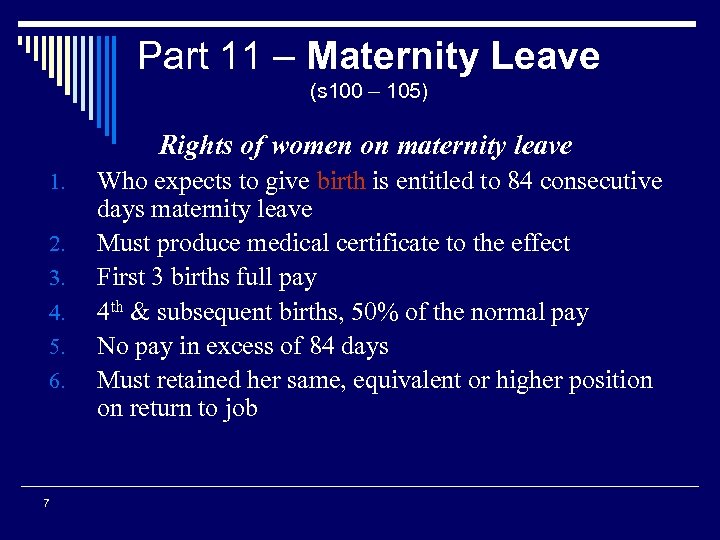 Part 11 – Maternity Leave (s 100 – 105) Rights of women on maternity leave 1. 2. 3. 4. 5. 6. 7 Who expects to give birth is entitled to 84 consecutive days maternity leave Must produce medical certificate to the effect First 3 births full pay 4 th & subsequent births, 50% of the normal pay No pay in excess of 84 days Must retained her same, equivalent or higher position on return to job
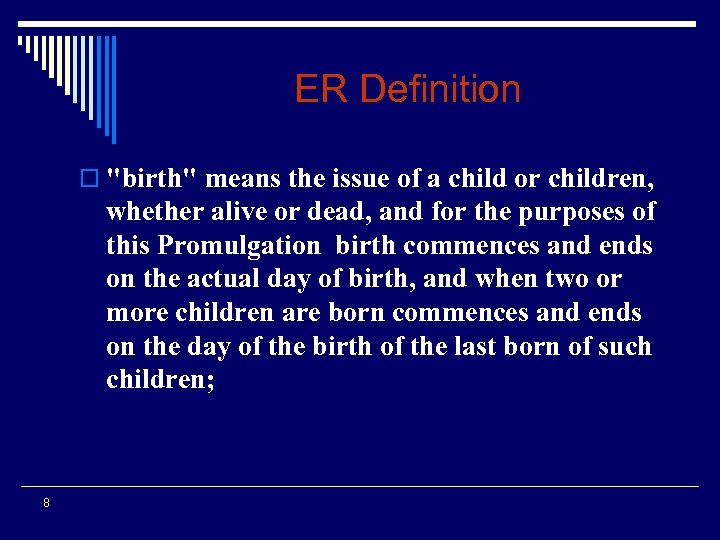 ER Definition o "birth" means the issue of a child or children, whether alive or dead, and for the purposes of this Promulgation birth commences and ends on the actual day of birth, and when two or more children are born commences and ends on the day of the birth of the last born of such children; 8
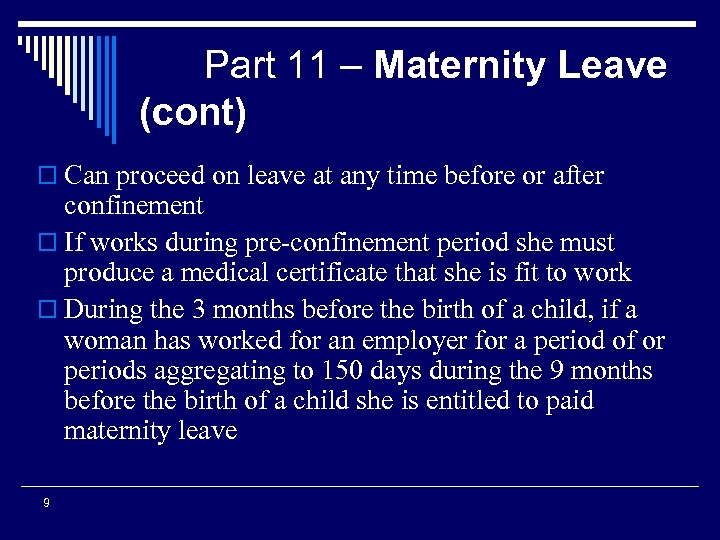 Part 11 – Maternity Leave (cont) o Can proceed on leave at any time before or after confinement o If works during pre-confinement period she must produce a medical certificate that she is fit to work o During the 3 months before the birth of a child, if a woman has worked for an employer for a period of or periods aggregating to 150 days during the 9 months before the birth of a child she is entitled to paid maternity leave 9
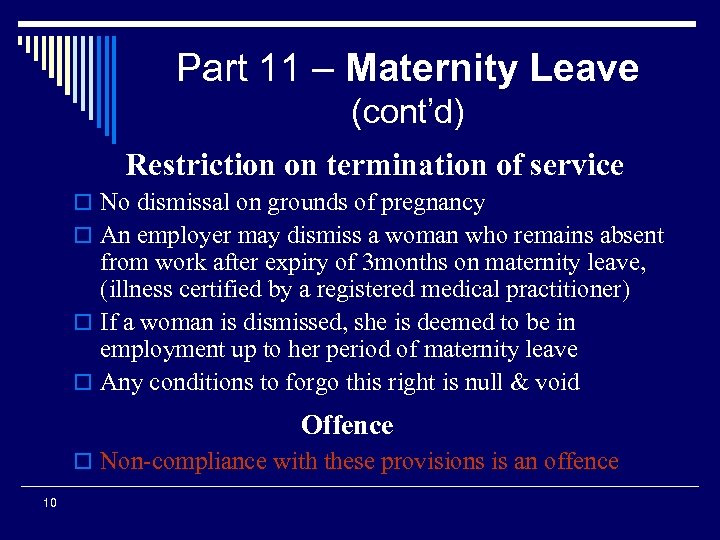 Part 11 – Maternity Leave (cont’d) Restriction on termination of service o No dismissal on grounds of pregnancy o An employer may dismiss a woman who remains absent from work after expiry of 3 months on maternity leave, (illness certified by a registered medical practitioner) o If a woman is dismissed, she is deemed to be in employment up to her period of maternity leave o Any conditions to forgo this right is null & void Offence o Non-compliance with these provisions is an offence 10
 Maternity Leave o Full pay for 3 births & half pay thereafter. o 84 consecutive days, optional to take either before of after birth. o Notify employer by medical certificate – specify possible date of confinement o Can not be terminated during pregnancy and maternity leave period Maximum absence three (3) months. o No reduction in conditions upon return to work 11 19 -Mar-18
 Part 12 – Redundancy for Economic, Technological or Structural Reasons (s 106 – 108) (new provision) Social protection with minimum disruption o Employers to notify workers rep. & PS 30 days before carrying out redundancy o Opportunity for consultation & measures to mitigate o Find alternative employment Redundancy Package o A week’s wages for each completed year of service 12
 EMPLOYMENT REALTIONS PROMULGATION 2007 (ERP) o The ERP establishes new institutions, such as Mediation Unit to provide mediation services. The ERP also establishes an Employment Relations Tribunal and Court to adjudicate grievances between parties to employment contracts. o ERP (2007) establishes the dispute settlement machineries for both unionized and non-unionized workers: o All in-house disputes are settled through an employment grievance procedure as stipulated under their individual contract and collective agreement. o All employment grievances reported to the Ministry is referred to Mediation Service (first port of call) 1– 13
 GRIEVANCES o A grievances is seen as a complaint, or question raised by an individual employee, frequently concerned with hisher entitlements on certain terms and condition of employment like wages, allowances, holiday pay, or promotion etc. , while a dispute is a complaint or a question relating to similar issues raised by, or applicable to groups of employees. o Grievance is when there is any disagreement between an individual employee and the employer. 3/19/2018 14
 Part 13 – Employment Grievances (s 109 – 114) Grounds of Grievances Dismissals 2. Disadvantages 3. Discrimination 4. Sexual harassment 5. Duress 1. 15
 EMPLOYMENT GRIEVANCES (ERP - 2007) o “employment grievance” means a grievance that a worker, may have against the worker’s employer or former employer because of the worker’s claim that— o (a) The worker has been dismissed; o (b) The worker’s employment, or one or more conditions of it, is or are affected to the worker’s disadvantage by some unjustifiable action by the employer; 3/19/2018 16
 EMPLOYMENT GRIEVANCES (ERP - 2007) o c) The worker has been discriminated within the terms of Part 9; o (d) The worker has been sexually harassed in the worker’s employment within the terms of section 76; or o (e) The worker has been subject to duress in the worker’s employment in relation to membership or nonmembership of a union; 3/19/2018 17
 Sexual Harassment o "sexual harassment" means when a worker is sexually harassed in his or her workplace, or places where workers are gathered for workrelated purposes including social activity, when an employer or its representative or a co-worker- a). Makes a request of that worker for sexual intercourse, sexual contact or any other form of sexual activity which contains an implied or overt (i) promise of preferential treatment in that worker’s employment; (ii) threat of detrimental treatment in that worker’s employment; or (iii) threat about the present or future employment status of that worker; 3/19/2018 18
 Sexual Harassment b). by the use of language (whether written or spoken) of a sexual nature or material of sexual nature; c). by physical behaviour or gestures of a sexual nature; or d). creates an intimidating, hostile or humiliating work environment by conduct, word or both on the basis of gender, that subjects the worker to behaviour which is unwelcome or offensive to that worker (whether or not that is conveyed to the employer, its representative or the perpetrator) and that either by its nature or its repetition has a detrimental effect on that worker’s employment, job performance or job satisfaction; In this context, “detrimental effect” includes the creation of an environment which affects a worker’s physical, emotional or mental health and wellbeing; 19
 Duress - ERP o "duress", in a worker’s employment, means if his or her employer or a representative of that employer directly or indirectlya) makes membership of a union or a particular union a condition to be fulfilled if that worker wishes to retain his or her employment; b) makes non-membership of a union or a particular union a condition to be fulfilled if that worker wishes to retain his or her employment; or 3/19/2018 20
 Duress - ERP (c). exerts undue influence on that worker, or offers, or threatens to withhold, or does withhold, a monetary incentive or advantage to or from that worker, or threatens to or does impose a monetary disadvantage on that worker, with intent to induce that worker to become or remain a member of a union or a particular union; to cease to be a member of a union or a particular union; not to become a member of a union or a particular union; in the case of a worker who is authorised to act on behalf of workers, not to act on their behalf or cease to act on their behalf; V. on account of the fact that the worker is, or, as the case may be, is not a member of a union or a particular union, to resign or leave his or her employment; VI. to participate in the formation of a union; or VII. not to participate in the formation of a union; I. III. IV. 3/19/2018 21
 Part 13 – Employment Grievances (cont’d) Grievance Procedures • • 22 An employment contract must set out grievance procedure for settling of grievances (otherwise Schedule 4 applies) Must exhaust all internal appeal system as per the employment contract before referring to mediation service On cases of discrimination & sexual harassment, a worker must decide either to proceed under the Promulgation or Human Rights Commission Act but not both Pursue grievance in person or assisted by a rep. Grievances must be submitted within 6 months After 6 months with employers consent or Tribunal’s permission with good reasons Tribunal may hear the grievance or refer to mediation
 Part of SCHEDULE 4 PROCEDURES FOR SETTLEMENT OF EMPLOYMENT GRIEVANCES o If the grievance is not settled, worker must give written statement to the employer setting out: i) the nature of grievance, ii) the facts giving rise to the grievance, and iii) the remedy sought. o If the employer is not prepared to grant the remedy sought, and the parties have not otherwise settled the grievance, the employer must as soon as possible, but in any event not later than the 7 th day after the day on which the employer receives the worker's written statement, give to the worker a written response setting out— o (a) the employers view of the facts; and o (b) the reasons why the employer is not prepared to grant the remedy sought 23
 Part of SCHEDULE 4 PROCEDURES FOR SETTLEMENT OF EMPLOYMENT GRIEVANCES 7. If— (a) the worker is dismissed; or (b) the worker is not satisfied with the employer's written response; or (c) the employer fails to provide, within 7 days after the day on which the employer receives the workers written statement, a written response; or (d) the employer and worker have agreed to waive the requirement for an exchange of written statements and the worker is not satisfied with the employers response to the grievance, o The worker may refer the employment grievance to the Mediation Services 1– 24
 Part 13 – Employment Grievances (cont’d) • Nature of grievance Cover other aspect of employment grievance during determination of a grievance Statements privileged Statements or information given during mediation Reasons for dismissal Employers must give reasons in writing for dismissal 25
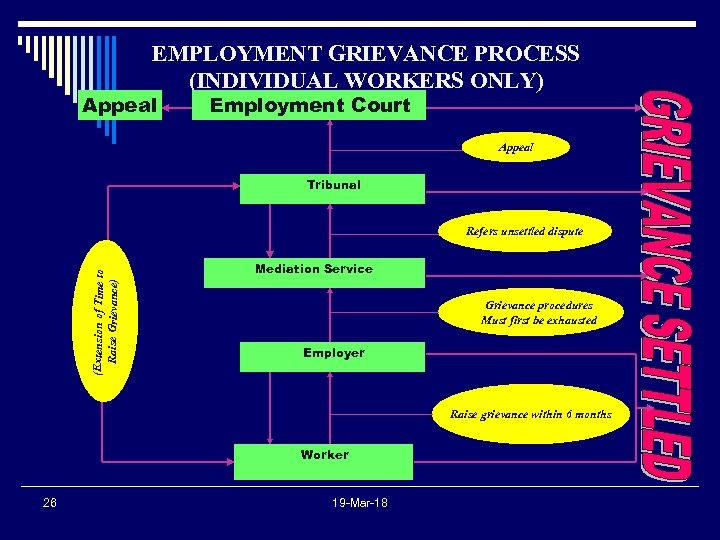 EMPLOYMENT GRIEVANCE PROCESS (INDIVIDUAL WORKERS ONLY) Appeal Employment Court Appeal Tribunal (Extension of Time to Raise Grievance) Refers unsettled dispute Mediation Service Grievance procedures Must first be exhausted Employer Raise grievance within 6 months Worker 26 19 -Mar-18
 Part 14 – Registration of Trade Unions (s 115 to 140) o Minister appoints any public officer as Registrar & Assistant Registrar to carry out duties & functions o Both to act independently (not subjected to direction/control by any person or body) when exercising duties & powers o Officers are not liable for duties done in good faith and without negligence in the exercise of any power 27
 Part 14 – Registration of Trade Unions (cont’d) o Registrar must keep a register of trade unions o All trade unions must be registered o More than (six) 6 members apply for registration o Must decide an application within 21 days o Refusal in writing within 7 days from the date of decision giving the grounds of refusal o Appeal within 30 days of the decision o Can be affiliated with a trade union or trade union federation (FTUC or FICTU), must be supported by more than 50% of all the members of that trade union 28
 PART 15 - RIGHTS AND LIABILITIES OF TRADE UNIONS (s 141 – 147) o Trade unions to function fully as social partners and legal entities capable of incurring legal obligations o Immunity from civil suit or legal proceedings for acts done in contemplation or furtherance of disputes o Trade union reps have access to workplace for union matters only 29
 Part 16 – Collective Bargaining Division 1 – Good Faith (s 148 – 152) (new provisions) What is the duty of Good Faith n n Regular meetings for bargaining n Consider and respond to each others proposals n Recognize role and authority of each person n Only bargain with agreed representatives n Not to undermine bargaining process n Provide information to each other to support claims n 30 Union & employer must use their best endeavors to initiate bargaining ERAB to develop a Code of Good Faith
 Collective Bargaining Division 2 – Bargaining (s 153 – 159) Who may initiate bargaining o One or more unions with one or more employers or vice versa o Collective Bargaining may be initiated by parties: i) at any time where there is no collective agreement ii) variation of collective agreements: - 30 days written notice to the other party with 1 CA, - 60 days written notice to the other party with 2 & more CAs 31
 Part 16 - Collective Bargaining Collective Agreements with Expiry dates Only one Collective agreement exists: o must not bargain for new CA earlier than 60 days before current CA expires More than one Collective Agreements exists between the parties: o must not bargain before 120 days the last CA expires or 60 days before the first CA expires or whichever is the later date 32
 Part 17 – Employment Disputes (s 167 – 173) Procedures for settling disputes o Must contain in employment contract: - agreed procedure in line with the promulgation - if no agreed procedure, Schedule 6 applies Reporting of disputes o May be reported to Permanent Secretary - by an employer - by a registered trade union - report of dispute must be in writing with all details o The party reporting a dispute must, within 3 days, provide a copy of the report of the dispute to each party to the dispute. 1– 33
 Part 17 – Employment Disputes (s 167 – 173) Role of Permanent Secretary o Within 30 days accept or reject a report of dispute received by him or her o If accepted become an employment dispute: Refer to Tribunal (interpretation, application or operation of employment contract matters) p Refer to Mediation Services (other matters) p o If rejected inform the parties with reasons. o If an employment dispute is referred to Mediation Services, the mediation process must first be exhausted before the employment dispute is referred to the Tribunal by the Mediator o Must not accept a report of dispute after 6 months from the date on which the dispute arose 1– 34
 ERP Definition "date on which the dispute arose" means the date commencing from the date the final decision is made on the grievance after the grievance procedure under an employment contract relating to the grievance has been exhausted 35
 Part 17 – Employment Disputes (cont’d) Decision by the Tribunal o Without delay and within 60 days from the date of completion of hearing o Decision concerning employment dispute may have retrospective effect Right to Appeal o If PS rejects a report of dispute, aggrieved party may appeal to Employment Relations Tribunal o A party aggrieved by Tribunal’s decision may appeal to Employment Relations Court 36
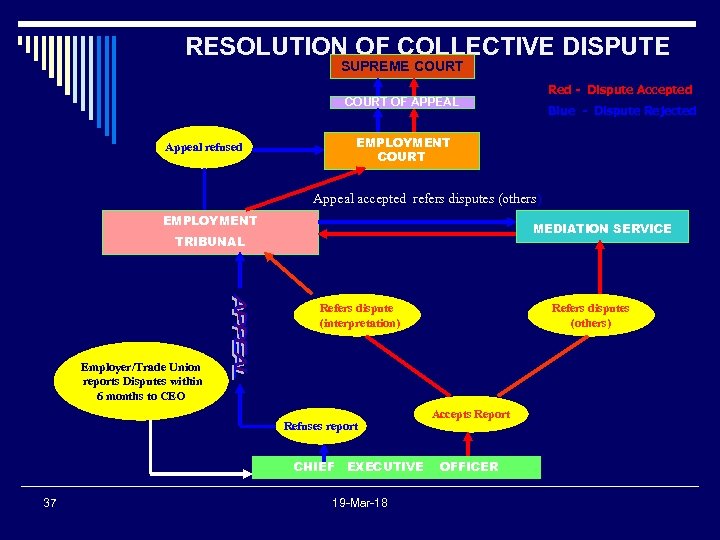 RESOLUTION OF COLLECTIVE DISPUTE SUPREME COURT Red - Dispute Accepted COURT OF APPEAL Appeal refused Blue - Dispute Rejected EMPLOYMENT COURT Appeal accepted refers disputes (others) EMPLOYMENT MEDIATION SERVICE TRIBUNAL Refers dispute (interpretation) Refers disputes (others) Employer/Trade Union reports Disputes within 6 months to CEO Refuses report CHIEF EXECUTIVE 37 19 -Mar-18 Accepts Report OFFICER
 Part 18 – Strikes & Lockouts (s 174 - 184) o. Secret Ballot pre requisite to strike - 21 days notification - state issues to be balloted supported by 50%members ballot supervised by Registrar strike mandate valid for 6 months. o. Notice for Lockouts - 38 28 days prior notice valid for 6 months.
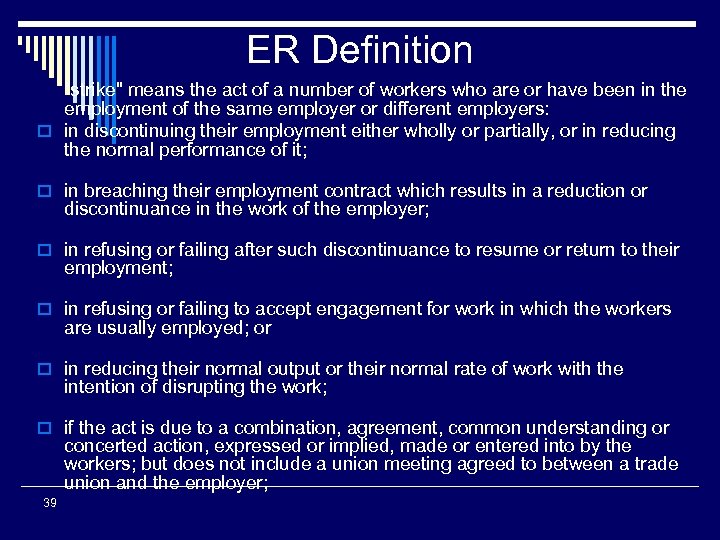 ER Definition "strike" means the act of a number of workers who are or have been in the employment of the same employer or different employers: o in discontinuing their employment either wholly or partially, or in reducing the normal performance of it; o in breaching their employment contract which results in a reduction or discontinuance in the work of the employer; o in refusing or failing after such discontinuance to resume or return to their employment; o in refusing or failing to accept engagement for work in which the workers are usually employed; or o in reducing their normal output or their normal rate of work with the intention of disrupting the work; o if the act is due to a combination, agreement, common understanding or concerted action, expressed or implied, made or entered into by the workers; but does not include a union meeting agreed to between a trade union and the employer; 39
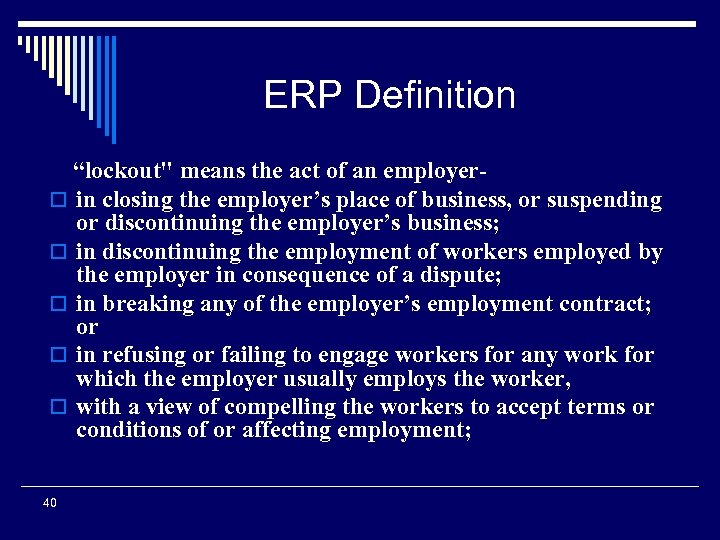 ERP Definition “lockout" means the act of an employero in closing the employer’s place of business, or suspending or discontinuing the employer’s business; o in discontinuing the employment of workers employed by the employer in consequence of a dispute; o in breaking any of the employer’s employment contract; or o in refusing or failing to engage workers for any work for which the employer usually employs the worker, o with a view of compelling the workers to accept terms or conditions of or affecting employment; 40
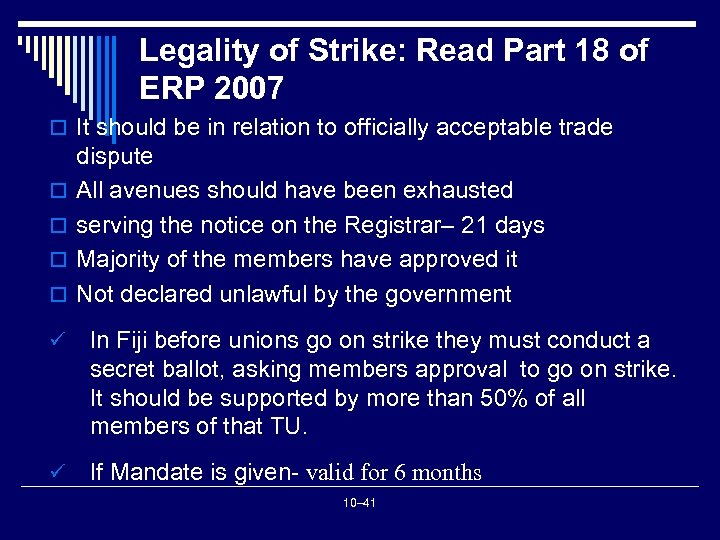 Legality of Strike: Read Part 18 of ERP 2007 o It should be in relation to officially acceptable trade o o dispute All avenues should have been exhausted serving the notice on the Registrar– 21 days Majority of the members have approved it Not declared unlawful by the government ü In Fiji before unions go on strike they must conduct a secret ballot, asking members approval to go on strike. It should be supported by more than 50% of all members of that TU. ü If Mandate is given- valid for 6 months 10– 41
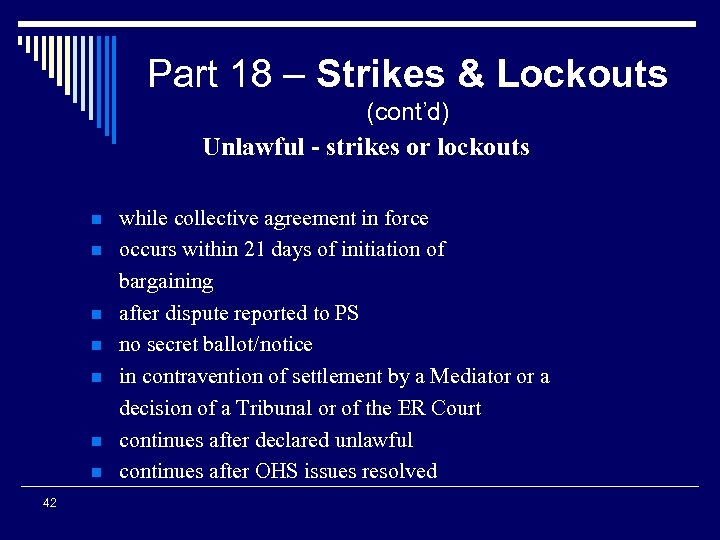 Part 18 – Strikes & Lockouts (cont’d) Unlawful - strikes or lockouts while collective agreement in force n occurs within 21 days of initiation of bargaining n after dispute reported to PS n no secret ballot/notice n in contravention of settlement by a Mediator or a decision of a Tribunal or of the ER Court n continues after declared unlawful n continues after OHS issues resolved n 42
 Part 18 – Strikes & Lockouts (cont’d) Lawful - strikes or lockouts On grounds of health and safety provided procedures under OHS Act have been exhausted n after lapse of 21 days from starting of bargaining n complied with notice provisions n 43
 ER Promulgation Effect of lawful strikes or lockouts S 179. Lawful participation in a strike or lockout does not give rise (a) to an action founded on tort; (b) to an action for the grant of an injunction; or (c) to any action or proceedings (i) for the breach of an employment contract; (ii) for a penalty under this Promulgation; or (iii) for the grant of a compliance order. 44
 Part 18 – Strikes & Lockouts (cont’d) o Power of Minister to declare strike or lockout unlawful o Employment Court has jurisdiction to order discontinuation of strike & lockout on application: - union for lockout, employer for strike, Minister for both in public interest or in essential service Other matters n n n 45 Employers not liable for wages except where the lockout is unlawful Records for strike Prohibition from expulsion as member of union
 Part 19 – Protection of Essential Services, Life & Property (s 185 191) Strikes in essential service n n Union to conduct secret ballot 28 days notice of strike to employer & PS Lockouts in essential service n n 28 days notice to the Registrar & trade union Lockout notice of to be displayed in premises Notice to be displayed n 46 Schedule 7 (List of Essential Services)
 ER Promulgation o The notice of strike must- (a) be signed by the trade union; (b) state the date and time on which the strike is contemplated and the place or places where the contemplated strike will occur; (c) state the category of workers who will strike; (d) state the estimated duration of the strike; and (e) be served by hand, registered mail or courier. 47
 ER Promulgation o The lockout notice required by section 187 (1)(b) must be signed by or on behalf of the employer and must specify(a) the nature of the proposed lockout, including whether or not it will be continuous; (b) the place or places where the proposed lockout will occur; (c) the date and time on which the lockout will begin; and (d) the names of the workers who will be locked out. 48
 List of Essential Services Schedule 7 o Air/ Sea Rescue Services o Air Traffic Control Services o Civil Aviation Telecommunications Services o Electricity Services o Emergency Services in times of national disaster o Fire services o Health services 49
 o Hospital Services o Light House Services o Meteorological Services o Mine Pumping, Ventilation, and Winding o Sanitary Services o Supply & distribution of fuel, petrol, oil, power & light essential to the maintenance of the Services in this Schedule o Telecommunications o Transport Services for the operation of any services in this Schedule & o Water Services 50
 ER Promulgation Minister to refer strike or lockout in essential services to the Court o S 191. - (1) Where there is a lawful strike or lockout in an essential service and (a) neither party is willing to settle the employment dispute; or (b) neither party reports the dispute under section 169; or (c) the Minister is satisfied that the continuance of the strike or lockout is not in the public interest or will jeopardise or is likely to jeopardise the life or livelihood of the nation, economy or public safety, the Minister may, in accordance with rules of the Court, refer the employment dispute or employment grievance to the Court. 51
 Part 20 – Institutions (s 192 -245) (new provision) Establishment of Institutions under ER o Mediation Services o Employment Relations Tribunal o Employment Relations Court o Establishes provisions for appeal 52
 Part 20 – Institutions (cont’d) MEDIATION SERVICES • • • 53 PS has the authority in providing mediation services First port of call for resolution of employment matters such as strikes, lockouts, etc Primary means of resolving grievances & disputes Provide information about employment rights and obligations Provide information about employment disputes & grievances
 Part 20 – Institutions (cont’d) Procedures for Mediation Services o Mediator decides the service appropriate to a case a) follows structured or unstructured procedures to resolve employment dispute or grievance b) receives information, statement, document or other material whether or not admissible in judicial proceedings o A party may appear in person or by a rep before a mediator o No legal practitioner is allowed to represent a party o Mediator refers unresolved dispute or grievance to the Tribunal 54
 Part 20 – Institutions (cont’d) Mediation process - - - 55 Settlements endorsed by a mediator is final and binding decision and can not be appealed Mediation services cannot be challenged or called in question before the Tribunal or any Court Preserve independence of mediation personnel Code of Ethic for Mediators has been developed as guide in performance of their duties
 Part 20 – Institutions (cont’d) Matters referred to Mediation Services p Employment grievance by a worker (whether or not a union member) p Employment dispute referred by PS as per s. 170 (4) (b) No double dipping - employment grievance cannot subsequently reported as an employment dispute or vice versa - discrimination & sexual harassment matters either through Human Rights Commission or under the Promulgation p p 56 Compulsory attendance of parties to mediation proceedings and failure constitutes an offence
 Part 20 – Institutions (cont’d) Employment Relations Tribunal Functions o Assist parties achieve and maintain effective employment relations by o o o 57 adjudicating and determining grievances or disputes Assist parties to amicably settle in any matters relating to employment contracts and settlement endorsed as a binding decision Mediation assistance not prerequisite to adjudication PROCEDURE Must act fairly and make decision within 60 days from the date of completion of the hearing Sitting schedule fixed by Tribunal and sittings recorded Matter withdrawn only on written consent of other party or prior leave of Tribunal
 Part 20 – Institutions (cont’d) Employment Relations Tribunal o o Jurisdiction of Tribunal Powers to adjudicate claims up to $40, 000 Hear & determine offence against the Promulgation Impose fines not exceeding $2, 000 or a term of imprisonment not exceeding 2 years Other matters – Power to order Compliance o By order require a party to do or cease to do within a specific time o Can determine classification of work & rate, implementation of equal pay o Give rulings for the exercise of its jurisdiction under this Part 58
 Part 20 – Institutions (cont’d) Employment Relations Tribunal Referral of question of law o Refer question of law to Court for determination o Court refer its opinion to the Tribunal for a decision in accordance with the determination Transfer of proceedings to ER Court o Upon application by a party to the proceedings o If the Tribunal declines, the party may seek special leave for an order of the Court o If the proceedings were not properly transferred, the Court orders the Tribunal to adjudicate the matter 59
 Part 20 – Institutions (cont’d) Employment Relations Court Jurisdiction of the Court o Has full & exclusive jurisdiction in all matters regarding the Promulgation o Appeals from adjudications of the Tribunal o Order compliance under the Promulgation o Cancel or vary an employment contract o Others matters – Proceedings not to abate by reason of death o Legal representative of the deceased must be substituted in the deceased party’s stead 60
 Part 20 – Institutions (cont’d) Employment Relations Court Power to prohibit publication o Name of a witness or part of any evidence before the Tribunal or Court Rules of Tribunal & ER Court o Chief Justice make rules otherwise: a) Magistrates’ Court Rules apply to the proceedings before the Tribunal b) High Court rules apply to the proceedings before the Employment Relations Court 61
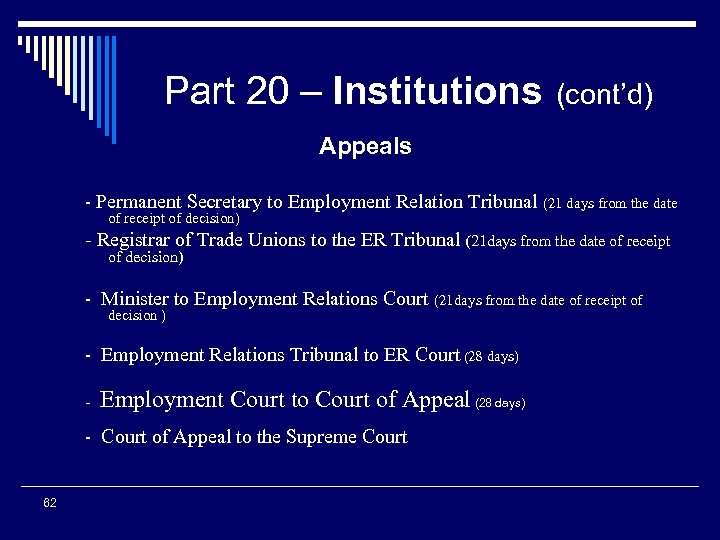 Part 20 – Institutions (cont’d) Appeals - Permanent Secretary to Employment Relation Tribunal (21 days from the date of receipt of decision) - Registrar of Trade Unions to the ER Tribunal (21 days from the date of receipt of decision) - Minister to Employment Relations Court (21 days from the date of receipt of decision ) - Employment Relations Tribunal to ER Court (28 days) - Employment Court to Court of Appeal (28 days) - Court of Appeal to the Supreme Court 62
 Part 21 - Offences (s 246 – 257) Types of penalties under the ER Promulgation: o General Penalty – refer s. 256 o Prescribed Penalty – as stated in the relevant section o Fixed Penalty – as stated in Schedule 8 63
 ER Promulgation General Penalty 256. A person who commits an offence for which no particular penalty is prescribed, is liable on conviction (a) for an individual, to a fine not exceeding $10, 000 or to a term of imprisonment not exceeding 2 years; (b) for a company or corporation or trade union, to a fine not exceeding $50, 000; and (c) where applicable, to disqualification from holding a post as an officer of a trade union for 5 years from the date of conviction for the offence. 64
 MISCELLANEOUS Conspiracy in employment disputes - An act in contemplation or furtherance of an employment dispute with an agreement is not punishable as a conspiracy - Unless the act if done without an agreement Time for instituting proceedings - Within the period of 12 months unless Court grants leave for a further 6 months Fixed Penalty Notices - Only to be issued by a Labour Officer or other Public Officer authorized by Permanent Secretary 65