


 Скачать презентацию HRM 501 Introduction To IR HRM Topic
45ad55b159a17f740c68fa935c3ba897.ppt
- Количество слайдов: 42
 HRM 501: Introduction To IR & HRM Topic 4: Employers Association 3/15/2018 1
 Learning Objectives o Outline the roles and function of employers association in workplace relation (Fiji’s context – Fiji Employers Federation) o Discuss the role of employer association in assisting management with employment relation matters o Discuss the origin and history of International Labour Organisation (ILO) o Outline the mission and objectives of ILO in workplace relations o Identify core ILO convention 3/15/2018 2
 Introduction o Management and employers are another key stakeholders in employment relations, and they have played a significant role in defining and shaping the nature of employment relations. o The management have a significant role to play in maintaining smooth industrial relations. o For a positive improvement in their relations with employees and maintaining sound human relations in the organization, the management must treat employees with dignity and respect. 3/15/2018 3
 Introduction o Employees should be given ‘say’ in the affairs of the organization generally and wherever possible, in the decision-making process as well o A participative and liberal altitude on the part of management tends to give an employee a feeling that he is an important member of the organization – a feeling that encourages a spirit of cooperativeness and dedication to work. 3/15/2018 4
 What is management o ‘Management’ is both the generic term used to describe the people who direct the activities of an organization on behalf of its owners and the functions performed by those people. o The term ‘management’ refers to both a stakeholder group and a process. o As a process, management is defined as the planning, organizing, leading and controlling of human and other resources to achieve organizational goals effectively and efficiently. o A manager is someone whose primary responsibility is to carry out the management process. o As a stakeholder group, the term ‘management’ refers collectively to the managers of an organization or organizations. 3/15/2018 5
 Structures for the management of employment relations o The management of employment relations is a complex and contradictory process o In managing their workforce, employers are concerned with the twin objectives of minimising labour cost and maximising labour application o Management policies and practices need to be understood within the broader content of strategic business objectives o In order to achieve these objectives, management develops a range of strategies conforming to the direct control (or low trust) or the responsible autonomy (or high trust) approach to labour management, or a combination of both 3/15/2018 6
 Structures for the management of employment relations Management Strategy and Practice o Definition of Strategy: n Conscious and rational forward planning and a common pattern of management practice that develops over time o Friedman’s dichotomy of management strategy: n n Direct control (low trust) Responsible autonomy (high trust) 3/15/2018 7
 Structures for the management of employment relations Management Strategy and Practice 1. Direct control – reflects an authoritarian or coercive approach to management, in which workers have minimal responsibility over their work and are subject to close supervision and strict discipline. 2. Responsible autonomy – reflects a more consultative approach to labour management, in which workers are provided more control over their work and related decisions. 3/15/2018 8
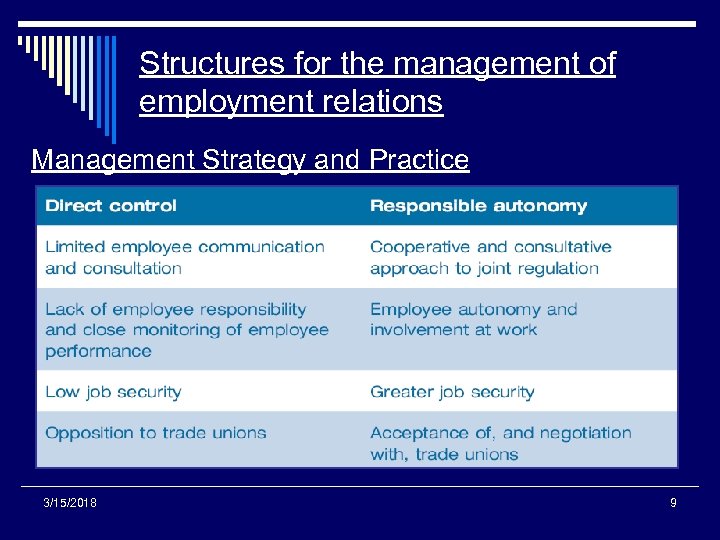 Structures for the management of employment relations Management Strategy and Practice 3/15/2018 9
 Structures for the management of employment relations o In order to understand the breath of management practice and the ability of management to implement contradictory approaches, writers such as Gospel and Wright have pointed to three main areas in which decisions about labour management occur. o These may be termed employee relations, work or task relations, collective industrial relations. o Though these categories are not mutually exclusive, and there is a degree of overlap between them, they provide a useful framework for understanding labour management from an employment relations perspective. 3/15/2018 10
 Structures for the management of employment relations 1. Employee Relations o The arrangements governing matters such as recruitment, selection and dismissal, training and development, and monetary and non-monetary reward (i). Welfarism – an early management control strategy designed to increase the loyalty and dependency of workers by providing a range of welfare benefits and services 3/15/2018 11
 Structures for the management of employment relations 1. Employee Relations (ii) Personnel Management – this development came in post-war because of rapid economic growth and labour shortages. o Number of welfare (or personnel) officers grew as appointed by many larger organizations to attract and retain workers, taking control away from line managers. o The duties of these officers expanded beyond the provisions of welfare and resulted in more formalized approaches to recruitment and selection (such as selection testing techniques and induction), employee training and development, and reward management (such as non-monetary benefits and wage incentive schemes. 3/15/2018 12
 Structures for the management of employment relations 1. Employee Relations (iii) Human Resource Management The Latest approach to these matters in HRM, which has developed since the 1980 s as a result of increased competitive pressures faced by firms and changes to government legislation. o In comparison to Personnel Management, HRM emphasises the integral involvement of HR mangers in corporate and business strategy decision making and the need to devolve policy implementation to line management. o 3/15/2018 13
 Structures for the management of employment relations 2. Work/Task Relations o o Refers to the way the technical and social features of work are organized Various authors wrote on labour Process ( how management transforms the potential for work (labour power) into work effort (labour) Braverman in his book , Labour and Monopoly Capitalism (1974) argued labour process transition required employers to reduce the uncertainty of the labour process by divorcing the conception of the work from its execution. Capitalist achieved this by deskilling craft workers and later clerical workers through the division of labour and mechanization. 3/15/2018 14
 Structures for the management of employment relations 2. Work/Task Relations o He further claimed that scientific management or Taylorism provided managers with a systematic means of undertaking this transformation of the labour process and that it became the fundamental strategy of the twentieth century. (i) Scientific Management : an approach to labour management that involves employees conducting repetitive unskilled jobs, and management setting specific goals and objectives based on a scientific measure of the ‘one best way’ of completing a task and the time this task should take. 3/15/2018 15
 Structures for the management of employment relations 2. Work/Task Relations o Scientific management techniques were introduced primarily by manufacturers operating in mass product markets (ii) Fordism : o The mass production of standardized products with management drawing on scientific management techniques, such as the division of labour and the organisation of work into routine and standardized tasks, closely monitored by management. 3/15/2018 16
 Structures for the management of employment relations 2. Work/Task Relations (iii) Post-Fordism or Flexible Specialization o This form of labour management emerged since 1970 s – the shift form traditional ‘Fordist’ system o Post-Fordism - the shift from the mass production of standardized products to the differentiated production of specialized products, associated with a shift from direct control approach of scientific management and Fordism to more flexible forms of work and a responsible autonomy approach to labour management. 3/15/2018 17
 Structures for the management of employment relations 2. Work/Task Relations (iii) Post-Fordism or Flexible Specialization Reasons for Shift 1. Increasing expectations of consumers for a greater variety of product choice and saturation of mass market, thus employers need to respond quickly to changes in demand 2. New Technology – Computerized, automated technology has provided the way for flexible, product variation to be achieved, and need for labour market flexibility has accompanied this shift 3/15/2018 18
 Structures for the management of employment relations 2. Work/Task Relations (iii) Post-Fordism or Flexible Specialization There were Various changes in work relation as well such as: 1. 2. 3. 4. Introduction of just-in-time (JIT) production methods, which reduce the degree to which resources such as labour, raw materials or capital are idle The shift away from de-skilled labour and close supervision towards a multi-skilled, flexible and autonomous workforce. The increased use of teamwork Total quality management (TQM), which requires the involvement and commitment of all managerial and nonmanagerial employees to quality improvement and the needs of customers. 3/15/2018 19
 Structures for the management of employment relations 3. Collective Industrial Relations o Refers to the way employers manage the collective aspects of employment relations, such as traded unions and collective bargaining. o For instance, employers in Australia operated under a system of compulsory arbitration for most of the twentieth century o Employers started to develop strategies to deal with collective arrangements and it varies over time between and within industries. These strategies can be categorized as anti-union, minimalist and consultative. 3/15/2018 20
 Structures for the management of employment relations 3. Collective Industrial Relations (i) Anti –Union o Anti-union strategies are aimed at undermining the role and relevance of unions, through either peaceful competition or forceful opposition. o Peaceful – paying over-award wages, profit-sharing and wage incentive schemes, the provision of superior facilities and working conditions, and other benefits associated with the physical and social welfare of workers. Forceful opposition – such as management’s refusal to recruit unionist, the dismissal of workers considered to be ‘agitator’ or ‘trouble-makers’ and denying union entry to the workplace. o 3/15/2018 21
 Structures for the management of employment relations 3. Collective Industrial Relations (ii). Minimalist Approach o The minimalist approach to collective decision-making involves the acceptance that trade unions have a legitimate bargain role but that impact on managerial prerogative should be minimized. (iii). Consultation o o Approach reflects management’s acceptance not only trade unions but also of the need to consult employees and union representatives in order to diffuse industrial conflict. For instance, in past some employers have formed closed-shop ( that is, compulsory unionism) 3/15/2018 22
 Decentralisation and Managerial Prerogative o Ability for employers to introduce changes since the late 1980 s occurred within a context of plant closures and downsizing o Employees and unions have had limited ability to challenge the bargaining agenda o Most changes have occurred without consultation or negotiation with employees or unions o In other words, enhanced managerial prerogative o For instance, in Australia introduction of Workplace Relations Act 1996 reduced the Role of AIRC ( Australian Industrial Relations Commissions ) and introduced individual work place bargaining, providing employers with greater opportunity to undermine union organizing and CB 3/15/2018 23
 Employer Associations o Definition — A collective organisation of employers whose primary interests include the regulation of relations between their members and employees or trade unions o Employers’ Associations Employers’ associations are formed, primarily, to promote and protect the interests of employers in trade and industry o They are “formal groups of employers set up to defend, represent or advise affiliated employers” o As a parallel to TU in the mid –eighteenth century the employers formed their own associations. The purpose of first employers associations was to oppose TUs and to join together in a common effort to fight and destroy the newly formed trade unions. 3/15/2018 24
 The Role of Employer Associations o Formative Years n n Response to unionism Opposition to compulsory arbitration o Services n n Represent members before industrial tribunals Provide advice and assistance on a range of employment matters
 Employer Associations o They perform several important functions: Primary: a. Promote and protect the interests of employers engaged in industry, trade and commerce. b. Study, analyze and disseminate information relating to labour policy, labour- management relations, collective bargaining, etc. Offer advice concerning various aspects of labour policy. Liaise with Union Government and initiate steps that are representative and legislative in nature. e. Assist employers during strike time. d. 3/15/2018 26
 Employer Associations o They perform several important functions: Secondary: f. Train and develop staff and members. g. Obtain data on wages and conditions of work in industries attached to them. h. Come out with surveys, research-based reports on issues of importance to both labour and management. i. Take up projects for social and family welfare. 3/15/2018 27
 Employer Associations o They perform several important functions: Secondary: j. Deal with safety and health at work place and working environment. k. Initiate steps to improve public image and improve public relations. l. Educate the public regarding the character, scope, importance and needs of trade, industry and commerce represented by members. 3/15/2018 28
 Disunity Among Employers o Employers are concerned with maintaining their autonomy o Employers may be competitors, both within and among associations o The interests and goals of employers differ widely due to a variety of factors: n n n Size of the firm Local or multinational Industry Domestic or export markets Declining or expanding product market
 Need for a United Voice? o A number of reasons why employer solidarity is not as crucial as employee solidarity in the form of a trade union: n The importance of business profitability to a capitalist economy means that governments need to look after the long-term needs of employers n Many employers are already well organised at an industry level n Many larger employers can use their own market power and resources when dealing with workers, trade unions or the government
 Employers Associations in Fiji o There is only one Employers’ Association in Fiji which was formed in the 1960 and is currently named as Fiji Commerce & Employers Federation (FCEF). o It was established with 21 members in 1960 with the name as the Fiji Employers Consultative Association (FECA), later changed its name to FEF in 1991. o Later in late 2010, the Fiji Employers Federation (FEF) changed it's name to the Fiji Commerce & Employers Federation (FCEF). o The primary reason was that FCEF will now broaden its focus on the Private Sector business related activities while at the same time carry out its traditional functions with regard to Industrial Relations and Human Resources Management issues. 6– 31
 Employers Associations in Fiji o FCEF is now the Fiji’s National Private Sector Organization under the umbrella of Pacific Islands Private Sector Organization (PIPSO). Historical overview o It was formed in response to the major strike in 1959 (FECA) between oil (fuel) companies and Oil and Allied Workers Union. o In its early days FECA restricted its activities to those of a traditional employers' organization largely related to providing assistance to members faced with trade union activity, a relatively new occurrence in Fiji's development at that time. – CB took wider root across the economy. 6– 32
 Employers Associations in Fiji Historical overview o FECA members were largely inexperienced in dealing with trade unions and relied heavily on FECA for advice and guidance in all labour matters. o From the late 1970's FECA began to widen its activities to encompass almost everything to do with the economic development of Fiji and was heavily involved in the formation and maintenance of the Tripartite Forum(TPF), seen by many countries as being a model of the effective workings of their social partners. o During 1980 s, there was some pressure within the FECA to distance itself from the TPF, so that wage negotiation could occur at the enterprise and plant level more freely. 6– 33
 Employers Associations in Fiji o Historical overview o In 1991, FECA changed its name to FEF. o After the structural economies reforms that were introduced during 1980 s many member supported labour market deregulation. o It slowed the expansion of the CB coverage- and in fact promoted a collapse of CB coverage in some sectors. o Due to the decline in the level & coverage of CB FEF provided support to new forms of Labour-management relationships which were prevalent in Australia and New Zealand such as the importation of HRM approach. o This approach advanced alternatives to CB. This was most noticeable in the private sector where union decline has been most dramatic. 6– 34
 Employers Associations in Fiji o Historical overview o While the FEF remained principally and advisory and support group for its members, it also represented employers on a number of boards and agencies. o In the field of IR directly, it is represented, along with the FTUC on the Labour Advisory Board o It also represented in each of the 10 wages councils-which periodically set minimum wage standards in sectors that remain unorganised. o Together with FTUC, it is also represented on the board of Training and Productivity Authority of Fiji (TPAF) –(formerly FNTC) and FNPF 6– 35
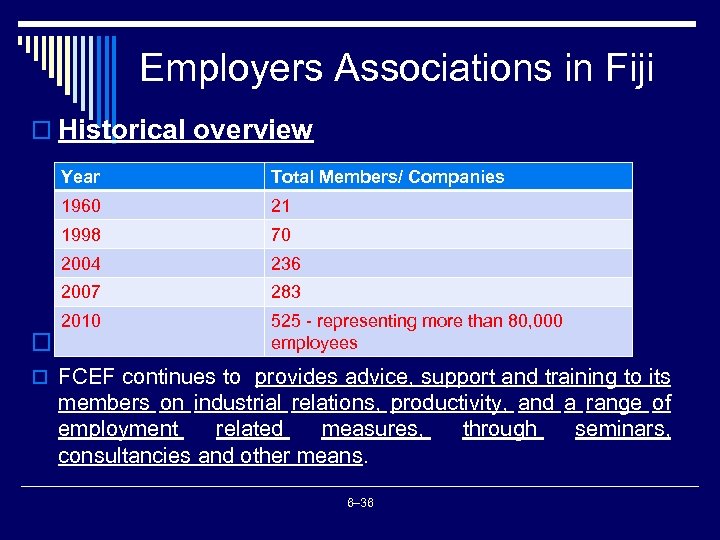 Employers Associations in Fiji o Historical overview Year 1960 21 1998 70 2004 236 2007 o Total Members/ Companies 283 2010 525 - representing more than 80, 000 employees o FCEF continues to provides advice, support and training to its members on industrial relations, productivity, and a range of employment related measures, through seminars, consultancies and other means. 6– 36
 Employers Associations in Fiji o Like the FTUC, it acts as a pressure group upon government to ensure that its policies promote the wider interests of its members, that is, providing a policy environment that supports private sector investment (Prasad, 2001). o AIMS of FCEF: Promotion of free trade and commerce and the economic development of Fiji 2. Provision of a forum for consultation and exchange of information and views arising from the relations between: - Employers and their work people, including Trade Unions - Employers and Government 1. 6– 37
 Employers Associations in Fiji AIMS of FCEF 3. Promotion of co-operation between employers in the many industries, businesses, and commercial activities in Fiji, as well as with the various statutory organizations. Promotion and acceptance of the concept that co-operation and consultation among employers is indispensable to the continued growth of Fiji. 5. Realization that although each member is autonomous and independent of other members, there is an inter dependence between employers in acting in concert for the common good of all in Fiji. 4. 6– 38
 Employers Associations in Fiji 6. Promotion of the understanding that the continued growth of employment opportunities in Fiji may be sustained only by the maintenance and development of a strong, dynamic and profitable private sector. 3/15/2018 39
 Summary o‘Management style’ refers to the guiding principles for management ER approach o. Managers and organisations possess degrees of choice in the conduct of ER, but it is shaped by: – – business objectives market conditions 5– 40
 Summary o The nature of an organisation’s employment relations practices is influenced by the ideology of key decisionmakers, which may lead to the development of distinctive styles of managementt o Regardless of the preferred style of management, pressures in the broader environment in which the organisation operates can have a strong influence on management’s choice of strategy and practice
 Summary o In recent years, managers have reconsidered their approach to labour management due to changes in product and labour markets o These changes, encouraged by the legislative and policy initiatives of governments, have reflected a resurgence of managerial prerogative o Employer associations have played an integral role in shaping the nature of industrial relations reform in Australia, despite the lack of a single authoritative voice at the national level