


 Скачать презентацию HRM 501 Introduction To IR HRM Topic
a5975d75cf3fa3d10fa0fdf777a35435.ppt
- Количество слайдов: 67
 HRM 501: Introduction To IR & HRM Topic 6: Employment Legislation (ERP 2007) – Part 1 3/19/2018 1
 Learning Objectives o Discuss and understand Employment Relations Promulgation – key changes from Fiji’s context o Identify salient features, principles and spirit of the ER Promulgation o Outline the paradigm shift in the labour Reform i. e. , from ‘Adversarial’ to ‘Good faith’. o Identify and discuss provisions on employment contract o Understand how employment can be terminated 3/19/2018 2
 Historical Development of ER Law • Fiji’s history of Labour legislation was based on the British Legislations brought by the Colonial administrators. • amendments were made over time to meet the changes in the labour market. • The existing Acts were ARCHAIC and have failed to keep pace with the developments in the labour market. 3/19/2018 3
 Historical Development of ER Law • First Labour Laws were made in 1870’s through Ordinances, • • • Governor Arthur Gordon, terms and condition of employment the start of industry • • • Cotton plantation, Sandalwood. Sugar Cane (34 sugar mills) o There was no conventions ratified prior to Independence 3/19/2018 4
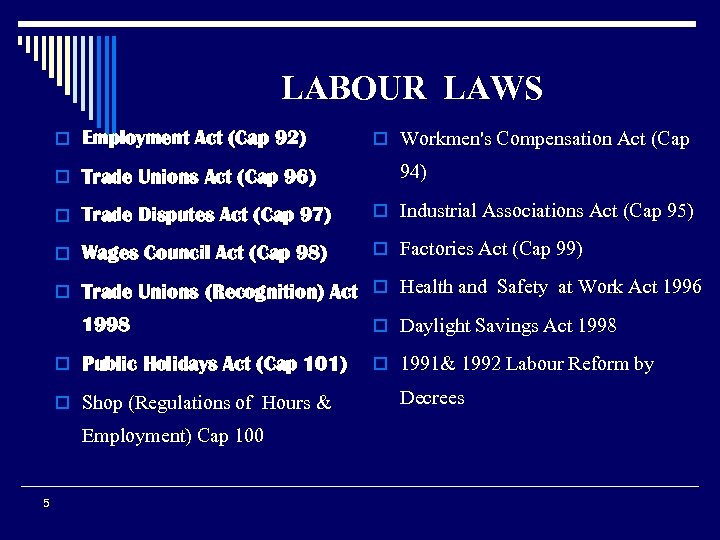 LABOUR LAWS o Employment Act (Cap 92) o Trade Unions Act (Cap 96) o Workmen's Compensation Act (Cap 94) o Trade Disputes Act (Cap 97) o Industrial Associations Act (Cap 95) o Wages Council Act (Cap 98) o Factories Act (Cap 99) o Trade Unions (Recognition) Act o Health and Safety at Work Act 1996 1998 o Public Holidays Act (Cap 101) o Shop (Regulations of Hours & Employment) Cap 100 5 o Daylight Savings Act 1998 o 1991& 1992 Labour Reform by Decrees
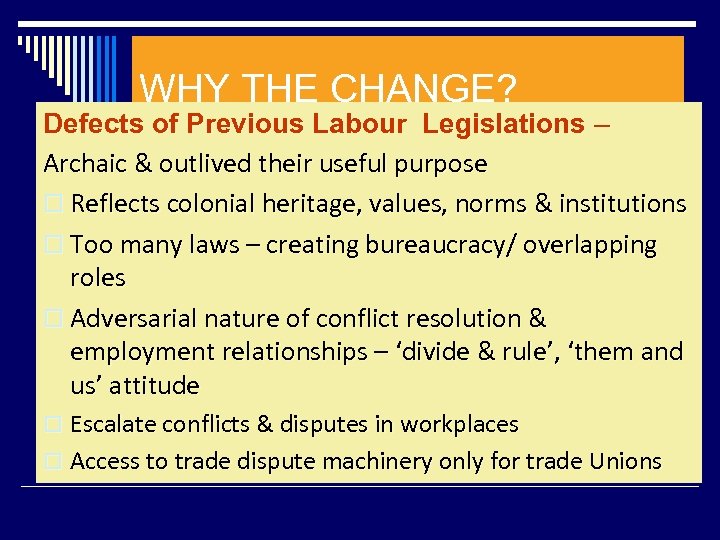 WHY THE CHANGE? Defects of Previous Labour Legislations – Archaic & outlived their useful purpose o Reflects colonial heritage, values, norms & institutions o Too many laws – creating bureaucracy/ overlapping roles o Adversarial nature of conflict resolution & employment relationships – ‘divide & rule’, ‘them and us’ attitude o Escalate conflicts & disputes in workplaces o Access to trade dispute machinery only for trade Unions
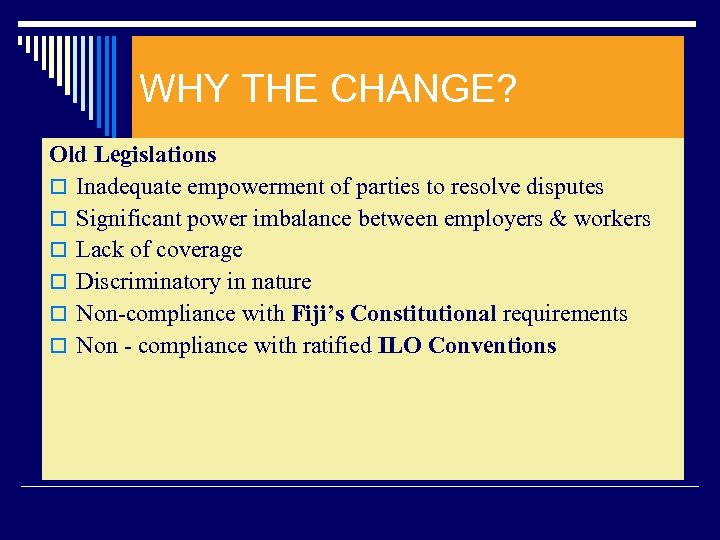 WHY THE CHANGE? Old Legislations o Inadequate empowerment of parties to resolve disputes o Significant power imbalance between employers & workers o Lack of coverage o Discriminatory in nature o Non-compliance with Fiji’s Constitutional requirements o Non - compliance with ratified ILO Conventions
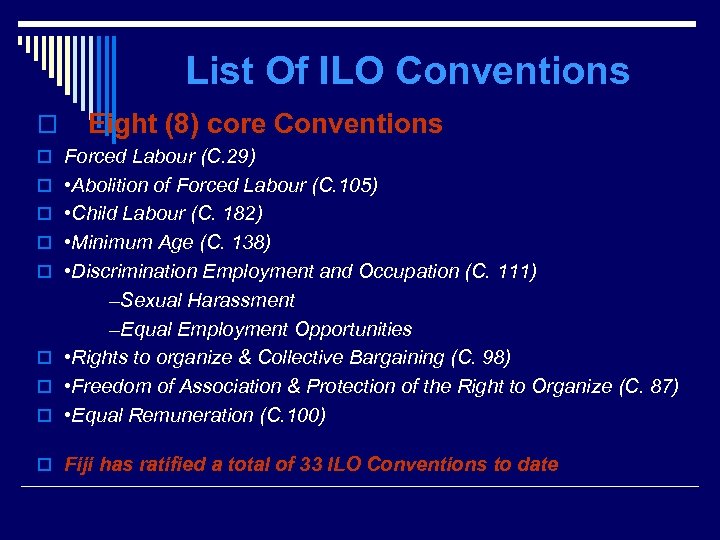 List Of ILO Conventions o Eight (8) core Conventions o Forced Labour (C. 29) o • Abolition of Forced Labour (C. 105) o • Child Labour (C. 182) o • Minimum Age (C. 138) o • Discrimination Employment and Occupation (C. 111) –Sexual Harassment –Equal Employment Opportunities o • Rights to organize & Collective Bargaining (C. 98) o • Freedom of Association & Protection of the Right to Organize (C. 87) o • Equal Remuneration (C. 100) o Fiji has ratified a total of 33 ILO Conventions to date
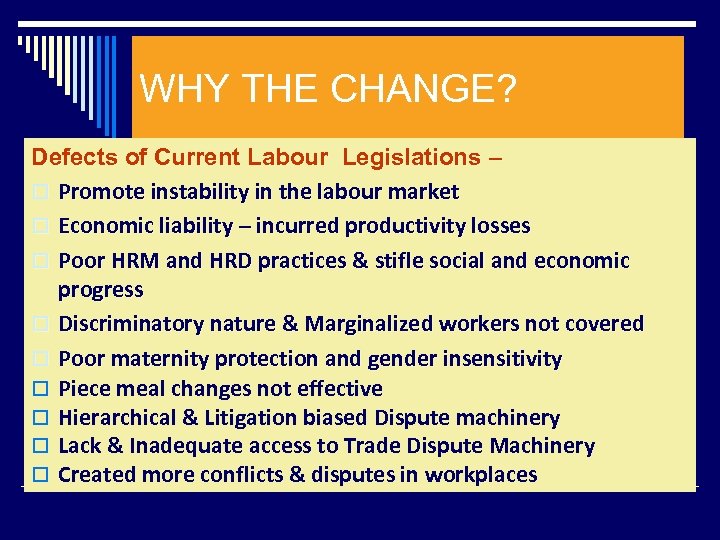 WHY THE CHANGE? Defects of Current Labour Legislations – o Promote instability in the labour market o Economic liability – incurred productivity losses o Poor HRM and HRD practices & stifle social and economic progress o Discriminatory nature & Marginalized workers not covered o Poor maternity protection and gender insensitivity o Piece meal changes not effective o Hierarchical & Litigation biased Dispute machinery o Lack & Inadequate access to Trade Dispute Machinery o Created more conflicts & disputes in workplaces
 What is the effect of change New Legislation: – o o o One Umbrella Law - User friendly, Consolidates 6 Labour Laws Promote consultative Good Faith approach Wide coverage - Domestic, government, sugar mill workers Conducive for business and national productivity development Encourage cooperation and good governance ü Labour Management Consultation and Cooperation (LMCC) o Maintain flexibility in wage settings o 10 Wages Councils -sets minimum rates of pay o Individual contract - include productivity measurement tools o Improve minimum Labour Standards - Uniform Standards applicable to all workers o Promote inclusiveness and Partnership n Equal Employment Opportunities (EEO) and Bi-partite involvement in LMC o Non-discriminatory o Promote welfare & prosperity o Compliance with Constitutional Requirements 10
 What is the effect of change Cont’d o Compliance with ratified ILO Conventions o Improve ER climate based on mutual trust, respect, dignity o o 11 & fair dealings Promotes Social Justice Principles Establishment of a national Mediation Services with Ministry Establishment of dedicated Employment Relations Tribunal & Employment Relations Court within the Ministry Speedy resolution of employment grievances & disputes
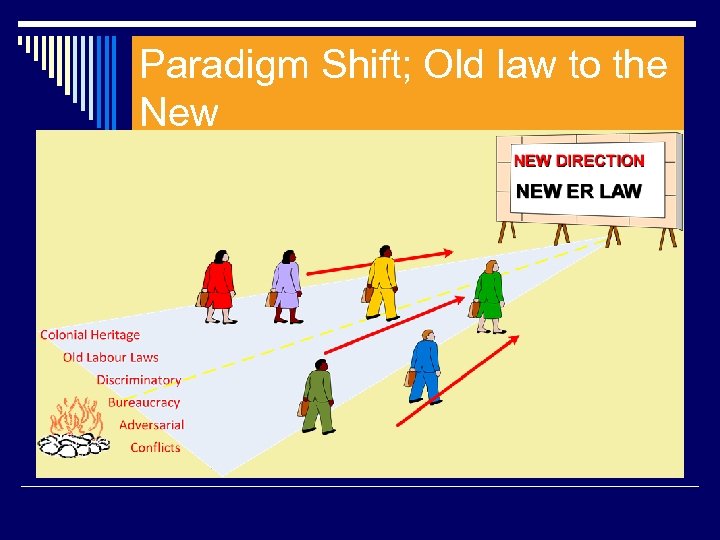 Paradigm Shift; Old law to the New
 Creation of the ER Legislation Stages of Development o 1996 First draft, Industrial Relations Bill based on NZ Employment Contract o o Act 1998 Tabled in Labour Advisory Board 2000 Delayed by the events of 2000 and subsequent boycotts of trade unions [LAB meetings and other tripartite bodies under the Labour Ministry] 2002 The LAB Subcommittee and their Experts developed IR Bill version 2 [by amending IR Bill after incorporating their stakeholders’ comments, as completed in 1998 2003 Third draft (version 3 )- examined by Ratu J. Madraiwiwi n aligned with ILO Conventions & Constitution 3/19/2018 13
 Creation of the ER Legislation Stages of Development o 2004 Fourth draft - Employment relations Bill, invigorated with-clear policy framework; (Extreme Makeover) n Established Institutions for speedy resolution of disputes n Code of Good Faith, Code of Ethics for Mediators and n Equal Employment Opportunities, Discrimination & Sexual Harassment policy. q 2005 Extensive Consultations-Fiji Wide road show -Draft distributed extensively to NGOS, Employer and Worker group, members of Academia, Religious groups o 2006 -Fifth draft-approved by Lower House on 20 th Nov, 06 but could not proceed through Upper house- due to Dec, 5 th events o 2007 - Reintroduced on 13 th Feb, 07 and approved by Cabinet. o 2007 - Awareness Training on ERP to stakeholders o Employment Relations Promulgation 2007 is fully effective from 2 nd April 2008 3/19/2018 14
 OVERARCHING OBJECTIVE OF ER PROMULGATION o Build productive employment relationship based on the principles of good faith o Promote Productivity Improvement at the personal, enterprise, industry & national levels 15
 SALIENT FEATURES OF THE EMPLOYMENT RELATIONS PROMULGATION v. The creation of labour standards that are fair to both workers & employers v. The introduction of equal employment opportunities to prevent any form of discrimination in the workplace v. The introduction of the principle of good faith to promote v orderly individual and collective bargaining v. The introduction of the mediation service, the employment v tribunal and the employment court to settle employment v grievances & disputes speedily 16
 NEW FEATURES OF ER PROMULGATION ü Fundamental Principles & Rights at Work ü Equal Employment Opportunities ü ü National Sexual Harassment Policy Institutions (Mediation Services, Employment Relation Tribunal & Employment Court) ü Principles of Good Faith & Bargaining Code of Ethics for Mediators ü LMC Committees ü Code of Good Faith ü Lockouts ü Women & Children ü ü Orderly Collective Bargaining Empowering Inspectors ü Redundancy ü 17 of
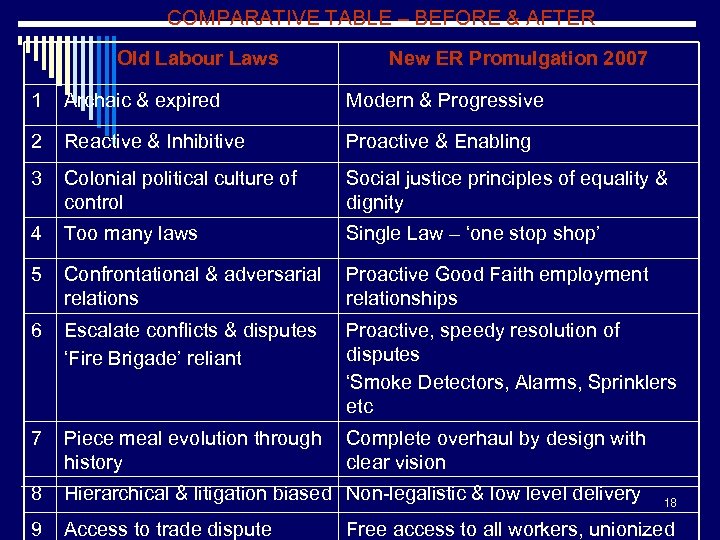 COMPARATIVE TABLE – BEFORE & AFTER Old Labour Laws New ER Promulgation 2007 1 Archaic & expired Modern & Progressive 2 Reactive & Inhibitive Proactive & Enabling 3 Colonial political culture of control Social justice principles of equality & dignity 4 Too many laws Single Law – ‘one stop shop’ 5 Confrontational & adversarial relations Proactive Good Faith employment relationships 6 Escalate conflicts & disputes ‘Fire Brigade’ reliant Proactive, speedy resolution of disputes ‘Smoke Detectors, Alarms, Sprinklers etc 7 Piece meal evolution through history Complete overhaul by design with clear vision 8 Hierarchical & litigation biased Non-legalistic & low level delivery 9 Access to trade dispute 18 Free access to all workers, unionized
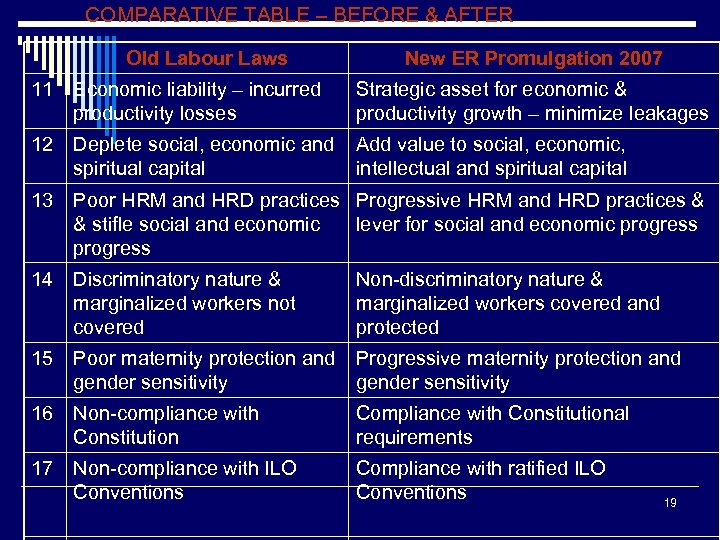 COMPARATIVE TABLE – BEFORE & AFTER Old Labour Laws New ER Promulgation 2007 11 Economic liability – incurred productivity losses Strategic asset for economic & productivity growth – minimize leakages 12 Deplete social, economic and spiritual capital Add value to social, economic, intellectual and spiritual capital 13 Poor HRM and HRD practices Progressive HRM and HRD practices & & stifle social and economic lever for social and economic progress 14 Discriminatory nature & marginalized workers not covered Non-discriminatory nature & marginalized workers covered and protected 15 Poor maternity protection and gender sensitivity Progressive maternity protection and gender sensitivity 16 Non-compliance with Constitution Compliance with Constitutional requirements 17 Non-compliance with ILO Conventions Compliance with ratified ILO Conventions 19
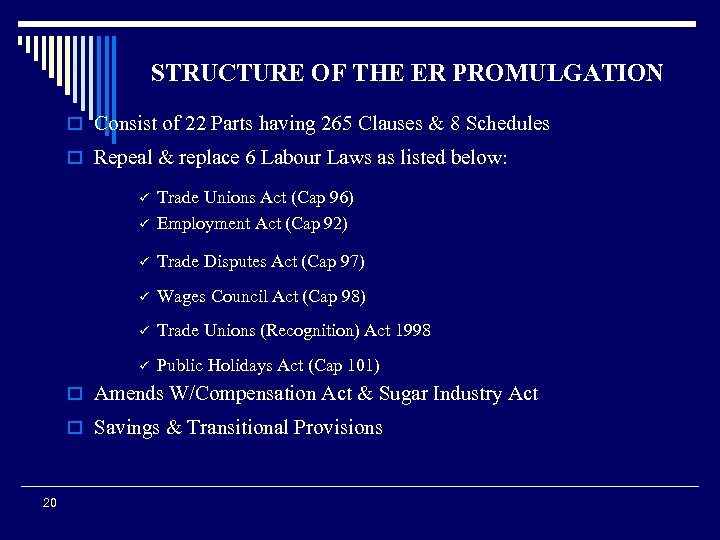 STRUCTURE OF THE ER PROMULGATION o Consist of 22 Parts having 265 Clauses & 8 Schedules o Repeal & replace 6 Labour Laws as listed below: ü Trade Unions Act (Cap 96) Employment Act (Cap 92) ü Trade Disputes Act (Cap 97) ü Wages Council Act (Cap 98) ü Trade Unions (Recognition) Act 1998 ü Public Holidays Act (Cap 101) ü o Amends W/Compensation Act & Sugar Industry Act o Savings & Transitional Provisions 20
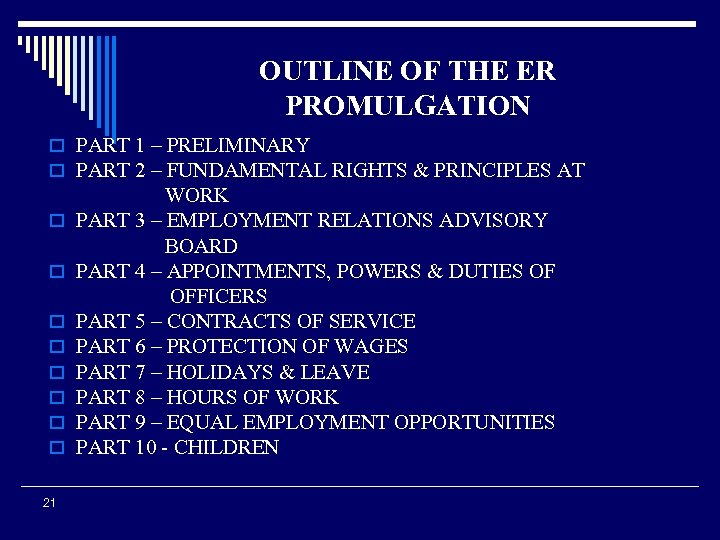 OUTLINE OF THE ER PROMULGATION o PART 1 – PRELIMINARY o PART 2 – FUNDAMENTAL RIGHTS & PRINCIPLES AT WORK o PART 3 – EMPLOYMENT RELATIONS ADVISORY BOARD o PART 4 – APPOINTMENTS, POWERS & DUTIES OF OFFICERS o PART 5 – CONTRACTS OF SERVICE o PART 6 – PROTECTION OF WAGES o PART 7 – HOLIDAYS & LEAVE o PART 8 – HOURS OF WORK o PART 9 – EQUAL EMPLOYMENT OPPORTUNITIES o PART 10 - CHILDREN 21
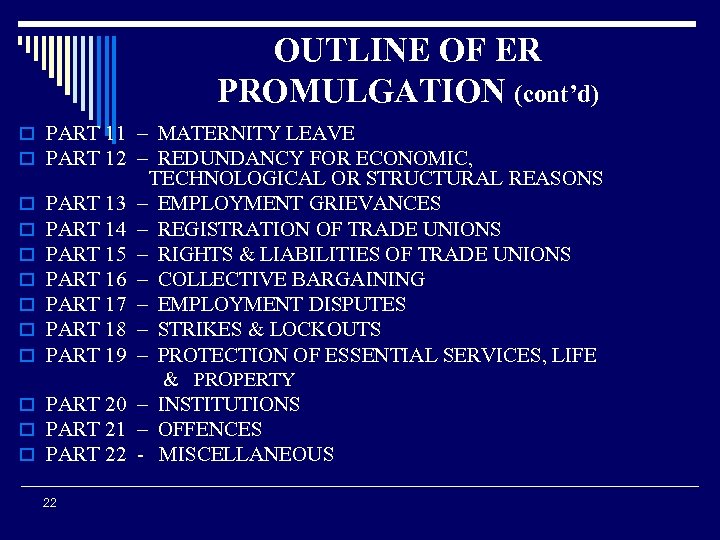 OUTLINE OF ER PROMULGATION (cont’d) o PART 11 – MATERNITY LEAVE o PART 12 – REDUNDANCY FOR ECONOMIC, o o o o o TECHNOLOGICAL OR STRUCTURAL REASONS PART 13 – EMPLOYMENT GRIEVANCES PART 14 – REGISTRATION OF TRADE UNIONS PART 15 – RIGHTS & LIABILITIES OF TRADE UNIONS PART 16 – COLLECTIVE BARGAINING PART 17 – EMPLOYMENT DISPUTES PART 18 – STRIKES & LOCKOUTS PART 19 – PROTECTION OF ESSENTIAL SERVICES, LIFE & PROPERTY PART 20 – INSTITUTIONS PART 21 – OFFENCES PART 22 - MISCELLANEOUS 22
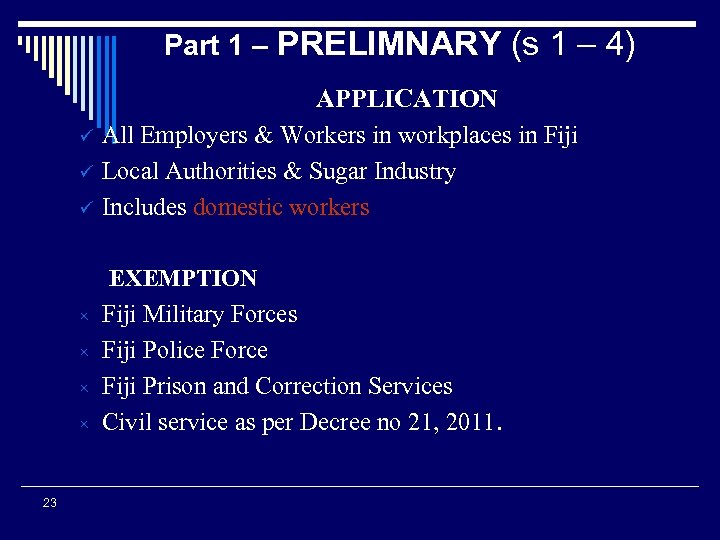 Part 1 – PRELIMNARY (s 1 – 4) ü ü ü × × 23 APPLICATION All Employers & Workers in workplaces in Fiji Local Authorities & Sugar Industry Includes domestic workers EXEMPTION Fiji Military Forces Fiji Police Force Fiji Prison and Correction Services Civil service as per Decree no 21, 2011.
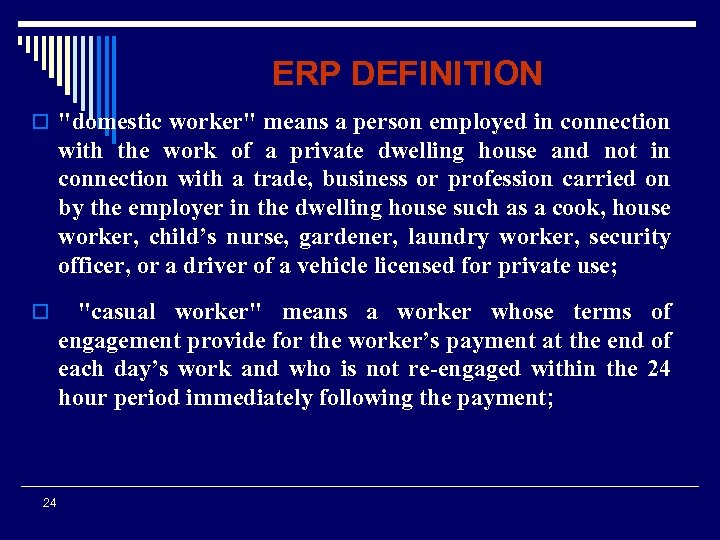 ERP DEFINITION o "domestic worker" means a person employed in connection with the work of a private dwelling house and not in connection with a trade, business or profession carried on by the employer in the dwelling house such as a cook, house worker, child’s nurse, gardener, laundry worker, security officer, or a driver of a vehicle licensed for private use; o 24 "casual worker" means a worker whose terms of engagement provide for the worker’s payment at the end of each day’s work and who is not re-engaged within the 24 hour period immediately following the payment;
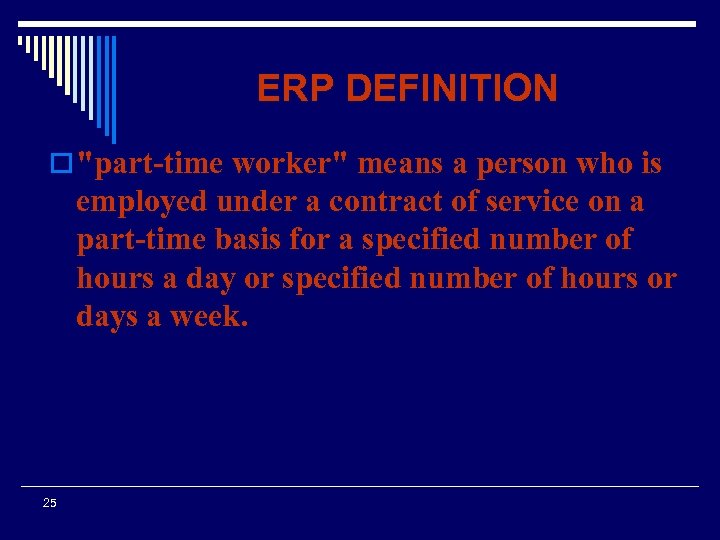 ERP DEFINITION o "part-time worker" means a person who is employed under a contract of service on a part-time basis for a specified number of hours a day or specified number of hours or days a week. 25
 Part 2 - Fundamental Rights & Principles at Work (s 5 & 6)(new) ILO provisions Consistent with ILO Conventions & Constitution of the Fiji Islands o Provides fair labour practices (equal pay for work of equal value – male or female) o Prohibits forced labour o Upholds fundamental rights & principles at work o Disallows discrimination in employment o Right to join or not to join union (workers choice) 26
 Part 3 – EMPLOYMENT RELATIONS ADVISORY BOARD (s 7 – 13) Composition Public officers as representatives of Government Representatives of employers, workers and other persons Appointment o The ERAB members are appointed by the Minister under this Promulgation for a term not exceeding 2 years o Members are eligible for re – appointment o Membership must includes male & female of all ethnic groups o Chairperson of the Board is the Permanent Secretary Requires experience & expertise in the areas covered by the functions of Board; employment relations, industrial commercial, legal, business or administrative matters 27
 Legislative Base under ERP Employment Relations Advisory Board o Section 8 - (1) This section establishes the Employment Relations Advisory Board consisting of the following members a) public officers as representatives of the Government; b) representatives of employers; c) representatives of workers; and d) other persons. (3) In making the appointments to the Board, the Minister may take into account the principles of equality set out in section 38 of the Constitution, necessary for the effective operation of the Board. 28
 Part 3 – EMPLOYMENT RELATIONS ADVISORY BOARD (cont’d) FUNCTIONS OF THE ERAB o Consider & advise the Minister on all matters pertaining to employment relations of this law or other written law o Inquire & report on employment - related matters referred to by the Minister o Facilitate development of Regulations, codes of practice & guides o Advise the Minister on ILO instruments (conventions) o Advise Minister on promotion & strengthening of Labour-Management Consultation and Cooperation (LMC) 29
 What is a LMC o LMC is the new workplace relationship where a committee comprising of employer & worker members cooperate to achieve for common goal for survival and nurture future employment relationships through the concept of good faith and promote productivity o A LMC will not interfere in the management of an organisation 30
 Establishment of LMC Committee Labour Management Consultation and Cooperation is employer based and each employer employing 20 or more workers is required to establish a LMC. If there is already existing in an organization a similar employer and worker committee, that committee can perform the role of a LMC i. e. OHS Workplace Committee. 31
 Establishment of LMC Committee (cont’d) Purpose o The purpose of LMC is to create a bi-partite forum for meaningful consultation and cooperation between employers and workers representatives, at the enterprise or organization level. Membership of Committee o A LMC is made up of equal number of employers and workers representatives and the membership should cover all levels of management and labour and also union members. The employers and workers in an organization are responsible for selecting their members. The Committee may by mutual agreement invite additional members to provide information and advice at its meetings. 32
 Establishment of LMC Committee Registration(cont’d) of LMC o A LMC must be registered with the Ministry by the employer and the employer shall be responsible for the payment of the prescribed fees. Work of Committee o A Committee shall meet at least once every 3 months or as directed by the Board. A LMC shall develop and regulate its own procedures to ensure that each member is given the due recognition for being a member of the LMC and is expected to contribute to the achievement of the overall objectives of the LMC. 33
 Legislative Base of LMC o Section 9(1)(d) of the Promulgation establish and regularize consultation & cooperation between an employer & workers o Section 9(3) makes provisions on an employer employing more than 20 workers to establish a LMC Committee o Section 9(4) provides ERAB powers to oversee & monitor the establishment of a LMC committee o Guidelines for action of a LMC committee are outlined in Schedule 1 of the Promulgation 34
![The Principal Driver Labour-Management Consultation and Cooperation Committee [LMC] o Synergize best practice in](https://present5.com/presentation/a5975d75cf3fa3d10fa0fdf777a35435/image-35.jpg "The Principal Driver Labour-Management Consultation and Cooperation Committee [LMC] o Synergize best practice in") The Principal Driver Labour-Management Consultation and Cooperation Committee [LMC] o Synergize best practice in people management with progressive business approach. o High performance working team o Creates meaningful consultation and cooperation at a workplace 35 35
The Principal Driver Labour-Management Consultation and Cooperation Committee [LMC] o Synergize best practice in people management with progressive business approach. o High performance working team o Creates meaningful consultation and cooperation at a workplace 35 35
 LMC Committee at Work 36
 Part 4 – Appointment, Powers & Duties of Offices (s 14 – 20) o PS & public officers to administer the Promulgation o PS, LO & LI to institute proceedings in Tribunal o Interest & confidentiality of information o Powers to issue fixed penalty notices with LO & LI o Officers have powers to enter workplaces to ensure compliance of the Promulgation o Officers must not enter private dwelling house without permission & on inspection visit must notify the employer 37
 Part 5 – Contracts of Service (s 21 - 41) Division 1 – General • All employment to be in accordance with this Promulgation • Contract of service, either oral or written • Obligation of employer to provide work & any failure to do so must pay for those days and pay in lieu if prevented by act of God • Upon death of a worker, an employer to pay all wages & deliver any property to spouse, dependent or nominated person • No wages on detention or imprisonment 38
 ER DEFINITION o "contract of service" means a written or oral contract, whether expressed or implied, to employ or to serve as a worker whether for a fixed or indefinite period, and includes a task, piecework or contract for service determined by the Tribunal as a contract of service; Contracts for Service o Means a subcontract which includes the erecting of buildings, clearing of and construction of roads, lawn mowing, etc where the employer has no control over the performance of duty but time limit and money maybe be quoted. o Simply saying there does not exist an employer – employee or master – servant relationship. 39
 Part 5 – Contracts of Service (s 21 - 41) Division 1 – General o Employers are now required to give notice in writing with reasons and pay all wages & any benefit due upon termination of service to a worker o Upon termination of a worker’s contract or upon dismissal of a worker’s service an employer is required to give a Service Certificate o Certificate includes: i) nature of employment and ii) period of service 40
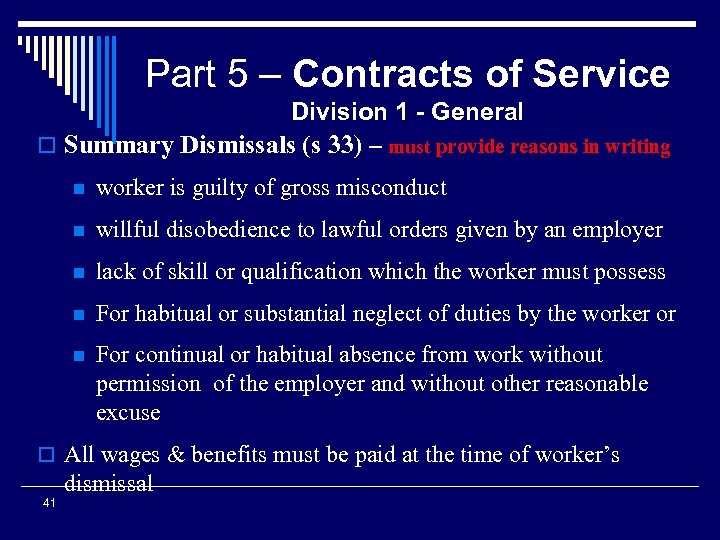 Part 5 – Contracts of Service Division 1 - General o Summary Dismissals (s 33) – must provide reasons in writing n worker is guilty of gross misconduct n willful disobedience to lawful orders given by an employer n lack of skill or qualification which the worker must possess n For habitual or substantial neglect of duties by the worker or n For continual or habitual absence from work without permission of the employer and without other reasonable excuse o All wages & benefits must be paid at the time of worker’s dismissal 41
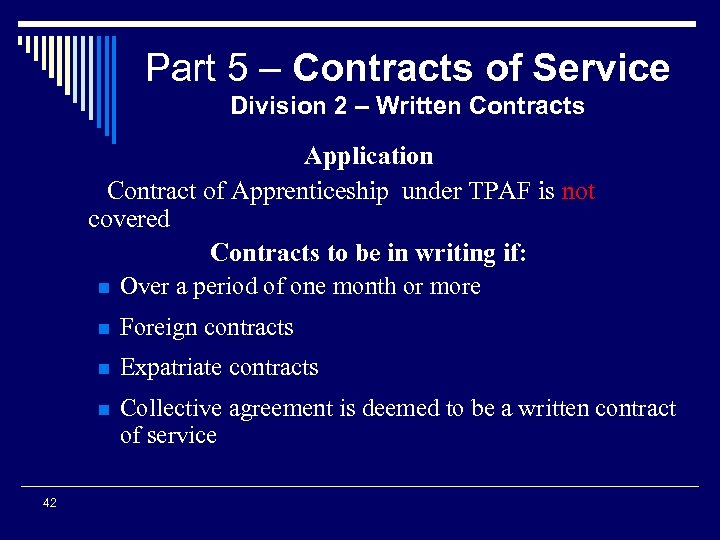 Part 5 – Contracts of Service Division 2 – Written Contracts Application Contract of Apprenticeship under TPAF is not covered Contracts to be in writing if: n Over a period of one month or more n n Expatriate contracts n 42 Foreign contracts Collective agreement is deemed to be a written contract of service
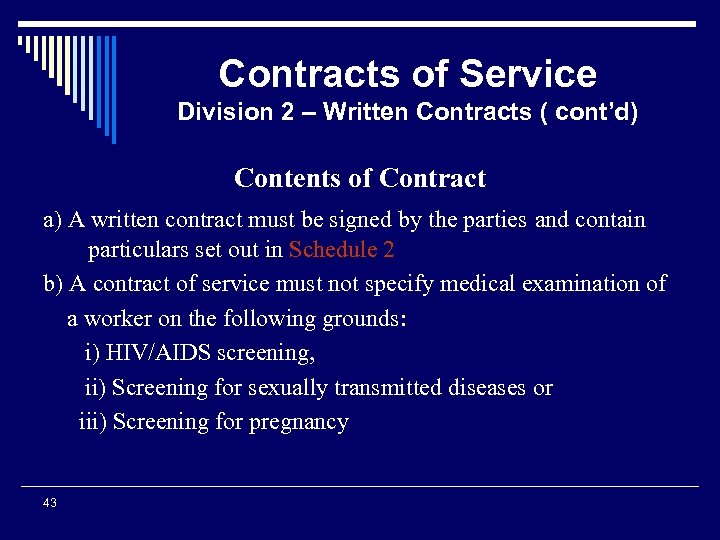 Contracts of Service Division 2 – Written Contracts ( cont’d) Contents of Contract a) A written contract must be signed by the parties and contain particulars set out in Schedule 2 b) A contract of service must not specify medical examination of a worker on the following grounds: i) HIV/AIDS screening, ii) Screening for sexually transmitted diseases or iii) Screening for pregnancy 43
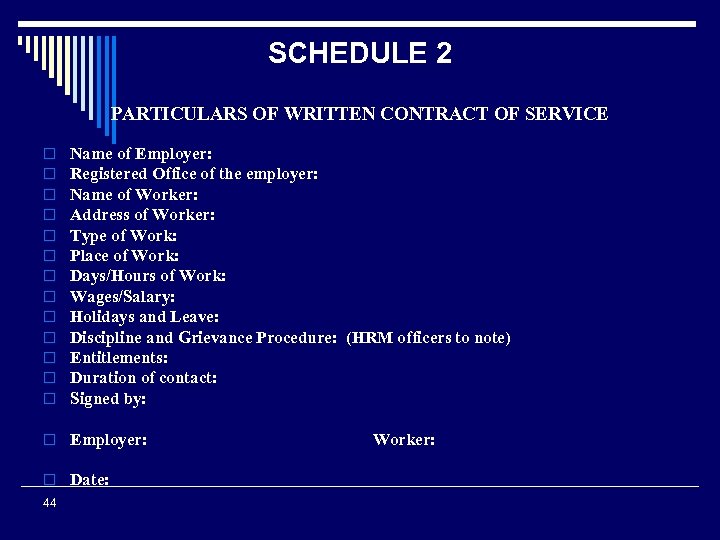 SCHEDULE 2 PARTICULARS OF WRITTEN CONTRACT OF SERVICE o o o o Name of Employer: Registered Office of the employer: Name of Worker: Address of Worker: Type of Work: Place of Work: Days/Hours of Work: Wages/Salary: Holidays and Leave: Discipline and Grievance Procedure: (HRM officers to note) Entitlements: Duration of contact: Signed by: o Employer: o Date: 44 Worker:
 Contracts of Service Division 2 – Written Contracts (cont’d) Termination of Contract a) Upon expiry date of the contract b) Upon death of a worker before the expiry date of the contract and if this happens it does not limit any legal claims by worker’s heirs or personal representatives c) If a worker dies before expiry of the date of the contract, its becomes employer’s responsibility to repatriate the deceased worker 45
 Part 6 – Protection of Wages Division 1 – General (42 – 56) Payment of Wages n n Cash at the end of contract period or on pay days Pay into workers Bank Account in Fiji or cheque with workers written request Pay whole pay into workers Credit Union account Payment to worker’s family if authorised in writing by the worker - In case of doubt of the authority, employer must withhold payment of wages & refer the matter to Labour Office for an investigation - In case of the failure to report & wages is paid to anyone not authorised to receive, the employer is liable to make good to the worker wages so paid by mistake 46
 Part 6 – Protection of Wages Division 1 – General (42 – 56) Wages statement n Must provide written or electronic pay slips on pay periods n If paid in not less than 12 or more than 26 equal installments on the following occasions only: a) commencement of service – 1 st pay b) occurring a change c) on termination of contract of service 47
 Part 6 – Protection of Wages Division 2 – Wages Council Establishment of Wages Council o On the recommendation of ERAB , the Minister has the power to establish a Wages Council, if satisfied that: - no adequate machinery exists for effective remuneration of a class of workers, or - existing machinery is likely to cease to exist or is inadequate o The Wages Council has powers to exercise in relation to the workers remunerations & other conditions either for the whole or part of the Fiji Islands 48
 Part 6 – Protection of Wages Division 2 – Wages Council (cont) Composition of Wages Council – Schedule 3 o Minister has power to appoint members of Wages Councils - not more than 3 independent members - equal number representing employers - equal number representing workers o Minister may appoint a chairperson of all Wages Council & a member of each wages council as deputy chairperson 49
 Part 6 – Protection of Wages Division 2(cont’d) Procedures in making Wages Council Order - A notice is published in the Gazette - Allows 30 days from the date of publication for objections and where to sent the objections - After considering all objections the Minister may make an Order based on the original proposal, or - Resubmit to objection process if amendments are substantive 50
 Part 6 – Protection of Wages (cont’d) Variation & revocation - Upon recommendation of ERAB, the Minister may vary and revoke Wages Council Order Effect, Enforcement of WRO & Notices - provides for statutory minimum remuneration - any person who fails to comply commits an offence - an employer who fails to display Wages Regulation Order commits an offence 51
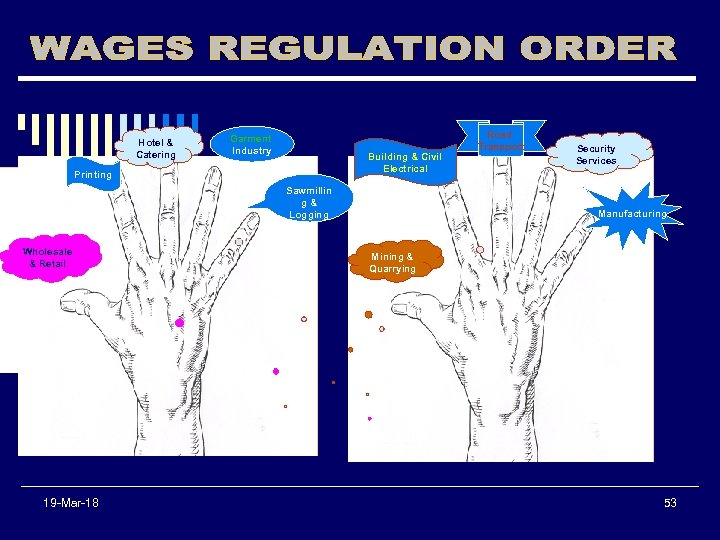
 Part 6 – Protection of Wages Division 2 – Wages Council (cont) Wages Regulation Orders 1) WHOLESALE & RETAIL TRADES 2) BUILDING & CIVIL & ELECTRICAL ENGINEERING TRADES 3) PRINTING TRADES 4) MANUFACTURING INDUSTRY 5) ROAD TRANSPORT 6) SAWMILLING & LOGGING INDUSTRY 7) GARMENT INDUSTRY 8) HOTEL AND CATERING INDUSTRY 9) MINING AND QUARRYING INDUSTRY 10) SECURITY SERVICES 52
 Hotel & Catering Garment Industry Building & Civil Electrical Printing Sawmillin g& Logging Wholesale & Retail 19 -Mar-18 Road Transport Security Services Manufacturing Mining & Quarrying 53
 Part 7 – Holidays and Leave (s 57 – 70) Annual Leave - Ten (10) working days holiday after each year of service, and - Must be paid in respect of such holidays, provided A worker is not entitled to such leave if absent for more than 20 normal working days, except supported by medical certificate or excused by the employer - A worker is entitled to five-sixths of a day’s wages if terminated after a period exceeding one month and less than one year or after a period of employment following the completion of a year 54
 Part 7 – Holidays and Leave (s 57 – 70) Public Holiday - 12 days paid public holidays and must be kept as public holidays in all workplaces - Minister appoints a special day as public holiday - A worker must be paid in respect of each p/h for the number of hours (exclusive of o/t) which the worker would have worked on that day had it not been a public holiday - A worker how works on public holiday is entitled to single rate of pay in addition to the entitlement A worker must be present at work the day before and the day after the public holiday unless absences is supported by medical certificate or excused by the employer 55
 Part 7 – Holidays and Leave (s 57 – 70) Declared Public Holiday 1) New Years Day 2) Good Friday 3) Easter Saturday 4) Easter Monday 5) Prophet Mohammed’s Birthday 6) Ratu Sir Lala Sukuna Day 7) Queen’s Birthday 8) Fiji Day 9) Diwali 10) Christmas Day 11) Boxing Day 56
 Part 7 – Holidays and Leave (cont’d) Paid Sick Leave - After 3 months continuous service, 10 working days during the year - Can not accumulate and lapses Paid Bereavement Leave - After 3 months continuous service, 3 working days in a year Offence - An employer who fails to observe provisions of this Part commits an offence 57
 Part 8 – Hours of Work (s 71 – 73) Prescribes Working Hours - 6 -day working week – normal 48 hrs (maximum) - 5 -day working week – normal 45 hrs (maximum) - Overtime pay after normal hours Exceptions n Recognition of Employer’s right to engage under special conditions. n Managerial/executive positions Consultants Special rates based on special skills, etc n n 58
 Part 9 – Equal Employment Opportunities (s 74 – 89) (new provisions) Provides equal opportunities in employment (a) Ensuring equal rates of remuneration for work of equal value (b) Prohibiting discrimination on particular grounds of actual or supposed personal characteristics or circumstances (c) Makes provision to prevent sexual harassment in workplaces (d) Specifying the exceptions to discrimination 59
 Part 9 – Equal Employment Opportunities Prohibited grounds of discrimination ü ethnic origin, colour ü place of origin ü Disability, HIV/AIDS status ü gender ü Social class ü opinion ü Marital status (including ü sexual orientation, birth ü primary language ü economic status ü age 60 living in a relationship in the nature of a marriage) ü employment status ü religion or belief
 Retirement Age in the Public Service State Service Decree 2009 No. 6 o 15. (1) Notwithstanding anything contained in any written law, the retirement age in the public service shall be 55 years. o (2) The retirement age of 55 years in subsection (1) above, shall extend to the civil service, Fiji Police Force and the Fiji Prisons Service. o (3) Any person employed in the civil service, Fiji Police Force and the Fiji Prisons Service, who is already over the age of 55 years, shall retire on 30 April 2009. o (4) Nothing in this section prevents, upon retirement, the continued employment of a person on a fixed term contractual employment, if his or her services are required in the Government. 61
 PART 9 – EQUAL EMPLOYMENT OPPORTUNITIES (cont’d) Discrimination in employment matters - Refuses employment to a worker who is fully qualified for the job - Offer less favorable terms and conditions of employment - Terminate employment of a worker in circumstances in which other workers of same description would not be terminated - Retire or cause the worker to resign subject to a law or employment contract having a retirement age or any reasons set out in the prohibited grounds for discrimination - involvement in union activities o 62 Employers with fifty or more workers may employ at least 2% physically disabled workers
 Disability EEO provisions applicable - This part provides for equal opportunities in employment by prohibiting discrimination based on personal characteristics, ensuring equal rates of pay for work of equal value and specifies the exceptions to discrimination. An employer who employs 50 or more workers may employ at least 2% of disabled workers - Employer obliged to make reasonable efforts to accommodate the need - without unreasonable disruption to work activities 63 19 -Mar-18 MG 316 Lecture by J. Lako
![PART 9 – EQUAL EMPLOYMENT OPPORTUNITIES (cont’d) [S 82 – 89] 1. 2. 3.](https://present5.com/presentation/a5975d75cf3fa3d10fa0fdf777a35435/image-64.jpg "PART 9 – EQUAL EMPLOYMENT OPPORTUNITIES (cont’d) [S 82 – 89] 1. 2. 3.") PART 9 – EQUAL EMPLOYMENT OPPORTUNITIES (cont’d) [S 82 – 89] 1. 2. 3. 4. 5. 6. 7. 64 Exceptions to the Promulgation In relation to authenticity & privacy For the purpose of religion In relation to disability In relation to age In relation to employment of political nature In relation to family status In relation to underground work for females
PART 9 – EQUAL EMPLOYMENT OPPORTUNITIES (cont’d) [S 82 – 89] 1. 2. 3. 4. 5. 6. 7. 64 Exceptions to the Promulgation In relation to authenticity & privacy For the purpose of religion In relation to disability In relation to age In relation to employment of political nature In relation to family status In relation to underground work for females
 Part 9 – Equal Employment Opportunities (new provisions) Adopts prohibited grounds of Discrimination from: Constitution of the Republic of the Fiji Islands, 2. Human Rights Commission Act and 3. ILO Conventions: a) C 100 - Equal Remuneration b) C 111 - Discrimination in Employment & Occupation 1. 65
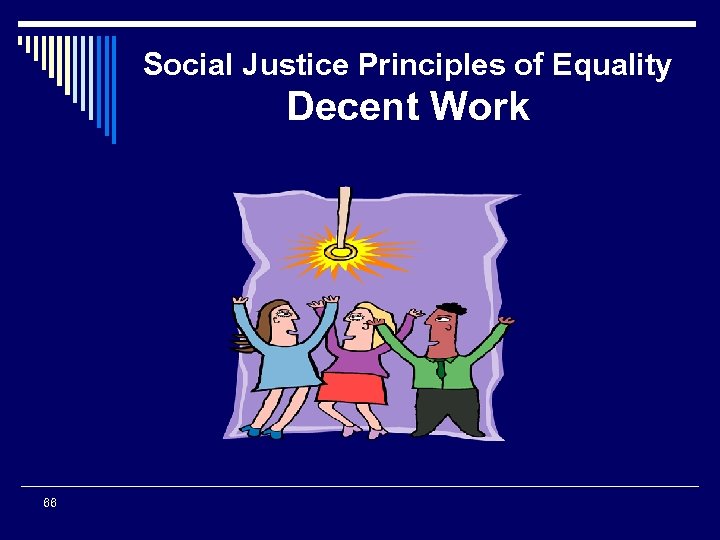 Social Justice Principles of Equality Decent Work 66
 Continued on Part 2 3/19/2018 67