


 Скачать презентацию HQ U S Air Force Academy Integrity —
9be3ca6ac88456660d3abec61ba26ce1.ppt
- Количество слайдов: 28
 HQ U. S. Air Force Academy Integrity - Service - Excellence Acclimatization to Moderate Altitude: Red Cell Mass & Performance Jeff Nelson, Ph. D. USAFA Human Performance Laboratory
 Outline n Adaptation and acclimatization to moderate altitude via chronic residence at USAFA n Lt Col Michael Brothers, Ph. D. – principal investigator Retrospective study n Longitudinal and cross-sectional studies n USAFA total hemoglobin mass altitude study n n Individual variability, Neocytolysis, Iron supplementation n Summary Integrity - Service - Excellence
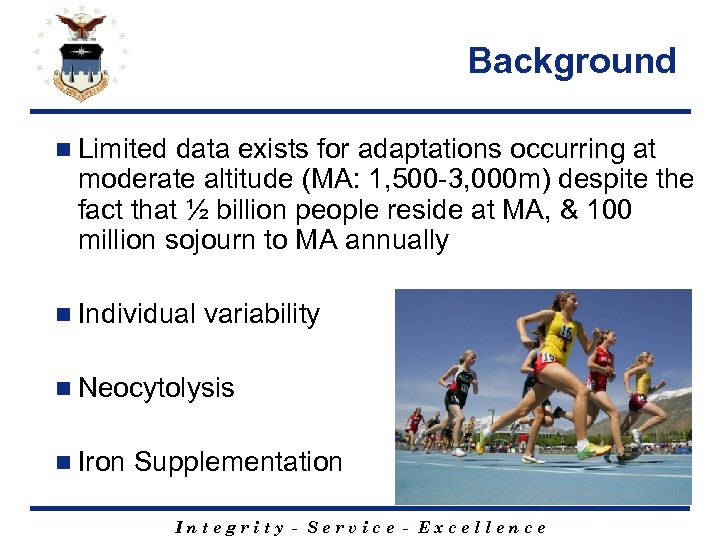 Background n Limited data exists for adaptations occurring at moderate altitude (MA: 1, 500 -3, 000 m) despite the fact that ½ billion people reside at MA, & 100 million sojourn to MA annually n Individual variability n Neocytolysis n Iron Supplementation Integrity - Service - Excellence
 USAFA for analysis of long-term MA adaptation Integrity - Service - Excellence
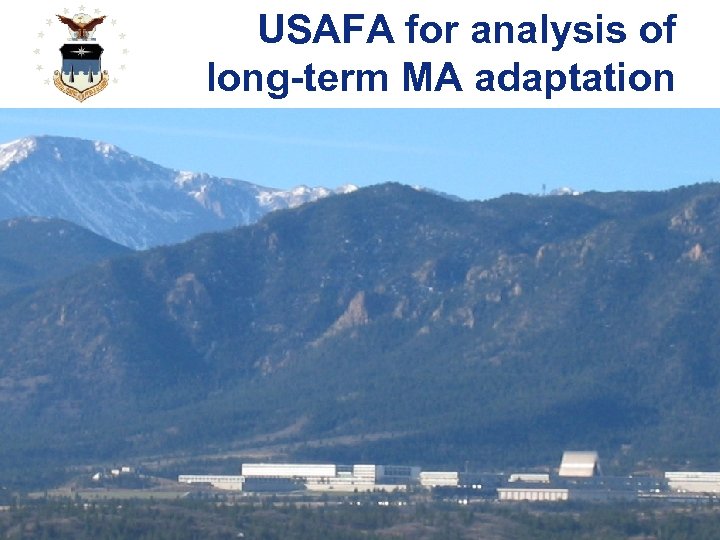
 USAFA for analysis of long-term MA adaptation n Elevation = 2210 m (7, 250 feet) n Freshman students from all over the world (SL & MA) arrive w/in 24 -hour period & in-process the same day each summer n Unique, well-controlled military environment: Stringent physiological requirements for appointment n Limited travel away from USAFA until Thanksgiving (46 days) or Winter (2 -3 week) break (+5. 5 month MA exposure) n Rigorous physical training/testing programs all 4 years n Nearly identical diet n Integrity - Service - Excellence
 Retrospective USAFA data n Examined pre-existing fitness (AFT/PFT) & blood data (H&H) of SL & MA cadets: n = 2, 147 male cadets (classes ’ 03 to ‘ 09) n SL < 153 m / 500 ft: DE, FL, LA, MS, RI n MA >1500 m / 5, 000 ft: CO, WY n Integrity - Service - Excellence
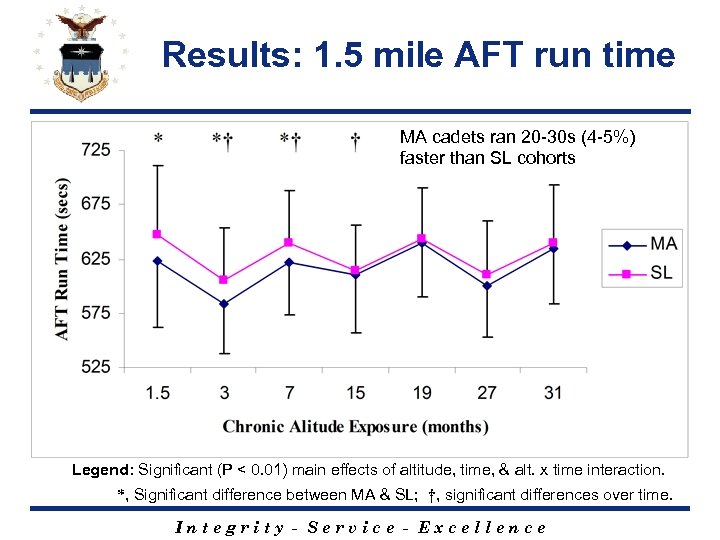 Results: 1. 5 mile AFT run time MA cadets ran 20 -30 s (4 -5%) faster than SL cohorts Legend: Significant (P < 0. 01) main effects of altitude, time, & alt. x time interaction. *, Significant difference between MA & SL; †, significant differences over time. Integrity - Service - Excellence
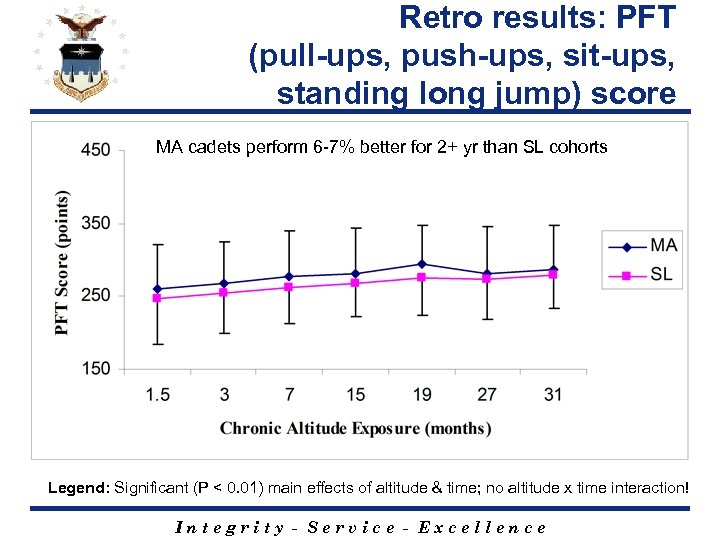 Retro results: PFT (pull-ups, push-ups, sit-ups, standing long jump) score MA cadets perform 6 -7% better for 2+ yr than SL cohorts Legend: Significant (P < 0. 01) main effects of altitude & time; no altitude x time interaction! Integrity - Service - Excellence
![Results: [Hb] MA cadets’ 1. 0 g/d. L (6%) higher initially; SL cadets’ increased](https://present5.com/presentation/9be3ca6ac88456660d3abec61ba26ce1/image-9.jpg "Results: [Hb] MA cadets’ 1. 0 g/d. L (6%) higher initially; SL cadets’ increased") Results: [Hb] MA cadets’ 1. 0 g/d. L (6%) higher initially; SL cadets’ increased 1. 5 g/d. L (10%) with long-term MA exposure Legend: Significant (P < 0. 005) main effects of altitude, time, & alt. x time interaction. Significant difference between MA & SL: § (P< 0. 001), * (P < 0. 01); Significant differences over time: Pre, † (P < 0. 001); Acute, ‡ (P < 0. 01). Integrity - Service - Excellence
Results: [Hb] MA cadets’ 1. 0 g/d. L (6%) higher initially; SL cadets’ increased 1. 5 g/d. L (10%) with long-term MA exposure Legend: Significant (P < 0. 005) main effects of altitude, time, & alt. x time interaction. Significant difference between MA & SL: § (P< 0. 001), * (P < 0. 01); Significant differences over time: Pre, † (P < 0. 001); Acute, ‡ (P < 0. 01). Integrity - Service - Excellence
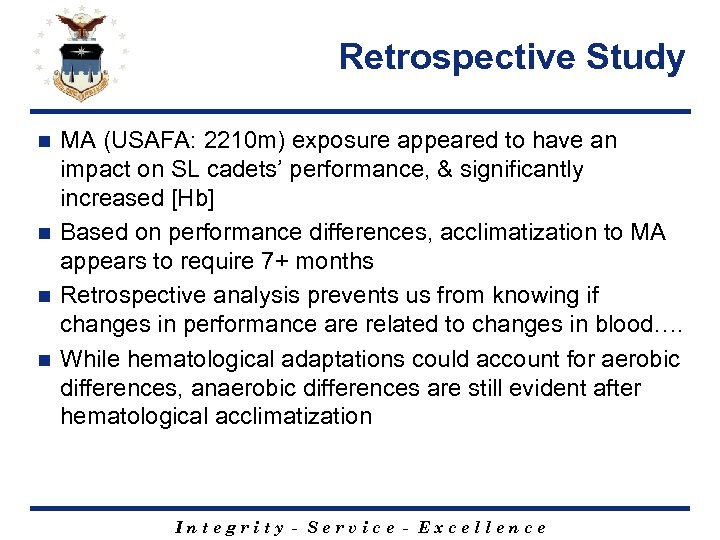 Retrospective Study MA (USAFA: 2210 m) exposure appeared to have an impact on SL cadets’ performance, & significantly increased [Hb] n Based on performance differences, acclimatization to MA appears to require 7+ months n Retrospective analysis prevents us from knowing if changes in performance are related to changes in blood…. n While hematological adaptations could account for aerobic differences, anaerobic differences are still evident after hematological acclimatization n Integrity - Service - Excellence
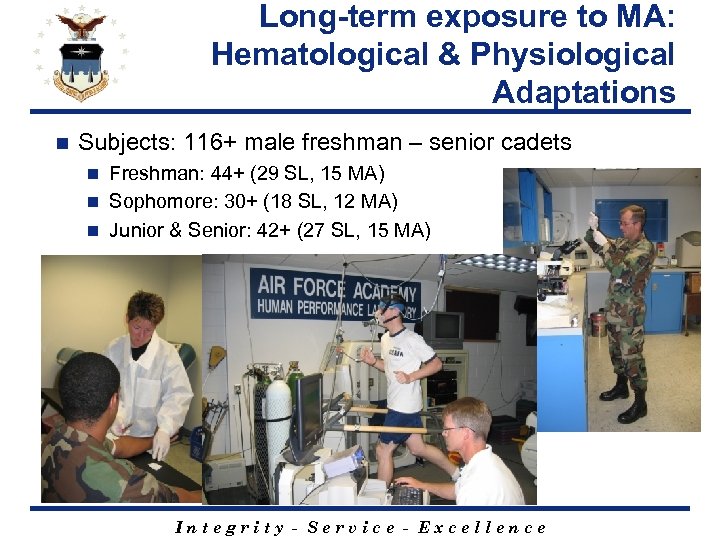 Long-term exposure to MA: Hematological & Physiological Adaptations n Subjects: 116+ male freshman – senior cadets Freshman: 44+ (29 SL, 15 MA) n Sophomore: 30+ (18 SL, 12 MA) n Junior & Senior: 42+ (27 SL, 15 MA) n Integrity - Service - Excellence
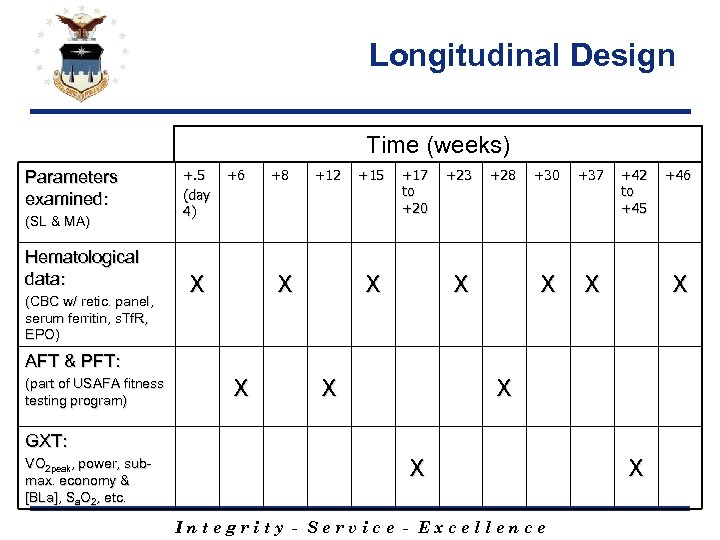 Longitudinal Design Time (weeks) Parameters examined: (SL & MA) Hematological data: (CBC w/ retic. panel, serum ferritin, s. Tf. R, EPO) +. 5 (day 4) +6 X +8 +12 X +15 +17 to +20 X +23 +28 +37 X X +30 +42 to +45 X X AFT & PFT: (part of USAFA fitness testing program) X X X GXT: VO 2 peak, power, submax. economy & [BLa], Sa. O 2, etc. X Integrity - Service - Excellence +46 X
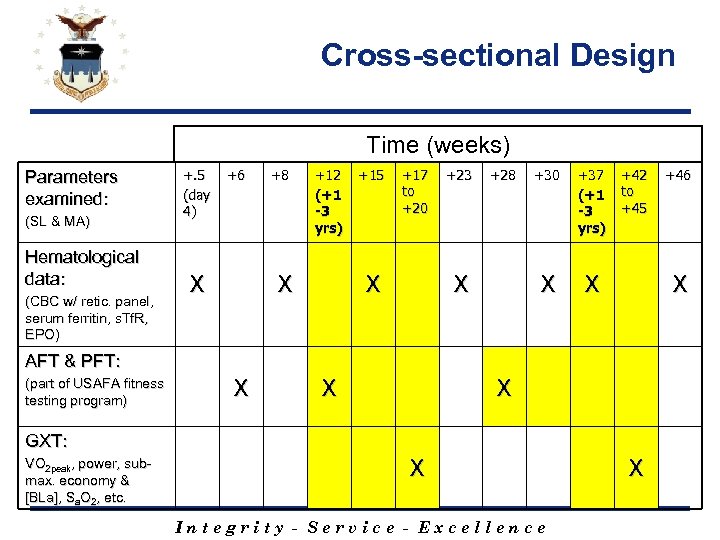 Cross-sectional Design Time (weeks) Parameters examined: (SL & MA) Hematological data: (CBC w/ retic. panel, serum ferritin, s. Tf. R, EPO) +. 5 (day 4) +6 X +8 +12 (+1 -3 yrs) X +15 +17 to +20 X +23 +28 +37 (+1 -3 yrs) X X +30 +42 to +45 X X AFT & PFT: (part of USAFA fitness testing program) X X X GXT: VO 2 peak, power, submax. economy & [BLa], Sa. O 2, etc. X Integrity - Service - Excellence +46 X
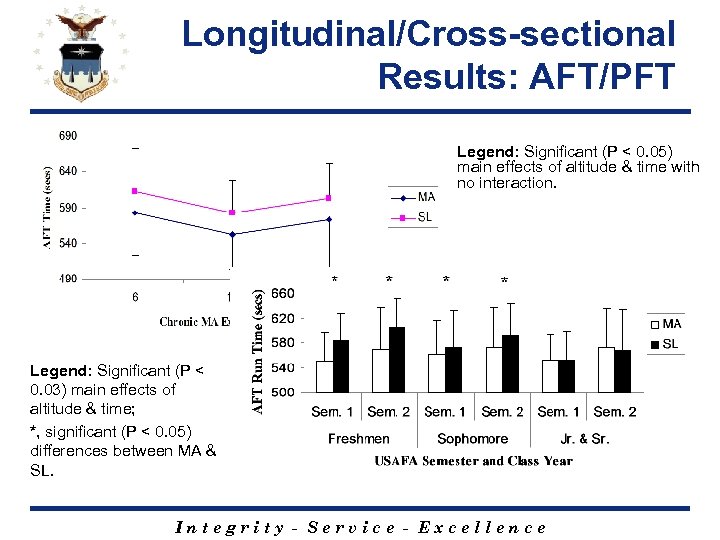 Longitudinal/Cross-sectional Results: AFT/PFT Legend: Significant (P < 0. 05) main effects of altitude & time with no interaction. Legend: Significant (P < 0. 03) main effects of altitude & time; *, significant (P < 0. 05) differences between MA & SL. Integrity - Service - Excellence
![Results: Cross-sectional hematological differences [Hb]: Significant (P < 0. 03) main effect of class,](https://present5.com/presentation/9be3ca6ac88456660d3abec61ba26ce1/image-15.jpg "Results: Cross-sectional hematological differences [Hb]: Significant (P < 0. 03) main effect of class,") Results: Cross-sectional hematological differences [Hb]: Significant (P < 0. 03) main effect of class, & class x time interaction. †, significant (P < 0. 05) between class; ‡, significant (P < 0. 05) differences over time. Integrity - Service - Excellence
Results: Cross-sectional hematological differences [Hb]: Significant (P < 0. 03) main effect of class, & class x time interaction. †, significant (P < 0. 05) between class; ‡, significant (P < 0. 05) differences over time. Integrity - Service - Excellence
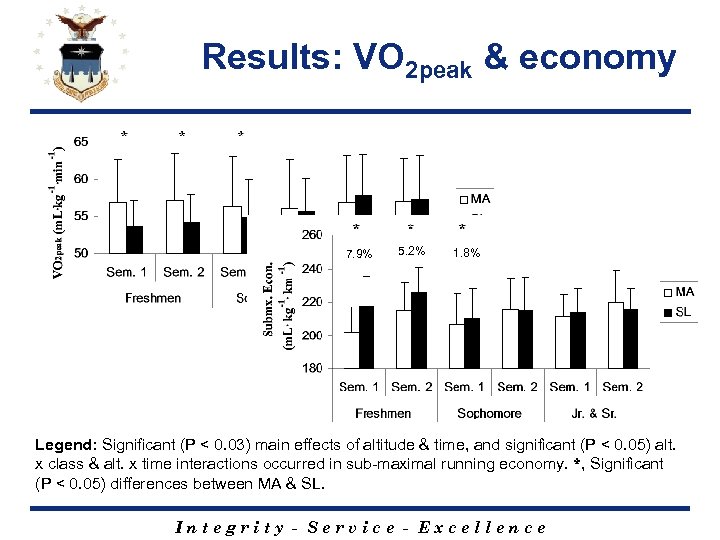 Results: VO 2 peak & economy 7. 9% 5. 2% 1. 8% Legend: Significant (P < 0. 03) main effects of altitude & time, and significant (P < 0. 05) alt. x class & alt. x time interactions occurred in sub-maximal running economy. *, Significant (P < 0. 05) differences between MA & SL. Integrity - Service - Excellence
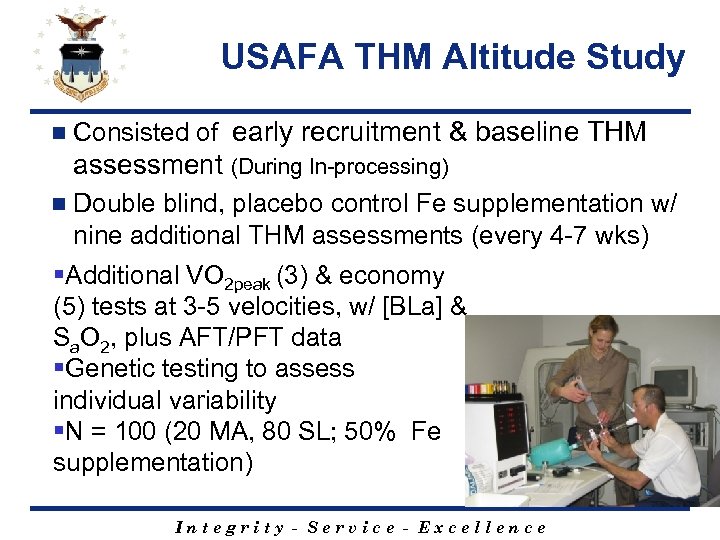 USAFA THM Altitude Study n Consisted of early recruitment & baseline THM assessment (During In-processing) n Double blind, placebo control Fe supplementation w/ nine additional THM assessments (every 4 -7 wks) §Additional VO 2 peak (3) & economy (5) tests at 3 -5 velocities, w/ [BLa] & Sa. O 2, plus AFT/PFT data §Genetic testing to assess individual variability §N = 100 (20 MA, 80 SL; 50% Fe supplementation) Integrity - Service - Excellence
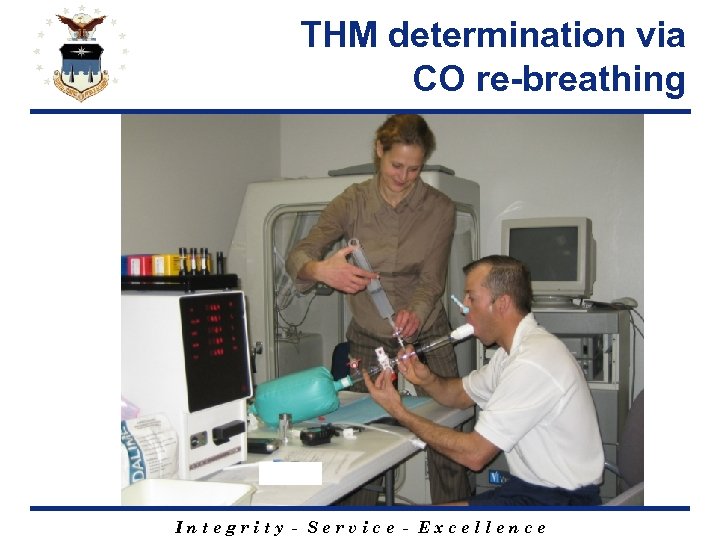 THM determination via CO re-breathing Integrity - Service - Excellence
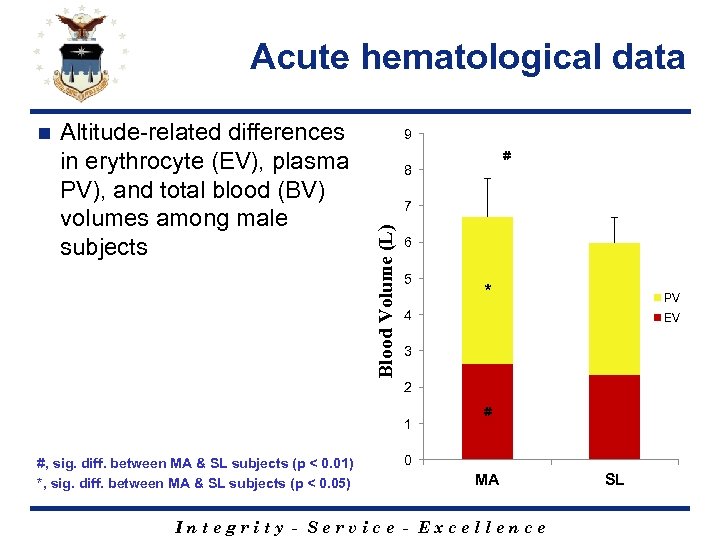 Acute hematological data Altitude-related differences in erythrocyte (EV), plasma PV), and total blood (BV) volumes among male subjects 9 # 8 7 Blood Volume (L) n 6 5 * PV 4 EV 3 2 1 #, sig. diff. between MA & SL subjects (p < 0. 01) *, sig. diff. between MA & SL subjects (p < 0. 05) # 0 MA Integrity - Service - Excellence SL
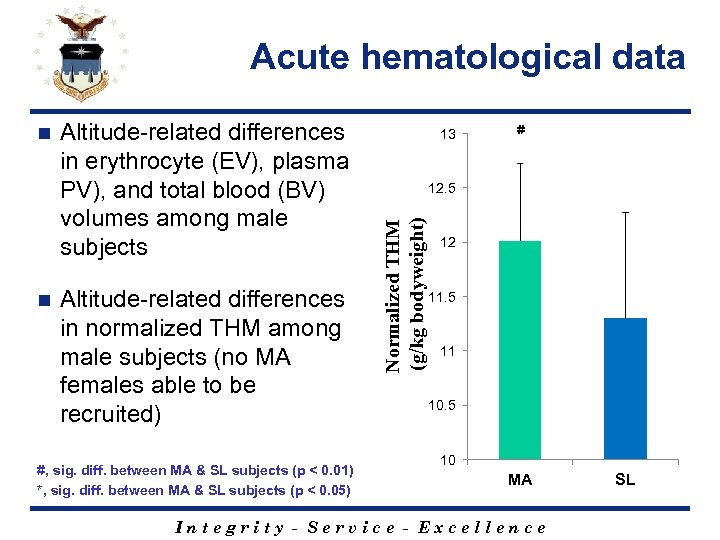 Acute hematological data n Altitude-related differences in erythrocyte (EV), plasma PV), and total blood (BV) volumes among male subjects Altitude-related differences in normalized THM among male subjects (no MA females able to be recruited) #, sig. diff. between MA & SL subjects (p < 0. 01) *, sig. diff. between MA & SL subjects (p < 0. 05) 13 # 12. 5 Normalized THM (g/kg bodyweight) n 12 11. 5 11 10. 5 10 MA Integrity - Service - Excellence SL
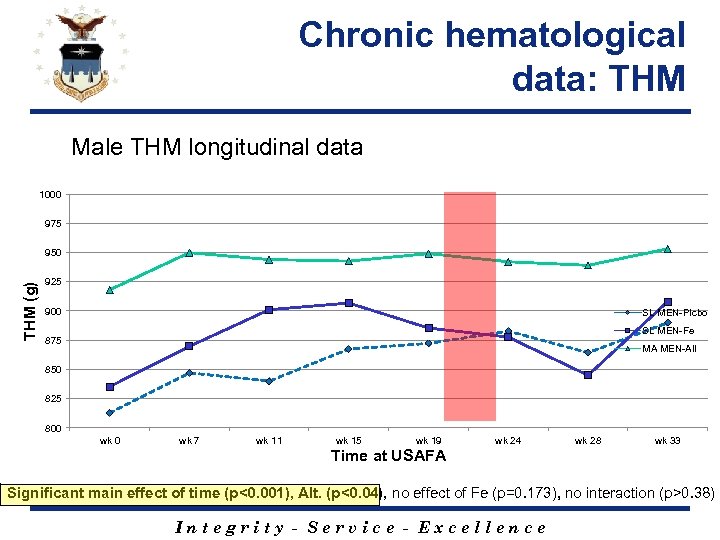 Chronic hematological data: THM Male THM longitudinal data 1000 975 THM (g) 950 925 900 SL MEN-Plcbo SL MEN-Fe 875 MA MEN-All 850 825 800 wk 7 wk 11 wk 15 wk 19 wk 24 wk 28 wk 33 Time at USAFA Significant main effect of time (p<0. 001), Alt. (p<0. 04), no effect of Fe (p=0. 173), no interaction (p>0. 38) Integrity - Service - Excellence
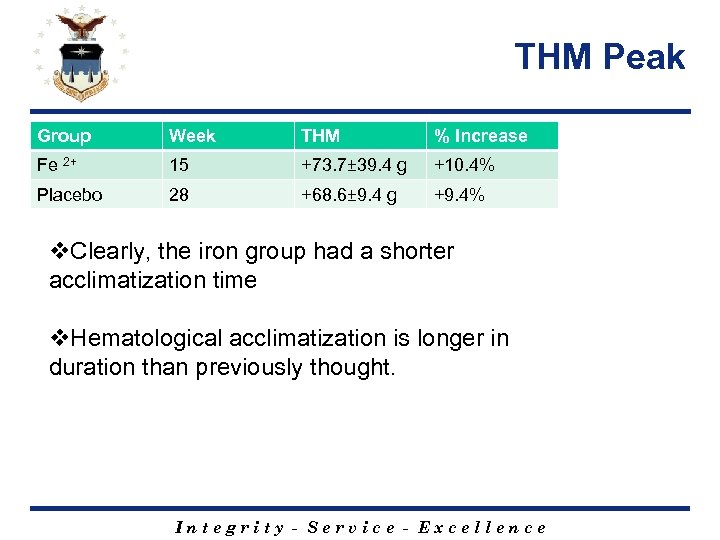 THM Peak Group Week THM % Increase Fe 2+ 15 +73. 7± 39. 4 g +10. 4% Placebo 28 +68. 6± 9. 4 g +9. 4% v. Clearly, the iron group had a shorter acclimatization time v. Hematological acclimatization is longer in duration than previously thought. Integrity - Service - Excellence
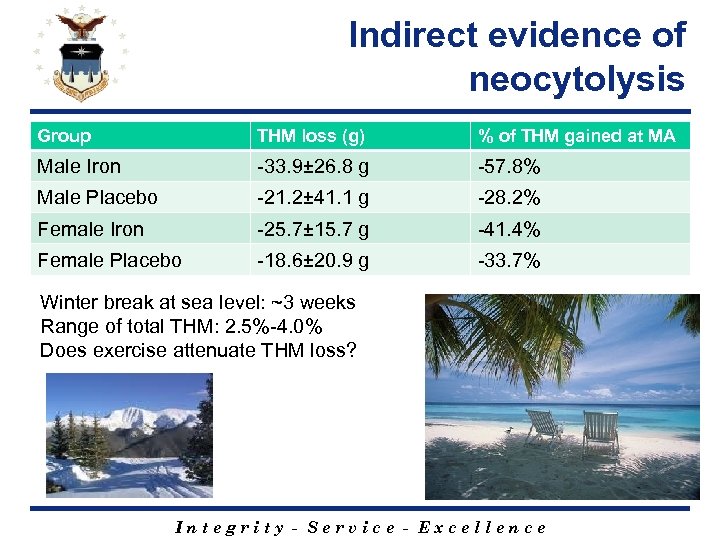 Indirect evidence of neocytolysis Group THM loss (g) % of THM gained at MA Male Iron -33. 9± 26. 8 g -57. 8% Male Placebo -21. 2± 41. 1 g -28. 2% Female Iron -25. 7± 15. 7 g -41. 4% Female Placebo -18. 6± 20. 9 g -33. 7% Winter break at sea level: ~3 weeks Range of total THM: 2. 5%-4. 0% Does exercise attenuate THM loss? Integrity - Service - Excellence
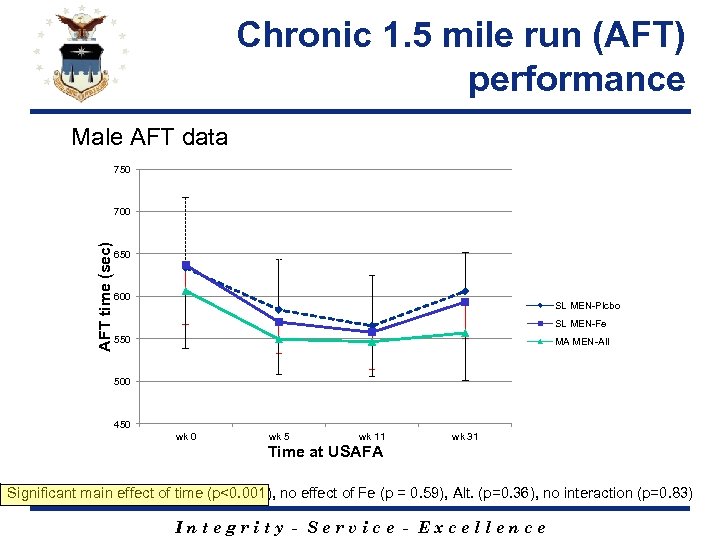 Chronic 1. 5 mile run (AFT) performance Male AFT data 750 AFT time (sec) 700 650 600 SL MEN-Plcbo SL MEN-Fe 550 MA MEN-All 500 450 wk 5 wk 11 wk 31 Time at USAFA Significant main effect of time (p<0. 001), no effect of Fe (p = 0. 59), Alt. (p=0. 36), no interaction (p=0. 83) Integrity - Service - Excellence
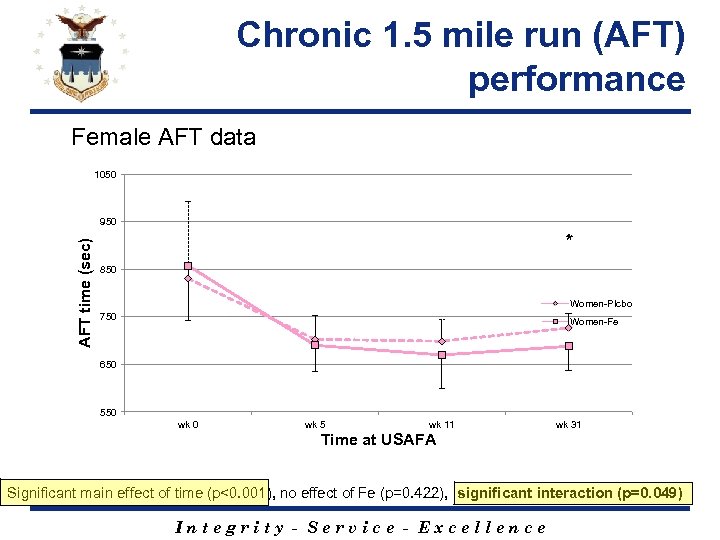 Chronic 1. 5 mile run (AFT) performance Female AFT data 1050 AFT time (sec) 950 * 850 Women-Plcbo 750 Women-Fe 650 550 wk 5 wk 11 wk 31 Time at USAFA Significant main effect of time (p<0. 001), no effect of Fe (p=0. 422), significant interaction (p=0. 049) Integrity - Service - Excellence
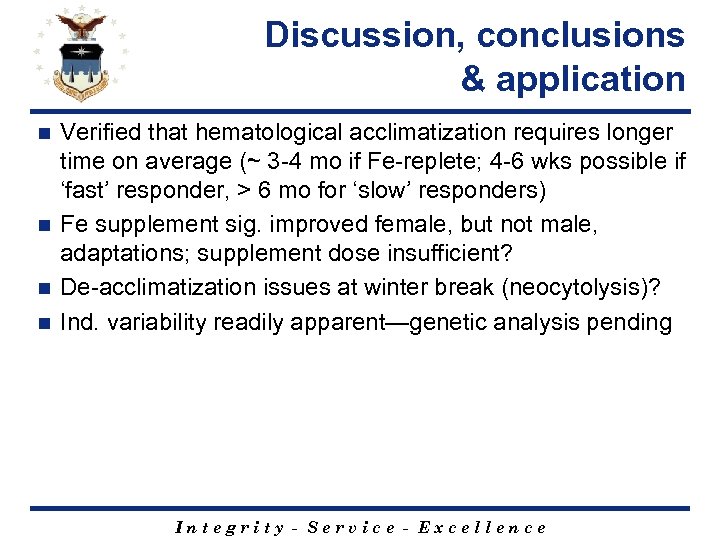 Discussion, conclusions & application Verified that hematological acclimatization requires longer time on average (~ 3 -4 mo if Fe-replete; 4 -6 wks possible if ‘fast’ responder, > 6 mo for ‘slow’ responders) n Fe supplement sig. improved female, but not male, adaptations; supplement dose insufficient? n De-acclimatization issues at winter break (neocytolysis)? n Ind. variability readily apparent—genetic analysis pending n Integrity - Service - Excellence
 Main Points n n n Hematological acclimatization at MA takes longer than originally thought: 15 -28 weeks, depending on genetics and/or iron availability Performance acclimatization takes ~ 1. 5 yrs in our cadet population Importance in acknowledging neocytolysis in acclimatization time Iron supplementation – importance to note toxicity potential if unmonitored; individual differences Application Integrity - Service - Excellence 26/22
 Acknowledgments / Questions Thanks to: Lt Col Brandon Doan (Ph. D. ), Lt Col Michael Zupan (Ph. D. ), Mr. Al Wile (M. S. ); Dr. Jeff Nelson, Dr. Bill Byrnes & Dr. Randy Wilber; Capt. Jules Macgregor, 2 d Lt Andrea Pinchak, TSgt Chris Ruth, Ms. Christina Minares; Cadets Courtney Hemmert, Zach Garrett, Russell Smith, Jane Hwang, Robert Edmonds, Andrew Groberg, Chloe Angello, and Tyner Apt (former USAFA 499 researchers), Ms. Liz Terry, Mr. Ben Ryan, Ms. Darci Thurston, (HPL interns), plus all the USAFA cadet subjects! Funding: HQ USAF/SGSR, AFRL and USAFA HERC USAFA Human Performance Laboratory HQ USAFA / ADPH 2169 Field House Drive, Ste 111 USAF Academy CO 80840 Jeff Nelson, Ph. D. jeffrey. nelson@usafa. edu Integrity - Service - Excellence