


 Скачать презентацию HPV Carcinoma of the Cervix Many
9bf5652001d6029c4b46008b874ab997.ppt
- Количество слайдов: 23
 HPV
HPV
 Carcinoma of the Cervix § Many risk factors for development of cervical cancer. • no routinely used positive predictive biological markers, which identify women at risk of developing high-grade lesions and ultimately invasive cancer.
 Human Papillomavirus (HPV) • • • Strong association with development of invasive cancer. >70 types of HPV. Low risk (6, 11). High risk (16, 18, 31, 33, 35, 39, 45, 51, 52, 56, 58, 59, 66, 68). Exposure to HPV is followed by a serological response to viral capsid proteins (VLPs). • Immune response is assoc. with persistent HPV infection and is type specific.
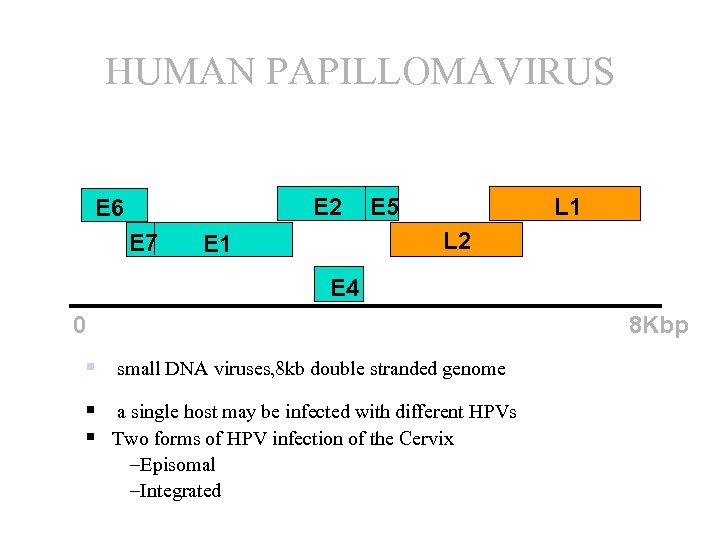 HUMAN PAPILLOMAVIRUS E 2 E 6 E 7 E 5 L 1 L 2 E 1 E 4 8 Kbp 0 § small DNA viruses, 8 kb double stranded genome § a single host may be infected with different HPVs § Two forms of HPV infection of the Cervix –Episomal –Integrated
 HPV • Integration of HPV DNA into host loss of E 2 orf. • Transcription of E 6 and E 7 is unregulated. • Transformation events within the cell. • Checkpoint for cell proliferation and transcription is lost.
 HPV • Expressed E 6 and E 7 proteins can then interact with other tumour suppressor genes including p 53 and p. RB uncontrolled cellular proliferation and malignant transformation. • 3 splice variants of E 6 HPV 16 recognised: E 6 I, II and III.
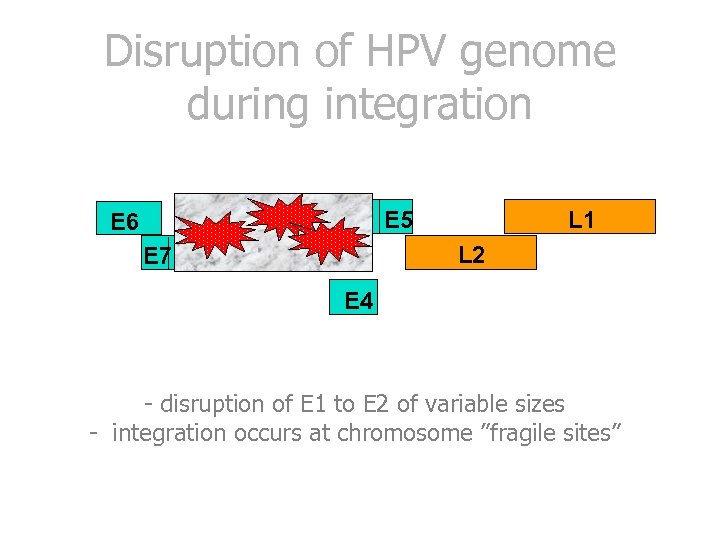 Disruption of HPV genome during integration E 2 E 6 E 7 E 5 L 1 L 2 E 1 E 4 - disruption of E 1 to E 2 of variable sizes - integration occurs at chromosome ”fragile sites”
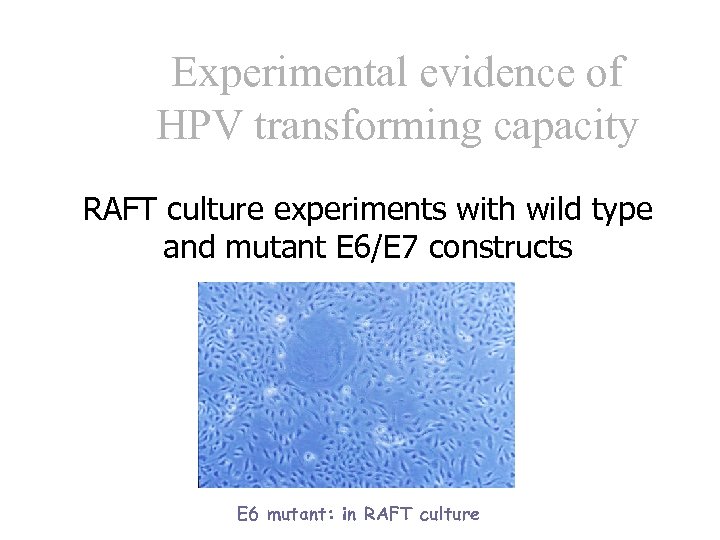 Experimental evidence of HPV transforming capacity RAFT culture experiments with wild type and mutant E 6/E 7 constructs E 6 mutant: in RAFT culture
 HPV Cells infected with oncogenic HPV types Immortalisation Uncontrolled cell proliferation
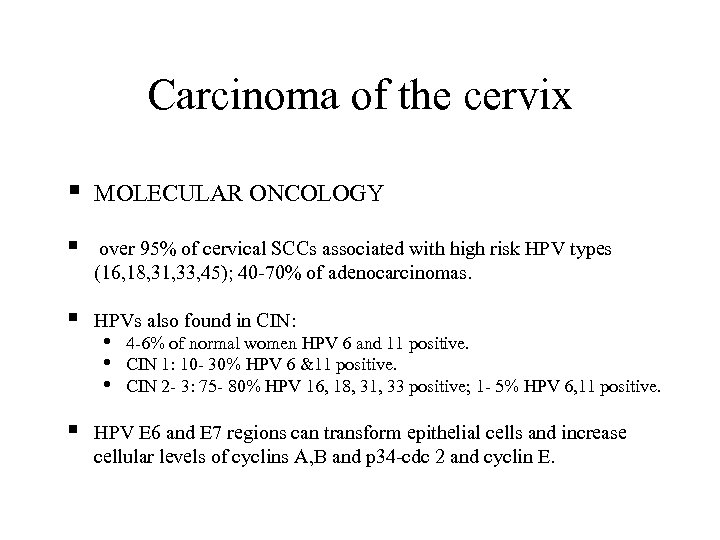 Carcinoma of the cervix § MOLECULAR ONCOLOGY § over 95% of cervical SCCs associated with high risk HPV types (16, 18, 31, 33, 45); 40 -70% of adenocarcinomas. § HPVs also found in CIN: § • • • 4 -6% of normal women HPV 6 and 11 positive. CIN 1: 10 - 30% HPV 6 &11 positive. CIN 2 - 3: 75 - 80% HPV 16, 18, 31, 33 positive; 1 - 5% HPV 6, 11 positive. HPV E 6 and E 7 regions can transform epithelial cells and increase cellular levels of cyclins A, B and p 34 -cdc 2 and cyclin E.
 HPV analysis • Who do we screen? – All Women? – HPV as a triage? • How do we screen? • Does HPV analysis give prognostic information? • HPV and other novel biomarkers of disease
 Future role for HPV screening • Post introduction of HPV vaccine § vaccines being produced to target HPV 16 and 18 E 6/E 7 regions. § requirement to monitor HPV status pre and post -vaccination. § possibility of using recombinant § anti-sense PNAs to specifically § target HPV E 6 and E 6 splice variants.
 How do we screen? • HPV analysis – Type – Load – Viral integration
 HPV analysis • Technologies available – Hybrid Capture II – PCR generic, (incl. PGYM, GP 5 and 6, green) – Type specific DNA PCR • • • Solution phase PCR Taq. Man PCR NASBA (HPV proofer) In-situ hybridisation (ISH) Sequence genotyping In-cell PCR – ICC SYBR
 HPV analysis • Hybrid Capture II – Liquid based system. – Low and high risk type analysis. – No information in relation to integration. – Indirect load information but NOT quantitative.
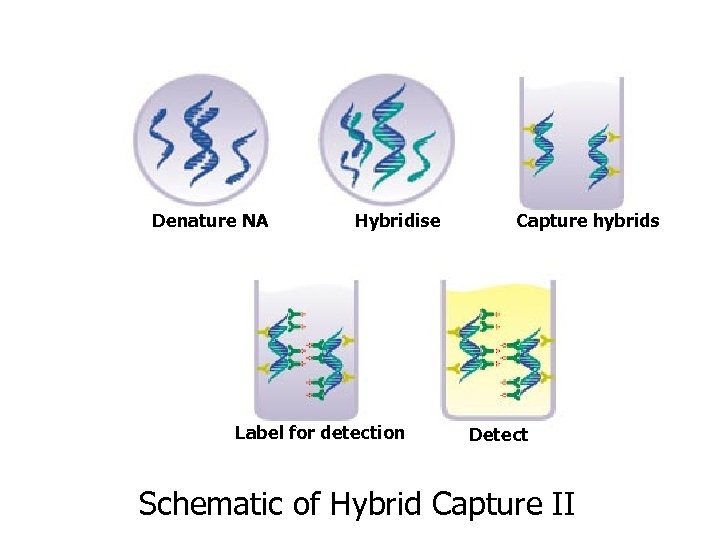 Denature NA Hybridise Label for detection Capture hybrids Detect Schematic of Hybrid Capture II
 HPV analysis Hybrid Capture II §Recommended cut-off for the HC-II test is 1 pg viral DNA per ml of buffer, equivalent to about 5000 viral genomes. §This cut-off value has been reduced to 0. 2 pg/ml but with the introduction of false positives (Peyton et al). §Data comparing PCR with HC-II found PCR identified HPV in 24. 5% of samples, while HC-II detected HPV in 13% using the recommended cut-off of 1 pg/ml, and in 22. 1% using a cut-off of 0. 2 pg/ml.
 HPV analysis -PCR • PCR generic / consensus – GP 5 and 6 – PGYM – MY 09/11 – SPF 10 – GP 5 and 6 + SYBR green
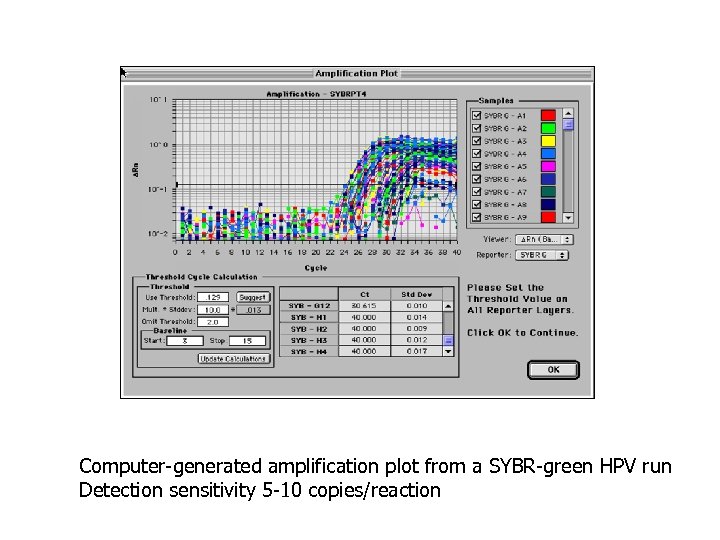 Computer-generated amplification plot from a SYBR-green HPV run Detection sensitivity 5 -10 copies/reaction
 HPV analysis • Type specific PCR – Solution phase PCR – Taq Man q(PCR) – NASBA (HPV proofer) – In-situ hybridisation – HPV genotyping
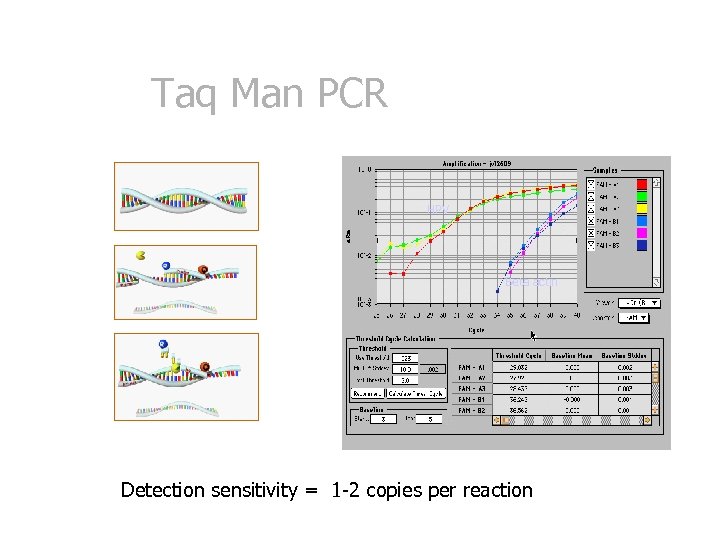 Taq Man PCR HPV Beta actin Detection sensitivity = 1 -2 copies per reaction
 HPV analysis • In-situ hybridisation – Cloned HPV subtypes (Zur Hausen) – Automated platforms available. – Commercial probes: • DAKO, Digene, Ventana, etc. Detection sensitivity = 1 -5 copies per biopsy
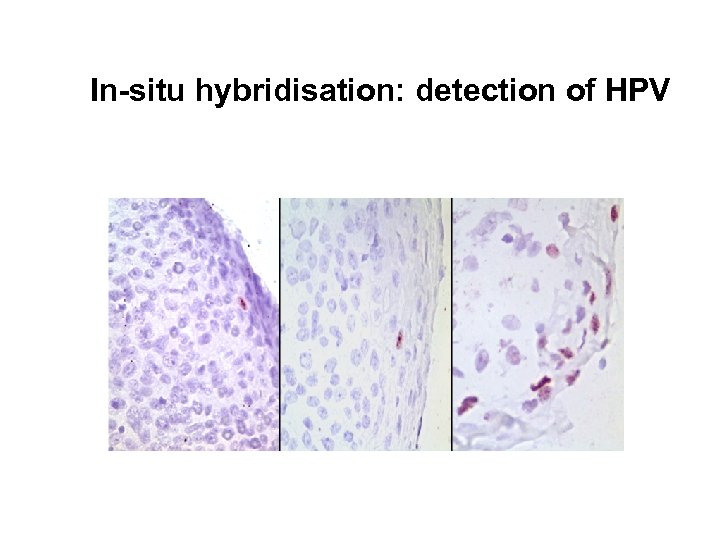 In-situ hybridisation: detection of HPV