


 Скачать презентацию HPC-Europa Portal Uniform Access to European HPC Infrastructure
e233c3824df24de92a6473ffdfd32a73.ppt
- Количество слайдов: 13
 HPC-Europa Portal: Uniform Access to European HPC Infrastructure Ariel Oleksiak ariel@man. poznan. pl Poznan Supercomputing and Networking Center www. hpc-europa. org
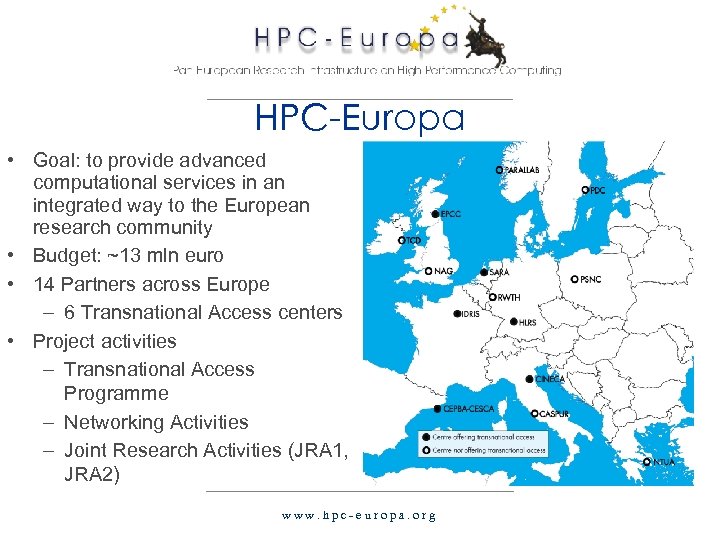 HPC-Europa • Goal: to provide advanced computational services in an integrated way to the European research community • Budget: ~13 mln euro • 14 Partners across Europe – 6 Transnational Access centers • Project activities – Transnational Access Programme – Networking Activities – Joint Research Activities (JRA 1, JRA 2) www. hpc-europa. org
 JRA 2: Single Point of Access • Motivation – To provide a uniform access to resources of all centers, transparently and regardless of user physical location • Main objectives – Ease of use, – Improvement of resources availability and utilization, – Enabling HPC centers to use their own middleware and local policies – Use of accounting data for charging and limiting resource usage • To achieve these goals JRA 2: – Builds the HPC-Europa portal based on the Grid. Sphere framework – Develops interfaces to needed tools and services www. hpc-europa. org
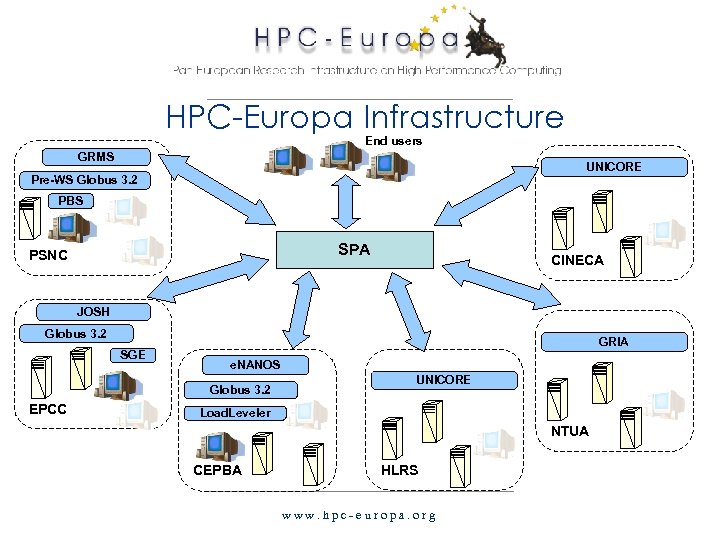 HPC-Europa Infrastructure End users GRMS UNICORE Pre-WS Globus 3. 2 PBS SPA PSNC CINECA JOSH Globus 3. 2 SGE GRIA e. NANOS Globus 3. 2 EPCC UNICORE Load. Leveler NTUA CEPBA HLRS www. hpc-europa. org
 User interfaces • Two types of interfaces (GUI) a) General and uniform interface for all users and applications b) Portlets for specific applications • Main requirements – Uniform access to various tools & services – Dynamic GUI adaptation to the functionality provided by diverse services (a) and applications (b) www. hpc-europa. org
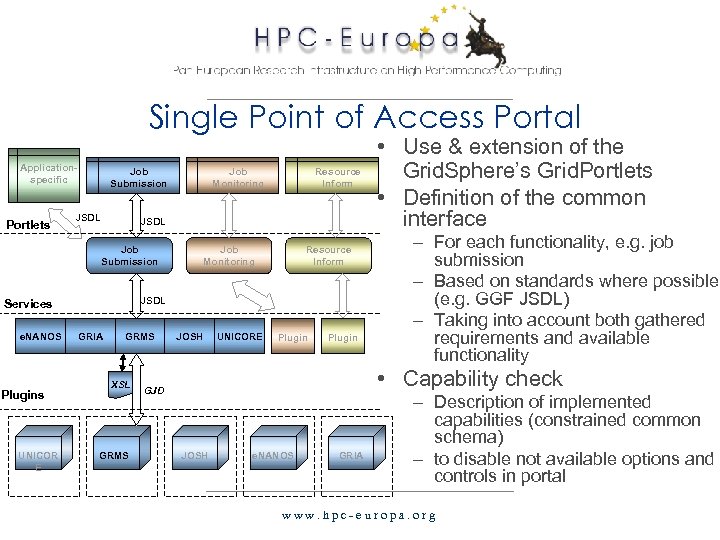 Single Point of Access Portal Applicationspecific Portlets Job Submission JSDL UNICOR E Job Monitoring Resource Inform JSDL Services Plugins Resource Inform JSDL Job Submission e. NANOS Job Monitoring GRIA GRMS XSL GRMS JOSH UNICORE Plugin • Use & extension of the Grid. Sphere’s Grid. Portlets • Definition of the common interface – For each functionality, e. g. job submission – Based on standards where possible (e. g. GGF JSDL) – Taking into account both gathered requirements and available functionality • Capability check GJD JOSH e. NANOS GRIA – Description of implemented capabilities (constrained common schema) – to disable not available options and controls in portal www. hpc-europa. org
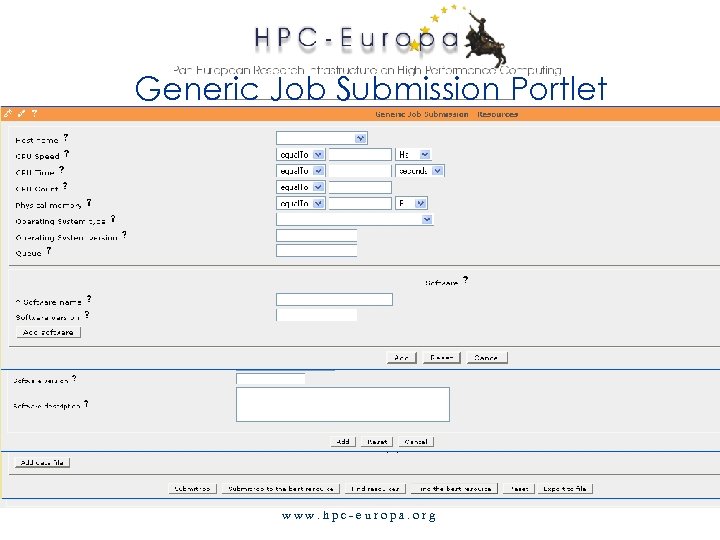 Generic Job Submission Portlet www. hpc-europa. org
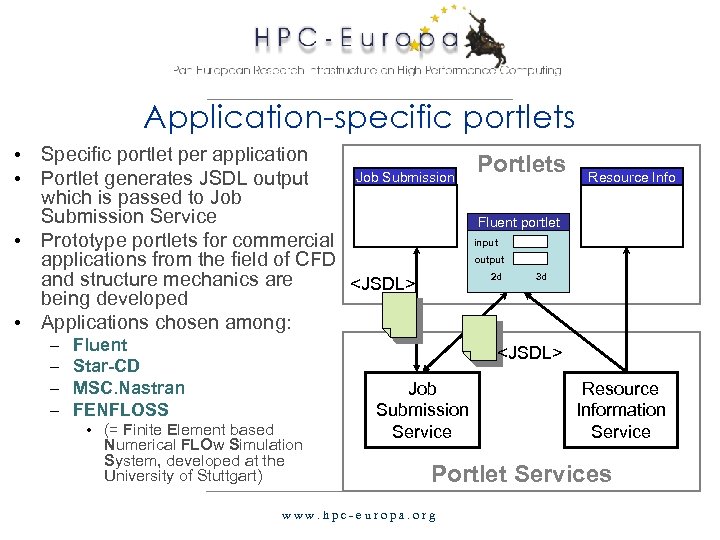 Application-specific portlets • Specific portlet per application Job Submission • Portlet generates JSDL output which is passed to Job Submission Service • Prototype portlets for commercial applications from the field of CFD and structure mechanics are
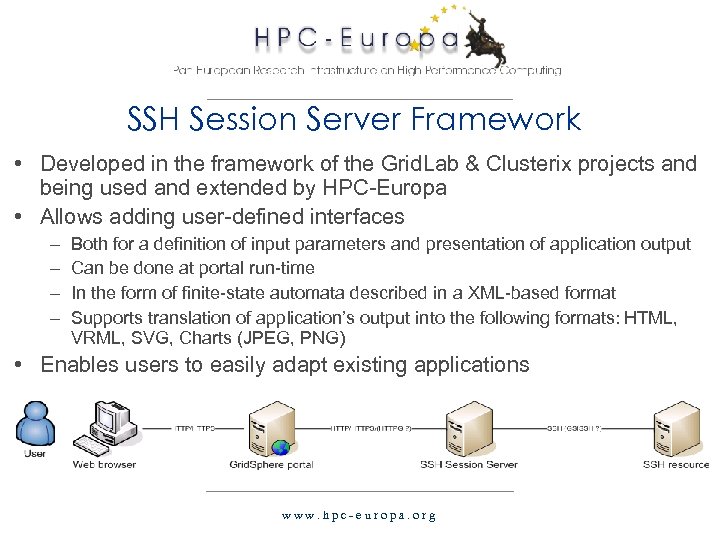 SSH Session Server Framework • Developed in the framework of the Grid. Lab & Clusterix projects and being used and extended by HPC-Europa • Allows adding user-defined interfaces – – Both for a definition of input parameters and presentation of application output Can be done at portal run-time In the form of finite-state automata described in a XML-based format Supports translation of application’s output into the following formats: HTML, VRML, SVG, Charts (JPEG, PNG) • Enables users to easily adapt existing applications www. hpc-europa. org
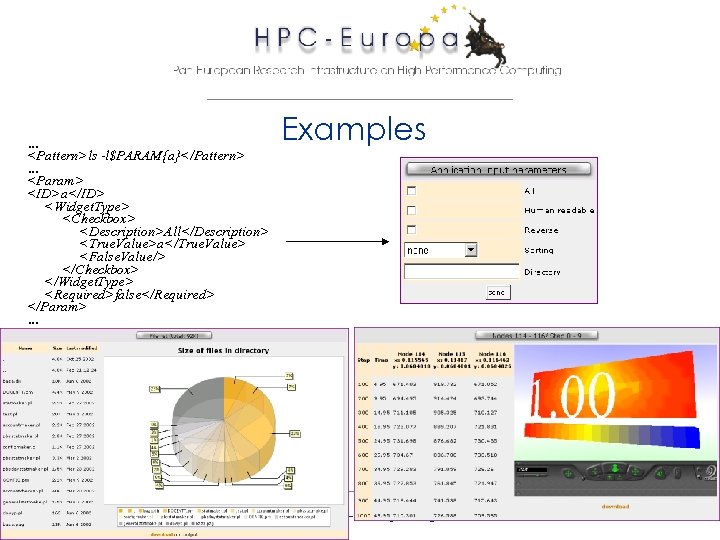 …
…
 Security issues • Authentication problem – Globus-based systems - use of GSI (proxy certificates) – UNICORE & GRIA - "end to end" security model based on a standard X 509 certificates (lack of delegation) • Current solution – SPA authenticates on behalf of users using its certificate – User's distinguish name (taken from proxy certificate) passed to the underlying system – Grid. Login used for certificate requests and storing users credentials to My. Proxy • Authorization – Grid Authorization System (GAS) – Local authorization systems www. hpc-europa. org
 Accounting & Charging Model • Allocation Unit (AU) – 1 TFlop sustained for 1 hour – TFlops measured using the Linpack benchmark – Kept for each resource provider for every single HPC system • Used for 2 purposes – charging the EC for the use of HPC facilities – limiting the maximum amount of resources a user (or group of users) may utilize • Currently available in HPC centers – Goal: to provide global accounting for all centers • Budgets – The processing capacity of the whole machine is divided between projects – The allocation for each project is subdivided into budgets – Users can be granted access to one or more budgets www. hpc-europa. org
 Conclusion • Two types of interfaces provided – Uniform interface for generic users – Application-specific portlets • Status & next steps – Job submission interface & portlet ready – The remaining interfaces under construction – Work on security issues and accounting • Portlets are JSR 168 -compliant, portlet services based on Spring (portability!) • Can be a basis for building a specific science gateway • Finally deployed for all Transnational Access centers? www. hpc-europa. org