 Скачать презентацию Howard Gardner By Laken Fritz Birth and
a30b8fede22f03e06a8a0eb30ebbe349.ppt
- Количество слайдов: 18



Howard Gardner By: Laken Fritz
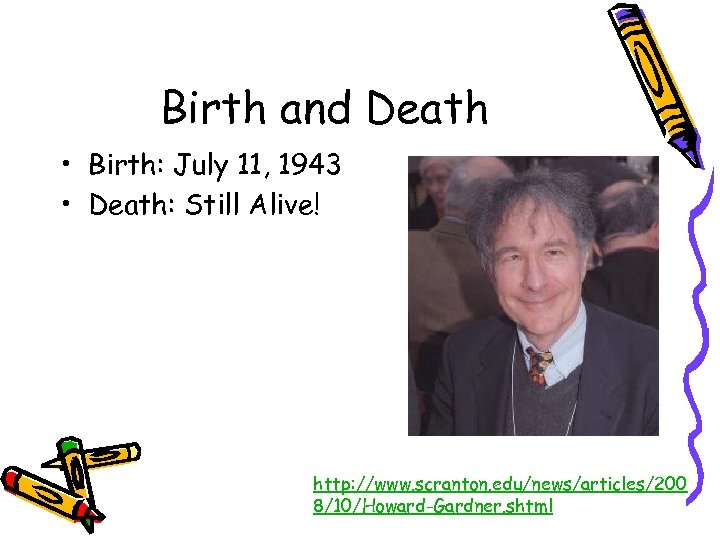
Birth and Death • Birth: July 11, 1943 • Death: Still Alive! http: //www. scranton. edu/news/articles/200 8/10/Howard-Gardner. shtml
Personal History • Born in Scranton PA • Had Eric Erikson as a tutor • John H. and Elisabeth A. Hobbs Professor of Cognition and Education at the Harvard Graduate School of Education • Adjunct Professor of Psychology at Harvard University • Senior Director of Harvard Project Zero • Originally a developmental psychologist and later in neuropsychology • Main area of research interest at that time was cognition, especially the capacity to use symbols, working with both normal and gifted children, and brain -damaged adults http: //www. ffst. hr/ENCYCLOPAEDIA/doku. p hp? id=howard_gardner_and_education
Personal History Continued- Awards • Mac. Arthur Prize Fellowship in 1981 • Honorary degrees from 26 colleges and universities – including institutions in Bulgaria, Chile, Greece, Ireland, Israel, Italy, and South Korea • By Foreign Policy and Prospect magazines as one of the 100 most influential public intellectuals in the world • 2011 Prince of Asturias Award in Social Sciences
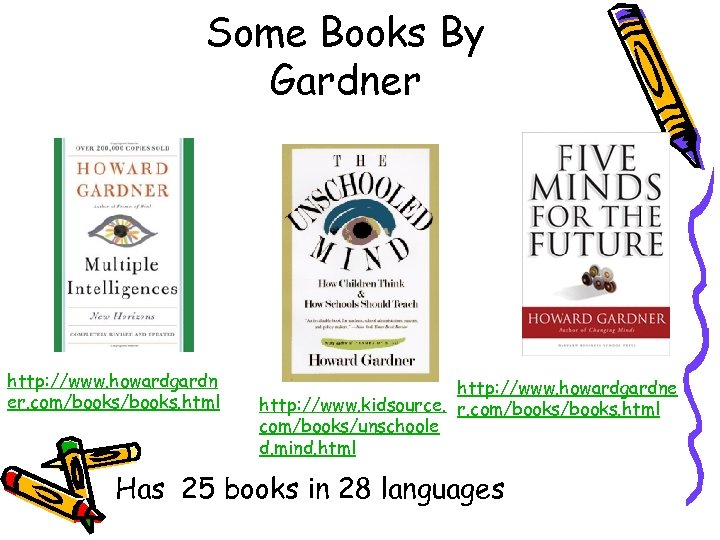
Some Books By Gardner http: //www. howardgardn er. com/books. html http: //www. howardgardne http: //www. kidsource. r. com/books. html com/books/unschoole d. mind. html Has 25 books in 28 languages
Works and Research • Multiple Intelligence – initially formulated a list of seven intelligences. The first two have been typically valued in schools; the next three are usually associated with the arts; and the final two are what Howard Gardner called 'personal intelligences' • Project Zero – Project Zero provided an environment in which Howard Gardner could begin to explore his interest in human cognition http: //www. infed. org/thinkers/gardn er. htm
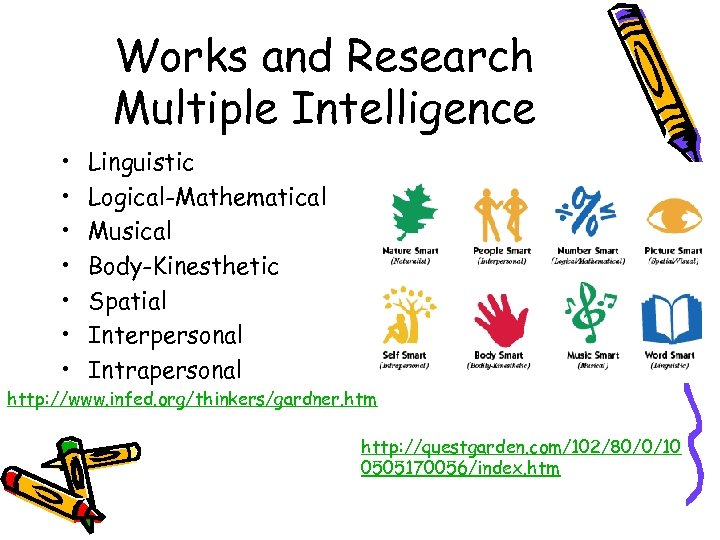
Works and Research Multiple Intelligence • • Linguistic Logical-Mathematical Musical Body-Kinesthetic Spatial Interpersonal Intrapersonal http: //www. infed. org/thinkers/gardner. htm http: //questgarden. com/102/80/0/10 0505170056/index. htm
Linguistic • Involves sensitivity to spoken and written language, the ability to learn languages, and the capacity to use language to accomplish certain goals • Writers, poets, lawyers and speakers are among those that see as having high linguistic intelligence. http: //www. infed. org/thinkers/gardner. htm http: //educreality. com/howardgardners-multipleintelligences/
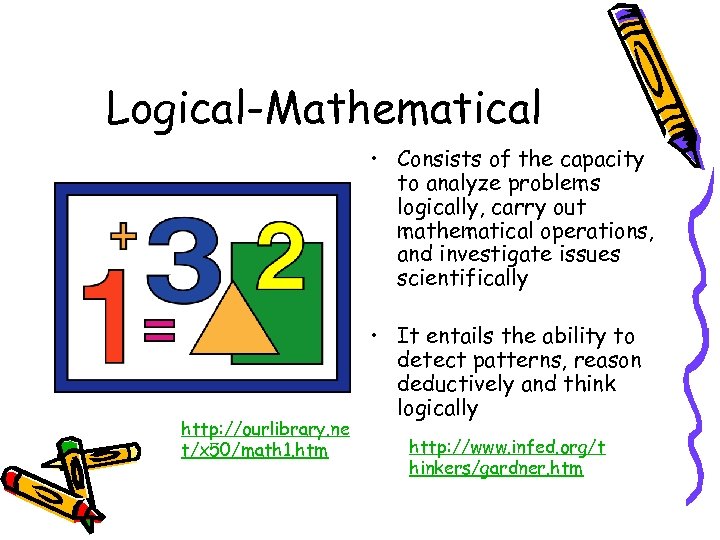
Logical-Mathematical • Consists of the capacity to analyze problems logically, carry out mathematical operations, and investigate issues scientifically http: //ourlibrary. ne t/x 50/math 1. htm • It entails the ability to detect patterns, reason deductively and think logically http: //www. infed. org/t hinkers/gardner. htm
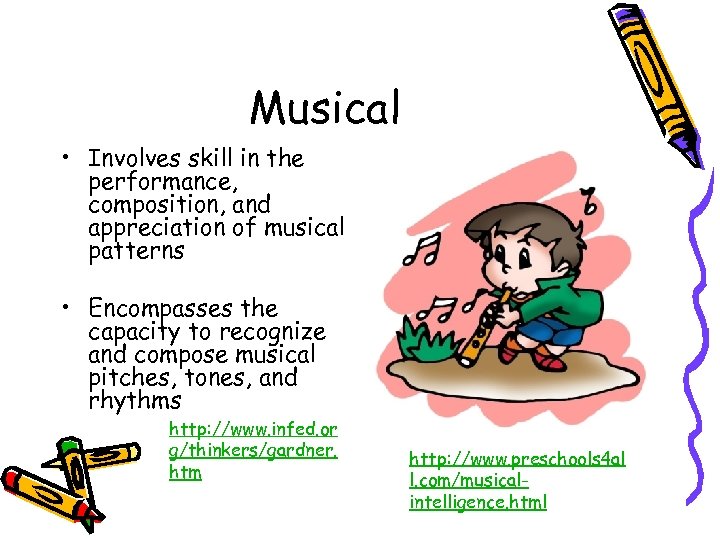
Musical • Involves skill in the performance, composition, and appreciation of musical patterns • Encompasses the capacity to recognize and compose musical pitches, tones, and rhythms http: //www. infed. or g/thinkers/gardner. htm http: //www. preschools 4 al l. com/musicalintelligence. html
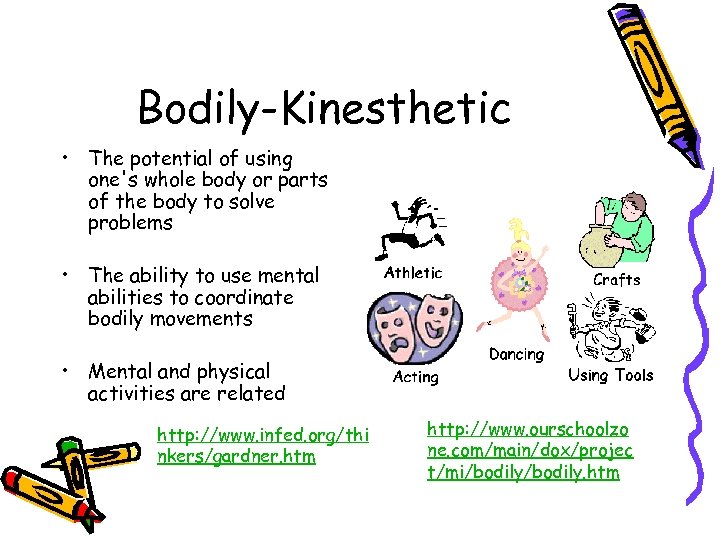
Bodily-Kinesthetic • The potential of using one's whole body or parts of the body to solve problems • The ability to use mental abilities to coordinate bodily movements • Mental and physical activities are related http: //www. infed. org/thi nkers/gardner. htm http: //www. ourschoolzo ne. com/main/dox/projec t/mi/bodily. htm
Spatial • Involves the potential to recognize and use the patterns of wide space and more confined areas http: //educreality. com/howardgardners-multipleintelligences/ http: //www. infe d. org/thinkers/ gardner. htm
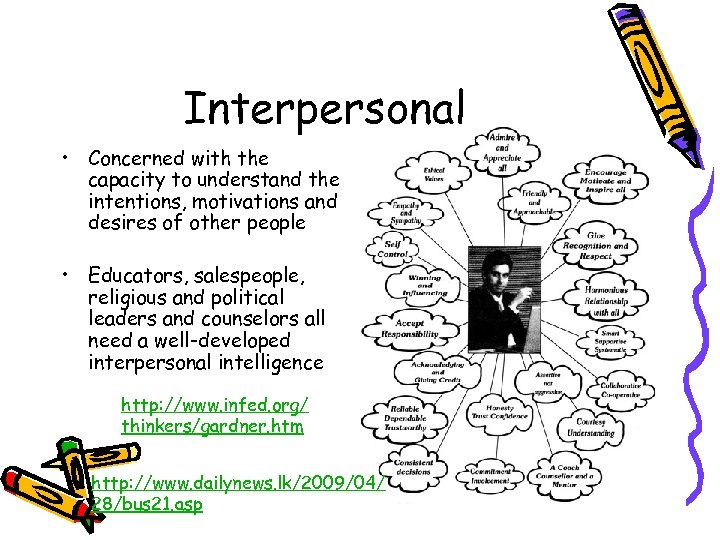
Interpersonal • Concerned with the capacity to understand the intentions, motivations and desires of other people • Educators, salespeople, religious and political leaders and counselors all need a well-developed interpersonal intelligence http: //www. infed. org/ thinkers/gardner. htm http: //www. dailynews. lk/2009/04/ 28/bus 21. asp
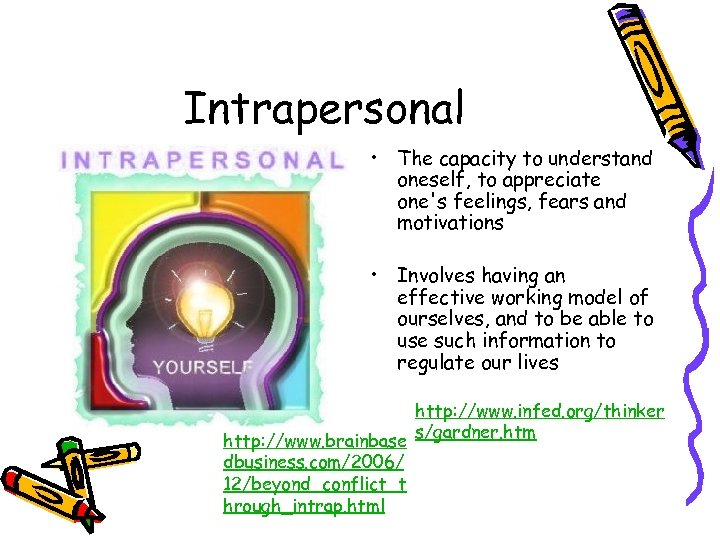
Intrapersonal • The capacity to understand oneself, to appreciate one's feelings, fears and motivations • Involves having an effective working model of ourselves, and to be able to use such information to regulate our lives http: //www. infed. org/thinker http: //www. brainbase s/gardner. htm dbusiness. com/2006/ 12/beyond_conflict_t hrough_intrap. html
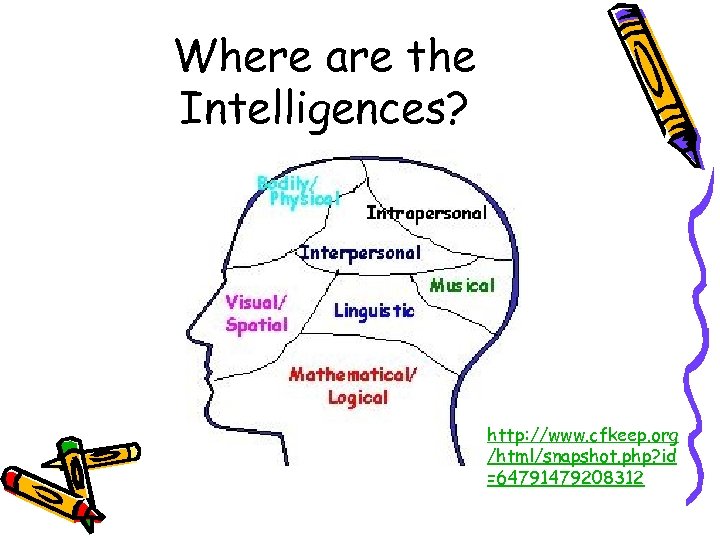
Where are the Intelligences? http: //www. cfkeep. org /html/snapshot. php? id =64791479208312
Works and Research Project Zero • Mission is to understand enhance learning, thinking, and creativity in the arts, as well as humanistic and scientific disciplines, at the individual and institutional levels • Begun at the Harvard Graduate School in 1967 by the philosopher Nelson Goodman • Aim of improving learning in the Arts through research • Gardner was co-director of this (with David Perkins) from 1972 to 2000 http: //pzweb. harvard. edu/index. cfm http: //www. ffst. hr/ENCYCLO PAEDIA/doku. php? id=howard_ gardner_and_education
History of Project Zero • Building on this research to help create communities of reflective, independent learners • To enhance deep understanding within disciplines • To promote critical and creative thinking • Research is done by human cognitive development and of the process of learning in the arts and other disciplines • The learners are at the center of the educational process, respecting the different ways in which an individual learns at various stages of life • As well as differences among individuals in the ways they perceive the world and express their ideas. http: //pzweb. harvard. edu /History. htm
The End
Скачать презентацию Howard Gardner By Laken Fritz Birth and
a30b8fede22f03e06a8a0eb30ebbe349.ppt