


 Скачать презентацию How Why Mirror From the Rearview Are
3e2fc03f17a997d41b9c2f4f00ad268e.ppt
- Количество слайдов: 42
 How & Why Mirror From the Rearview Are University Libraries Changing? & the Windshield Denise Troll Covey Principal Librarian for Special Projects Carnegie Mellon University Libraries Quality in University Libraries – Palma de Mallorca – January 2005
 Overview • The perspective from the rearview mirror • The perspective from outside of the car • The perspective from the windshield • What do we have in the car? • Speculations on a GPS for academic libraries
 Perspective from the rearview mirror • Trends – Indicate how libraries are changing – Vary significantly across institutions & countries – Are difficult to interpret without context
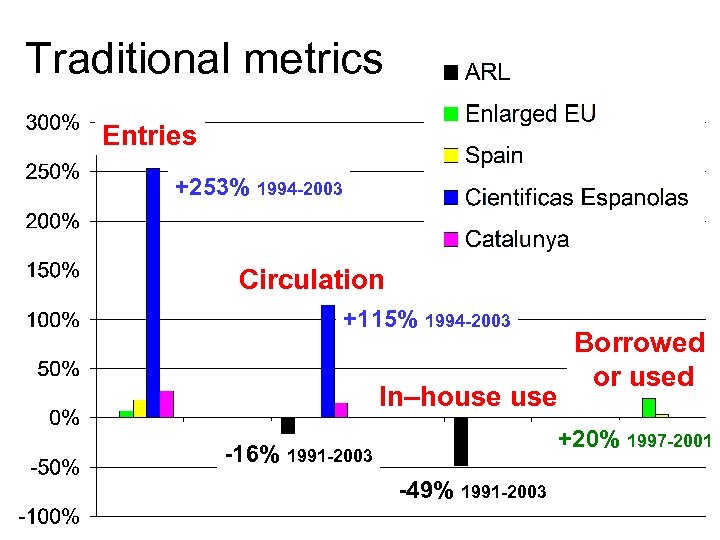 Traditional metrics Entries +253% 1994 -2003 Circulation +115% 1994 -2003 In–house Borrowed or used +20% 1997 -2001 -16% 1991 -2003 -49% 1991 -2003
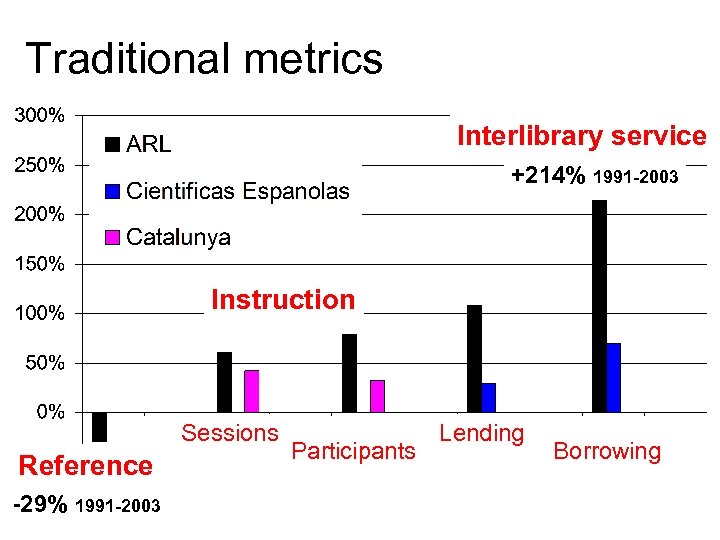 Traditional metrics Interlibrary service +214% 1991 -2003 Instruction Sessions Reference -29% 1991 -2003 Participants Lending Borrowing
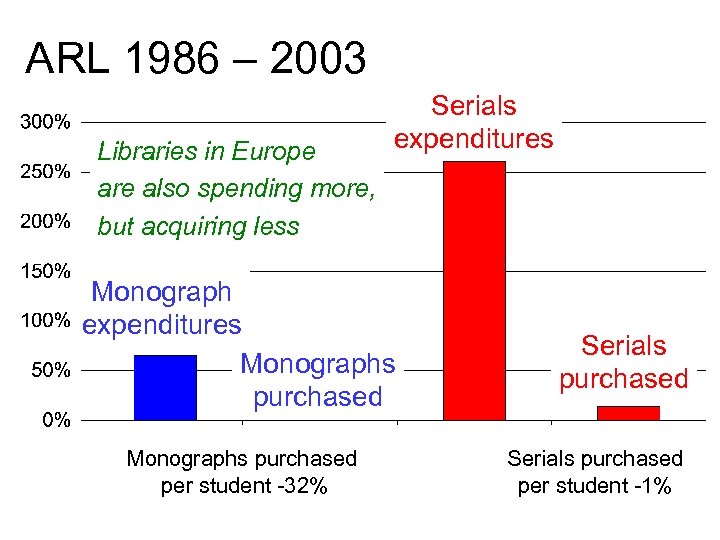 ARL 1986 – 2003 Libraries in Europe are also spending more, but acquiring less Serials expenditures Monographs purchased per student -32% Serials purchased per student -1%
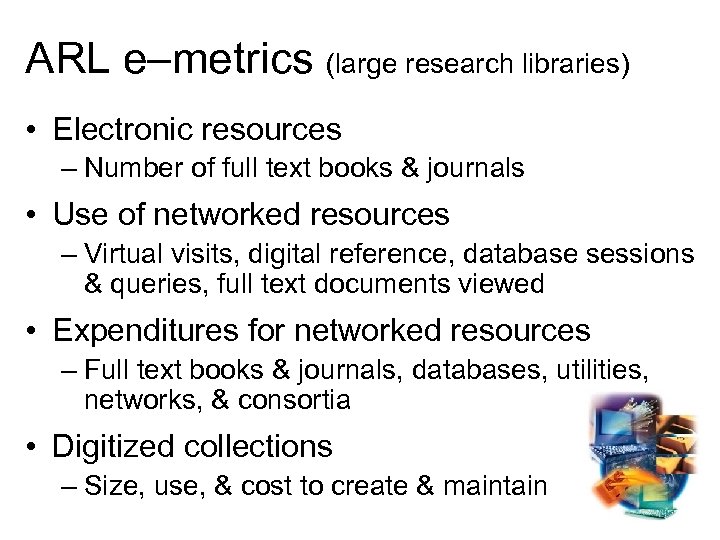 ARL e–metrics (large research libraries) • Electronic resources – Number of full text books & journals • Use of networked resources – Virtual visits, digital reference, database sessions & queries, full text documents viewed • Expenditures for networked resources – Full text books & journals, databases, utilities, networks, & consortia • Digitized collections – Size, use, & cost to create & maintain
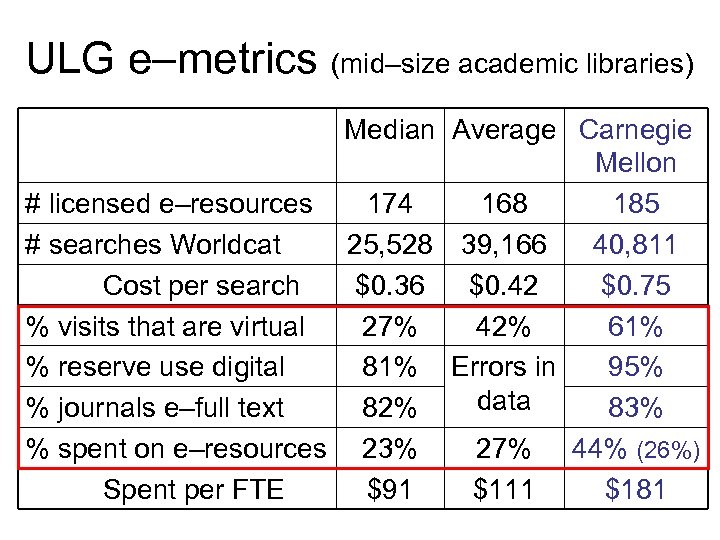 ULG e–metrics (mid–size academic libraries) Median Average Carnegie Mellon # licensed e–resources 174 168 185 # searches Worldcat 25, 528 39, 166 40, 811 Cost per search $0. 36 $0. 42 $0. 75 % visits that are virtual 27% 42% 61% % reserve use digital 81% Errors in 95% data % journals e–full text 82% 83% % spent on e–resources 23% 27% 44% (26%) Spent per FTE $91 $111 $181
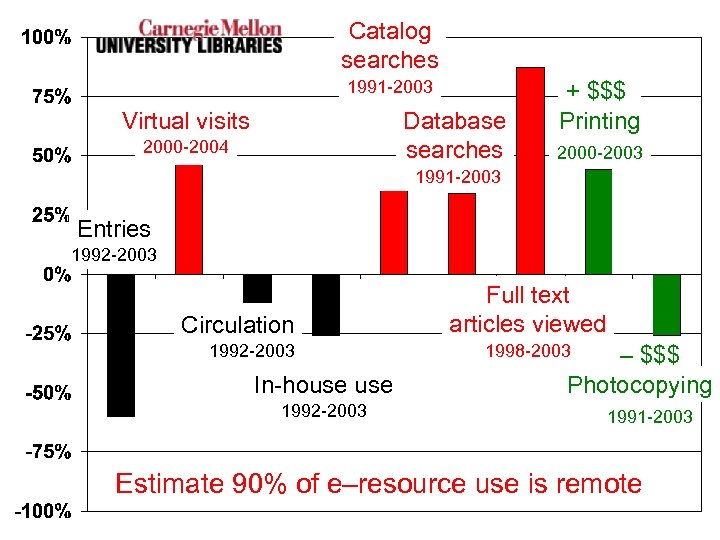 Catalog searches 1991 -2003 Virtual visits Database searches 2000 -2004 + $$$ Printing 2000 -2003 1991 -2003 Entries 1992 -2003 Circulation 1992 -2003 In-house 1992 -2003 Full text articles viewed 1998 -2003 – $$$ Photocopying 1991 -2003 Estimate 90% of e–resource use is remote
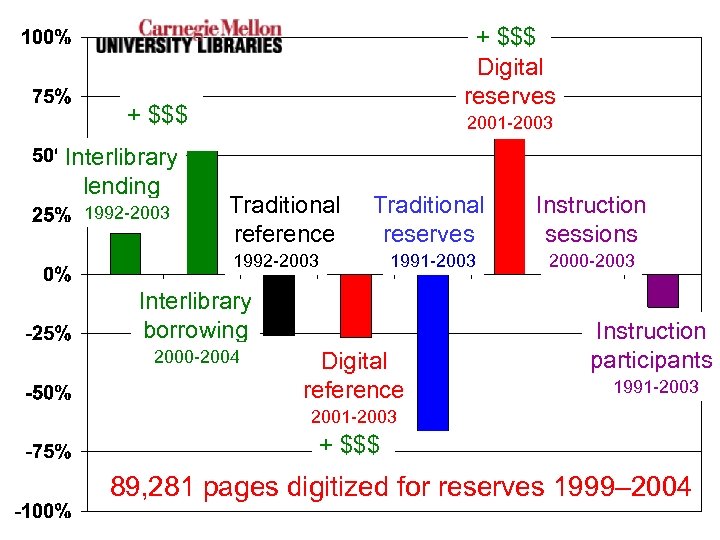 + $$$ Digital reserves + $$$ Interlibrary lending 1992 -2003 2001 -2003 Traditional reference Traditional reserves Instruction sessions 1991 -2003 2000 -2003 1992 -2003 Interlibrary borrowing 2000 -2004 Digital reference Instruction participants 1991 -2003 2001 -2003 + $$$ 89, 281 pages digitized for reserves 1999– 2004
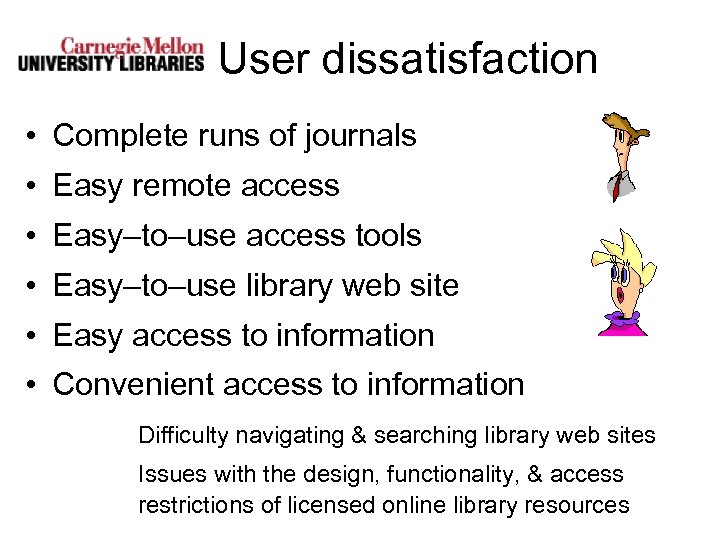 User dissatisfaction • Complete runs of journals • Easy remote access • Easy–to–use access tools • Easy–to–use library web site • Easy access to information • Convenient access to information Difficulty navigating & searching library web sites Issues with the design, functionality, & access restrictions of licensed online library resources
 Perspective from outside the car • Environmental scans – Reveal full scope of change – Illuminate why libraries are changing – Help identify which changes are mission critical – Facilitate formulating a critical & appropriate response to change
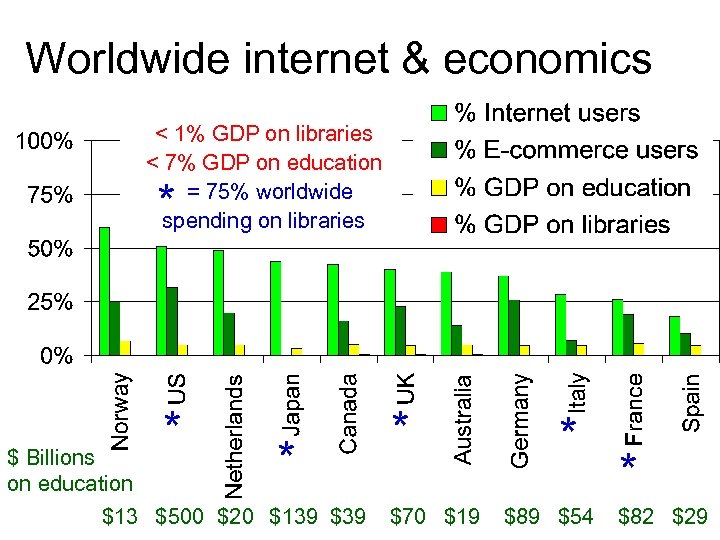 Worldwide internet & economics < 1% GDP on libraries < 7% GDP on education 3. 2% worldwide = 75% worldwide spending on US 2. 6% Europe 0. 5% – libraries Slow economic growth * * * $ Billions on education $13 $500 $20 $139 $39 * $70 $19 * $89 $54 * $82 $29
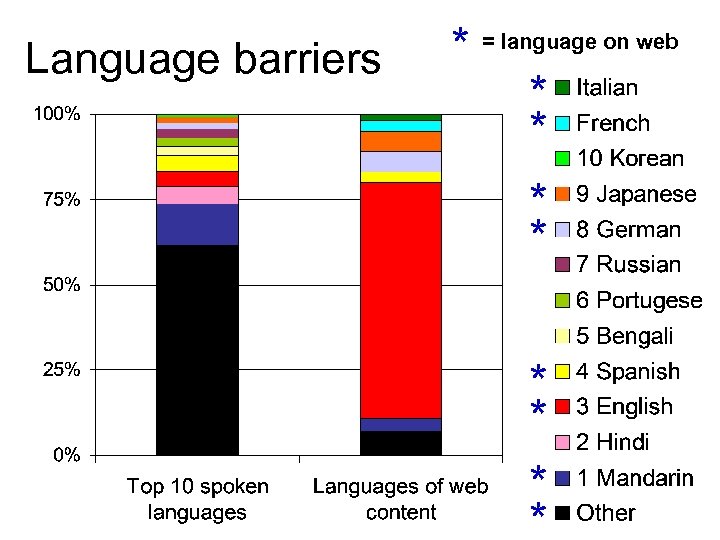 Language barriers * = language on web * * * *
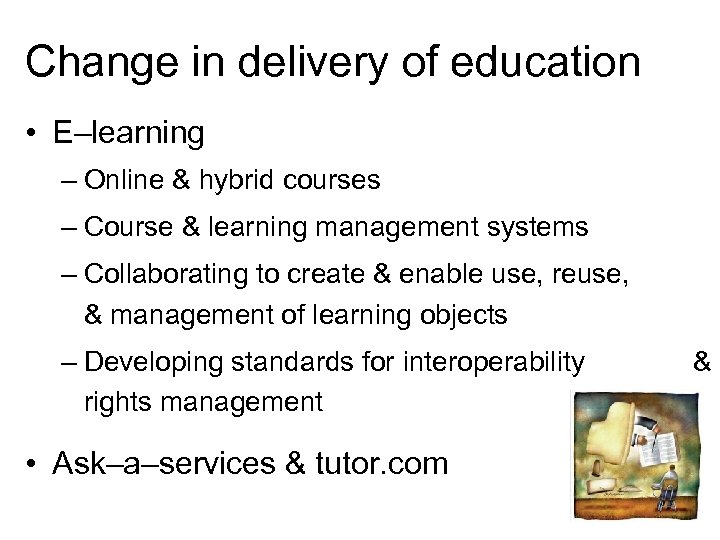 Change in delivery of education • E–learning – Online & hybrid courses – Course & learning management systems – Collaborating to create & enable use, reuse, & management of learning objects – Developing standards for interoperability rights management • Ask–a–services & tutor. com &
 Change in scholarly infrastructure • Ubiquitous computing & high bandwidth • Scholarly communication – Digital libraries – Commoditization of knowledge – Digital assets – Open access – Grid computing – Institutional repositories • Integrating information literacy • Interdisciplinary collaboration
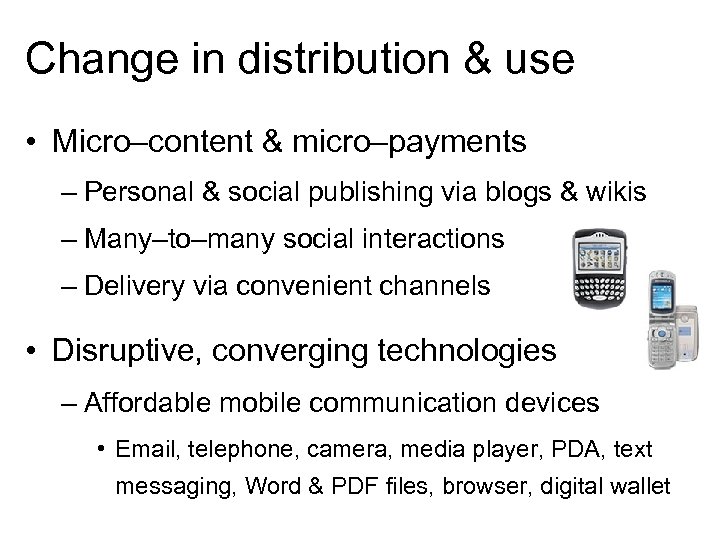 Change in distribution & use • Micro–content & micro–payments – Personal & social publishing via blogs & wikis – Many–to–many social interactions – Delivery via convenient channels • Disruptive, converging technologies – Affordable mobile communication devices • Email, telephone, camera, media player, PDA, text messaging, Word & PDF files, browser, digital wallet
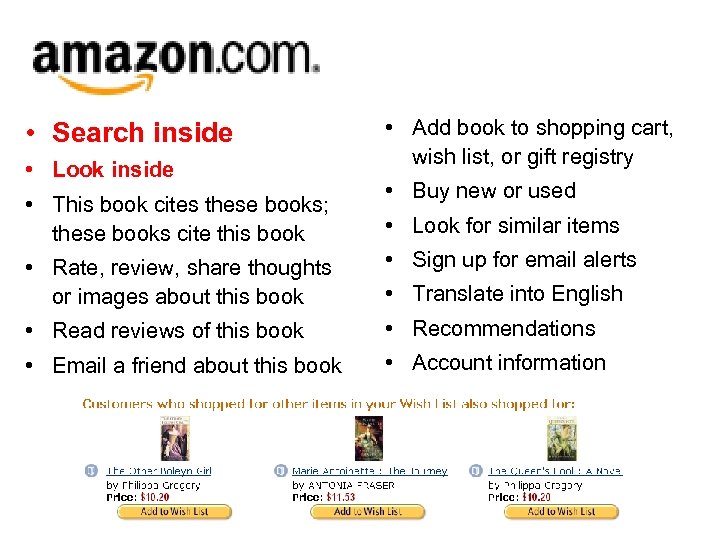 • Add book to shopping cart, wish list, or gift registry • Search inside • Look inside • This book cites these books; June these books cite this book • Rate, review, 14, 952, 600 share thoughts or images about this book • Buy new or used • Look 2001: for similar items • Sign up for email unique users alerts • Translate into English • Read reviews of this book • Recommendations • Email a friend about this book • Account information Currently: 50, 000 members of Amazon Web Services
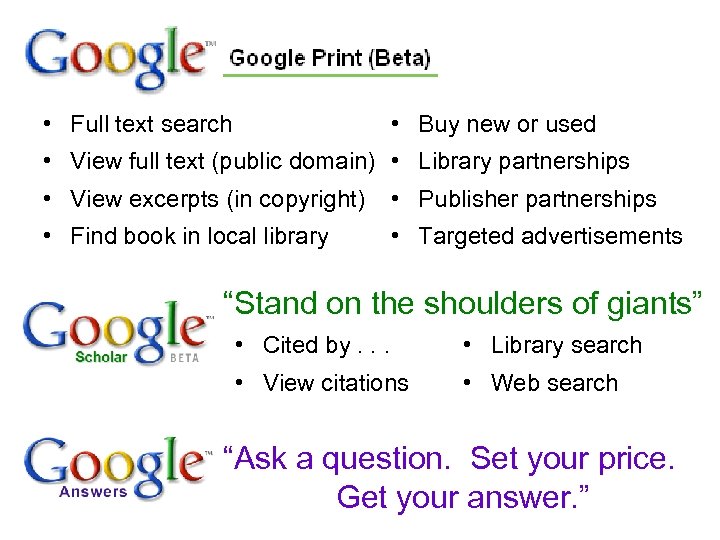 • Full text search • Buy new or used • View full text (public domain) • Library partnerships • View excerpts (in copyright) • Publisher partnerships June • Targeted advertisements • Find book in local library 2001: 10, 082, 127 unique users “Stand on the shoulders of giants” • Cited by. . . • Library search • View citations • Web search Currently: 200 million requests a day in a languages “Ask 88 question. Set your price. Get your answer. ”
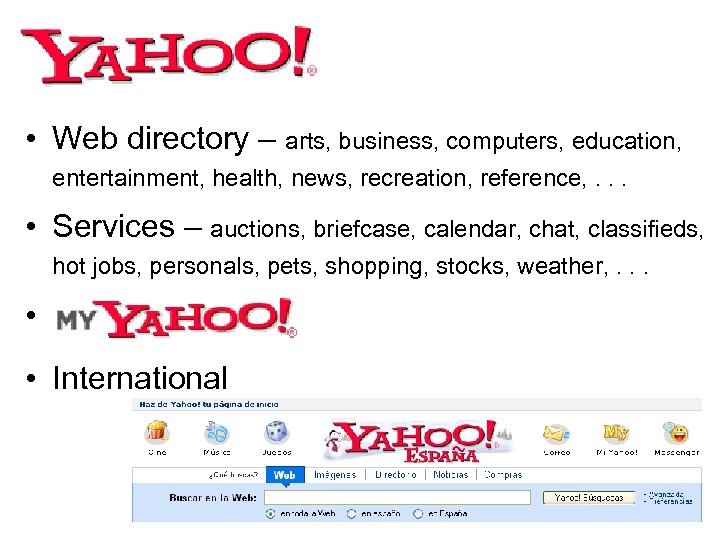 • Web directory – arts, business, computers, education, entertainment, health, June 2001: news, recreation, reference, . . . 54, 493, 102 unique users • Services – auctions, briefcase, calendar, chat, classifieds, hot jobs, personals, pets, shopping, stocks, weather, . . . • May 2004: Searches • International
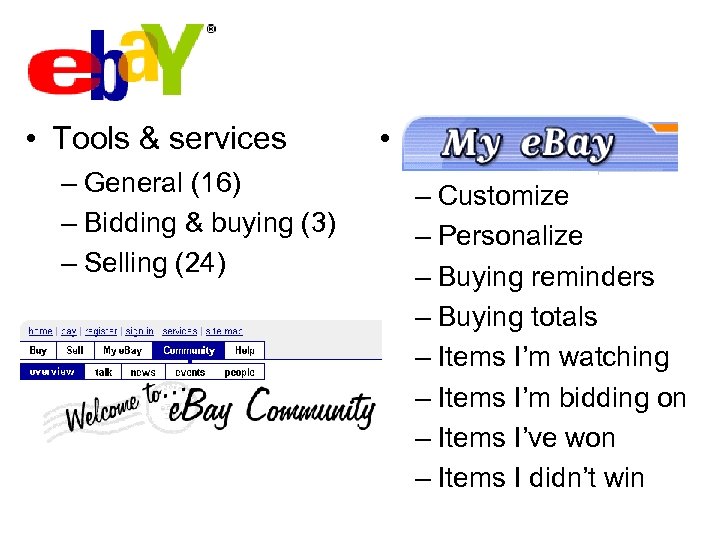 • Tools & services • – General (16) – Customize – Bidding & buying. June 2001: Personalize (3) – 15, 949, 118 unique usersreminders – Selling (24) – Buying Average 300 pages & 2 hours person per month while at work – Buying totals Currently: – Items I’m watching – Items I’m 1 billion queries per month bidding on – Items I’ve won 8, 000 members of e. Bay API program – Items I didn’t win
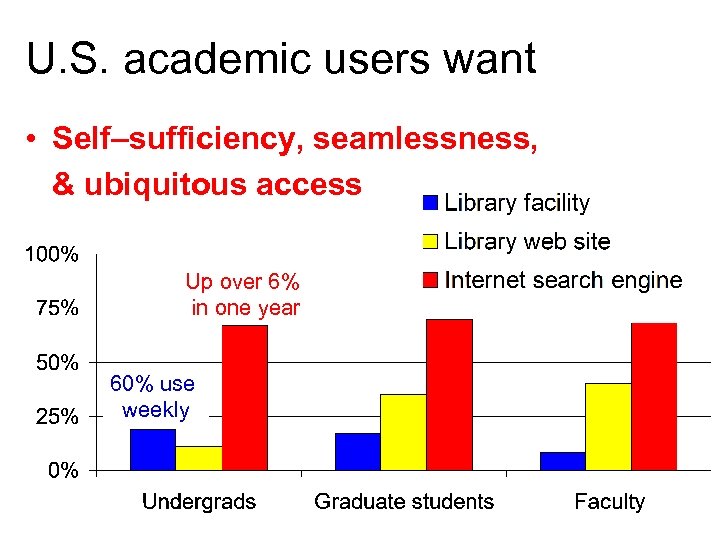 U. S. academic users want • Self–sufficiency, seamlessness, & ubiquitous access Up over 6% in one year 60% use weekly
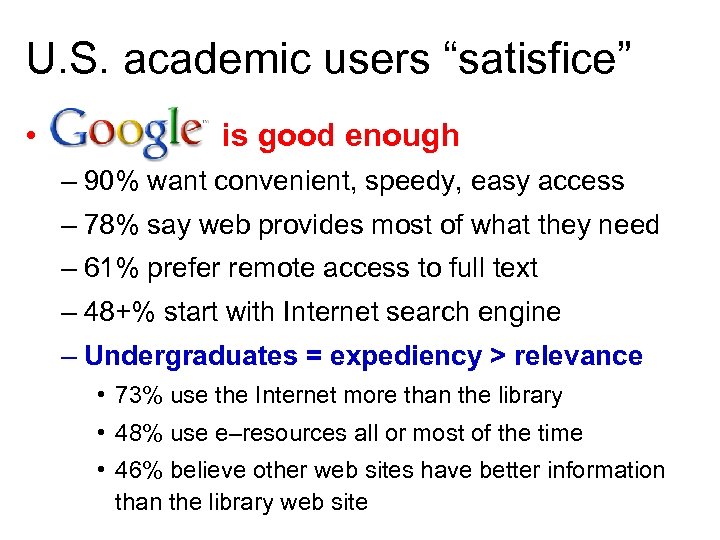 U. S. academic users “satisfice” • is good enough – 90% want convenient, speedy, easy access – 78% say web provides most of what they need – 61% prefer remote access to full text – 48+% start with Internet search engine – Undergraduates = expediency > relevance • 73% use the Internet more than the library • 48% use e–resources all or most of the time • 46% believe other web sites have better information than the library web site
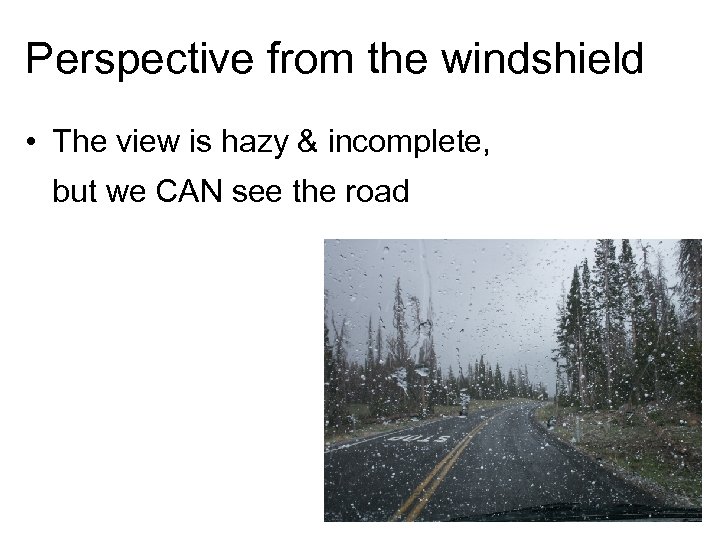 Perspective from the windshield • The view is hazy & incomplete, but we CAN see the road
 The future is digital • Increasing computer–savvy users – Nomadic, wireless, wearable computing • Increasing seamlessness & personalization – Distributed, interoperable, enterprise systems • Increasing knowledge economy • Increasing speed of change • Increasing competition
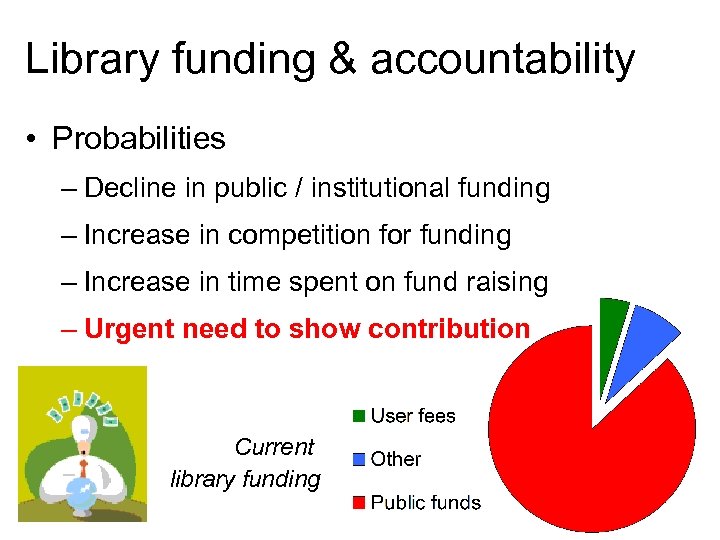 Library funding & accountability • Probabilities – Decline in public / institutional funding – Increase in competition for funding – Increase in time spent on fund raising – Urgent need to show contribution Current library funding
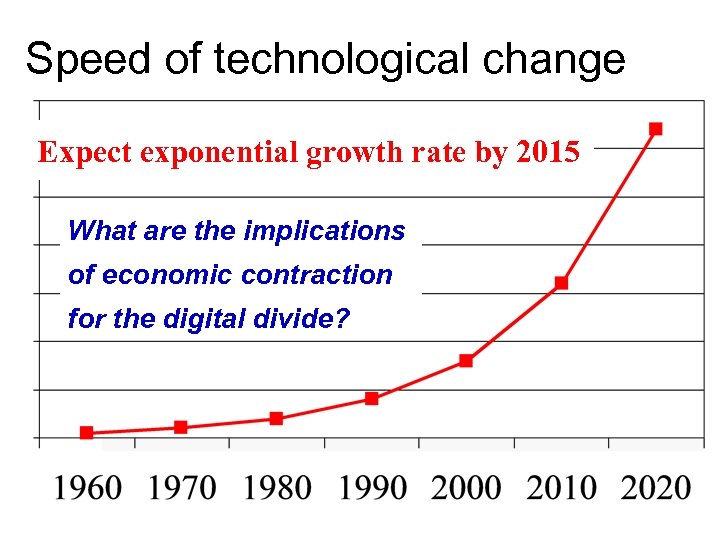 Speed of technological change Expect exponential growth rate by 2015 What are the implications of economic contraction for the digital divide?
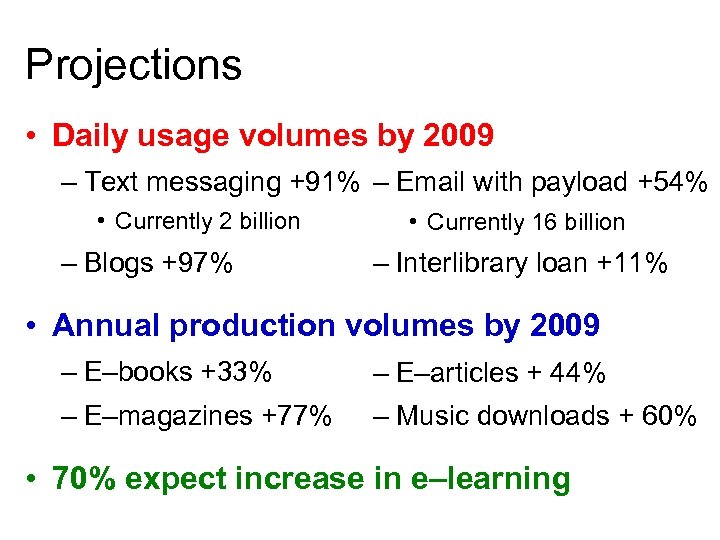 Projections • Daily usage volumes by 2009 – Text messaging +91% – Email with payload +54% • Currently 2 billion – Blogs +97% • Currently 16 billion – Interlibrary loan +11% • Annual production volumes by 2009 – E–books +33% – E–articles + 44% – E–magazines +77% – Music downloads + 60% • 70% expect increase in e–learning
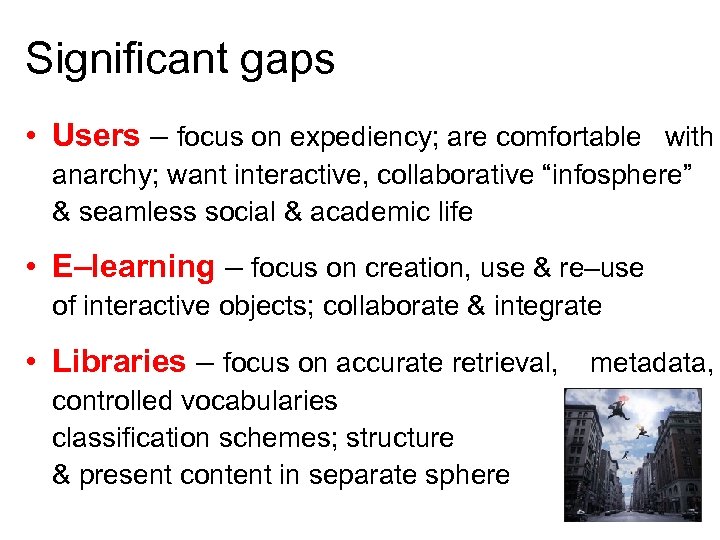 Significant gaps • Users – focus on expediency; are comfortable with anarchy; want interactive, collaborative “infosphere” & seamless social & academic life • E–learning – focus on creation, use & re–use of interactive objects; collaborate & integrate • Libraries – focus on accurate retrieval, metadata, controlled vocabularies classification schemes; structure & present content in separate sphere &
 Significant perils • Poorly curated data • Lack of standards & best practices • Lack of digital preservation strategies • Lack of rights expression & management • Wasted resources
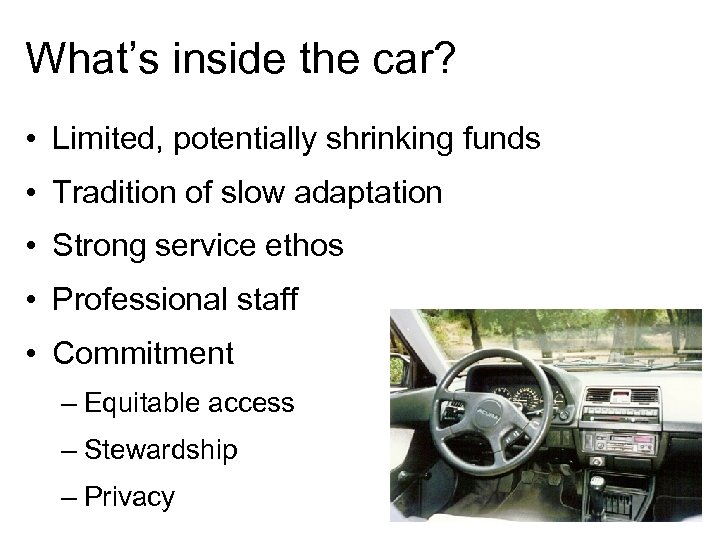 What’s inside the car? • Limited, potentially shrinking funds • Tradition of slow adaptation • Strong service ethos • Professional staff • Commitment – Equitable access – Stewardship – Privacy
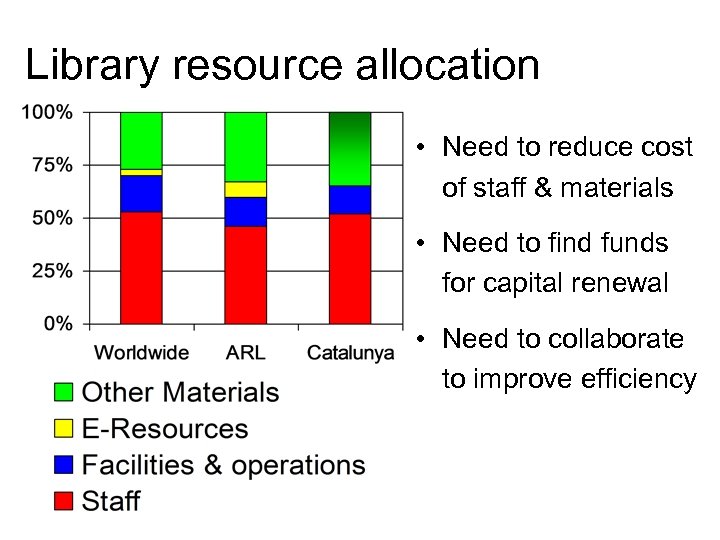 Library resource allocation • Need to reduce cost of staff & materials • Need to find funds for capital renewal • Need to collaborate to improve efficiency
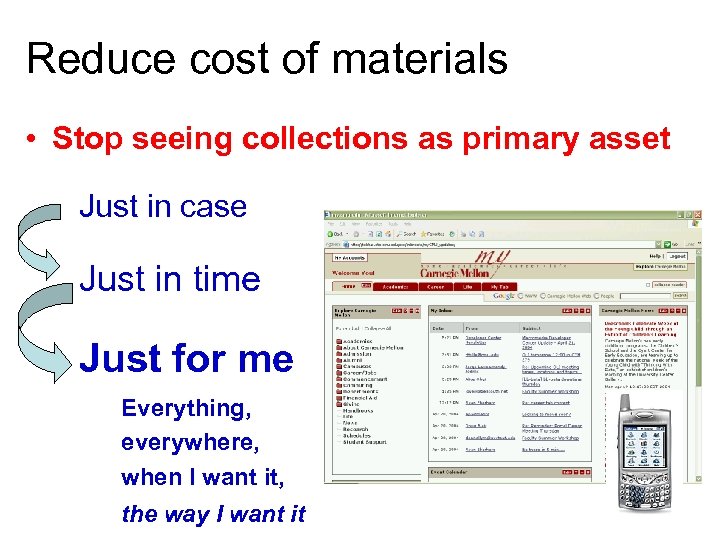 Reduce cost of materials • Stop seeing collections as primary asset Just in case Just in time More affordable, but not enough. . . Just for me $283. 08 avg cost of serial subscription Everything, everywhere, when I want it, the way I want it $52. 75 avg cost of monograph $21. 59 avg cost of interlibrary borrow
 Reduce cost of staff • Stop automating 19 th Century librarianship – Focus on what users want – Eliminate low use & low yield services • Eliminate, combine & upgrade positions to acquire skills & competitive salaries – Integrate & maintain collections, systems & equipment, develop web interfaces & services, write grant proposals, conduct research, & analyze & manage data
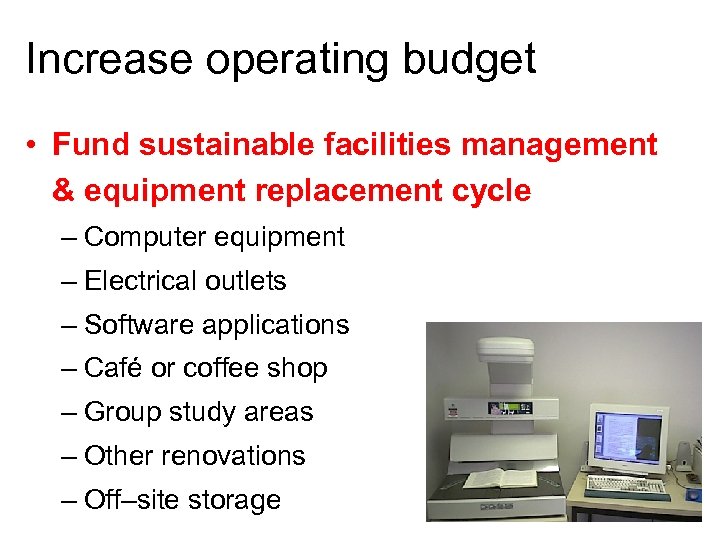 Increase operating budget • Fund sustainable facilities management & equipment replacement cycle – Computer equipment – Electrical outlets – Software applications – Café or coffee shop – Group study areas – Other renovations – Off–site storage
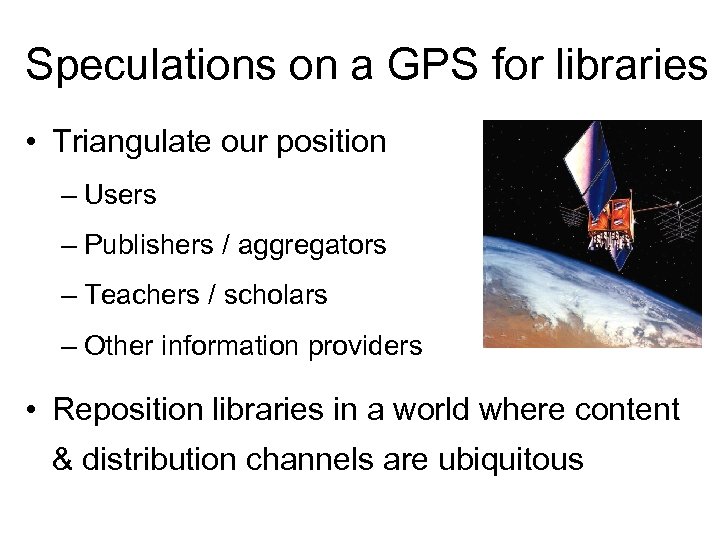 Speculations on a GPS for libraries • Triangulate our position – Users – Publishers / aggregators – Teachers / scholars – Other information providers • Reposition libraries in a world where content & distribution channels are ubiquitous
 Mission critical requirements • Create seamless experience • Change structure & organization of library to improve quality & reduce cost • Shift from being service provider to being proactive collaborator
 Appear in users’ workspace • Deliver content to mobile devices • Integrate with non–library systems • Provide library tool bar – Metasearch, My. Library, Google scholar, –a–librarian, Renew / Hold / Recall book, Collaborate, Interlibrary borrow, . . . • Make library content accessible in & Ask
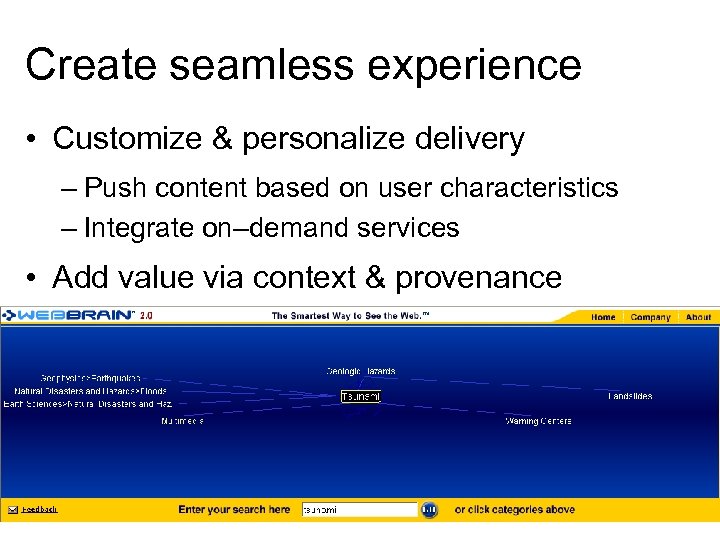 Create seamless experience • Customize & personalize delivery – Push content based on user characteristics – Integrate on–demand services • Add value via context & provenance
 Change structure & organization • Focus on user needs & expectations – Conductadvocacy, assessment, & marketing assessments that guide transformation • Increase – Support transition to e–learning & scholarship • Change what content libraries acquire, – Vitalize information literacy & how they acquire, organize, & deliver it • Support new models of learning & research • Facilitate partnering & fund raising • Learn to argue persuasively
 Become proactive collaborator • Engage students & faculty – For example, blogs & wikis • Lead by leveraging strengths – Develop coherent, seamless, easy–to–use knowledge management & delivery systems – Develop whole, multi–lingual collections – Address perils to digital future • Upgrade education of librarians
 Thank you! Denise Troll Covey troll@andrew. cmu. edu 4909 Frew St. , Hunt Library Carnegie Mellon Pittsburgh, PA 15213