



 How to Write an Essay
 What is an argument? • An argument is the process of presenting an opinion for the purpose of persuading an audience. • An argument, however, does not always have to persuade. An argument can also inform by presenting facts. • An argument that successfully persuades or informs demonstrates coherence. Coherence means that the argument is clear and logical. • A coherent argument demonstrates English language proficiency. Proficiency means skill and knowledge.
 Deduction and Induction • Deduction and induction are ways to organize a verbal or written argument. Look at the following examples. • Deductive response begins with an opinion. Inductive response develops examples first, then ends with a conclusion (opinion) based on the examples.
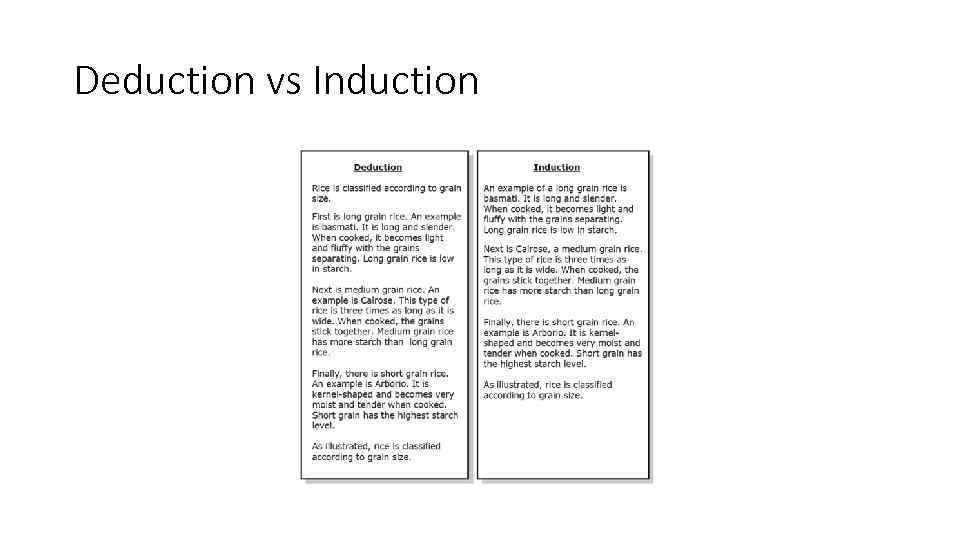 Deduction vs Induction
 Rhetorical Strategies • Rhetorical strategies are tools. Speakers and writers use rhetorical strategies to develop arguments. You need to learn the following rhetorical strategies: narration, description, compare-and-contrast, cause-and-effect, definition, classification. • Narration describes the passing of time. When we arrange events according to time, we put them in chronological or time order. • Description creates pictures of people, places and things using adjectives and adverbs. Description appeals to the senses: smell, sight, taste, hearing and touch. • Compare-and-contrast describes the differences and similarities between two or more objects, people or ideas. Compare-and-contrast also describes differences in opinion. • Cause-and-effect means action and result. We use cause-and-effect to describe an action and the results, or consequences, of that action. • A definition is a detailed description of a person, place, object or idea. The purpose of a definition is to give meaning. • To classify means to put people, things or ideas into sub groups under a main topic.
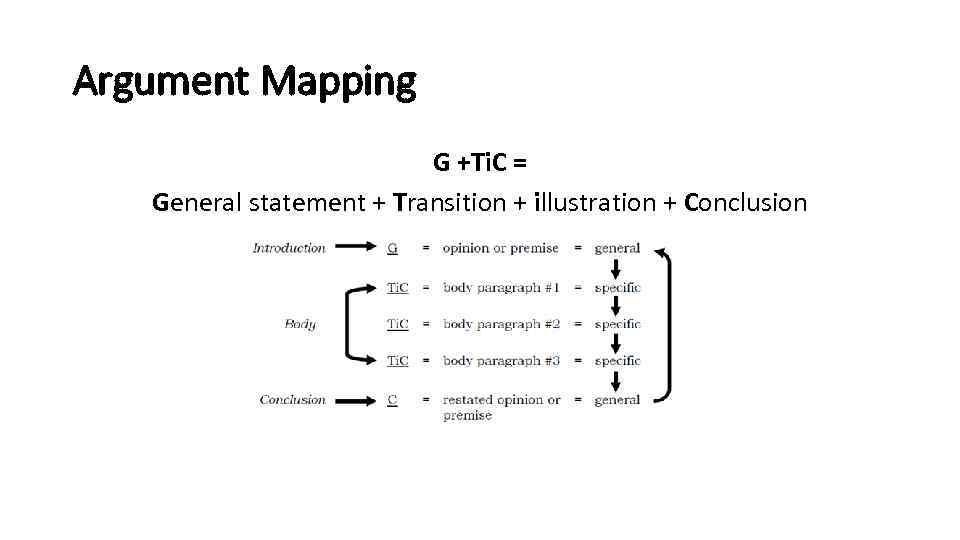 Argument Mapping G +Ti. C = General statement + Transition + illustration + Conclusion
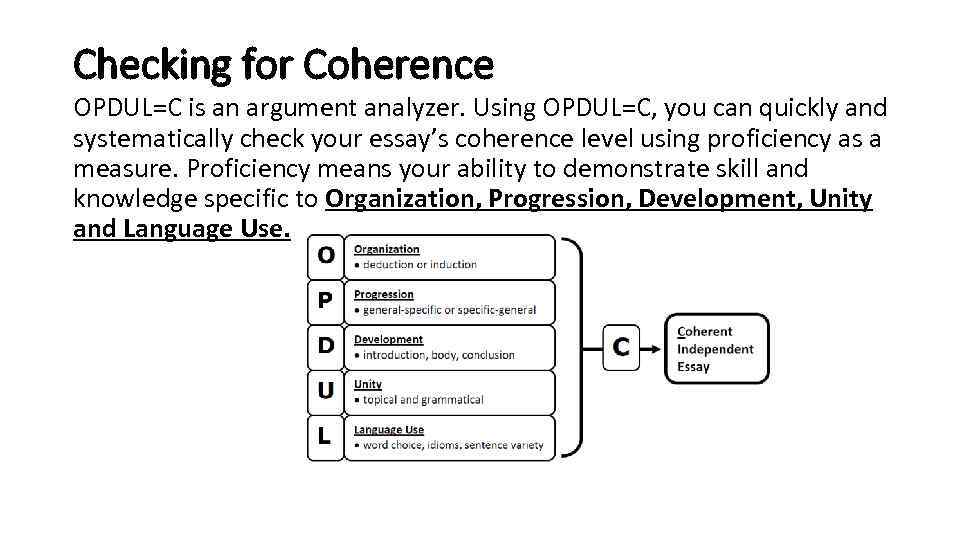 Checking for Coherence OPDUL=C is an argument analyzer. Using OPDUL=C, you can quickly and systematically check your essay’s coherence level using proficiency as a measure. Proficiency means your ability to demonstrate skill and knowledge specific to Organization, Progression, Development, Unity and Language Use.
 Advanced Introduction Strategies (G) = hook + transition + opinion Simple Hooks: a. Or Question Hook b. Restate-the-Prompt Hook c. Pro-Con Hook d. General Fact + Or Question Hook
 Complex Hooks A complex hook uses information from researched sources, information you bring to the essay. Look at the following complex hooks. a. Statistic Hook b. Definition Hook c. Shocking-Statistic Hook d. Famous-Quote Hook e. Idiom Hook f. Anecdote Hook g. Provocative Hook
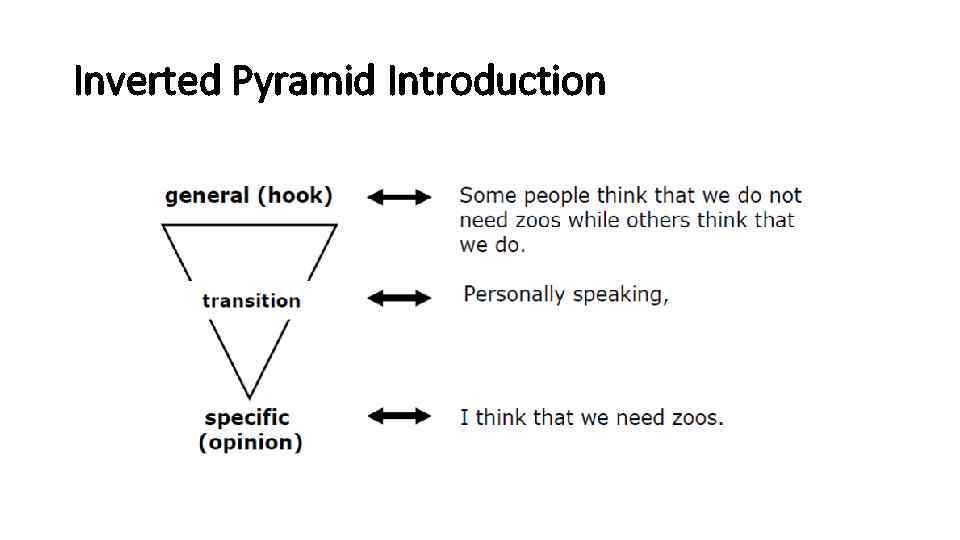 Inverted Pyramid Introduction
 Advanced Conclusion Strategies You can apply the following advanced conclusion strategies to develop a basic independent essay into an advanced independent essay. a. Suggestion b. Suggestion + Prediction c. Warning + Prediction d. Rhetorical Question e. Call-To-Action f. Call-To-Action + Rhetorical Question g. Suggestion + Prediction + Rhetorical Question h. Predictor Thesis Restated in Your Conclusion
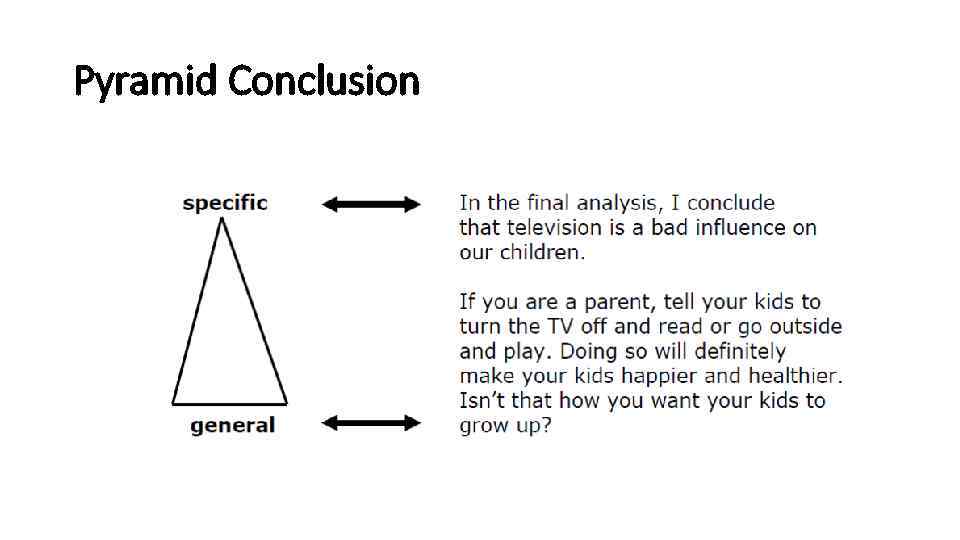 Pyramid Conclusion