


 Скачать презентацию How to Write a Scientific Article Rules and
How to Write an Article.pptx
- Количество слайдов: 20
 How to Write a Scientific Article Rules and tools for effective article writing help you to make your article sharper, clearer, and more convincing than ever. Prewriting Planning As the saying goes, “Anything worth doing is worth doing well. ” The steps toward publication can be summarized like this: 1. Do a SAP (subject, audience, and purpose) analysis as outlined in the sections that follow. 2. Gather the information you need and do whatever additional research is required to complete the article. 3. Make a simple 1 -2 -3 outline of the points you need to cover, in the order you want to present them, write manuscript. 4. Sit down and start writing!
 Subject, Object and Purpose Subject, Audience and Purpose analysis is a process that quickly enables you to pin down the content and organization of your article. The process requires you to ask and answer three questions: • What is the subject (topic) of your article? • Who is your audience? (Who will be receiving your article? ) • What is the purpose of your article?
 Subject What is the subject (topic) of the article? Make it as narrow and specific as possible.
 Conducting a research “Research = study of a subject to find out new things about it or to test new ideas, products etc. ” (Financial and business terms) • • The major steps in conducting research: Identification of research problem Literature review Specifying the purpose of research Determine specific research questions or hypotheses Data collection Analyzing and interpreting the data Reporting and evaluating research
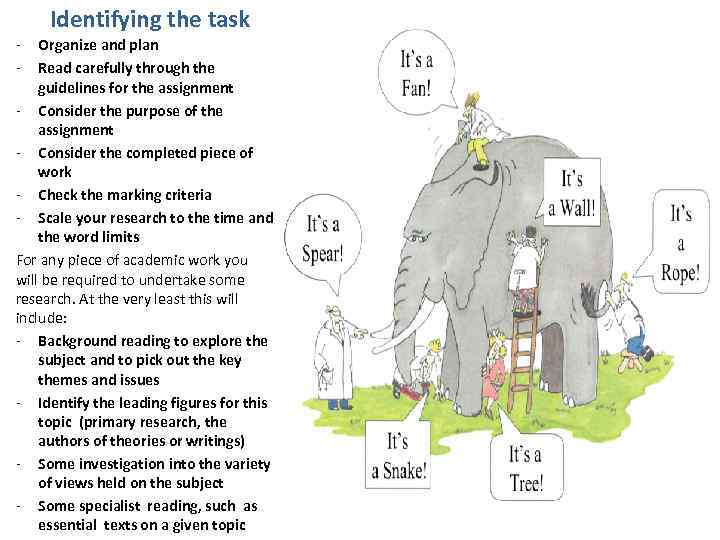 Identifying the task - Organize and plan Read carefully through the guidelines for the assignment - Consider the purpose of the assignment - Consider the completed piece of work - Check the marking criteria - Scale your research to the time and the word limits For any piece of academic work you will be required to undertake some research. At the very least this will include: - Background reading to explore the subject and to pick out the key themes and issues - Identify the leading figures for this topic (primary research, the authors of theories or writings) - Some investigation into the variety of views held on the subject - Some specialist reading, such as essential texts on a given topic
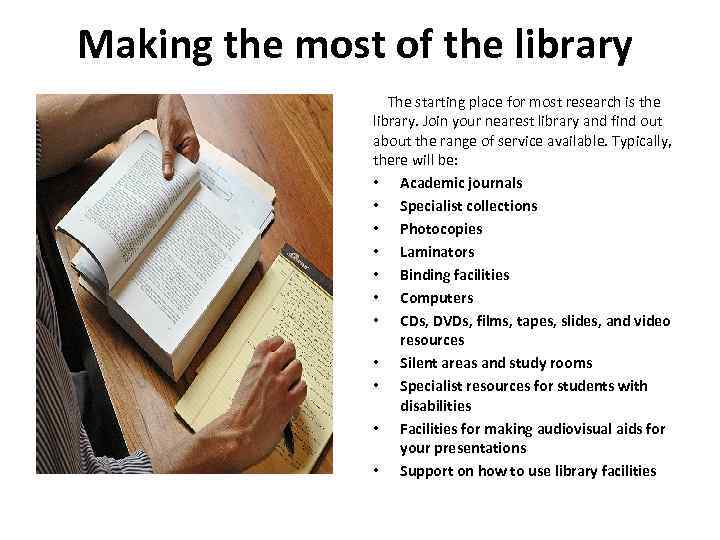 Making the most of the library The starting place for most research is the library. Join your nearest library and find out about the range of service available. Typically, there will be: • Academic journals • Specialist collections • Photocopies • Laminators • Binding facilities • Computers • CDs, DVDs, films, tapes, slides, and video resources • Silent areas and study rooms • Specialist resources for students with disabilities • Facilities for making audiovisual aids for your presentations • Support on how to use library facilities
 Research skills: identifying and selecting relevant information Reading selectively - Use the reading list Select the latest information Select the most relevant information Select by reliability Select by amount
 The 3 -Step Writing Process - writing - rewriting - polishing
 Writing Most professional writers go through a minimum of three drafts. The first is this initial “go with the flow” draft where the words come tumbling out. When you sit down to write, let the words flow freely. Don’t worry about style, syntax, punctuation, or typos — just write. You can always go back and fix it later. By “letting it all out, ” you build momentum and overcome inhibitions that block your ability to write and think.
 Rewriting In the second draft — the rewriting step — you take a critical look at what you’ve written. You edit for organization, logic, content, and persuasiveness. Using your PC, you add, delete, and rearrange paragraphs. You rewrite jumbled passages to make them clear.
 Polishing In the third draft, you give your prose a final polishing by editing for style, syntax, spelling, and punctuation. This is the step where you worry about things like consistency in numbers, units of measure, equations, symbols, abbreviations, and capitalization.
 Doing the Writing • • • • • Keep to the subject Keep to the structure of a scientific article: Title Author name(s) and address(es) Abstract Introduction Main body of manuscript Conclusion/Summary Acknowledgments References Cited Illustrations and Figure captions Tables Keep to the style Be concise Be consistent Break your writing into short sessions Use the passive voice Prefer the specific to the general
 Tips on style and word choice that can make writing clear and persuasive • Title - needs to succinctly encapsulate the subject of the article (use key words to do this) to tell the reader what it is about; - should be interesting to catch the reader’s attention and make him want to read it; - shouldn’t be long (most effective titles are fever than ten words, think of it as a label, leave out nonessential words and phrases and similar descriptors Phrased another way, think of Google keywords. If you wouldn’t ask Google to find a word, try to leave that word out of your title - should be as specific and informative as possible.
 Abstract - provides an overview of your findings and should stimulate reader interest; - briefly (100 -200/150 -350 words –length varies with the journal) conveys the essential information of your article, including its purpose, methods, the results and conclusion; - seldom contains references to other articles; - should be written last, after the rest of the paper is ready; - should be written with short sentences and active verbs for brevity, clarity, and impact; - should be written in the past tense. An example: “A complete skull of pliosaur from the Thermopolis Shale is described. It is referred to Alphasaurus on the basis of the unique premaxillary-maxillary notch. The skull also shares with Betasaurus the pineal opening at the frontal –pariental suture. Therefore, Betasaurus is considered a junior synonim”.
 Introduction - Start with a strong opening sentences to set the tone of your paper, for example: Is the busy executive more likely to die prematurely from coronary artery disease? - Keep a reader interested and reading, tell him why you wrote the paper. - Present the purpose and scope of the paper and provide any background information your reader needs. - Write your introduction in the present tense, because you’re giving established and accepted information.
 Main Body of Text Materials and Methods - Explain how you conducted your study. - Write it in the past tense. - Include source of data, method of organization, and system of analysis. - Give the reader enough information to assess the validity of your study and repeat your method if he wants to. Results - Present your data or results in a straightfoward, factual manner, without commentary or interpretation. - Summarize your data in the most complete and efficient manner possible. - Write this section in the past tense. - Tables and figures can be a big help in clarifying your data presentation. Discussions - Explain here why your findings matter - Speculate and theorize, spark the reader’s imagination. - Write this in the present tense, because your findings are now established scientific knowledge.
 Conclusion/ Summary - restate your main thesis and summarize your findings and conclusions; - make recommendations for the future research or application of your findings; - the last sentence should convey closure so that the reader recognizes “The End” without you having to write those words.
 Writing style - Be careful about jargon. - Be careful about terminology. - Avoid long sentences, cut them into two or more (sentences should rarely exceed 25 words, and then only if you are presenting a list).
 IMPERSONAL TONE Impersonal tone is used when you either want to keep a relationship on a strictly professional level, or when you want to distance yourself from the other person or the subject at hand. Impersonal tone is also used when the relationship is adversarial, or to stress the urgency and serious nature of the situation being written about. To achieve an impersonal tone in your writing: 1. Do not use the person’s name. 2. Avoid personal pronouns when possible. 3. Use the passive voice when possible. 4. Write in the third person (for example, “the company, ” “the vendor, ” “the purchasing department, ” “the client”). 5. Write in a corporate or formal style. 6. Be remote and aloof.
 TYPE STYLES, FONTS, AND SIZES • Use a plain, simple type for body copy. Times Roman is clean and a favorite with many PC users. You can use New Courier or Prestige Elite, which gives the look and feel of a letter typed on an IBM Selectric typewriter. • Type size depends on the style selected. For New Courier, you can use 9 - or 10 -point type. For Times Roman, 11 - or 12 -point type is better. • Boldface and italic fonts can be used for emphasis. Bullets or numbers help set lists apart and make them easy to scan. For longer documents, you might consider breaking up the text into short sections, each with a boldface subhead.