


 Скачать презентацию How to Set Performance Targets in Inventory Control
d6a9621e0ac2f67dfeffbecca915e8f8.ppt
- Количество слайдов: 42
 How to Set Performance Targets in Inventory Control Dr. Everette S. Gardner, Jr. 1
 How to Set Performance Targets in Inventory Control q q q Clean up the parts list Develop a basic forecasting system Use the forecasts to classify parts (ABC+) Decide what to stock Decide where to stock it Divide the inventory into control groups: q q 2 JIT, MRP, EOQ, Annual buy Develop benchmark performance measures
 Clean Up the Parts List q Code substitute items q q Delete obsolete items (no longer used in current product line) q q 3 Do the part numbers apply to other customers or products? Review items with no recent demand q q Ensure historical demand recorded against primary items Stocking rules usually depend on demand in the last 6 months or the last year Negotiate with vendors to return parts for credit
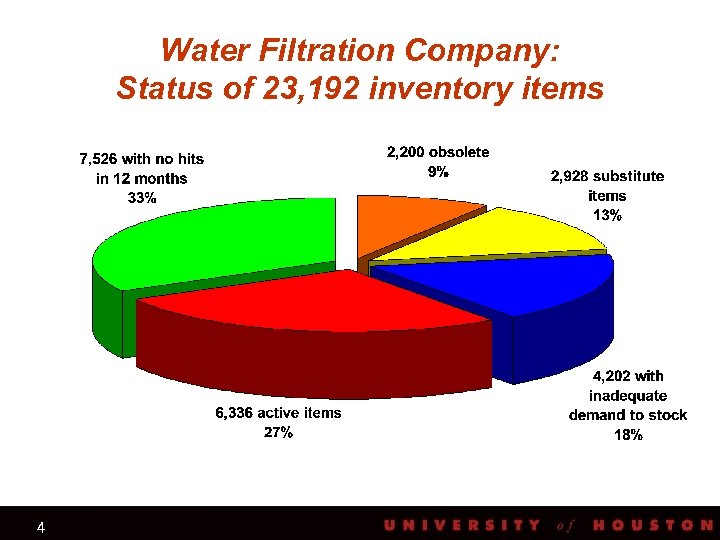 Water Filtration Company: Status of 23, 192 inventory items 4
 The Importance of Forecasting q Forecasts determine production and inventory quantities q q q 5 MRP: Master schedule EOQ: Order quantity, leadtime demand, safety stock JIT: Requirements to internal and external suppliers
 The Importance of Forecasting (cont. ) q Better forecast accuracy cuts inventory investment. Example: q q q 6 Forecast accuracy is measured by the standard deviation of the forecast error. Safety stocks are usually set at 3 times the standard deviation If the standard deviation is cut by $1, safety stocks are cut by $3
 Forecasting Tools for Inventory Control q Simple exponential smoothing q q q Weighted-moving-average technique for stable items Highly recommended for repair parts demand Trend-adjusted exponential smoothing q q Estimates and projects growth (or decline) in demand Types of growth q q 7 Exponential Linear Damped Both models are easily modified to handle seasonal demands
 Origins of the Damped Trend q Reference q q Operational requirement q q Gardner & Mc. Kenzie, Management Science, 1985 Automatic forecasting system for military repair and maintenance parts Theory q Lewandowski, IJF, 1982 (M 1 -Competition) Trend extrapolation should become more conservative as the forecast horizon increases. 8
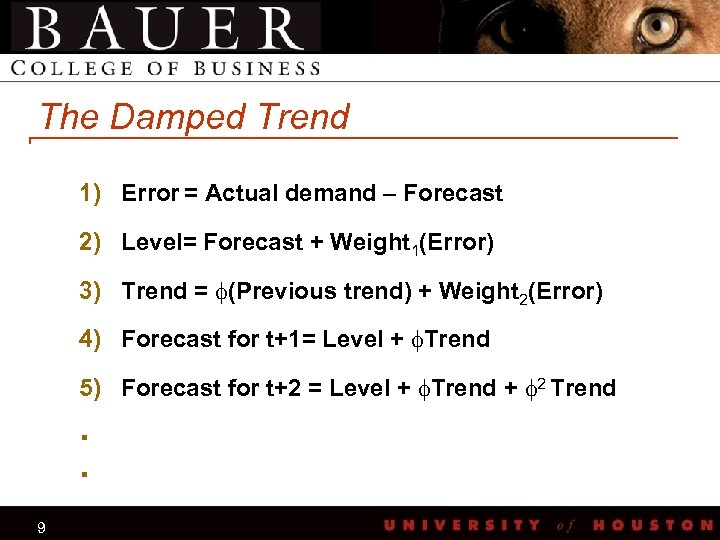 The Damped Trend 1) Error = Actual demand – Forecast 2) Level= Forecast + Weight 1(Error) 3) Trend = (Previous trend) + Weight 2(Error) 4) Forecast for t+1= Level + Trend 5) Forecast for t+2 = Level + Trend + 2 Trend . . 9
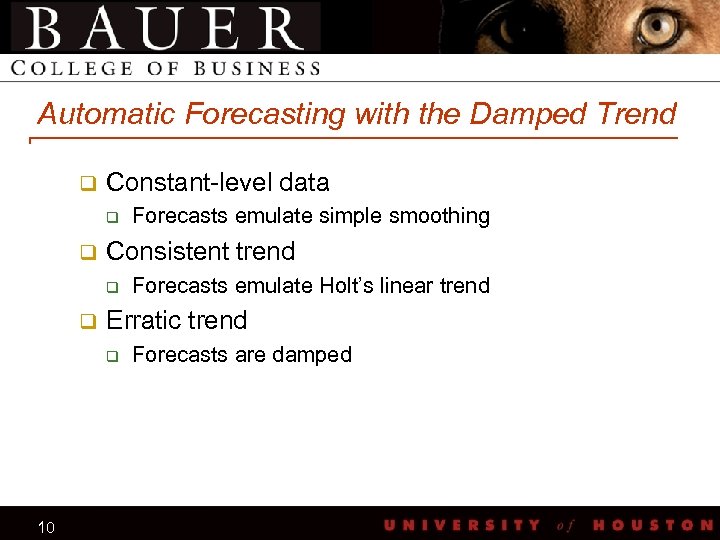 Automatic Forecasting with the Damped Trend q Constant-level data q q Consistent trend q q Forecasts emulate Holt’s linear trend Erratic trend q 10 Forecasts emulate simple smoothing Forecasts are damped
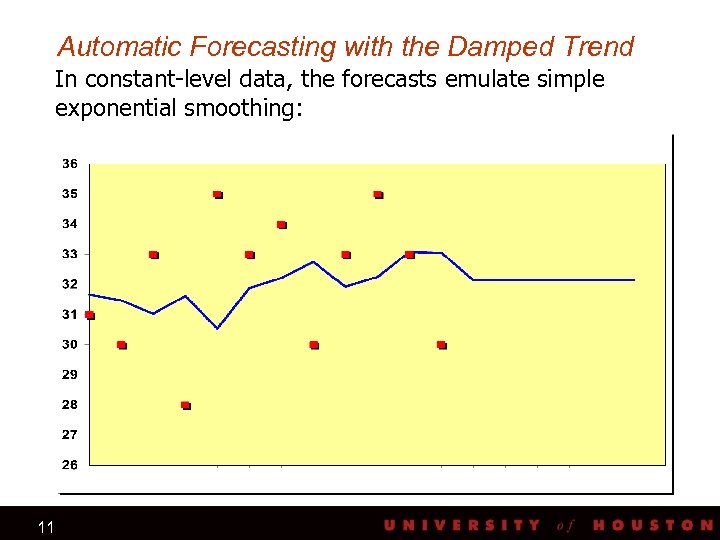 Automatic Forecasting with the Damped Trend In constant-level data, the forecasts emulate simple exponential smoothing: 11
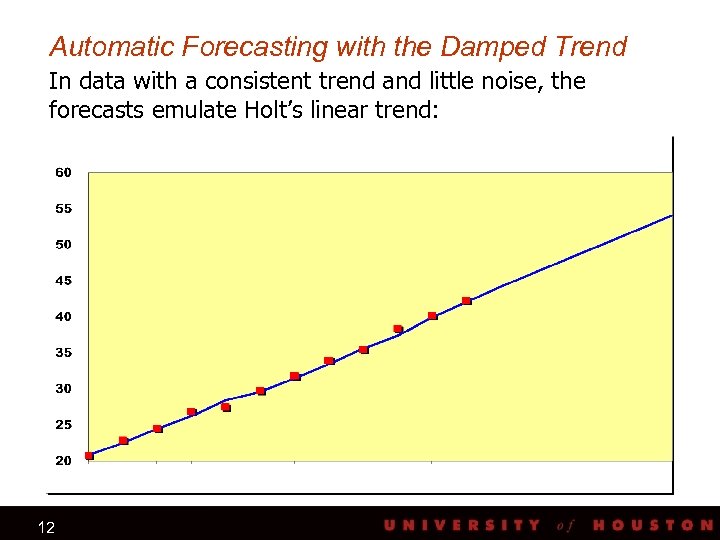 Automatic Forecasting with the Damped Trend In data with a consistent trend and little noise, the forecasts emulate Holt’s linear trend: 12
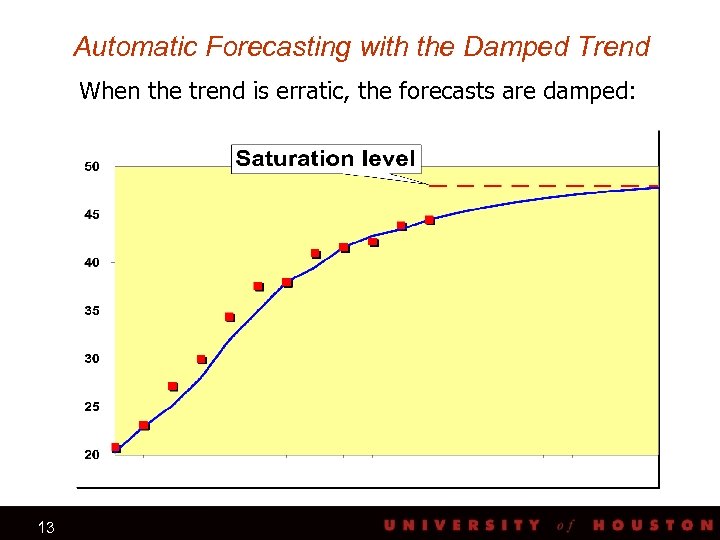 Automatic Forecasting with the Damped Trend When the trend is erratic, the forecasts are damped: 13
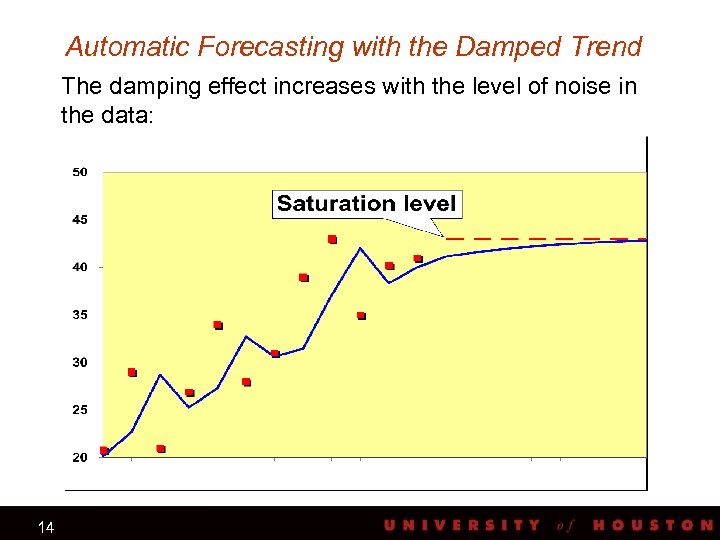 Automatic Forecasting with the Damped Trend The damping effect increases with the level of noise in the data: 14
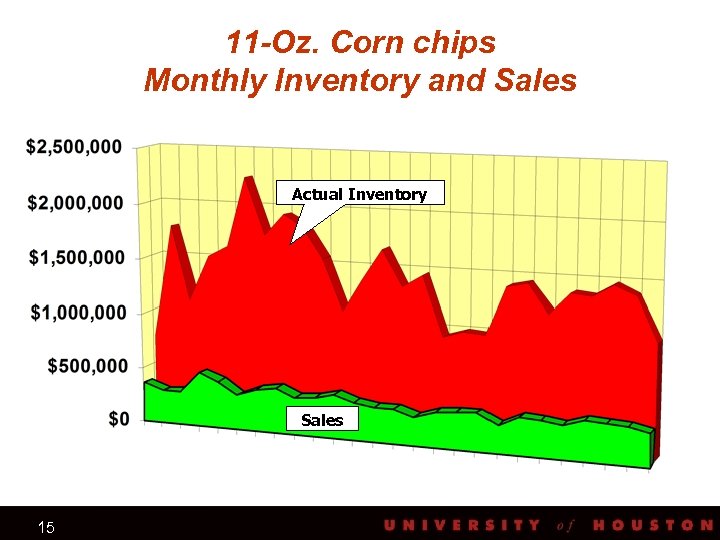 11 -Oz. Corn chips Monthly Inventory and Sales Actual Inventory Sales 15
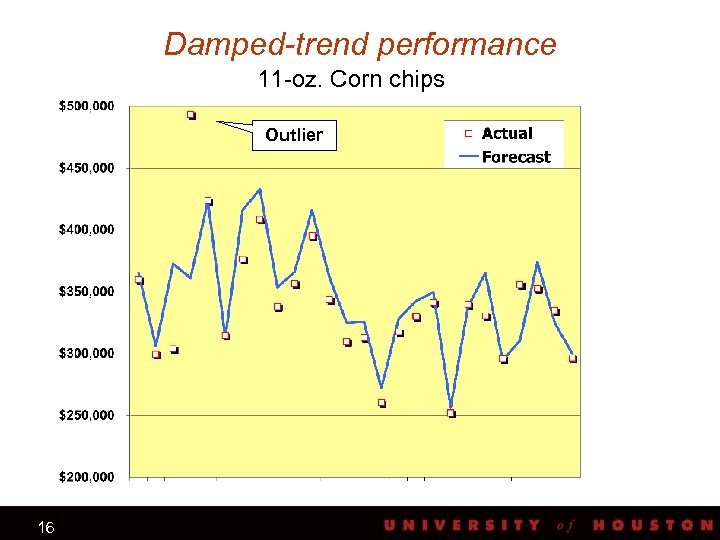 Damped-trend performance 11 -oz. Corn chips Outlier 16
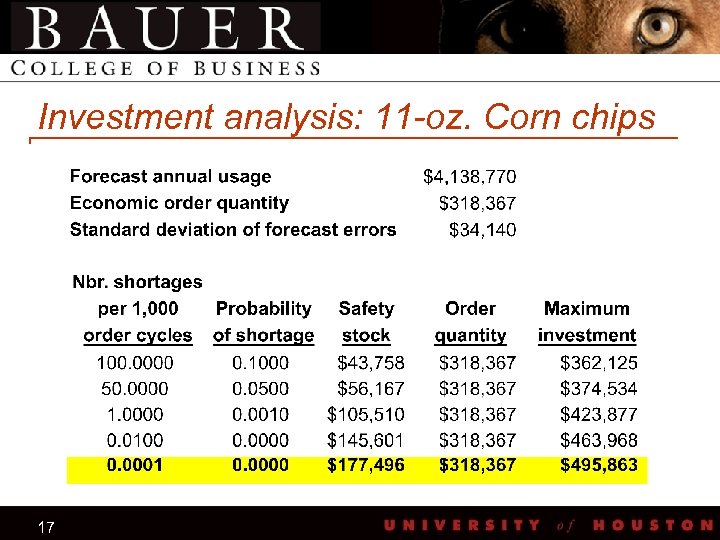 Investment analysis: 11 -oz. Corn chips 17
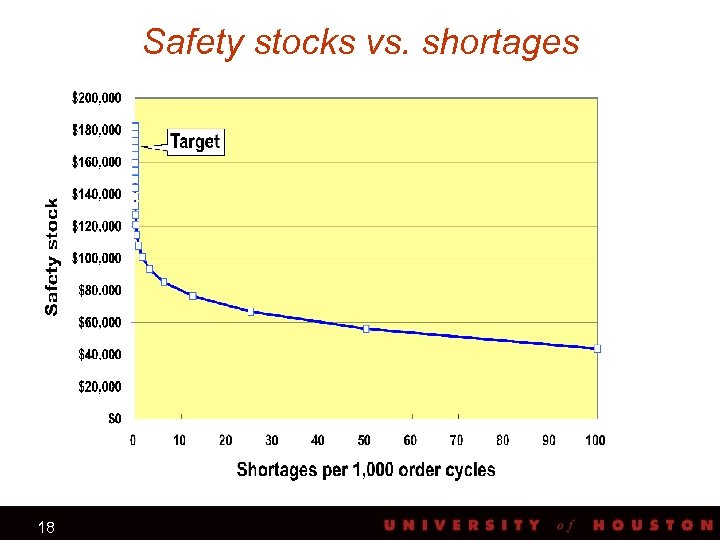 Safety stocks vs. shortages 18
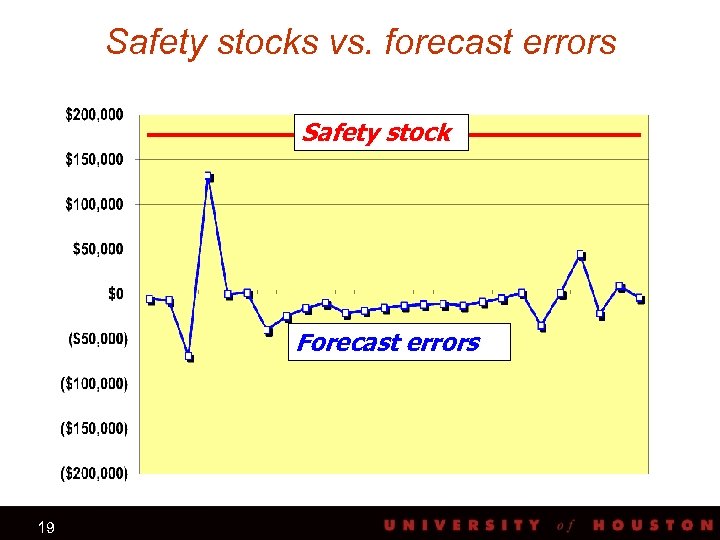 Safety stocks vs. forecast errors Safety stock Forecast errors 19
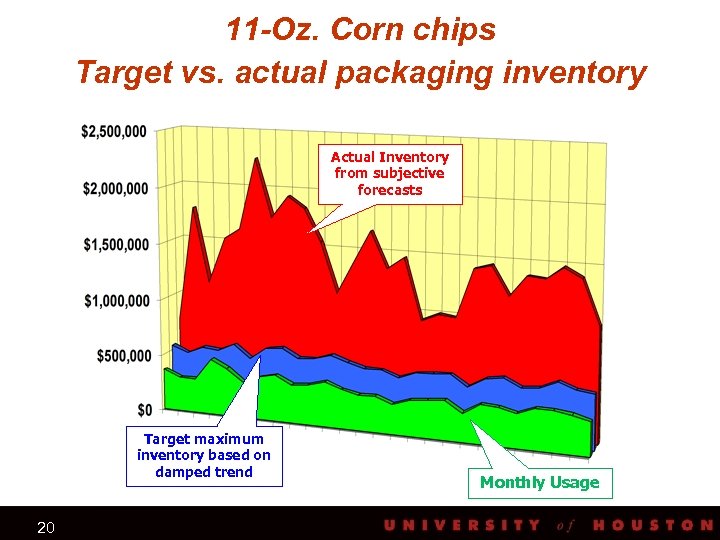 11 -Oz. Corn chips Target vs. actual packaging inventory Actual Inventory from subjective Actual Inventory forecasts from subjective forecasts Target maximum inventory based on damped trend 20 Monthly Usage
 How to forecast regional demand n n 21 Forecast total units with the damped trend Forecast regional percentages with simple exponential smoothing
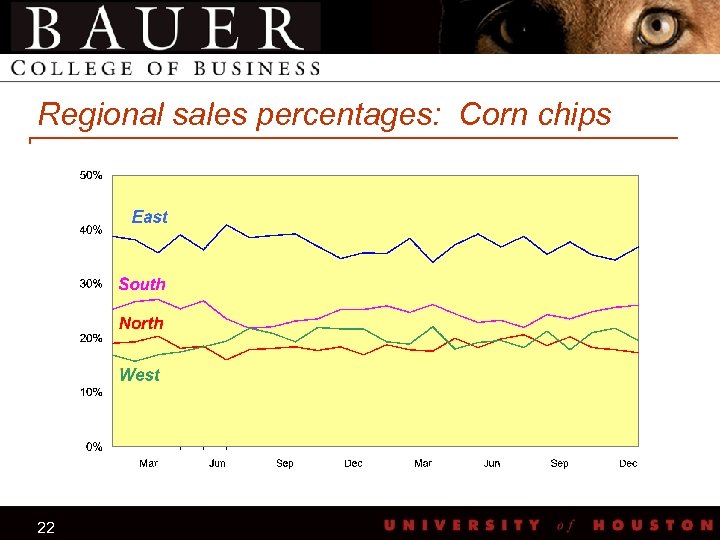 Regional sales percentages: Corn chips 22
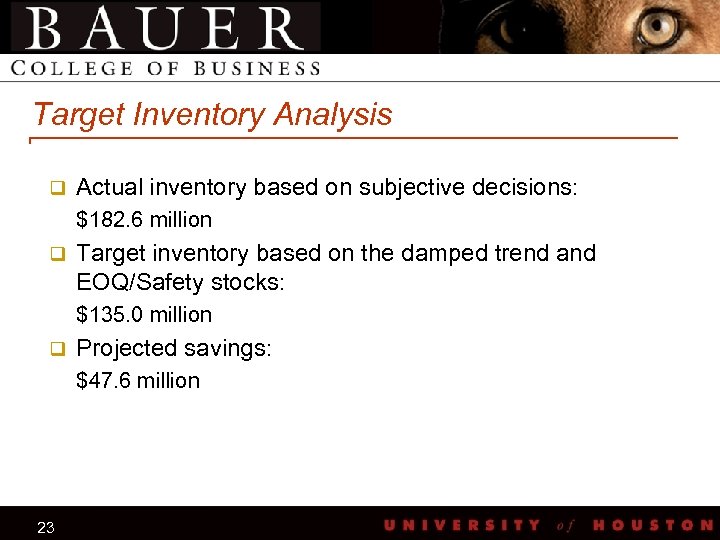 Target Inventory Analysis q Actual inventory based on subjective decisions: $182. 6 million q Target inventory based on the damped trend and EOQ/Safety stocks: $135. 0 million q Projected savings: $47. 6 million 23
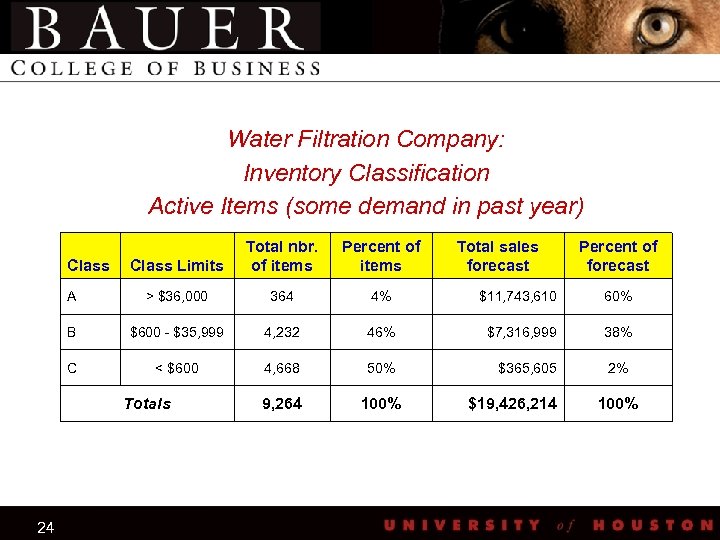 Water Filtration Company: Inventory Classification Active Items (some demand in past year) Class Limits Total nbr. of items Percent of items A > $36, 000 364 4% $11, 743, 610 60% B $600 - $35, 999 4, 232 46% $7, 316, 999 38% C < $600 4, 668 50% $365, 605 2% 9, 264 100% Class Totals 24 Total sales forecast $19, 426, 214 Percent of forecast 100%
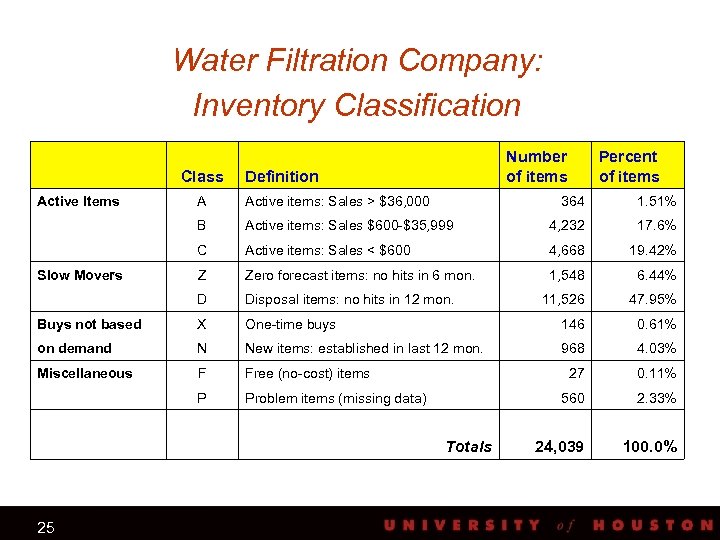 Water Filtration Company: Inventory Classification Class Active Items Number of items Definition 364 1. 51% Active items: Sales > $36, 000 B Active items: Sales $600 -$35, 999 4, 232 17. 6% C Active items: Sales < $600 4, 668 19. 42% Z Zero forecast items: no hits in 6 mon. 1, 548 6. 44% D Disposal items: no hits in 12 mon. 11, 526 47. 95% Buys not based X One-time buys 146 0. 61% on demand N New items: established in last 12 mon. 968 4. 03% Miscellaneous F Free (no-cost) items 27 0. 11% P Problem items (missing data) 560 2. 33% 24, 039 100. 0% Slow Movers A Percent of items Totals 25
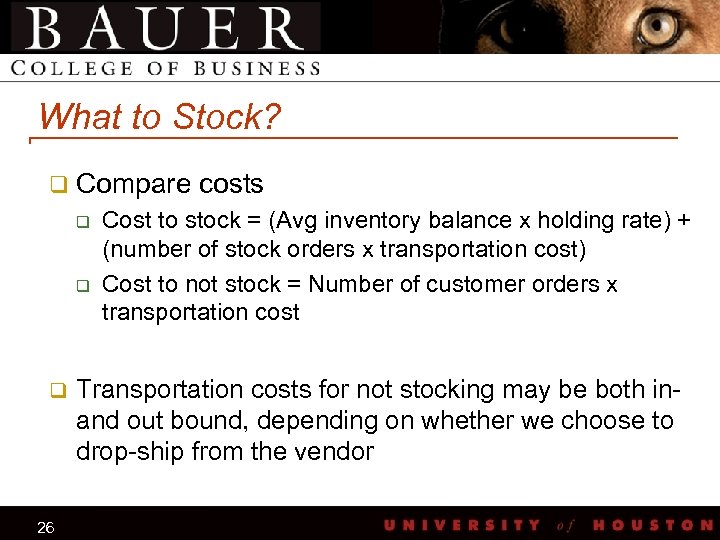 What to Stock? q Compare q q q 26 costs Cost to stock = (Avg inventory balance x holding rate) + (number of stock orders x transportation cost) Cost to not stock = Number of customer orders x transportation cost Transportation costs for not stocking may be both inand out bound, depending on whether we choose to drop-ship from the vendor
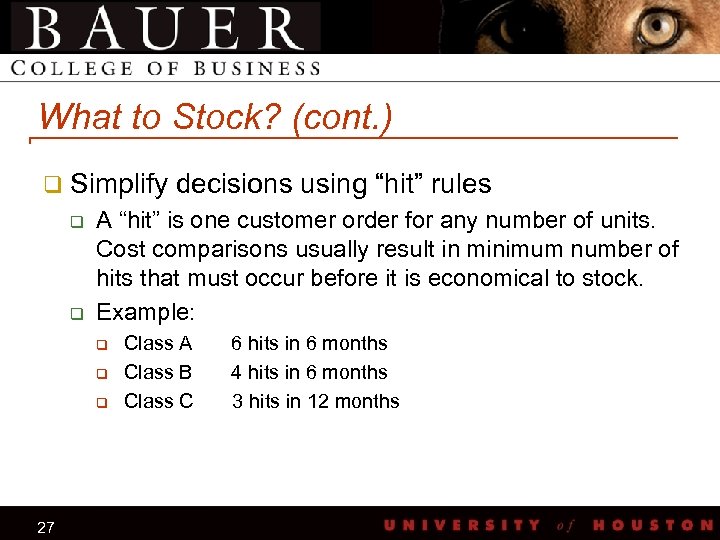 What to Stock? (cont. ) q Simplify q q A “hit” is one customer order for any number of units. Cost comparisons usually result in minimum number of hits that must occur before it is economical to stock. Example: q q q 27 decisions using “hit” rules Class A Class B Class C 6 hits in 6 months 4 hits in 6 months 3 hits in 12 months
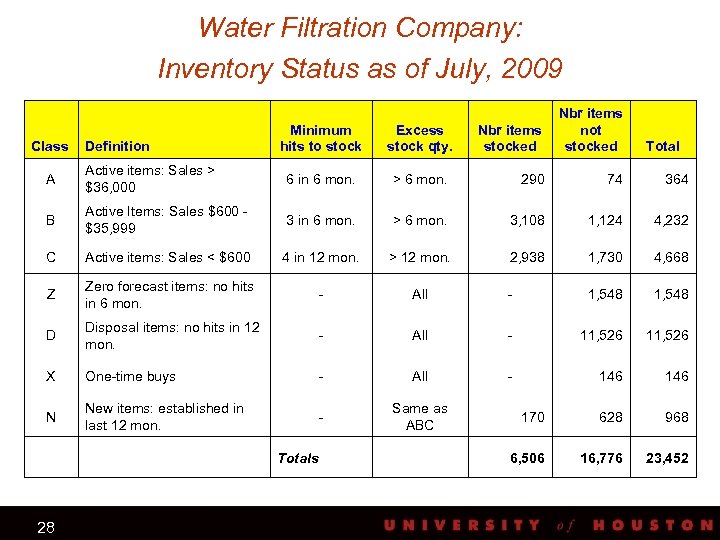 Water Filtration Company: Inventory Status as of July, 2009 Class Definition Minimum hits to stock Excess stock qty. Nbr items stocked Nbr items not stocked Total A Active items: Sales > $36, 000 6 in 6 mon. > 6 mon. 290 74 364 B Active Items: Sales $600 $35, 999 3 in 6 mon. > 6 mon. 3, 108 1, 124 4, 232 C Active items: Sales < $600 4 in 12 mon. > 12 mon. 2, 938 1, 730 4, 668 Z Zero forecast items: no hits in 6 mon. - All - 1, 548 D Disposal items: no hits in 12 mon. - All - 11, 526 X One-time buys - All - 146 N New items: established in last 12 mon. - Same as ABC 170 628 968 6, 506 16, 776 23, 452 Totals 28
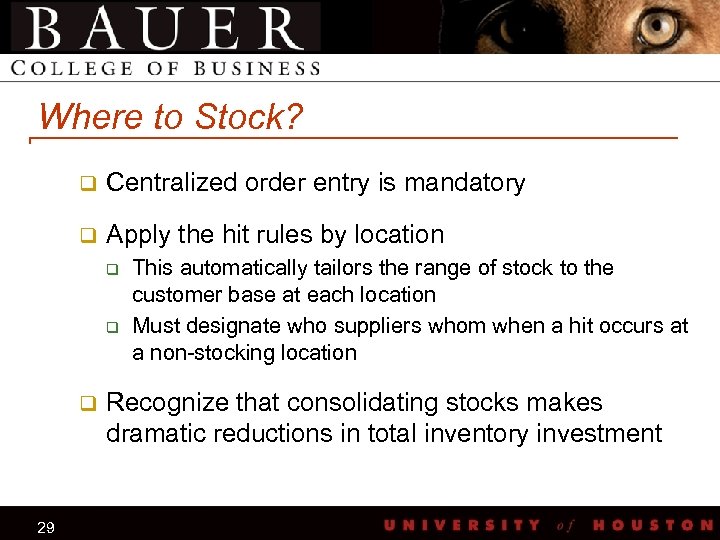 Where to Stock? q Centralized order entry is mandatory q Apply the hit rules by location q q q 29 This automatically tailors the range of stock to the customer base at each location Must designate who suppliers whom when a hit occurs at a non-stocking location Recognize that consolidating stocks makes dramatic reductions in total inventory investment
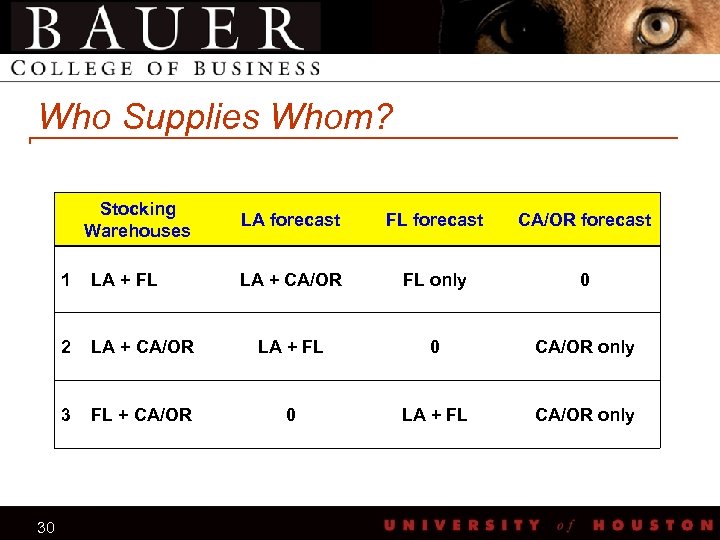 Who Supplies Whom? Stocking Warehouses LA forecast FL forecast CA/OR forecast LA + CA/OR FL only 0 1 2 LA + CA/OR LA + FL 0 CA/OR only 3 30 LA + FL FL + CA/OR 0 LA + FL CA/OR only
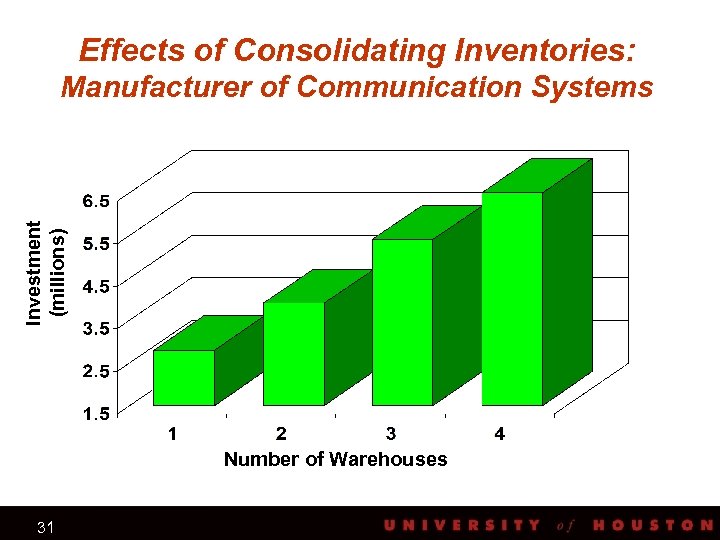 Effects of Consolidating Inventories: Investment (millions) Manufacturer of Communication Systems Number of Warehouses 31
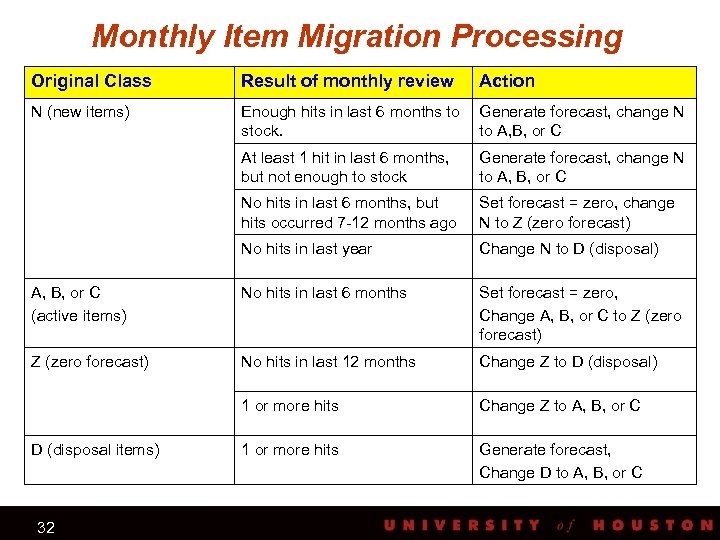 Monthly Item Migration Processing Original Class Result of monthly review Action N (new items) Enough hits in last 6 months to stock. Generate forecast, change N to A, B, or C At least 1 hit in last 6 months, but not enough to stock Generate forecast, change N to A, B, or C No hits in last 6 months, but hits occurred 7 -12 months ago Set forecast = zero, change N to Z (zero forecast) No hits in last year Change N to D (disposal) A, B, or C (active items) No hits in last 6 months Set forecast = zero, Change A, B, or C to Z (zero forecast) No hits in last 12 months Change Z to D (disposal) 1 or more hits Change Z to A, B, or C 1 or more hits Generate forecast, Change D to A, B, or C D (disposal items) 32
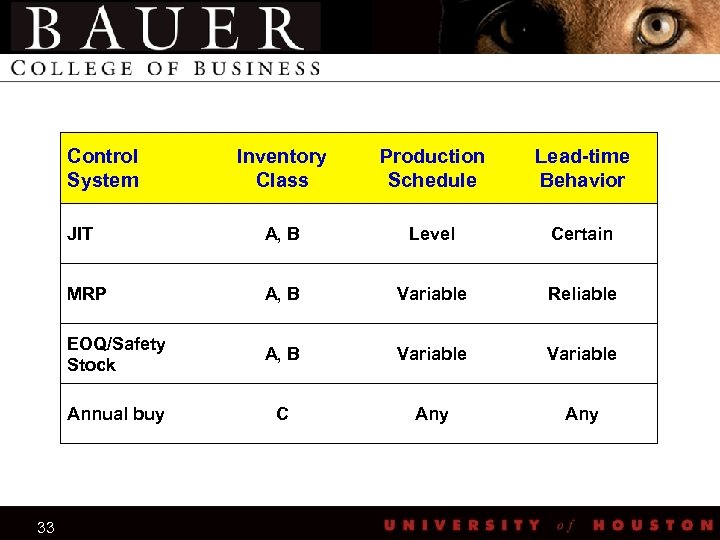 Control System Production Schedule Lead-time Behavior JIT A, B Level Certain MRP A, B Variable Reliable EOQ/Safety Stock A, B Variable Annual buy 33 Inventory Class C Any
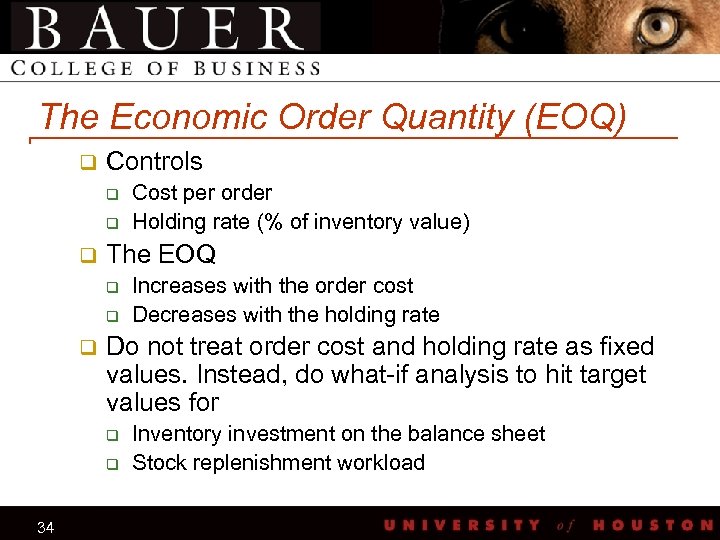 The Economic Order Quantity (EOQ) q Controls q q q The EOQ q q q Increases with the order cost Decreases with the holding rate Do not treat order cost and holding rate as fixed values. Instead, do what-if analysis to hit target values for q q 34 Cost per order Holding rate (% of inventory value) Inventory investment on the balance sheet Stock replenishment workload
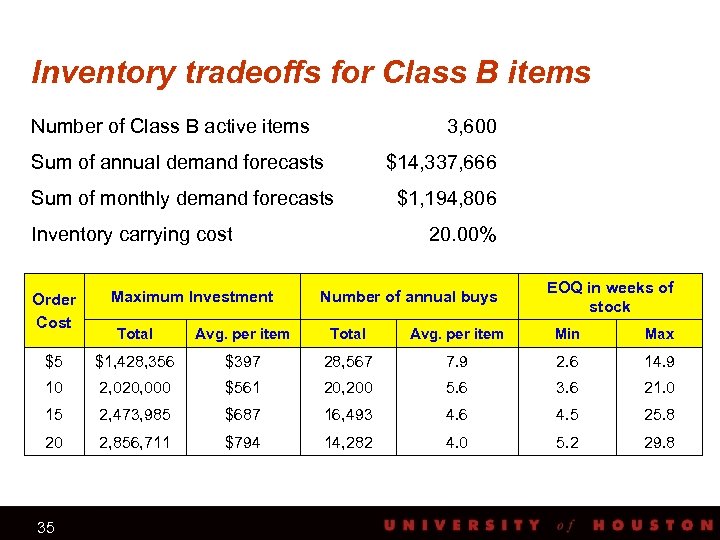 Inventory tradeoffs for Class B items Number of Class B active items 3, 600 Sum of annual demand forecasts $14, 337, 666 Sum of monthly demand forecasts $1, 194, 806 Inventory carrying cost Order Cost Maximum Investment 20. 00% Number of annual buys EOQ in weeks of stock Total Avg. per item Min Max $5 $1, 428, 356 $397 28, 567 7. 9 2. 6 14. 9 10 2, 020, 000 $561 20, 200 5. 6 3. 6 21. 0 15 2, 473, 985 $687 16, 493 4. 6 4. 5 25. 8 20 2, 856, 711 $794 14, 282 4. 0 5. 2 29. 8 35
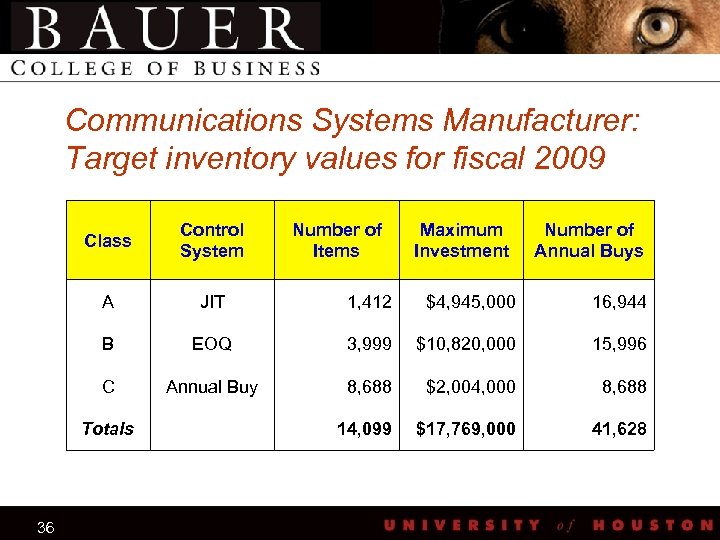 Communications Systems Manufacturer: Target inventory values for fiscal 2009 Class Control System A JIT 1, 412 $4, 945, 000 16, 944 B EOQ 3, 999 $10, 820, 000 15, 996 C Annual Buy 8, 688 $2, 004, 000 8, 688 14, 099 $17, 769, 000 41, 628 Totals 36 Number of Items Maximum Investment Number of Annual Buys
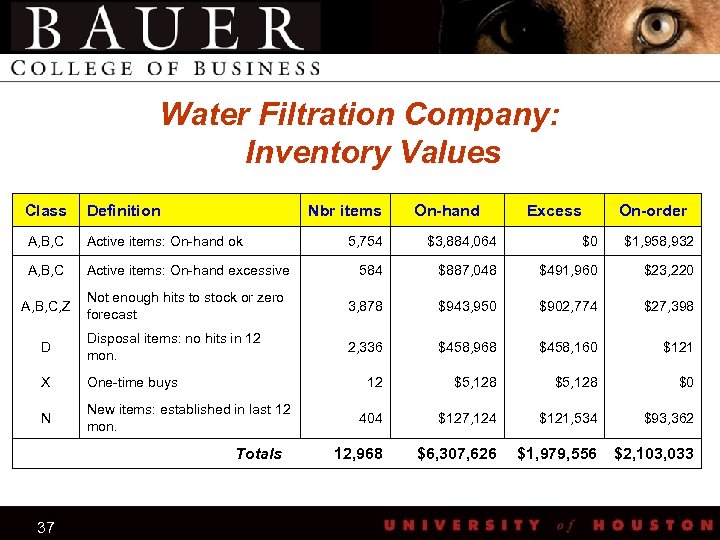 Water Filtration Company: Inventory Values Class Definition Nbr items A, B, C Active items: On-hand ok A, B, C Active items: On-hand excessive A, B, C, Z On-hand Excess On-order 5, 754 $3, 884, 064 $0 $1, 958, 932 584 $887, 048 $491, 960 $23, 220 Not enough hits to stock or zero forecast 3, 878 $943, 950 $902, 774 $27, 398 D Disposal items: no hits in 12 mon. 2, 336 $458, 968 $458, 160 $121 X One-time buys 12 $5, 128 $0 N New items: established in last 12 mon. 404 $127, 124 $121, 534 $93, 362 12, 968 $6, 307, 626 $1, 979, 556 $2, 103, 033 Totals 37
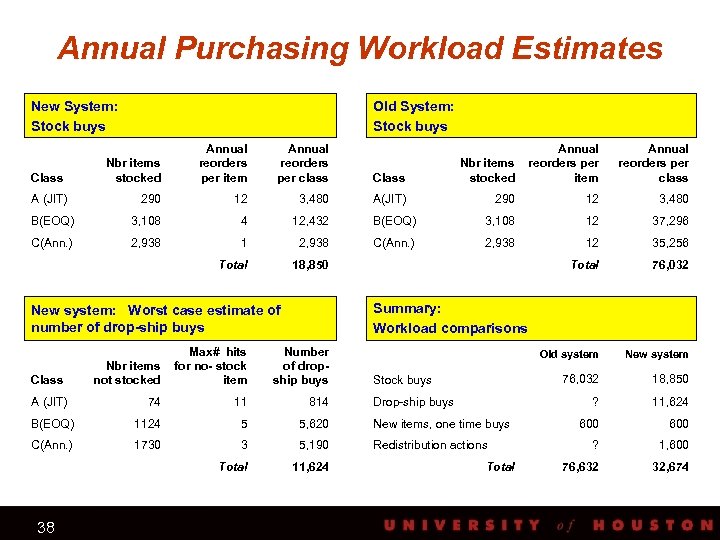 Annual Purchasing Workload Estimates New System: Stock buys Old System: Stock buys Nbr items stocked Annual reorders per item Annual reorders per class 290 12 3, 480 B(EOQ) 3, 108 4 12, 432 C(Ann. ) 2, 938 1 2, 938 Total 18, 850 Class A (JIT) Class Nbr items stocked Annual reorders per item Annual reorders per class A(JIT) 290 12 3, 480 B(EOQ) 3, 108 12 37, 296 C(Ann. ) 2, 938 12 35, 256 Total 76, 032 Old system New system 76, 032 18, 850 ? 11, 624 600 ? 1, 600 76, 632 32, 674 Summary: Workload comparisons New system: Worst case estimate of number of drop-ship buys Nbr items not stocked Max# hits for no- stock item Number of dropship buys 74 11 814 B(EOQ) 1124 5 5, 620 New items, one time buys C(Ann. ) 1730 3 5, 190 Redistribution actions Total 11, 624 Class A (JIT) 38 Stock buys Drop-ship buys Total
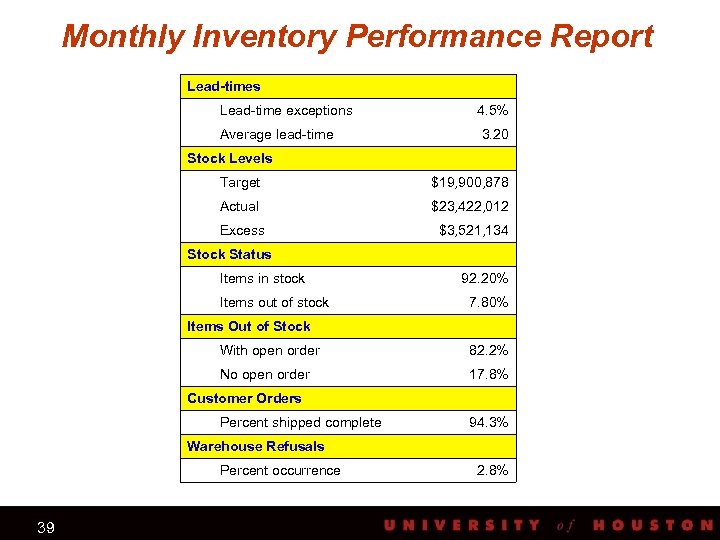 Monthly Inventory Performance Report Lead-times Lead-time exceptions Average lead-time 4. 5% 3. 20 Stock Levels Target $19, 900, 878 Actual $23, 422, 012 Excess $3, 521, 134 Stock Status Items in stock Items out of stock 92. 20% 7. 80% Items Out of Stock With open order 82. 2% No open order 17. 8% Customer Orders Percent shipped complete 94. 3% Warehouse Refusals Percent occurrence 39 2. 8%
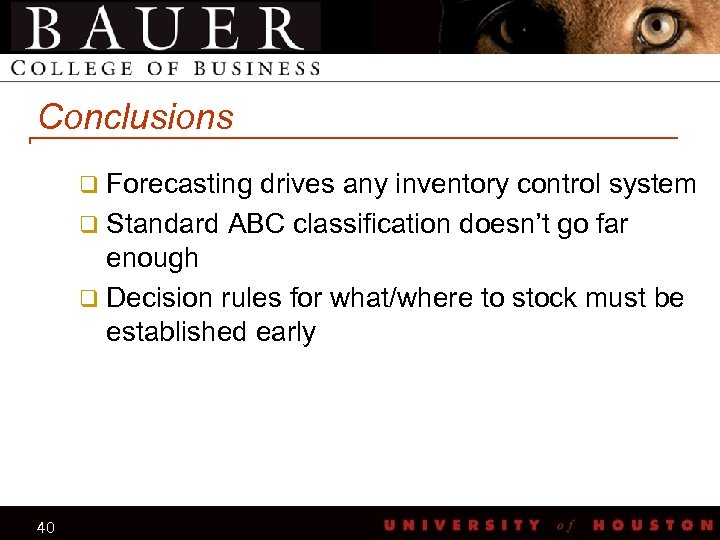 Conclusions q Forecasting drives any inventory control system q Standard ABC classification doesn’t go far enough q Decision rules for what/where to stock must be established early 40
 Conclusions (cont. ) q Performance q q q 41 measurement is essential to: Justify a new system Tailor the system to the inventory Track progress
 Conclusions (cont. ) q The best inventory system is likely to be a hybrid of: q q 42 JIT MRP EOQ Annual buy