 Скачать презентацию How to Recruit Gen X Faculty Members Inside
b48dd1c22684b65a712ca9a22579065d.ppt
- Количество слайдов: 42



How to Recruit Gen X Faculty Members Inside Higher Ed Audio Conference July 17, 2007 Cathy A. Trower, Ph. D.
A Sea Change § Many colleges and universities will hire more faculty in the next 8 -10 years than they currently employ because of retirements and growth. § Will the best and brightest faculty (crucial to student engagement and retention, research, and service – mission fulfillment) seek employment inside or outside academe? At your campus or your competitor’s? §
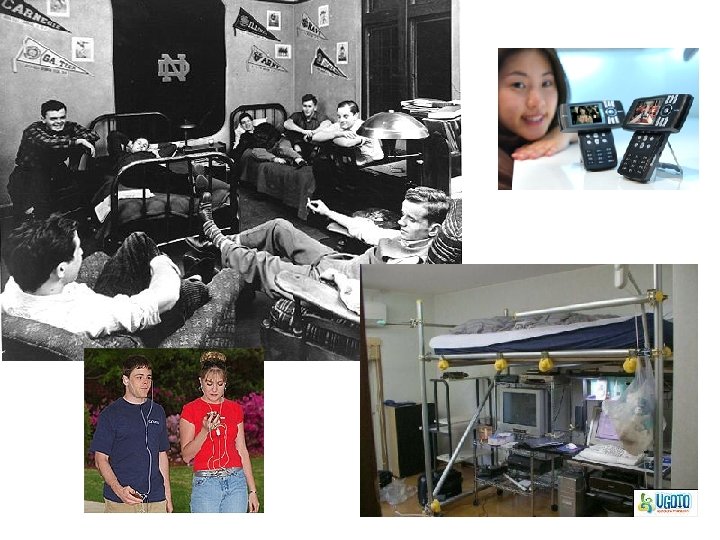
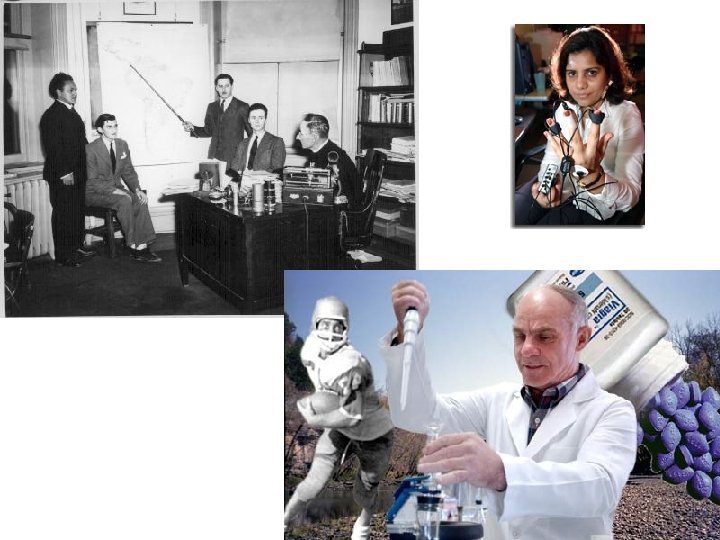
Who & What is Gen X? Or…They Want What?
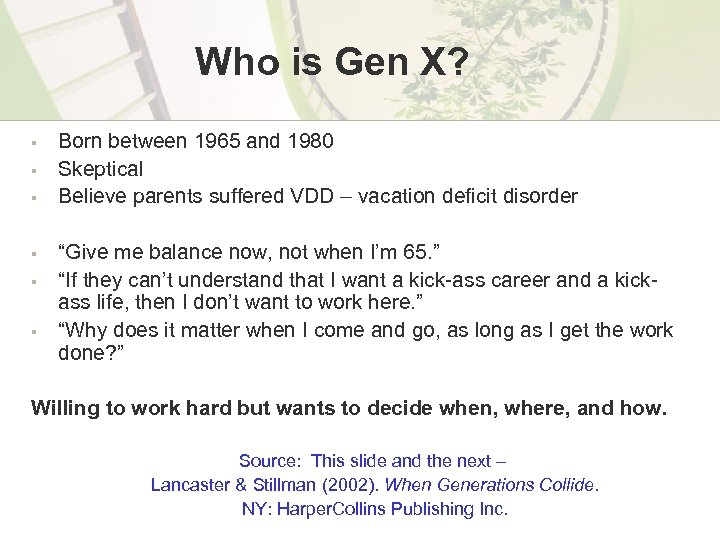
Who is Gen X? § § § Born between 1965 and 1980 Skeptical Believe parents suffered VDD – vacation deficit disorder “Give me balance now, not when I’m 65. ” “If they can’t understand that I want a kick-ass career and a kickass life, then I don’t want to work here. ” “Why does it matter when I come and go, as long as I get the work done? ” Willing to work hard but wants to decide when, where, and how. Source: This slide and the next – Lancaster & Stillman (2002). When Generations Collide. NY: Harper. Collins Publishing Inc.
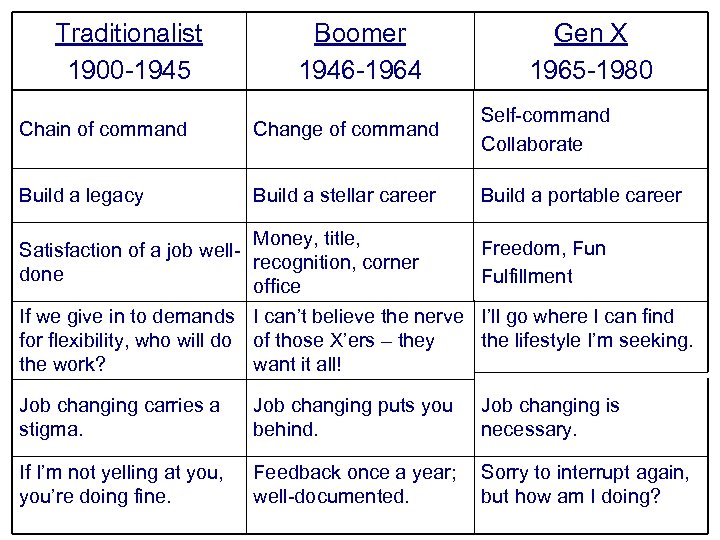
Traditionalist 1900 -1945 Boomer 1946 -1964 Gen X 1965 -1980 Chain of command Change of command Self-command Collaborate Build a legacy Build a stellar career Build a portable career Money, title, Satisfaction of a job wellrecognition, corner done office If we give in to demands I can’t believe the nerve for flexibility, who will do of those X’ers – they the work? want it all! Freedom, Fun Fulfillment Job changing carries a stigma. Job changing puts you behind. Job changing is necessary. If I’m not yelling at you, you’re doing fine. Feedback once a year; well-documented. Sorry to interrupt again, but how am I doing? I’ll go where I can find the lifestyle I’m seeking.
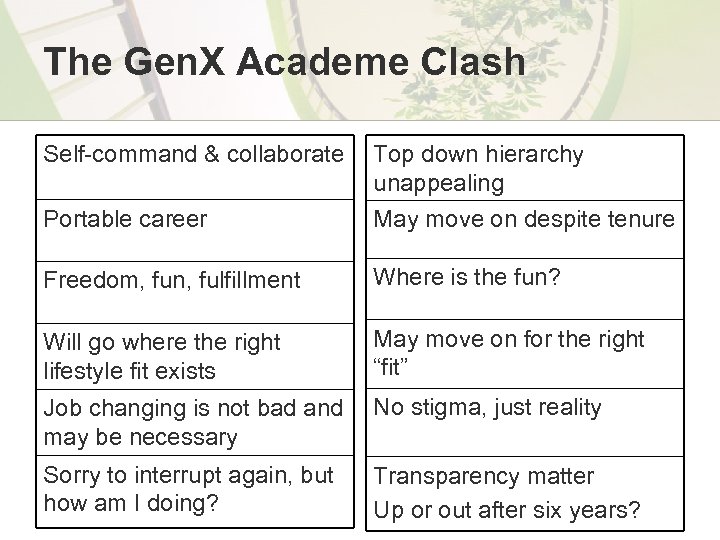
The Gen. X Academe Clash Self-command & collaborate Top down hierarchy unappealing Portable career May move on despite tenure Freedom, fun, fulfillment Where is the fun? Will go where the right lifestyle fit exists May move on for the right “fit” Job changing is not bad and may be necessary No stigma, just reality Sorry to interrupt again, but how am I doing? Transparency matter Up or out after six years?
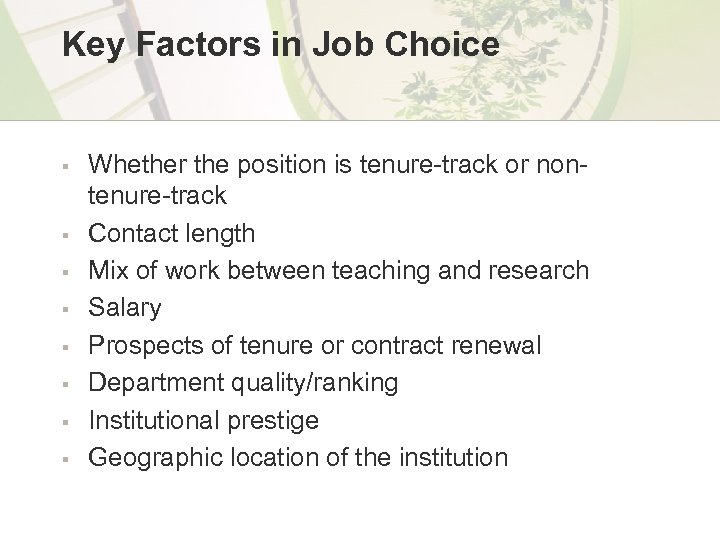
Key Factors in Job Choice § § § § Whether the position is tenure-track or nontenure-track Contact length Mix of work between teaching and research Salary Prospects of tenure or contract renewal Department quality/ranking Institutional prestige Geographic location of the institution
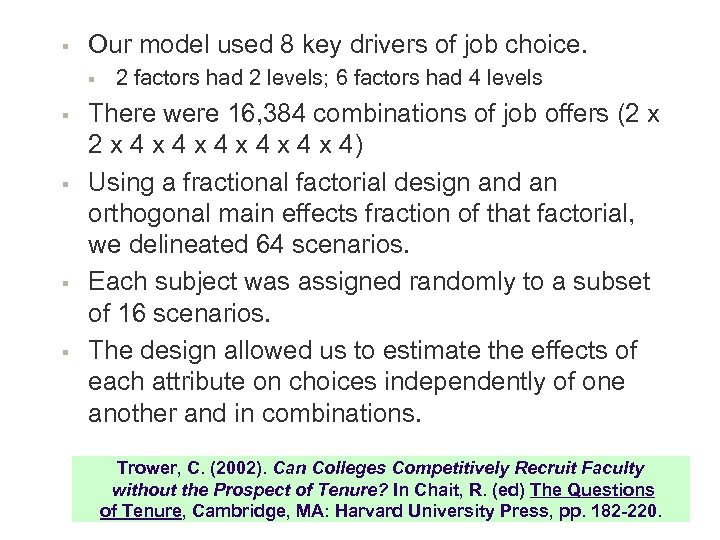
§ Our model used 8 key drivers of job choice. § § § 2 factors had 2 levels; 6 factors had 4 levels There were 16, 384 combinations of job offers (2 x 4 x 4) Using a fractional factorial design and an orthogonal main effects fraction of that factorial, we delineated 64 scenarios. Each subject was assigned randomly to a subset of 16 scenarios. The design allowed us to estimate the effects of each attribute on choices independently of one another and in combinations. Trower, C. (2002). Can Colleges Competitively Recruit Faculty without the Prospect of Tenure? In Chait, R. (ed) The Questions of Tenure, Cambridge, MA: Harvard University Press, pp. 182 -220.
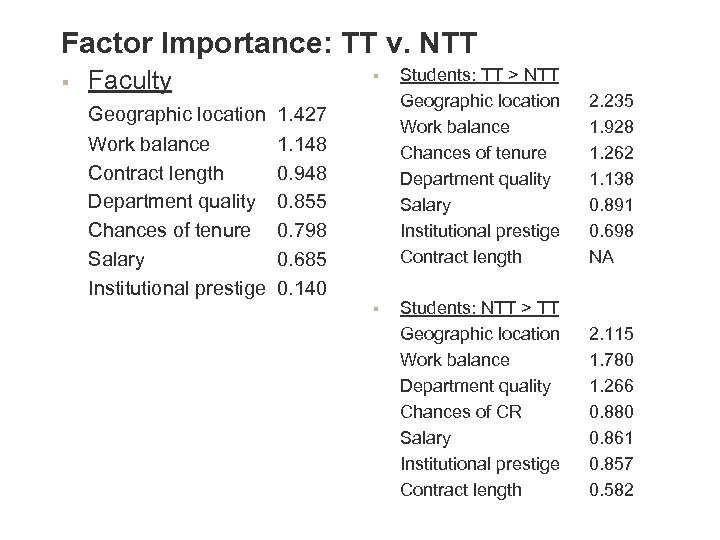
Factor Importance: TT v. NTT § Faculty Geographic location Work balance Contract length Department quality Chances of tenure Salary Institutional prestige § 1. 427 1. 148 0. 948 0. 855 0. 798 0. 685 0. 140 § Students: TT > NTT Geographic location Work balance Chances of tenure Department quality Salary Institutional prestige Contract length 2. 235 1. 928 1. 262 1. 138 0. 891 0. 698 NA Students: NTT > TT Geographic location Work balance Department quality Chances of CR Salary Institutional prestige Contract length 2. 115 1. 780 1. 266 0. 880 0. 861 0. 857 0. 582
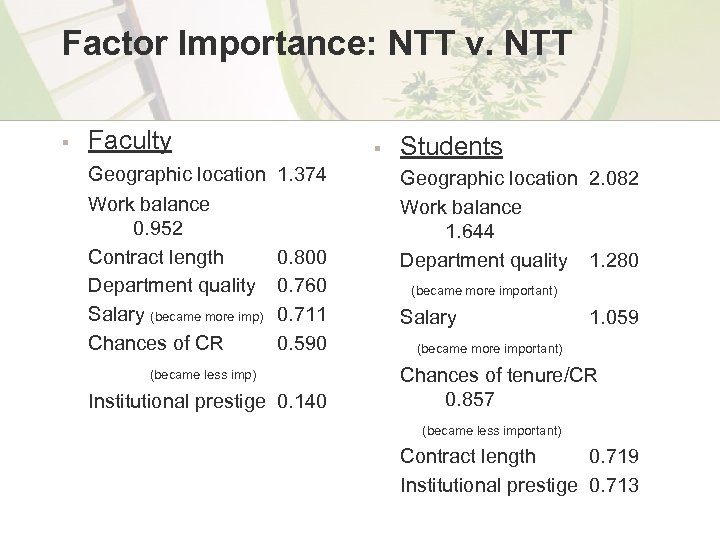
Factor Importance: NTT v. NTT § Faculty Geographic location Work balance 0. 952 Contract length Department quality Salary (became more imp) Chances of CR § 1. 374 0. 800 0. 760 0. 711 0. 590 (became less imp) Institutional prestige 0. 140 Students Geographic location 2. 082 Work balance 1. 644 Department quality 1. 280 (became more important) Salary 1. 059 (became more important) Chances of tenure/CR 0. 857 (became less important) Contract length 0. 719 Institutional prestige 0. 713
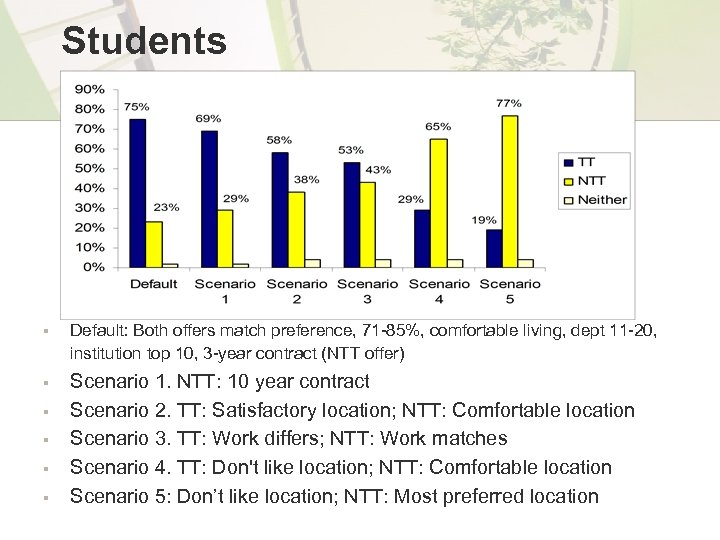
Students § Default: Both offers match preference, 71 -85%, comfortable living, dept 11 -20, institution top 10, 3 -year contract (NTT offer) § Scenario 1. NTT: 10 year contract Scenario 2. TT: Satisfactory location; NTT: Comfortable location Scenario 3. TT: Work differs; NTT: Work matches Scenario 4. TT: Don't like location; NTT: Comfortable location Scenario 5: Don’t like location; NTT: Most preferred location § §
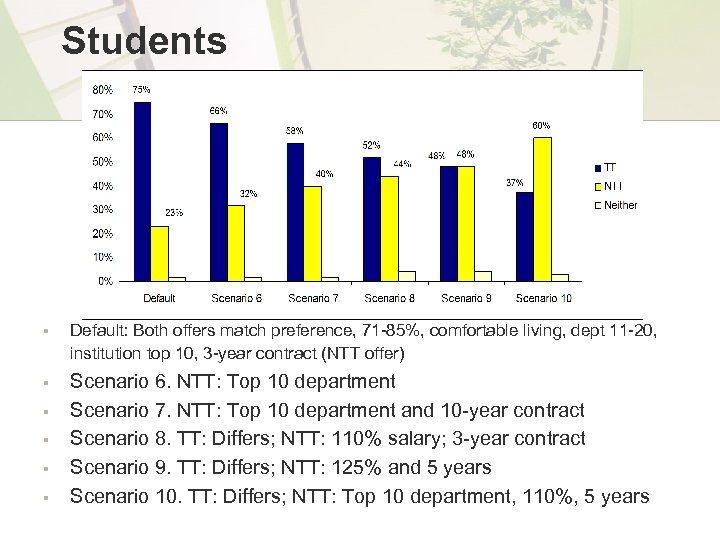
Students § Default: Both offers match preference, 71 -85%, comfortable living, dept 11 -20, institution top 10, 3 -year contract (NTT offer) § Scenario 6. NTT: Top 10 department Scenario 7. NTT: Top 10 department and 10 -year contract Scenario 8. TT: Differs; NTT: 110% salary; 3 -year contract Scenario 9. TT: Differs; NTT: 125% and 5 years Scenario 10. TT: Differs; NTT: Top 10 department, 110%, 5 years § §
Can’t compete on salary…now what? § § Our research shows that WHAT and WHERE matter more than prestige and salary. For attractively situated institutions, no sweat. . . For less so, market the location (just like we do with students!) Offer an appealing balance of work
Key components of faculty satisfaction (and ultimately success) are: § Clarity surrounding… Ø Ø Tenure process, criteria, standards, body of evidence Expectations for scholarship, teaching, advising, colleagueship, campus citizenship § Reasonable and consistent performance expectations § A climate, culture supporting great work – collegiality § Quality of life on the job and off § Workload equity § Professional development and support
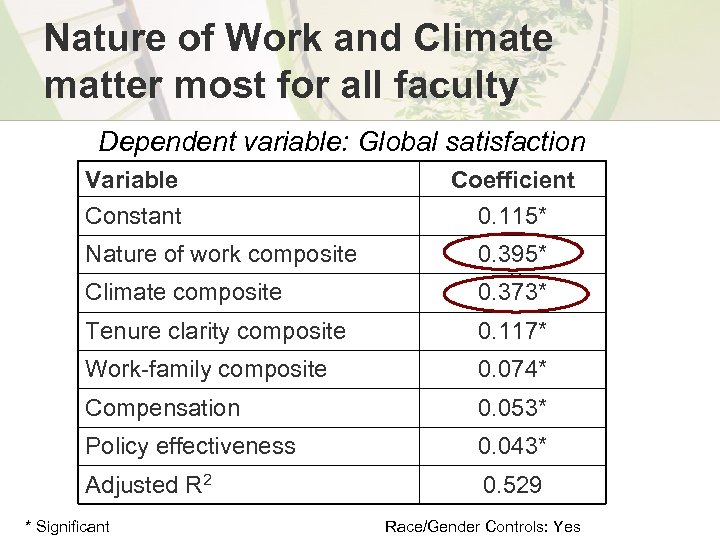
Nature of Work and Climate matter most for all faculty Dependent variable: Global satisfaction Variable Constant Coefficient 0. 115* Nature of work composite 0. 395* Climate composite 0. 373* Tenure clarity composite 0. 117* Work-family composite 0. 074* Compensation 0. 053* Policy effectiveness 0. 043* Adjusted R 2 0. 529 * Significant Race/Gender Controls: Yes
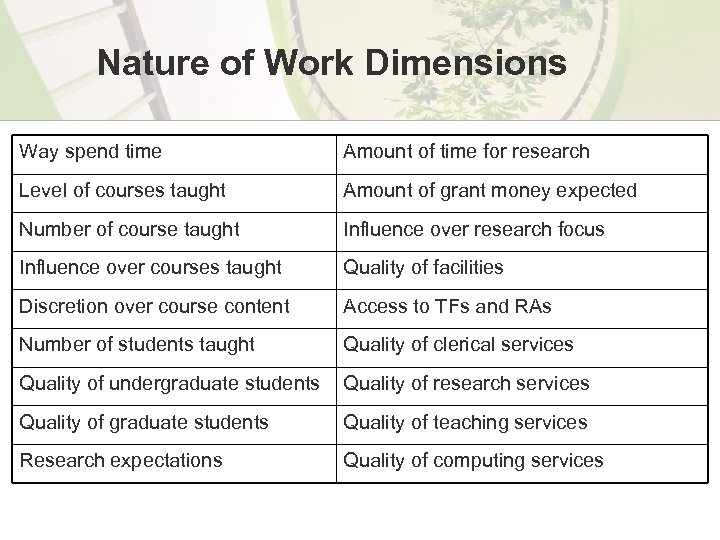
Nature of Work Dimensions Way spend time Amount of time for research Level of courses taught Amount of grant money expected Number of course taught Influence over research focus Influence over courses taught Quality of facilities Discretion over course content Access to TFs and RAs Number of students taught Quality of clerical services Quality of undergraduate students Quality of research services Quality of graduate students Quality of teaching services Research expectations Quality of computing services
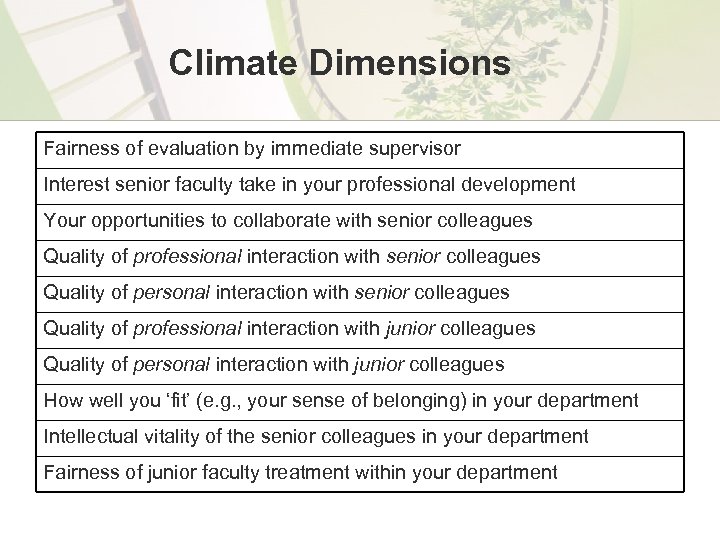
Climate Dimensions Fairness of evaluation by immediate supervisor Interest senior faculty take in your professional development Your opportunities to collaborate with senior colleagues Quality of professional interaction with senior colleagues Quality of personal interaction with senior colleagues Quality of professional interaction with junior colleagues Quality of personal interaction with junior colleagues How well you ‘fit’ (e. g. , your sense of belonging) in your department Intellectual vitality of the senior colleagues in your department Fairness of junior faculty treatment within your department
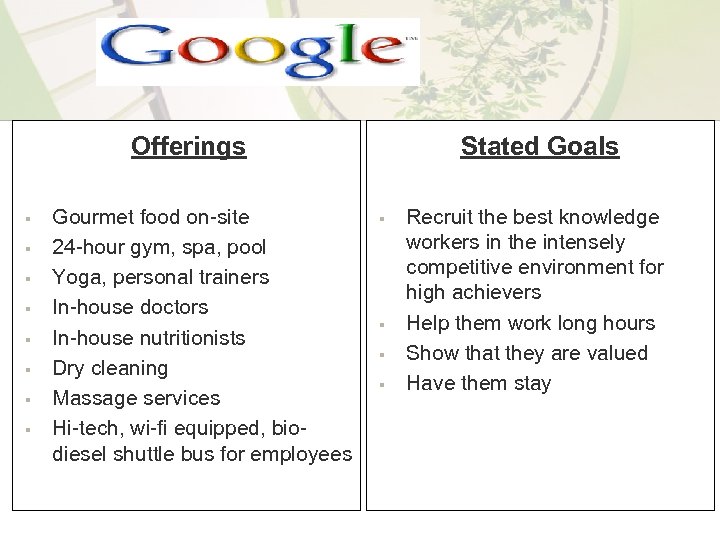
Offerings § § § § Gourmet food on-site 24 -hour gym, spa, pool Yoga, personal trainers In-house doctors In-house nutritionists Dry cleaning Massage services Hi-tech, wi-fi equipped, biodiesel shuttle bus for employees Stated Goals § § Recruit the best knowledge workers in the intensely competitive environment for high achievers Help them work long hours Show that they are valued Have them stay
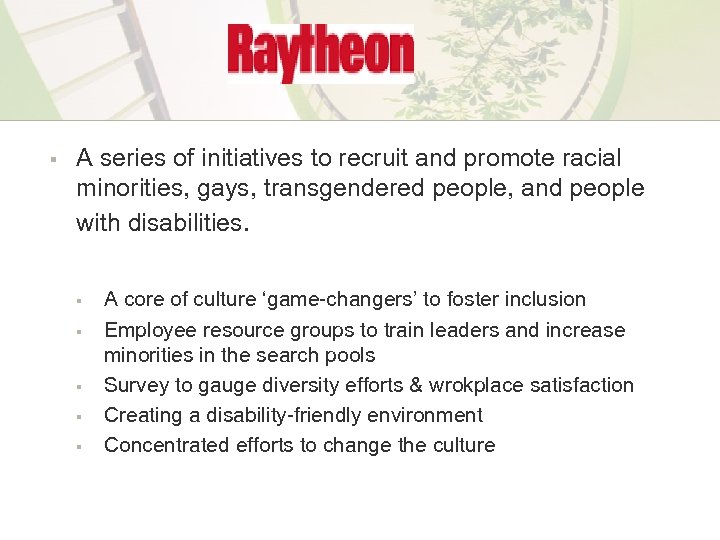
§ A series of initiatives to recruit and promote racial minorities, gays, transgendered people, and people with disabilities. § § § A core of culture ‘game-changers’ to foster inclusion Employee resource groups to train leaders and increase minorities in the search pools Survey to gauge diversity efforts & wrokplace satisfaction Creating a disability-friendly environment Concentrated efforts to change the culture
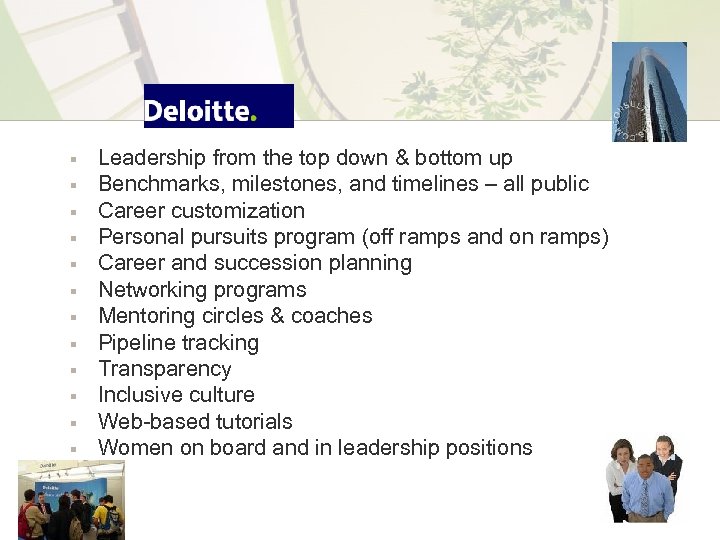
§ § § Leadership from the top down & bottom up Benchmarks, milestones, and timelines – all public Career customization Personal pursuits program (off ramps and on ramps) Career and succession planning Networking programs Mentoring circles & coaches Pipeline tracking Transparency Inclusive culture Web-based tutorials Women on board and in leadership positions
Law Firms § § § § Push and pull strategies (training and mentoring) Did away with up or out Reduced hours tracks 17 weeks paid maternity leave Hire and promote female managing partners Exploring underlying assumptions Competing to be a great place to work
What ‘They’ Have That We Don’t § § § Cool, virtual locations v. office in academic building Flexible hours v. office hours Flexible policies v. set policies Entrepreneurial spirit v. entrenched rules Make your own career v. tenure, up-or-out, take it or leave it Funding to work on your favorite research v. find your own funding and teach and go to meetings and be a good citizen
More … § § “We can do that”/ “just do it” attitude v. “well, that’s interesting but we’ve never done it that way” “I think you’d need the department chair’s approval first…and then the dean’s…and then the provost’s” “We’ll have to have a committee look at that” Child care, expense account, stock options, executive suite, moving allowance, personal trainer, clothing allowance…v. use of the university athletic center but no time to go there.
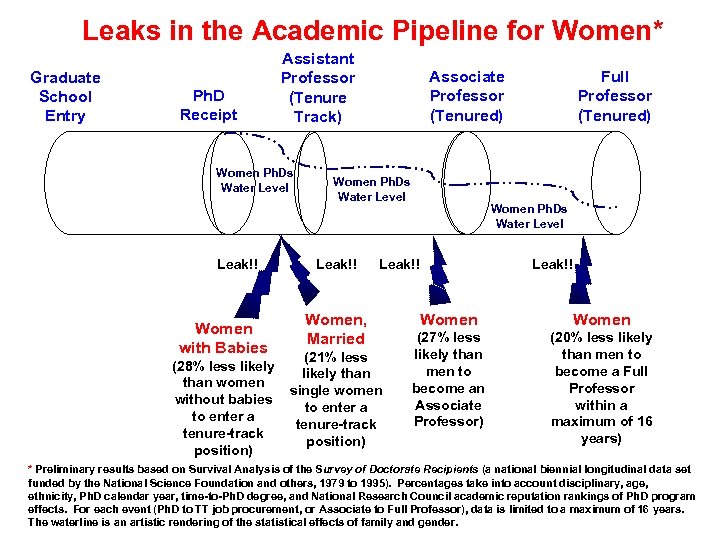
Leaks in the Academic Pipeline for Women* Graduate School Entry Ph. D Receipt Assistant Professor (Tenure Track) Women Ph. Ds Water Level Leak!! Women with Babies (28% less likely than women without babies to enter a tenure-track position) Associate Professor (Tenured) Women Ph. Ds Water Level Leak!! Women, Married (21% less likely than single women to enter a tenure-track position) Full Professor (Tenured) Leak!! Women (27% less likely than men to become an Associate Professor) (20% less likely than men to become a Full Professor within a maximum of 16 years) * Preliminary results based on Survival Analysis of the Survey of Doctorate Recipients (a national biennial longitudinal data set funded by the National Science Foundation and others, 1979 to 1995). Percentages take into account disciplinary, age, ethnicity, Ph. D calendar year, time-to-Ph. D degree, and National Research Council academic reputation rankings of Ph. D program effects. For each event (Ph. D to TT job procurement, or Associate to Full Professor), data is limited to a maximum of 16 years. The waterline is an artistic rendering of the statistical effects of family and gender.
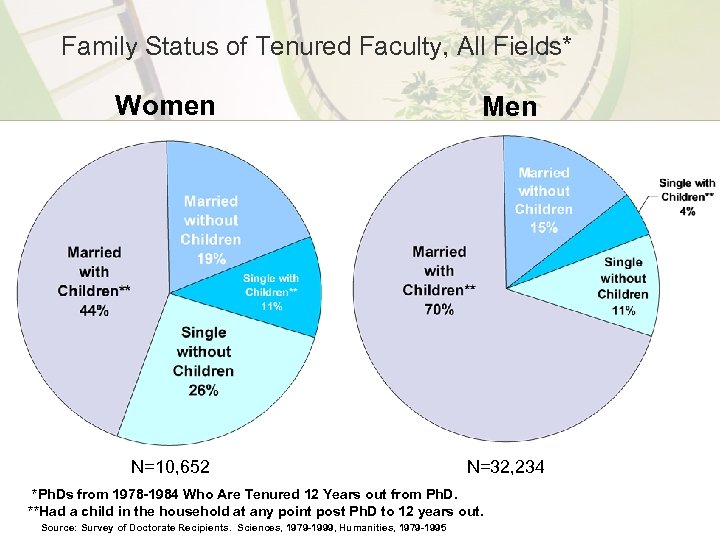
Family Status of Tenured Faculty, All Fields* Women Men N=10, 652 N=32, 234 *Ph. Ds from 1978 -1984 Who Are Tenured 12 Years out from Ph. D. **Had a child in the household at any point post Ph. D to 12 years out. Source: Survey of Doctorate Recipients. Sciences, 1979 -1999, Humanities, 1979 -1995
What Can Be Done? § There is no magic bullet that will eliminate the ‘ideal worker’ (Drago) norm and the expectations of family built around that norm. § Changes in policy are needed…BUT… Changes in culture, climate, and day-to-day practices and expectations across all levels of the academy are required for long-term improvement. Absent those changes, even the most progressive work/family policies will likely be ignored by faculty. § §
Institutional Support § Provide “instrumental” mentoring • • • Critiques of scholarly work Nominate for career-enhancing rewards Include in valuable networks Collaborate on research and teaching Be Co-PI Arrange for them to chair conference or submit their name Moody, J. (2004) Academe, “Supporting Women and Minority Faculty, ” 90 (1).
Institutional Support § Provide clarity and fairness in tenure • • • Clear and written criteria Clear body of evidence Be realistic about what junior faculty can reasonably do In evaluating ‘national’ reputation, realize that not everyone can travel Spell out joint appointments carefully Credit outside of class work: independent studies and dissertations
Institutional Support § § § § Teach junior faculty how to document teaching Recognizes significant editorial work, advising, service work in tenure process Have year-long campus-wide orientation Help faculty build a network Hold demystifying workshops on tenure Provide mentoring teams Protect from service No one sees first year student evaluations but the new faculty member
Institutional Support § Systematically assess bias in evaluation § Monitor equity § § § § Work load Collaboration Travel funds Start-up packages Space/lab/office Resources Salary RA support
Faculty Reviews Should Be… § § § § § Clear Transparent Fair Equitable Frequent Consistent Helpful Written Focused § Conducted by: § § § Senior colleagues who understand the complexities and environment facing the junior faculty member Chairs who are trained Based on: § Reasonable requirements
Improve the experiences of junior faculty Focus on Fit o o o o ‘Speed date’ if possible – internships, residencies Discuss department culture/numbers/success rates prior to hire (but not the same as being there) Orientation to university, school, and department Connections/networks/mentors (create pull) Ensure collaborations with senior faculty Chair training around establishing inclusive culture Involve senior faculty Help ensure consistent messages (in writing)
Improve the experiences of junior faculty Retention through Research o o Making time for research (success strategies) Professional assistance writing grants Realistic research expectations Support for research § TAs/RAs § Travel funds § Leave § Allow saying “no” to service § Tell them the ‘ropes’ § Grant writing workshops
Institutional Policies § § § § Transitional Support Program (Univ WA) Stop-the-clock automatic Part-Time Tenure Flexible appointments Research leave Decrease teaching load Onsite child care, lactation rooms Job sharing § § § Structure for dual careers Networking clubs Assistance with grant proposal writing Reward collaboration Preparing Future Faculty Program Minimize number of new course preps
A New Bottom Line? § § § Provide flexibility Provide a harmonious work environment/minimize politics Minimize red-tape and rules Provide work balance Provide work/personal life balance/bridge Just because they’re scholars doesn’t mean they’re nerds. . .
Quality of Life § Where? § § What? § § Desirable location Balance: personal and professional With whom? § Colleagueship, harmonious work life, minimal political squabbles, minimal administrivia
To Learn More COACHE -The Collaborative on Academic Careers in Higher Education § http: //www. coache. org § cathy_trower@harvard. edu § 617 -496 -9344
Скачать презентацию How to Recruit Gen X Faculty Members Inside
b48dd1c22684b65a712ca9a22579065d.ppt