Скачать презентацию How to present in English Why Should
Presentation_maxims_-_kopia.ppt
- Количество слайдов: 70
 How to present in English
 Why Should I Do a Presentation? l to gain visibility and inform others of the results you have achieved. l to increase your chances feedback on your work l to establish new contacts. l to get more funds. of getting
 What Kind of Presentations Do Audiences Like to See? l are professional and are delivered by someone who is credible and confident l look like they were prepared specifically for us and make it immediately clear why we should be interested l have clear slides, with minimal detail and helpful and/or entertaining images
 What Kind of Presentations Do Audiences Like to See? (cont. ) l tell us interesting, curious, and counterintuitive things l are delivered in a friendly, enthusiastic, and relatively informal way l entertain us and interact with us
 What Kind of Presentations Do Audiences NOT Like to See? l has clearly not practiced the presentation l has no clear introduction, a confused structure, and no conclusions l appears to be talking to himself/herself rather than engaging with the audience l reads the slides
 What Kind of Presentations Do Audiences NOT Like to See? (cont. ) l has a series of similar slides full of text and diagrams l relies on animations l is too technical, too detailed l speaks too fast, speaks with a monotone, speaks for too long l shows little interest in his/her topic
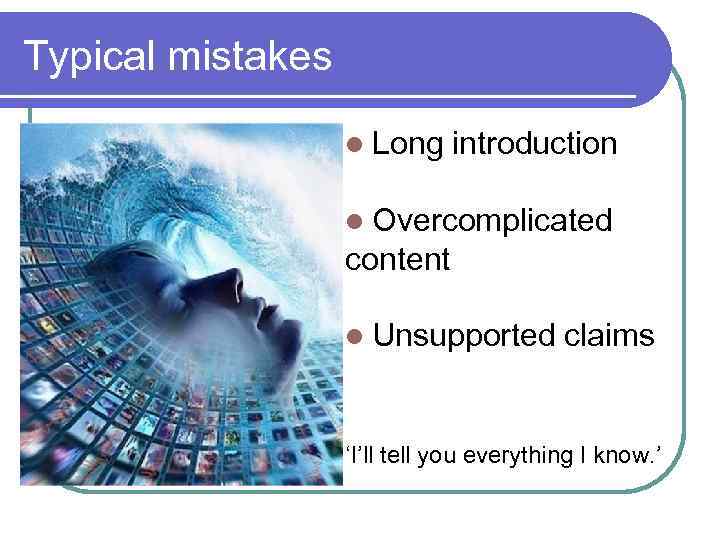 Typical mistakes l Long introduction l Overcomplicated content l Unsupported claims ‘I’ll tell you everything I know. ’
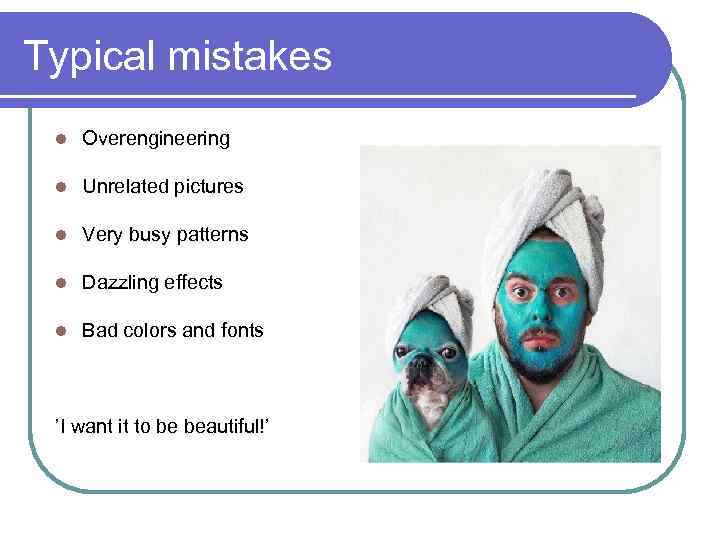 Typical mistakes l Overengineering l Unrelated pictures l Very busy patterns l Dazzling effects l Bad colors and fonts ’I want it to be beautiful!’
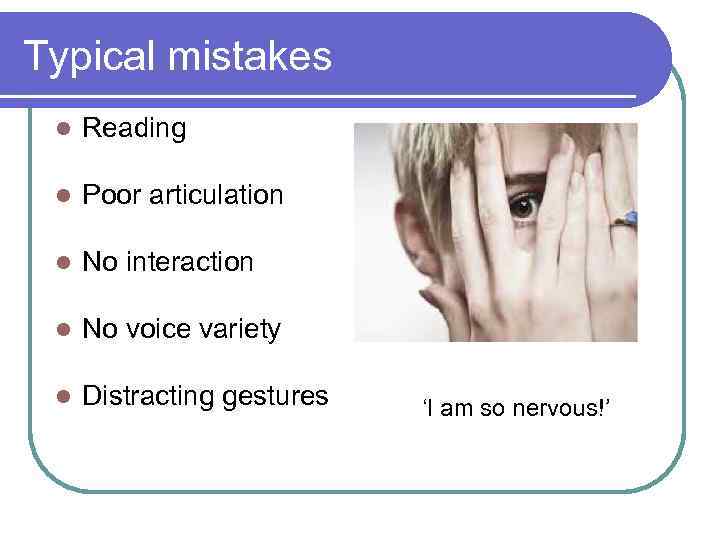 Typical mistakes l Reading l Poor articulation l No interaction l No voice variety l Distracting gestures ‘I am so nervous!’
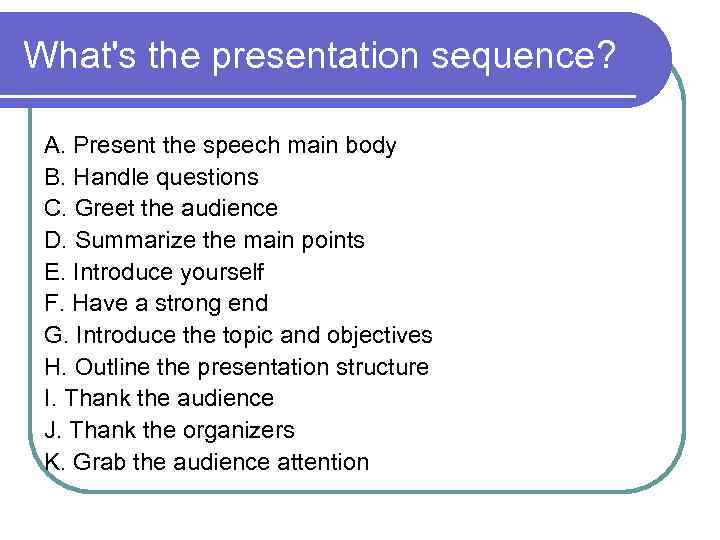 What's the presentation sequence? A. Present the speech main body B. Handle questions C. Greet the audience D. Summarize the main points E. Introduce yourself F. Have a strong end G. Introduce the topic and objectives H. Outline the presentation structure I. Thank the audience J. Thank the organizers K. Grab the audience attention
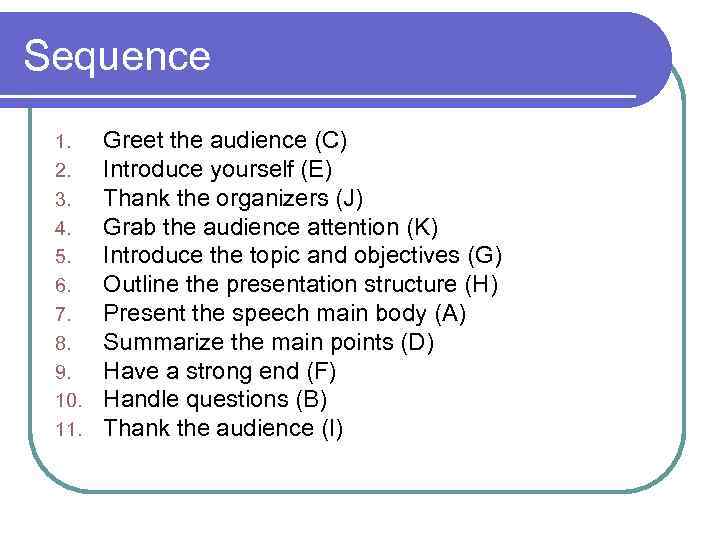 Sequence 1. 2. 3. 4. 5. 6. 7. 8. 9. 10. 11. Greet the audience (C) Introduce yourself (E) Thank the organizers (J) Grab the audience attention (K) Introduce the topic and objectives (G) Outline the presentation structure (H) Present the speech main body (A) Summarize the main points (D) Have a strong end (F) Handle questions (B) Thank the audience (I)
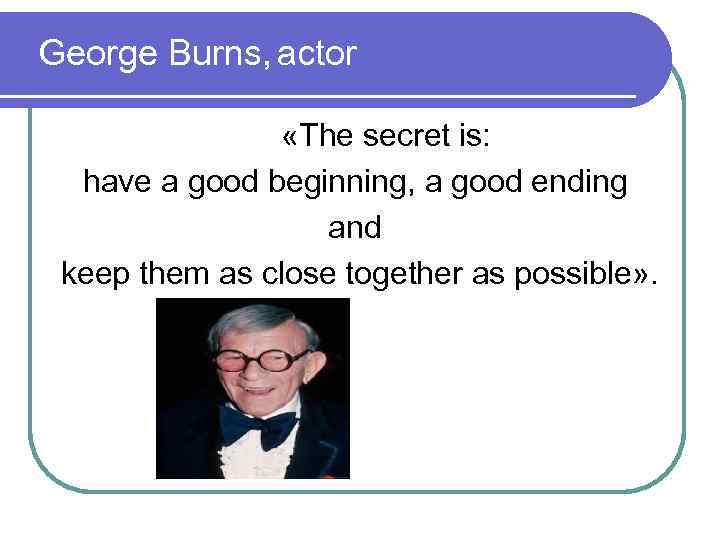 George Burns, actor «The secret is: have a good beginning, a good ending and keep them as close together as possible» .
 What Constitutes a Professional Presentation? l. A “professional” presentation is one where you put the audience first. l Grab l The your audience s attention important thing is to be relaxed.
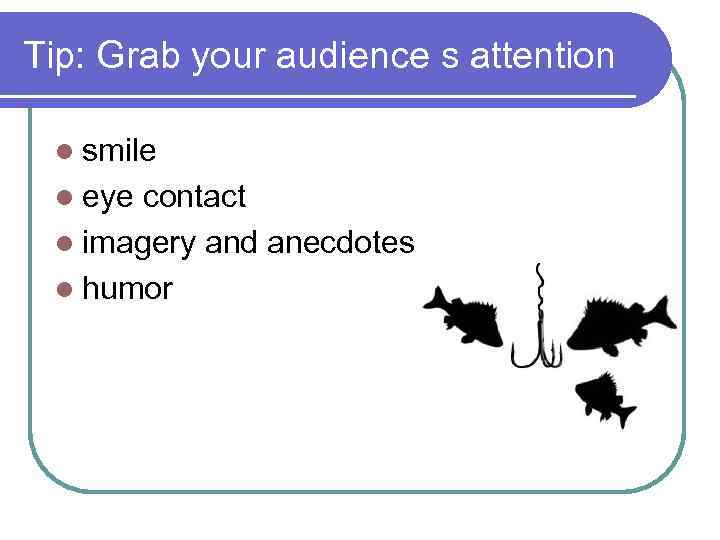 Tip: Grab your audience s attention l smile l eye contact l imagery and anecdotes l humor
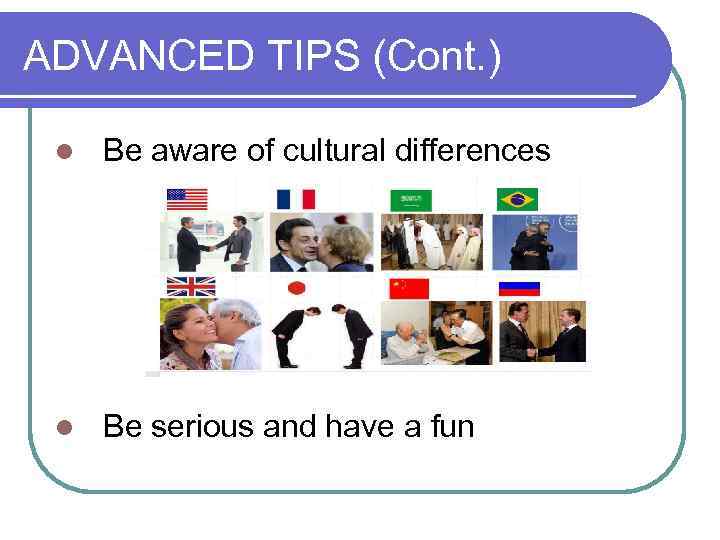 ADVANCED TIPS (Cont. ) l Be aware of cultural differences l Be serious and have a fun
 Handling Your Nerves l Identify your fears l Don’t focus on your English l Have a positive attitude l Organize your time l Learn relaxation techniques l Do some physical exercises: breathe in deeply relax/warm your neck and shoulder muscles exercise your jaw
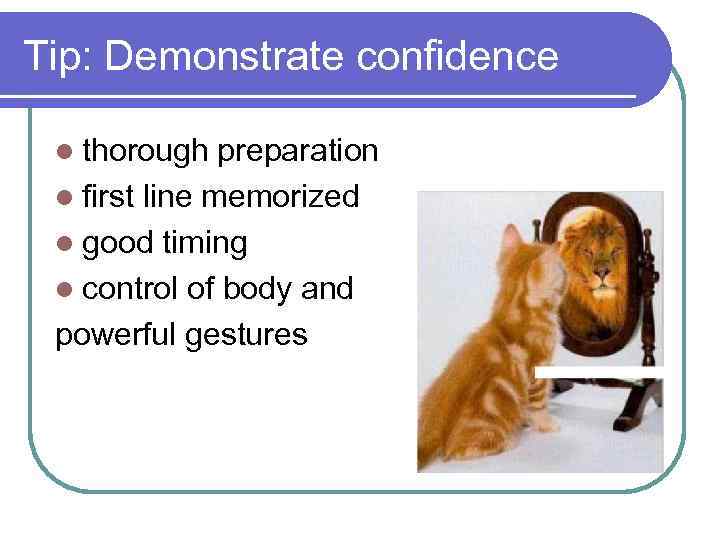 Tip: Demonstrate confidence l thorough preparation l first line memorized l good timing l control of body and powerful gestures
 Tip: Add variety to your voice l voice modulation l emphasis l powerful pauses l tempo l loudness
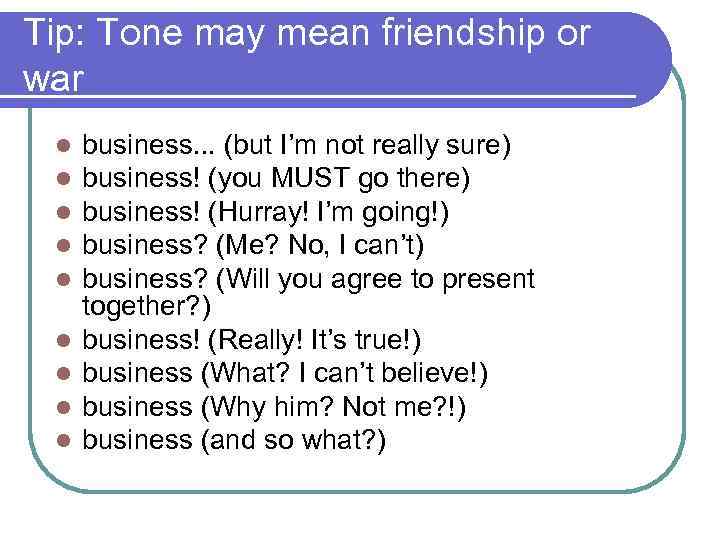 Tip: Tone may mean friendship or war l l l l l business. . . (but I’m not really sure) business! (you MUST go there) business! (Hurray! I’m going!) business? (Me? No, I can’t) business? (Will you agree to present together? ) business! (Really! It’s true!) business (What? I can’t believe!) business (Why him? Not me? !) business (and so what? )
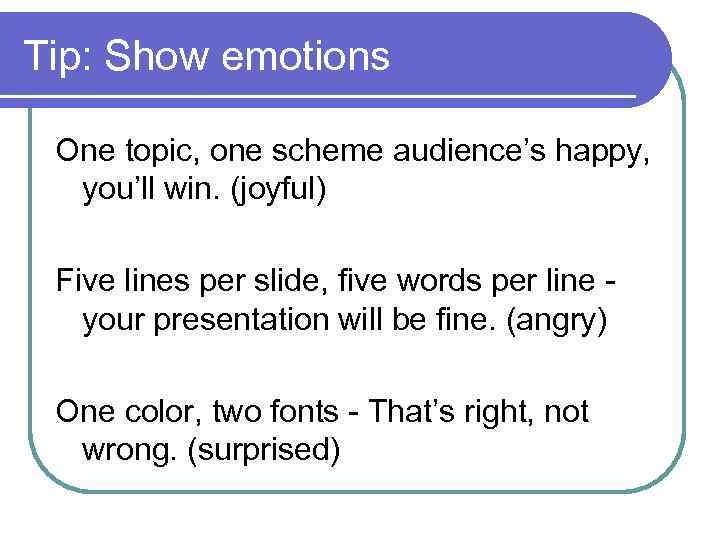 Tip: Show emotions One topic, one scheme audience’s happy, you’ll win. (joyful) Five lines per slide, five words per line your presentation will be fine. (angry) One color, two fonts That’s right, not wrong. (surprised)
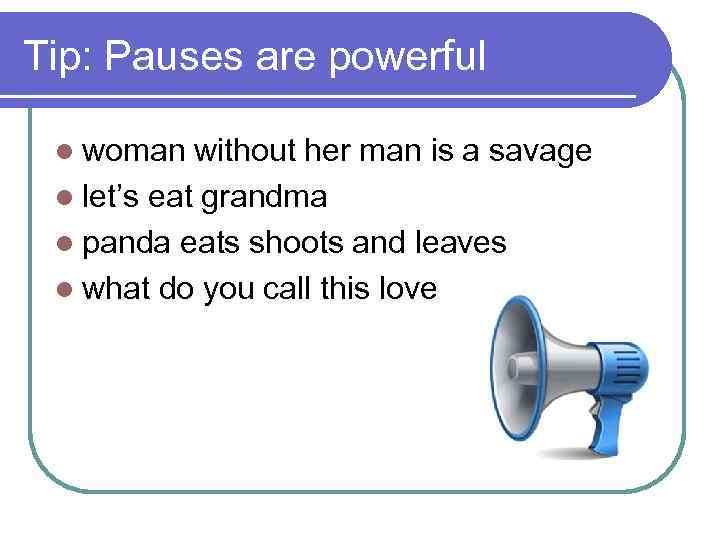 Tip: Pauses are powerful l woman without her man is a savage l let’s eat grandma l panda eats shoots and leaves l what do you call this love
 TIPS (Cont. ) l Don’t speak too fast or too much l Use stress to highlight the key words l Vary your voice and speed l Sound interested
 Find out about the potential audience l It is very useful to find out how much the audience already know about your topic. l If you are too general you will bore the experts. l Need to find the right balance
 Give your presentation a structure l Divide your speech/notes into sections l l l Introduction Methodology Results Discussion Conclusions
 Identify your key points/messages l what problem you wanted to resolve/investigate and why this was important for the scientific community l how l what you did it (your methodology) success you had (your results)
 Stages in Preparing l Prepare a two minute talk l Expand into a longer presentation
 Writing out your speech in English Tell a story. ? l Why did I choose this topic in general? Why am I enthusiastic about it? What can I tell the audience that they probably don’t know but that they will find interesting? How can I make it interesting to those attendees who are not experts in this field? l What motivated me to decide to test a particular hypothesis or investigate a particular aspect? Was I stimulated by someone else’s research? l What did I do to test the hypothesis/aspect?
 Writing out your speech in English (Cont) l What did I find? And what did I not find? Did my findings confirm my initial hypothesis? Were there any inconsistencies or surprises? l What is the significance of my work in the big picture of my field of interest? How and where can my findings be applied? l What questions do I still have? What am I planning to do next? (Plus a reminder to the audience of most important results so far) l Think of your presentation as the headlines in a newspaper.
 Create the slides l makes an explanation less complicated and quicker l helps people to visualize and recall something better l makes something abstract become more concrete l attracts attention
 What to Write on the Slides l l l l l the title your name the name and date of the conference co authors the name and/or logo of your institute/research unit your supervisor acknowledgments sponsors a photo a background image
 ADVANCED TIPS l Check your grammar l Check your spelling
 Use slide titles to help explain a process l l l Outline: Methodology: Results: Discussion: Future work: Thank you: l l l Why? How? What did we find? So what? What next? That’s all folks
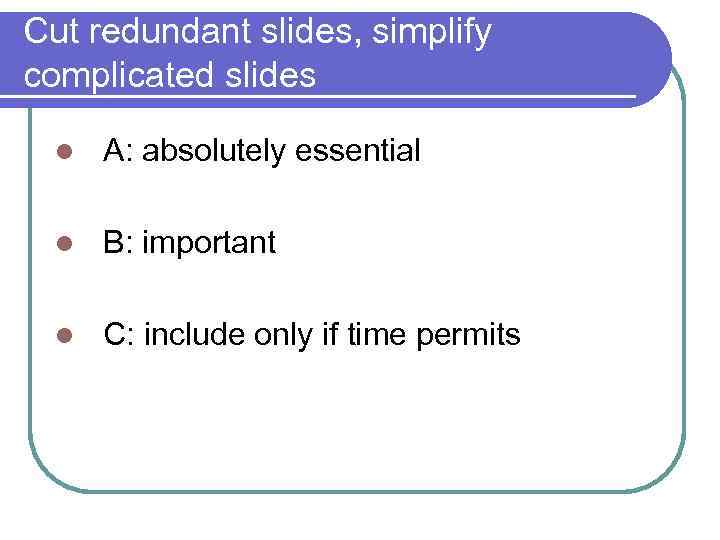 Cut redundant slides, simplify complicated slides l A: absolutely essential l B: important l C: include only if time permits
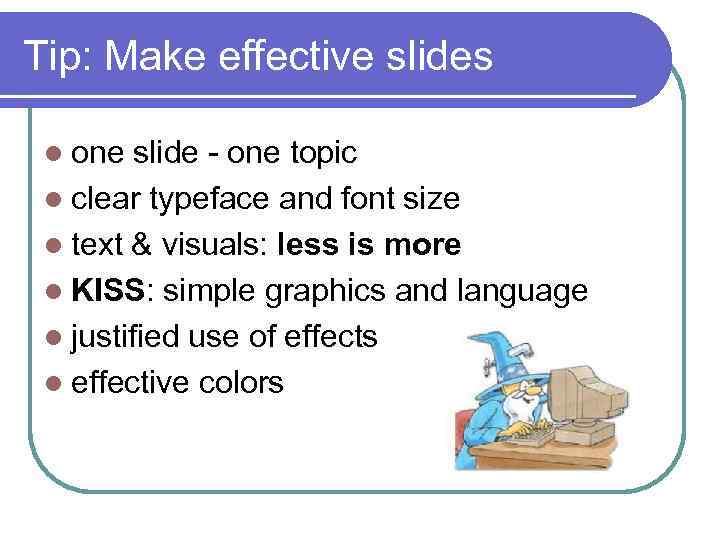 Tip: Make effective slides l one slide one topic l clear typeface and font size l text & visuals: less is more l KISS: simple graphics and language l justified use of effects l effective colors

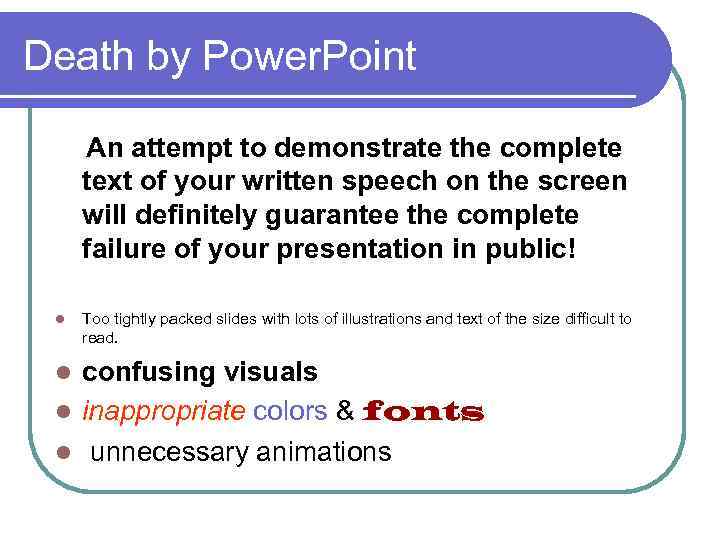 Death by Power. Point An attempt to demonstrate the complete text of your written speech on the screen will definitely guarantee the complete failure of your presentation in public! l Too tightly packed slides with lots of illustrations and text of the size difficult to read. confusing visuals l inappropriate colors & fonts l unnecessary animations l
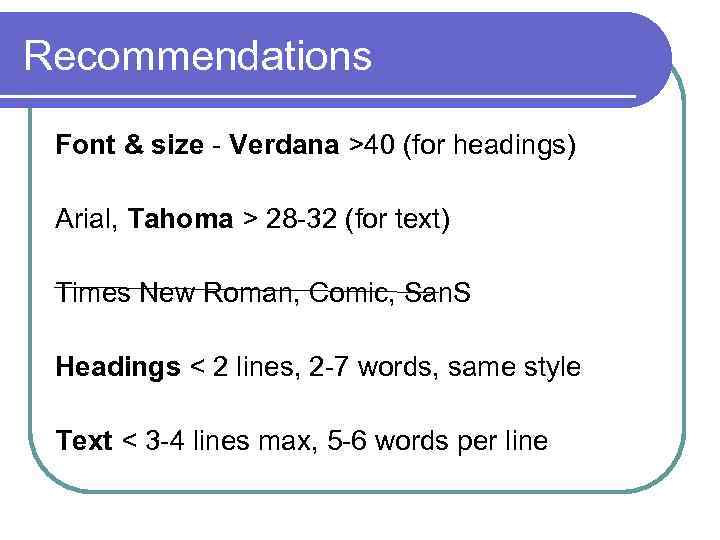 Recommendations Font & size Verdana >40 (for headings) Arial, Tahoma > 28 32 (for text) Times New Roman, Comic, San. S Headings < 2 lines, 2 7 words, same style Text < 3 4 lines max, 5 6 words per line
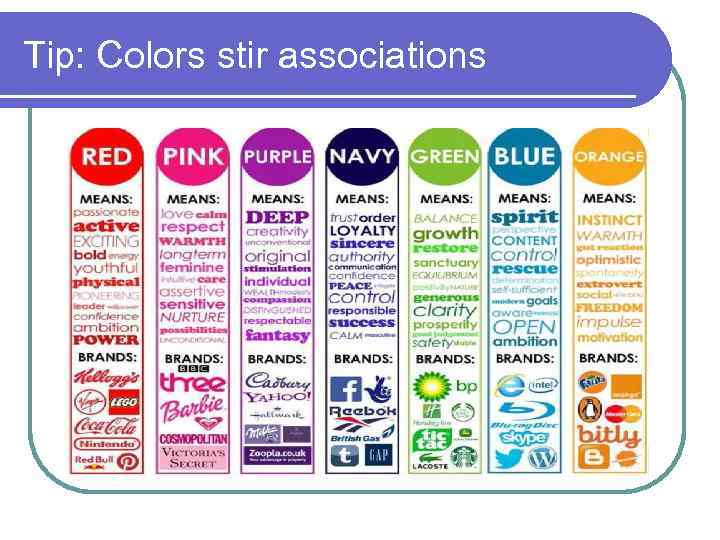 Tip: Colors stir associations
 Zack Holman A good set of slides won’t magically make your talk great. But a great talk is badly hurt by bad slides.
 Practice with colleagues Questions and Answers l Practice and learning from other people’s presentations l Ask colleagues, friends, or family members to listen to you. When you have finished, get them to write down questions to ask you. Do this with a variety of people.
 Practice and Learn from Other People’s Presentations l Use your notes l Practice your position relative to the screen l Don’t sit. Stand move around l Use your hands l Have an expressive face and smile l Learn how to be self critical: practice with colleagues l Improve your slides after the presentation
 TIPS l Understand the critical importance of correct pronunciation l Learn any irregular pronunciations l Be very careful of English technical words that also exist in your language l Practice the pronunciation of key words that have no synonyms l Enunciate numbers very clearly l Use your normal speaking voice
 TIPS: Q and A Session l Don’t underestimate the importance of the Q&A session l Prepare in advance for all possible questions l Always be polite
 Write a speech l A written script will also help you to: l identify words that you may not be able to pronounce l check that the sentences are not too long or complex to say naturally and to understand easily l understand when an example would be useful for the audience
 Write a speech (Cont. ) l clarify where you need to make connections between slides l delete redundancy and unnecessary repetition l think of how you could deliver your message in a more powerful or dynamic way l time how long the presentation will take
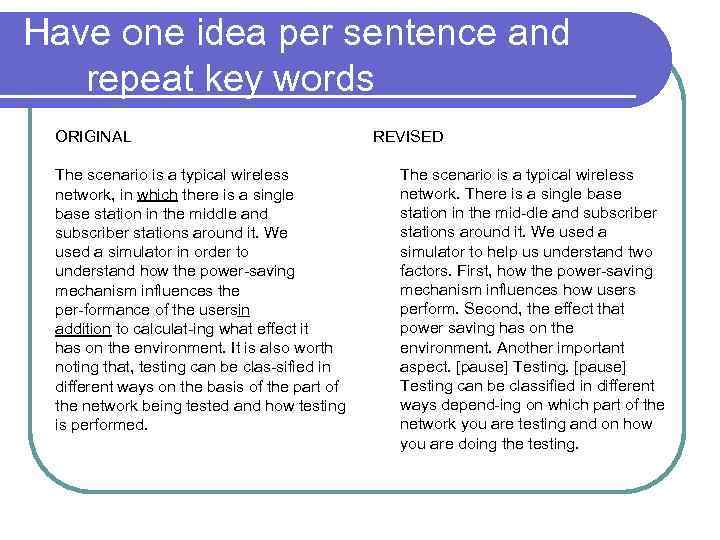 Have one idea per sentence and repeat key words ORIGINAL The scenario is a typical wireless network, in which there is a single base station in the middle and subscriber stations around it. We used a simulator in order to understand how the power saving mechanism influences the per formance of the usersin addition to calculat ing what effect it has on the environment. It is also worth noting that, testing can be clas sified in different ways on the basis of the part of the network being tested and how testing is performed. REVISED The scenario is a typical wireless network. There is a single base station in the mid dle and subscriber stations around it. We used a simulator to help us understand two factors. First, how the power saving mechanism influences how users perform. Second, the effect that power saving has on the environment. Another important aspect. [pause] Testing can be classified in different ways depend ing on which part of the network you are testing and on how you are doing the testing.
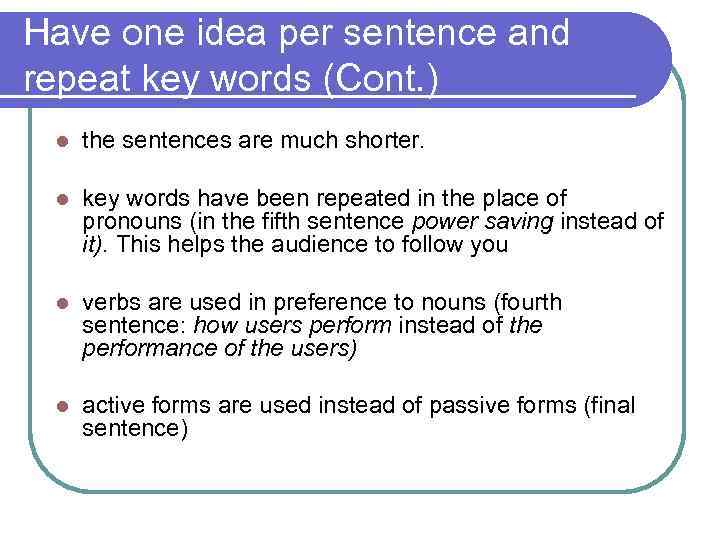 Have one idea per sentence and repeat key words (Cont. ) l the sentences are much shorter. l key words have been repeated in the place of pronouns (in the fifth sentence power saving instead of it). This helps the audience to follow you l verbs are used in preference to nouns (fourth sentence: how users perform instead of the performance of the users) l active forms are used instead of passive forms (final sentence)
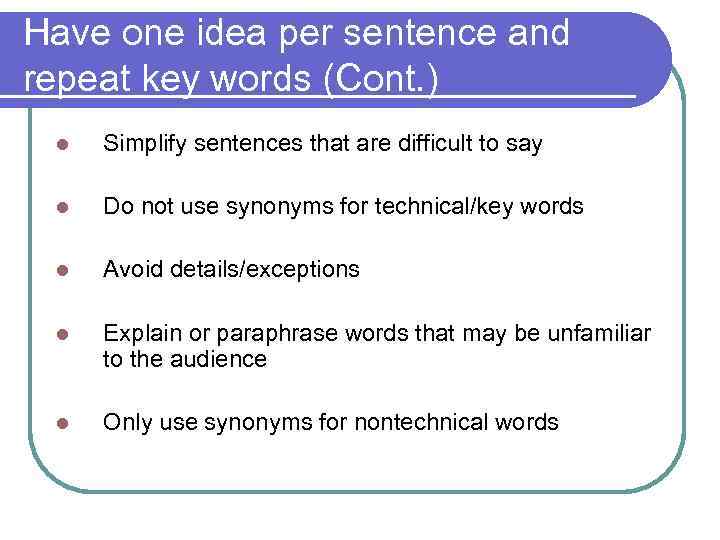 Have one idea per sentence and repeat key words (Cont. ) l Simplify sentences that are difficult to say l Do not use synonyms for technical/key words l Avoid details/exceptions l Explain or paraphrase words that may be unfamiliar to the audience l Only use synonyms for nontechnical words
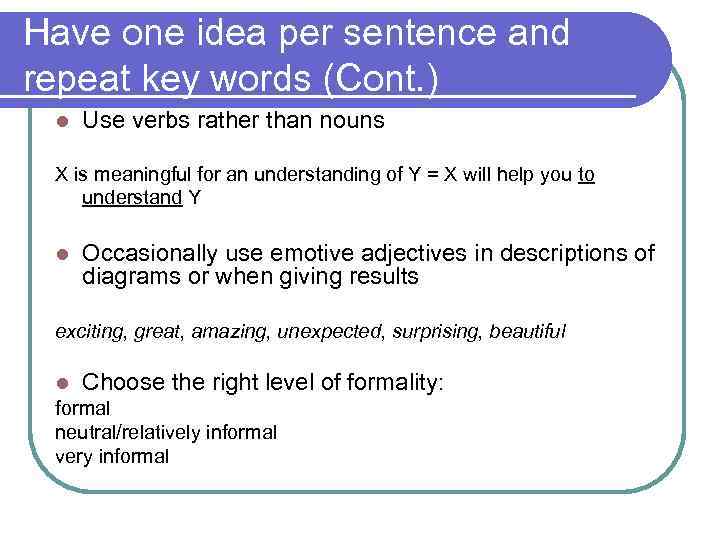 Have one idea per sentence and repeat key words (Cont. ) l Use verbs rather than nouns X is meaningful for an understanding of Y = X will help you to understand Y l Occasionally use emotive adjectives in descriptions of diagrams or when giving results exciting, great, amazing, unexpected, surprising, beautiful l Choose the right level formal neutral/relatively informal very informal of formality:
 Introduction l l l Good morning/afternoon, ladies and gentlemen. It’s good to see you all here. Let me introduce myself. I’m Ann Brown from. . . What I’d like to present to you today is. . . Today I’m going to talk about. . . My topic is/will be very important for you because. . .
 Outline l Let me just outline what I’ll be discussing today. l First, I’m going to tell you something about the background to this work. l Then I’ll take a brief look at the related literature and the methods we used. l Finally, and most importantly, I’ll show you our key results.
 Referring to future points in the presentation l As we will see in the next slide. . . l As we will be seeing in the next slide. . . l I’ll tell you more about this later. . . l I’ll be telling you more about this later. . . l I will give you details on that at the end … l I will be giving you details on. . .
 Explaining the background and motivations l Use the present simple to talk about the general situation, established scientific fact, and to explain your opinions and hypotheses. As is well known, smoking causes cancer. But what we don’t know is why people still continue to smoke. Despite some progress, not much is known about. . . l Use the simple past for events and situations that have ended. We decided to address this area because: We started working on this in May last year. l Use the present perfect to talk about open issues, the progress that has been made in your field so far and when; the precise time is not important. Other researchers have tried to address this problem, but no one has yet managed to solve it. Our experience has shown that. . .
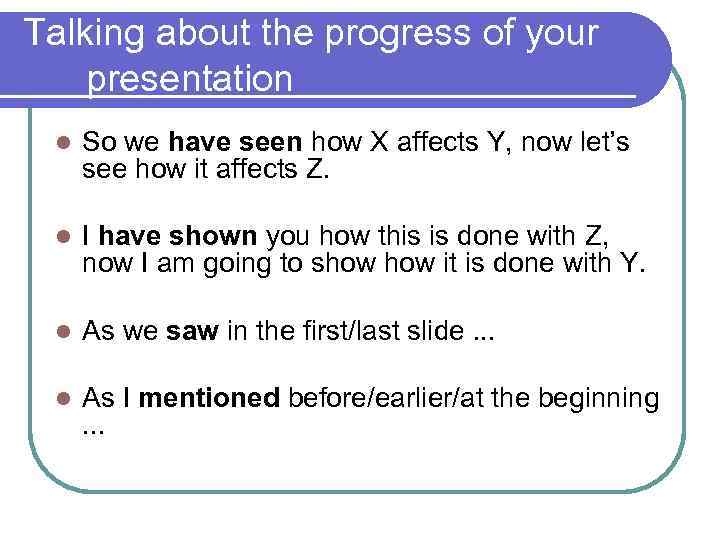 Talking about the progress of your presentation l So we have seen how X affects Y, now let’s see how it affects Z. l I have shown you how this is done with Z, now I am going to show it is done with Y. l As we saw in the first/last slide. . . l As I mentioned before/earlier/at the beginning. . .
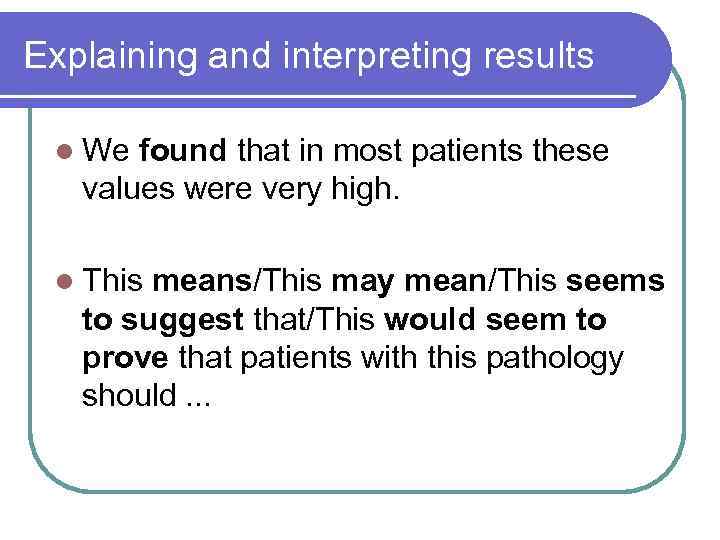 Explaining and interpreting results l We found that in most patients these values were very high. l This means/This may mean/This seems to suggest that/This would seem to prove that patients with this pathology should. . .
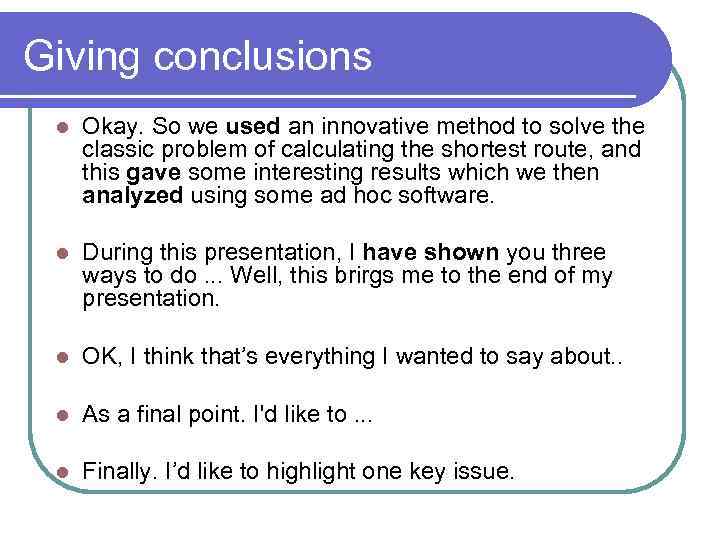 Giving conclusions l Okay. So we used an innovative method to solve the classic problem of calculating the shortest route, and this gave some interesting results which we then analyzed using some ad hoc software. l During this presentation, I have shown you three ways to do. . . Well, this brirgs me to the end of my presentation. l OK, I think that’s everything I wanted to say about. . l As a final point. I'd like to. . . l Finally. I’d like to highlight one key issue.
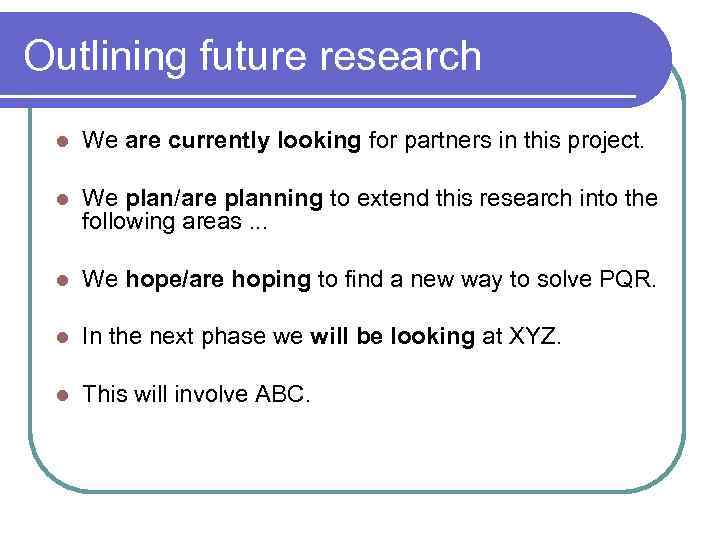 Outlining future research l We are currently looking for partners in this project. l We plan/are planning to extend this research into the following areas. . . l We hope/are hoping to find a new way to solve PQR. l In the next phase we will be looking at XYZ. l This will involve ABC.
 Useful Phrases l use the most appropriate phrase in different stages of your presentation l recognize, and thus understand, the typical phrases used in other people’s presentations
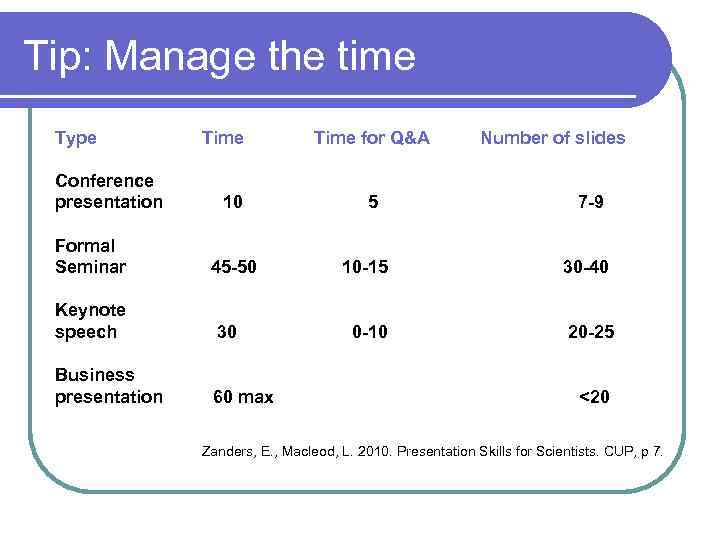 Tip: Manage the time Type Conference presentation Formal Seminar Time 10 45 -50 Keynote speech 30 Business presentation 60 max Time for Q&A 5 Number of slides 7 -9 10 -15 30 -40 0 -10 20 -25 <20 Zanders, E. , Macleod, L. 2010. Presentation Skills for Scientists. CUP, p 7.
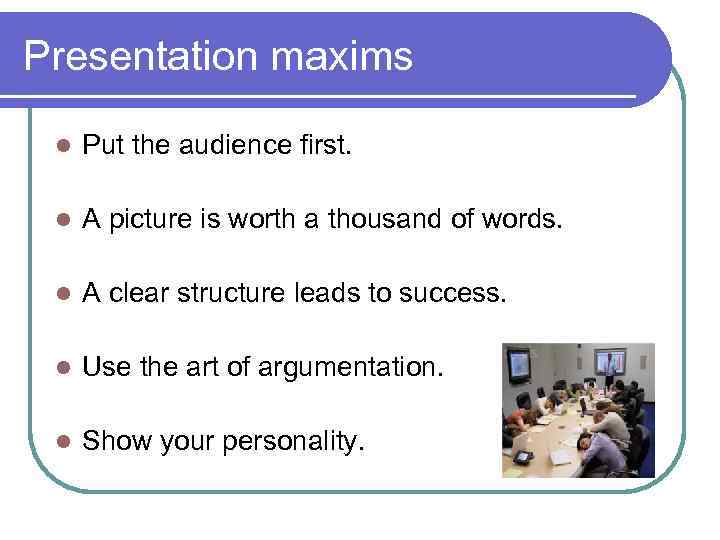 Presentation maxims l Put the audience first. l A picture is worth a thousand of words. l A clear structure leads to success. l Use the art of argumentation. l Show your personality.
 Plea bargaining across boarders by postgraduate student of law department Olga Klimanova
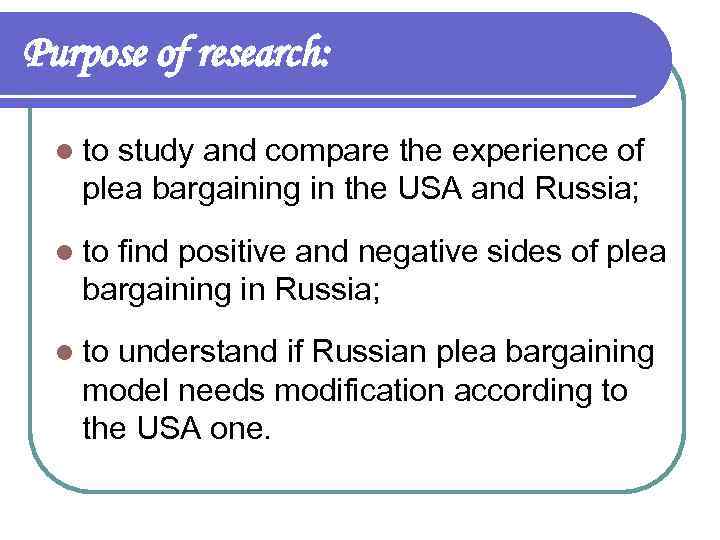 Purpose of research: l to study and compare the experience of plea bargaining in the USA and Russia; l to find positive and negative sides of plea bargaining in Russia; l to understand if Russian plea bargaining model needs modification according to the USA one.
 Problems and aims Problems: l 1. the ways of integration of international law into the English national law; l 2. the boarders of judicial precedent. Aims: l 1. to find out the most appropriate ways of incorporation international law into the English national law by analyzing the English law practice; l 2. to propose some mechanisms which can protect human rights in the context of English legal system.
 Overview 1) General review of British legal system; 2) Types of law in England; 3) Human rights and English legal system.
 Conclusion Russian plea bargaining institution appeared only in 2001. Russian legislators tried to adopt this institution but didn’t generally adjusted it to our specific legal system. These are the reasons of some practical problems. It will be effective to use experience of other countries (for example, USA) for correction of foresaid application difficulties.
 References 1. Presidential Speech at the Plenary Meeting of the 70 th Session of the UN General Assembly http: //en. kremlin. ru/events/president/news/5 0385 2. Rosenberg M. G. The necessity of an explicit list of law principles // Zakon. 2008. N 10.
 Thank you!
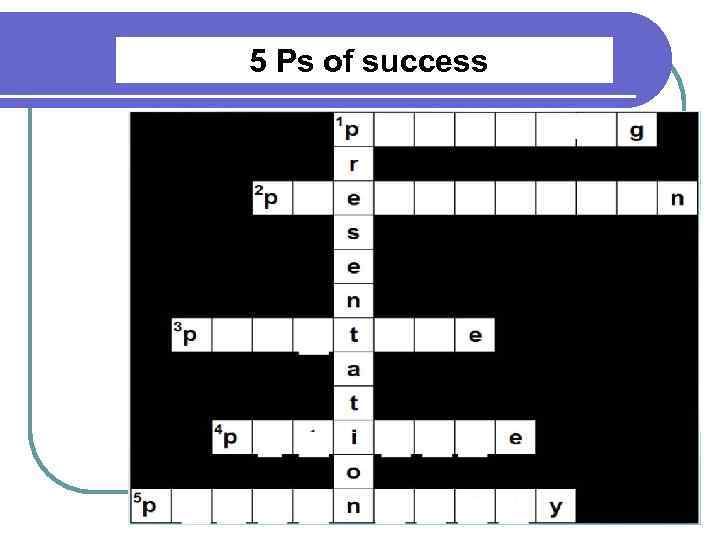 5 Ps of success
 References l l l http: //www. empower vourself with color psvchology. com/meaning of colors. html http: //www. color meanings. com/category/color meaning/ http: //www. ssau. ru/info/style/ Suchkova, S. Cicero's Secrets: how to become a successful public speaker. 2007. Samara: Ofort. Zanders, E. , Macleod, L. 2010. Presentation Skills for Scientists. CUP.