 Скачать презентацию How to Prepare and Present Proposals September 2009
0a5de5c615c9012e891a713325fb6cd2.ppt
- Количество слайдов: 90



How to Prepare and Present Proposals: September 2009 Workshop Gabarone, Botswana “Improving our capacity to prepare complete and balanced proposals shortens the path from good ideas to implementation. ”
Background • • Meetings in Bonn, Montreal & Other Locations Identification of a Core Communications Problem Commissioning of Guidebook Launch in Nairobi Development of Training Materials Vienna Trainers Workshop Commencement of Regional Workshops Objective: more complete, more balanced proposals presented by Champions in shorter time frames to private and public sector resource providers (Enablers).
Session 1 Overview • Why are we here? • What are we expected to accomplish? • What information and techniques will we share? • What are the different examples and problems we will work on? • How will we work and critique our work?
Proposals in Workbook Annex • • • Burkina Faso Solar PV Pumping Egypt Biofuels Ghana Small Hydro Kenya Floodwater Management Lesotho Improved Stoves There also two sample proposals – Egypt Waste to Energy and Ghana LPG – in the back of the Workbook itself.
Typical Proposal Problems • Incomplete or Imbalanced • Misdirected • Non-responsive • Terminology Gap
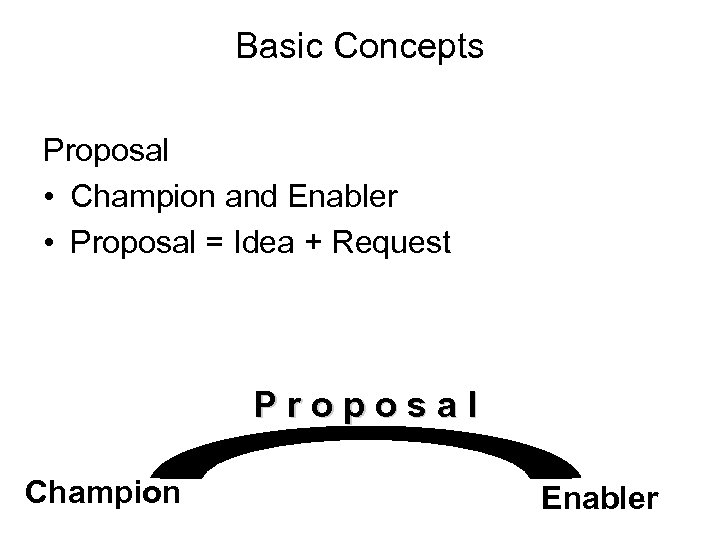
Basic Concepts Proposal • Champion and Enabler • Proposal = Idea + Request P r o p o s a l Champion Enabler
Clarification: Directed versus Allpurpose Proposals Directed Proposals supply driven prescriptive & targeted fit for purpose public sector-specific output & outcome oriented small part of this workshop All-purpose Proposals demand driven market oriented open-ended and multiple outputs & outcomes presentable to numerous sources focus of workshop
Introductions • • Sponsors Principal Instructors Team Mentors Participants
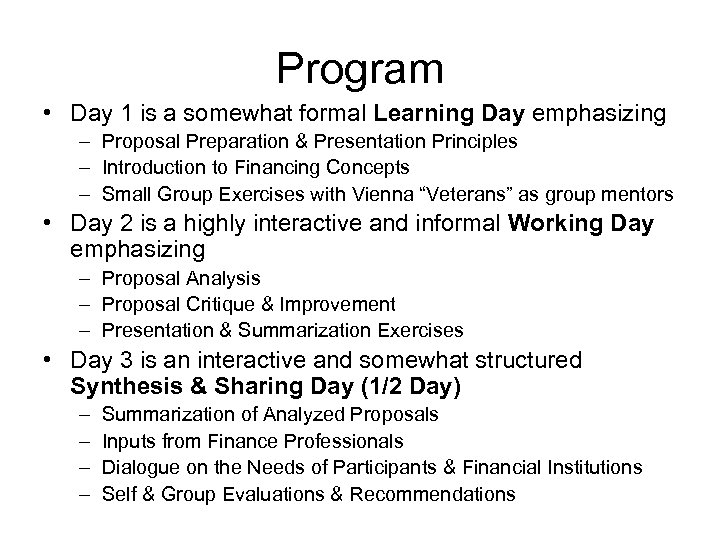
Program • Day 1 is a somewhat formal Learning Day emphasizing – Proposal Preparation & Presentation Principles – Introduction to Financing Concepts – Small Group Exercises with Vienna “Veterans” as group mentors • Day 2 is a highly interactive and informal Working Day emphasizing – Proposal Analysis – Proposal Critique & Improvement – Presentation & Summarization Exercises • Day 3 is an interactive and somewhat structured Synthesis & Sharing Day (1/2 Day) – – Summarization of Analyzed Proposals Inputs from Finance Professionals Dialogue on the Needs of Participants & Financial Institutions Self & Group Evaluations & Recommendations
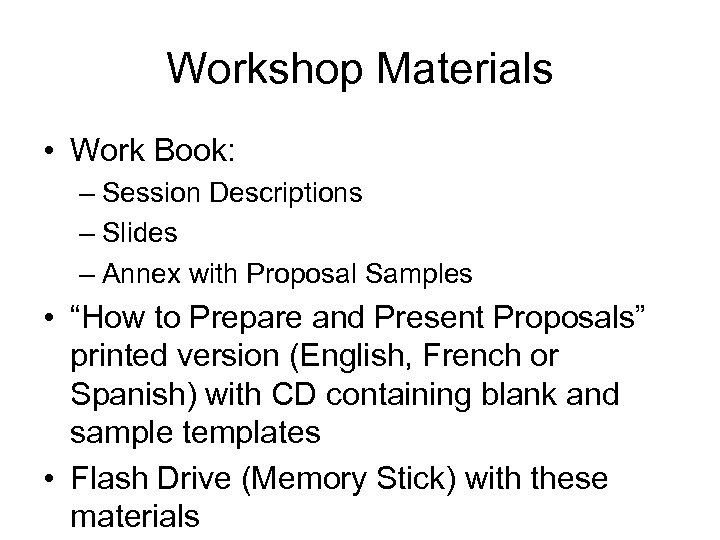
Workshop Materials • Work Book: – Session Descriptions – Slides – Annex with Proposal Samples • “How to Prepare and Present Proposals” printed version (English, French or Spanish) with CD containing blank and sample templates • Flash Drive (Memory Stick) with these materials
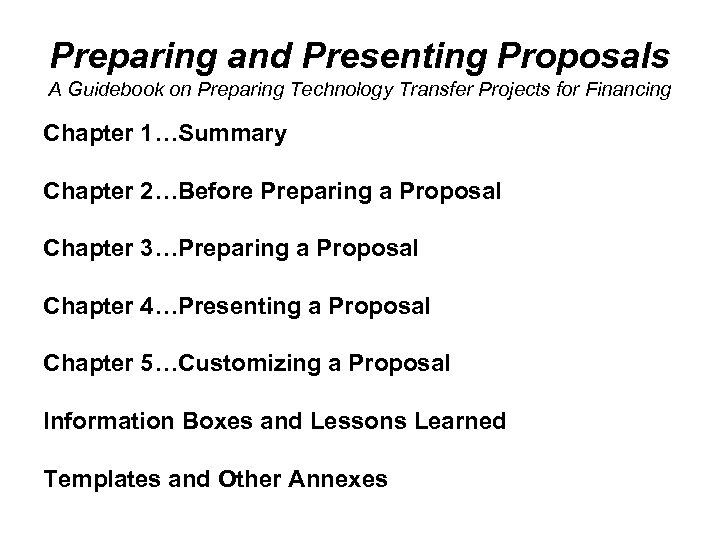
Preparing and Presenting Proposals A Guidebook on Preparing Technology Transfer Projects for Financing Chapter 1…Summary Chapter 2…Before Preparing a Proposal Chapter 3…Preparing a Proposal Chapter 4…Presenting a Proposal Chapter 5…Customizing a Proposal Information Boxes and Lessons Learned Templates and Other Annexes
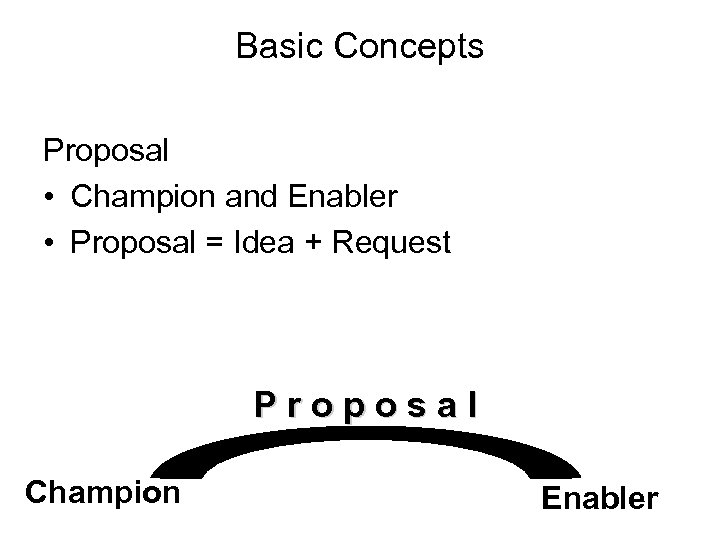
Basic Concepts Proposal • Champion and Enabler • Proposal = Idea + Request P r o p o s a l Champion Enabler
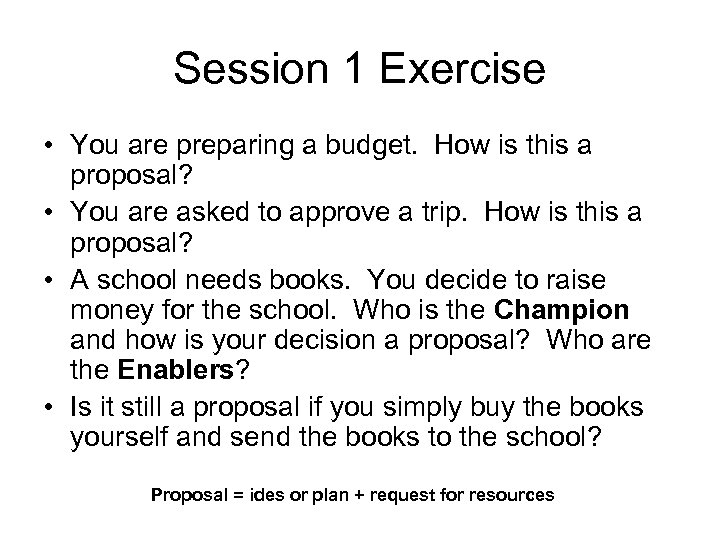
Session 1 Exercise • You are preparing a budget. How is this a proposal? • You are asked to approve a trip. How is this a proposal? • A school needs books. You decide to raise money for the school. Who is the Champion and how is your decision a proposal? Who are the Enablers? • Is it still a proposal if you simply buy the books yourself and send the books to the school? Proposal = ides or plan + request for resources
Feedback and Break • • Too long, too short? Too simple, too much? Lecture and Exercise Critique Questions and Discussions helped, distracted?
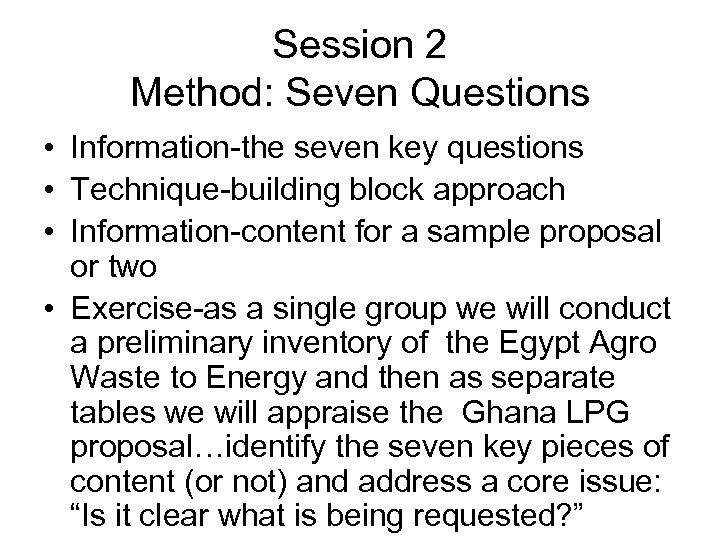
Session 2 Method: Seven Questions • Information-the seven key questions • Technique-building block approach • Information-content for a sample proposal or two • Exercise-as a single group we will conduct a preliminary inventory of the Egypt Agro Waste to Energy and then as separate tables we will appraise the Ghana LPG proposal…identify the seven key pieces of content (or not) and address a core issue: “Is it clear what is being requested? ”
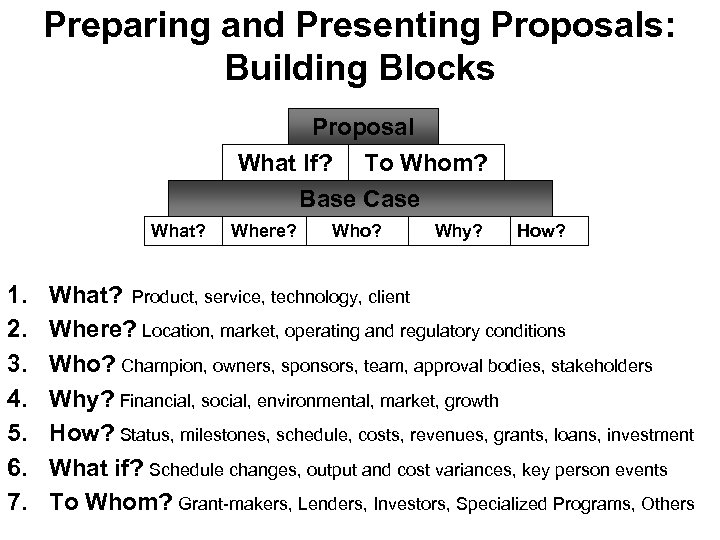
Preparing and Presenting Proposals: Building Blocks Proposal What If? To Whom? Base Case What? 1. 2. 3. 4. 5. 6. 7. Where? Who? Why? How? What? Product, service, technology, client Where? Location, market, operating and regulatory conditions Who? Champion, owners, sponsors, team, approval bodies, stakeholders Why? Financial, social, environmental, market, growth How? Status, milestones, schedule, costs, revenues, grants, loans, investment What if? Schedule changes, output and cost variances, key person events To Whom? Grant-makers, Lenders, Investors, Specialized Programs, Others
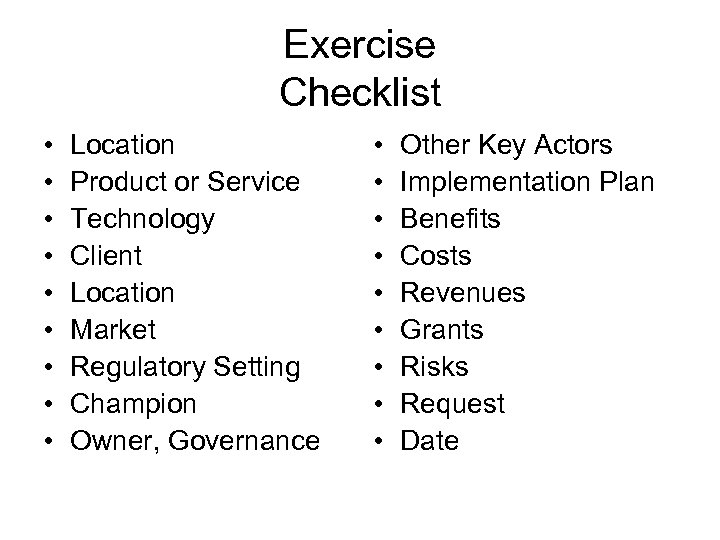
Exercise Checklist • • • Location Product or Service Technology Client Location Market Regulatory Setting Champion Owner, Governance • • • Other Key Actors Implementation Plan Benefits Costs Revenues Grants Risks Request Date
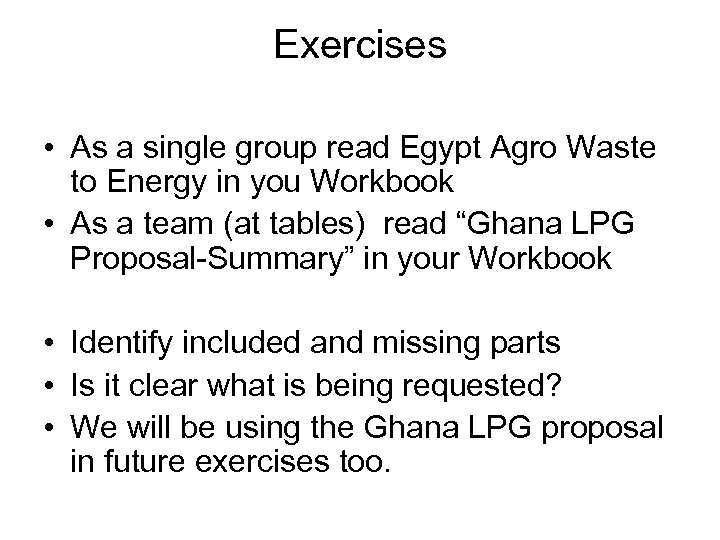
Exercises • As a single group read Egypt Agro Waste to Energy in you Workbook • As a team (at tables) read “Ghana LPG Proposal-Summary” in your Workbook • Identify included and missing parts • Is it clear what is being requested? • We will be using the Ghana LPG proposal in future exercises too.
Feedback and Break • • Was the session too long, too short? Too simple, too much? Lecture and Exercise Critique Questions and Discussions helped, distracted?
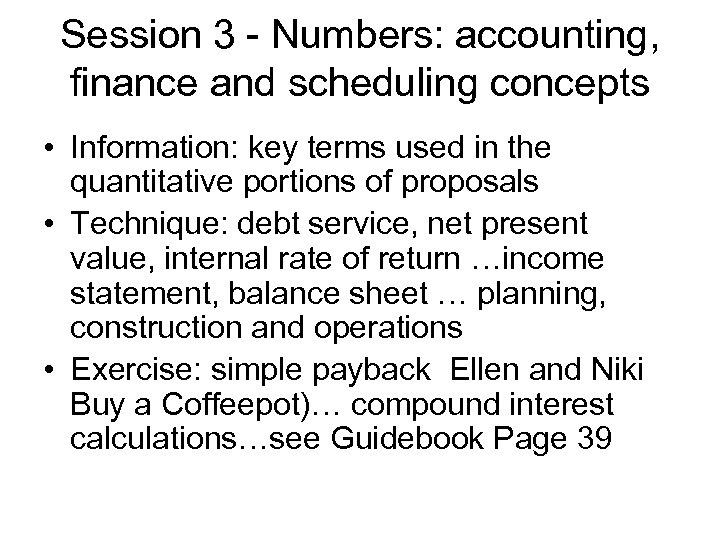
Session 3 - Numbers: accounting, finance and scheduling concepts • Information: key terms used in the quantitative portions of proposals • Technique: debt service, net present value, internal rate of return …income statement, balance sheet … planning, construction and operations • Exercise: simple payback Ellen and Niki Buy a Coffeepot)… compound interest calculations…see Guidebook Page 39
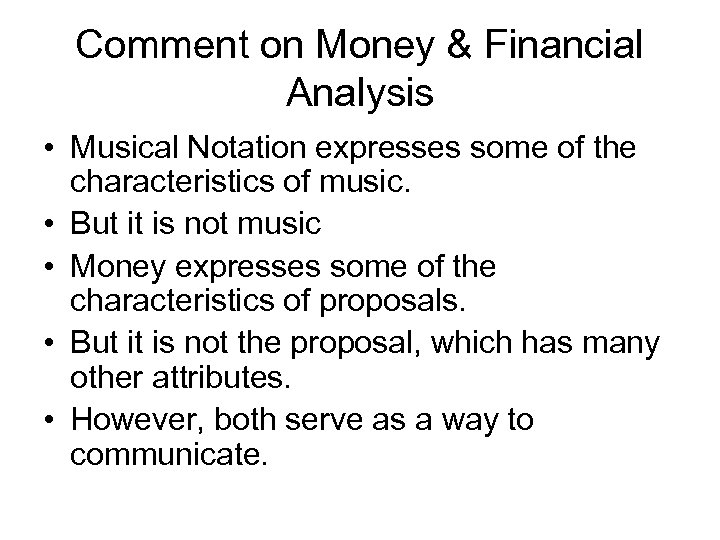
Comment on Money & Financial Analysis • Musical Notation expresses some of the characteristics of music. • But it is not music • Money expresses some of the characteristics of proposals. • But it is not the proposal, which has many other attributes. • However, both serve as a way to communicate.
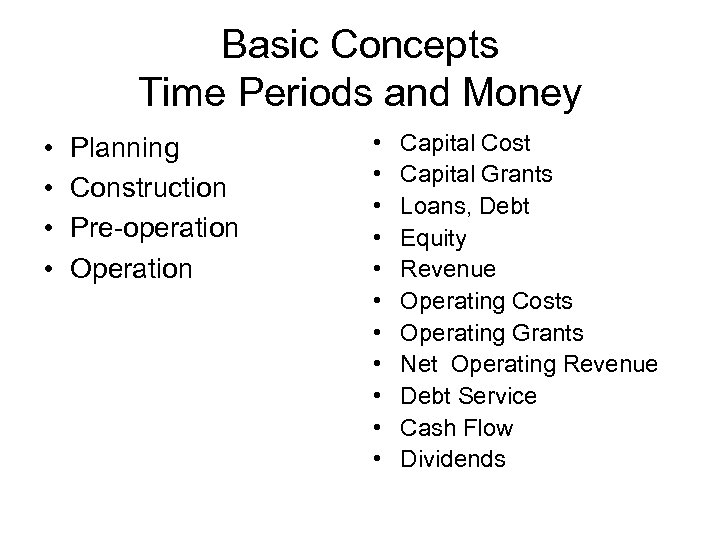
Basic Concepts Time Periods and Money • • Planning Construction Pre-operation Operation • • • Capital Cost Capital Grants Loans, Debt Equity Revenue Operating Costs Operating Grants Net Operating Revenue Debt Service Cash Flow Dividends
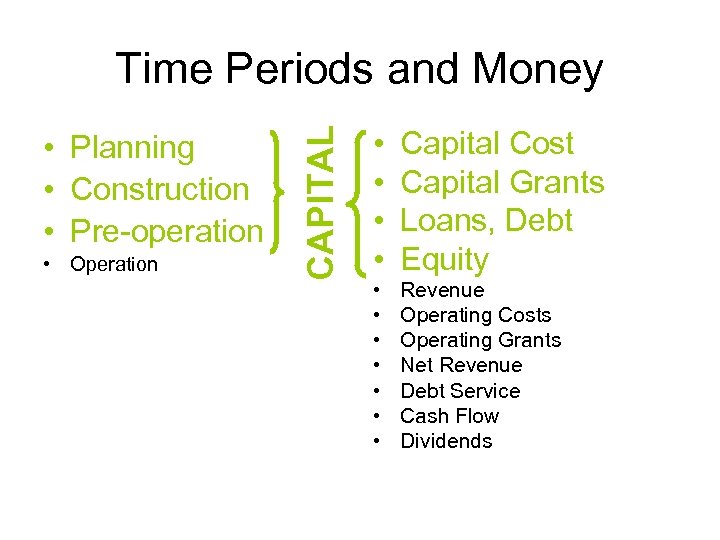
• Planning • Construction • Pre-operation • Operation CAPITAL Time Periods and Money • • Capital Cost Capital Grants Loans, Debt Equity • • Revenue Operating Costs Operating Grants Net Revenue Debt Service Cash Flow Dividends
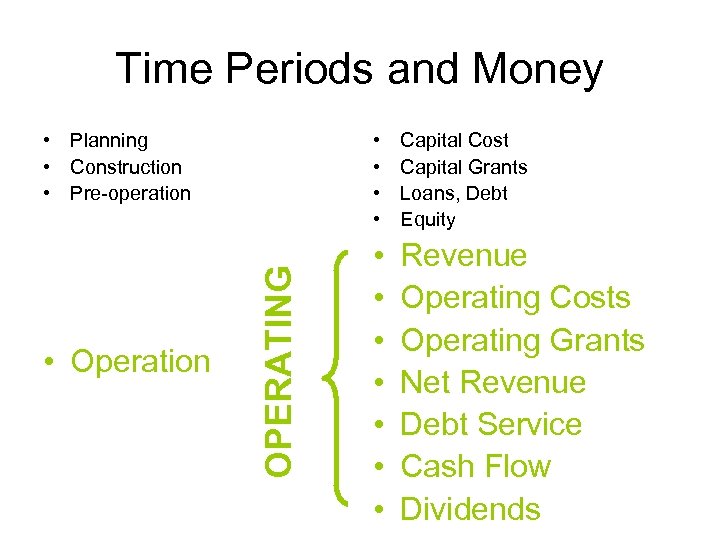
Time Periods and Money • Operation • • OPERATING • Planning • Construction • Pre-operation Capital Cost Capital Grants Loans, Debt Equity • • Revenue Operating Costs Operating Grants Net Revenue Debt Service Cash Flow Dividends
Planning includes • • • Technical analysis Site selection Environmental and social assessments Feasibility analysis Obtaining all permits and approvals Finding, negotiating and “closing” the necessary funding to make a proposal reality • During the planning period, the Champion must track and record time spent on activities. Sometimes called “sweat equity”, this information becomes extremely helpful in later discussions, especially with new potential investorowners.
Construction and pre-operation include: • • Site acquisition Preparation of land Building of structures Installation of infrastructure Acquisition and installation of equipment Setting up offices and distribution points Acquisition of operating equipment (vehicles, office, maintenance) • Fees to be paid to experts • Fees to be paid or credited as shares of ownership to Champions
An operating budget and plan includes: • Revenue estimates that show both the number of units expected to be produced and the value of each unit • Labour costs (separated between labour to produce the product or service and labour to run the company or the programme) • Raw materials to produce the product or service (e. g. , fuel to produce electricity or untreated bed-nets and the special coating to be applied) • Transport: fuel, maintenance • Communications: phone, fax, e-mail, postage • Utilities: heat, cooling, water, electricity • Packaging • Office supplies • Equipment rental • Insurance • Accounting and auditing services
Basic Concepts Financial Analysis • • Cash Flow Interest Debt Service Net Present Value Internal Rate of Return Debt Service Coverage Ratios Project “Rate of Return
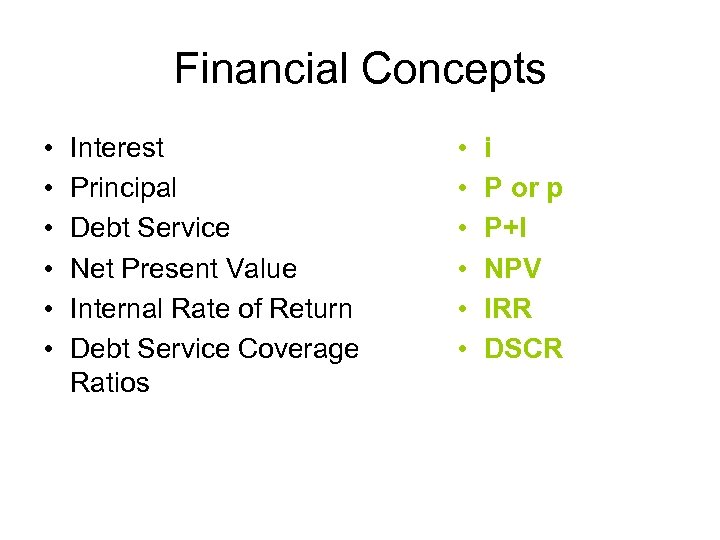
Financial Concepts • • • Interest Principal Debt Service Net Present Value Internal Rate of Return Debt Service Coverage Ratios • • • i P or p P+I NPV IRR DSCR
Ellen and Niki Buy a Coffeepot Lesson One of Three
Ellen and Niki work in the same office … • Every day Ellen and Niki stop at Starbucks on the way to work … Picture of Starbucks
They each spend $1. 70 … Picture of two cups of coffee
$3. 40 per day … Picture of Calendar • … at least 20 days per month
“We’re spending $68 a month …” Ellen and Niki in conversation • “What would it cost if we made coffee instead of buying it? ”

“We would need a good coffeepot …” Picture of coffeepot With price tag of $158. 00
“We would need to buy coffee, milk and sugar …” Picture of coffee, milk and sugar bowl • About $12. 00 per pound
“How many cups will that make? picture of random cups

Seventeen cups
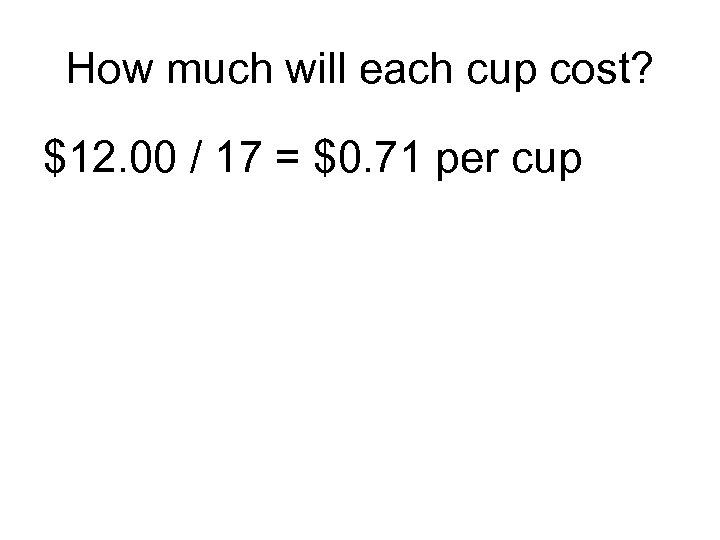
How much will each cup cost? $12. 00 / 17 = $0. 71 per cup
“But we need to buy the coffeepot? • “Yes” Picture of coffeepot with $158 price tag
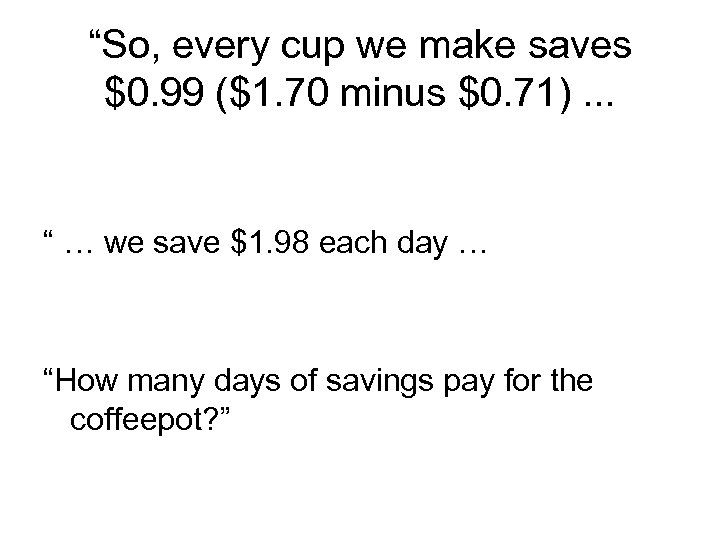
“So, every cup we make saves $0. 99 ($1. 70 minus $0. 71). . . “ … we save $1. 98 each day … “How many days of savings pay for the coffeepot? ”
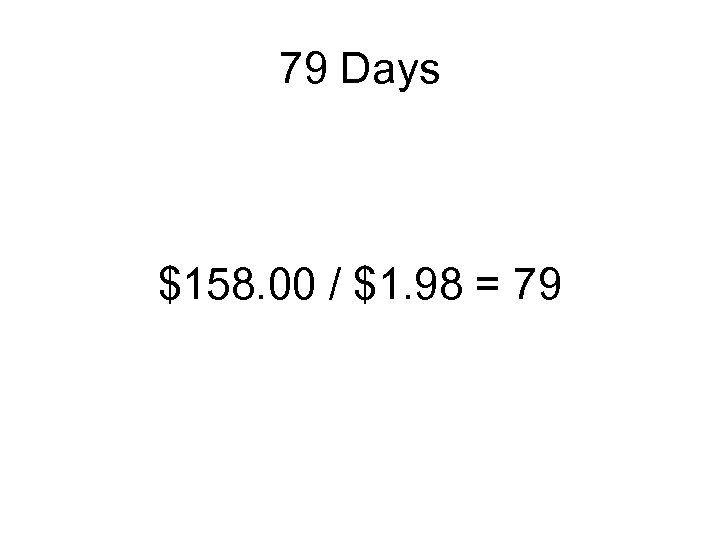
79 Days $158. 00 / $1. 98 = 79
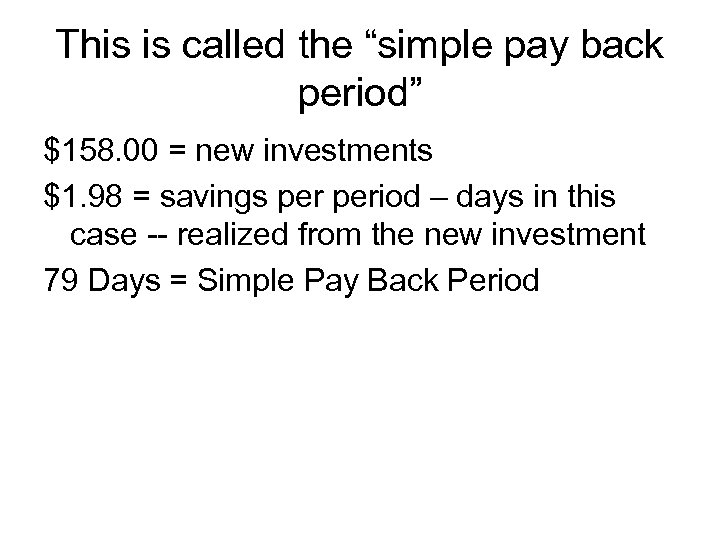
This is called the “simple pay back period” $158. 00 = new investments $1. 98 = savings period – days in this case -- realized from the new investment 79 Days = Simple Pay Back Period
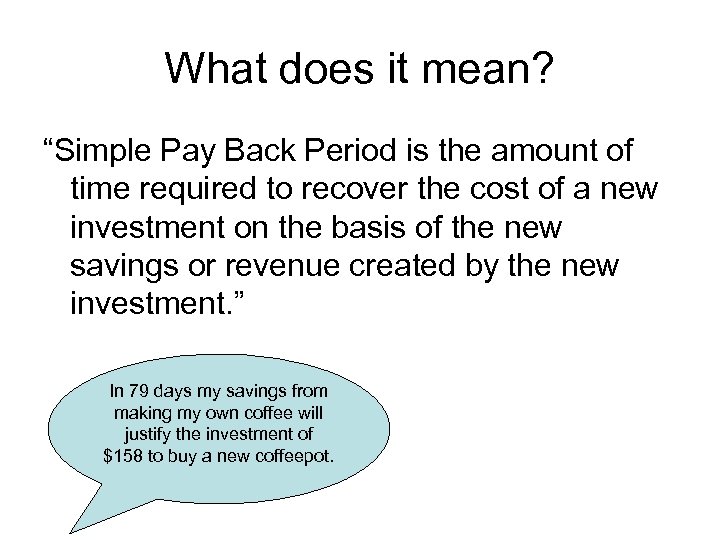
What does it mean? “Simple Pay Back Period is the amount of time required to recover the cost of a new investment on the basis of the new savings or revenue created by the new investment. ” In 79 days my savings from making my own coffee will justify the investment of $158 to buy a new coffeepot.
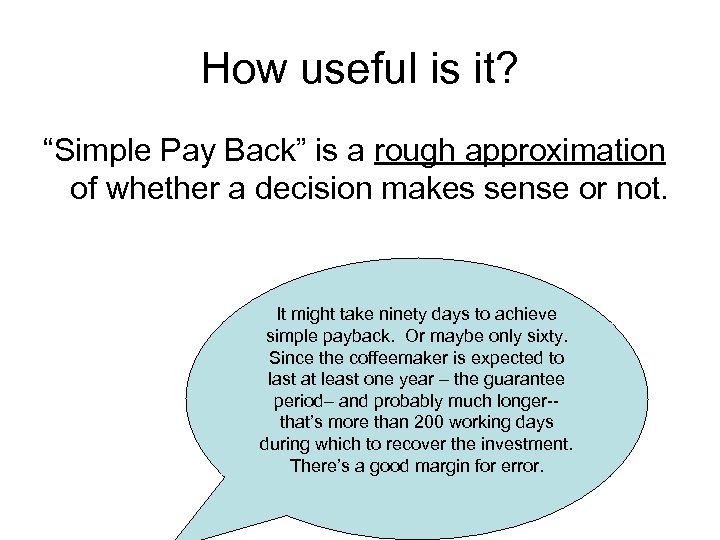
How useful is it? “Simple Pay Back” is a rough approximation of whether a decision makes sense or not. It might take ninety days to achieve simple payback. Or maybe only sixty. Since the coffeemaker is expected to last at least one year – the guarantee period– and probably much longer-- that’s more than 200 working days during which to recover the investment. There’s a good margin for error.
What is its limitation? • It does not take into account the value of money spent today ($158. 00) versus the savings to be realized over the next seventy, eighty or one hundred days. • Our next lesson takes that into account • It also assumes you have access to the $158. 00. Our third lesson addresses this issue.
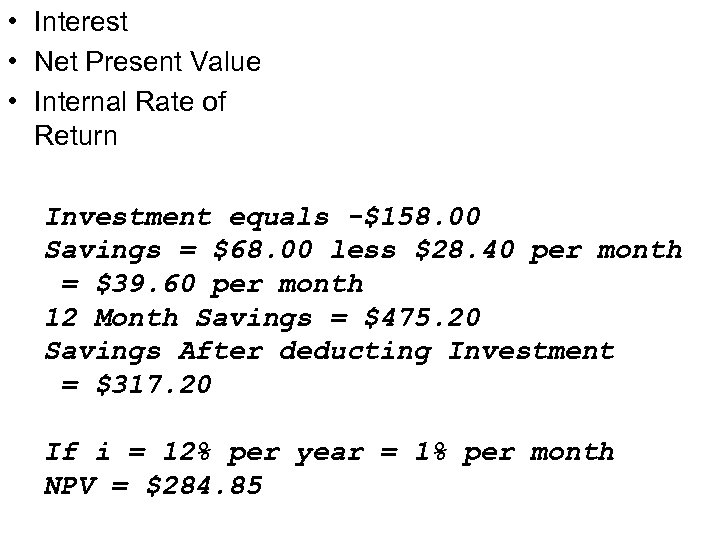
• Interest • Net Present Value • Internal Rate of Return Investment equals -$158. 00 Savings = $68. 00 less $28. 40 per month = $39. 60 per month 12 Month Savings = $475. 20 Savings After deducting Investment = $317. 20 If i = 12% per year = 1% per month NPV = $284. 85
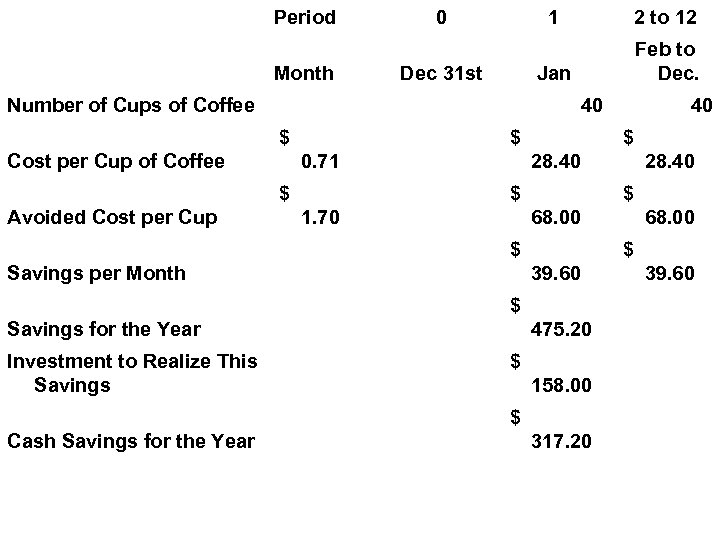
Period Month Number of Cups of Coffee 0 Dec 31 st 1 2 to 12 Jan Feb to Dec. 40 40 Cost per Cup of Coffee $ 0. 71 $ 28. 40 $ 28. 40 Avoided Cost per Cup $ 1. 70 $ 68. 00 $ 68. 00 Savings per Month $ 39. 60 $ 39. 60 Savings for the Year $ 475. 20 Investment to Realize This Savings $ 158. 00 Cash Savings for the Year $ 317. 20
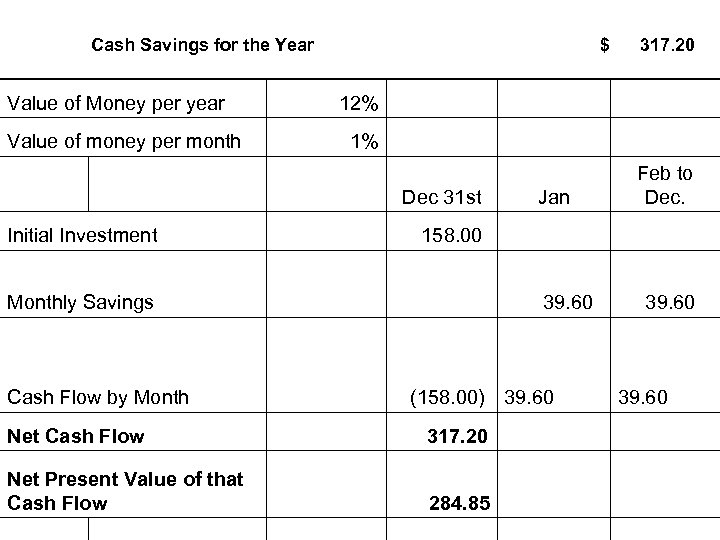
Cash Savings for the Year Value of Money per year Value of money per month $ 317. 20 12% 1% Dec 31 st Initial Investment Jan 158. 00 Monthly Savings 39. 60 Cash Flow by Month (158. 00) 39. 60 Net Cash Flow 317. 20 Net Present Value of that Cash Flow Feb to Dec. 284. 85 39. 60
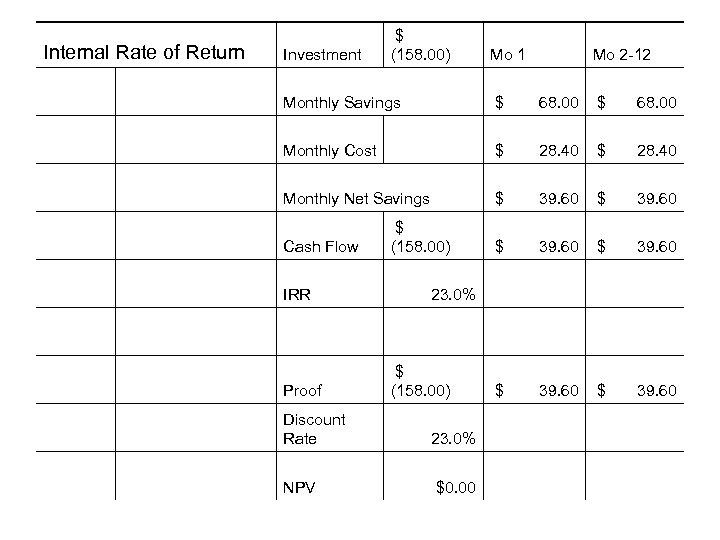
Internal Rate of Return Investment $ (158. 00) Mo 1 Mo 2 -12 Monthly Savings $ 68. 00 Monthly Cost $ 28. 40 Monthly Net Savings $ 39. 60 Cash Flow IRR Proof Discount Rate NPV $ (158. 00) $ 39. 60 23. 0% $ (158. 00) 23. 0% $0. 00 $ 39. 60
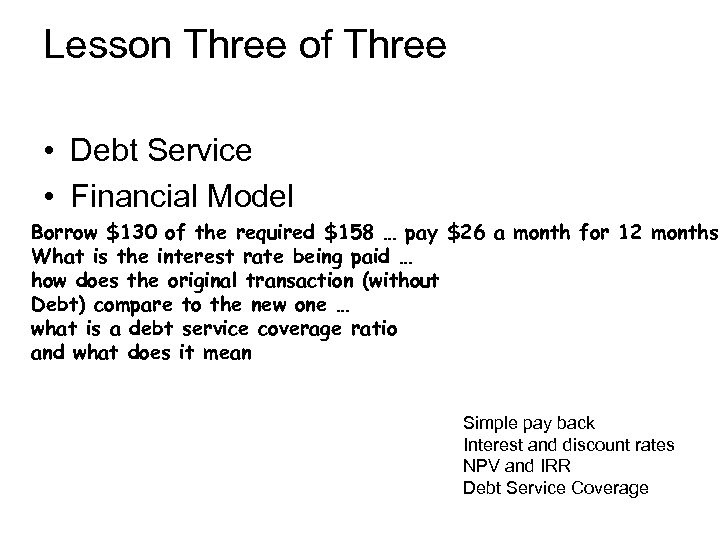
Lesson Three of Three • Debt Service • Financial Model Borrow $130 of the required $158 … pay $26 a month for 12 months What is the interest rate being paid … how does the original transaction (without Debt) compare to the new one … what is a debt service coverage ratio and what does it mean Simple pay back Interest and discount rates NPV and IRR Debt Service Coverage
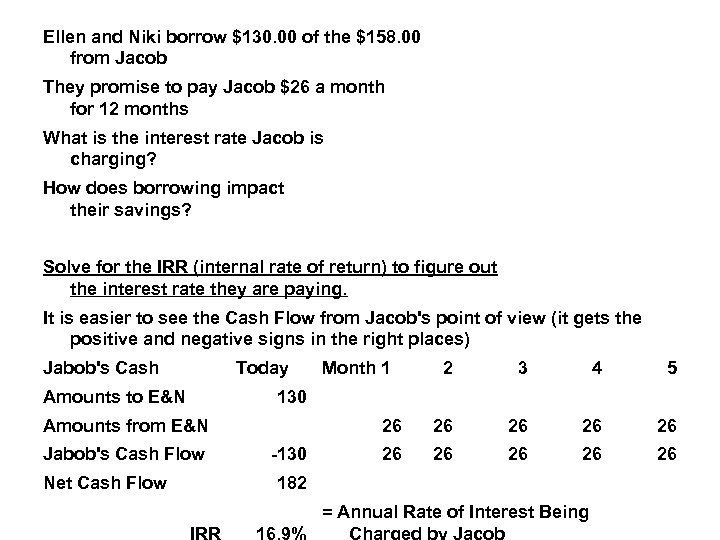
Ellen and Niki borrow $130. 00 of the $158. 00 from Jacob They promise to pay Jacob $26 a month for 12 months What is the interest rate Jacob is charging? How does borrowing impact their savings? Solve for the IRR (internal rate of return) to figure out the interest rate they are paying. It is easier to see the Cash Flow from Jacob's point of view (it gets the positive and negative signs in the right places) Jabob's Cash Today Amounts to E&N Month 1 2 3 4 5 26 26 26 130 Amounts from E&N Jabob's Cash Flow Net Cash Flow -130 182 IRR = Annual Rate of Interest Being 16. 9% Charged by Jacob
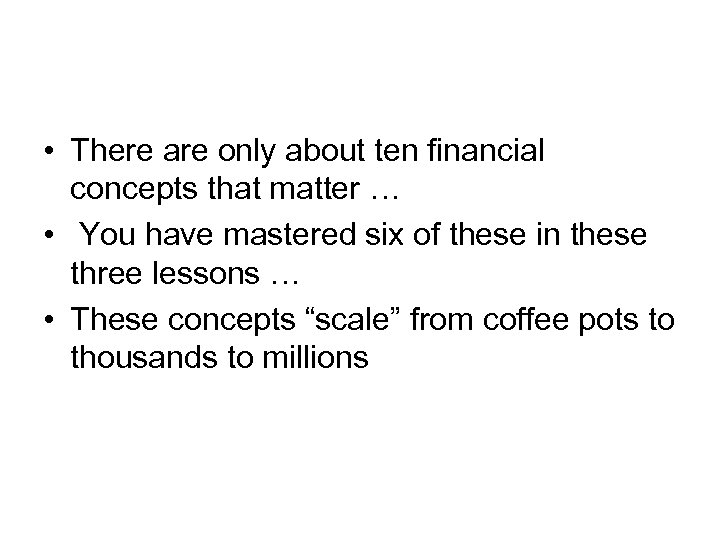
• There are only about ten financial concepts that matter … • You have mastered six of these in these three lessons … • These concepts “scale” from coffee pots to thousands to millions
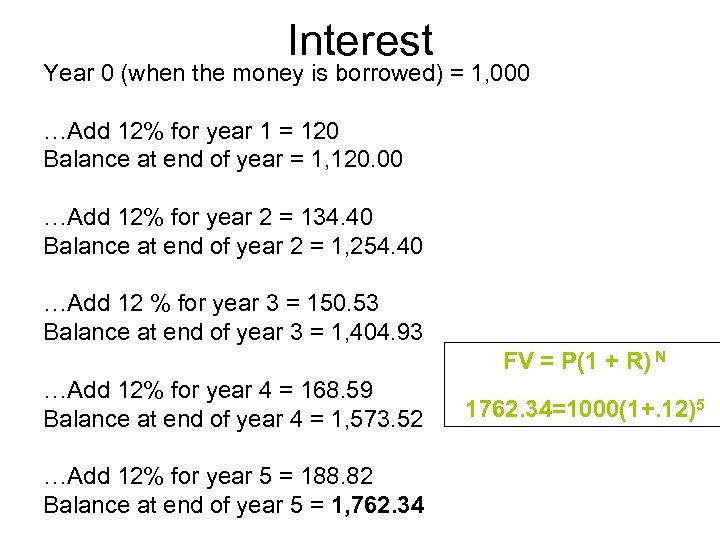
Interest Year 0 (when the money is borrowed) = 1, 000 …Add 12% for year 1 = 120 Balance at end of year = 1, 120. 00 …Add 12% for year 2 = 134. 40 Balance at end of year 2 = 1, 254. 40 …Add 12 % for year 3 = 150. 53 Balance at end of year 3 = 1, 404. 93 FV = P(1 + R) N …Add 12% for year 4 = 168. 59 Balance at end of year 4 = 1, 573. 52 …Add 12% for year 5 = 188. 82 Balance at end of year 5 = 1, 762. 34 1762. 34=1000(1+. 12)5
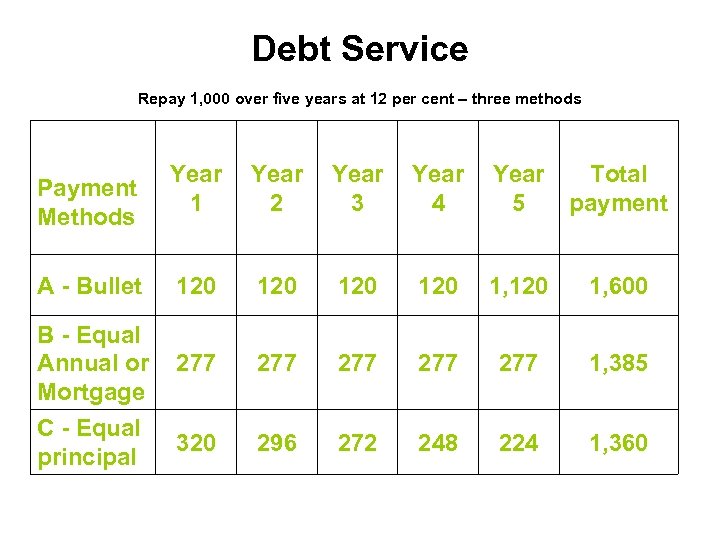
Debt Service Repay 1, 000 over five years at 12 per cent – three methods Payment Methods A - Bullet Year Year Total 1 2 3 4 5 payment 120 120 1, 600 B - Equal Annual or 277 Mortgage 277 277 1, 385 C - Equal principal 296 272 248 224 1, 360 320
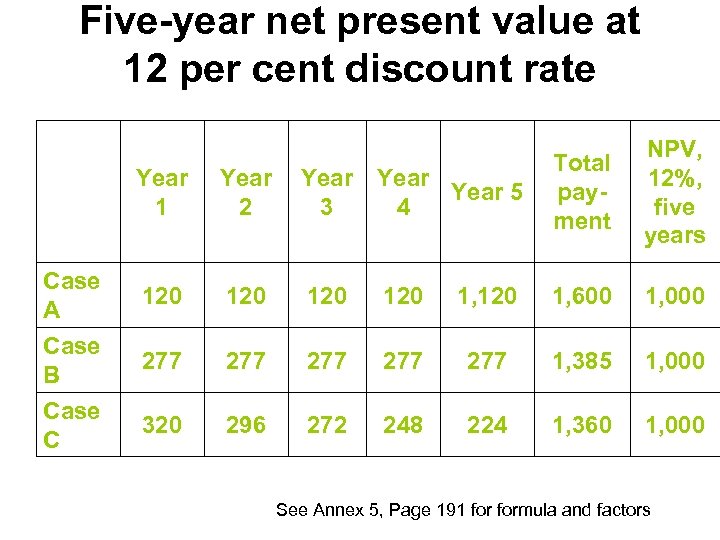
Five-year net present value at 12 per cent discount rate NPV, 12%, five years Year 1 Case A Case B Case C Year 5 2 3 4 Total payment 120 120 1, 600 1, 000 277 277 277 1, 385 1, 000 320 296 272 248 224 1, 360 1, 000 See Annex 5, Page 191 formula and factors
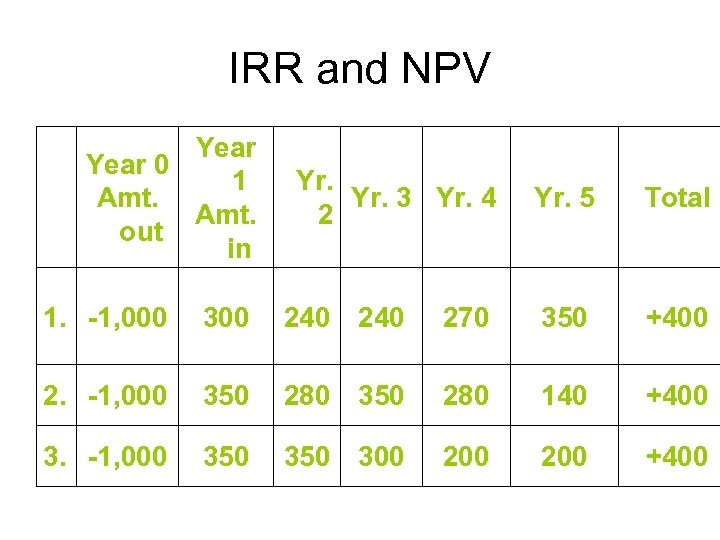
IRR and NPV Year 0 1 Yr. Amt. Yr. 3 Yr. 4 2 Amt. out in Yr. 5 Total 1. -1, 000 300 240 270 350 +400 2. -1, 000 350 280 140 +400 3. -1, 000 350 300 200 +400
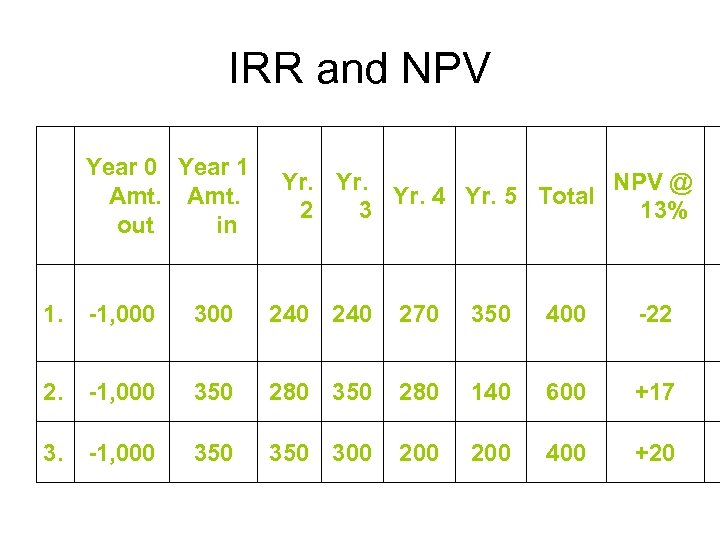
IRR and NPV Year 0 Year 1 Amt. out in Yr. NPV @ Yr. 4 Yr. 5 Total 2 3 13% 1. -1, 000 300 240 270 350 400 -22 2. -1, 000 350 280 140 600 +17 3. -1, 000 350 300 200 400 +20
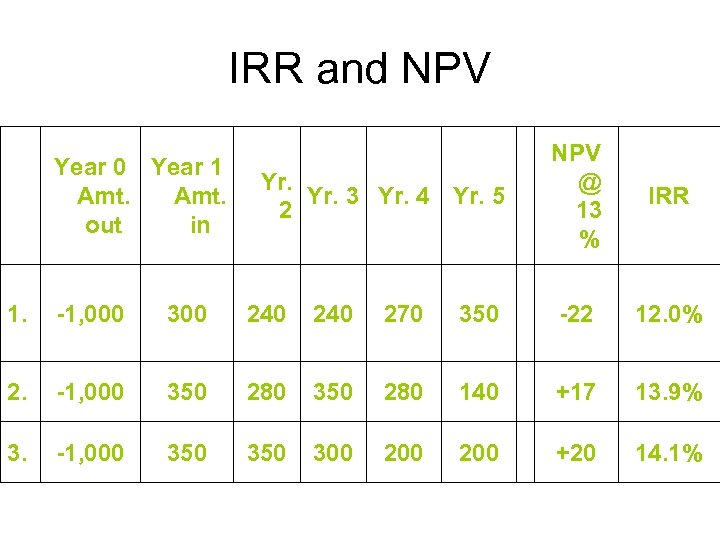
IRR and NPV Year 0 Year 1 Yr. Amt. Yr. 3 Yr. 4 Yr. 5 2 out in NPV @ 13 % IRR 1. -1, 000 300 240 270 350 -22 12. 0% 2. -1, 000 350 280 140 +17 13. 9% 3. -1, 000 350 300 200 +20 14. 1%
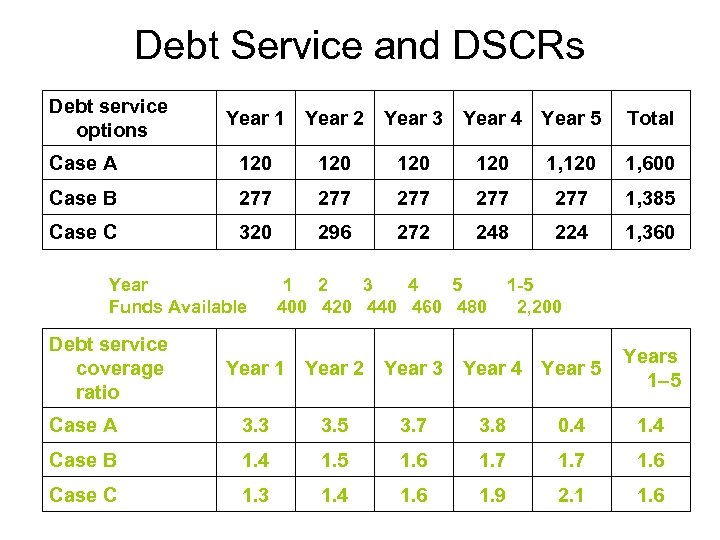
Debt Service and DSCRs Debt service options Year 1 Year 2 Year 3 Year 4 Year 5 Total Case A 120 120 1, 600 Case B 277 277 277 1, 385 Case C 320 296 272 248 224 1, 360 Year 1 2 3 4 5 1 -5 Funds Available 400 420 440 460 480 2, 200 Debt service coverage ratio Year 1 Year 2 Year 3 Year 4 Year 5 Years 1– 5 Case A 3. 3 3. 5 3. 7 3. 8 0. 4 1. 4 Case B 1. 4 1. 5 1. 6 1. 7 1. 6 Case C 1. 3 1. 4 1. 6 1. 9 2. 1 1. 6
Feedback and Break • • Too long, too short? Too simple, too much? Lecture and Exercise Critique Questions and Discussions helped, distracted?
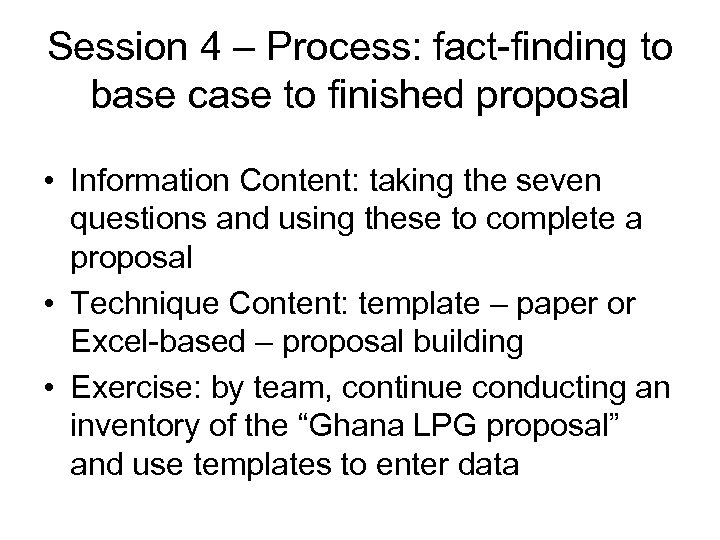
Session 4 – Process: fact-finding to base case to finished proposal • Information Content: taking the seven questions and using these to complete a proposal • Technique Content: template – paper or Excel-based – proposal building • Exercise: by team, continue conducting an inventory of the “Ghana LPG proposal” and use templates to enter data
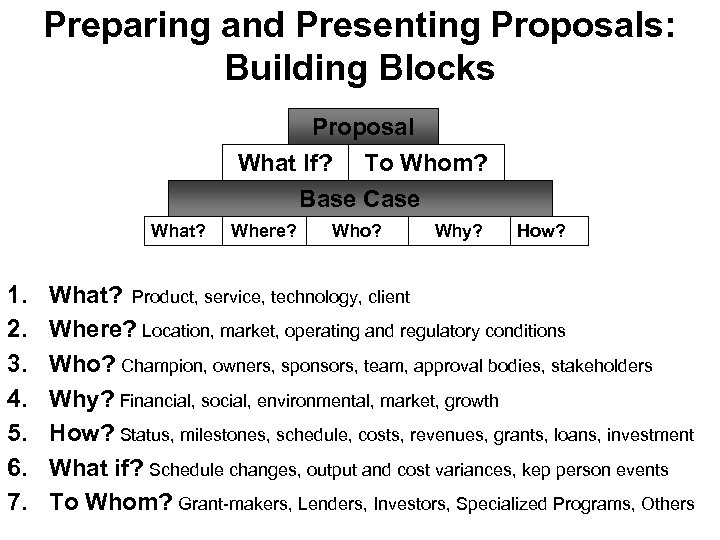
Preparing and Presenting Proposals: Building Blocks Proposal What If? To Whom? Base Case What? 1. 2. 3. 4. 5. 6. 7. Where? Who? Why? How? What? Product, service, technology, client Where? Location, market, operating and regulatory conditions Who? Champion, owners, sponsors, team, approval bodies, stakeholders Why? Financial, social, environmental, market, growth How? Status, milestones, schedule, costs, revenues, grants, loans, investment What if? Schedule changes, output and cost variances, kep person events To Whom? Grant-makers, Lenders, Investors, Specialized Programs, Others
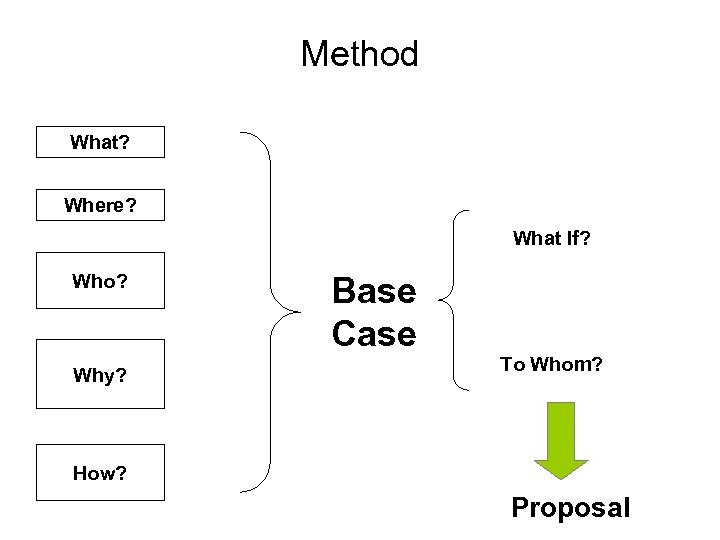
Method What? Where? Who? Why? How? What If? Base Case To Whom? Proposal
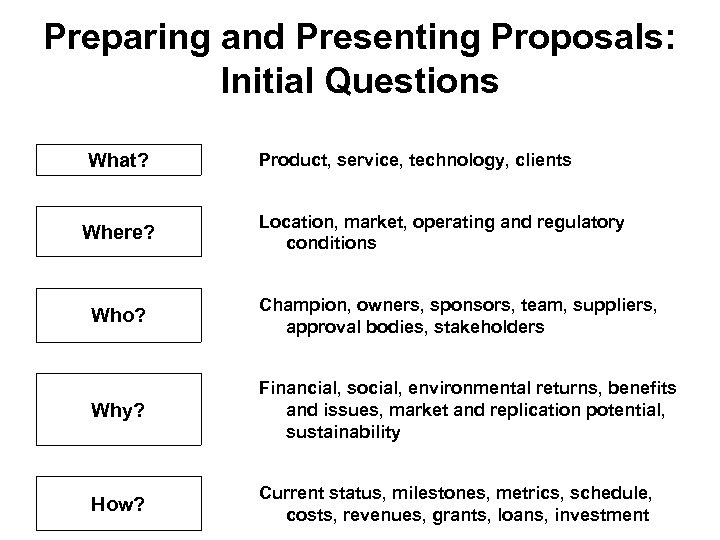
Preparing and Presenting Proposals: Initial Questions What? Where? Who? Why? Location, market, operating and regulatory conditions Champion, owners, sponsors, team, suppliers, approval bodies, stakeholders Financial, social, environmental returns, benefits and issues, market and replication potential, sustainability How? Product, service, technology, clients Current status, milestones, metrics, schedule, costs, revenues, grants, loans, investment
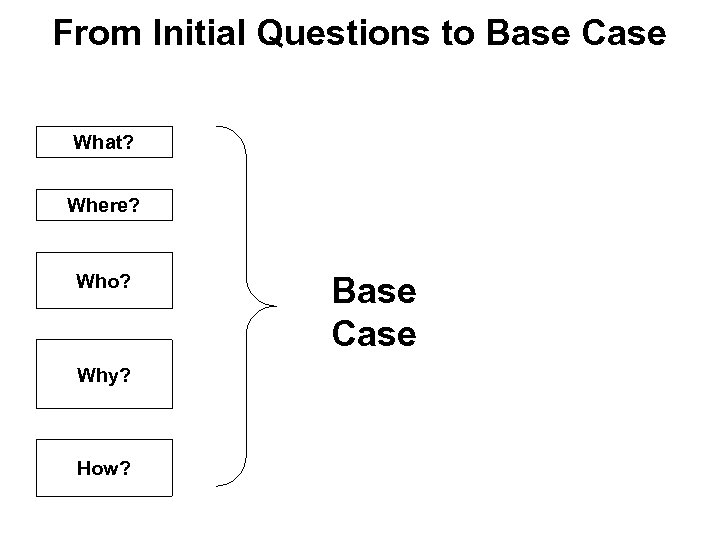
From Initial Questions to Base Case What? Where? Who? Why? How? Base Case
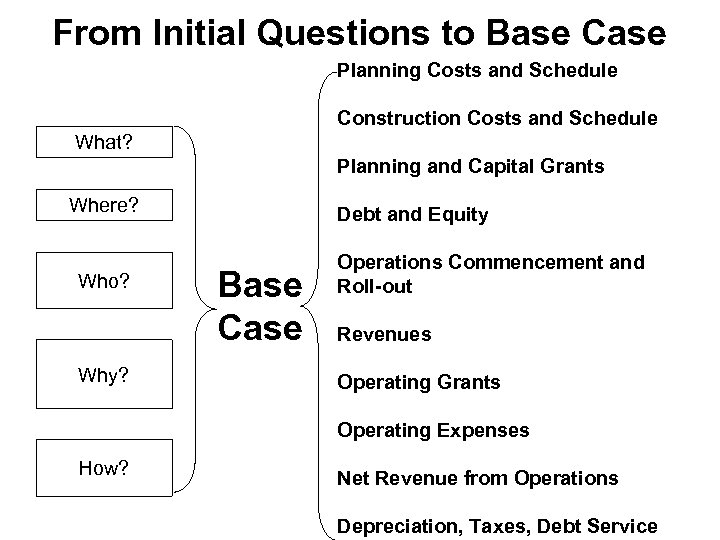
From Initial Questions to Base Case Planning Costs and Schedule Construction Costs and Schedule What? Where? Planning and Capital Grants Debt and Equity Base Case Operations Commencement and Roll-out Who? Why? Operating Grants Operating Expenses How? Net Revenue from Operations Revenues Depreciation, Taxes, Debt Service
Template Use • What? Where? And Who? = Q&A, easy but not simple (because motives and skills need to be assessed). • Use workbook and open templates and begin practicing the entry of data. • Hint: at back of Ghana LPG Proposal will be found partially “filled in” templates…this information can also be found on Template Samples (see Template Koala Gas. xls)
Part 2 -Day 2 • We begin working as teams from here on. • Each team will examine one proposals: • Session 5 will examine What and Where. Teams will make notes on one copy of the proposal (very important) and report their analysis to all teams. Country representatives will be on the team examining the proposal for their country. There are no right or wrong answers; the objective is to apply the seven question method, examine proposals as a team and distill and present a point of view, highlighting both the strengths and the weaknesses of the sample proposals.
Session 5 What? And Where? • Information Content: the different dimensions of defining product, service, technology, clients, market and setting • Technique Content: use of templates as guides to questions to be addressed in proposal review • Exercise: by teams, investigate the “What? ” and the “Where? ” of one sample proposal, record “Notes and Comments” to be shared with other teams and proposal authors • Use Excel WHAT and WHERE Templates for Prompting Questions
What and Where Feedback to the Workshop • Introduce the Proposal in one or two sentences. From the WHAT and WHERE perspectives identify: – Strengths and Weaknesses? – Needed Improvements? – Core Ideas.
Session 6 Who? and How? • Information Content: the variety of human and institutional skills and motivations to be considered in creating an implementation teams and a plan • Technique content: use of templates to build such an inventory • Exercise: teams prepare an assessment of the team and the plan prepared, creating a series of questions and notes to be shared with other teams.
Session 7 Why? impacts and benefits • Information Content: classifying the type of project from an environmental perspective and creating an inventory of the benefits offered by a proposal • Technique Content: recognizing project differences and impacts, thinking beyond conventional classifications to realize the maximum “triple bottom line” • Exercise: the notes, comments and questions thus far will be reviewed and the impacts and benefits of the projects discussed.
Who and How Feedback to the Workshop • Different team member again introduces the Proposal in one or two sentences. From the WHO and HOW perspectives identify: – Strengths and Weaknesses? – Needed Improvements? • Get feedback from the larger group on both the proposal and the team’s analysis thus far.
Session 8 – the base case • Information Content-base components • Exercise-teams examine data and begin the compile a list of what is missing and could go wrong.
Base Case Feedback to the Workshop • Different team member summarizes the basic assumptions that underpin each proposal. – What information was clear? – What information needs to be developed? – How is the team feeling about the practicality, completeness and balance of the Proposal? • Get feedback from the larger group on both the proposal and the team’s analysis thus far.
Feedback and Break on Sessions 5 -8 • • Too long, too short? Too simple, too much? Lecture and Exercise Critique Questions and Discussions helped, distracted?
Session 9 What if? sensitivity analysis • Information Content – discussion of things that might go wrong…review of typical “risk” categories used by financiers • Technique Content – risk analysis, sensitivity analysis … grouping like events and impacts • Exercise – a series of sensitivity cases will be prepared an inventory made of key versus “other” risks
• Completion risk involves the risk that something started might not be completed after a lender has made funds available. This can happen when a proposal costs far more than originally expected or the market has changed significantly during construction. Completion risk can be managed through the type of contract entered into to design, build and commission (start operation). • Technology risk involves something not performing as planned or becoming obsolete far more rapidly than expected. If the technology never performs as agreed to in the installation phase this can be part of completion risk, but generally it is considered to be in a separate category. Technology risk is most often managed through guarantees and warranties from the suppliers of equipment and also through the acceptance testing process. Longer-term performance can be enhanced through operations and maintenance contracts and various types of insurance.
• Supply risk involves raw materials not being available. This can include resources which the project is going to use (e. g. , a mine or a plantation forest) or buy (e. g. , fuel or supplies). Managing supply risk sometimes requires entering contracts for sufficiently long enough periods of time and with predictable prices to assure an uninterrupted supply of inputs. • Economic risk exists even after a project is completed, the technology is working and the inputs are available. The result might be inefficient or the estimated market (“demand”) evaporates. Confidence in (conservative and realistic) market projections and the Champion’s demonstration of market knowledge and awareness are crucial in managing economic risk.
• Political risk involves the risk that the rules and regulations governing a proposal might change. A good example might be the risk that a government may arbitrarily raise the taxes on a project to render it not economic. • Environmental risk involves unknown environmental conditions that might disrupt a plan after it is begun. • Social risk is a category that takes into account all manner of social disturbances or disruptions that can impair a proposal’s implementation. • Force majeure risk is the risk that something catastrophic – a storm, an earthquake, a devastating accident – may cause a project to fail. Insurance programmes directly address force majeure risks.
• Financial risk occurs either when variable interest rates are used, refinancing of the project is assumed sometime during its life or additional financing is required in the future. Interest rates change. Large changes can make an enterprise non-competitive or not “liquid” (“liquidity” means having the cash to meet repayment obligation to lenders). • Currency risk is closely related to financial risk and could be lumped into that category, but the very nature of technology transfer projects warrants it being treated separately. Currency risk involves the difference between the value of the currency that impacts income or expenses and the value of the currency in which the loan repayments must be made.
Session 10 To Whom? • Information Content: types of enablers and funders, relationship of funders to rates of return • Technique Content: classifying and matching funding needs to enablers • Exercise: teams (with authors) create a list of what to pursue
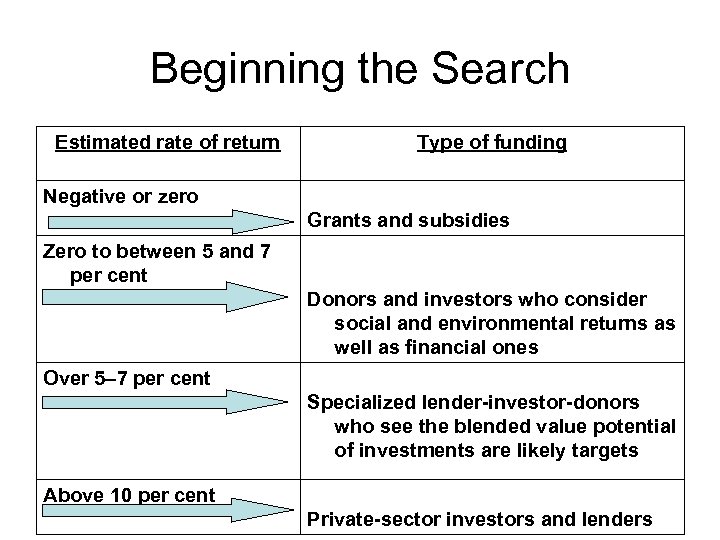
Beginning the Search Estimated rate of return Type of funding Negative or zero Grants and subsidies Zero to between 5 and 7 per cent Donors and investors who consider social and environmental returns as well as financial ones Over 5– 7 per cent Specialized lender-investor-donors who see the blended value potential of investments are likely targets Above 10 per cent Private-sector investors and lenders
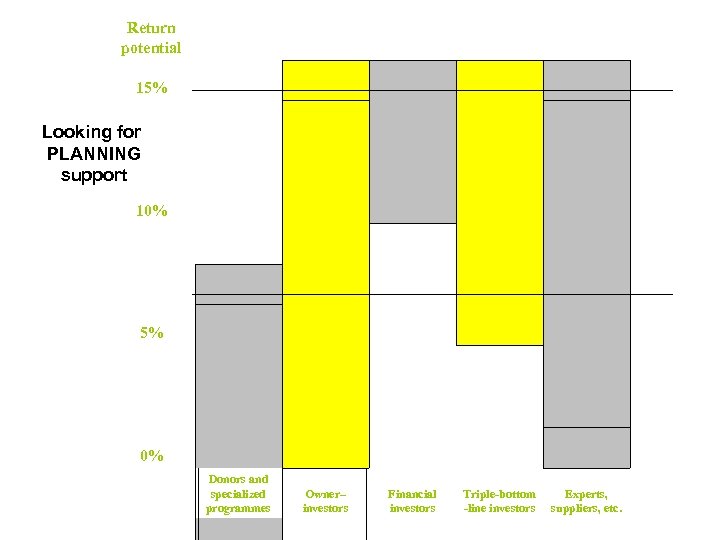
Return potential 15% Donors and specialized programmes Owner– investors Looking for PLANNING support 10% 5% 0% Financial investors Triple-bottom -line investors Experts, suppliers, etc.
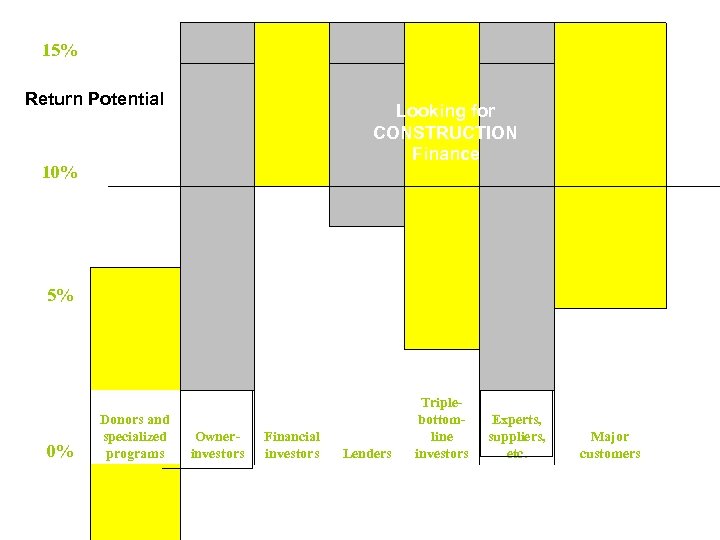
15% Return Potential Looking for CONSTRUCTION Finance 10% 5% 0% Donors and specialized programs Ownerinvestors Financial investors Lenders Triplebottomline investors Experts, suppliers, etc. Major customers
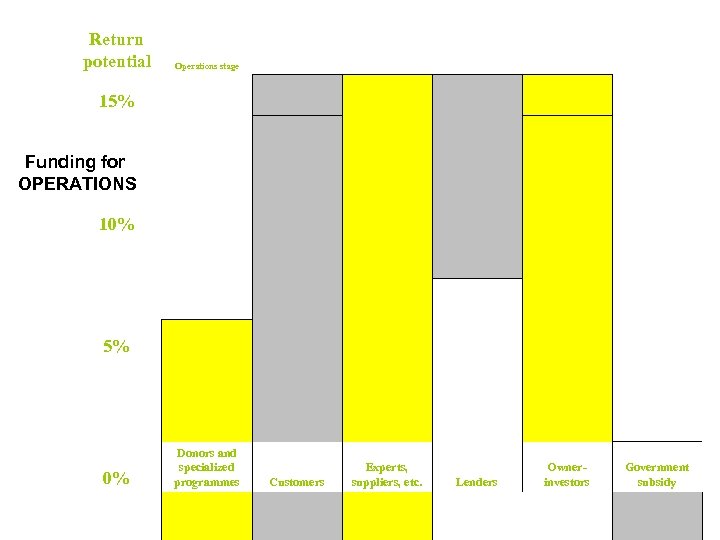
Return potential Operations stage 15% Donors and specialized programmes Customers Experts, suppliers, etc. Ownerinvestors Funding for OPERATIONS 10% 5% 0% Lenders Government subsidy
Session 11 Customizing and Summarizing • Information Content: types of customization, key elements of summarization • Exercise: teams summarize “their” proposals on one page and prepare 5 -7 minute presentations (“elevator pitch”) • Open Discussion with Finance Professionals
Session 12 • Information Content: review of the information and techniques conveyed, methods used and exercises • Technique Content: feedback and improvements … suggestions on adaptations and usefulness • Exercise: team feedback, author feedback, individual feedback … inventory of materials needed.
Technology transfer is about all the combinations of products, services and knowhow available to fashion the desired result of sustainable development. “Innovative financing” for technology transfer is more about connecting new combinations of actors and interests and applying tried and true approaches than it is about creating new, neverbefore-used products, services and tools. Thank You and Good Luck Contact Information
Скачать презентацию How to Prepare and Present Proposals September 2009
0a5de5c615c9012e891a713325fb6cd2.ppt