


 Скачать презентацию How to participate in FP 7 Martin Penny
b9cfefcc22cc4e8ad561ea92e8dfdee2.ppt
- Количество слайдов: 37
 How to participate in FP 7 Martin Penny International Cooperation DG Research European Commission
 Presentation outline • FP 7 Overview • Why are SMEs and R&D important? • Funding for SMEs in FP 7 • How to apply • Overview of funding offered
 The Framework Programme • The EU programme for research and technological development • Multi-annual programme to integrate research, foster excellence, pool resources, address globalisation etc. • Open to applications from European researchers from all sectors, in collaboration with other European and non-European researchers • Delivers the European Research Area • Established by three key legal texts – the Framework Programme, the Rules for Participation and the Specific Programmes • Separate programmes for nuclear research
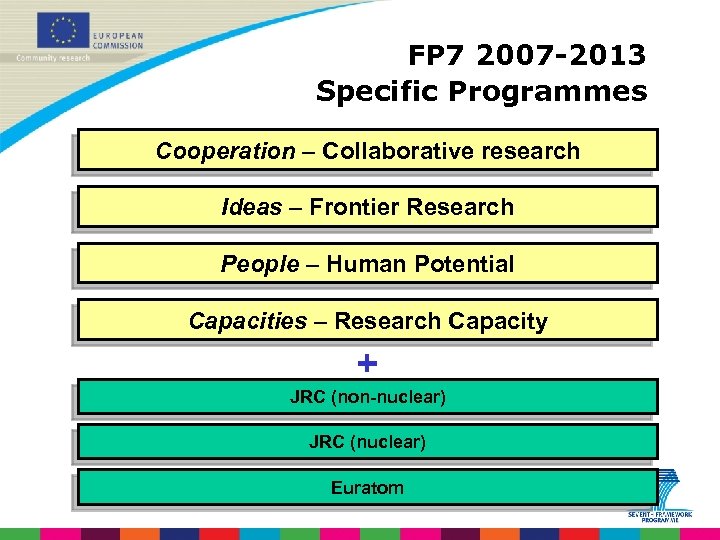 FP 7 2007 -2013 Specific Programmes Cooperation – Collaborative research Ideas – Frontier Research People – Human Potential Capacities – Research Capacity + JRC (non-nuclear) JRC (nuclear) Euratom
 Cooperation – Collaborative research 10 Themes 1. 2. 3. 4. 5. 6. 7. 8. 9. 10. Health Food, agriculture and fisheries and biotechnology Information and communication technologies Nanosciences, nanotechnologies, materials and new production technologies Energy Environment (including climate change) Transport (including aeronautics) Socio-economic sciences & the humanities Space Security
 Capacities – Research Capacity 1. 2. 3. 4. 5. 6. 7. Research Infrastructures Research for the benefit of SMEs Regions of Knowledge Research Potential Science in Society Coherent Development of Policies Activities of International Cooperation
 Participation of Moldova • International Cooperation Partner Country (ICPC) • Eligible to receive funding (same rights and obligations) • Consortia must have the minimum required number of MS / AC participants • Expert evaluators – https: //cordis. europa. eu/emmfp 7/
 SMEs and R&D Why should SMEs bother with R&D? § Global challenges: environment, energy, ageing, security, food supply, etc. § SMEs form 99% of all companies in Europe and are major contributors to growth and employment § SMEs have to respond increasingly to a strong competition in the internal market and globally
 SMEs and R&D Why R&D for SMEs? § SMEs should seize the opportunities offered by the transition to a knowledgebased economy & society § The ‘global challenges’ are opportunities for all SMEs § R&D results should enable SMEs to develop new products, processes and services to enhance their competitiveness § EU support allows SMEs to foster and develop transnational R&D cooperation
 FP 7 and SMEs • Creating knowledge for growth (turning knowledge into profit) • Research and technology-driven innovation • FP 7 provides financial support for transnational research for and by SMEs wishing to innovate and improve their competitiveness
 SMEs in FP 7 • A grant for research, not a loan. • 75% funding for SMEs in R&D activities • Target of 15% SME participation in (Cooperation Programme) • Over 6000 SMEs have participated so far in FP 7
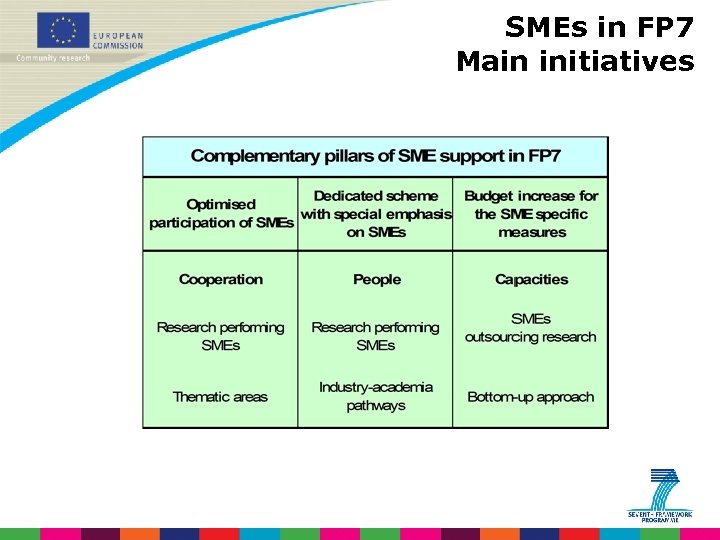 SMEs in FP 7 Main initiatives
 SMEs in Cooperation • All areas of the programme fully open to SMEs • Specific SME measures (e. g. NMP programme) • Dedicated SME strategy under each Theme • Identification of areas of particular interest to SMEs in each work programme • Simplified financial and administrative procedures
 SMEs in People All actions are open to SMEs Industry-academia partnerships and pathways (next call Autumn 2010) Staff secondment between academia and industry including SMEs • Temporary hosting of experienced researchers from outside partnership • 10% financial contribution to small equipment related to SME participation • Bottom-up approach: no thematic focus
 Capacities: Research for the benefit of SMEs Research for SMEs: • Low to medium technology SMEs with little or no research capability • Research intensive SMEs that need to outsource research to complement their core research capability Research for SME associations: • SME associations representing their members and their common technical problems • Bottom-up approach: no thematic focus
 Who can participate in FP 7? • Any undertaking, university or research centre or other legal entity, whether established in a: - Member State (MS), or - Associated country (AC)* , or • International organisations and participants from third countries can participate only if in addition to the minima * Albania, Bosnia & Herzegovina, Croatia, Iceland, Israel, Liechtenstein, FYROM, Montenegro, Norway, Serbia, Switzerland, Turkey, Faroe Islands (from Jan 10)
 Conditions for participation • Minimum number, as a general rule at least 3 independent participants from 3 different Member States (MS) or Associated countries (AC) • Additional conditions can be established by the work programme or specific programme (number or type of participant, place of establishment) • Specific conditions apply for: – Frontier research actions (Ideas SP), 1 legal entity established in a MS or AC - Marie Curie Actions (People SP) – For specific cooperation actions dedicated to International Cooperation Partner Countries (ICPC) – minimum 4 participants: 2 MS or AC and 2 from ICPC countries
 Proposal Submission • Submission only through the EPSS – Electronic Proposal Submission Service • Deadlines strict: to the second! • Proposal: – Part A: administrative forms – Part B: main text of proposal • Full information in the Guide for Applicants – specific to each call
 Evaluation Process • Funding decisions are based on peer review of research proposals • High quality evaluators are at the core of the system • Sign up to be an evaluator! • Quality control – Questionnaire survey of experts – Independent observers – Redress system
 Eligibility checks • Receipt before deadline – Impossible to be late with EPSS! • Minimum number of independent partners – As set out in work programme and call • Completeness of proposal – Presence of all requested forms • ‘Out of scope’ • Others (e. g. budget limits)
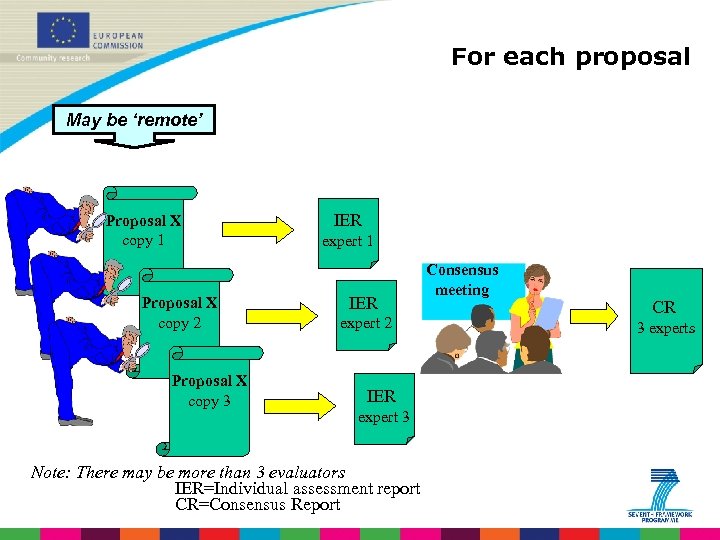 For each proposal May be ‘remote’ Proposal X copy 1 Proposal X copy 2 Proposal X copy 3 IER expert 1 IER expert 2 IER expert 3 Note: There may be more than 3 evaluators IER=Individual assessment report CR=Consensus Report Consensus meeting CR 3 experts
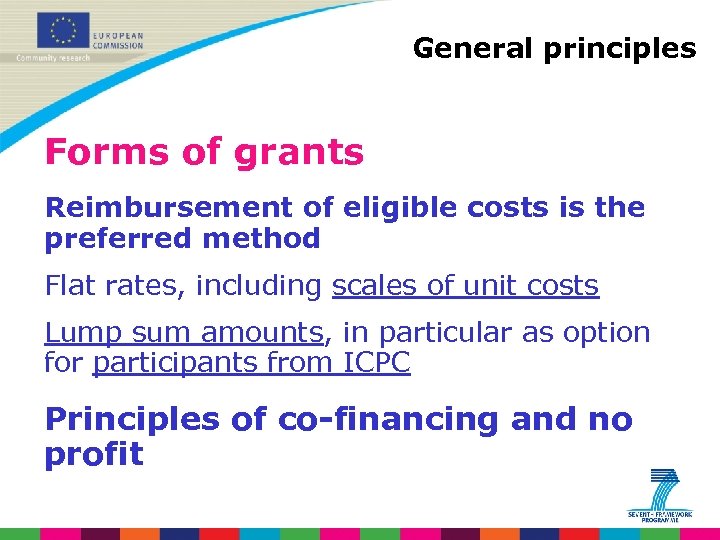 General principles Forms of grants Reimbursement of eligible costs is the preferred method Flat rates, including scales of unit costs Lump sum amounts, in particular as option for participants from ICPC Principles of co-financing and no profit
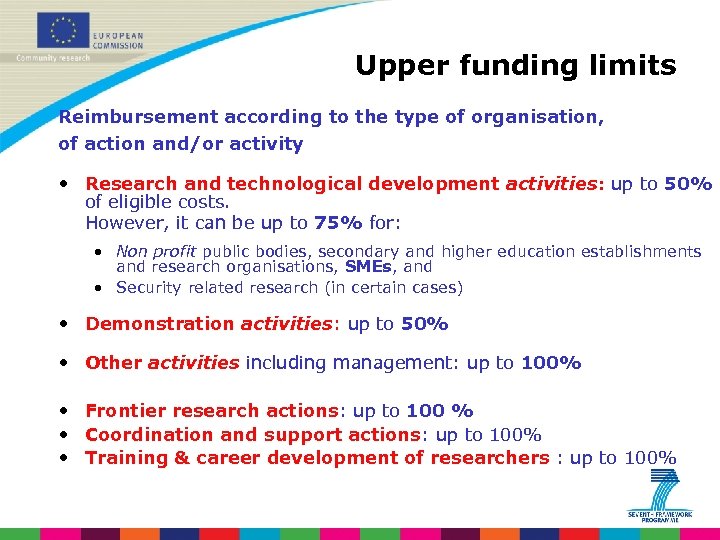 Upper funding limits Reimbursement according to the type of organisation, of action and/or activity • Research and technological development activities: up to 50% of eligible costs. However, it can be up to 75% for: • Non profit public bodies, secondary and higher education establishments and research organisations, SMEs, and • Security related research (in certain cases) • Demonstration activities: up to 50% • Other activities including management: up to 100% • Frontier research actions: up to 100 % • Coordination and support actions: up to 100% • Training & career development of researchers : up to 100%
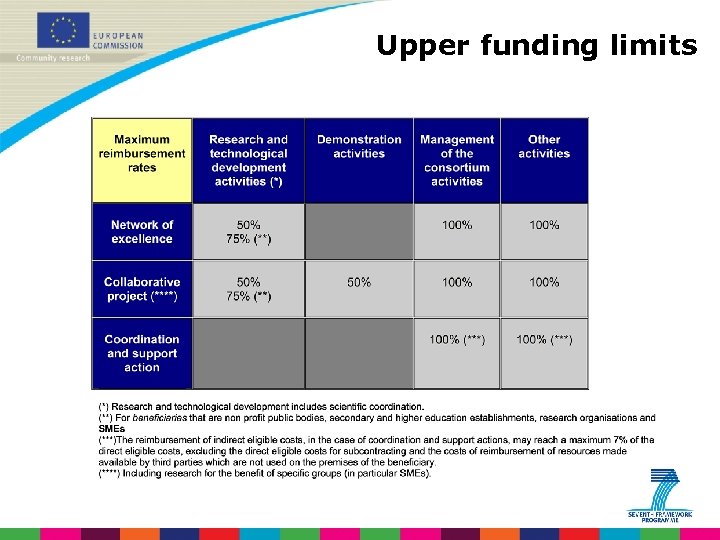 Upper funding limits
 Eligible Costs – Eligible • actual • during duration of project • in accordance with its usual accounting and management principles • recorded in the accounts of beneficiary • used for the sole purpose of achieving the objectives of the project – Non-eligible (identifiable indirect taxes including VAT…)
 Direct Costs • No cost models (NEW) • All beneficiaries report all their real direct costs
 Indirect Costs • For all: – either actual overhead or simplified method* – flat rate of 20% of direct costs minus subcontracting and 3 rd parties not used on the premises of the beneficiary. • For Non-profit Public Bodies, Secondary and Higher Education establishments, Research Organisations and SMEs unable to identify real indirect costs, may apply for a flat rate of 60% for funding schemes with RTD. • For CSA limit of 7% of direct costs
 Indirect Costs *simplified method • A participant may use a simplified method to calculate its indirect costs at the level of the legal entity • if this is in accordance with its usual management and accounting principles • If no analytical accounting system • Based on actual costs of the last closed accounting year Why this new approach? to introduce a way to facilitate the transition from the Additional Cost model (abolished) towards the declaration of actual indirect costs
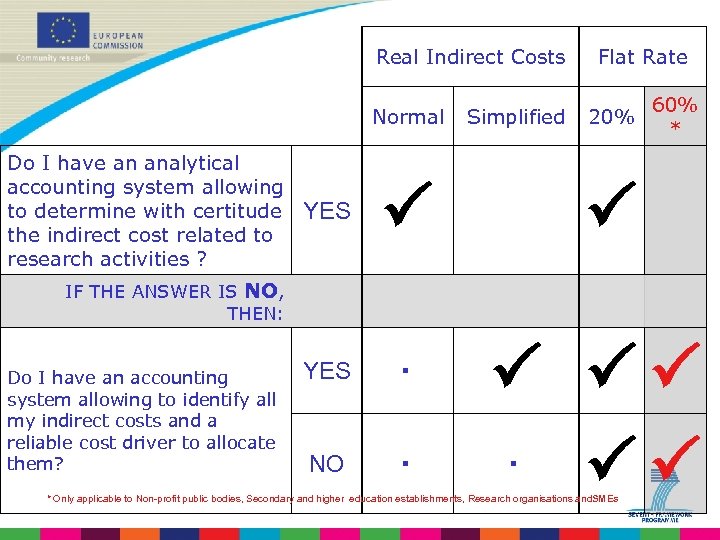 Real Indirect Costs Flat Rate Normal Do I have an analytical accounting system allowing to determine with certitude the indirect cost related to research activities ? IF THE ANSWER IS NO, THEN: Do I have an accounting system allowing to identify all my indirect costs and a reliable cost driver to allocate them? Simplified 20% 60% * YES YES NO * Only applicable to Non-profit public bodies, Secondary and higher education establishments, Research organisations and MEs S
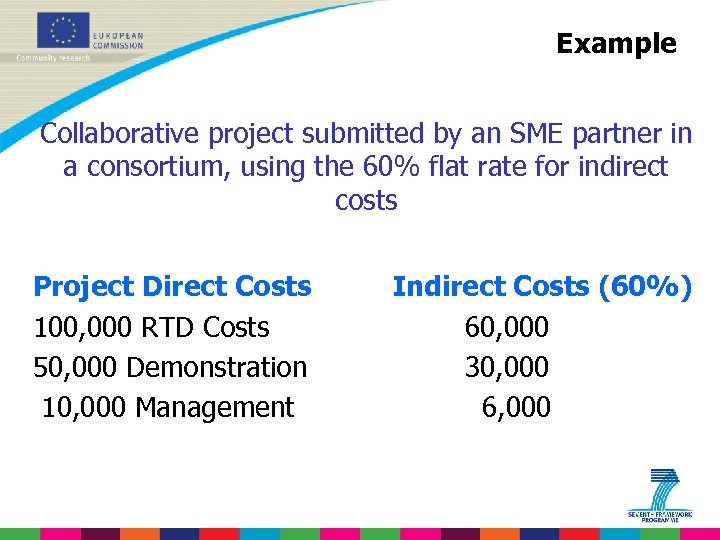 Example Collaborative project submitted by an SME partner in a consortium, using the 60% flat rate for indirect costs Project Direct Costs 100, 000 RTD Costs 50, 000 Demonstration 10, 000 Management Indirect Costs (60%) 60, 000 30, 000 6, 000
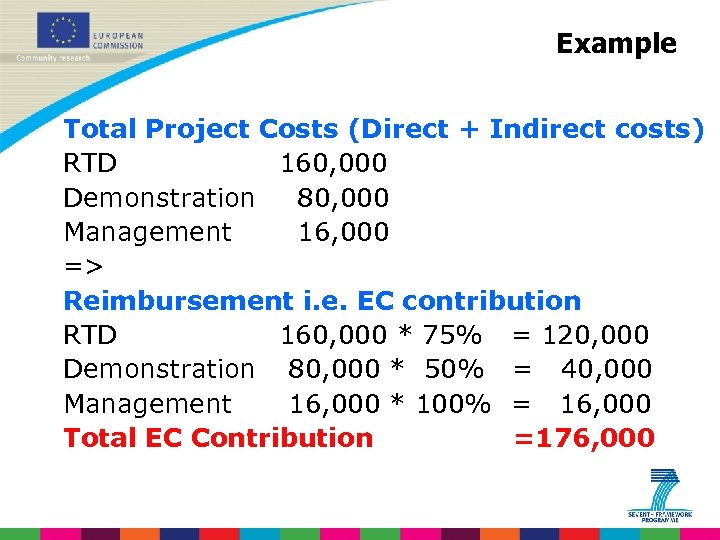 Example Total Project Costs (Direct + Indirect costs) RTD 160, 000 Demonstration 80, 000 Management 16, 000 => Reimbursement i. e. EC contribution RTD 160, 000 * 75% = 120, 000 Demonstration 80, 000 * 50% = 40, 000 Management 16, 000 * 100% = 16, 000 Total EC Contribution =176, 000
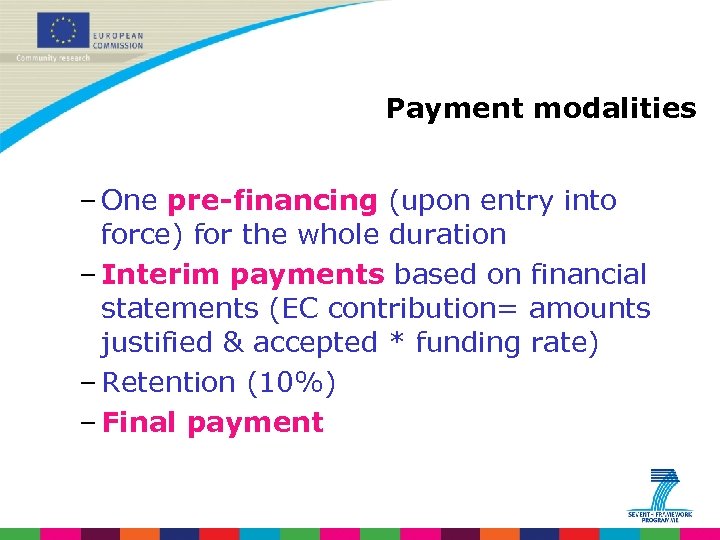 Payment modalities – One pre-financing (upon entry into force) for the whole duration – Interim payments based on financial statements (EC contribution= amounts justified & accepted * funding rate) – Retention (10%) – Final payment
 Example Project duration 3 years, EC funding 3 Mio€ • Pre-financing (average EU funding 1 M/year, usually 160%) = 1. 6 Mio€ • 1 st Interim payment 1 Mio€ accepted, payment 1 Mio€ • 2 nd Interim payment 1 Mio€ accepted, payment 0, 1 Mio€ (retention 10%!) • Final payment 0, 3 Mio€ (retention 10%)
 Guarantee Fund • No collective financial responsibility • Instead: establishment of a financial guarantee fund to cover risks • 5% of EC contribution • However, there is still a responsibility to carry out the technical aspects of the project
 Payment modalities EXAMPLE: Project duration 3 years, EC funding 3 Mio€ • Pre-financing = 1. 6 Mio€ of which 0, 15 Mio€ to the Fund • 1 st Interim payment 1 Mio€ accepted, payment 1 Mio€ • 2 nd Interim payment 1 Mio€ accepted, payment 0, 1 Mio€ (retention 10%!) • Final payment 0, 3 Mio€ (retention 10%)+0, 15 Mio€ of the Fund
 Documents and Contacts • Rules for Participation • Work Programme • Rules for Submission and Evaluation of Proposals • Guides for Applicants • NCPs – Network of NCPs in Moldova
 Further Information • EU research: http: //ec. europa. eu/research/ • 7 th Framework Programme: http: //ec. europa. eu/research/fp 7/ • Information on research activities and projects: http: //cordis. europa. eu/ • research*eu magazine: http: //ec. europa. eu/research-eu/ • Questions? http: //ec. europa. eu/research/index. cfm? pg =enquiries