


 Скачать презентацию How to moderate the impact of agriculture on
41cc323392b90221059f2d92660225b7.ppt
- Количество слайдов: 37
 How to moderate the impact of agriculture on climate B. Seguin, D. Arrouays, J. F Soussana INRA (France), A. Bondeau, S. Zaehle PIK Potsdam (Germany) N. de Noblet, P. Smith, N. Viovy, N. Vuichard LSCE (France)
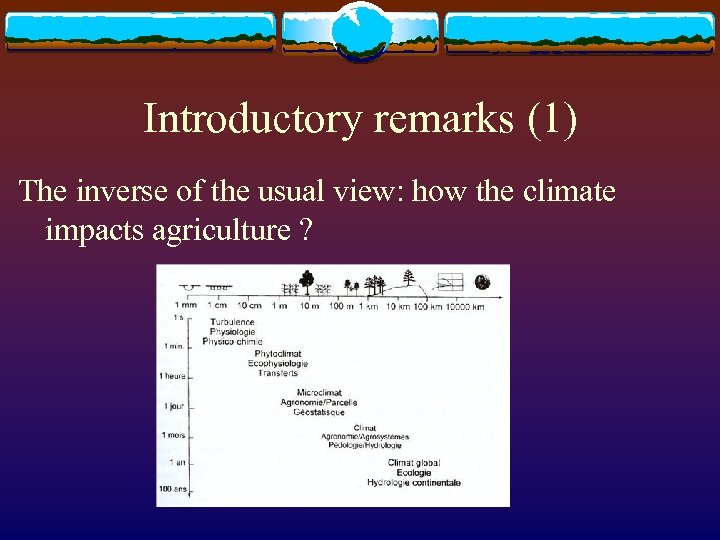 Introductory remarks (1) The inverse of the usual view: how the climate impacts agriculture ?
 Introductory remarks (2) ‘ moderate’ implies: . an a priori of negative impact (to be discussed) . impact well understood (not totally the case !!) v the impact of agriculture on climate may combine : . indirect effects on GHG net emissions (CO 2, CH 4, N 20. . and H 2 O ) . direct effects on SEB components , water cycle and local/global climate to be considered concurrently( regional climate change potential as defined by Pielke et al 2002) at different spatial scales… v
 I. At field scale (~100 m) basically action by management practices as : . conservation tillage, fertilization/ irrigation scheduling, residues, animal feed, . . for GHG emissions . mainly irrigation for biophysical SEB, but also timing of crop cycles (winter/summer) v scale corresponding to practical outputs of farmer tactical decisions within the strategic options v first level of interactions (tillage CO 2/N 20, irrigation for SEB/ N 20, pasture management for CH 4/N 20. . ) v
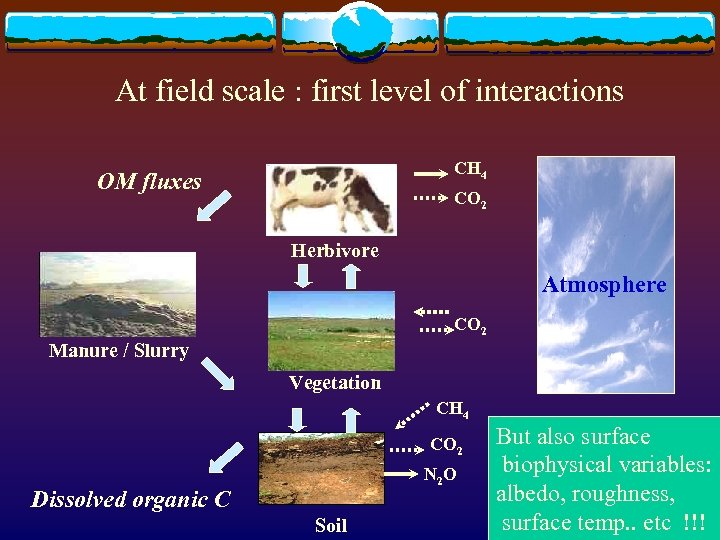 At field scale : first level of interactions CH 4 OM fluxes CO 2 Herbivore Atmosphere CO 2 Manure / Slurry Vegetation CH 4 CO 2 N 2 O Dissolved organic C Soil But also surface biophysical variables: albedo, roughness, surface temp. . etc !!!
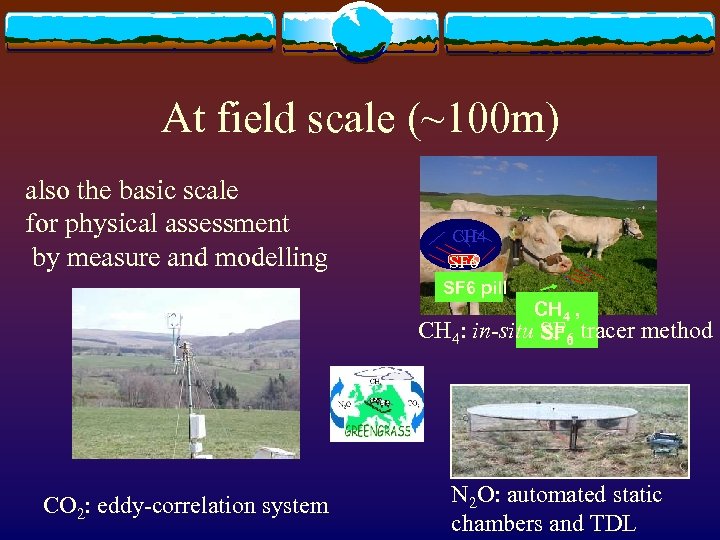 At field scale (~100 m) also the basic scale for physical assessment by measure and modelling CH 4 SF 6 pill CH 4 , CH 4: in-situ SF 6 tracer method SF CO 2: eddy-correlation system N 2 O: automated static chambers and TDL
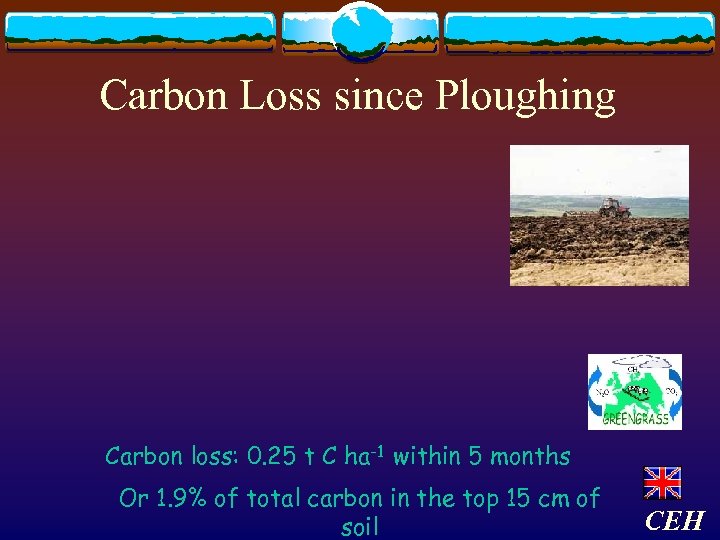 Carbon Loss since Ploughing Carbon loss: 0. 25 t C ha-1 within 5 months Or 1. 9% of total carbon in the top 15 cm of soil CEH
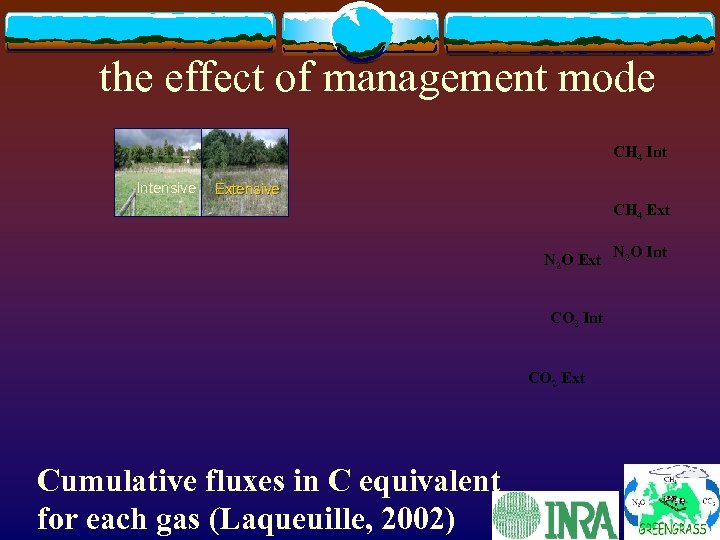 the effect of management mode CH 4 Intensive Extensive CH 4 Ext N 2 O Ext CO 2 Int CO 2 Ext Cumulative fluxes in C equivalent for each gas (Laqueuille, 2002) N 2 O Int
 the effect of management mode ( 2002) Greenhouse gas balance (Laqueuille, 2002)
 II. At farm scale (~1 to 10 km) the basic scale for strategic options (choice of agricultural productions and resulting crop/livestock systems) v mainly driven by economical constraints v includes alternative solutions as energy cropping (biomass for heat and power, biofuels) and biogas v second level of interactions (annual crops/livestock, conventional/organic farming. . ) including the fuel energy use (fertilizers, machinery. . ) v accessible with farm-scale models v
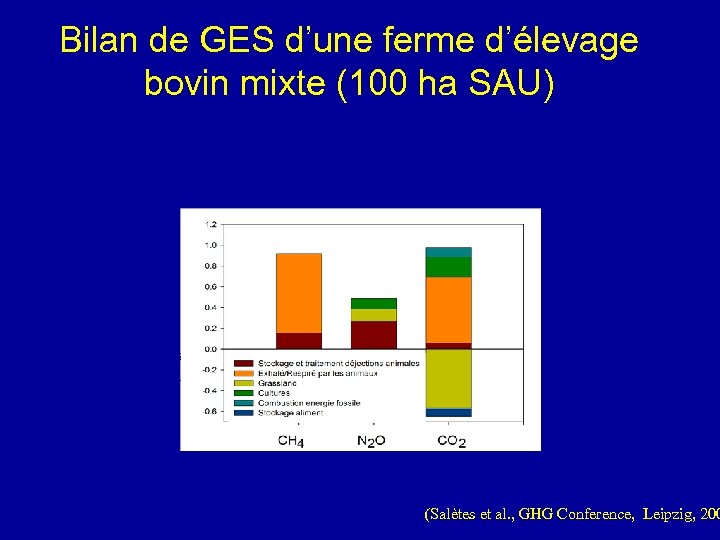 Bilan de GES d’une ferme d’élevage bovin mixte (100 ha SAU) (Salètes et al. , GHG Conference, Leipzig, 200
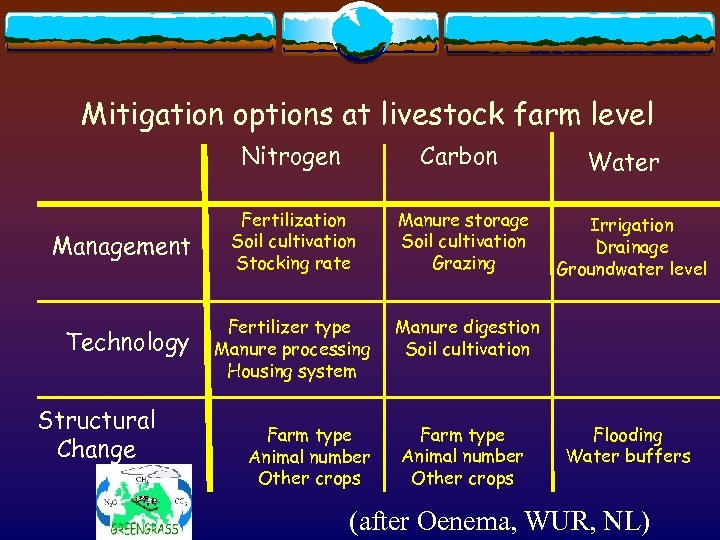 Mitigation options at livestock farm level Nitrogen Management Technology Structural Change Carbon Fertilization Soil cultivation Stocking rate Manure storage Soil cultivation Grazing Fertilizer type Manure processing Housing system Manure digestion Soil cultivation Farm type Animal number Other crops Water Irrigation Drainage Groundwater level Flooding Water buffers (after Oenema, WUR, NL)
 Farm scale budgets and mitigation (J Olesen, DIAS, DK) Account for all emissions from the barn to the pastures
 III. At large scales (~ 10 to 1000 km) mainly land-use (crops, pastures, forests, urban areas. . with/without irrigation) and landscape components (trees, hedges) v only accessible with atmospheric models: . local features (detailed land-use, irrigation, landscape components like trees, hedges) in mesoscale models . regional features (main land-use classes) in global models v
 Average organic C stocks in French soils vs. land use (0 -30 cm) (Arrouays et al. 2002)
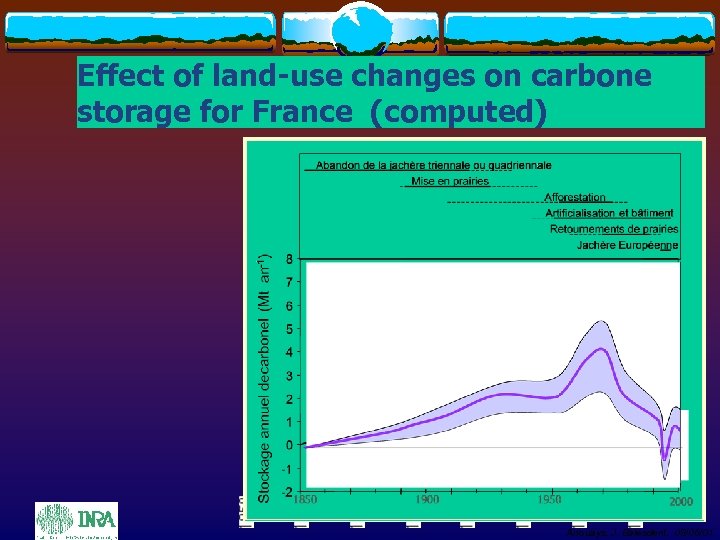 Effect of land-use changes on carbone storage for France (computed) Arrouays, J. Balesdent, 08/06/01
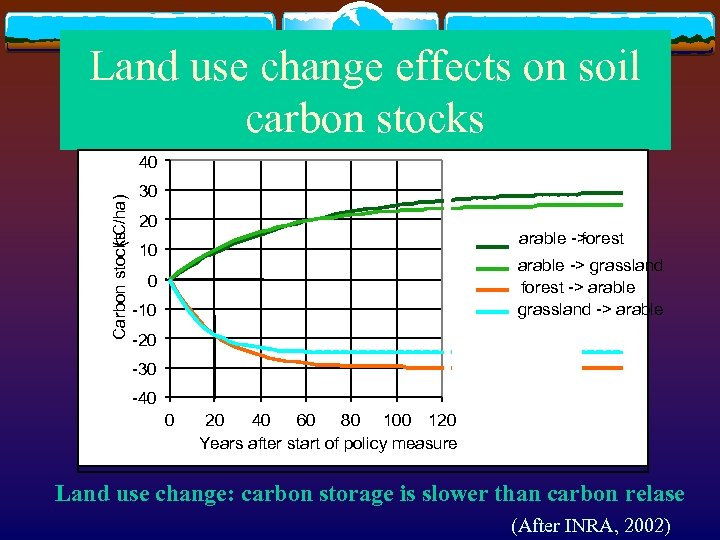 Land use change effects on soil carbon stocks Carbon stocks (t. C/ha) 40 30 20 arable -> forest 10 arable -> grassland forest -> arable grassland -> arable 0 -10 -20 -30 -40 0 20 40 60 80 100 120 Years after start of policy measure Land use change: carbon storage is slower than carbon relase (After INRA, 2002)
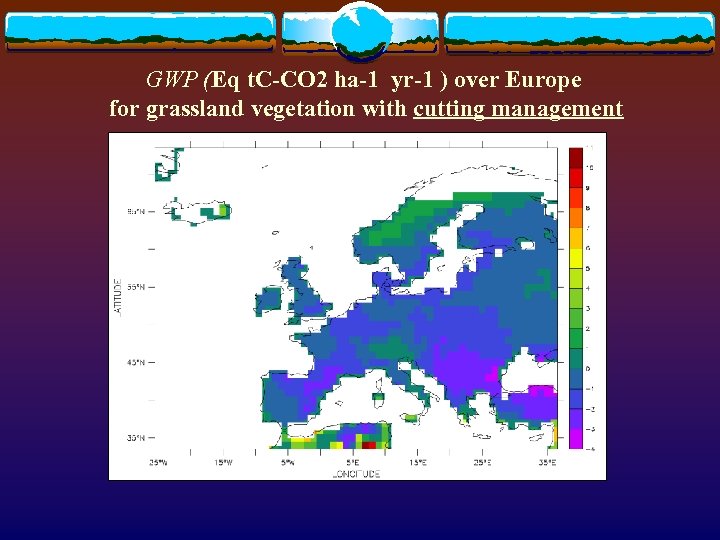 GWP (Eq t. C-CO 2 ha-1 yr-1 ) over Europe for grassland vegetation with cutting management
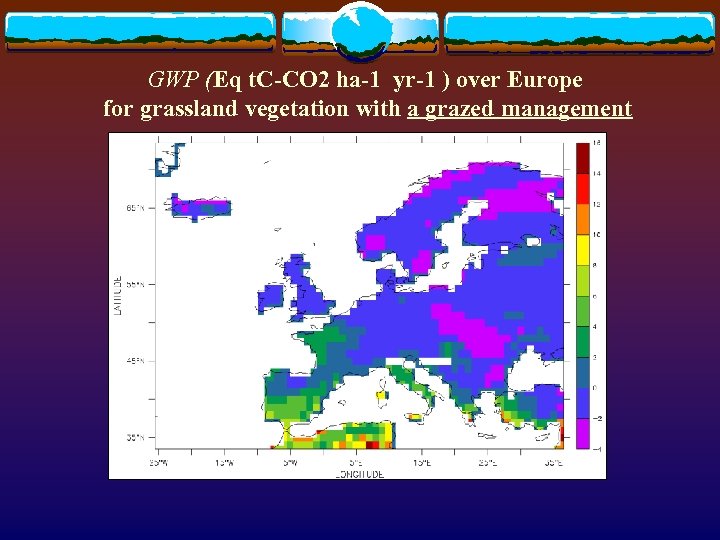 GWP (Eq t. C-CO 2 ha-1 yr-1 ) over Europe for grassland vegetation with a grazed management
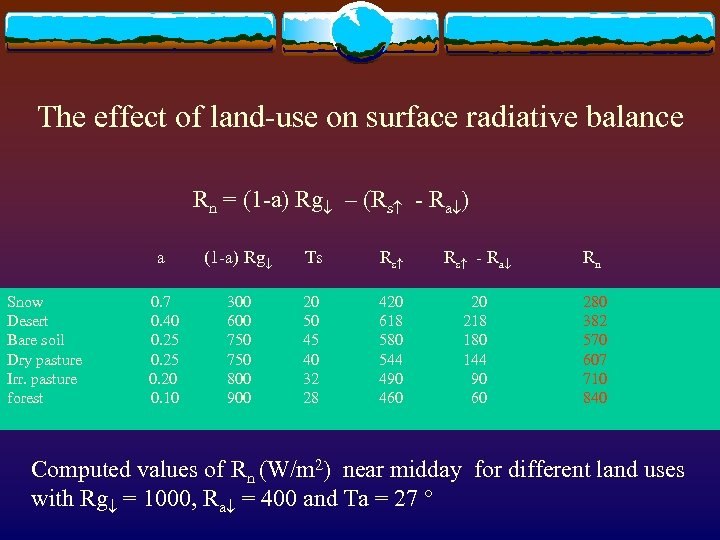 The effect of land-use on surface radiative balance Rn = (1 -a) Rg – (Rs - Ra ) a (1 -a) Rg Ts Rs Snow 0. 7 300 Desert 0. 40 600 Bare soil 0. 25 750 Dry pasture 0. 25 750 Irr. pasture 0. 20 800 forest 0. 10 900 20 50 45 40 32 28 420 618 580 544 490 460 Rs - Ra Rn 20 280 218 382 180 570 144 607 90 710 60 840 Computed values of Rn (W/m 2) near midday for different land uses with Rg = 1000, Ra = 400 and Ta = 27 °
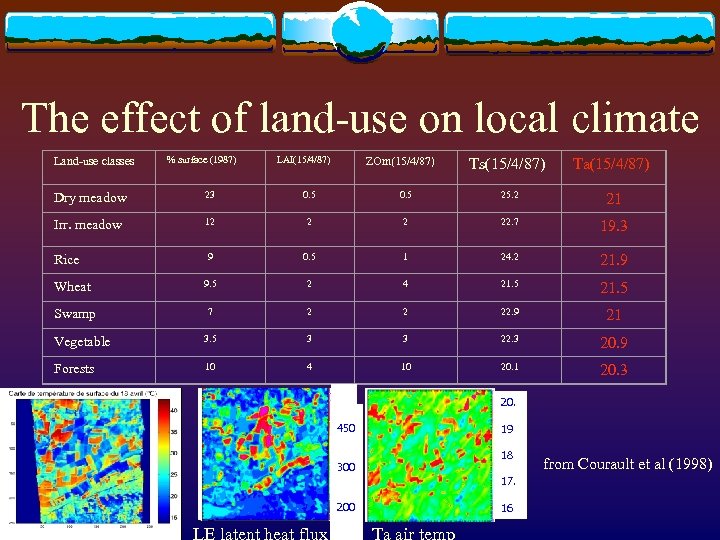 The effect of land-use on local climate Land-use classes % surface (1987) LAI(15/4/87) ZOm(15/4/87) Ts(15/4/87) Ta(15/4/87) Dry meadow 23 0. 5 25. 2 21 Irr. meadow 12 2 2 22. 7 19. 3 Rice 9 0. 5 1 24. 2 21. 9 Wheat 9. 5 2 4 21. 5 Swamp 7 2 2 22. 9 21 Vegetable 3. 5 3 3 22. 3 20. 9 Forests 10 4 10 20. 1 20. 3 20. 450 19 18 300 17. 200 LE latent heat flux 16 Ta air temp from Courault et al (1998)
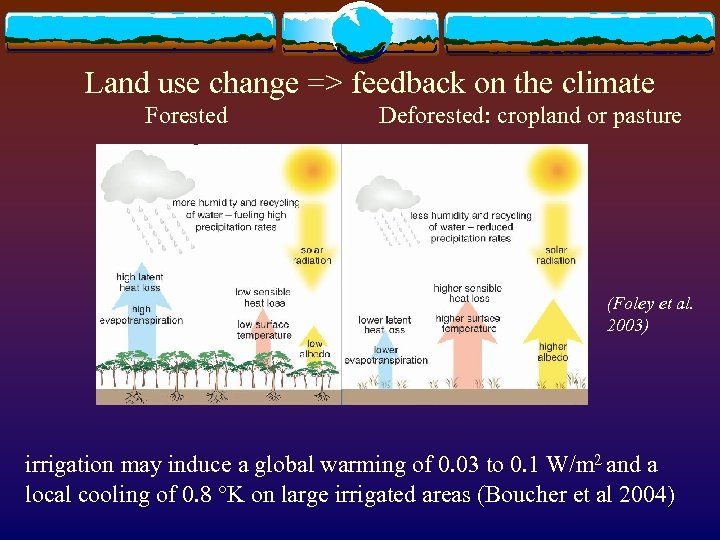 Land use change => feedback on the climate Forested Deforested: cropland or pasture (Foley et al. 2003) irrigation may induce a global warming of 0. 03 to 0. 1 W/m 2 and a local cooling of 0. 8 °K on large irrigated areas (Boucher et al 2004)
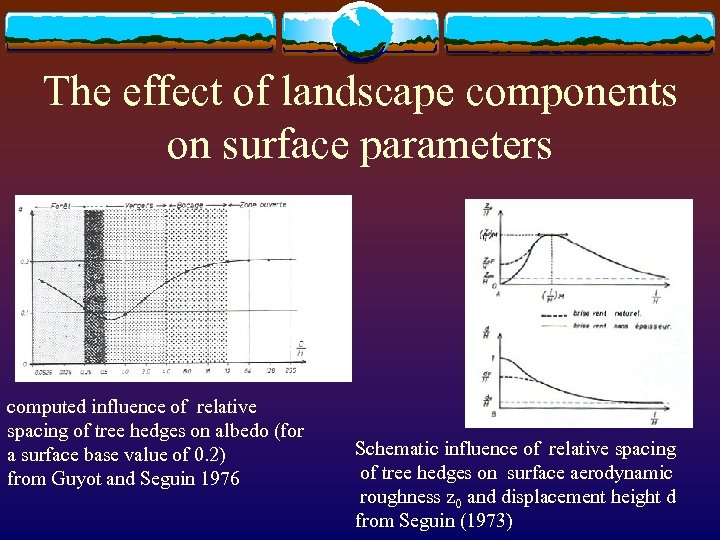 The effect of landscape components on surface parameters computed influence of relative spacing of tree hedges on albedo (for a surface base value of 0. 2) from Guyot and Seguin 1976 Schematic influence of relative spacing of tree hedges on surface aerodynamic roughness z 0 and displacement height d from Seguin (1973)
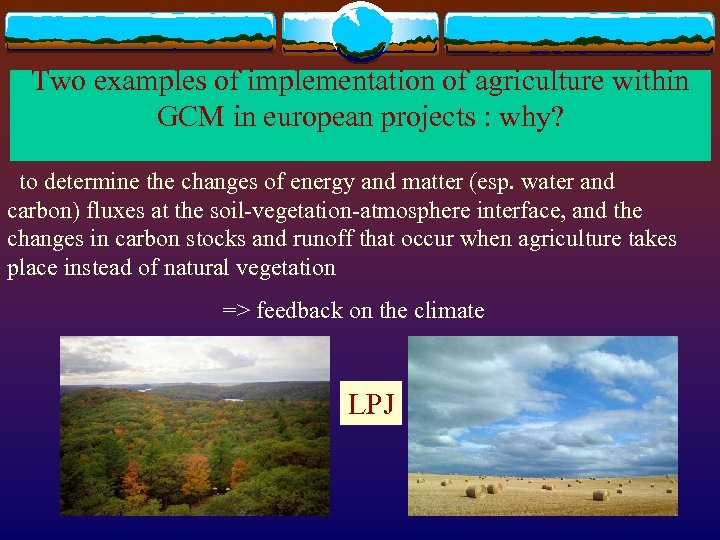 Two examples of implementation of agriculture within GCM in european projects : why? to determine the changes of energy and matter (esp. water and carbon) fluxes at the soil-vegetation-atmosphere interface, and the changes in carbon stocks and runoff that occur when agriculture takes place instead of natural vegetation => feedback on the climate LPJ
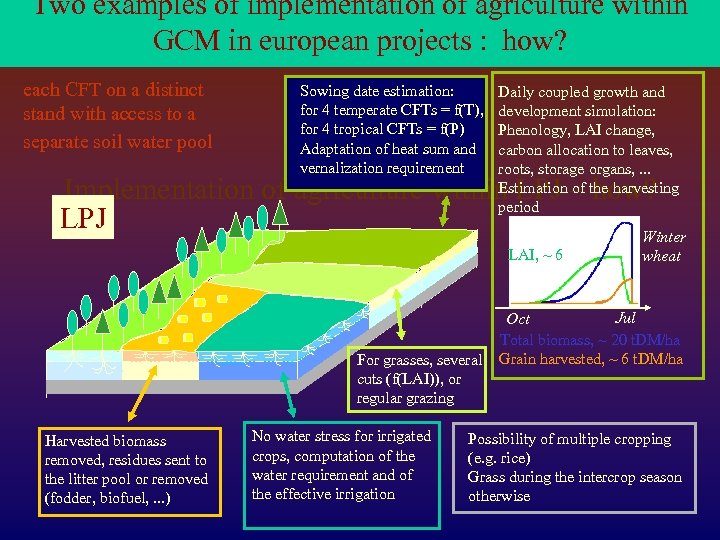 Two examples of implementation of agriculture within GCM in european projects : how? each CFT on a distinct stand with access to a separate soil water pool Sowing date estimation: for 4 temperate CFTs = f(T), for 4 tropical CFTs = f(P) Adaptation of heat sum and vernalization requirement Daily coupled growth and development simulation: Phenology, LAI change, carbon allocation to leaves, roots, storage organs, . . . Estimation of the harvesting period Implementation of agriculture within LPJ – how? LPJ Winter LAI, ~ 6 wheat Jul Oct Total biomass, ~ 20 t. DM/ha For grasses, several Grain harvested, ~ 6 t. DM/ha cuts (f(LAI)), or regular grazing Harvested biomass removed, residues sent to the litter pool or removed (fodder, biofuel, . . . ) No water stress for irrigated crops, computation of the water requirement and of the effective irrigation Possibility of multiple cropping (e. g. rice) Grass during the intercrop season otherwise
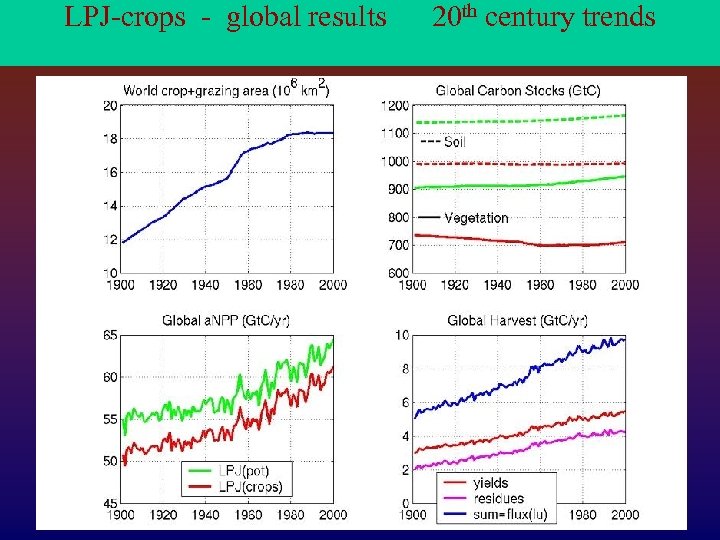 LPJ-crops - global results 20 th century trends
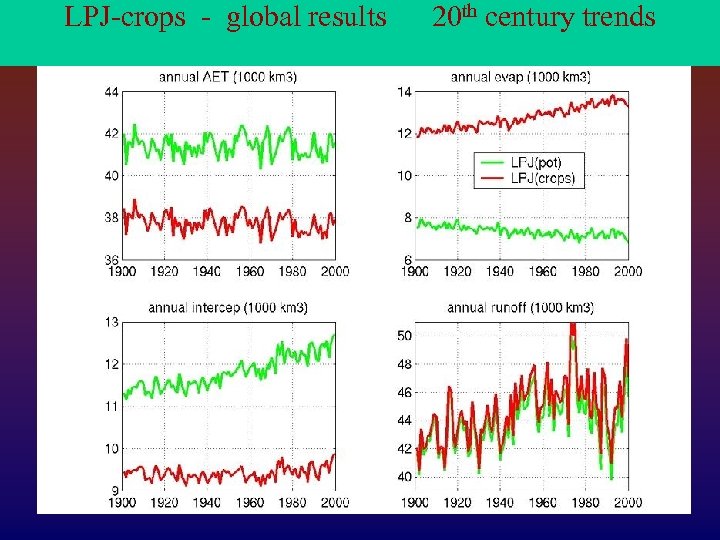 LPJ-crops - global results 20 th century trends
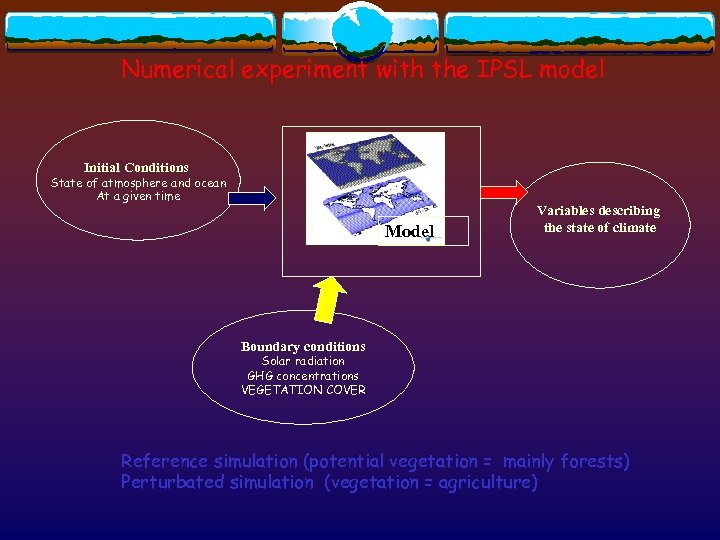 Numerical experiment with the IPSL model Initial Conditions State of atmosphere and ocean At a given time Model Variables describing the state of climate Boundary conditions Solar radiation GHG concentrations VEGETATION COVER Reference simulation (potential vegetation = mainly forests) Perturbated simulation (vegetation = agriculture)
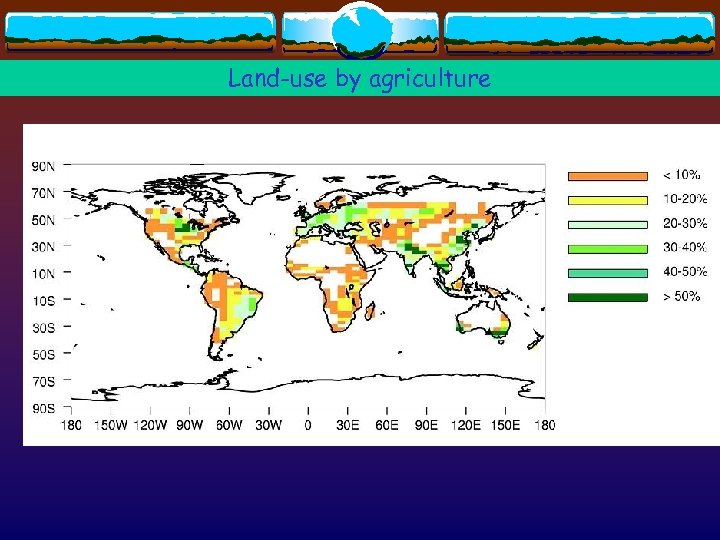 Land-use by agriculture
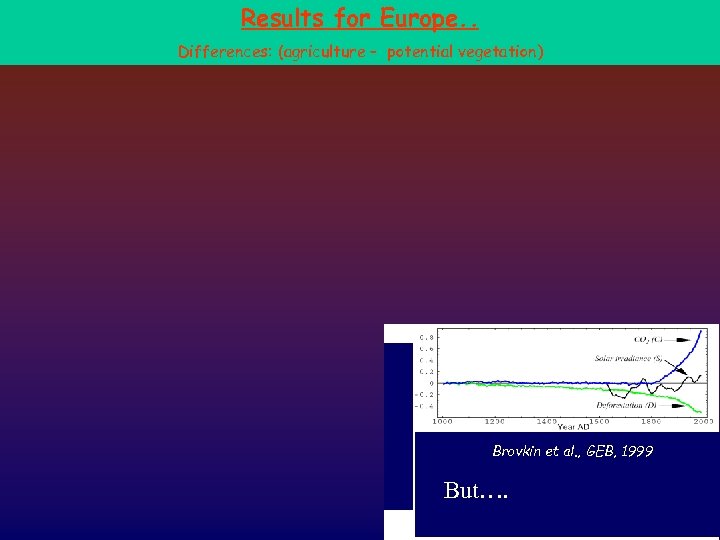 Results for Europe. . Differences: (agriculture – potential vegetation) Brovkin et al. , GEB, 1999 But….
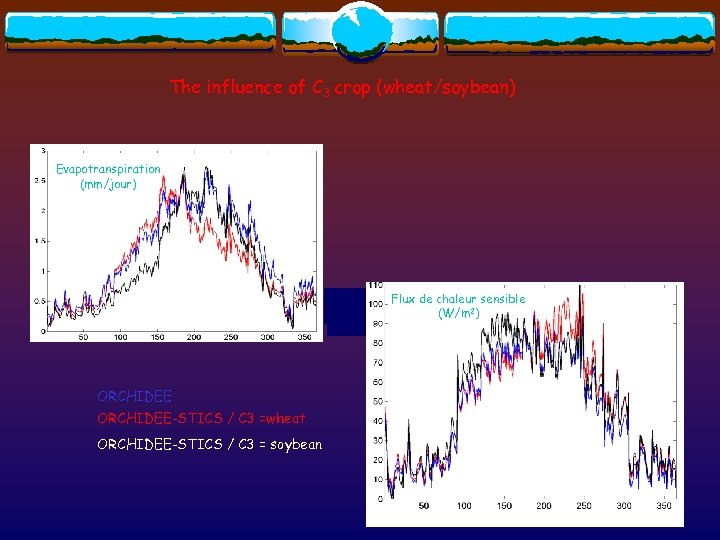
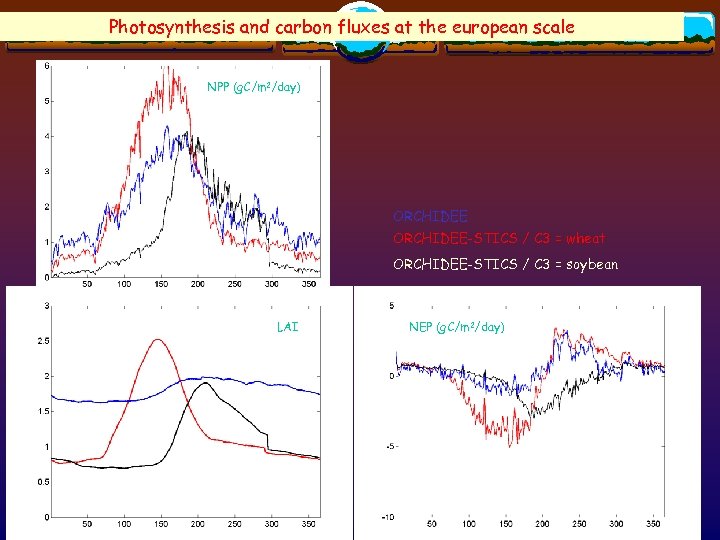
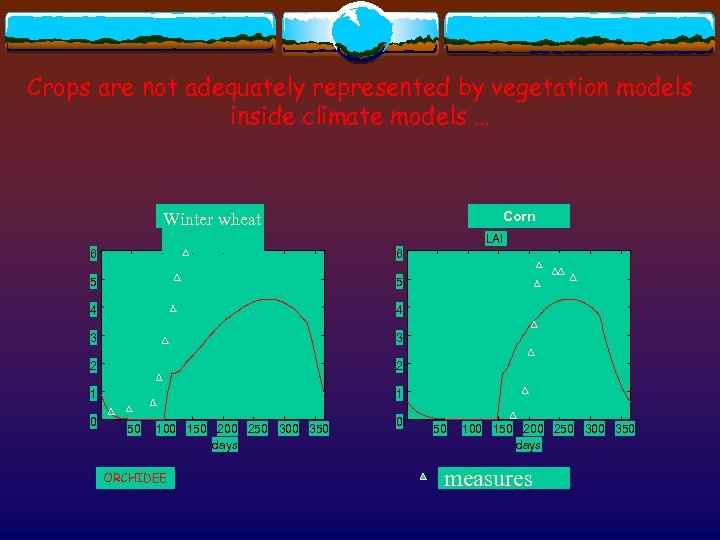 Crops are not adequately represented by vegetation models inside climate models … Blé d’hiver Winter wheat Corn LAI : LAI 6 6 5 5 4 4 3 3 2 2 1 1 0 50 100 150 200 250 300 350 days ORCHIDEE 0 50 100 150 200 250 300 350 days measures
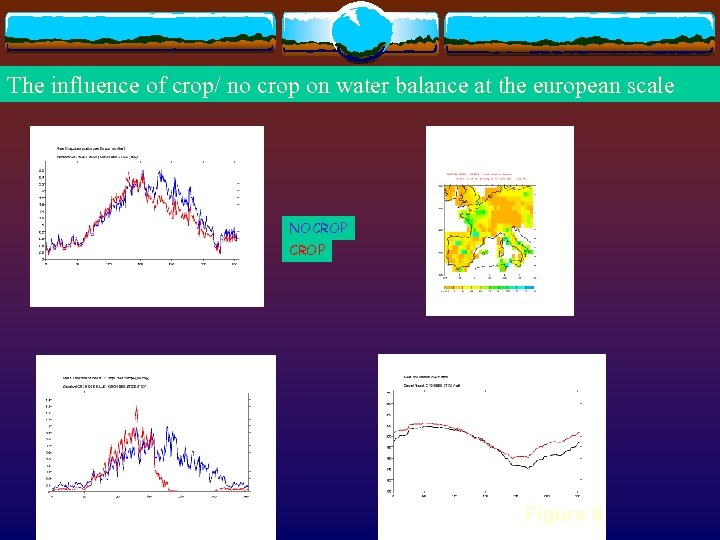
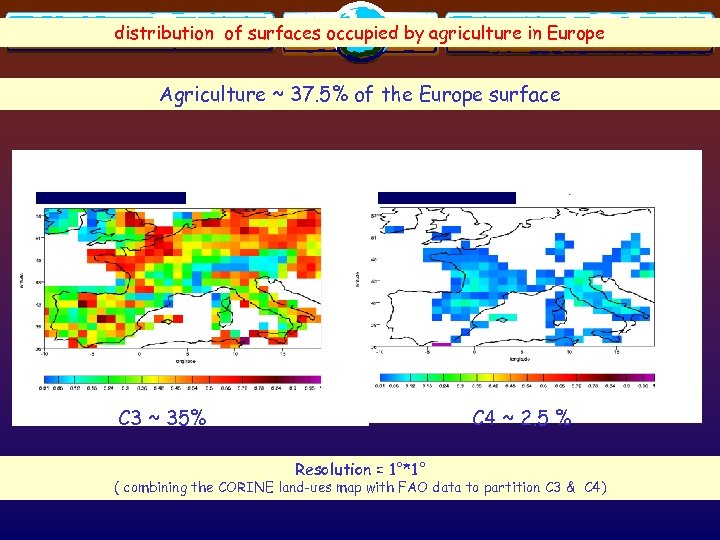 distribution of surfaces occupied by agriculture in Europe Agriculture ~ 37. 5% of the Europe surface C 3 ~ 35% C 4 ~ 2. 5 % Resolution = 1°*1° ( combining the CORINE land-ues map with FAO data to partition C 3 & C 4)
 The influence of crop/ no crop on water balance at the european scale NOCROP Figure 8
 The influence of C 3 crop (wheat/soybean) Evapotranspiration (mm/jour) Flux de chaleur sensible (W/m 2) ORCHIDEE-STICS / C 3 =wheat ORCHIDEE-STICS / C 3 = soybean
 Photosynthesis and carbon fluxes at the european scale NPP (g. C/m 2/day) ORCHIDEE-STICS / C 3 = wheat ORCHIDEE-STICS / C 3 = soybean LAI 4 -5 NEP (g. C/m 2/day)
 Conclusions (1/2) v v technical bases for mitigation of GHG emissions by agriculture exist at the field scale their advantages may be limited (or possibly inversed) by technical aspects at the field scale when considering trade-offs with other GHG or longer term scales. consistent inventories at the plot scale are lacking in current IPCC methodology strategical orientations at the farm level (organic/conventional, extensive/intensive management for grassland, etc. . ) may lead to farm use efficiency as the best tool
 Conclusions (2/2) At the larger scales, land-use also induce significant tradeoffs, so that biophysical variables need to be considered to fully evaluate the effect of GHG mitigation procedures v Only more comprehensive studies allowing to assess the overall aspects at the various scales (from local to global) will give the significant inputs v If GHG emissions may be considered as aggregative along spatial scales, actions on micro or local climates may significantly locally affect the global climate v