


 Скачать презентацию How to make good notes An analysis of
0cde1f0efccf2f580c86f8ddd5549356.ppt
- Количество слайдов: 15
 How to make good notes An analysis of errors in selected student work PS: Only promising examples included
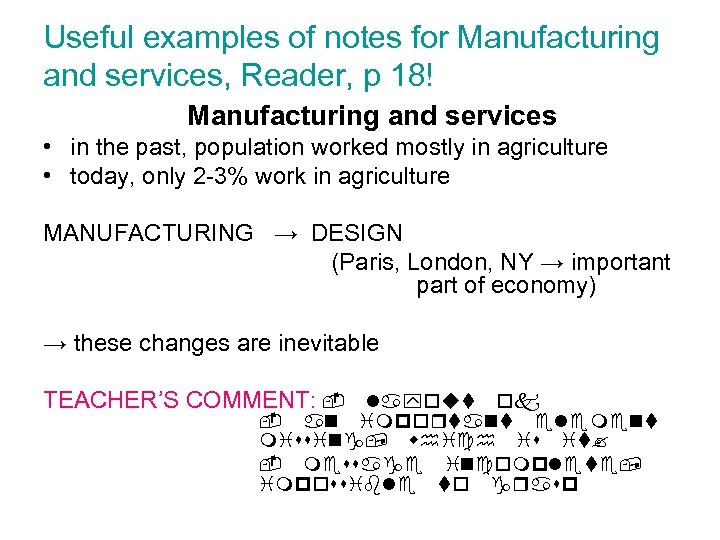 Useful examples of notes for Manufacturing and services, Reader, p 18! Manufacturing and services • in the past, population worked mostly in agriculture • today, only 2 -3% work in agriculture MANUFACTURING → DESIGN (Paris, London, NY → important part of economy) → these changes are inevitable TEACHER’S COMMENT: - layout ok - an important element missing, which is it? - message incomplete, impossible to grasp
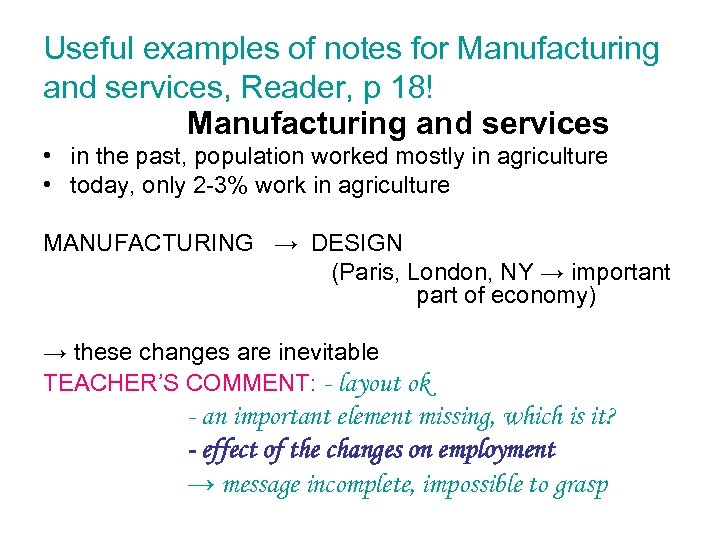 Useful examples of notes for Manufacturing and services, Reader, p 18! Manufacturing and services • in the past, population worked mostly in agriculture • today, only 2 -3% work in agriculture MANUFACTURING → DESIGN (Paris, London, NY → important part of economy) → these changes are inevitable TEACHER’S COMMENT: - layout ok - an important element missing, which is it? - effect of the changes on employment → message incomplete, impossible to grasp
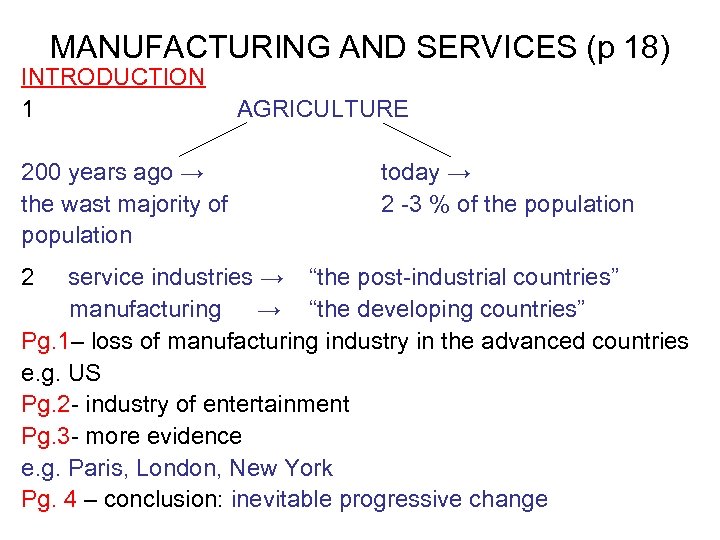 MANUFACTURING AND SERVICES (p 18) INTRODUCTION 1 200 years ago → the wast majority of population 2 AGRICULTURE today → 2 -3 % of the population service industries → “the post-industrial countries” manufacturing → “the developing countries” Pg. 1– loss of manufacturing industry in the advanced countries e. g. US Pg. 2 - industry of entertainment Pg. 3 - more evidence e. g. Paris, London, New York Pg. 4 – conclusion: inevitable progressive change
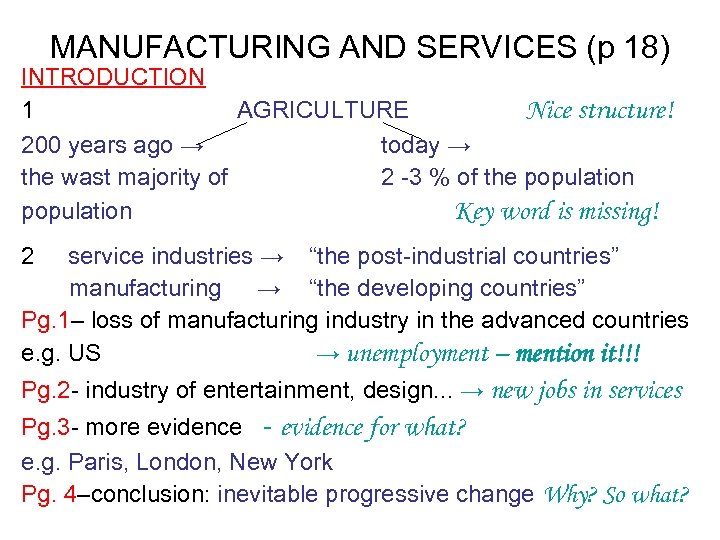 MANUFACTURING AND SERVICES (p 18) INTRODUCTION 1 AGRICULTURE Nice structure! 200 years ago → today → the wast majority of 2 -3 % of the population Key word is missing! 2 service industries → “the post-industrial countries” manufacturing → “the developing countries” Pg. 1– loss of manufacturing industry in the advanced countries e. g. US → unemployment – mention it!!! Pg. 2 - industry of entertainment, design. . . → new jobs in services Pg. 3 - more evidence - evidence for what? e. g. Paris, London, New York Pg. 4–conclusion: inevitable progressive change Why? So what?
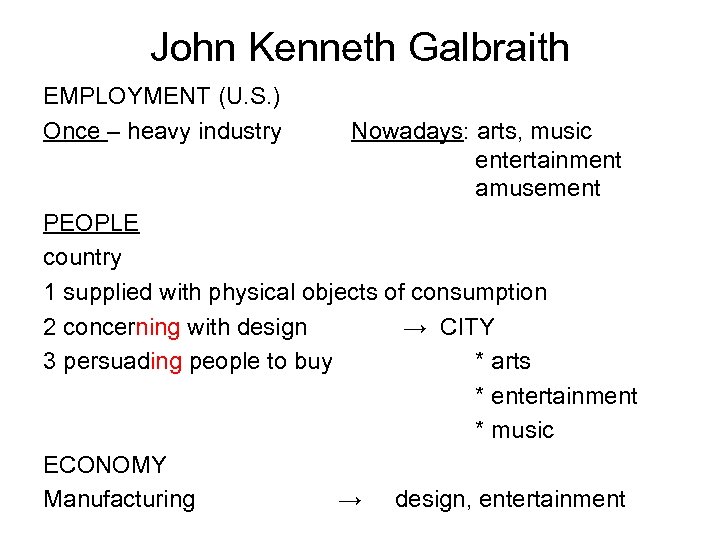 John Kenneth Galbraith EMPLOYMENT (U. S. ) Once – heavy industry Nowadays: arts, music entertainment amusement PEOPLE country 1 supplied with physical objects of consumption 2 concerning with design → CITY 3 persuading people to buy * arts * entertainment * music ECONOMY Manufacturing → design, entertainment
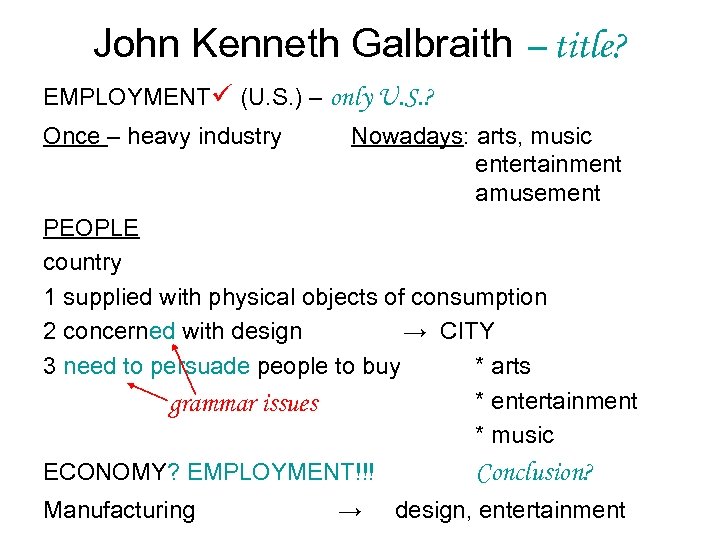 John Kenneth Galbraith – title? EMPLOYMENT (U. S. ) – only U. S. ? Once – heavy industry Nowadays: arts, music entertainment amusement PEOPLE country 1 supplied with physical objects of consumption 2 concerned with design → CITY 3 need to persuade people to buy * arts * entertainment grammar issues * music ECONOMY? EMPLOYMENT!!! Manufacturing → Conclusion? design, entertainment
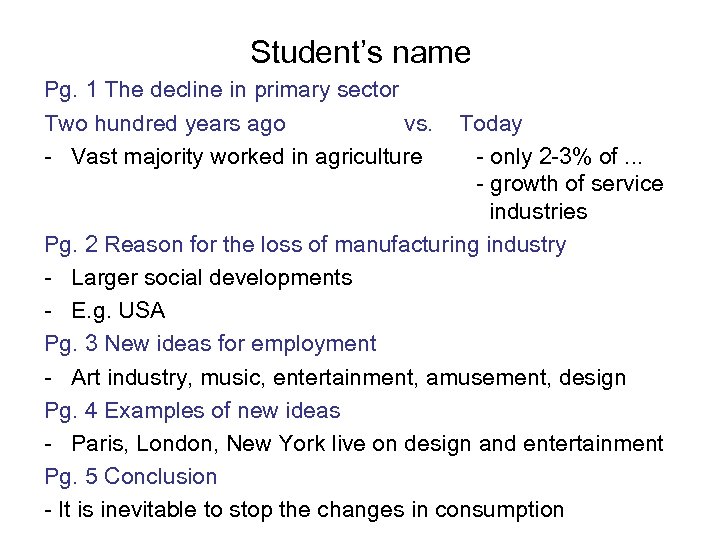 Student’s name Pg. 1 The decline in primary sector Two hundred years ago vs. - Vast majority worked in agriculture Today - only 2 -3% of. . . - growth of service industries Pg. 2 Reason for the loss of manufacturing industry - Larger social developments - E. g. USA Pg. 3 New ideas for employment - Art industry, music, entertainment, amusement, design Pg. 4 Examples of new ideas - Paris, London, New York live on design and entertainment Pg. 5 Conclusion - It is inevitable to stop the changes in consumption
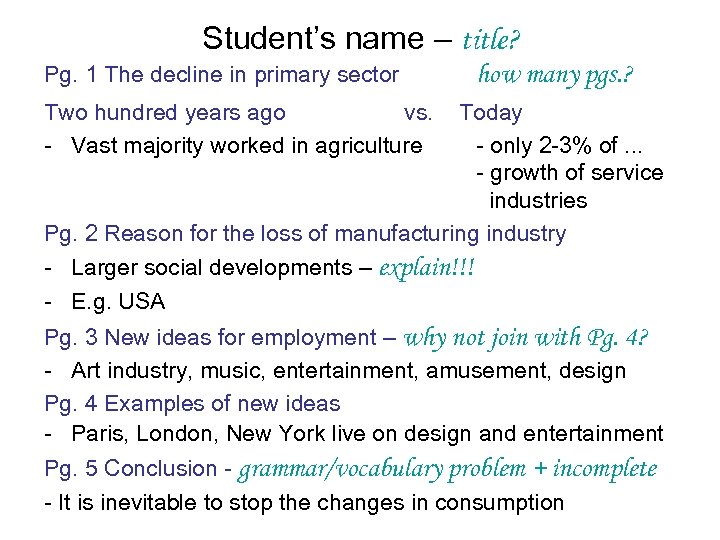 Student’s name – title? Pg. 1 The decline in primary sector how many pgs. ? Two hundred years ago vs. - Vast majority worked in agriculture Today - only 2 -3% of. . . - growth of service industries Pg. 2 Reason for the loss of manufacturing industry - Larger social developments – explain!!! - E. g. USA Pg. 3 New ideas for employment – why not join with Pg. 4? - Art industry, music, entertainment, amusement, design Pg. 4 Examples of new ideas - Paris, London, New York live on design and entertainment Pg. 5 Conclusion - grammar/vocabulary problem + incomplete - It is inevitable to stop the changes in consumption
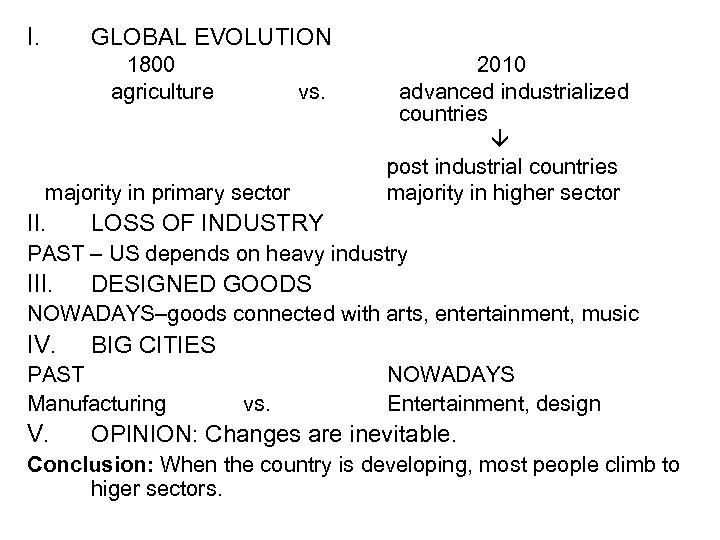 I. GLOBAL EVOLUTION 1800 agriculture vs. majority in primary sector II. 2010 advanced industrialized countries post industrial countries majority in higher sector LOSS OF INDUSTRY PAST – US depends on heavy industry III. DESIGNED GOODS NOWADAYS–goods connected with arts, entertainment, music IV. BIG CITIES PAST Manufacturing V. vs. NOWADAYS Entertainment, design OPINION: Changes are inevitable. Conclusion: When the country is developing, most people climb to higer sectors.
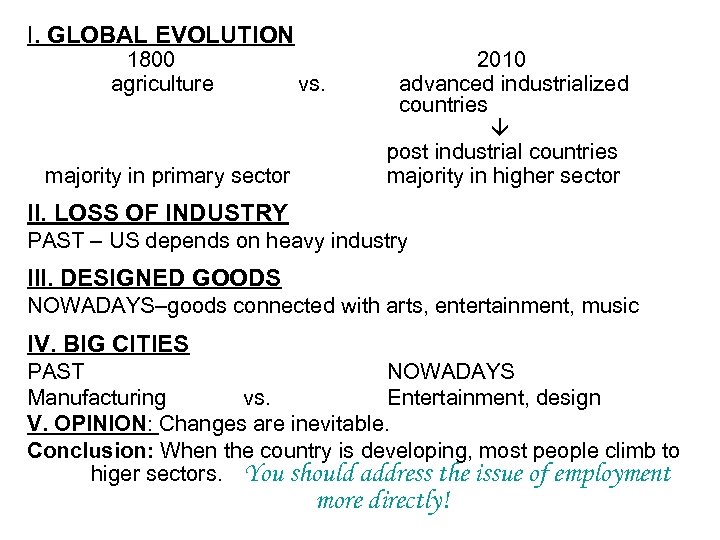 I. GLOBAL EVOLUTION 1800 agriculture majority in primary sector vs. 2010 advanced industrialized countries post industrial countries majority in higher sector II. LOSS OF INDUSTRY PAST – US depends on heavy industry III. DESIGNED GOODS NOWADAYS–goods connected with arts, entertainment, music IV. BIG CITIES PAST NOWADAYS Manufacturing vs. Entertainment, design V. OPINION: Changes are inevitable. Conclusion: When the country is developing, most people climb to higer sectors. You should address the issue of employment more directly!
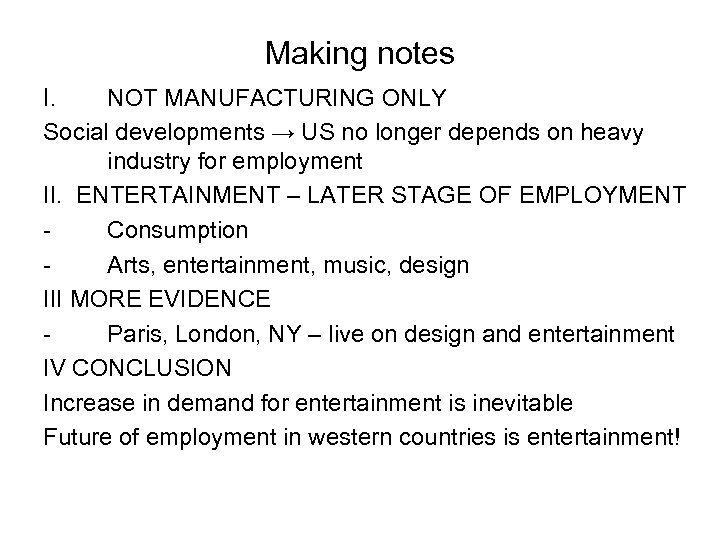 Making notes I. NOT MANUFACTURING ONLY Social developments → US no longer depends on heavy industry for employment II. ENTERTAINMENT – LATER STAGE OF EMPLOYMENT Consumption Arts, entertainment, music, design III MORE EVIDENCE Paris, London, NY – live on design and entertainment IV CONCLUSION Increase in demand for entertainment is inevitable Future of employment in western countries is entertainment!
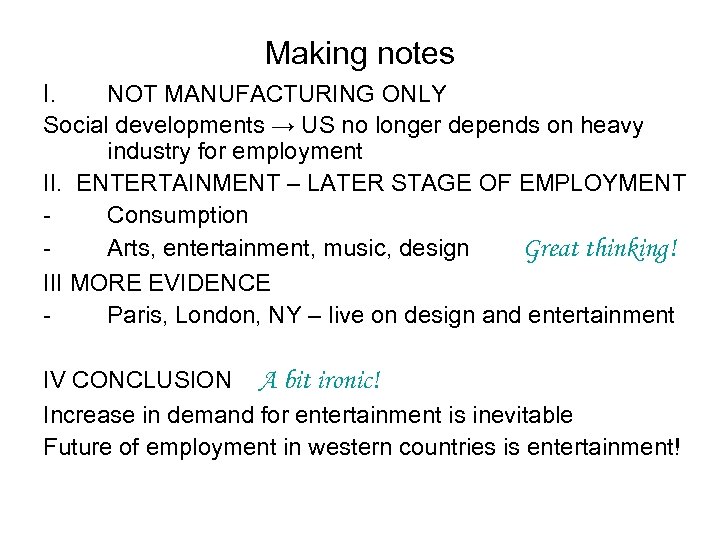 Making notes I. NOT MANUFACTURING ONLY Social developments → US no longer depends on heavy industry for employment II. ENTERTAINMENT – LATER STAGE OF EMPLOYMENT Consumption Arts, entertainment, music, design Great thinking! III MORE EVIDENCE Paris, London, NY – live on design and entertainment IV CONCLUSION A bit ironic! Increase in demand for entertainment is inevitable Future of employment in western countries is entertainment!
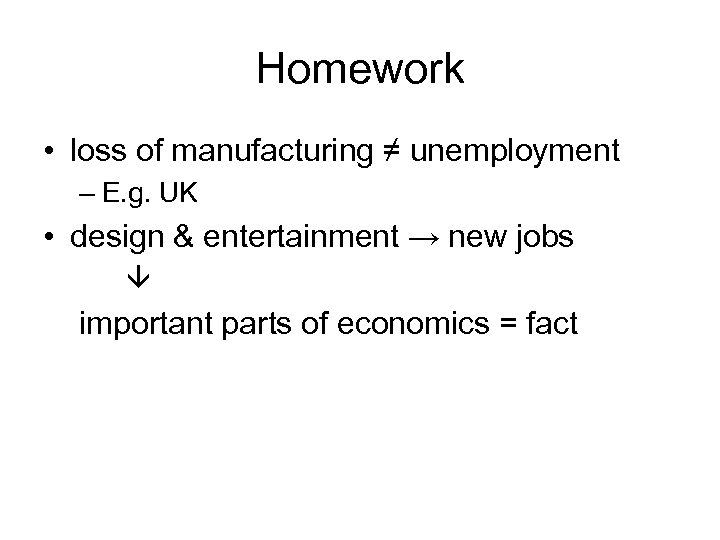 Homework • loss of manufacturing ≠ unemployment – E. g. UK • design & entertainment → new jobs important parts of economics = fact
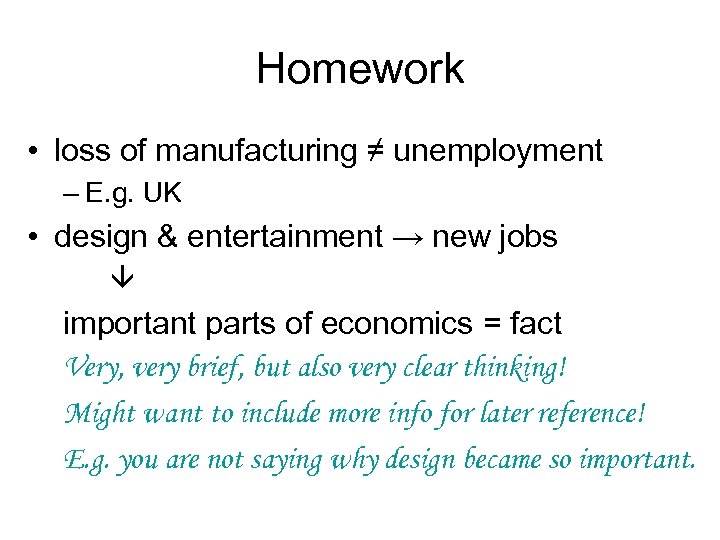 Homework • loss of manufacturing ≠ unemployment – E. g. UK • design & entertainment → new jobs important parts of economics = fact Very, very brief, but also very clear thinking! Might want to include more info for later reference! E. g. you are not saying why design became so important.