


 Скачать презентацию How to lower the energy use of your
0dfbf57ec53a3060443a283e087ca4e3.ppt
- Количество слайдов: 28
 How to lower the energy use of your home David Parker Building Analyst/ Energy Auditor Parker Energy Solutions
 Topics to be covered Ø Energy use statistics & standards Ø Home energy saving opportunities Ø Home Energy Auditing Ø Auditor Certification Ø Saving energy by conservation, efficiency, Renewable generation
 Energy use statistics & standards Ø What is energy? Ø What is power? Ø Units of energy & power.
 Energy Basics Energy is the ability to do work There are different forms of energy: Heat (thermal) Light (radiant) Motion (kinetic) Electrical Chemical Nuclear energy Gravitational
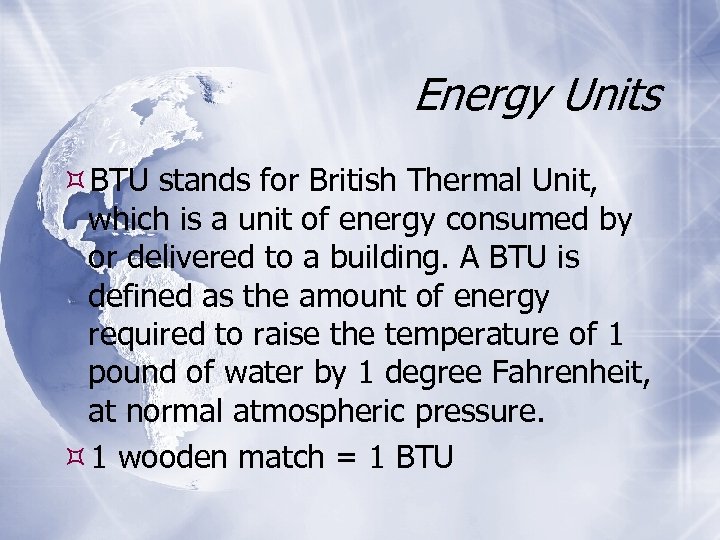 Energy Units BTU stands for British Thermal Unit, which is a unit of energy consumed by or delivered to a building. A BTU is defined as the amount of energy required to raise the temperature of 1 pound of water by 1 degree Fahrenheit, at normal atmospheric pressure. 1 wooden match = 1 BTU
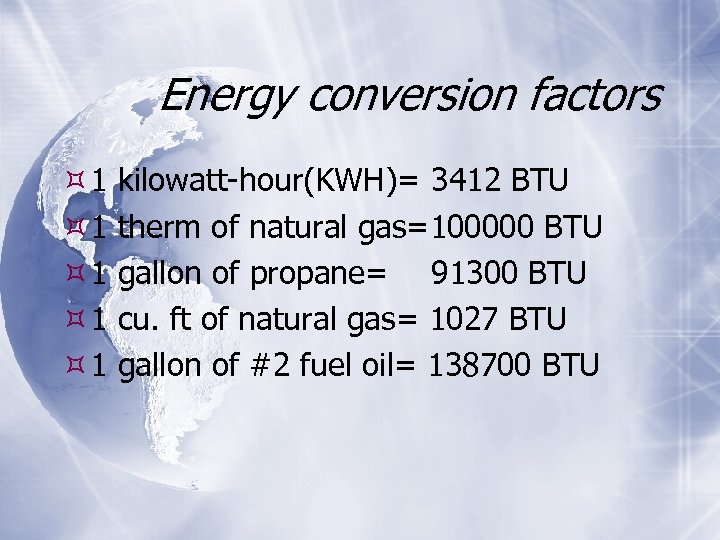 Energy conversion factors 1 1 1 kilowatt-hour(KWH)= 3412 BTU therm of natural gas=100000 BTU gallon of propane= 91300 BTU cu. ft of natural gas= 1027 BTU gallon of #2 fuel oil= 138700 BTU
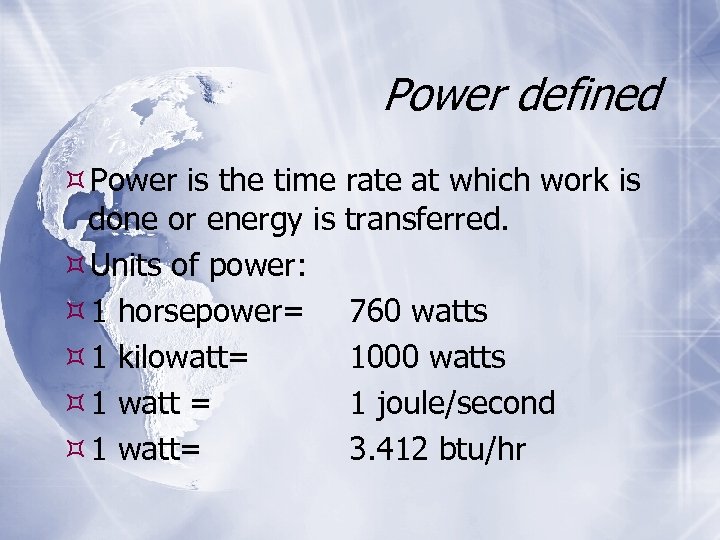 Power defined Power is the time rate at which work is done or energy is transferred. Units of power: 1 horsepower= 760 watts 1 kilowatt= 1000 watts 1 watt = 1 joule/second 1 watt= 3. 412 btu/hr
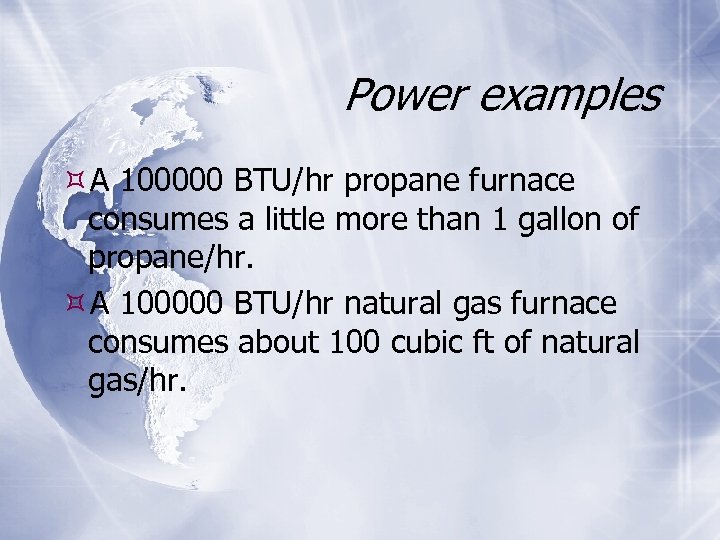 Power examples A 100000 BTU/hr propane furnace consumes a little more than 1 gallon of propane/hr. A 100000 BTU/hr natural gas furnace consumes about 100 cubic ft of natural gas/hr.
 Total US Energy Use by sector Source: U. S. Energy Information Administration Annual Energy Review 2009
 What are the top three things one can do to personally reduce his/her carbon emissions? 1. Drive a more fuel-efficient car 2. Insulate/weatherize your home 3. Eat less beef
 How much energy do we use in our homes? (What is our Energy Use Intensity)? A measure of the energy efficiency of a building Units of kbtu/ft^2/yr Source: Energy Information Administration, Residential Energy Consumption Survey 2005
 How do we use energy in our homes? Source: DOE, 2009 Buildings Energy databook
 Home energy saving opportunities 1. 2. 3. 4. Whole house air leakage/infiltration Air duct leakage Insulation Other common opportunities
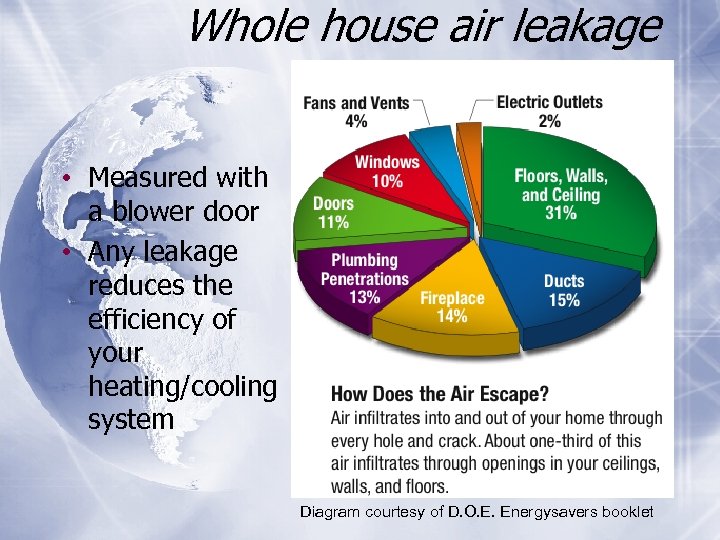 Whole house air leakage • Measured with a blower door • Any leakage reduces the efficiency of your heating/cooling system Diagram courtesy of D. O. E. Energysavers booklet
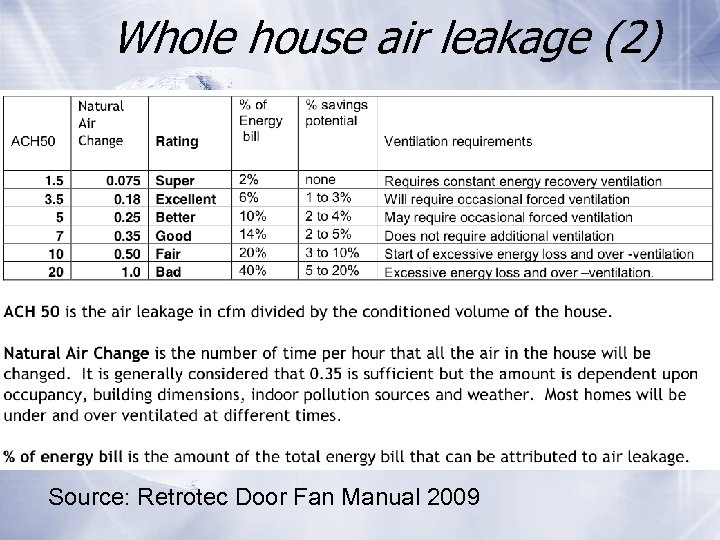 Whole house air leakage (2) Source: Retrotec Door Fan Manual 2009
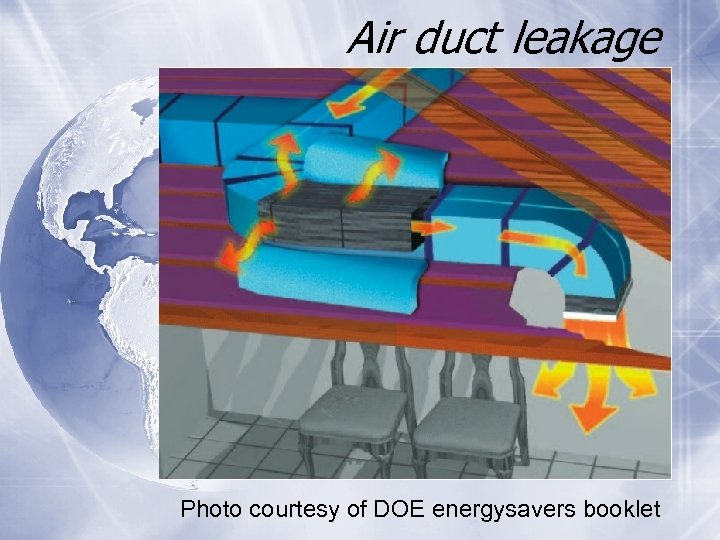 Air duct leakage Photo courtesy of DOE energysavers booklet
 Air duct leakage(2) The average forced air distribution system in California leaks about 30% Sealing a system to 5% leakage will reduce system energy consumption by 19% Source: PG&E (Proper procedures for charging A/C or heat pumps)
 Insulation
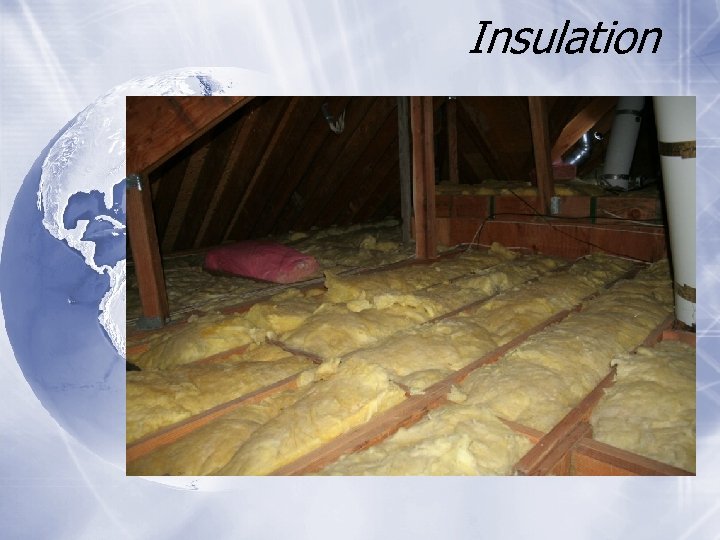
 Insulation Opportunities 1. Inadequate insulation in ceiling, subfloor, and walls 2. Poor installation: gaps between batts and floor/roof joists 3. Missing/not coincident with pressure/air barrier (typical troublespots are showers/tubs and bay windows.
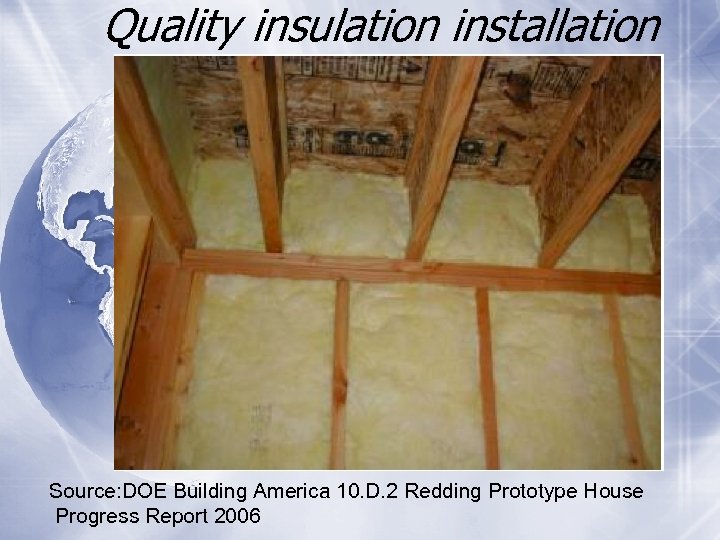 Quality insulation installation Source: DOE Building America 10. D. 2 Redding Prototype House Progress Report 2006
 Other common opportunities Inadequate duct insulation Low air handler airflow Furnace/AC over-sized Ducts not sized correctly for room loads
 Home Energy Auditing What is an energy audit? An energy audit or assessment is a service where the energy efficiency of a house is evaluated by a person using professional equipment (such as blower doors, duct testers, and combustion analyzers), with the aim to suggest the best ways to improve energy efficiency in heating and cooling the house. The audit also identifies any health, safety, or comfort issues.
 Home Energy Auditing (2) The product of an audit is a report that gives recommendations on specific energy efficiency improvements. The report may also “benchmark” your home or compare your home to similar homes in your region.
 Home Energy Auditing (3) *Total annual savings do not add directly since each savings estimate assumes that all other features remain the same.
 Auditor Certification RESNET HERS raters certification BPI Building Analyst certification HERS Raters are trained to do both home energy audits and home energy ratings. BPI Building Analysts have more training (and required tests) with combustion appliances and measurements of the combustion appliance zone.
 Saving energy by conservation, efficiency, Renewable generation The cheapest kw. H is the one you don’t use. Real time energy monitoring can help people conserve energy use. Energy efficiency improvements are the next priority On site renewable energy generation should be examined after the above methods are explored.
 Summary What we covered: Ø Energy use statistics & standards Ø Home energy saving opportunities Ø Home Energy Auditing Ø Auditor Certification Ø Saving energy by conservation, efficiency, Renewable generation
 Questions?