


 Скачать презентацию How to Identify Sell and Negotiate Your Strategic
0be214fcfa7d2b3208d3db1e8d3a7b9d.ppt
- Количество слайдов: 32
 How to Identify, Sell and Negotiate Your Strategic Plans for Your CEO and Management Kaufman Laura Steck Growth and Leadership Center
 Today’s Objectives How To: 1. Develop HR business goals that align with the Vision, Strategy and Goals of the company 2. Contribute by: identifying, mapping pitching and negotiating Strategic HR initiatives that support the goals 3. Build measurement methods for specific HR strategic initiatives 2
 HR Strategic Partnering Why Is It Important Today? 1. Building Sustainable Competitive Advantage 2. Supporting Global Workforces 3. Enhancing Intellectual Assets 4. Driving the HR Value Imperative 5. Staying Strategic While Dealing with Economic Uncertainty 3
 5 Steps To Get Your Initiatives Through Your CEO, CFO and Top Management Team 1. Identify the Needs and map to strategy 2. Sell the competitive value proposition 3. Develop a dynamic, solutions-based message/materials that helps solve the core business needs 4. Ask penetrating questions to isolate and overcome objections 5. Negotiate using the leaders own mind set 4
 Step 1: What They Need • What does the CEO need? • What does the CFO need? • What does the Senior Management Team need? • What are their perspectives and objections? 5
 CEOs Care About Building Competitive Advantage and Return for Stakeholders “Look, HR should be every company’s ‘killer app’. What could possibly be more important than who gets hired, developed, promoted or moved out the door? ” --Jack Welch Former CEO, GE 6
 CFOs Need and Care About • Financial Returns – Need ROI and other financial measurements • They also care about supporting – CEO/BOD strategy 7
 The Top Management Team Cares About • Strategy and Execution • The right people and organization • They are key to building your ROI connection 8
 What Are Your Current Areas of Focus? 1. Learning and Development q Talent Management q Leveled Training q Leadership Development/Coaching q Employee Champion q Succession Planning 2. Organizational Effectiveness q Change Management q M&A Integration/Restructuring q Team Development q Talent-Role Alignment q Outsourcing 3. Compensation and Benefits q Benefits Costs q Health & Welfare, q Retirement 4. Staffing q Recruitment q Retention q International Mobility 5. Legal/Regulatory Compliance q Equal Employment Opportunity policy q Sexual Harassment policy q Hiring policy q Litigation 6. Operational Effectiveness q Systems q Processes q Other Infrastructure q. Globalization q. Other_____ 9
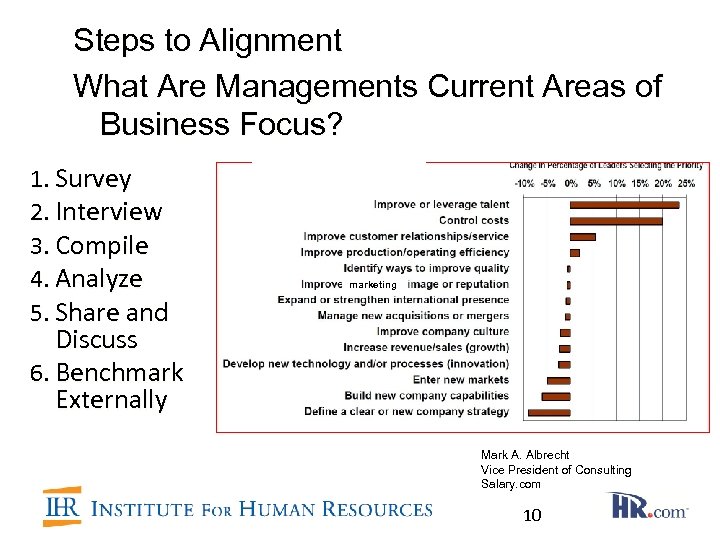 Steps to Alignment What Are Managements Current Areas of Business Focus? 1. Survey 2. Interview 3. Compile 4. Analyze 5. Share and marketing Discuss 6. Benchmark Externally Mark A. Albrecht Vice President of Consulting Salary. com 10
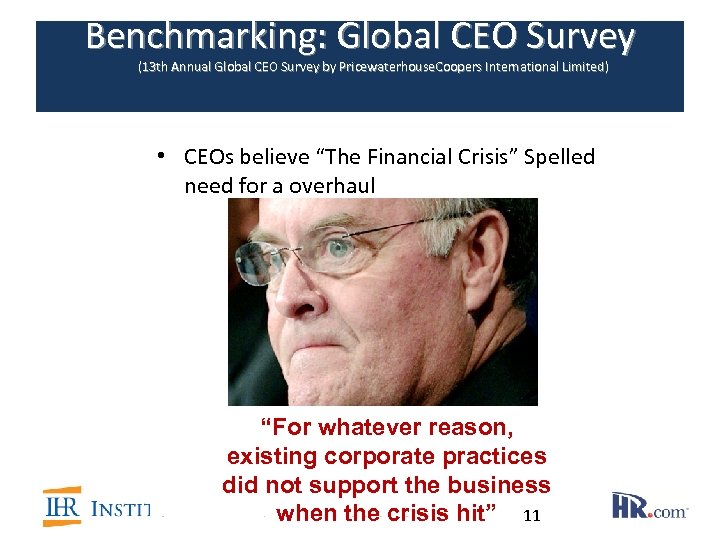 Benchmarking: Global CEO Survey (13 th Annual Global CEO Survey by Pricewaterhouse. Coopers International Limited) • CEOs believe “The Financial Crisis” Spelled need for a overhaul “For whatever reason, existing corporate practices did not support the business when the crisis hit” 11
 Benchmarking: Global CEO Survey (13 th Annual Global CEO Survey by Pricewaterhouse. Coopers International Limited) • Benchmark Your Company: – 13 th Annual Global CEO Survey by Pricewaterhouse. Coopers International Limited – 79% to increase focus and investment on managing people through change 1. Redefining employees’ roles in the organization. 2. Change strategies for managing talent 12
 Benchmarking: Global CEO Survey (13 th Annual Global CEO Survey by Pricewaterhouse. Coopers International Limited) • Financial Crisis Highlights 3 major HR failures 1. Existing reward models broken. 2. CEOs were unable to move talent around quickly when the crisis hit. 3. Employees lack the key skills needed to operate and compete in the new emerging environment. 13
 Benchmarking: Global CEO Survey (13 th Annual Global CEO Survey by Pricewaterhouse. Coopers International Limited) • Also, CEOs indicate government sponsorship education has failed – To supply a workforce with the right skills. – 41% to increase focus on learning and development 14
 Step 2: Sell The Competitive Value Proposition 1. Utilize Strategic HR Partnerships 2. Understand the Value Chain 3. Establish ROI 15
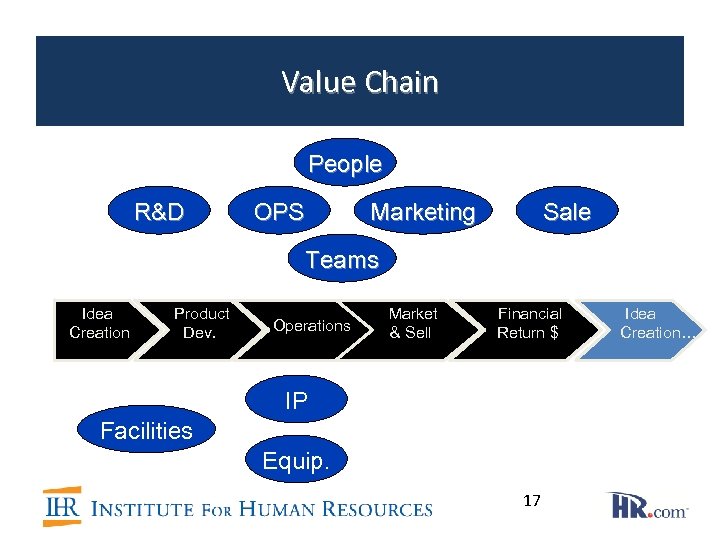 Value Chain People R&D OPS Marketing Sale Teams Idea Creation Product Dev. Operations Market & Sell Financial Return $ IP Facilities Equip. 17 Idea Creation…
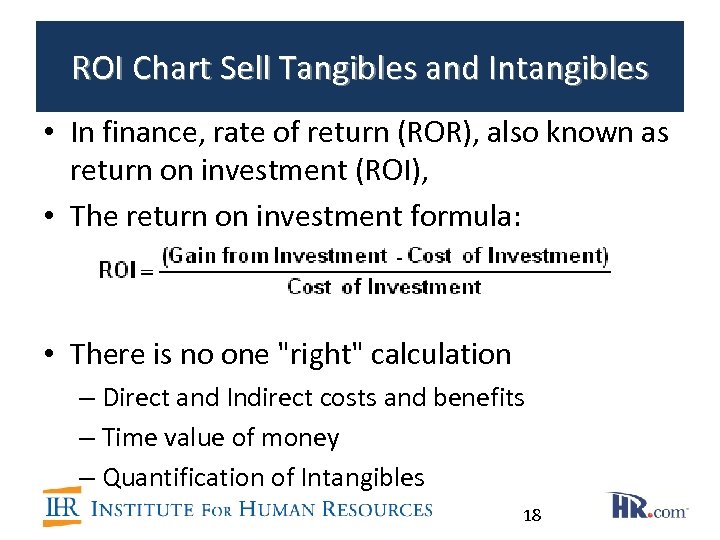 ROI Chart Sell Tangibles and Intangibles • In finance, rate of return (ROR), also known as return on investment (ROI), • The return on investment formula: • There is no one "right" calculation – Direct and Indirect costs and benefits – Time value of money – Quantification of Intangibles 18
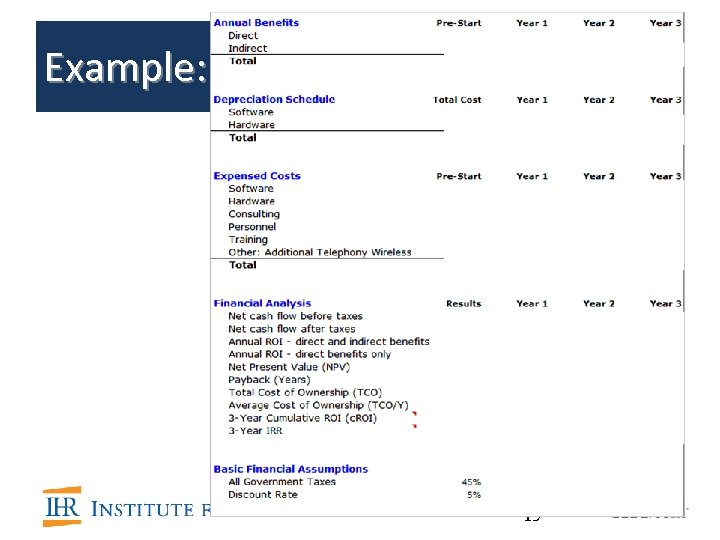 Example: 19
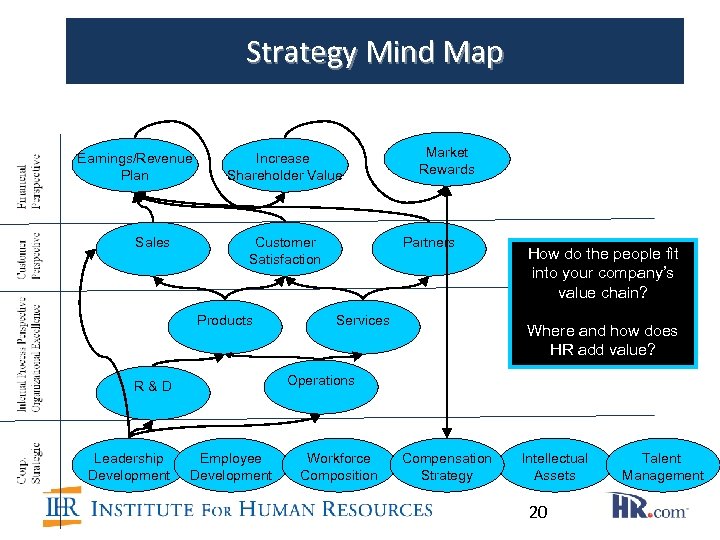 Strategy Mind Map Earnings/Revenue Plan Sales Increase Shareholder Value Customer Satisfaction Products Partners Services How do the people fit into your company’s value chain? Where and how does HR add value? Operations R&D Leadership Development Market Rewards Employee Development Workforce Composition Compensation Strategy Intellectual Assets 20 Talent Management
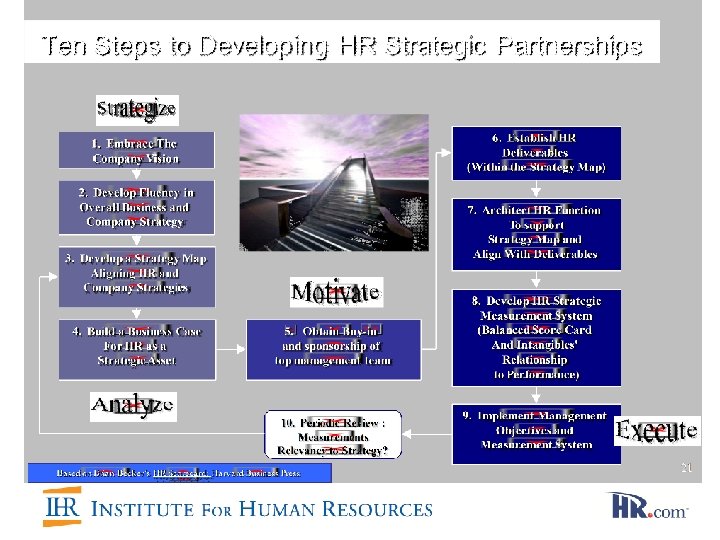
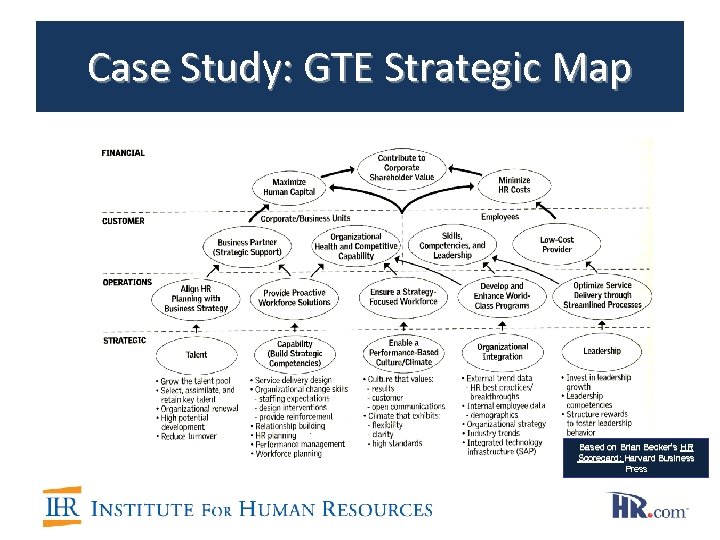 Case Study: GTE Strategic Map Based on Brian Becker’s HR Scorecard; Harvard Business Press
 Seagate Case Study "HR was not meeting Seagate's HR information access needs… "We had at least 17 different HR management systems … no consistent navigation to benefits and other HR pages, and it wasn't of much value to the user. “ • Six-point plan: 1. establish global HR centers of expertise 2. align HR with company business leaders and designate an HR go-to person for the 100 top executives; 3. set up regional HR service centers; 4. Implement manager self-service (MSS); 5. implement employee self-service (ESS); and 6. designate local HR staff to provide services best offered at each site • Because top management demanded better HR service, VP HR Karen Hanlon was able to convince them (CEO/CFO/TMT) of the return on investment – "Just getting a global HRMS was enough of a business case. Our CFO said to look at it as deferred maintenance” 22 Content to order: HR Magazine, by Bill Roberts
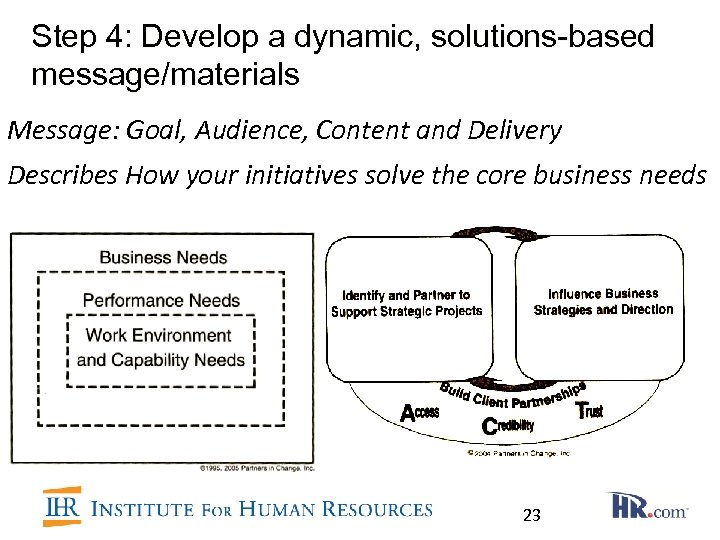 Step 4: Develop a dynamic, solutions-based message/materials Message: Goal, Audience, Content and Delivery Describes How your initiatives solve the core business needs 23
 Step 4: Ask penetrating questions to isolate and overcome objections • • Who… What… When… Where… How… And Especially Why? Overcoming Objections with criteria, content and out of the box thinking 24
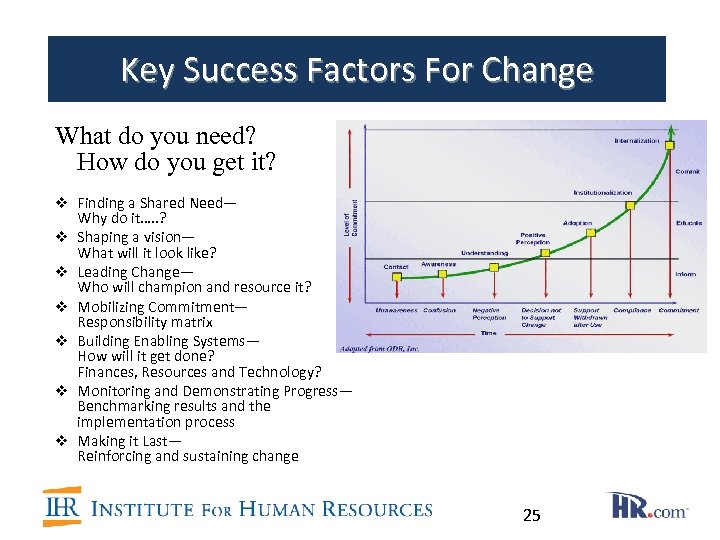 Key Success Factors For Change What do you need? How do you get it? v Finding a Shared Need— v v v Why do it…. . ? Shaping a vision— What will it look like? Leading Change— Who will champion and resource it? Mobilizing Commitment— Responsibility matrix Building Enabling Systems— How will it get done? Finances, Resources and Technology? Monitoring and Demonstrating Progress— Benchmarking results and the implementation process Making it Last— Reinforcing and sustaining change 25
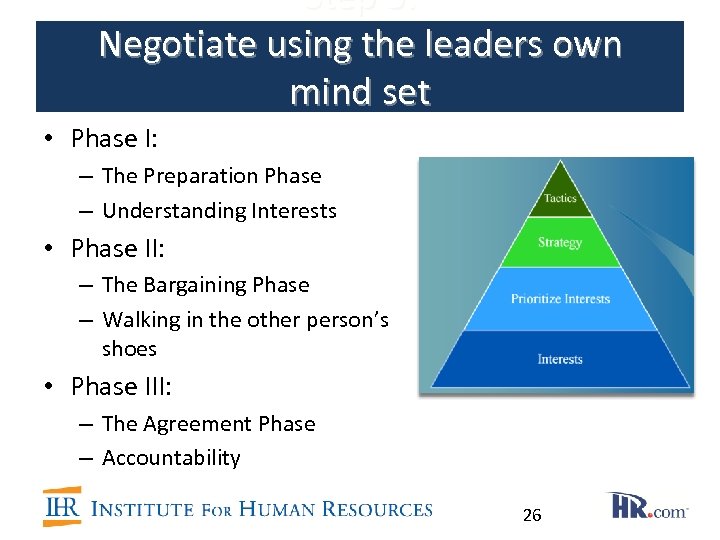 Step 5: Negotiate using the leaders own mind set • Phase I: – The Preparation Phase – Understanding Interests • Phase II: – The Bargaining Phase – Walking in the other person’s shoes • Phase III: – The Agreement Phase – Accountability 26
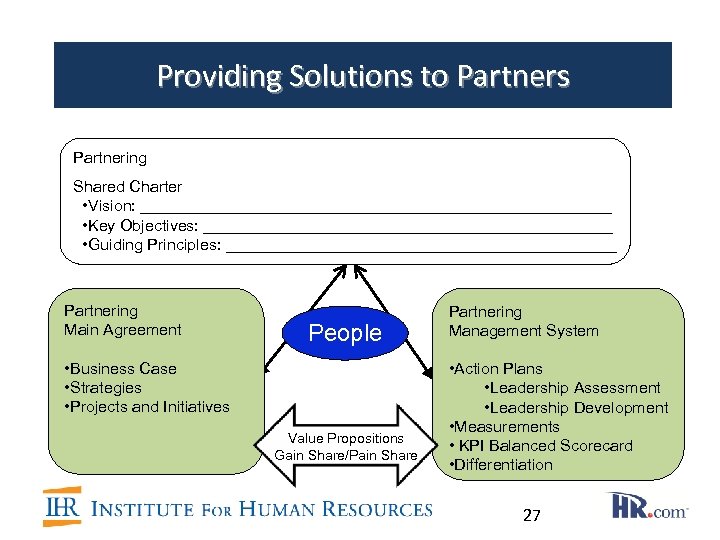 Providing Solutions to Partners Partnering Shared Charter • Vision: ___________________________ • Key Objectives: _______________________ • Guiding Principles: ______________________ Partnering Main Agreement People • Business Case • Strategies • Projects and Initiatives Value Propositions Gain Share/Pain Share Partnering Management System • Action Plans • Leadership Assessment • Leadership Development • Measurements • KPI Balanced Scorecard • Differentiation 27
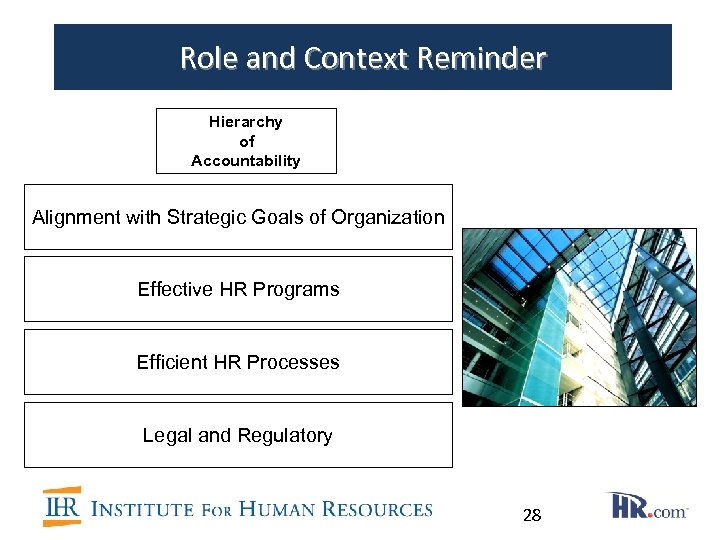 Role and Context Reminder Hierarchy of Accountability Alignment with Strategic Goals of Organization Effective HR Programs Efficient HR Processes Legal and Regulatory 28
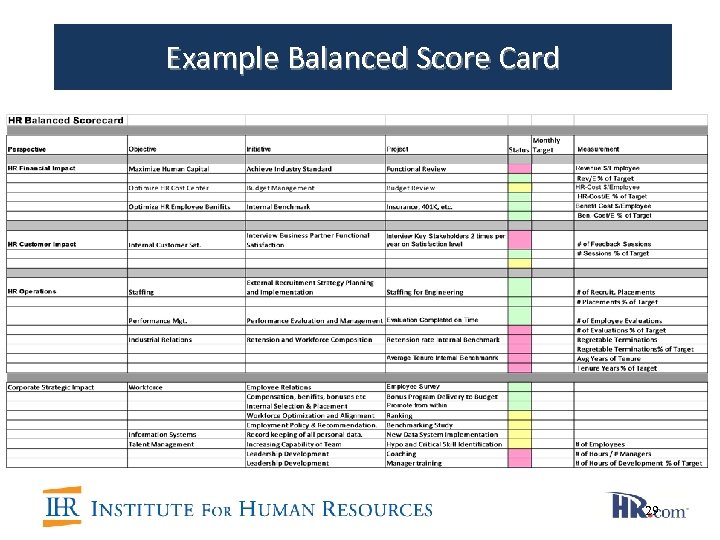 Example Balanced Score Card 29
 Summary: Delivering On HR Strategic Value • Align HR Strategy and Tactics With Organizational Goals • SBP Strategic Impact • Do Your Work and Your Homework • Influence Before You Need To • Plan Your Campaigns: Beginning, Middle and End • Negotiate Win/Win • Build Your Measurement Systems Celebrate Your Successes! 30
 Speakers Kent Kaufman, MS, M. S. E, Chief Executive Officer Ø Kent Kaufman brings over 20 years of Leadership and stellar business experience to Growth & Leadership Center. Kent's work history covers the technical and business gamut including VP and senior levels of engineering, sales, marketing, operations and business development. Kent currently coaches high tech businesses with strategy, HR , Sales and business Growth with companies at all stages. Laura Steck, M. A. , President & Executive Coach Ø Laura, President, Executive Coach, and licensed clinician, has worked doing executive Coaching and teambuilding with many CEO’s, HR Professionals and leaders in Silicon Valley’s High Tech companies for the past 20 years. Laura is an expert at teaching optimistic interactions and business Leadership during critical transitions in organizations. Laura’s passion and emphasis is focusing on high level strategy, business changes, women’s leadership and conflict resolution. Her clients include Chevron, HP, Abbott, Intel and Rudolpgh and Sletten. Kent Kaufman and Laura Steck Growth and Leadership Center 408. 734. 2300 info@glcweb. com © GL C 31
 Bibliography • References • ARMSTRONG, M and BARON, A. (2002) Strategic HRM: the key to improved business performance. Developing practice. London: Chartered Institute of Personnel and Development. Available at http: //www. cipd. co. uk/bookstore • Content to order: a knowledge base is one key to Seagate's HR systems strategy - HR Technology: Systems & Solutions - Seagate Technology Inc - human resources HR Magazine, July, 2002 by Bill Roberts • SCHULER, R. S. (1992) Strategic human resource management: linking people with the needs of the business. Organizational Dynamics. Vol 21, No 1. pp 18 -32. • WRIGHT, P. M. and MCMAHAN, G. C. (1992) Theoretical perspectives for SHRM. Journal of Management. March. pp 215 -247. • Brian Becker’s “HR Scorecard”; Harvard Business Press • BOXALL, P. and PURCELL, J. (2003) Strategy and human resource management. Basingstoke: Palgrave Macmillan. • DYER, L. and HOLDER, G. Strategic human resource management and planning. In: DYER, L. (ed) (1998) Human resource management: evolving roles and responsibilities. Washington DC: Bureau of National Affairs. • PURCELL, J. , KINNIE, N. and HUTCHINSON, S. (2003) Understanding the people and performance link: unlocking the black box. London: Chartered Institute of Personnel and Development. Available at http: //www. cipd. co. uk/bookstore • BARON, A. and ARMSTRONG, M. (2007) Human capital management. London: Kogan Page. • BROWN, D. , CALDWELL, R. and WHITE, K. (2004) Business partnering: a new direction for HR. A guide. London: Chartered Institute of Personnel and Development. Available at: http: //www. cipd. co. uk/guides • BROWN, R. , EGAN, J. and SUFF, P. (2004) Developing HR strategy. Managing best practice. London: Work Foundation. • LEOPOLD, J. , HARRIS, L. and WATSON, T. J. (2005) The strategic managing of human resources. Harlow: Pearson Education. • MILLMORE, M. , LEWIS, P. and SAUNDERS, M. (2007) Strategic human resource management: contemporary issues. Harlow: Financial Times/Prentice Hall. • VERE, D. and BUTLER, L. (2007) Fit for business: transforming HR. Research into practice. London: Chartered Institute of Personnel and Development. • Journal articles • REILLY, P. (2008) Strategic HR? Ask yourself the questions. HR Director. No 44, February. pp 12 -14, 16 -17 • RICHARDS, J. (2007) Aligning HR with the business: two steps forward, one step back. IRS Employment Review. No 866, 2 March. pp 6 -12. 32