


 Скачать презентацию How to give a science talk in context
How_to_give_a_science_talk.pptx
- Количество слайдов: 22
 How to give a science talk in context of IYPT by Andrei Klishin MIT Physics Department Lyceum BSU, June 7, 2014 MIT Junior Lab 8. 13 1
 Preview 1. 2. 3. 4. 5. How it’s already done Who’s your audience What’s your message How to support the message throughout How to finish 2
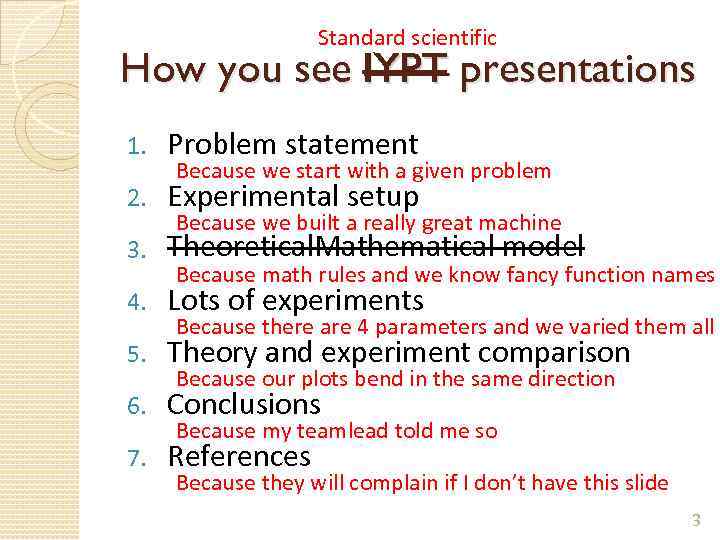 Standard scientific How you see IYPT presentations 1. Problem statement 2. Experimental setup 3. Theoretical. Mathematical model Theoretical model 4. Lots of experiments 5. Theory and experiment comparison 6. Conclusions 7. References Because we start with a given problem Because we built a really great machine Because math rules and we know fancy function names Because there are 4 parameters and we varied them all Because our plots bend in the same direction Because my teamlead told me so Because they will complain if I don’t have this slide 3
 Think about your audience It cannot happen that most of your jury board is simultaneously incompetent. If they all don’t get what you say – it’s your problem. It’s your job to do science work and make conclusions. It’s their job to listen. When you’re not reporting, observe yourself observing a talk. What matters for you, what convinces you, what bores? 4
 Think about your message No elements of your talk are obligatory and Supreme Forces-required. You want to say that you solved the required problem. Saying how much you struggled on it doesn’t help the case. You prove that you’re correct by presenting a compelling argument. 5
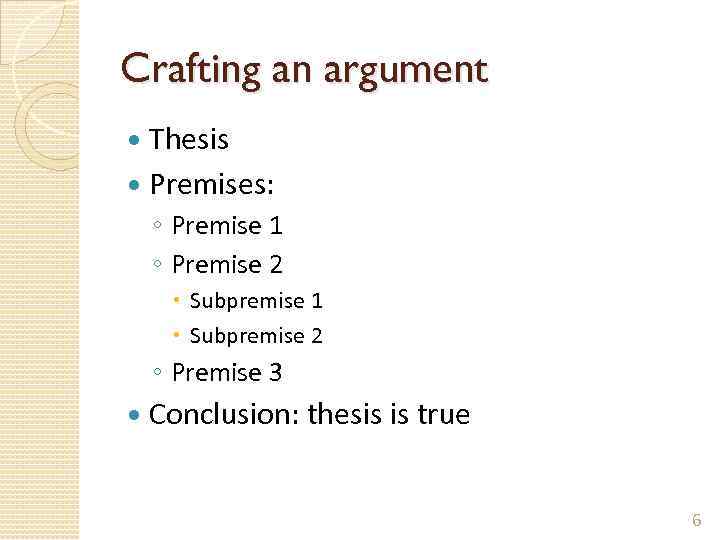 Crafting an argument Thesis Premises: ◦ Premise 1 ◦ Premise 2 Subpremise 1 Subpremise 2 ◦ Premise 3 Conclusion: thesis is true 6
 How to tell proud from truth Audience generally believes what you say. If you claim that you’ve done all the thinking work yourself, it is obnoxious. Your novelty is only visible in contrast with existing knowledge. Making unified conclusions is harder than measuring and writing formulas and reading papers. Be proud of your higherlevel achievements. 9
 Why cite and reference Building up from basic physics is cool, but it’s unlikely that each your idea is original. Some ideas are, and conclusions are. For this reason referencing contemporary research and journals is more respectable than referencing textbooks. Often existence of reference is more important than its content. 10
 HOW TO MAKE THEM UNDERSTAND YOU Trick 1: Thin down/skip/gloss over Trick 2: Walk-through Trick 3: Dichotomies (comparing of two objects) 11
 Perception of many objects Human brain cannot process too many objects at the same time. It does not depend on the competence of the viewer, it depends on the quality of presentation. Fortunately, you usually really don’t need to draw attention to many objects to convey your message. 12
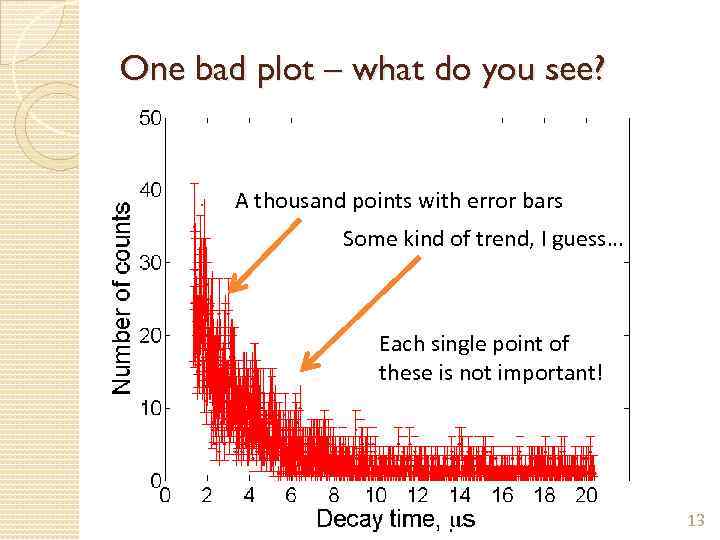 One bad plot – what do you see? A thousand points with error bars Some kind of trend, I guess… Each single point of these is not important! 13
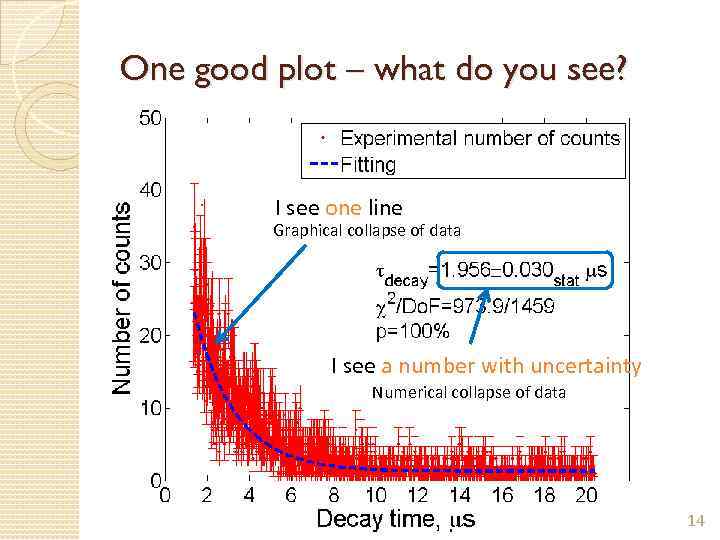 One good plot – what do you see? I see one line Graphical collapse of data I see a number with uncertainty Numerical collapse of data 14
 Trick 1 What did I just do with one plot? I glossed over all my raw data showing that I did it. I distracted you by showing the trend line and the number, thinned down my data. I skipped telling you the methods of these collapses, and you still believe me. 15
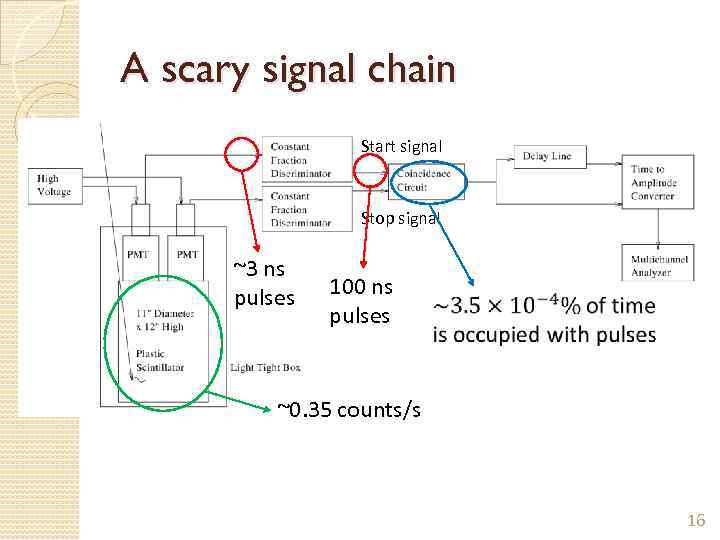 A scary signal chain Start signal Stop signal ~3 ns pulses 100 ns pulses ~0. 35 counts/s 16
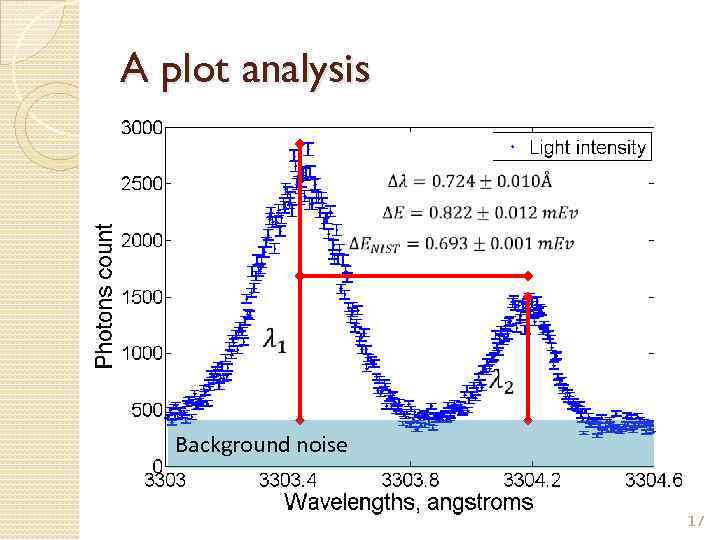 A plot analysis Background noise 17
 Trick 2 Why are these comprehensible? I showed you the whole scheme/plot. I put animations showing technical details along the signal chain or plot analysis. I walked you through the chain/analysis. I used colored takeaway points. I showed different information with the main scheme and the takeaways. 18
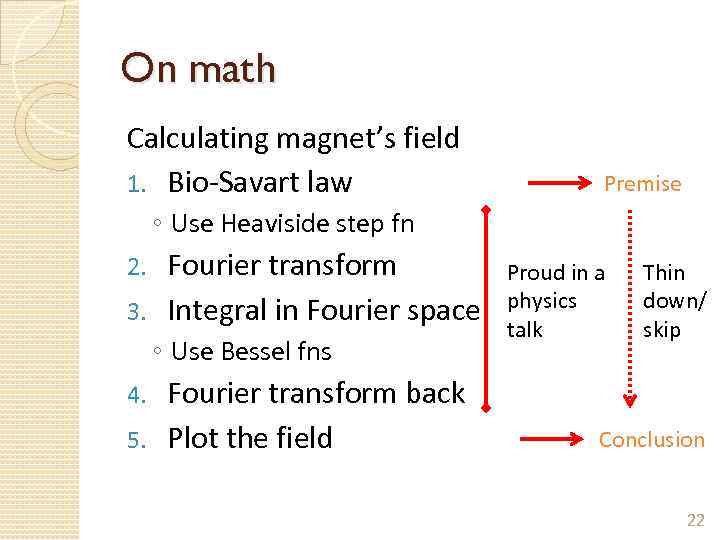 On math Calculating magnet’s field 1. Bio-Savart law Premise ◦ Use Heaviside step fn Fourier transform 3. Integral in Fourier space 2. ◦ Use Bessel fns Fourier transform back 5. Plot the field Proud in a physics talk Thin down/ skip 4. Conclusion 22
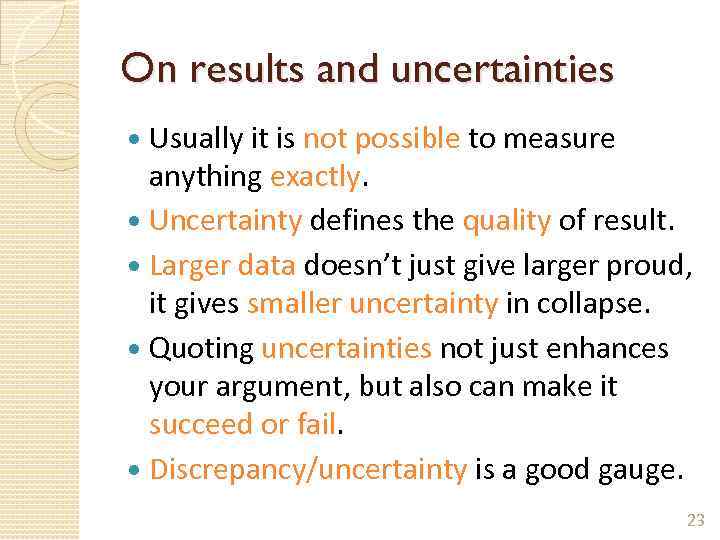 On results and uncertainties Usually it is not possible to measure anything exactly. Uncertainty defines the quality of result. Larger data doesn’t just give larger proud, it gives smaller uncertainty in collapse. Quoting uncertainties not just enhances your argument, but also can make it succeed or fail. Discrepancy/uncertainty is a good gauge. 23
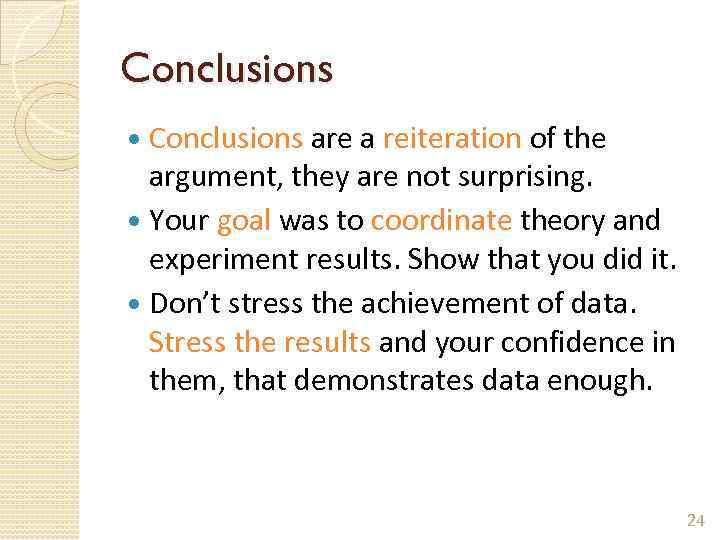 Conclusions are a reiteration of the argument, they are not surprising. Your goal was to coordinate theory and experiment results. Show that you did it. Don’t stress the achievement of data. Stress the results and your confidence in them, that demonstrates data enough. 24
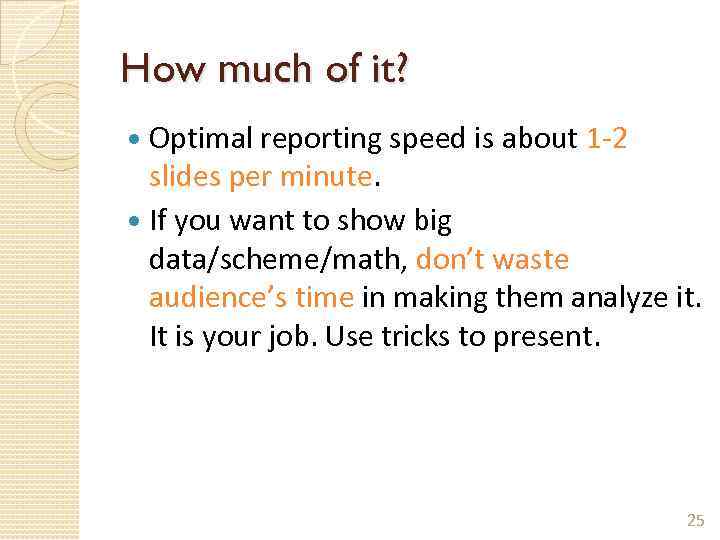 How much of it? Optimal reporting speed is about 1 -2 slides per minute. If you want to show big data/scheme/math, don’t waste audience’s time in making them analyze it. It is your job. Use tricks to present. 25
 Common courtesies Provide the audience with the structure of your talk. Show section delimiters if it’s long, provide an outline, provide visible slide numbers. Don’t invite anybody to your extra slides. Whenever you go there, you are almost surely lost. Same rules of proud vs truth apply to extra slides. 27
 Thanks for your attention Think of the audience and the argument. Be brave and confident. 31