


 Скачать презентацию How to Get NSF to Fund Your Social
e0123b19c1958df4ec515d08c9a5c62f.ppt
- Количество слайдов: 41
 How to Get NSF to Fund Your Social Science Research Robert E. O’Connor, Director Program in Decision, Risk and Management Sciences Division of Social and Economic Sciences Directorate for Social, Behavioral, and Economic Sciences National Science Foundation Penn State 2013
 Workshop Outline • Background on the National Science Foundation • Social Science Research Opportunities • Submission Procedures • Separating Awards from Declinations
 NSF in a Nutshell • Independent Agency • Discipline-based structure • Supports basic research • Cross-disciplinary mechanisms • Uses grant mechanism • Low overhead; highly automated • Use of Rotators/IPAs • 2014 budget request: $7. 626 billion
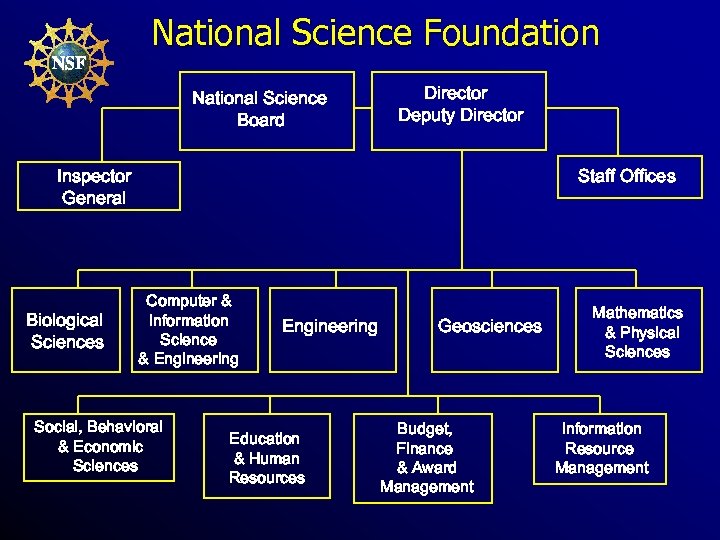 National Science Foundation National Science Board Director Deputy Director Inspector General Biological Sciences Staff Offices Computer & Information Science & Engineering Social, Behavioral & Economic Sciences Engineering Education & Human Resources Geosciences Budget, Finance & Award Management Mathematics & Physical Sciences Information Resource Management
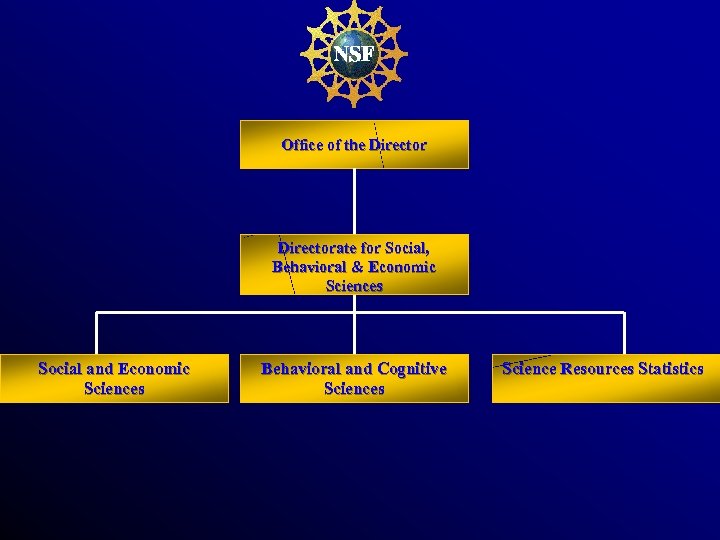 Office of the Directorate for Social, Behavioral & Economic Sciences Social and Economic Sciences Behavioral and Cognitive Sciences Science Resources Statistics
 Why Do You Want NSF Funding? • • Funds curiosity-driven research Pays full overhead (no match) Provides summer salary support Uses the grant mechanism
 Opportunities • • Unsolicited competitions Special solicitations (e. g. , SEES-related) Rapid response research (RAPID) Early-concept grants for exploratory research (EAGER) CAREER grants Dear Colleague Letter Doctoral dissertation improvement grants Research Coordination Networks
 Where to Start? • www. nsf. gov • Check awards by program, keyword, etc. (www. nsf. gov/awardsearch/) • Read solicitation carefully (if not unsolicited competition) • Download Grant Proposal Guide (http: //www. nsf. gov/publications/pub_sum m. jsp? ods_key=gpg)
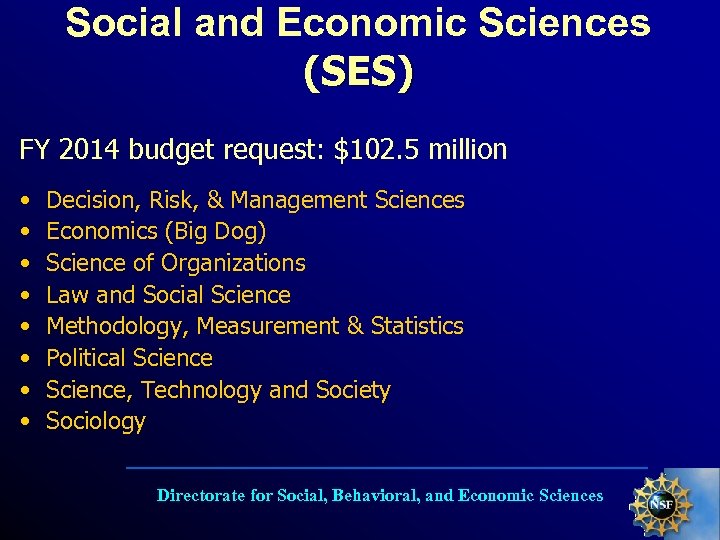 Social and Economic Sciences (SES) FY 2014 budget request: $102. 5 million • • Decision, Risk, & Management Sciences Economics (Big Dog) Science of Organizations Law and Social Science Methodology, Measurement & Statistics Political Science, Technology and Society Sociology Directorate for Social, Behavioral, and Economic Sciences
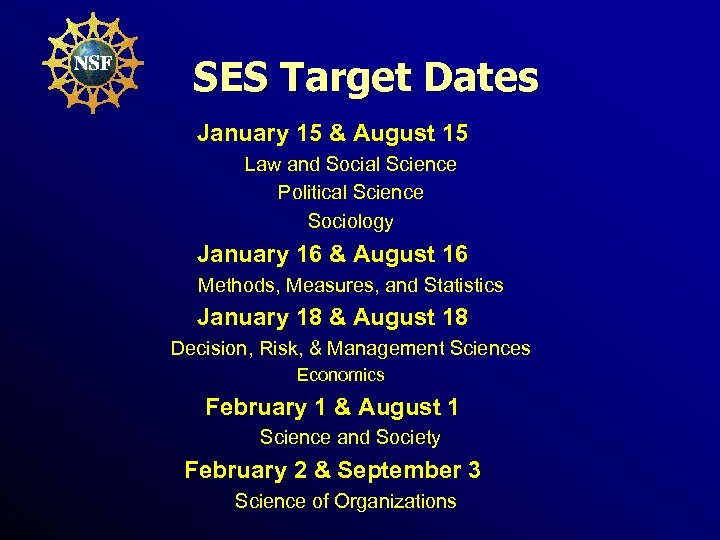 SES Target Dates January 15 & August 15 Law and Social Science Political Science Sociology January 16 & August 16 Methods, Measures, and Statistics January 18 & August 18 Decision, Risk, & Management Sciences Economics February 1 & August 1 Science and Society February 2 & September 3 Science of Organizations
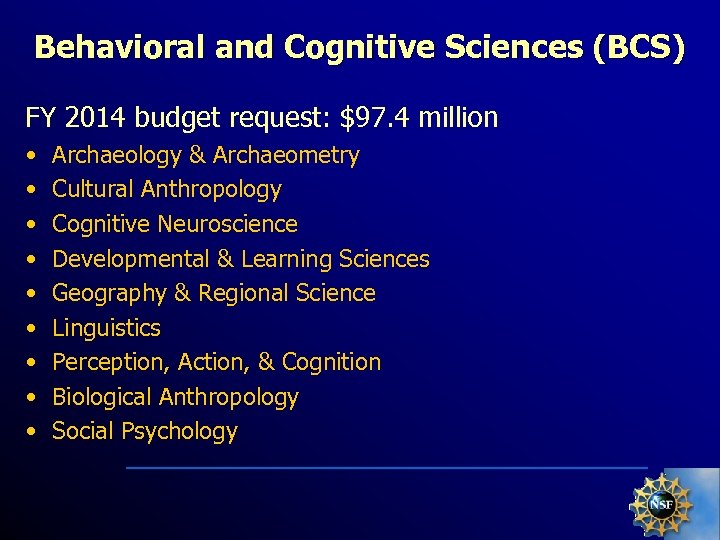 Behavioral and Cognitive Sciences (BCS) FY 2014 budget request: $97. 4 million • • • Archaeology & Archaeometry Cultural Anthropology Cognitive Neuroscience Developmental & Learning Sciences Geography & Regional Science Linguistics Perception, Action, & Cognition Biological Anthropology Social Psychology
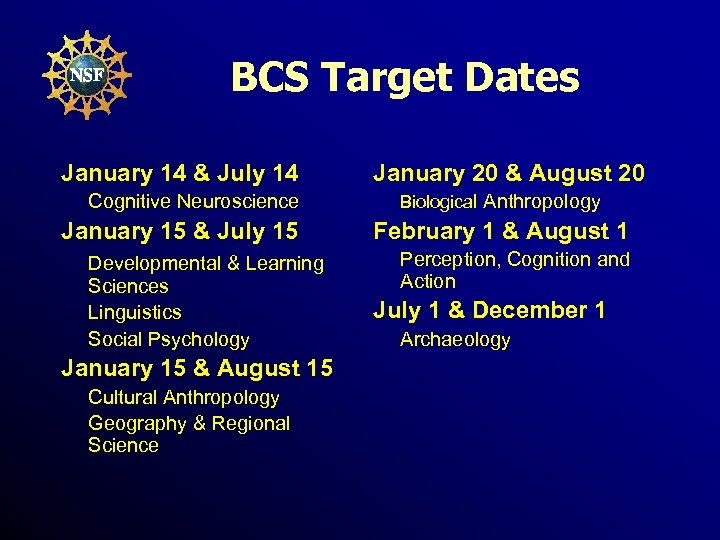 BCS Target Dates January 14 & July 14 Cognitive Neuroscience January 15 & July 15 Developmental & Learning Sciences Linguistics Social Psychology January 15 & August 15 Cultural Anthropology Geography & Regional Science January 20 & August 20 Biological Anthropology February 1 & August 1 Perception, Cognition and Action July 1 & December 1 Archaeology
 Doctoral Dissertation Improvement Awards • Archaeology • Cultural Anthropology • Decision, Risk, & Management Science • Economics • Geography & Regional Science • • • Law and Social Science Linguistics Biological Anthropology Political Science and Society Sociology Directorate for Social, Behavioral, and Economic Sciences
 Faculty Early Career Development (CAREER) Program • • • Untenured faculty (or comparable) Single scholar award $400, 000, 5 -years minimum award Three proposals lifetime limit July 1 deadline “Walk on Water” expectation
 Rapid Response Research (RAPID) • • • Research when data are ephemeral $200, 000 maximum; 1 year 5 -page project description Internal review only Contact program officer first
 Early-concept grants for exploratory research (EAGER) • Exploratory work on untested, potentially transformative ideas • High-risk, high-potential payoff • $300, 000 maximum; 2 years • 8 -page descriptive • Internal review only • Contact program officer first
 Dear Colleague Letter Example: Stimulating Research Related to the Science of Broadening Participation • http: //www. nsf. gov/pubs/2011/nsf 11023/nsf 1 1023. jsp • Submit to relevant SBE program • Front office to pay half of award
 Science, Engineering, and Education for Sustainability • http: //www. nsf. gov/funding/pgm_sum m. jsp? pims_id=504707 • Social science friendly solicitations: – Water sustainability and climate (9/10/13 deadline) – SEES fellows (11/21/13 deadline) – Hazards SEES • FY 2014 request: $223 million
 Research Coordination Networks • http: //www. nsf. gov/pubs/2011/nsf 11531. htm? WT. mc_id=USNSF_25 &WT. mc_ev=click • Support groups of scholars focused on a theme • Submit to a program • Limited to 5 -years, $500, 000
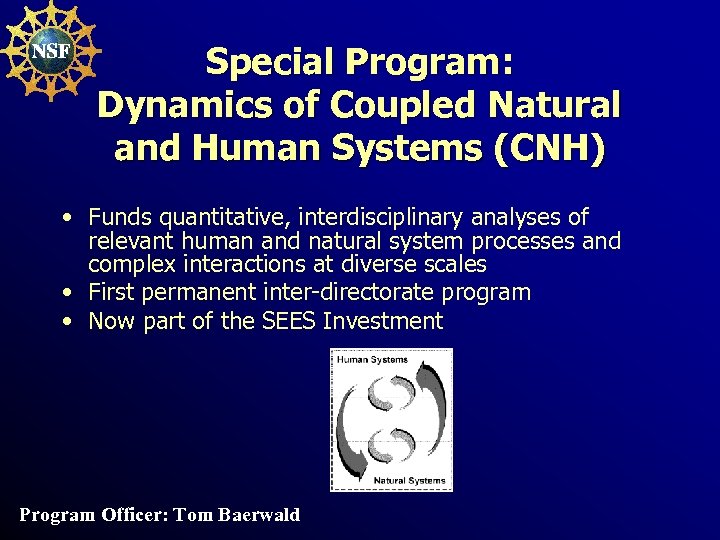 Special Program: Dynamics of Coupled Natural and Human Systems (CNH) • Funds quantitative, interdisciplinary analyses of relevant human and natural system processes and complex interactions at diverse scales • First permanent inter-directorate program • Now part of the SEES Investment Program Officer: Tom Baerwald
 INSPIRE Integrated NSF Support Promoting Interdisciplinary Research and Education http: //www. nsf. gov/funding/pgm_summ. jsp? pims_id=504852 • Requires authorization from two “intellectually distinct programs” to apply • $1 M or $3 awards • Bold interdisciplinary projects • FY 2014 request: $63 million
 IGERT Integrative Graduate Education and Research Traineeship Program • Penn State is a past recipient of IGERT funding • Focused training in specific topical areas for graduate students—pre- and post-doctoral • Big changes coming?
 STEM* Initiatives • NSF Graduate STEM Fellows in K-12 Education (GK-12) • National STEM Education Distributed Learning (NSDL) • Alliances for Broadening Participation in STEM (ABP) As three examples. . * Science, Technology, Engineering, and Mathematics
 NSF’s Future? • FY 2014 budget request is an 8. 4% increase over 2012 budget • The eternal conflict: disciplinary v. interdisciplinary priorities • Threats to social science
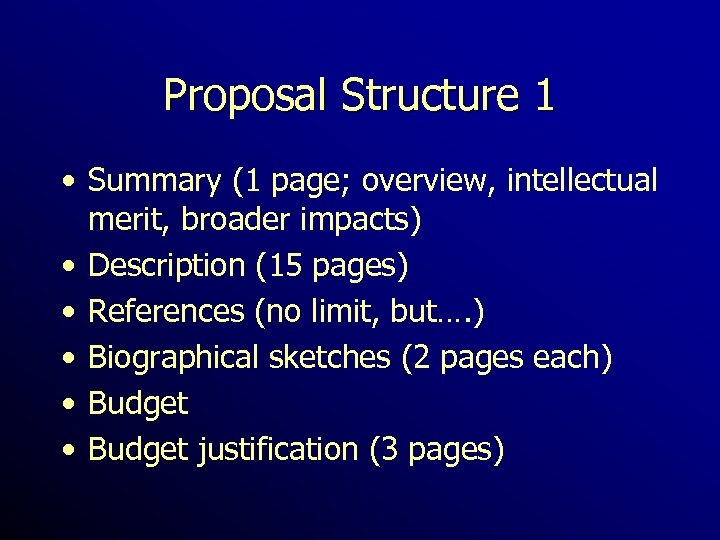 Proposal Structure 1 • Summary (1 page; overview, intellectual merit, broader impacts) • Description (15 pages) • References (no limit, but…. ) • Biographical sketches (2 pages each) • Budget justification (3 pages)
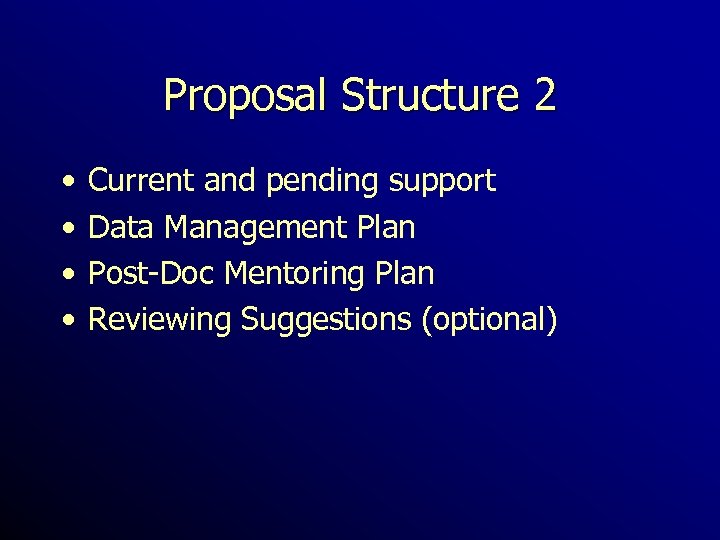 Proposal Structure 2 • • Current and pending support Data Management Plan Post-Doc Mentoring Plan Reviewing Suggestions (optional)
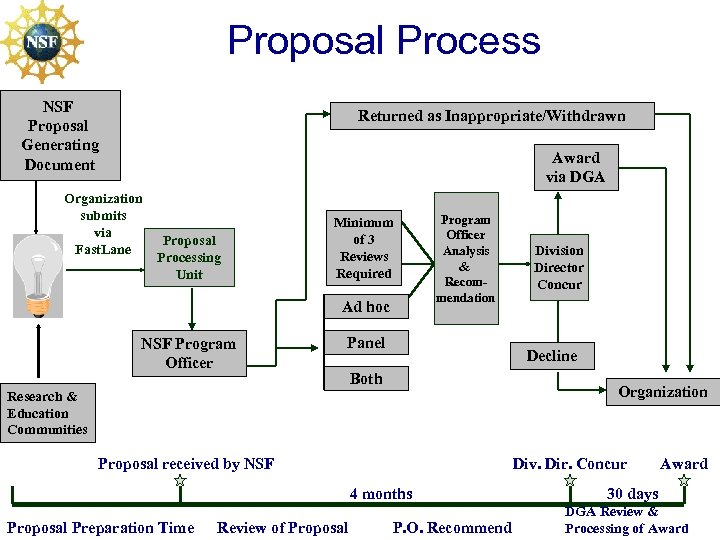 Proposal Process NSF Proposal Generating Document Returned as Inappropriate/Withdrawn Award via DGA Organization submits via Fast. Lane Proposal Processing Unit Minimum of 3 Reviews Required Ad hoc NSF Program Officer Analysis & Recommendation Panel Decline Both Organization Research & Education Communities Proposal received by NSF Div. Dir. Concur 4 months Proposal Preparation Time Review of Proposal Division Director Concur P. O. Recommend Award 30 days DGA Review & Processing of Award
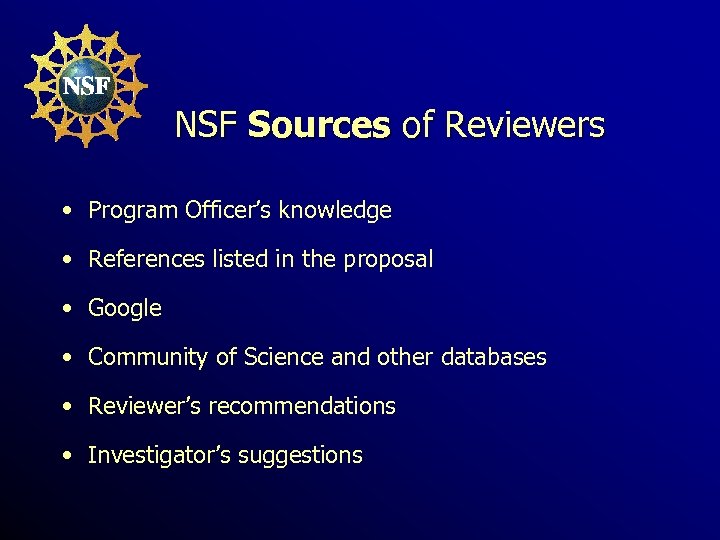 NSF Sources of Reviewers • Program Officer’s knowledge • References listed in the proposal • Google • Community of Science and other databases • Reviewer’s recommendations • Investigator’s suggestions
 Human Subjects • No award for a project involving human subjects can be made without prior Institutional Review Board (IRB) approval of the research activity. • IRB approval is not needed at the time of proposal submission.
 Funding Decisions • Program Officer decision • Feedback to PI • Informal and formal notification • Scope of work and budget discussions
 Two Funding Criteria • Intellectual merit • Broader impacts
 Intellectual Merit? • NSF funds basic research • Intellectual merit means increasing knowledge through developing and examining basic theories or methods
 Broader Impacts The Project Description must contain, as a separate section within the narrative, a discussion of the broader impacts of the proposed activities. Broader impacts may be accomplished through the research itself, through the activities that are directly related to specific research projects, or through activities that are supported by, but are complementary to the project. NSF values the advancement of scientific knowledge and activities that contribute to the achievement of societally relevant outcomes. Such outcomes include, but are not limited to: full participation of women, persons with disabilities, and underrepresented minorities in science, technology, engineering, and mathematics (STEM); improved STEM education and educator development at any level; increased public scientific literacy and public engagement with science and technology; improved well-being of individuals in society; development of a diverse, globally competitive STEM workforce; increased partnerships between academia, industry, and others; improved national security; increased economic competitiveness of the United States; and enhanced infrastructure for research and education.
 Budget Tips • Amounts – Reasonable for work -- Realistic – Well justified -- Need established – In-line with program guidelines • Eligible costs – Personnel – Equipment – Travel – Other Direct Costs, Subawards – Facilities & Administrative Costs
 Myths about NSF • Only funds scholars at elite graduate institutions • Only funds “famous” academics • Once declined, you are likely always to be declined • Only funds “normal science” • Advisory committees make funding decisions
 Reasons for Declinations • “Trust-me” proposal • Not feasible – Expertise gaps – Insufficient funding – Too ambitious • Incremental contribution • Bad luck
 How to Put Together an Interdisciplinary Team • Commit for the long haul – Be wary if untenured – Expect a long development period • Find a wise and strong leader – Proposals need coherence – Leaders need to listen and then decide • Meet for intellectual as well as taskrelated purposes
 NSF vs. NIH • NSF tends to be smaller • NSF is more open to risky, exploratory, paradigm-challenging work • NSF stresses basic research • NSF has no scoring system, percentile system • NSF program officers make funding decisions • NSF uses “revision encouragement” loosely
 Advice • Learn to love rejection • Team up • E-mail or call Program Officer with specific questions • Encourage dissertation improvement grant proposals (check program first)
 Useful to submit even if declined • • • Revise and resubmit Discover other funding sources Forces thinking Build relationships Receive reviews from experts
 QUESTIONS? ? Contact Bob O’Connor (703) 292 -7263 roconnor@nsf. gov