 Скачать презентацию How to Establish a B-to-B Brand With Oligopoly
790c4ed6c72f14fafae4573b4ad467c4.ppt
- Количество слайдов: 26



How to Establish a B-to-B Brand With Oligopoly Strategy – A Study of Wintek Corporation Hyley Huang Wintek Corporation, Taiwan and Jen-Hung Huang National Chiao Tung University, Taiwan The 15 th annual Conference on Pacific Basin Finance, Economics, Accounting and Management Page 0
Introduction Technology is borderless. Fueled by the 150 billion dollar market for personal computers and 100 billion dollar market for mobile phones, technology brands are becoming a new force in the world. The rise of the global economy and Internet over the past twenty years has made brands more influential than any time in history. It is undeniable that technology has had a major hand in the growth of the global society over the past twenty years. Amidst this wave of change, technology companies are now occupying a different market position than they have in the past. Oligopoly strategy encourages companies to throw off the chains of competition and shift their focus away from their competitors, By moving outside of the price cutting red ocean, companies enter high value added and high profit niche markets. Oligopoly strategy is the best strategy for building brands. From another perspective, successful brand strategy can also create oligopoly markets and realize the oligopoly strategy. Page 1
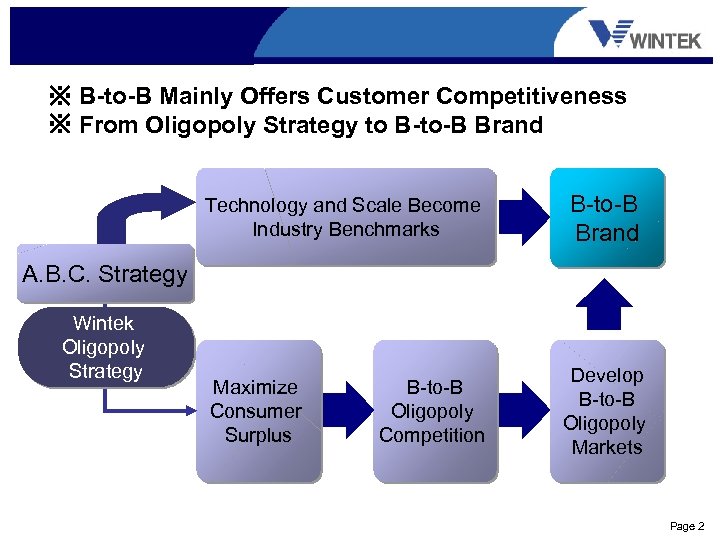
※ B-to-B Mainly Offers Customer Competitiveness ※ From Oligopoly Strategy to B-to-B Brand Technology and Scale Become Industry Benchmarks B-to-B Brand A. B. C. Strategy Wintek Oligopoly Strategy Maximize Consumer Surplus B-to-B Oligopoly Competition Develop B-to-B Oligopoly Markets Page 2
How to Establish a B-to-B Brand Technology and Scale are Industry Benchmarks: A B-to-B company can share technology field with company brand by developing technology and scale to industry benchmark levels and this also brings brand value to the company. For example, Intel usually comes to mind when thinking of CPUs. When one thinks of small to medium mobile phone display suppliers, one thinks of suppliers such as Epson, Samsung, Sharp and Wintek Corporation is a leading company in the small to medium STN and CSTN mobile phone panel field. In fact, the name “Wintek” has become the representative brand in the industry. Page 3
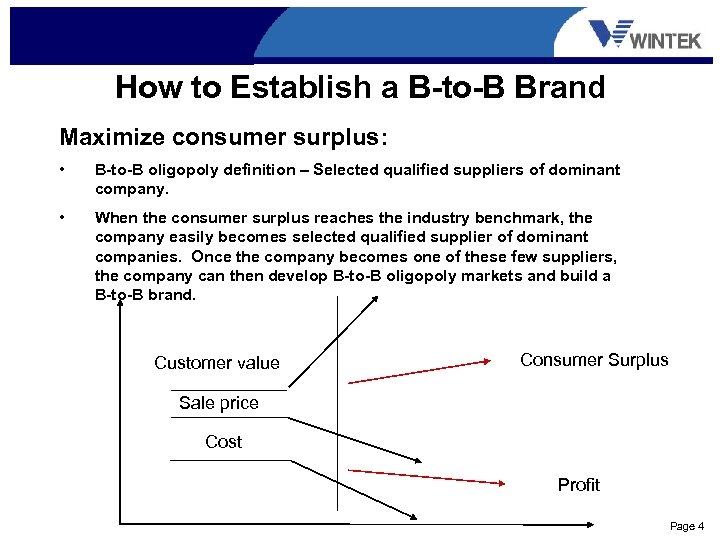
How to Establish a B-to-B Brand Maximize consumer surplus: • B-to-B oligopoly definition – Selected qualified suppliers of dominant company. • When the consumer surplus reaches the industry benchmark, the company easily becomes selected qualified supplier of dominant companies. Once the company becomes one of these few suppliers, the company can then develop B-to-B oligopoly markets and build a B-to-B brand. Consumer Surplus Customer value Sale price Cost Profit Page 4
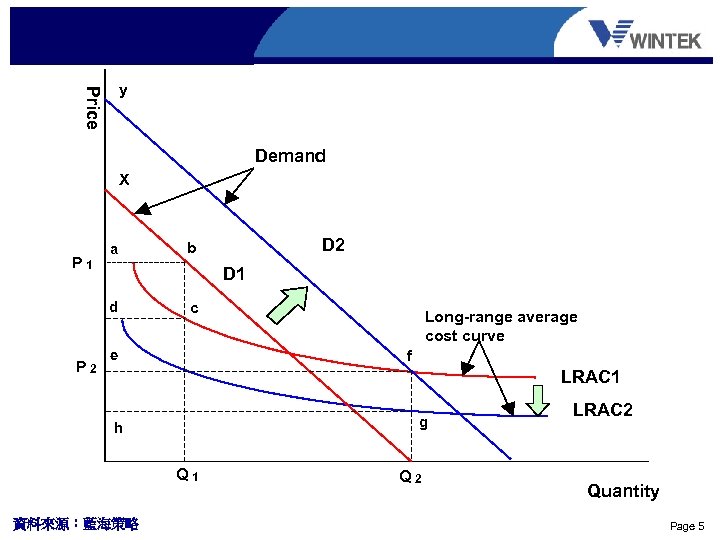
Price y Demand X P 1 a D 1 d P 2 D 2 b c Long-range average cost curve e f LRAC 1 g h Q 1 資料來源:藍海策略 Q 2 LRAC 2 Quantity Page 5
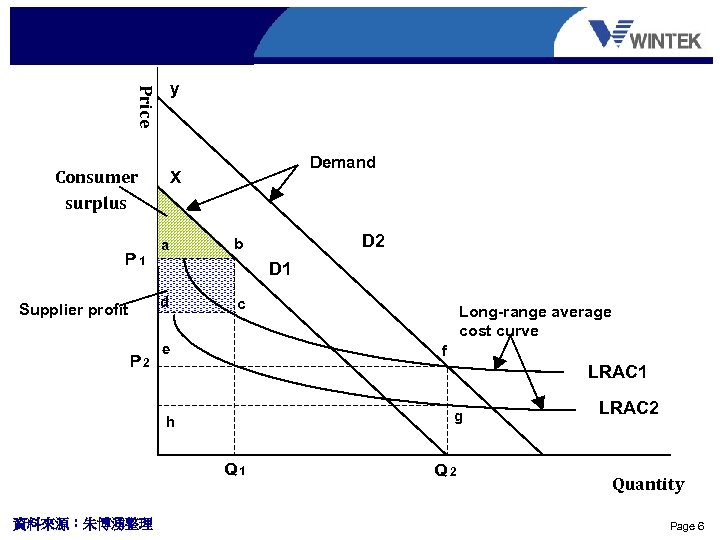
Price y Consumer surplus P 1 a P 2 D 2 b D 1 d Supplier profit Demand X c Long-range average cost curve e f LRAC 1 g h Q 1 資料來源:朱博湧整理 Q 2 LRAC 2 Quantity Page 6
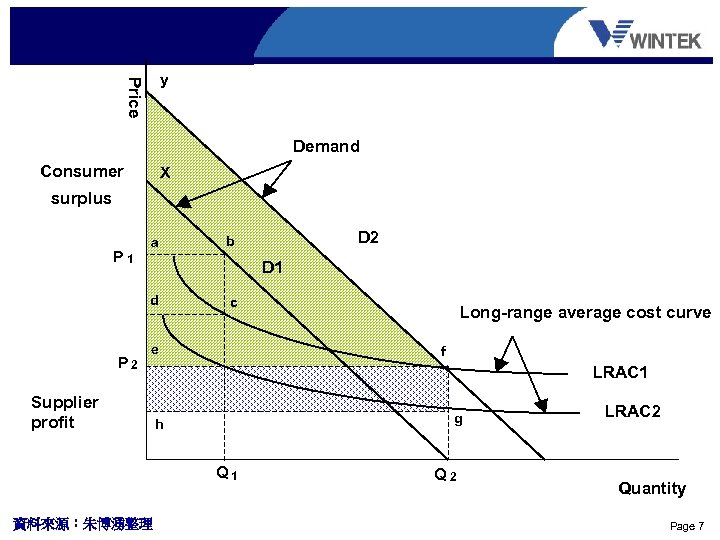
Price y Demand Consumer X surplus P 1 a D 1 d P 2 D 2 b c Long-range average cost curve e Supplier profit f LRAC 1 g h Q 1 資料來源:朱博湧整理 Q 2 LRAC 2 Quantity Page 7
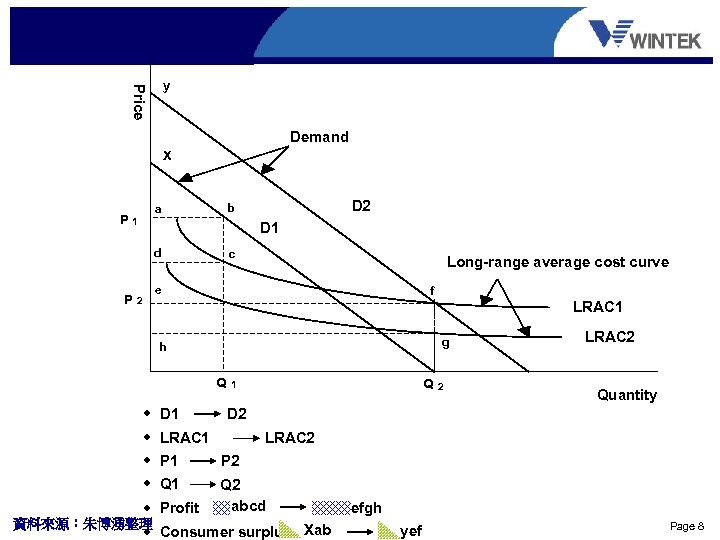
Price y Demand X P 1 D 1 d P D 2 b a c Long-range average cost curve e 2 f LRAC 1 g h Q Q 1 l D 1 l LRAC 1 l P 1 Q 1 l Profit Q 2 abcd Quantity P 2 l 2 LRAC 2 資料來源:朱博湧整理 l D 2 LRAC 2 Consumer surplus Xab efgh yef Page 8
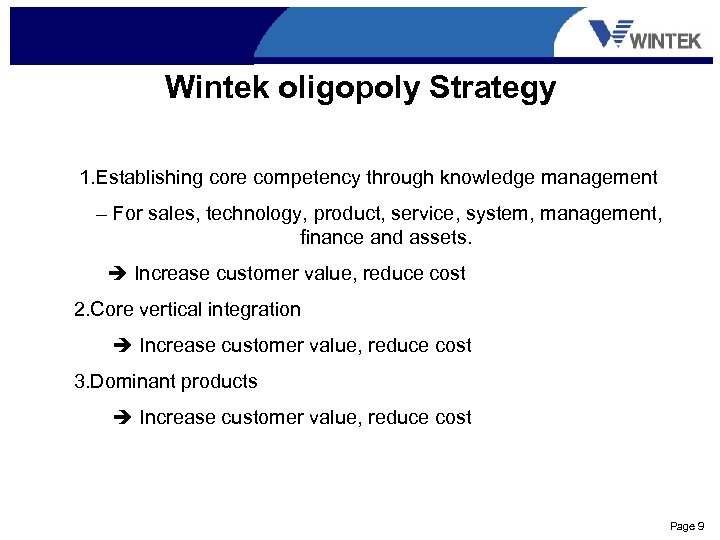
Wintek oligopoly Strategy 1. Establishing core competency through knowledge management – For sales, technology, product, service, system, management, finance and assets. Increase customer value, reduce cost 2. Core vertical integration Increase customer value, reduce cost 3. Dominant products Increase customer value, reduce cost Page 9
Establishing core competency through knowledge management Page 10
Strategic Architecture Concept Using the strategic architecture process, companies can reconceptualize the marketplace and redirect future business development by determining what core competencies are needed to establish a blueprint for future development. When the strategic architecture is put into place, all personnel in the organization clearly understand how various resources are allocated to create shared goals for everyone in the organization. Strategic architecture processes allow the company to overcome the technical barriers in building or acquiring core competencies. The critical technology, which can be obtained through attracting talent, independent development, licensing or business alliances, is then integrated into a core competency that is capable of creating value for the customer. Page 11
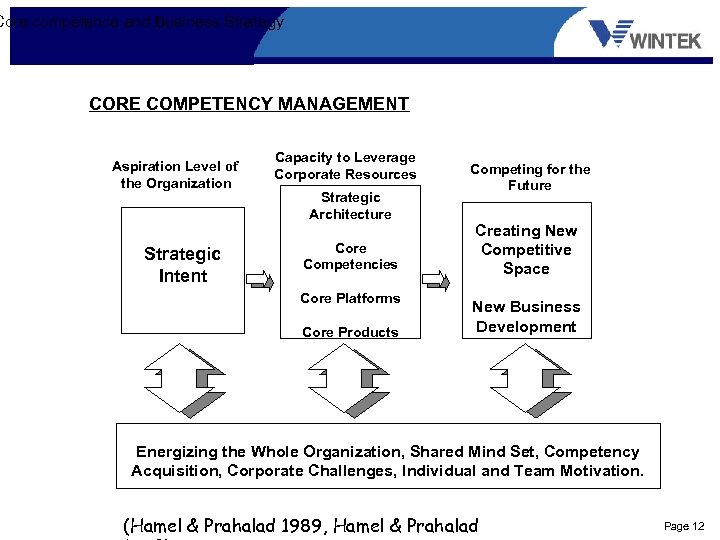
Core competence and Business Strategy CORE COMPETENCY MANAGEMENT Aspiration Level of the Organization Strategic Intent Capacity to Leverage Corporate Resources Strategic Architecture Competencies Core Platforms Core Products Competing for the Future Creating New Competitive Space New Business Development Energizing the Whole Organization, Shared Mind Set, Competency Acquisition, Corporate Challenges, Individual and Team Motivation. (Hamel & Prahalad 1989, Hamel & Prahalad Page 12
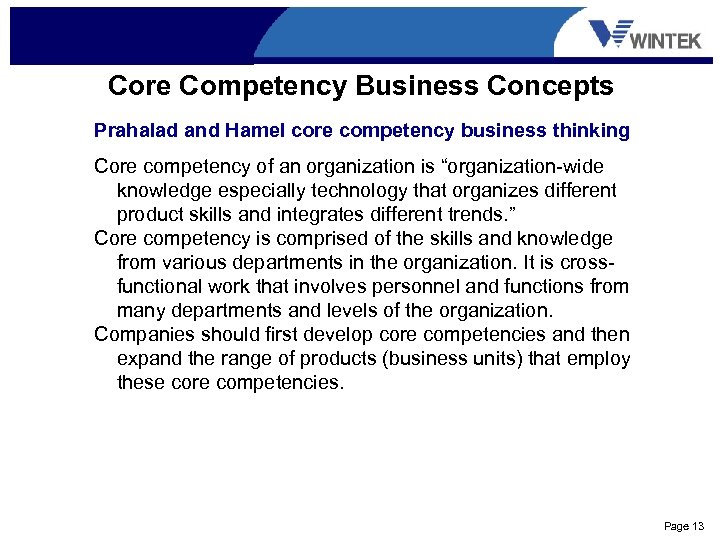
Core Competency Business Concepts Prahalad and Hamel core competency business thinking Core competency of an organization is “organization-wide knowledge especially technology that organizes different product skills and integrates different trends. ” Core competency is comprised of the skills and knowledge from various departments in the organization. It is crossfunctional work that involves personnel and functions from many departments and levels of the organization. Companies should first develop core competencies and then expand the range of products (business units) that employ these core competencies. Page 13
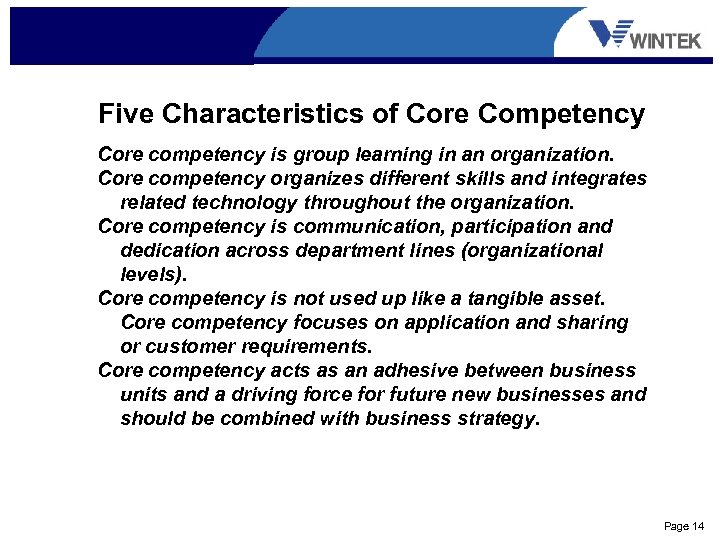
Five Characteristics of Core Competency Core competency is group learning in an organization. Core competency organizes different skills and integrates related technology throughout the organization. Core competency is communication, participation and dedication across department lines (organizational levels). Core competency is not used up like a tangible asset. Core competency focuses on application and sharing or customer requirements. Core competency acts as an adhesive between business units and a driving force for future new businesses and should be combined with business strategy. Page 14
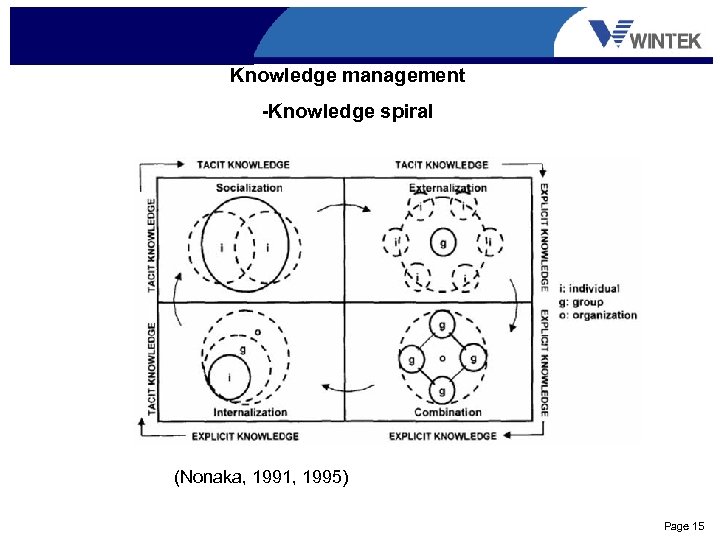
Knowledge management -Knowledge spiral (Nonaka, 1991, 1995) Page 15
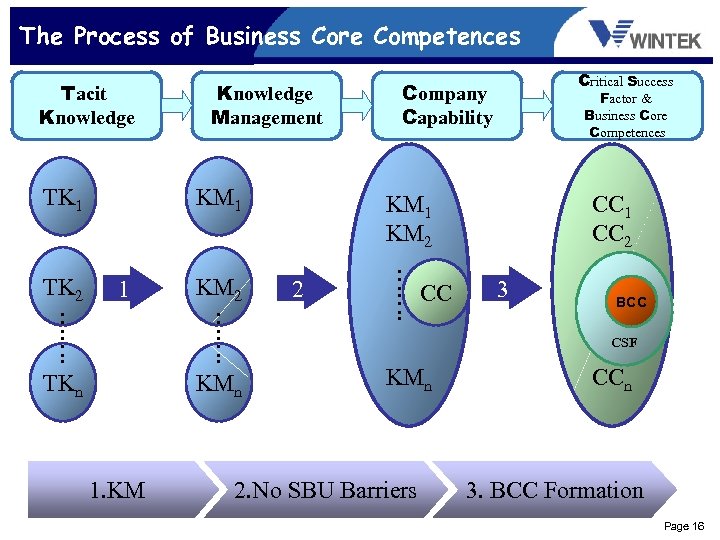
The Process of Business Core Competences Tacit Knowledge TK 1 Company Capability KM 1 1 KM 2 ……. TKn KMn 1. KM Factor & Business Core Competences KM 1 KM 2 ……. TK 2 Knowledge Management Critical Success CC CC 1 CC 2 3 BCC CSF KMn 2. No SBU Barriers CCn 3. BCC Formation Page 16
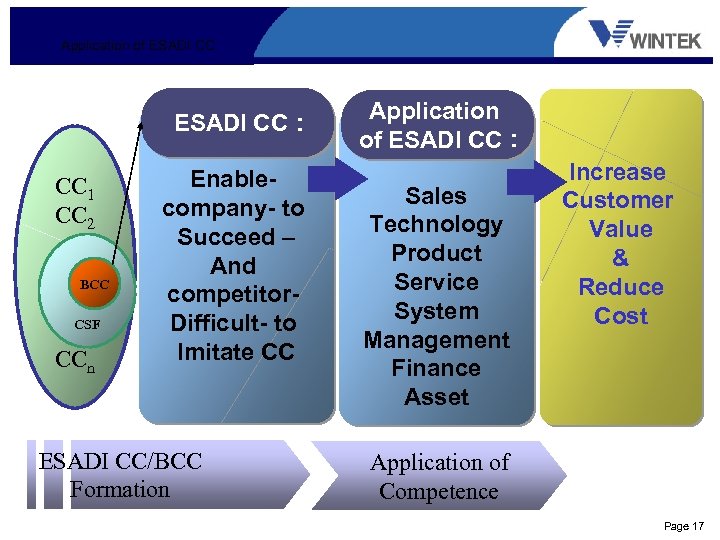
Application of ESADI CC: CC 1 CC 2 BCC CSF CCn Enablecompany- to Succeed – And competitor. Difficult- to Imitate CC ESADI CC/BCC Formation Application of ESADI CC: Sales Technology Product Service System Management Finance Asset Increase Customer Value & Reduce Cost Application of Competence Page 17
Core Vertical Integration Page 18
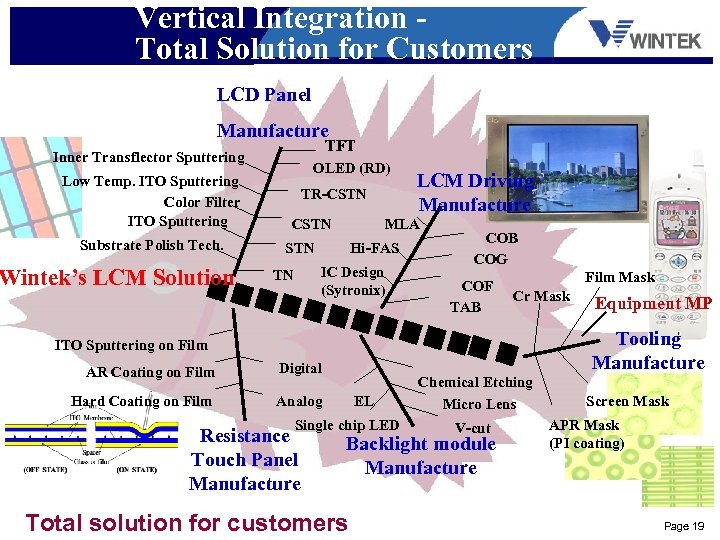
Vertical Integration Total Solution for Customers LCD Panel Manufacture TFT Inner Transflector Sputtering Low Temp. ITO Sputtering Color Filter ITO Sputtering Substrate Polish Tech. Wintek’s LCM Solution OLED (RD) TR-CSTN MLA STN Hi-FAS IC Design (Sytronix) TN LCM Driving Manufacture COB COG COF TAB Film Mask Cr Mask Tooling Manufacture ITO Sputtering on Film AR Coating on Film Digital Hard Coating on Film Analog EL Single chip LED Resistance Touch Panel Manufacture Equipment MP Chemical Etching Micro Lens V-cut Backlight module Manufacture Total solution for customers Screen Mask APR Mask (PI coating) Page 19
Dominant products, dominant strategy Imbalance advantage Page 20
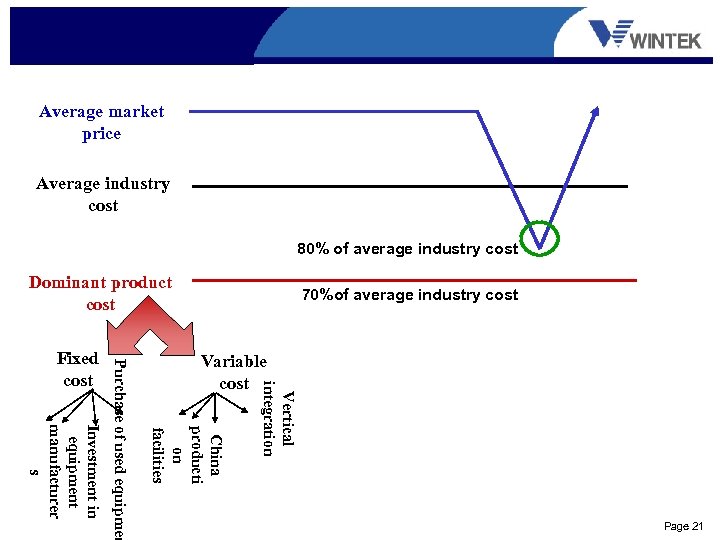
Average market price Average industry cost 80% of average industry cost Dominant product cost Vertical integration Variable cost China producti on facilities Investment in equipment manufacturer s Purchase of used equipmen Fixed cost 70%of average industry cost Page 21
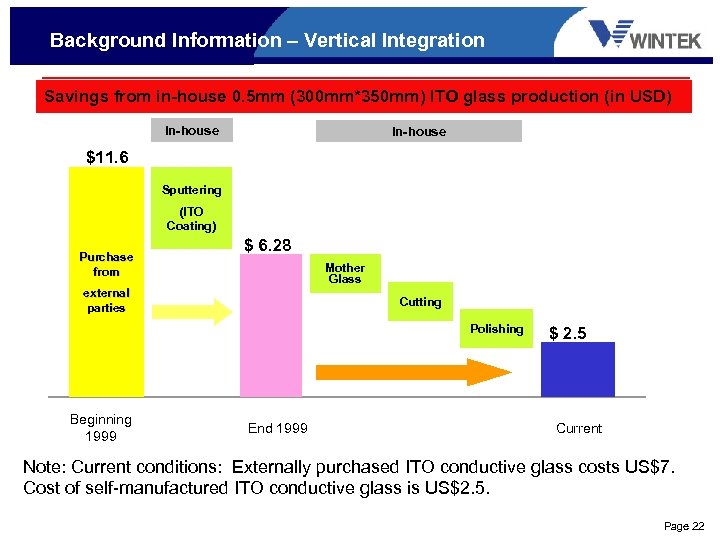
Background Information – Vertical Integration Savings from in-house 0. 5 mm (300 mm*350 mm) ITO glass production (in USD) In-house $11. 6 Sputtering (ITO Coating) Purchase from $ 6. 28 Mother Glass external parties Cutting Polishing Beginning 1999 End 1999 $ 2. 5 Current Note: Current conditions: Externally purchased ITO conductive glass costs US$7. Cost of self-manufactured ITO conductive glass is US$2. 5. Page 22
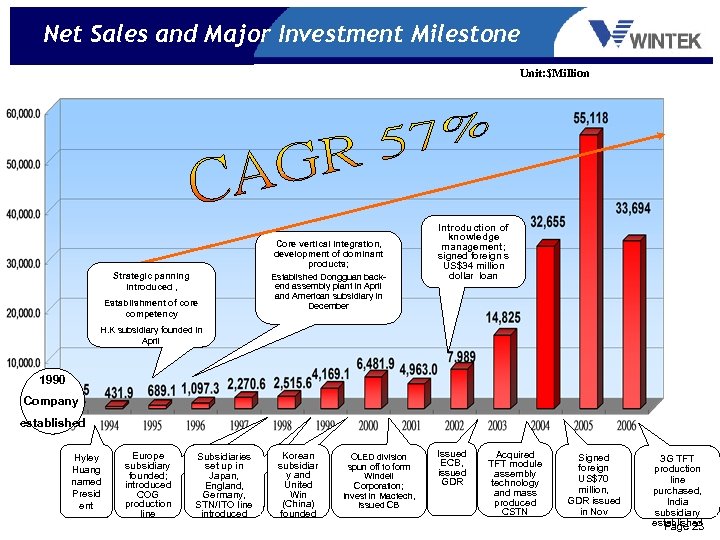
Net Sales and Major Investment Milestone Unit: $Million Strategic panning introduced , Establishment of core competency Core vertical integration, development of dominant products; Established Dongguan backend assembly plant in April and American subsidiary in December Introduction of knowledge management; signed foreign s US$34 million dollar loan H. K subsidiary founded in April 1990 Company established Hyley Huang named Presid ent Europe subsidiary founded; introduced COG production line Subsidiaries set up in Japan, England, Germany, STN/ITO line introduced Korean subsidiar y and United Win (China) founded OLED division spun off to form Windell Corporation; Invest in Mactech, issued CB Issued ECB, issued GDR Acquired TFT module assembly technology and mass produced CSTN Signed foreign US$70 million, GDR issued in Nov 3 G TFT production line purchased, India subsidiary established Page 23
Conclusion Wintek’s oligopoly strategy increases customer value, reduces cost, raises entry barriers of price and cost for other competitors, and has made Wintek into one of the selected qualified suppliers of dominant company. Wintek continuously creates oligopoly strategy for an improved future has also made Wintek’s technology and scale into a benchmark of the industry which in turn BUILDS WINTEK’S B-TO-B BRAND. Page 24
The End Page 25
Скачать презентацию How to Establish a B-to-B Brand With Oligopoly
790c4ed6c72f14fafae4573b4ad467c4.ppt