


 Скачать презентацию How to Do Interpreting Research Ren Wen Professor
0f5585541530fee09bdfbb428c5a01fa.ppt
- Количество слайдов: 55
 How to Do Interpreting Research? Ren Wen, Professor, Ph. D 如何做口译研究 任文(四川大学外国语学院) 1
 I. Why do we do interpreting research? II. What is interpreting research? III. How can budding scholars attempt interpreting research? IV. Possible orientations for future research 2
 I. Why do we do interpreting research? 3
 1. 1 Pragmatic reasons 1. 2 Academic reasons: contributing to disciplinary development (Daniel Gile, 2001: 2 -3) : 1. 2. 1 Empirical contribution 1. 2. 2 Conceptual/Theoretical contributions 1. 2. 3 Methodological contributions 4
 Empirical contributions -- desirable input speed for SI -- the interpreter’s working memory span for CI without note-taking -- anticipation and adjustment strategies for SI -- the comfort zone of time lag in SI -- internship as a transition from interpreting students to interpreting professionals … 5
 Information Units • 7± 2 principle 2003年 6月29日//,中华人民共和国商务部//安民 //副部长//代表中国政府//与香港特别行政区//财政 司//梁锦松司长//共同签署了//《内地与香港//关于 建立更紧密经贸关系的//安排//》,总体目标包括// 货物贸易//和服务贸易的//自由化//,以及贸易投 资便利化三个方面//。 6
 Conceptual contributions -- Why is interpreting quality perception by participants highly variable? -- Why do the two primary parties tend to look at the interpreter when they are encouraged to look at each other and ignore the existence of the interpreter? -- Why do interpreters choose to gatekeep certain information even if they are required to always produce verbatim or close renditions? 7
 Interpreters must relay accurately and completely all that is said by all parties in a meeting – including derogatory or vulgar remarks, non-verbal clues, and anything they know that is untrue; not alter, add or omit anything from the assigned work. AUSIT (Australian Institute of Translators and Interpreters) 8
 Methodological contributions -- new experimental designs -- new statistical procedures -- new models -- new measurement tools -- new analytical procedures -- new categorisation tools 9
 II. What is interpreting research? Research is a systematic approach to finding answers to questions. Hatch and Farhady, 1982, p. 1 10
 Interpreting research is a systematic approach to finding answers to questions arising from interpreting practice, training, and research. 11
 Which scientific category does IS belong to? Natural science studies the universe or nature: astronomy, biology, chemistry, physics, etc. 12
 Social science studies human society and individual relationships in society: sociology, anthropology, political science, economics, linguistics, etc. 13
 Humanities studies human values, spirit, emotions, ideas: literature, art, religion, philosophy, ancient and modern language, etc. 14
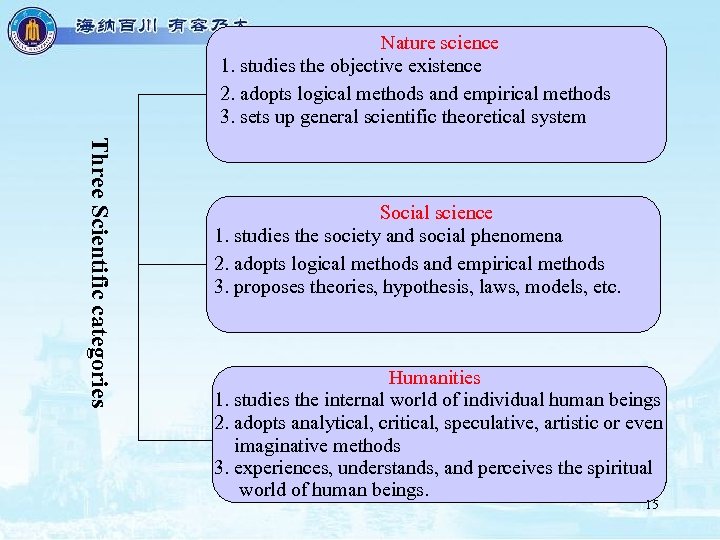 Nature science 1. studies the objective existence 2. adopts logical methods and empirical methods 3. sets up general scientific theoretical system Three Scientific categories Social science 1. studies the society and social phenomena 2. adopts logical methods and empirical methods 3. proposes theories, hypothesis, laws, models, etc. Humanities 1. studies the internal world of individual human beings 2. adopts analytical, critical, speculative, artistic or even imaginative methods 3. experiences, understands, and perceives the spiritual world of human beings. 15
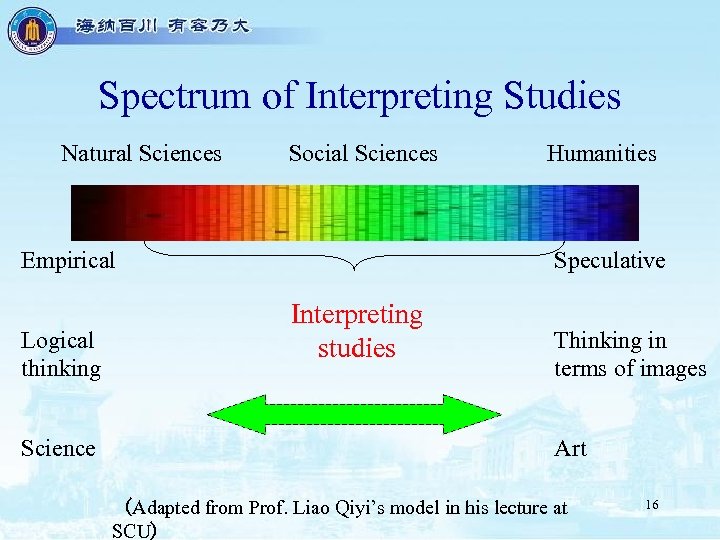 Spectrum of Interpreting Studies Natural Sciences Social Sciences Empirical Logical thinking Science Humanities Speculative Interpreting studies Thinking in terms of images Art (Adapted from Prof. Liao Qiyi’s model in his lecture at SCU) 16
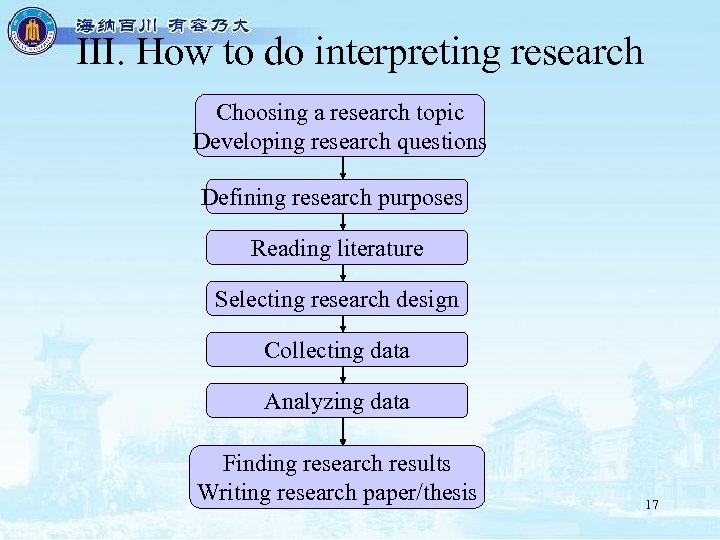 III. How to do interpreting research Choosing a research topic Developing research questions Defining research purposes Reading literature Selecting research design Collecting data Analyzing data Finding research results Writing research paper/thesis 17
 3. 1 Choosing a research topic/ developing research questions 3. 1. 1 Moving from a general topic to a specific one * Identify a topic based on personal interest and close to baseline expertise; * Narrow down the topic by asking “who”, “what”, “how”, etc. 18
 e. g. General topic: Interpreter training Who: Who are the interpreters? SI or CI? Conference I or Liaison I? What: What kind of training do I wish to focus on? (classroom T? on-line training? internship training? self training? ) What is the internship training I intend to talk about? How: How is internship training carried out? Is it effective? How: How will I go about finding internship training method and its effect? Specific topic: A. Internship training for potential business interpreters: forging partnership with employers B. On-campus and off-campus internship training for would-be consecutive interpreters 19
 3. 1. 2 Formulating a few research questions * What is an internship training program? * What are the differences and similarities between classroom training and internship training? * In what ways and to what extent can internship training help trainees develop their interpreting skills? * How to measure the results of internship training? * How to forge partnership with employers? 20
 3. 1. 4 Some do’s and don’ts A. A topic/question should be valuable (not too trivial/simple); B. A topic/question should be original (not too old/repeatedly tackled); C. A topic/question should be manageable/answerable (not too ambitious/unanswerable). * The topic is too broad; * The available resources are too limited; * The topic is far beyond one’s research baseline expertise; * The expected result would be too subjective/unscientific. 21
 Most studies “only” contribute one or a few bricks to the building which is being erected by many other members of the community, and more comprehensive (albeit generally provisional) answers generally result from the efforts of dozens, if not hundreds of researchers over long periods. Daniel Gile, 2001: 4) 22
 3. 2 Define research purposes Exploration Description Explanation Prediction 23
 3. 3 Reading literature A. Three types of literature a. Within the field of interpreting b. In the related fields c. About research methods 24
 3. 3 Reading literature B. Three types of reading a. Occasional reading b. Selective reading c. Close reading 25
 Close reading/critical reading A. a. b. c. B. a. b. c. d. Reading for comprehension Understanding the author’s purposes Understanding the methods used Understanding the results/conclusion of the study Reading for assessment Assessing the author’s purposes Assessing the methods used Assessing the use of literature Assessing the author’s inferences Daniel Gile: , 2001: 24 -32 26
 C. Three types of notes a. Notes for abstracts b. Notes for critical comments c. Notes for comments concerning potential use 27
 3. 4 Selecting research design A. Deciding on a theoretical framework B. Choosing research methods 28
 A. Deciding on a theoretical framework Theory: a judgment, conception, proposition, or formula by speculation or deduction, or by abstraction and generalization from facts. Webster’s, 1986: 2371 Only studies which are indeed carried out within a defined theoretical framework deserve to be regarded as “research activities”. Toury, 1991: 184 “Theory” in interpreting is anything that is not practice. Pöchhacker in Gile, 2001: 200 29
 B. Choosing research methods Research methodology/methods/techniques Methodology: the systematic study of methods that are applied within a discipline. Methods: different types of approaches to do research. Techniques/tools: used for concretization and operationalization of a research method (also called subtypes of research methods). 30
 Research methodological system methodology methods techniques (Adapted from Feng Xiaotian, 2001: 8, 9, 13, 16) philosophical assumption logic paradigm objectivity survey experiment field work document study questionnaire interview observation case study critical analysis 31
 3. 5 Choosing research methods to collect data A. Survey: In survey research, the researcher selects a sample of respondents from a population and administers a standardized questionnaire to them. 32
 B. Experiment An experiment is a method of investigating causal relationships among variables. The method involves manipulating one variable to determine if changes in one variable cause changes in another variable. 33
 C. Field work, or field study, is aimed at collecting raw data for qualitative research. It involves face-to-face interviewing, direct observation, and a case study. 34
 D. Document study Also called secondary research. It is an indirect study by obtaining and analyzing data from existing literature, such as newspapers, diaries, memoir, autobiography, letters, historical documents, etc. 35
 3. 6 Analyzing data • Quantitative research is empirical research where the data are in the form of numbers. • Qualitative research is empirical research where the data are not in the form of numbers. K. F. Punch, 1998: 4 Quantitative data can only be analyzed statistically while qualitative data can be analyzed both nonstatistically and statistically. 36
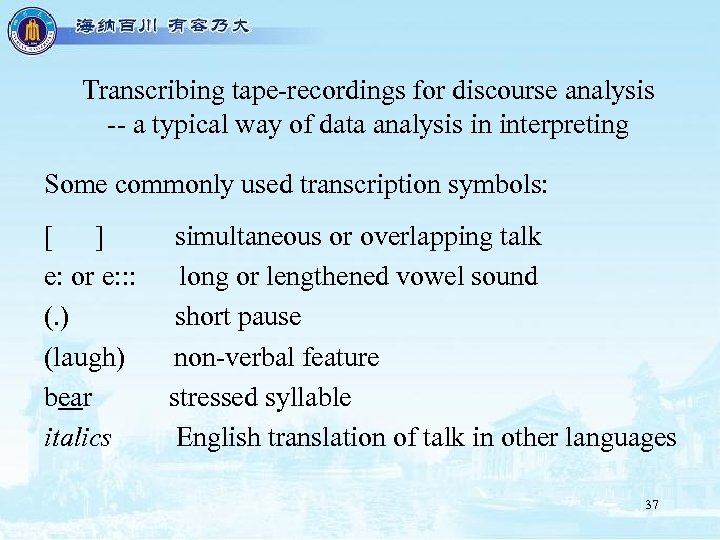 Transcribing tape-recordings for discourse analysis -- a typical way of data analysis in interpreting Some commonly used transcription symbols: [ ] e: or e: : : (. ) (laugh) bear italics simultaneous or overlapping talk long or lengthened vowel sound short pause non-verbal feature stressed syllable English translation of talk in other languages 37
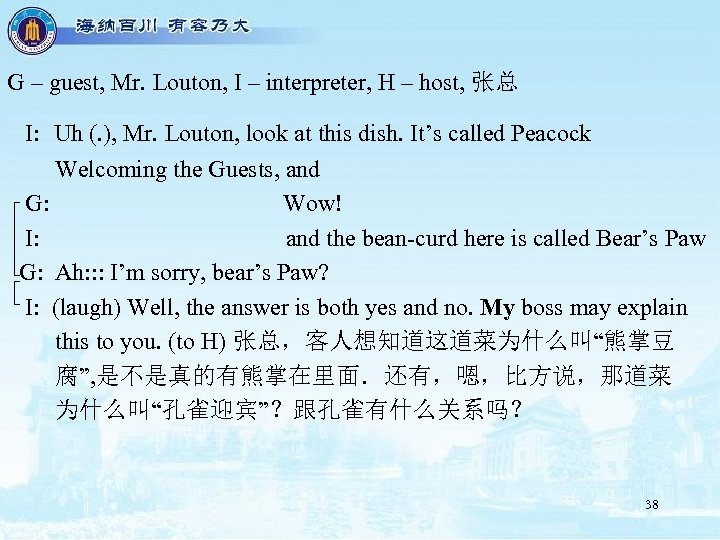 G – guest, Mr. Louton, I – interpreter, H – host, 张总 I: Uh (. ), Mr. Louton, look at this dish. It’s called Peacock Welcoming the Guests, and G: Wow! I: and the bean-curd here is called Bear’s Paw G: Ah: : : I’m sorry, bear’s Paw? I: (laugh) Well, the answer is both yes and no. My boss may explain this to you. (to H) 张总,客人想知道这道菜为什么叫“熊掌豆 腐”, 是不是真的有熊掌在里面.还有,嗯,比方说,那道菜 为什么叫“孔雀迎宾”?跟孔雀有什么关系吗? 38
 3. 7 Finding results Writing research paper/thesis Research results are the answers to the research questions and the findings yielded from your study. A thesis/dissertation is an argument in which different parts are logically related and all centered around research question. Wen Qiufang, 2008: 251 39
 IV. Possible orientations for future research 4. 1 Paradigm shifts: Social turn in China? Sociological turn? Ethical turn? Technological turn? Liaison interpreting turn in China? Sign language interpreting turn in China? China’s minority language interpreting turn? Interpreting turn in translation studies? 40
 4. 2 Research methods/techniques -- sizeable audio-visual recordings of a specialized interpreting setting (medical, business, legal, etc. ), transcriptions and critical analysis of data -- user investigations (possibly in exchange for nopay) -- Experiments … 41
 A sample research project Research topic: The non-verbal communication features of conference interpreters and liaison interpreters in consecutive mode. 42
 Step 1: Please formulate 3 -5 questions based on the topic. Q 1: Q 2: Q 3: Q 4: 43
 Step 1: Please formulate 3 -5 questions based on the topic. A. What is NVC and how many types of NVC do we usually observed in daily interaction? B. What are the most common NVC features observed in consecutive interpreters? C. To what extent does the specific setting affect the interpreter’s NV behaviours? D. Can the main differences between the NV features of conference interpreters and those of liaison interpreters be identified? If so, how? E. How will these differences be interpreted? 44
 Main types of NVC observed in daily interaction: A. Kinesics (facial expression, gesture, posture, eye gaze, blinking, etc. ) B. Paralanguage (tone of voice, volume, rate of speaking, voice quality, coughing, laughing, throat clearing, pet phrases, chuckling, etc. ) C. Appearance or object language (clothing, hairstyles, choice of color, etc. ) D. Time and space E. Touch 45
 X – 小向, a local guide, C – a Chinese local official, I – Interpreter, A – an American businessman X: 你跟他讲,这个,如果他喜欢的话,我就送他了。一件 小礼物吧. C:这可是小向花了几个月的时间画的,别人管他要,他还 不给呢。 I: If you like it, Mr. Xiang would like to give it to you as a small gift. He spent months painting it. Normally he doesn’t give it away even if asked for. A: Don’t bother. (Walk away) I: (Smile, softly)不用了,不过非常感谢你的好意. 46
 Step 2: Define your working hypothesis and research Purposes (exploration, description, explanation). Hypothesis: Liaison interpreters and conference interpreters demonstrate different NVC features Research purposes: 2 or all of the 3 47
 Step 3: Specify the categories of the related literature that you may need to read and study in order to complete the project. 48
 Step 4: Work out your research plan: think of the possible theoretical framework for your research topic and the research methods that are likely to be adopted. 49
 Step 5: Think of the research techniques or tools that you may use for data collection. 50
 Step 6: How would you do data analysis based on the research techniques/tools that you’ve chosen? 51
 Step 7: What are the possible research results that you may draw from your research work? Are there any possible implications to future interpreting practice/training /research? 52
 Possible results/findings: A. Liaison interpreters demonstrate more evident and more varied NVC features than conference interpreters; B. Liaison interpreters are more likely to exert more impact on the process and outcome of the interaction. 53
![References: Gile, Daniel, et al. eds. Getting Started in Interpreting Research [C]. Amsterdam: John](https://present5.com/presentation/0f5585541530fee09bdfbb428c5a01fa/image-54.jpg "References: Gile, Daniel, et al. eds. Getting Started in Interpreting Research [C]. Amsterdam: John") References: Gile, Daniel, et al. eds. Getting Started in Interpreting Research [C]. Amsterdam: John Benjamins, 2001. Hansen, Gyde, et al, eds. Efforts and Models in Interpreting and Translation Research [C]. Amsterdam/Philadelphia, 2008. Hatch, E. & Farhady, H. Research Design and Statistics for Applied Linguistics [M]. Rowley: Newbury House Publishers, INC. , 1982. Pöchhacker, Franz. Working within a theoretical framework [A] in Daniel Gile, ibid. 199 -219. Pöchhacker, Franz. Introducing Interpreting Studies [M]. London: Routledge, 2004. Punch, K. F. Introduction to Social Research: Quantitative & Qualitative Approaches [M]. London: Sage, 1998. Wen Qiufang. Applied Linguistics: Research Methods and Thesis Writing [M], Beijing: FLTRP, 2008. 风笑天.社会学研究方法[M].北京:中国人民大学出版社, 2001. 林聚任等.社会科学研究方法[C].济南:山东人民出版社,2004. 54 www. wikipedia. org
References: Gile, Daniel, et al. eds. Getting Started in Interpreting Research [C]. Amsterdam: John Benjamins, 2001. Hansen, Gyde, et al, eds. Efforts and Models in Interpreting and Translation Research [C]. Amsterdam/Philadelphia, 2008. Hatch, E. & Farhady, H. Research Design and Statistics for Applied Linguistics [M]. Rowley: Newbury House Publishers, INC. , 1982. Pöchhacker, Franz. Working within a theoretical framework [A] in Daniel Gile, ibid. 199 -219. Pöchhacker, Franz. Introducing Interpreting Studies [M]. London: Routledge, 2004. Punch, K. F. Introduction to Social Research: Quantitative & Qualitative Approaches [M]. London: Sage, 1998. Wen Qiufang. Applied Linguistics: Research Methods and Thesis Writing [M], Beijing: FLTRP, 2008. 风笑天.社会学研究方法[M].北京:中国人民大学出版社, 2001. 林聚任等.社会科学研究方法[C].济南:山东人民出版社,2004. 54 www. wikipedia. org
 Thank You! 55