


 Скачать презентацию How To Design Energy Efficiency Ships SMTU St
20130226-SMTU-Energy_Efficiency.pptx
- Количество слайдов: 46
 How To Design Energy Efficiency Ships SMTU St Petersburg, 26 th February 2013 Pierre BESSE Vice President – Director of the Research Department
 Proposed Agenda Regulatory Environment § NOx, SOx & CO 2 measures Energy Efficiency Prevention Solutions § CO 2 reduction solutions Ship Energy Efficiency Calculation & Analysis Tool (SEECAT) Hydrodynamic Efficiency Evaluation Conclusions 2
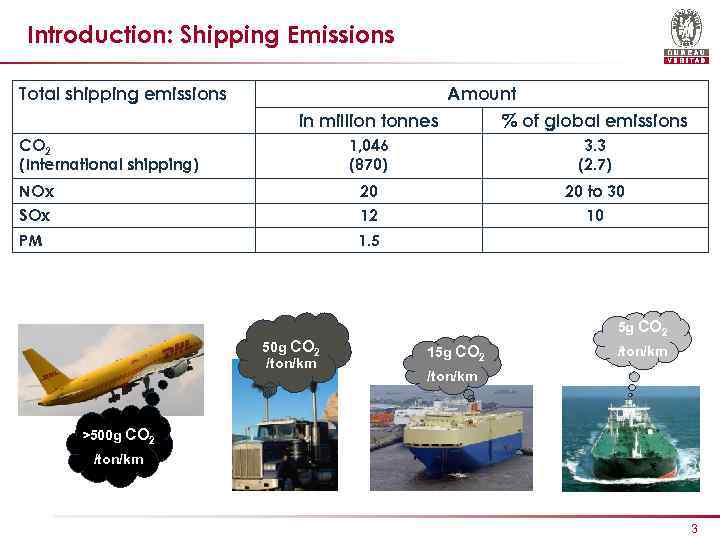 Introduction: Shipping Emissions Total shipping emissions Amount in million tonnes % of global emissions CO 2 (International shipping) 1, 046 (870) 3. 3 (2. 7) NOx 20 20 to 30 SOx 12 10 PM 1. 5 50 g CO 2 /ton/km 5 g CO 2 15 g CO 2 /ton/km >500 g CO 2 /ton/km 3
 Regulatory Environment SOx, NOx Emissions & CO 2 Measures
 Measures for Air Pollution & GHG In the absence of policies, projections show a potential increase in ships’ emissions of 150% - 250% by 2050 IMO Measures The measures aim to be: § Cost-effective § Goal based and not prescriptive § Practical, transparent and easy to administer 1. Air Pollution Prevention § NOx Emissions § SOx Emissions § VOC 2. GHG Monitoring § Energy Efficiency Design Index (EEDI) § Ship Energy Efficiency Management Plan (SEEMP) § PM 5
 Energy Efficiency Design Index (EEDI) Reference MSC. 203(62) – New ch. 4 of MARPOL Annex VI – Reg. 19, 20, 21 Entry into force 1 January 2013 Applicable to new ships ≥ 400 gt (except ships with diesel-electric propulsion, turbine propulsion or hybrid propulsion systems so far) Introduction of the EEDI to stimulate innovation and technical development in order to increase the energy efficiency from the design stage as follows: Environmental costs CO 2 emissions at 75% MCR + fixed auxiliaries power Benefits for society cargo capacity x ship speed x correction factors Capacity measured in DWT or GRT: § § DWT: Dry cargo ships, Tankers, Gas Tankers GRT: Passenger ships, RO-RO Passenger ships 65% DWT ? : Container ships Correction Factors: § Sea state dependent § For any technical / regulatory capacity limit (e. g. ice class) Ship Speed: § Taken at 75% of MCR ü CO 2 reduction due to energy recovery systems taken into account directly in the calculation ü Auxiliary power calculation refers only for propulsion machinery systems & accommodation 6
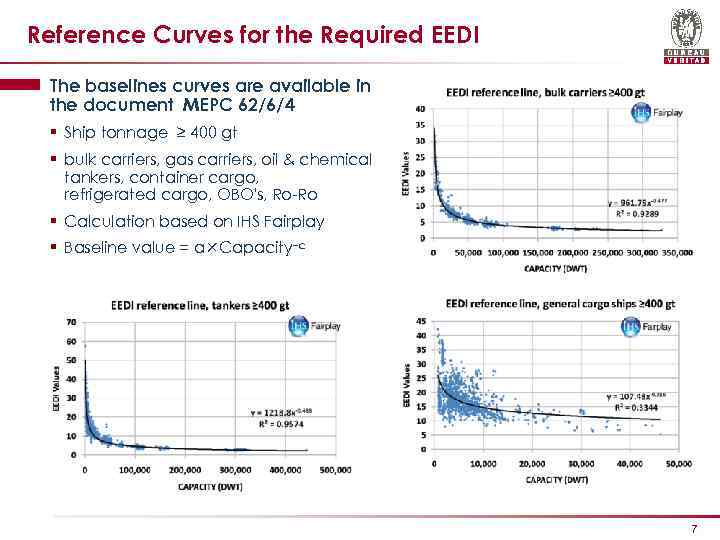 Reference Curves for the Required EEDI The baselines curves are available in the document MEPC 62/6/4 § Ship tonnage ≥ 400 gt § bulk carriers, gas carriers, oil & chemical tankers, container cargo, refrigerated cargo, OBO's, Ro-Ro § Calculation based on IHS Fairplay § Baseline value = a Capacity−c 7
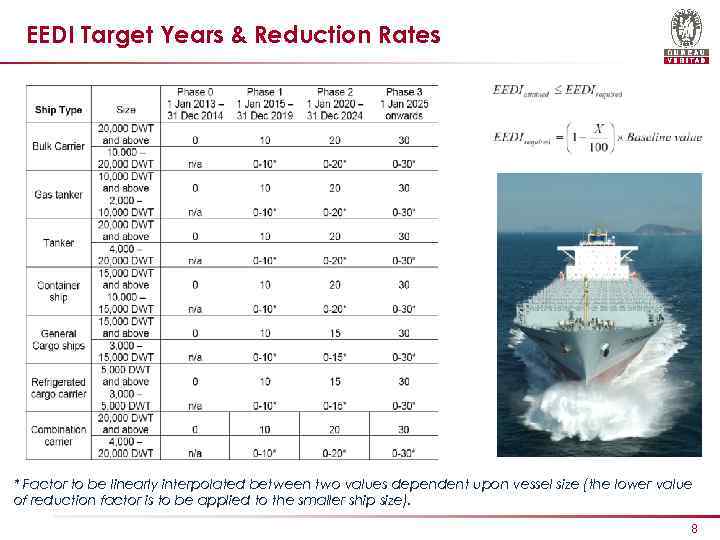 EEDI Target Years & Reduction Rates * Factor to be linearly interpolated between two values dependent upon vessel size (the lower value of reduction factor is to be applied to the smaller ship size). 8
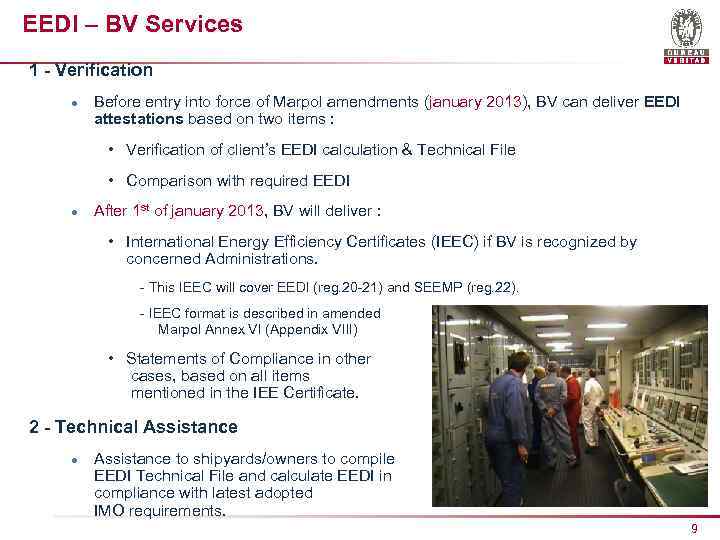 EEDI – BV Services 1 - Verification l Before entry into force of Marpol amendments (january 2013), BV can deliver EEDI attestations based on two items : • Verification of client’s EEDI calculation & Technical File • Comparison with required EEDI l Maersk Newton After 1 st of january 2013, BV will deliver : • International Energy Efficiency Certificates (IEEC) if BV is recognized by concerned Administrations. - This IEEC will cover EEDI (reg. 20 -21) and SEEMP (reg. 22). - IEEC format is described in amended Marpol Annex VI (Appendix VIII) • Statements of Compliance in other cases, based on all items mentioned in the IEE Certificate. 2 - Technical Assistance to shipyards/owners to compile EEDI Technical File and calculate EEDI in compliance with latest adopted IMO requirements. 9
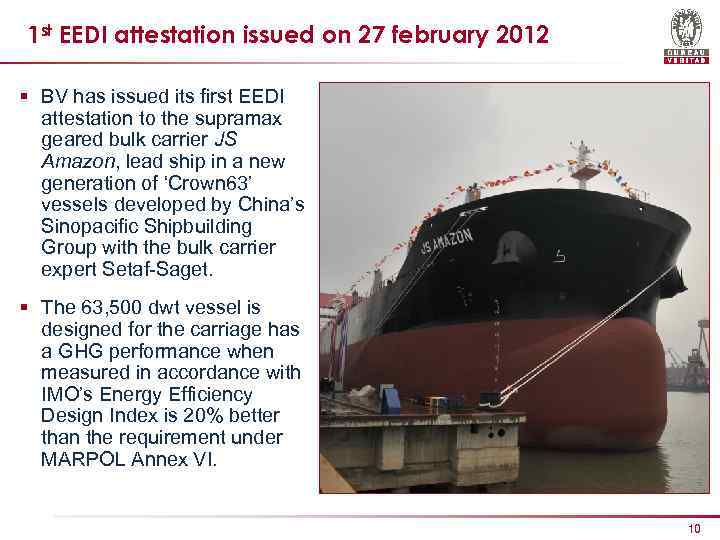 1 st EEDI attestation issued on 27 february 2012 § BV has issued its first EEDI attestation to the supramax geared bulk carrier JS Amazon, lead ship in a new generation of ‘Crown 63’ vessels developed by China’s Sinopacific Shipbuilding Group with the bulk carrier expert Setaf-Saget. § The 63, 500 dwt vessel is designed for the carriage has a GHG performance when measured in accordance with IMO’s Energy Efficiency Design Index is 20% better than the requirement under MARPOL Annex VI. 10
 Ship Energy Efficiency Management Plan - SEEMP The purpose of a Ship Energy Efficiency Management Plan (SEEMP) is to establish a mechanism for a company and/or a ship to improve the energy efficiency of a ship’s operation 11
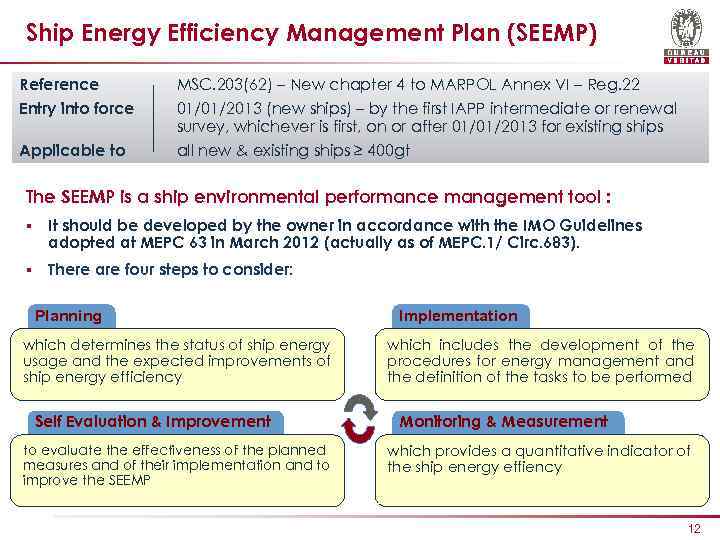 Ship Energy Efficiency Management Plan (SEEMP) Reference MSC. 203(62) – New chapter 4 to MARPOL Annex VI – Reg. 22 Entry into force 01/01/2013 (new ships) – by the first IAPP intermediate or renewal survey, whichever is first, on or after 01/01/2013 for existing ships Applicable to all new & existing ships ≥ 400 gt The SEEMP is a ship environmental performance management tool : § It should be developed by the owner in accordance with the IMO Guidelines adopted at MEPC 63 in March 2012 (actually as of MEPC. 1/ Circ. 683). § There are four steps to consider: Planning which determines the status of ship energy usage and the expected improvements of ship energy efficiency Self Evaluation & Improvement to evaluate the effectiveness of the planned measures and of their implementation and to improve the SEEMP Implementation which includes the development of the procedures for energy management and the definition of the tasks to be performed Monitoring & Measurement which provides a quantitative indicator of the ship energy effiency 12
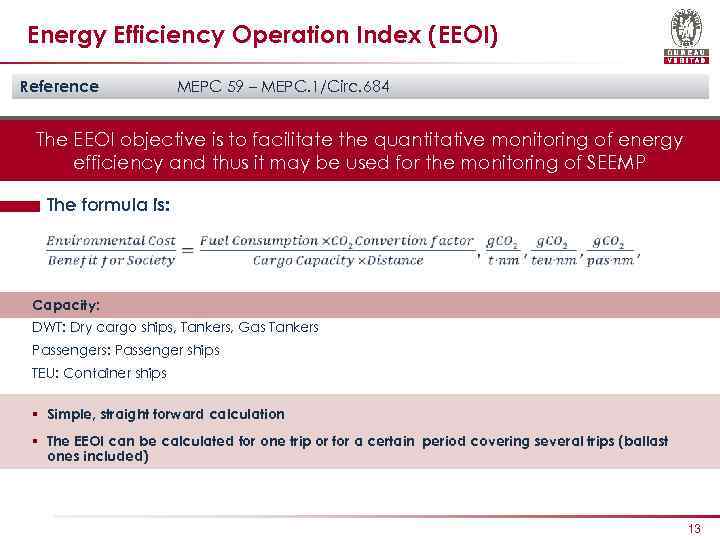 Energy Efficiency Operation Index (EEOI) Reference MEPC 59 – MEPC. 1/Circ. 684 The EEOI objective is to facilitate the quantitative monitoring of energy efficiency and thus it may be used for the monitoring of SEEMP The formula is: • Capacity: DWT: Dry cargo ships, Tankers, Gas Tankers Passengers: Passenger ships TEU: Container ships § Simple, straight forward calculation § The EEOI can be calculated for one trip or for a certain period covering several trips (ballast ones included) 13
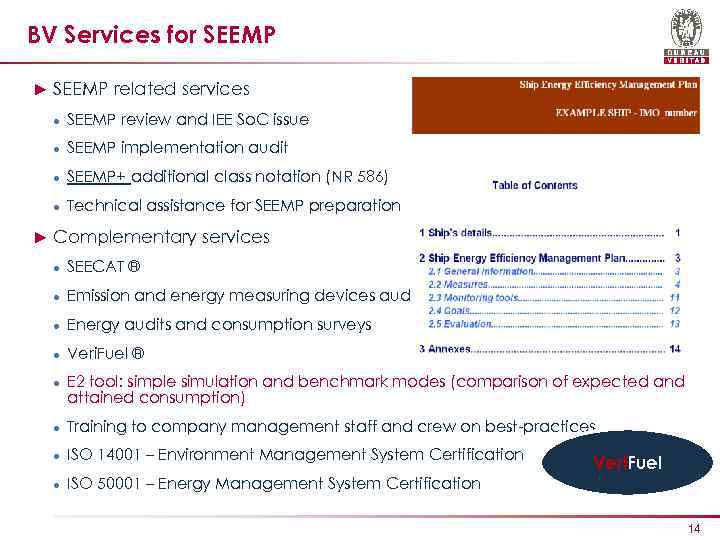 BV Services for SEEMP ► SEEMP related services l SEEMP review and IEE So. C issue l SEEMP implementation audit l SEEMP+ additional class notation (NR 586) l Technical assistance for SEEMP preparation ► Complementary services l SEECAT ® l Emission and energy measuring devices audit l Energy audits and consumption surveys l Veri. Fuel ® l E 2 tool: simple simulation and benchmark modes (comparison of expected and attained consumption) l Training to company management staff and crew on best-practices l ISO 14001 – Environment Management System Certification l ISO 50001 – Energy Management System Certification Veri. Fuel 14
 CO 2 Reduction Solutions Energy Efficiency
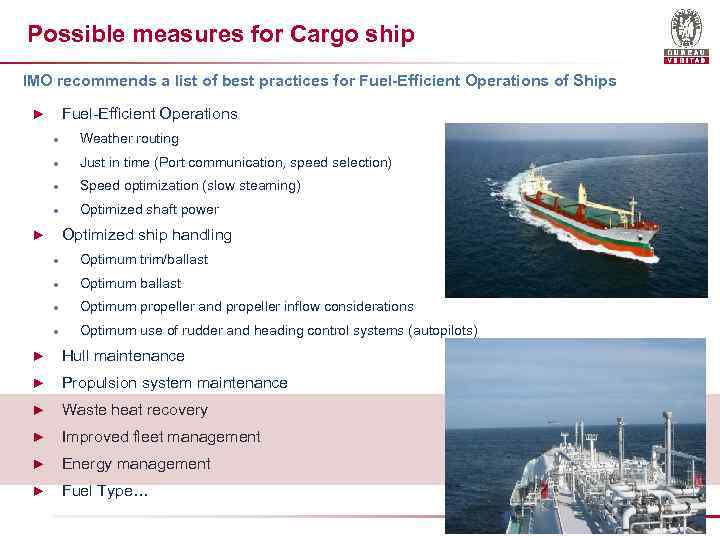 Possible measures for Cargo ship IMO recommends a list of best practices for Fuel-Efficient Operations of Ships Fuel-Efficient Operations ► l Weather routing l Just in time (Port communication, speed selection) l Speed optimization (slow steaming) l Optimized shaft power Optimized ship handling ► l Optimum trim/ballast l Optimum propeller and propeller inflow considerations l Optimum use of rudder and heading control systems (autopilots) ► Hull maintenance ► Propulsion system maintenance ► Waste heat recovery ► Improved fleet management ► Energy management ► Fuel Type… 16
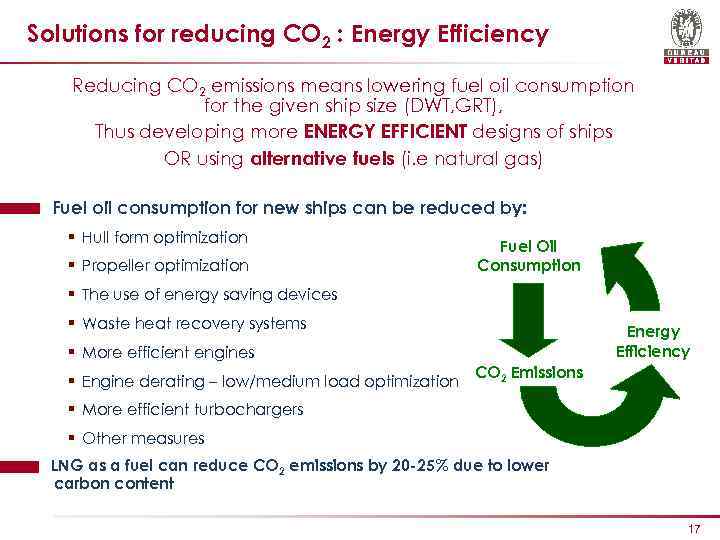 Solutions for reducing CO 2 : Energy Efficiency Reducing CO 2 emissions means lowering fuel oil consumption for the given ship size (DWT, GRT), Thus developing more ENERGY EFFICIENT designs of ships OR using alternative fuels (i. e natural gas) Fuel oil consumption for new ships can be reduced by: § Hull form optimization § Propeller optimization Fuel Oil Consumption § The use of energy saving devices § Waste heat recovery systems Energy Efficiency § More efficient engines § Engine derating – low/medium load optimization CO 2 Emissions § More efficient turbochargers § Other measures LNG as a fuel can reduce CO 2 emissions by 20 -25% due to lower carbon content 17
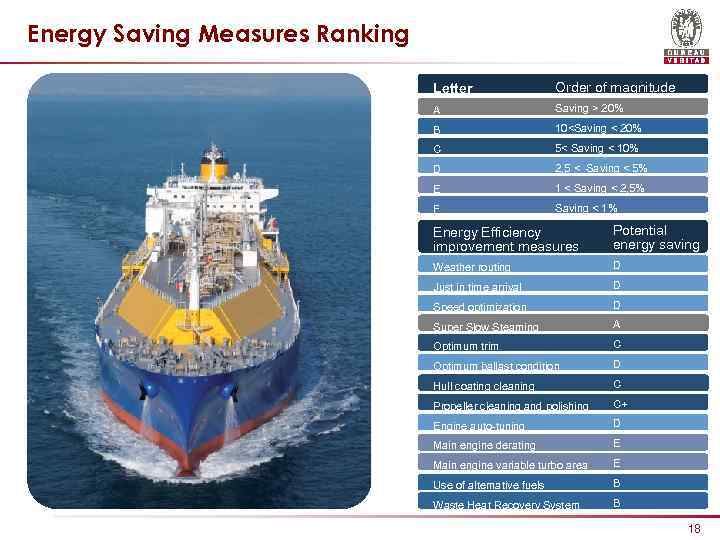 Energy Saving Measures Ranking Letter Order of magnitude A Saving > 20% B 10
 The BV SEECAT® tool for ship energy modelling
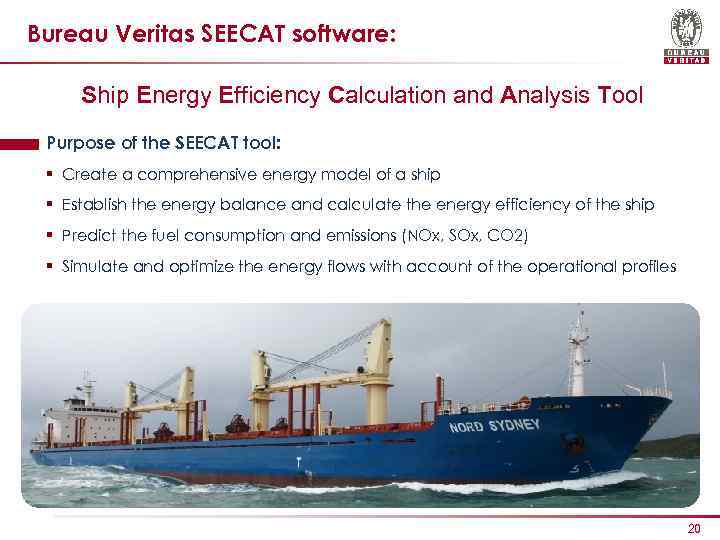 Bureau Veritas SEECAT software: Ship Energy Efficiency Calculation and Analysis Tool Purpose of the SEECAT tool: § Create a comprehensive energy model of a ship § Establish the energy balance and calculate the energy efficiency of the ship § Predict the fuel consumption and emissions (NOx, SOx, CO 2) § Simulate and optimize the energy flows with account of the operational profiles 20
 The modeling method • The SEECAT modeling method is based on a global approach where all energy producers and consumers are taken into account. The interactions amongst the different kinds of energy involved are taken into account. It concerns in particular l the chemical energy from fuel l the mechanical energy (. e. g. that transmitted to the propeller) l the electrical energy l thermal energy (e. g. that contained in steam, cooling water, exhaust gases) • This approach makes it possible to model almost any kind of marine propulsion architecture. 21
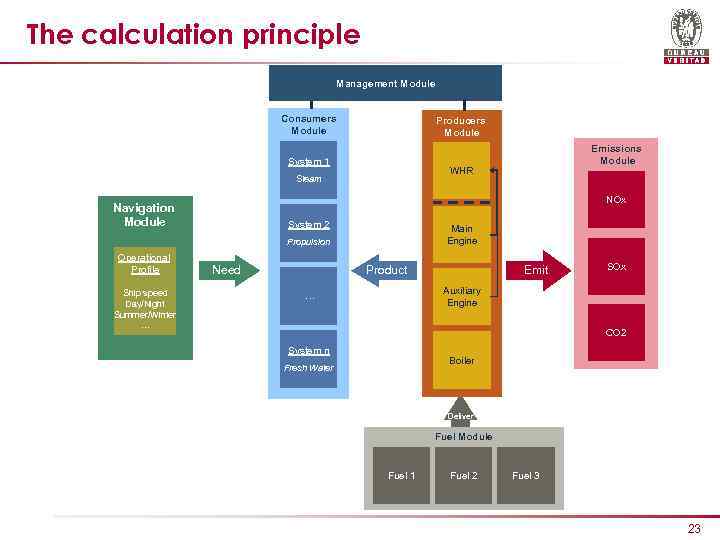 The calculation principle Management Module Consumers Module Producers Module System 1 WHR Steam NOx Navigation Module System 2 Main Engine Propulsion Operational Profile Ship speed Day/Night Summer/Winter … Emissions Module Need Emit Product SOx Auxiliary Engine … CO 2 System n Boiler Fresh Water Deliver Fuel Module Fuel 1 Fuel 2 Fuel 3 23
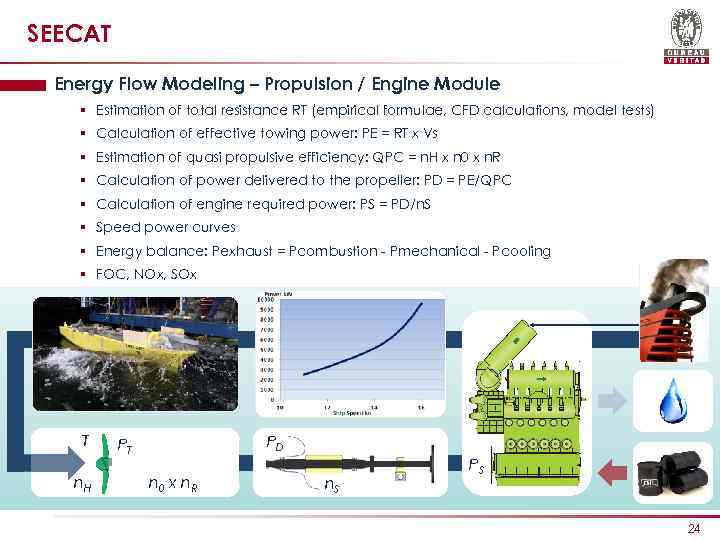 SEECAT Energy Flow Modeling – Propulsion / Engine Module § Estimation of total resistance RT (empirical formulae, CFD calculations, model tests) § Calculation of effective towing power: PE = RT x Vs § Estimation of quasi propulsive efficiency: QPC = n. H x n 0 x n. R § Calculation of power delivered to the propeller: PD = PE/QPC § Calculation of engine required power: PS = PD/n. S § Speed power curves § Energy balance: Pexhaust = Pcombustion - Pmechanical - Pcooling § FOC, NOx, SOx T n. H PD PT n 0 x n R n. S PS 24
 SEECAT Energy Flow Modeling –Electricity Module § Calculation of electrical demand according to different operations (sailing, loading/unloading, ballast exchange etc. ) § Calculation of power balance & respective power management of diesel generators according to electrical demand § FOC, NOx, Sox 25
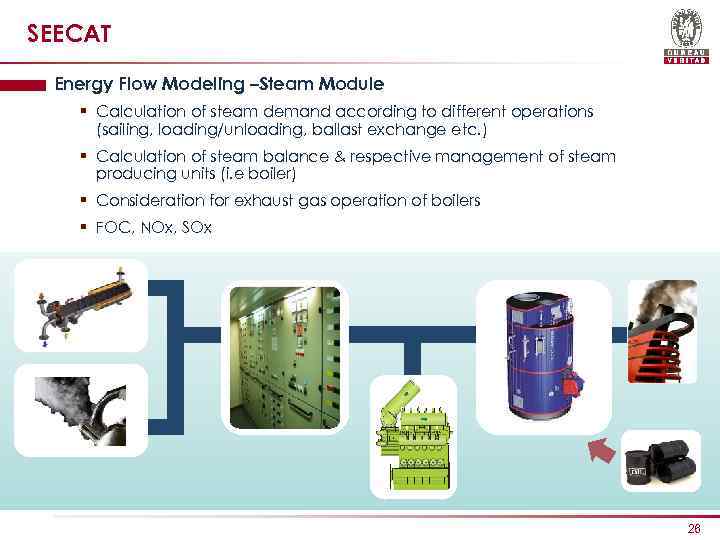 SEECAT Energy Flow Modeling –Steam Module § Calculation of steam demand according to different operations (sailing, loading/unloading, ballast exchange etc. ) § Calculation of steam balance & respective management of steam producing units (i. e boiler) § Consideration for exhaust gas operation of boilers § FOC, NOx, SOx 26
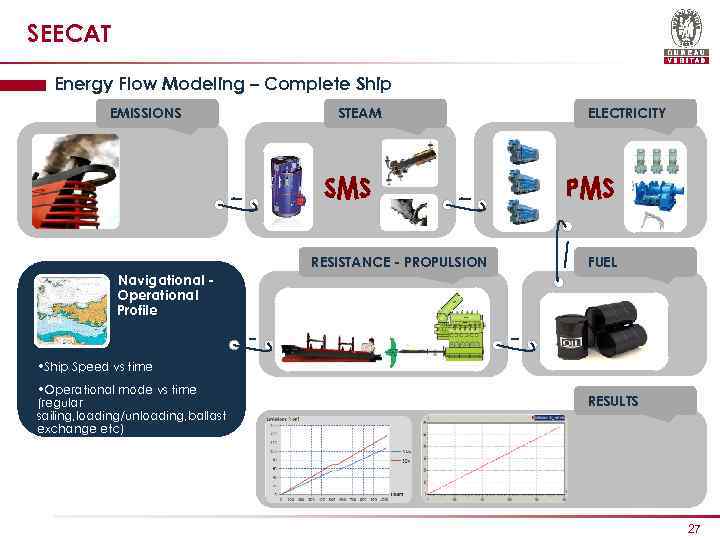 SEECAT Energy Flow Modeling – Complete Ship EMISSIONS STEAM ELECTRICITY RESISTANCE - PROPULSION FUEL Navigational Operational Profile • Ship Speed vs time • Operational mode vs time (regular sailing, loading/unloading, ballast exchange etc) RESULTS 27
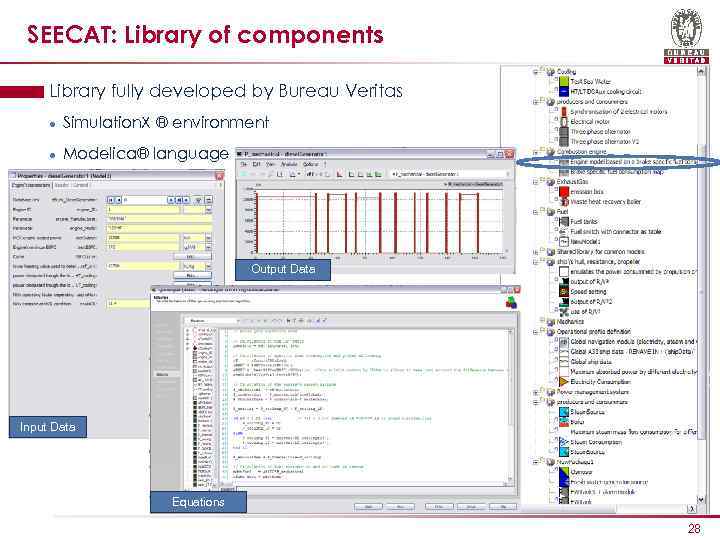 SEECAT: Library of components ► Library fully developed by Bureau Veritas l Simulation. X ® environment l Modelica® language Output Data Input Data Equations 28
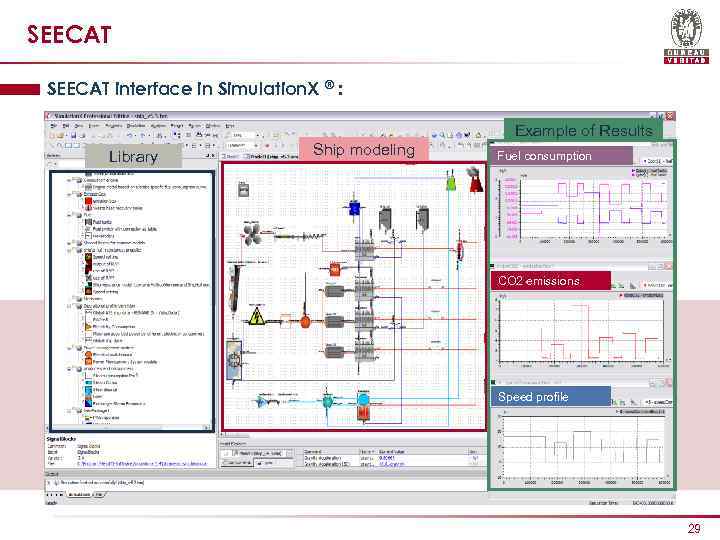 SEECAT interface in Simulation. X ® : Example of Results Library Ship modeling Fuel consumption CO 2 emissions Speed profile 29
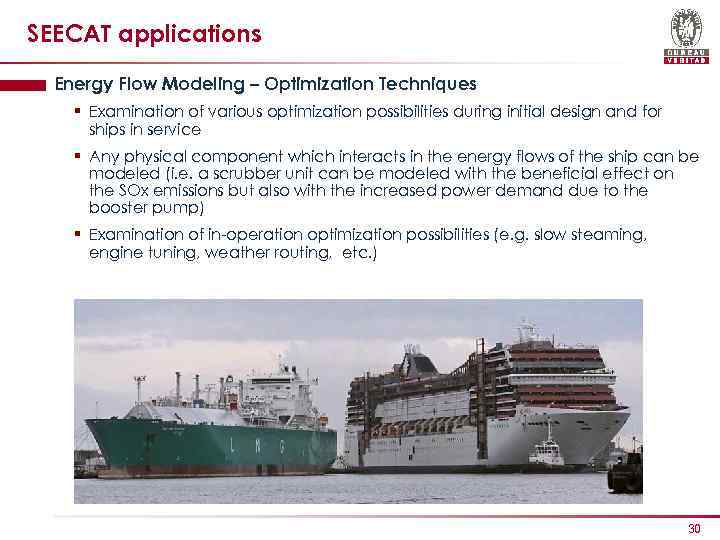 SEECAT applications Energy Flow Modeling – Optimization Techniques § Examination of various optimization possibilities during initial design and for ships in service § Any physical component which interacts in the energy flows of the ship can be modeled (i. e. a scrubber unit can be modeled with the beneficial effect on the SOx emissions but also with the increased power demand due to the booster pump) § Examination of in-operation optimization possibilities (e. g. slow steaming, engine tuning, weather routing, etc. ) 30
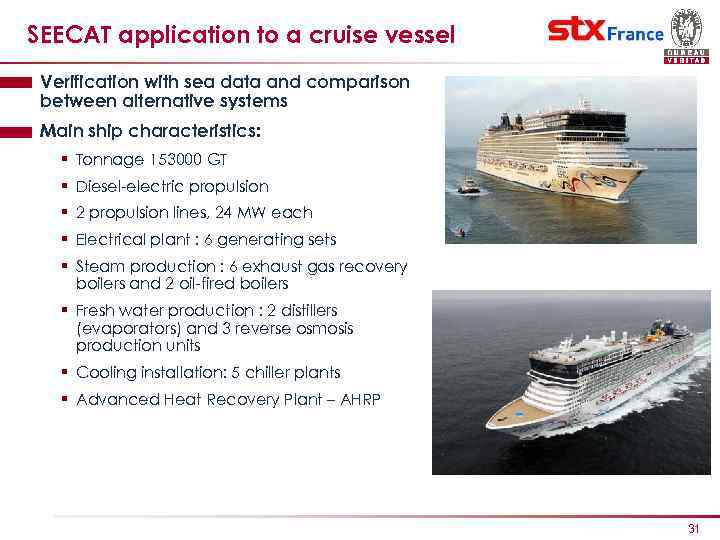 SEECAT application to a cruise vessel Verification with sea data and comparison between alternative systems Main ship characteristics: § Tonnage 153000 GT § Diesel-electric propulsion § 2 propulsion lines, 24 MW each § Electrical plant : 6 generating sets § Steam production : 6 exhaust gas recovery boilers and 2 oil-fired boilers § Fresh water production : 2 distillers (evaporators) and 3 reverse osmosis production units § Cooling installation: 5 chiller plants § Advanced Heat Recovery Plant – AHRP 31
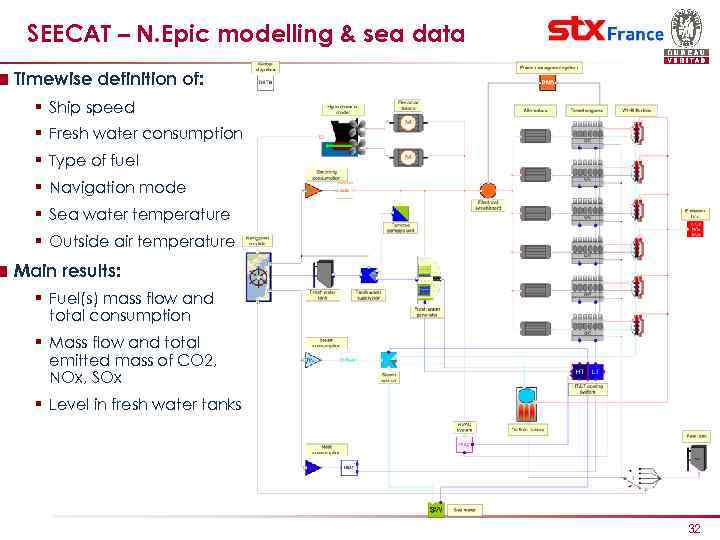 SEECAT – N. Epic modelling & sea data Timewise definition of: § Ship speed § Fresh water consumption § Type of fuel § Navigation mode § Sea water temperature § Outside air temperature Main results: § Fuel(s) mass flow and total consumption § Mass flow and total emitted mass of CO 2, NOx, SOx § Level in fresh water tanks 32
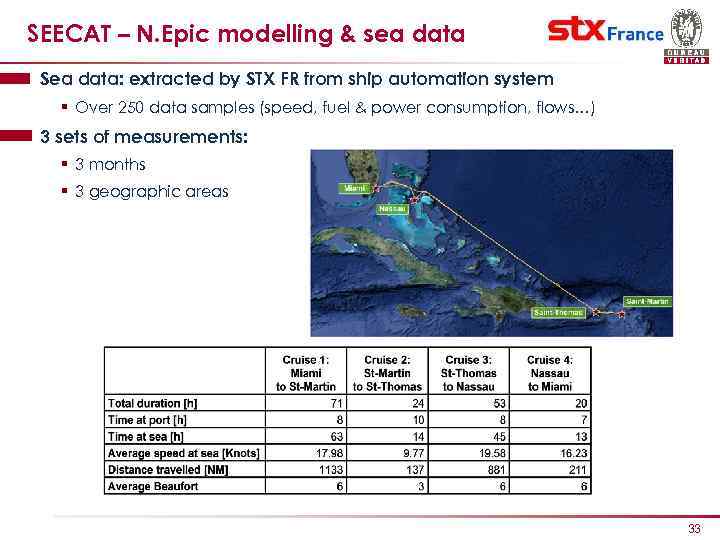 SEECAT – N. Epic modelling & sea data Sea data: extracted by STX FR from ship automation system § Over 250 data samples (speed, fuel & power consumption, flows…) 3 sets of measurements: § 3 months § 3 geographic areas 33
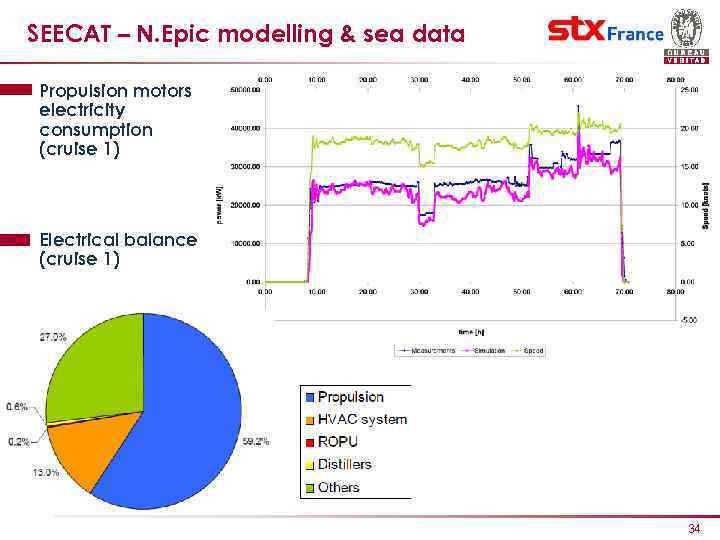 SEECAT – N. Epic modelling & sea data Propulsion motors electricity consumption (cruise 1) Electrical balance (cruise 1) 34
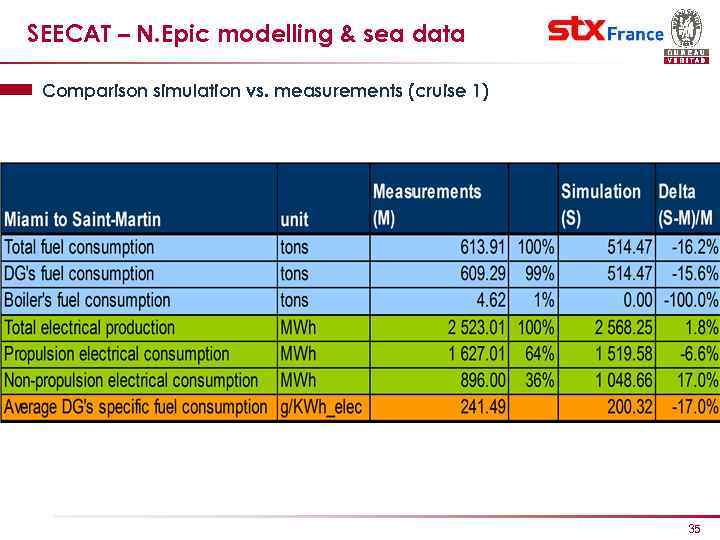 SEECAT – N. Epic modelling & sea data Comparison simulation vs. measurements (cruise 1) 35
 SEECAT – N. Epic modelling & sea data 36
 SEECAT – N. Epic modelling & sea data 37
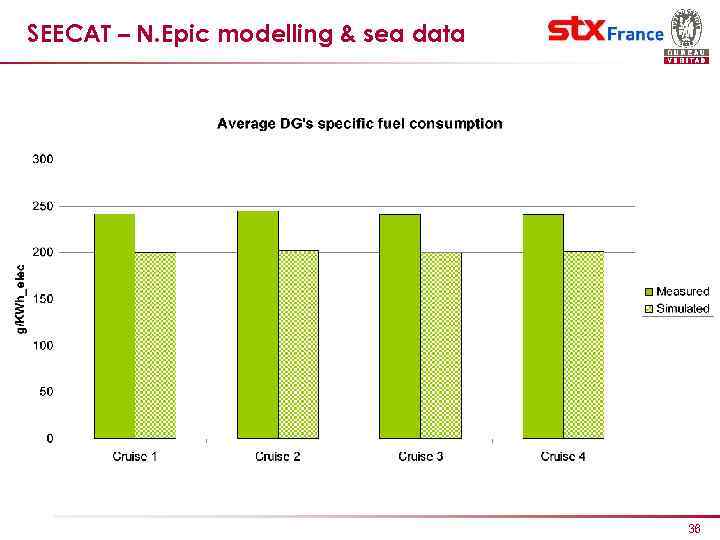
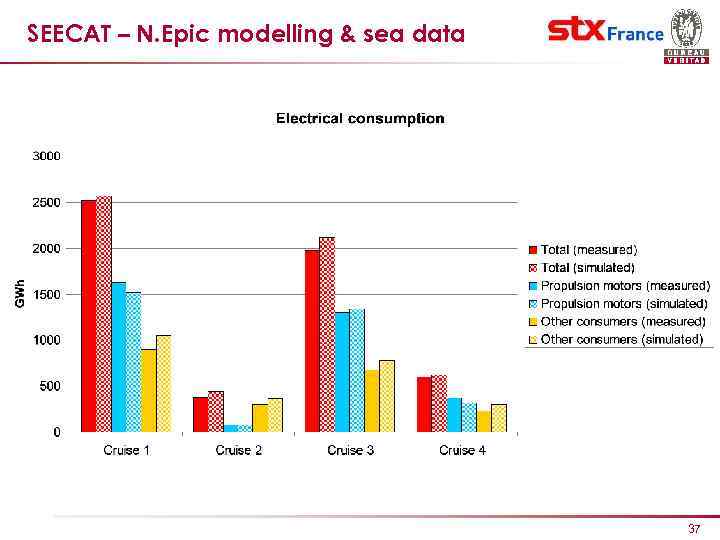
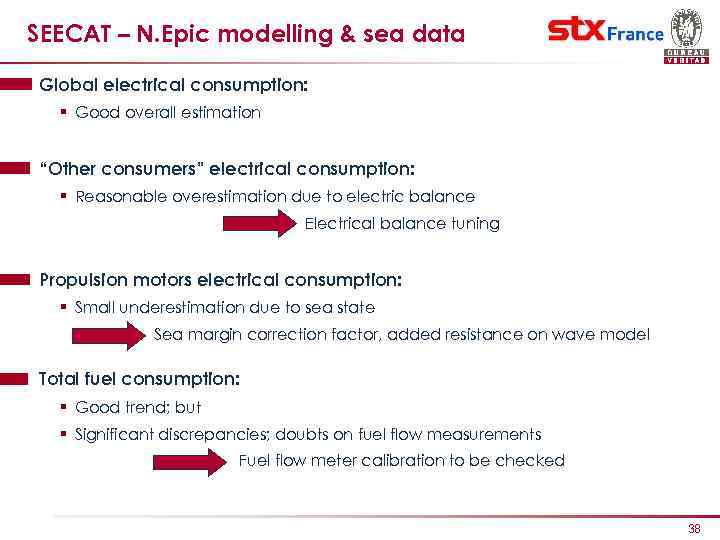 SEECAT – N. Epic modelling & sea data Global electrical consumption: § Good overall estimation “Other consumers” electrical consumption: § Reasonable overestimation due to electric balance Electrical balance tuning Propulsion motors electrical consumption: § Small underestimation due to sea state Sea margin correction factor, added resistance on wave model Total fuel consumption: § Good trend; but § Significant discrepancies; doubts on fuel flow measurements Fuel flow meter calibration to be checked 38
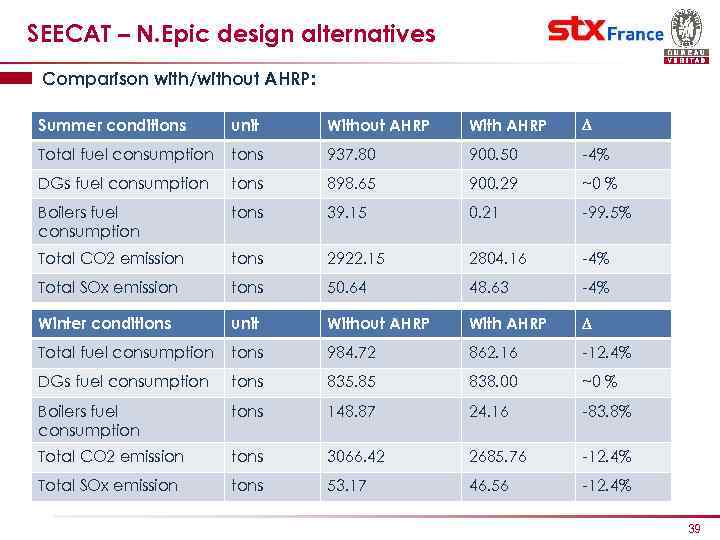 SEECAT – N. Epic design alternatives Comparison with/without AHRP: Summer conditions unit Without AHRP With AHRP D Total fuel consumption tons 937. 80 900. 50 -4% DGs fuel consumption tons 898. 65 900. 29 ~0 % Boilers fuel consumption tons 39. 15 0. 21 -99. 5% Total CO 2 emission tons 2922. 15 2804. 16 -4% Total SOx emission tons 50. 64 48. 63 -4% Winter conditions unit Without AHRP With AHRP D Total fuel consumption tons 984. 72 862. 16 -12. 4% DGs fuel consumption tons 835. 85 838. 00 ~0 % Boilers fuel consumption tons 148. 87 24. 16 -83. 8% Total CO 2 emission tons 3066. 42 2685. 76 -12. 4% Total SOx emission tons 53. 17 46. 56 -12. 4% 39
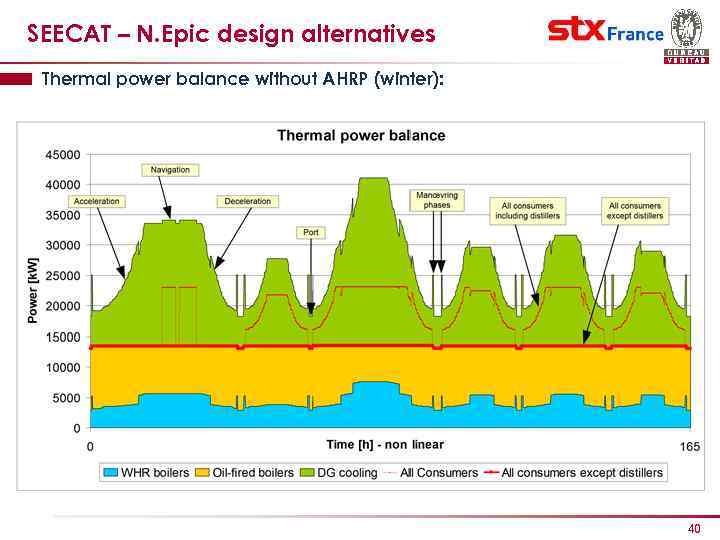 SEECAT – N. Epic design alternatives Thermal power balance without AHRP (winter): 40
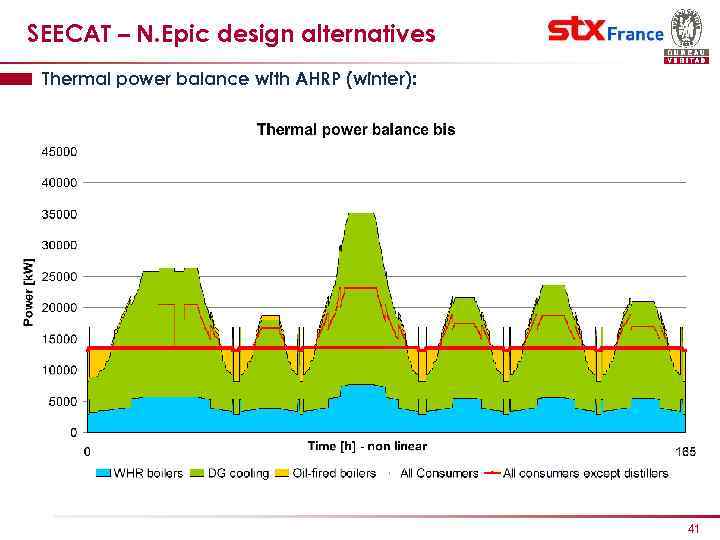 SEECAT – N. Epic design alternatives Thermal power balance with AHRP (winter): 41
 SEECAT current status
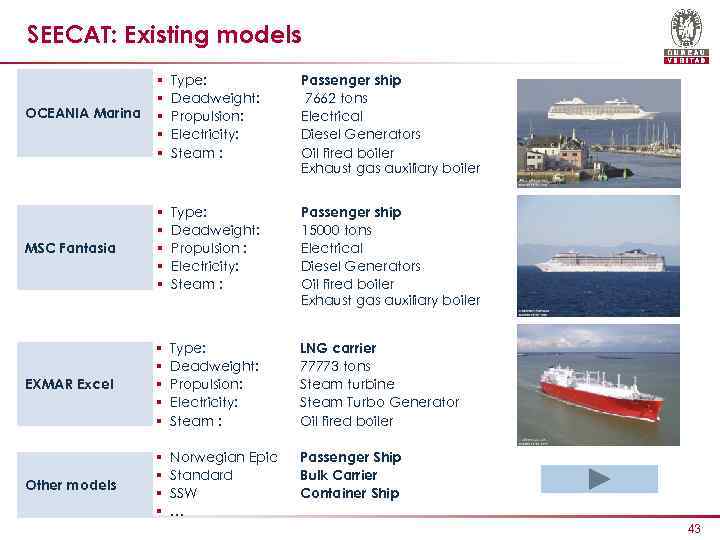 SEECAT: Existing models OCEANIA Marina § § § Type: Deadweight: Propulsion: Electricity: Steam : Passenger ship 7662 tons Electrical Diesel Generators Oil fired boiler Exhaust gas auxiliary boiler MSC Fantasia § § § Type: Deadweight: Propulsion : Electricity: Steam : Passenger ship 15000 tons Electrical Diesel Generators Oil fired boiler Exhaust gas auxiliary boiler EXMAR Excel § § § Type: Deadweight: Propulsion: Electricity: Steam : LNG carrier 77773 tons Steam turbine Steam Turbo Generator Oil fired boiler Other models § § Norwegian Epic Standard SSW … Passenger Ship Bulk Carrier Container Ship . 43
 Conclusions
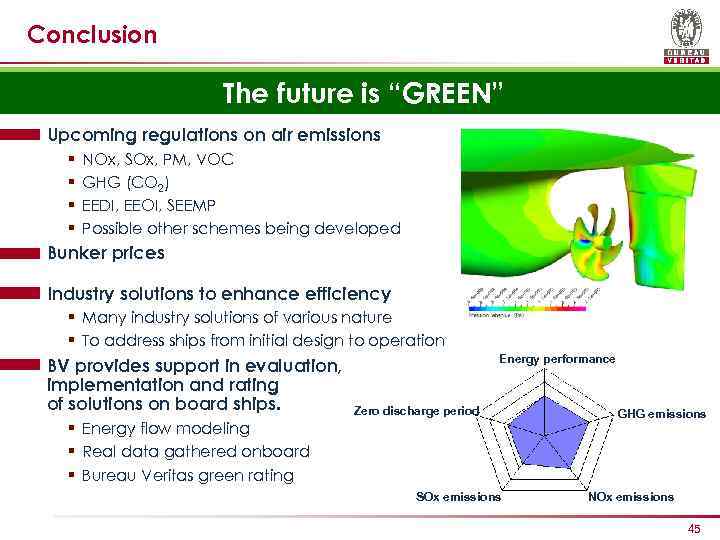 Conclusion The future is “GREEN” Upcoming regulations on air emissions § § NOx, SOx, PM, VOC GHG (CO 2) EEDI, EEOI, SEEMP Possible other schemes being developed Bunker prices Industry solutions to enhance efficiency § Many industry solutions of various nature § To address ships from initial design to operation BV provides support in evaluation, implementation and rating of solutions on board ships. Energy performance Zero discharge period § Energy flow modeling § Real data gathered onboard § Bureau Veritas green rating SOx emissions GHG emissions NOx emissions 45
 Present situation in 2012 A global overcapacity: Shipping Crisis Accelerated Obsolescence § Global overcapacity of recent ships § Low rates in the major markets ( bulk carriers, oil tankers, containerships) § Conclusion from 2012 BRS annual report: “With soaring fuel prices and falling freight rates, it is now critical that shipowners economize and place the emphasis on reducing fuel costs rather than expecting increased earnings. ” Accelerated obsolescence of the existing fleet may contribute to reduce the duration of the crisis. New ship designs offer: § Reduced fuel costs § Reduced maintenance costs through new strength standards § Compliance with new requirements for environmental protection § Rising fuel prices in particular may reduce the competitive advantage of existing tonnage 46
 © - Copyright Bureau Veritas