


 Скачать презентацию How To Conduct All-Inclusive Performance Evaluation of Your
69398004c29d74a2a5502a16f65e26c2.ppt
- Количество слайдов: 64
 How To Conduct All-Inclusive Performance Evaluation of Your Biometric System Dr. Dmitry O. Gorodnichy Video Surveillance & Biometrics Section Science and Engineering Directorate 1.
 Outline 1. What’s Biometrics? – to the user 1. What is it used for? 2. Biometric systems evolution and taxonomy Ø 2. CBSA case studies: Iris, faces (e. Passport, in video) What’s Biometrics? – to the developer 1. 2. 3. Why Biometrics may fail? What are the factors? What is biometrics Performance Evaluation? Conducting comprehensive Performance Evaluation 1. 2. Basic metrics: counting False Matches vs. Non-Matches 3. Multi-order analysis: Taking into account all scores 4. General workflow Examples – what to look for Lessons learnt 2.
 Intro to CBSA 3.
 Canada Border Services Agency Ø CBSA was created in December 2003 as one of six agencies in the Public Safety (PS) portfolio § RCMP (Police) is another PS agency Ø Integrates ‘border’ functions previously spread among 3 organizations: § Customs branch from the former Canada Customs and Revenue Agency (CCRA) § Intelligence, Interdiction and Enforcement program of Citizenship and Immigration Canada (CIC) § Import inspection at Ports of Entry (POE) program from the Canadian Food Inspection Agency (CFIA) Ø Mandate: to provide integrated border services that support national security and public safety priorities and facilitate the free flow of persons and goods 4.
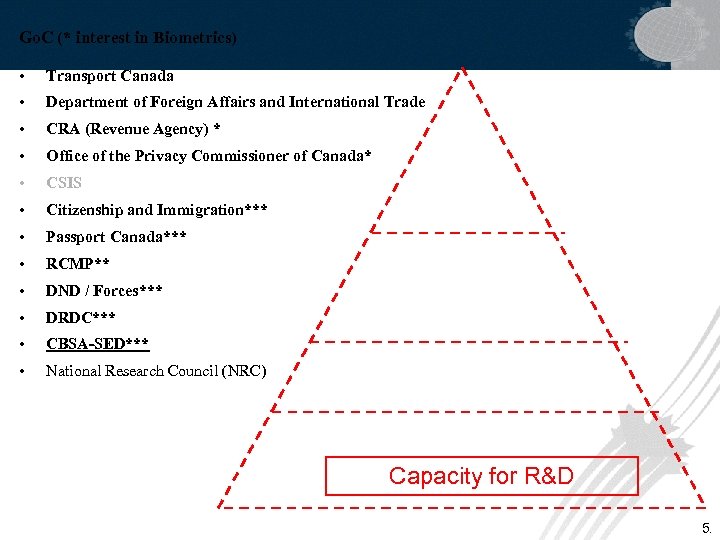 Go. C (* interest in Biometrics) • Transport Canada • Department of Foreign Affairs and International Trade • CRA (Revenue Agency) * • Office of the Privacy Commissioner of Canada* • CSIS • Citizenship and Immigration*** • Passport Canada*** • RCMP** • DND / Forces*** • DRDC*** • CBSA-SED*** • National Research Council (NRC) Capacity for R&D 5.
 Science & Engineering Directorate Part of Technology Branch • We are 100 people strong and multi-disciplinary (chemistry, physics, mathematics, forensics, etc. ) • We work from one central facility (i. e. no regional offices) • Main thrust areas: Advanced Analysis and Analytics • Traditionally, chemistry-based, now in the forensic and physics (optical) space, moving towards the data/information space Advanced Sensors (and Integrated Sensor Networks) • Building off RADNet concepts where “sensors” can be for Chemical, Biological, Radiological, Nuclear or Explosive (CBRNE), electronics, and/or people, and remoting these sensors to create a “virtual presence” 6.
![5 -year Strategy released [2008] • To become Agency’s Science and Engineering Authority •](https://present5.com/presentation/69398004c29d74a2a5502a16f65e26c2/image-7.jpg "5 -year Strategy released [2008] • To become Agency’s Science and Engineering Authority •") 5 -year Strategy released [2008] • To become Agency’s Science and Engineering Authority • Evolve a Chief Scientific Officer role • Continue operational excellence: regulatory and projects for solving today’s problems • Dedicate resources to proactively shape tomorrow and increase level of readiness Laboratory & Scientific Services “Science & Engineering Directorate Directorate” make decisions or take actions based on sound evidence 7.
5 -year Strategy released [2008] • To become Agency’s Science and Engineering Authority • Evolve a Chief Scientific Officer role • Continue operational excellence: regulatory and projects for solving today’s problems • Dedicate resources to proactively shape tomorrow and increase level of readiness Laboratory & Scientific Services “Science & Engineering Directorate Directorate” make decisions or take actions based on sound evidence 7.
 … as a result Video Surveillance and Biometrics (VSB) Section was created (Jan 2009) - to support agency’s Portfolios in Video Surveillance and Biometrics with expertise in Image Analysis & Pattern Recognition (Overlap of Comp. Sci. AND Math) .
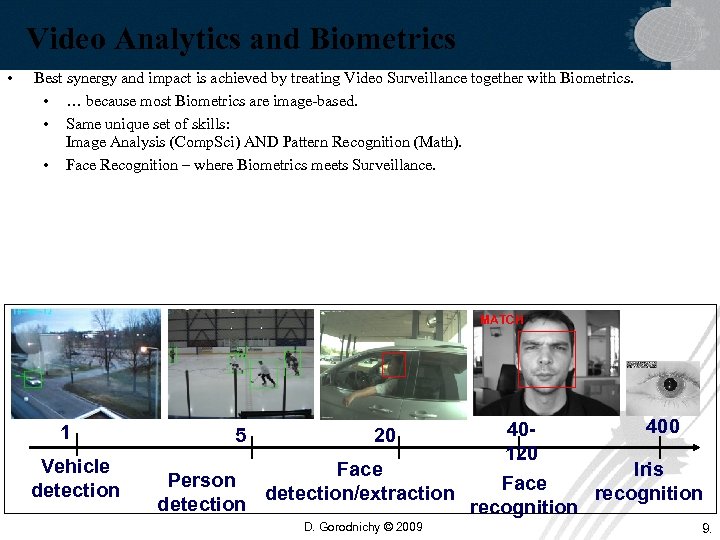 Video Analytics and Biometrics • Best synergy and impact is achieved by treating Video Surveillance together with Biometrics. • … because most Biometrics are image-based. • Same unique set of skills: Image Analysis (Comp. Sci) AND Pattern Recognition (Math). • Face Recognition – where Biometrics meets Surveillance. MATCH 1 Vehicle detection 400 40120 Face Iris Person Face detection/extraction recognition detection recognition 5 20 D. Gorodnichy © 2009 9.
 Three foci of our R&D work: Our objective: To find what is possible and the best: • in Video Analytics, Biometrics, Face Recognition • for LAND and AIRPORT Points of Entry (POE) to be in a position to recommend solutions to CBSA & OGD. Focus 1: Evaluation of Market Solutions Focus 2: In-house R&D Focus 3: Live Tests/Pilots in the Field Specifically: in Iris and Face (from Video) recognition 10.
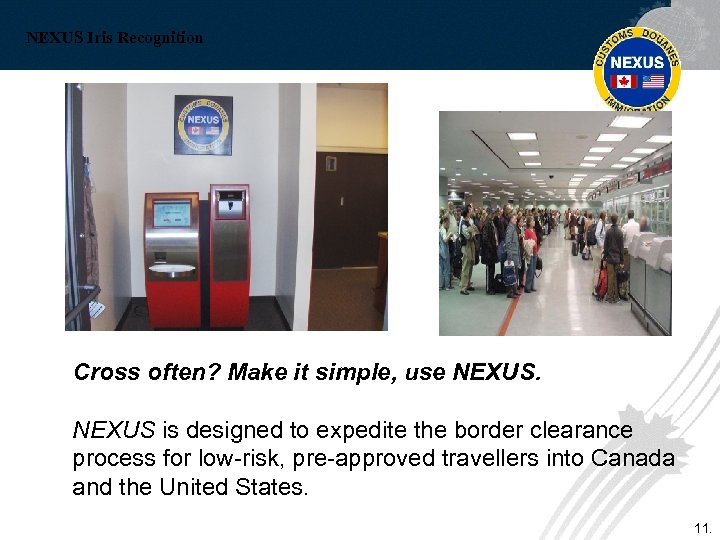 NEXUS Iris Recognition Cross often? Make it simple, use NEXUS is designed to expedite the border clearance process for low-risk, pre-approved travellers into Canada and the United States. 11.
 NEXUS Iris Recognition (cntd) • Fully operational at: ØVancouver International Airport ØHalifax International Airport ØToronto- L. B. Pearson International Airport ØMontréal – Trudeau International Airport ØCalgary International Airport ØWinnipeg International Airport ØEdmonton International Airport ØOttawa-Mac. Donald Cartier International Airport • More about NEXUS: www. nexus. gc. ca, 12.
 1. Biometric needs 13.
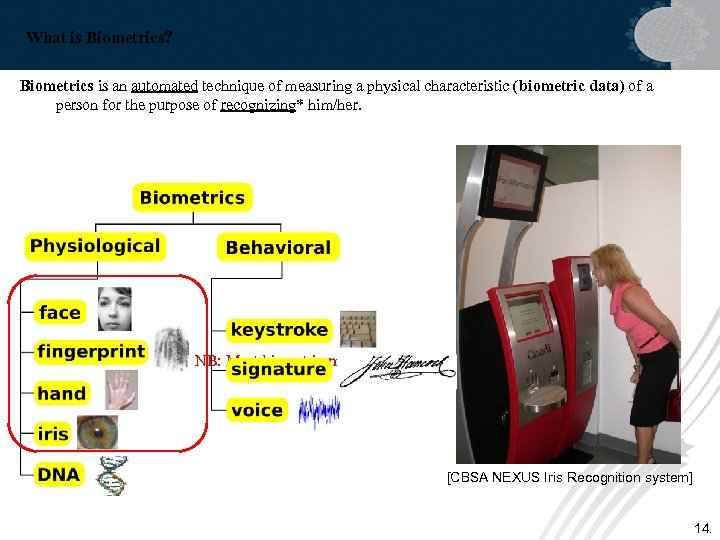 What is Biometrics? Biometrics is an automated technique of measuring a physical characteristic (biometric data) of a person for the purpose of recognizing* him/her. NB: Most biometric modalities are image-based! [CBSA NEXUS Iris Recognition system] 14.
 Biometric system taxonomy • By recognition task • By operational considerations • By environmental conditions • By modality characteristics • By recognition performance requirements • By decision making 15.
 Four “recognition” tasks 1. Verification / Authentification: 1 to 1 (eg. Access Card) • Instant decision making, facilitated by pre-stored biometric data 2. “White List” identification: 1 to N a) N is small/limited (eg. laptop users, secret facility personnel) b) N is large and growing (bank clients, trusted travelers) • Instant decision making, facilitated by Cooperation from users 3. “Black List” identification / Screening: 1 to M, M not large • Time-weighted decision made by an Trained Analysts • With intelligence coming from difference sources 4. Classification / Categorization: 1 to K, K – small Ø What is his type, eg. Gender, Age, race ? (soft biometrics) Ø Whom of K people he resembles most ? (eg. tracking in video) 16.
 Operational Considerations • Recognition task: verification vs. identification (harder) • Overt vs covert image capture • Cooperative vs non-cooperative participant • Structured (constrained) vs non-structured environment • Small database vs. large database • Lighting conditions at enrollment and passage • Relative impact (Cost) of False Match vs False Non-Match Other: • Training of staff etc. 17.
 Decision making • Final decision vs. list of options/candidates for further investigation • Based only biometric data provided vs. with additional data • Instantly made – in live mode vs. time-weighted decision – by go • Fully automated (no human involved) vs. made by Forensic Analyst Example: Face Recognition used for helping police/immigration to capture criminals vs. used for Access Control with e. Passports and Smartgates 18.
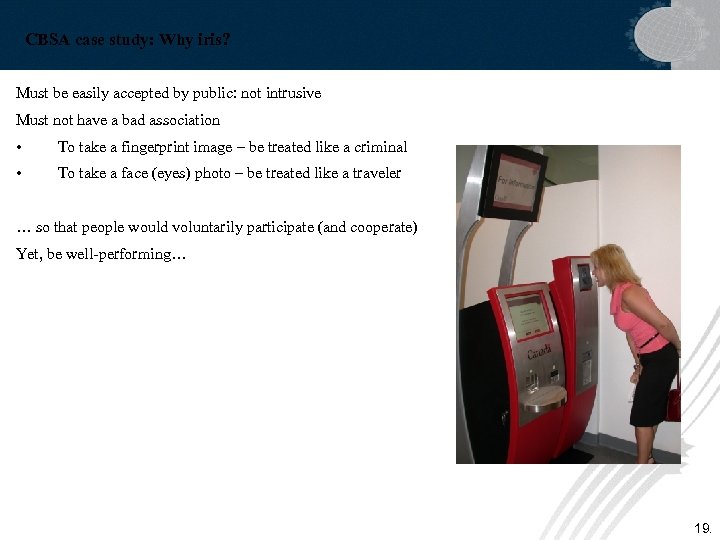 CBSA case study: Why iris? Must be easily accepted by public: not intrusive Must not have a bad association • To take a fingerprint image – be treated like a criminal • To take a face (eyes) photo – be treated like a traveler … so that people would voluntarily participate (and cooperate) Yet, be well-performing… 19.
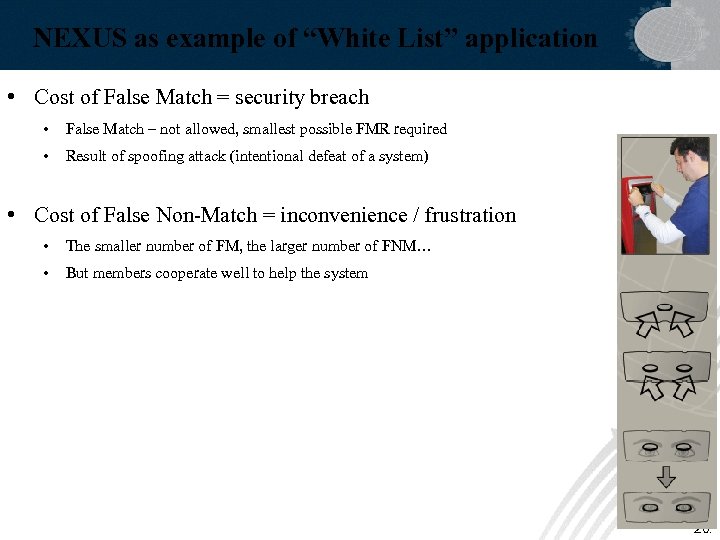 NEXUS as example of “White List” application • Cost of False Match = security breach • False Match – not allowed, smallest possible FMR required • Result of spoofing attack (intentional defeat of a system) • Cost of False Non-Match = inconvenience / frustration • The smaller number of FM, the larger number of FNM… • But members cooperate well to help the system 20.
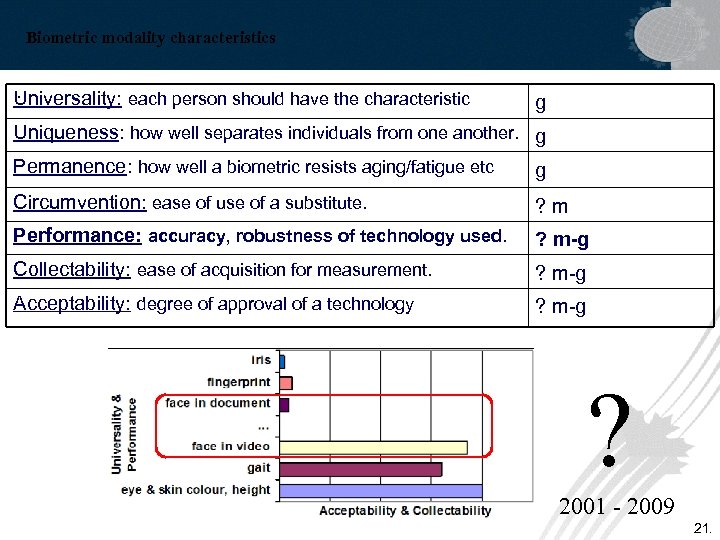 Biometric modality characteristics . Universality: each person should have the characteristic g Uniqueness: how well separates individuals from one another. g Permanence: how well a biometric resists aging/fatigue etc g Circumvention: ease of use of a substitute. ? m Performance: accuracy, robustness of technology used. ? m-g Collectability: ease of acquisition for measurement. ? m-g Acceptability: degree of approval of a technology ? m-g ? 2001 - 2009 21.
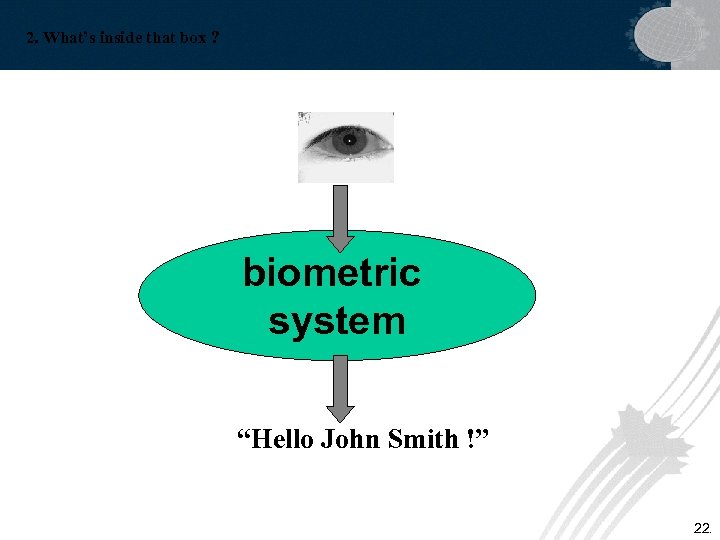 2. What’s inside that box ? biometric system “Hello John Smith !” 22.
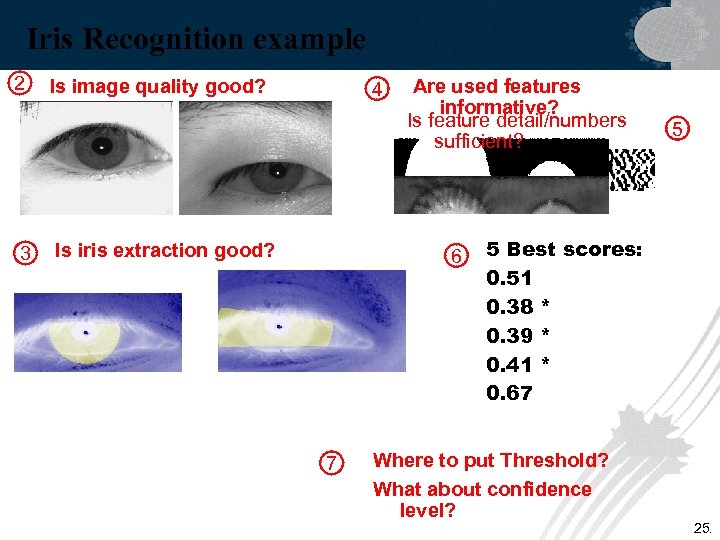
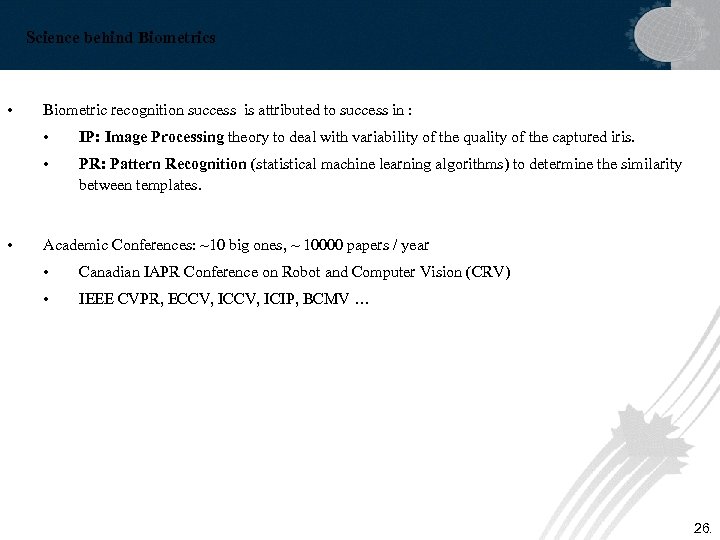
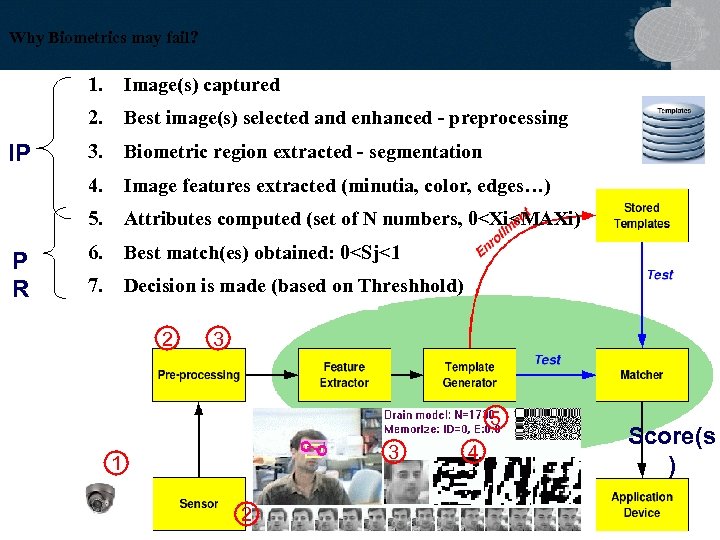 Why Biometrics may fail? 1. 2. 3. Biometric region extracted - segmentation Image features extracted (minutia, color, edges…) 5. P R Best image(s) selected and enhanced - preprocessing 4. IP Image(s) captured Attributes computed (set of N numbers, 0
 Scores for Genuine and Imposter users: • NB: Traditionally, Match is when score is lower a threshold (ie. And it could be not the smallest score!) 24.
 Iris Recognition example 2 3 Is image quality good? 4 Is iris extraction good? Are used features informative? Is feature detail/numbers sufficient? 6 7 5 5 Best scores: 0. 51 0. 38 * 0. 39 * 0. 41 * 0. 67 Where to put Threshold? What about confidence level? 25.
 Science behind Biometrics • Biometric recognition success is attributed to success in : • • • IP: Image Processing theory to deal with variability of the quality of the captured iris. PR: Pattern Recognition (statistical machine learning algorithms) to determine the similarity between templates. Academic Conferences: ~10 big ones, ~ 10000 papers / year • Canadian IAPR Conference on Robot and Computer Vision (CRV) • IEEE CVPR, ECCV, ICIP, BCMV … 26.
 Evolution of Biometrics Faces from video Soft biometrics (audio/visual) Multi-modal fusion Automated identification of people from video 2020. 2010 2000 Automated detection of events 1990 1980 Remote monitoring only Faces from video Soft biometrics full (audio/visual) Multi-modal fusion mor Controlled environment e Manual selection iris little fingerprint none 1970 . Biometrics Surveillance Level of automation and intelligent processing Towards more collectable, unconstrained environments Towards collecting intelligence / evidence D. Gorodnichy © 2009 27.
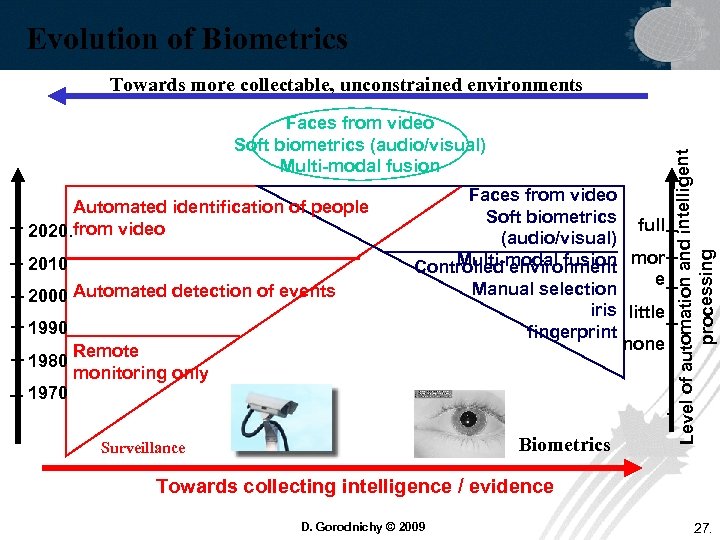
 New biometric technologies As a result of evolution, the arrival of such biometric technologies as • Biometric Surveillance, • Soft Biometrics, • Stand-off Biometrics, also identified as Biometrics at a Distance, Remote Biometrics, Biometrics on the Move or Biometrics on the Go • And increased demand for Face Recognition from Video, . 28.
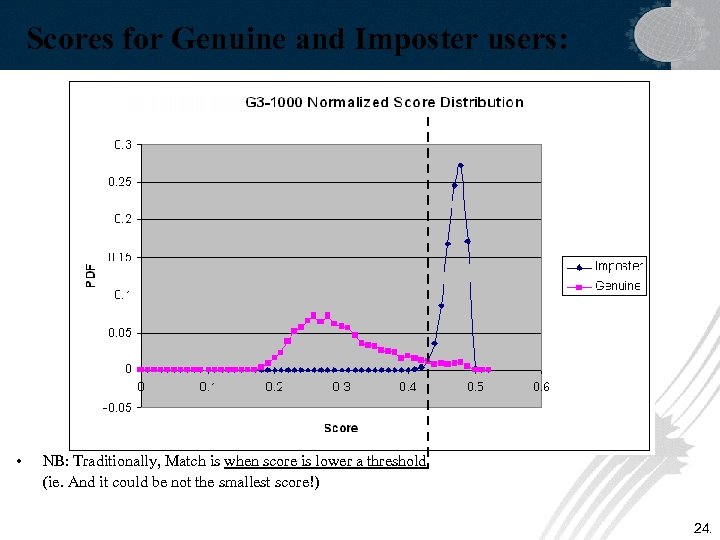
 Stand-off vs. Stand-in biometrics: a person intentionally comes in contact with a biometric sensor Stand-off biometrics: without person’s direct engagement with the sensor (In many cases, s/he may not even know where a capture device is located or whether his/her biometric trait is being captured. ) As a result, a single biometric measurement is normally much less identifying. This means two things: 1. there could be more than one match below the threshold, or two or more very close matching scores. 2. final recognition decision is not based on a single measurement, but on a number of biometric measurements taken from the same or different sensor, combined together using some data fusion technique 29.
 To conclude… Why to conduct evaluation ? Because … • Biometric system is not a “magic box”, but a statistically-derived tool, and it is not error-free (and never will !) And because you want … • To select the best system for your needs • Or, if you already got one, to make it perform better! 30.
 3. How to do it and what to watch for 31.
 What is performance evaluation ? Definition: Performance evaluation is a procedure that involves the testing of a system on a database and/or in a specific setup for the purpose of obtaining measurable statistics (metrics) that can be used to compare systems or system setups to one another. Basic Measurements: • Scores • Decisions (correct vs. incorrect) : • False Match (FM), True Match • False Non-match (FNM), True Non-Match 32.
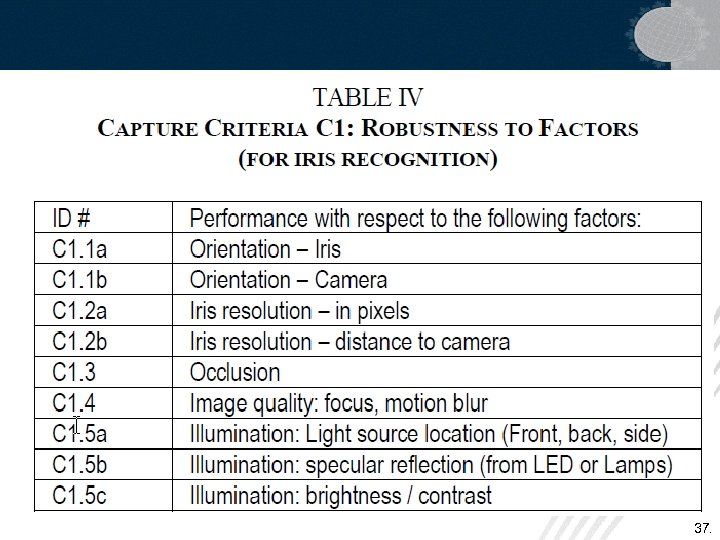
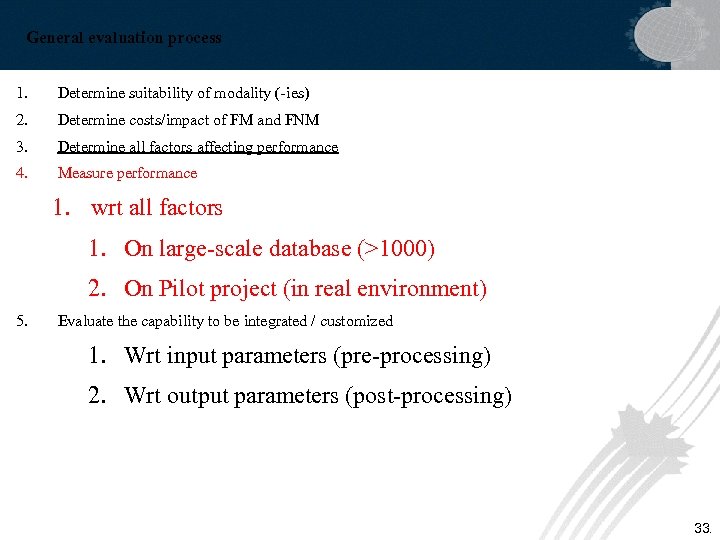 General evaluation process 1. Determine suitability of modality (-ies) 2. Determine costs/impact of FM and FNM 3. Determine all factors affecting performance 4. Measure performance 1. wrt all factors 1. On large-scale database (>1000) 2. On Pilot project (in real environment) 5. Evaluate the capability to be integrated / customized 1. Wrt input parameters (pre-processing) 2. Wrt output parameters (post-processing) 33.
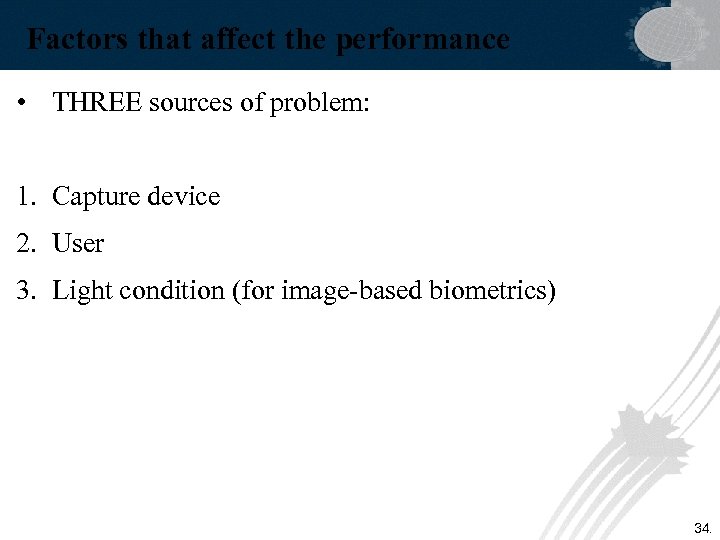 Factors that affect the performance • THREE sources of problem: 1. Capture device 2. User 3. Light condition (for image-based biometrics) 34.
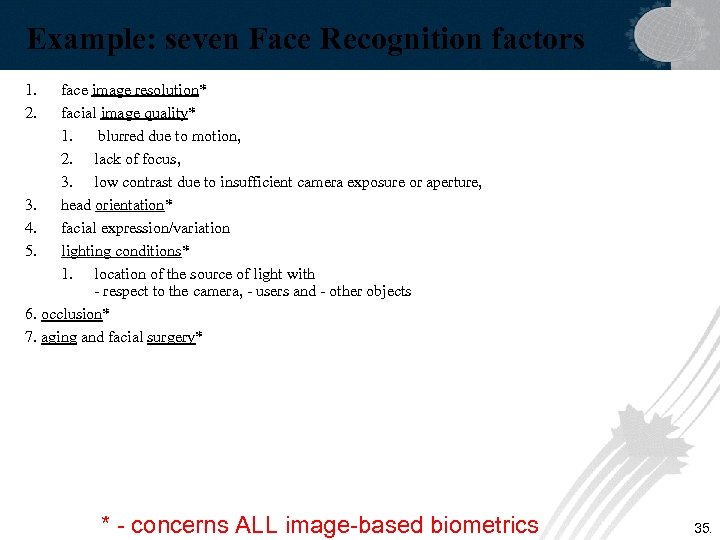 Example: seven Face Recognition factors 1. 2. face image resolution* facial image quality* 1. blurred due to motion, 2. lack of focus, 3. low contrast due to insufficient camera exposure or aperture, 3. head orientation* 4. facial expression/variation 5. lighting conditions* 1. location of the source of light with - respect to the camera, - users and - other objects 6. occlusion* 7. aging and facial surgery* * - concerns ALL image-based biometrics 35.
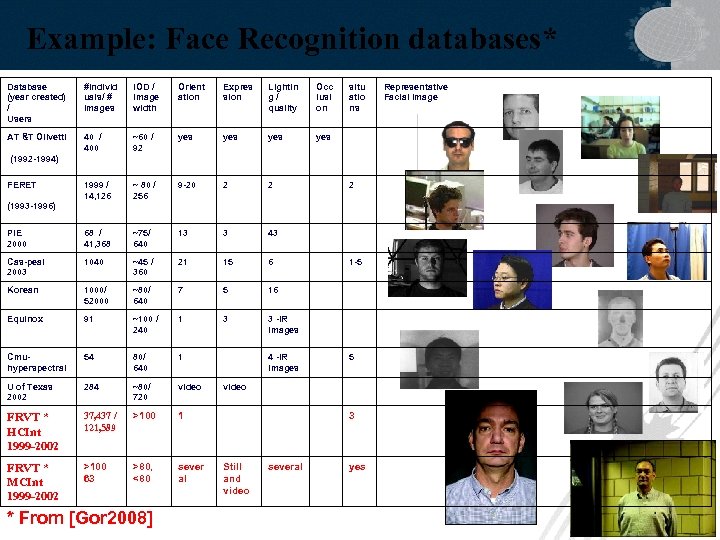 Example: Face Recognition databases* Database (year created) / Users #individ uals/ # images IOD / image width Orient ation Expres sion Lightin g / quality Occ lusi on AT &T Olivetti 40 / 400 ~60 / 92 yes yes 1999 / 14, 126 ~ 80 / 256 9 -20 2 2 PIE 2000 68 / 41, 368 ~75/ 640 13 3 43 Cas-peal 2003 1040 ~45 / 360 21 15 6 Korean 1000/ 52000 ~80/ 640 7 5 16 Equinox 91 ~100 / 240 1 3 3 -IR images Cmu- hyperspectral 54 80/ 640 1 U of Texas 2002 284 ~80/ 720 video FRVT * HCInt 1999 -2002 37, 437 / 121, 589 >100 1 FRVT * MCInt 1999 -2002 >100 63 >80, <80 sever al situ atio ns Representative Facial image (1992 -1994) FERET 2 (1993 -1996) * From [Gor 2008] 4 -IR images 1 -5 5 video 3 Still and video several yes 36.
 37.
37.
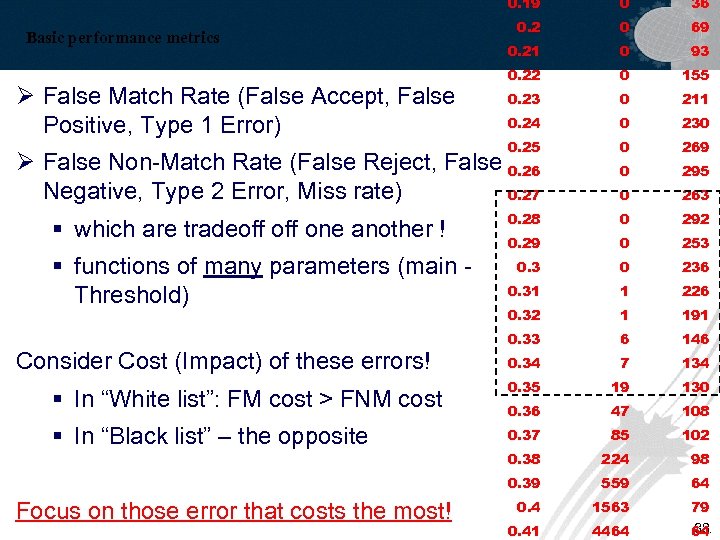 0. 19 Ø False Match Rate (False Accept, False Positive, Type 1 Error) 36 0. 2 0 69 0. 21 0 93 0. 22 0 155 0. 23 0 211 0. 24 0 230 0. 25 0 269 0 295 0 263 0. 28 0 292 0. 29 0 253 0. 3 0 236 0. 31 1 226 0. 32 1 191 0. 33 6 146 0. 34 7 134 0. 35 19 130 0. 36 47 108 0. 37 85 102 0. 38 224 98 0. 39 Basic performance metrics 0 559 64 0. 4 1563 79 0. 41 4464 38 64. Ø False Non-Match Rate (False Reject, False 0. 26 Negative, Type 2 Error, Miss rate) 0. 27 § which are tradeoff one another ! § functions of many parameters (main - Threshold) Consider Cost (Impact) of these errors! § In “White list”: FM cost > FNM cost § In “Black list” – the opposite Focus on those error that costs the most!
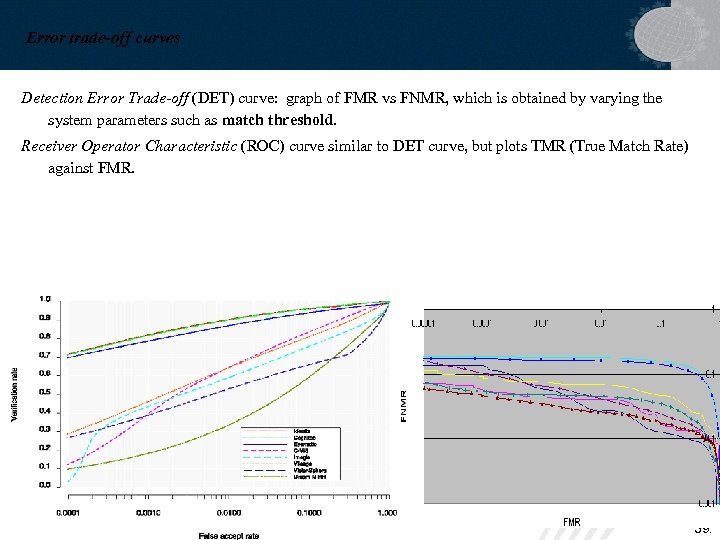 Error trade-off curves Detection Error Trade-off (DET) curve: graph of FMR vs FNMR, which is obtained by varying the system parameters such as match threshold. Receiver Operator Characteristic (ROC) curve similar to DET curve, but plots TMR (True Match Rate) against FMR. 39.
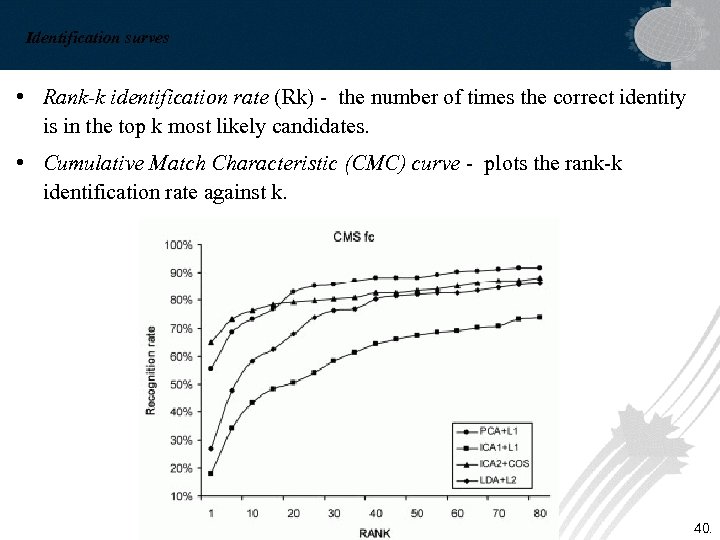 Identification surves • Rank-k identification rate (Rk) - the number of times the correct identity is in the top k most likely candidates. • Cumulative Match Characteristic (CMC) curve - plots the rank-k identification rate against k. 40.
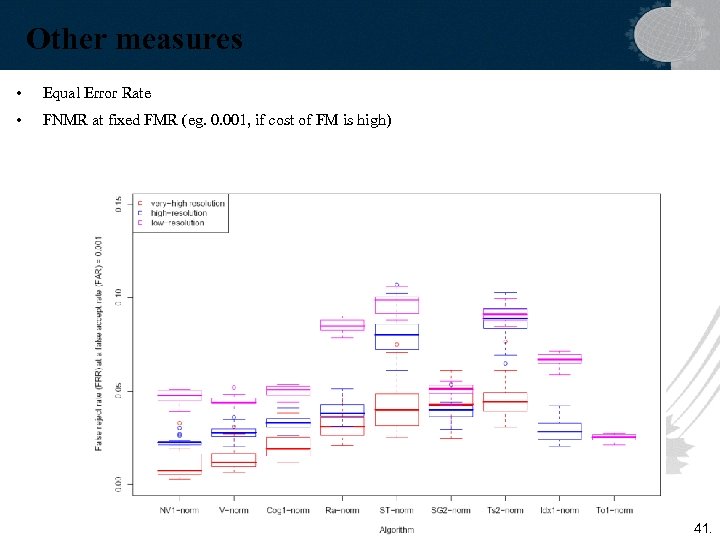 Other measures • Equal Error Rate • FNMR at fixed FMR (eg. 0. 001, if cost of FM is high) 41.
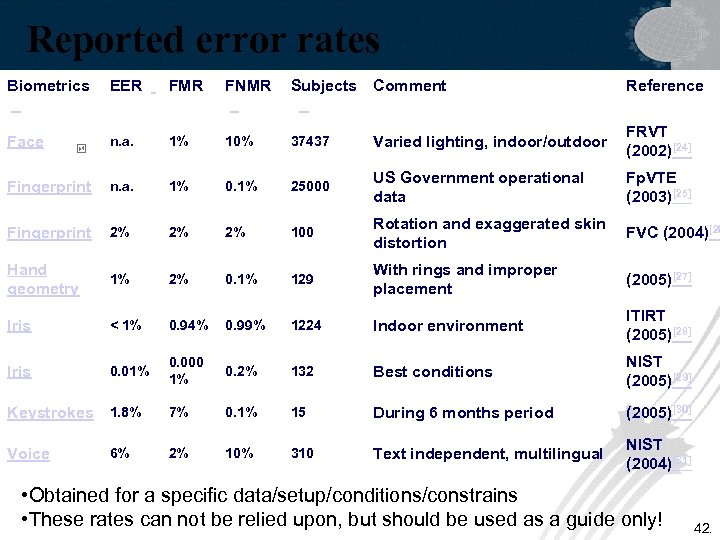 Reported error rates Biometrics EER FMR FNMR Subjects Comment Reference Face n. a. 1% 10% 37437 Varied lighting, indoor/outdoor FRVT (2002)[24] Fingerprint n. a. 1% 0. 1% 25000 US Government operational data Fp. VTE (2003)[25] Fingerprint 2% 2% 2% 100 Rotation and exaggerated skin distortion FVC (2004)[26 Hand geometry 1% 2% 0. 1% 129 With rings and improper placement (2005)[27] Iris < 1% 0. 94% 0. 99% 1224 Indoor environment ITIRT (2005)[28] Iris 0. 01% 0. 000 1% 0. 2% 132 Best conditions NIST (2005)[29] Keystrokes 1. 8% 7% 0. 1% 15 During 6 months period (2005)[30] Voice 6% 2% 10% 310 Text independent, multilingual NIST (2004)[31] • Obtained for a specific data/setup/conditions/constrains • These rates can not be relied upon, but should be used as a guide only! 42.
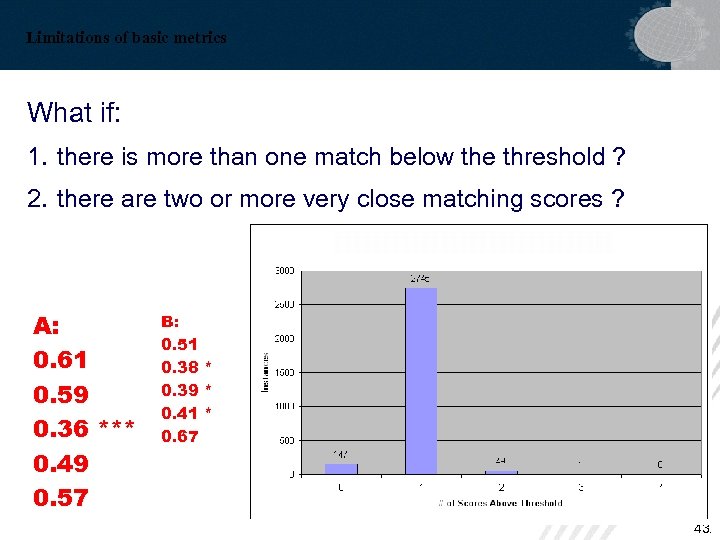 Limitations of basic metrics What if: 1. there is more than one match below the threshold ? 2. there are two or more very close matching scores ? A: 0. 61 0. 59 0. 36 *** 0. 49 0. 57 B: 0. 51 0. 38 * 0. 39 * 0. 41 * 0. 67 43.
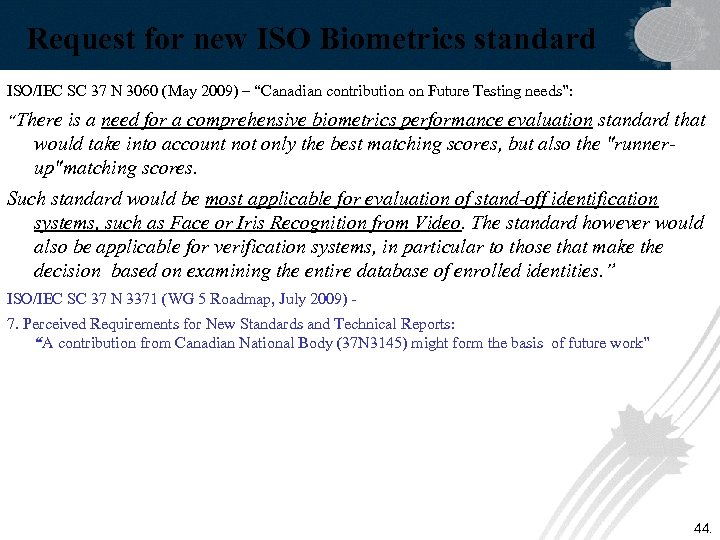 Request for new ISO Biometrics standard ISO/IEC SC 37 N 3060 (May 2009) – “Canadian contribution on Future Testing needs”: “There is a need for a comprehensive biometrics performance evaluation standard that would take into account not only the best matching scores, but also the "runnerup"matching scores. Such standard would be most applicable for evaluation of stand-off identification systems, such as Face or Iris Recognition from Video. The standard however would also be applicable for verification systems, in particular to those that make the decision based on examining the entire database of enrolled identities. ” ISO/IEC SC 37 N 3371 (WG 5 Roadmap, July 2009) 7. Perceived Requirements for New Standards and Technical Reports: “A contribution from Canadian National Body (37 N 3145) might form the basis of future work” 44.
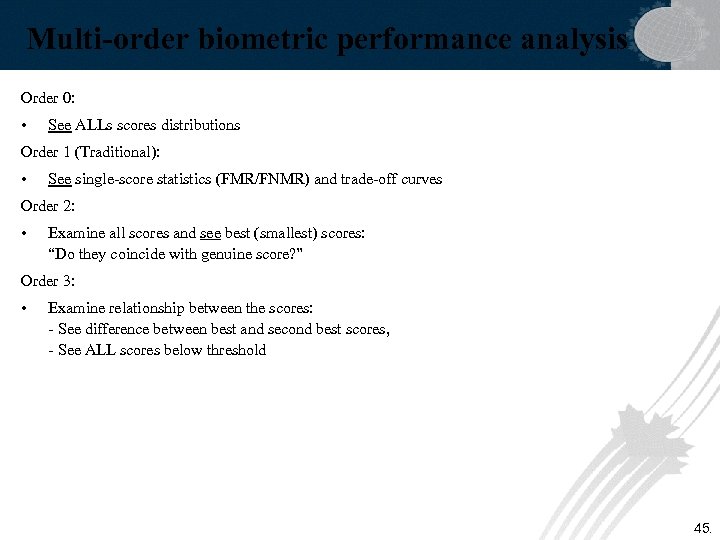 Multi-order biometric performance analysis Order 0: • See ALLs scores distributions Order 1 (Traditional): • See single-score statistics (FMR/FNMR) and trade-off curves Order 2: • Examine all scores and see best (smallest) scores: “Do they coincide with genuine score? ” Order 3: • Examine relationship between the scores: - See difference between best and second best scores, - See ALL scores below threshold 45.
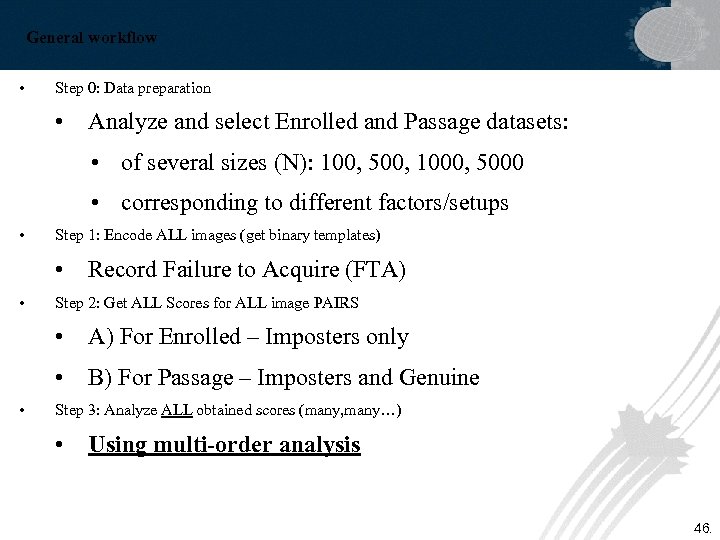 General workflow • Step 0: Data preparation • Analyze and select Enrolled and Passage datasets: • of several sizes (N): 100, 500, 1000, 5000 • corresponding to different factors/setups • Step 1: Encode ALL images (get binary templates) • Record Failure to Acquire (FTA) • Step 2: Get ALL Scores for ALL image PAIRS • A) For Enrolled – Imposters only • B) For Passage – Imposters and Genuine • Step 3: Analyze ALL obtained scores (many, many…) • Using multi-order analysis 46.
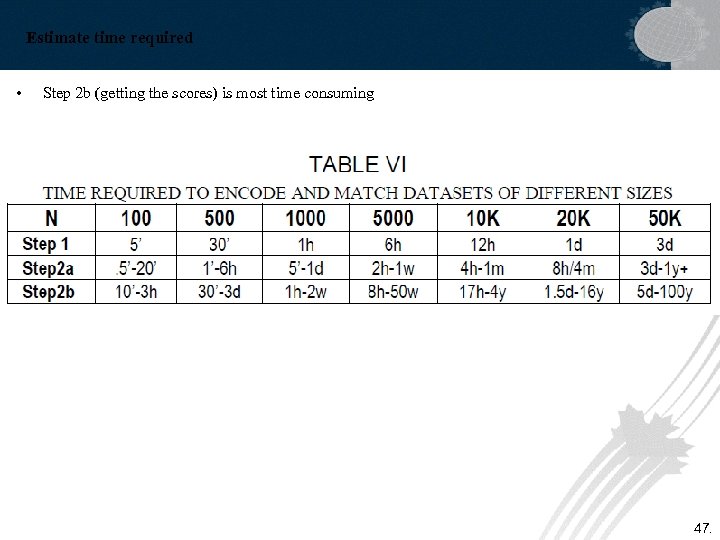 Estimate time required • Step 2 b (getting the scores) is most time consuming 47.
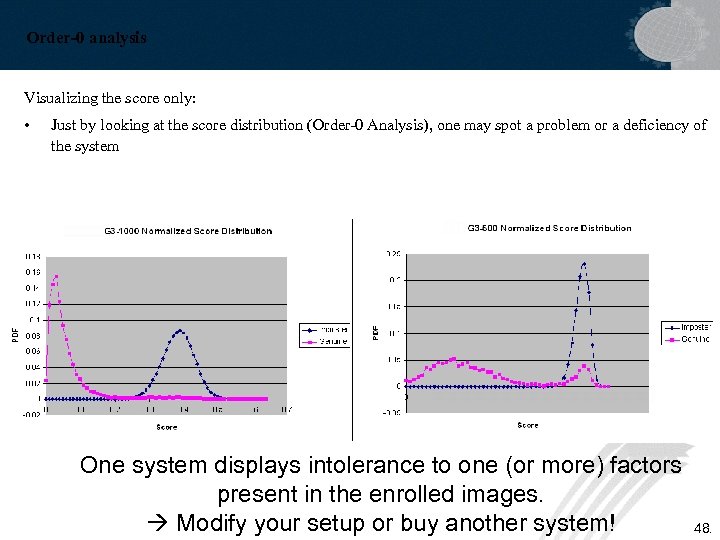 Order-0 analysis Visualizing the score only: • Just by looking at the score distribution (Order-0 Analysis), one may spot a problem or a deficiency of the system One system displays intolerance to one (or more) factors present in the enrolled images. Modify your setup or buy another system! 48.
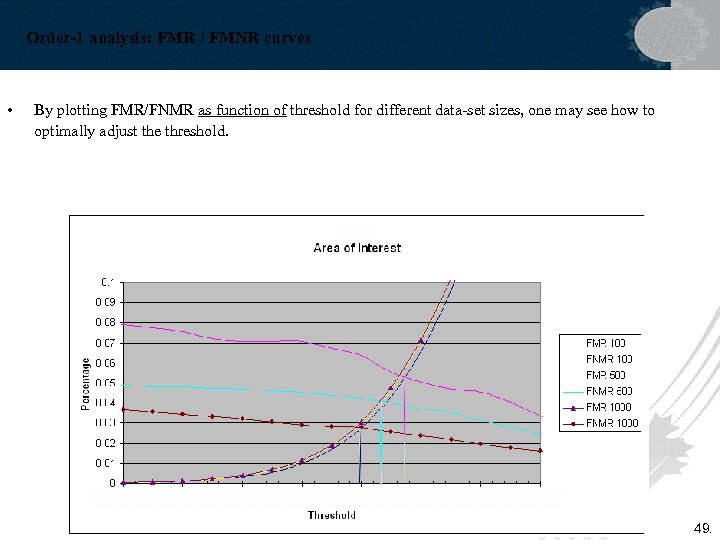 Order-1 analysis: FMR / FMNR curves • By plotting FMR/FNMR as function of threshold for different data-set sizes, one may see how to optimally adjust the threshold. 49.
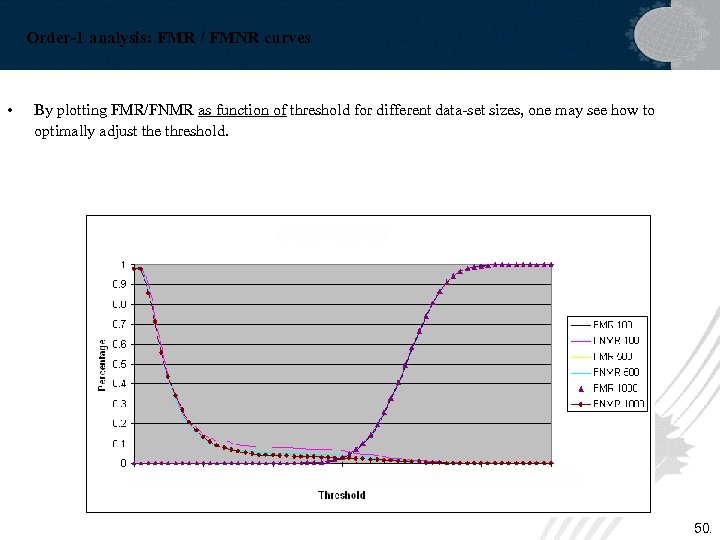 Order-1 analysis: FMR / FMNR curves • By plotting FMR/FNMR as function of threshold for different data-set sizes, one may see how to optimally adjust the threshold. 50.
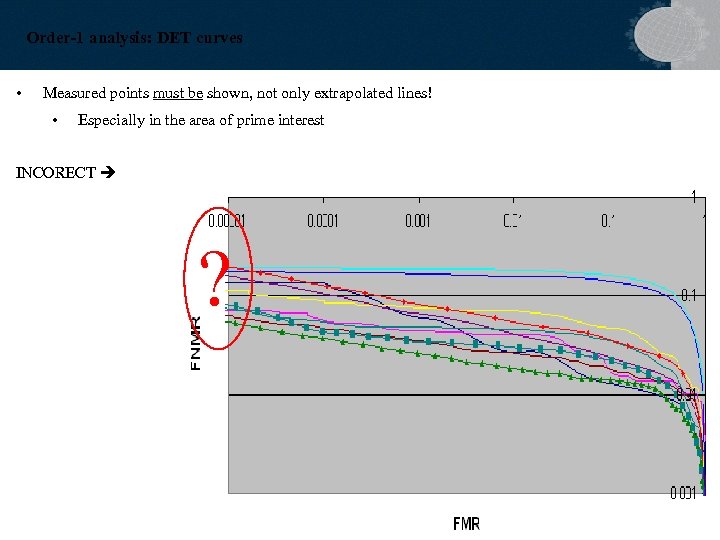 Order-1 analysis: DET curves • Measured points must be shown, not only extrapolated lines! • Especially in the area of prime interest INCORECT ? 51.
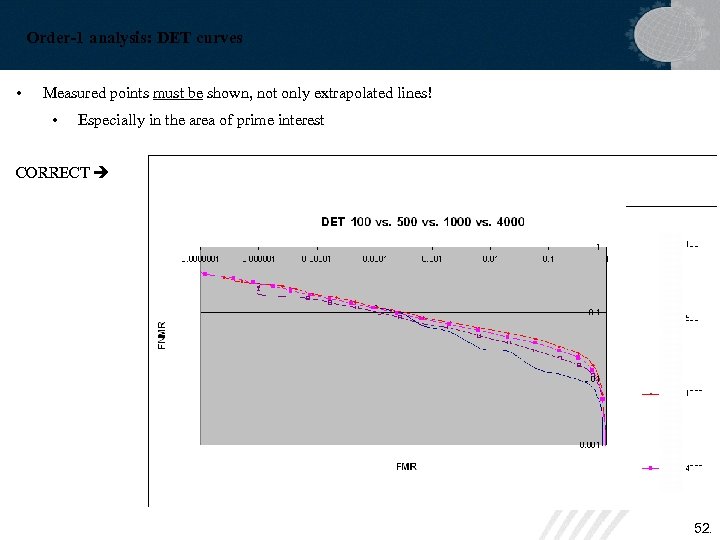 Order-1 analysis: DET curves • Measured points must be shown, not only extrapolated lines! • Especially in the area of prime interest CORRECT 52.
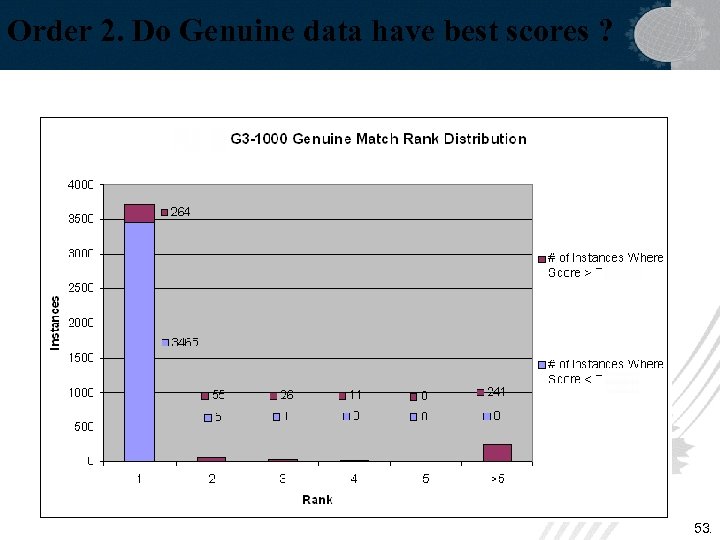 Order 2. Do Genuine data have best scores ? 53.
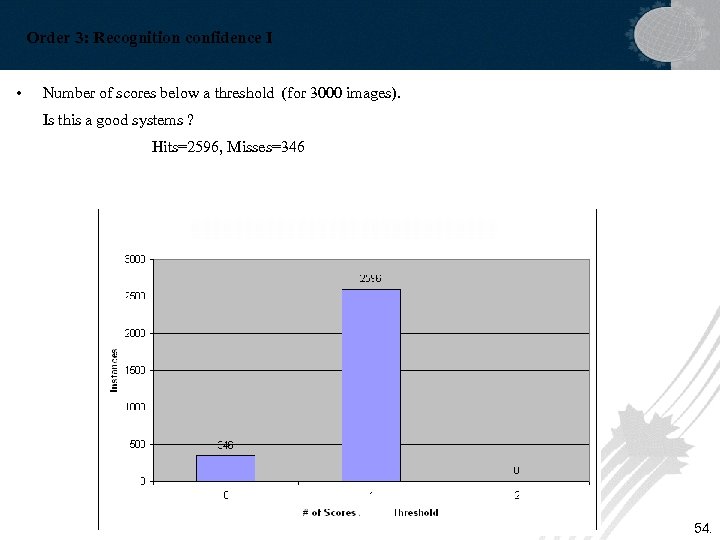 Order 3: Recognition confidence I • Number of scores below a threshold (for 3000 images). Is this a good systems ? Hits=2596, Misses=346 54.
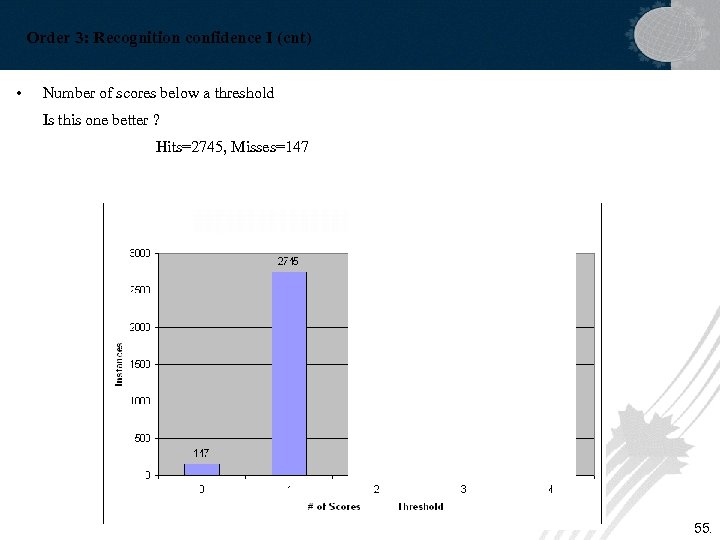 Order 3: Recognition confidence I (cnt) • Number of scores below a threshold Is this one better ? Hits=2745, Misses=147 55.
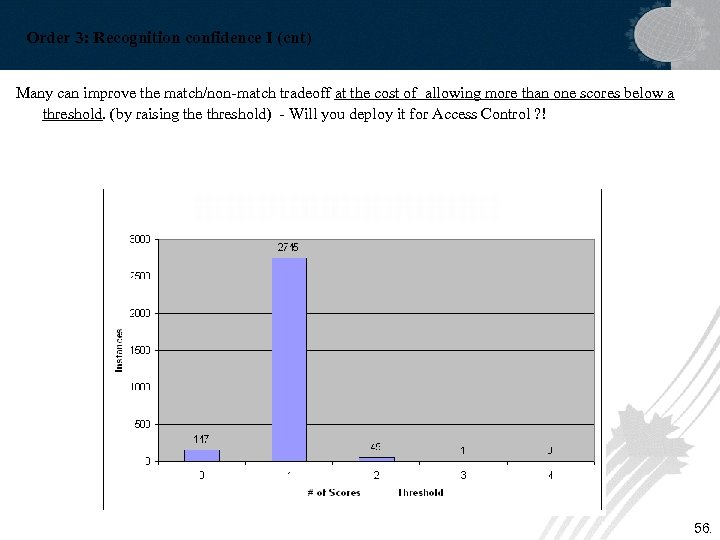 Order 3: Recognition confidence I (cnt) Many can improve the match/non-match tradeoff at the cost of allowing more than one scores below a threshold. (by raising the threshold) - Will you deploy it for Access Control ? ! 56.
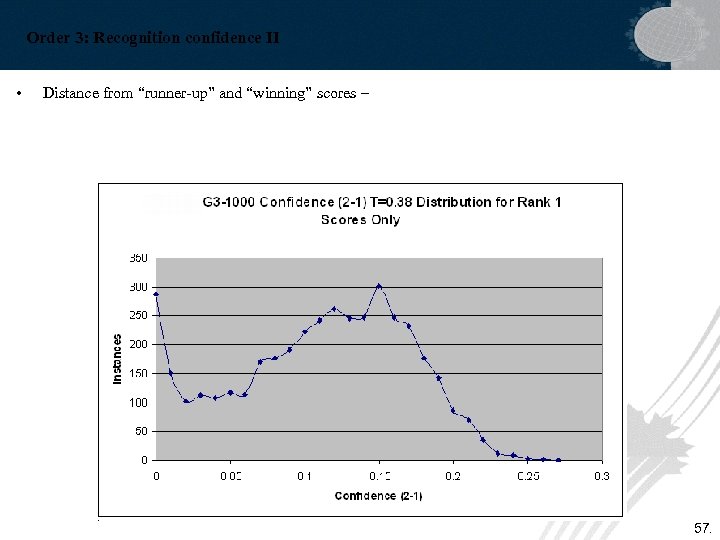 Order 3: Recognition confidence II • Distance from “runner-up” and “winning” scores – 57.
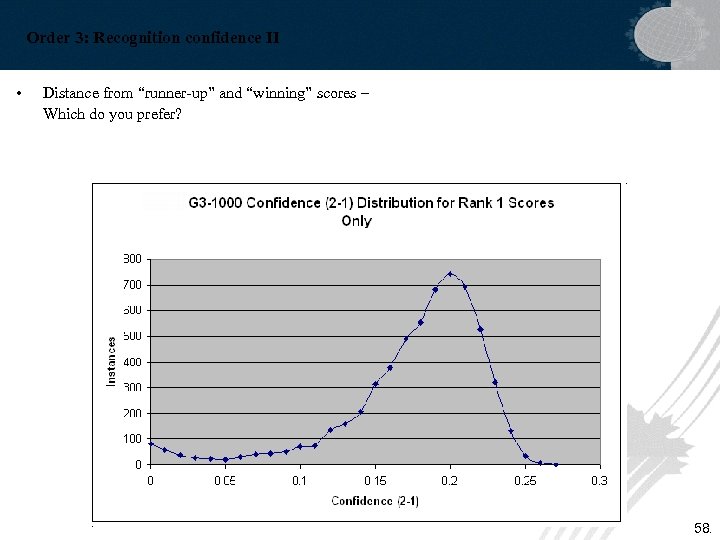 Order 3: Recognition confidence II • Distance from “runner-up” and “winning” scores – Which do you prefer? 58.
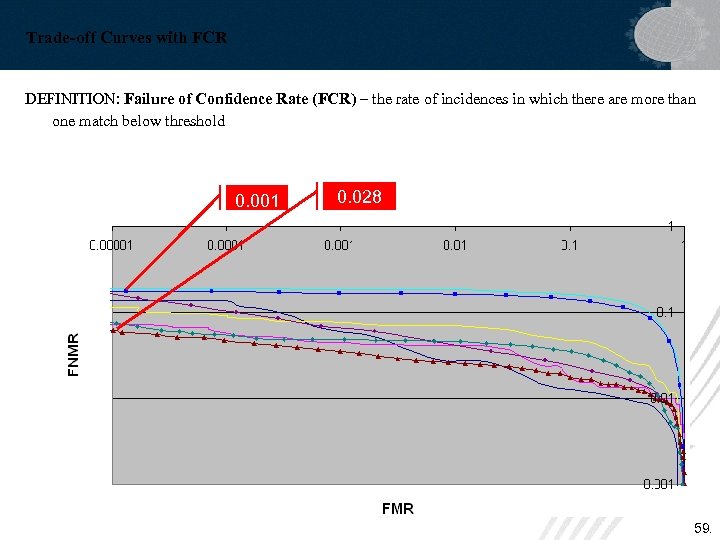 Trade-off Curves with FCR DEFINITION: Failure of Confidence Rate (FCR) – the rate of incidences in which there are more than one match below threshold 0. 001 0. 028 59.
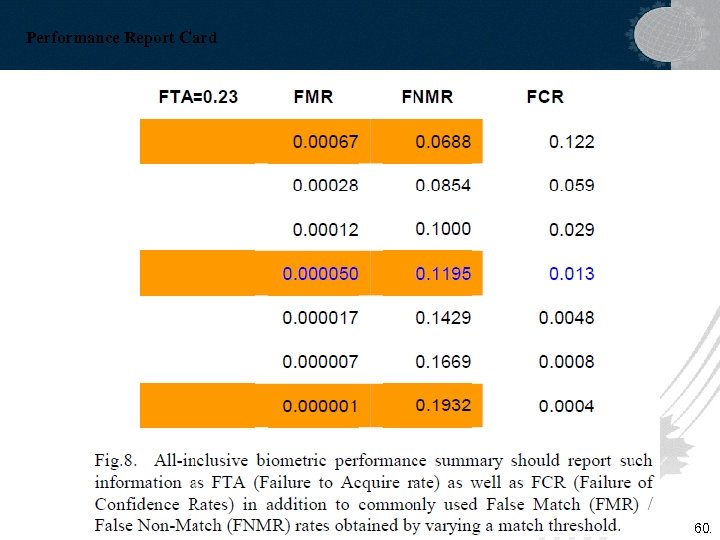 Performance Report Card 60.
 In addition to Match/Non-Match Errors … Report: • FTA (Failure To Acquire): because some systems may produce better DET curves by rejecting (i. e. failing to acquire) the images that are more difficult to recognize, eg. iris images that are occluded. • FCR (Failure of Confidence Rate): because some systems may produce better DET curves by allowing more matches below/above the matching threshold, ie by producing less reliable recognition decisions. 61.
 4. Lessons learnt Main lesson and motivation for deploying biometrics: “Even though no biometric modality is error-free, with proper system tuning and setup adjustment, critical errors of the biometric systems can be minimized to the level allowed for the operational use”. And it is only through performance evaluation that - biometric systems errors, and - factors / parameters that affect the recognition performance can be discovered and properly taken into account! 62.
 Especially because … • There are many biometric error types (eg. FMR, FTA, FCR…) • There are many factors that affect the performance (lighting, location …) • Performance may deteriorate over time (as number of stored people increases and spoofing techniques become more sophisticated). While … • There also many ways to improve the performance (eg. more samples, modalities, constraints, …) 63.
 References • ISO/IEC 19795: Biometric performance testing and reporting. • D. Gorodnichy. “Face databases and evaluation”, in Encyclopedia of Biometrics (Editor: Stan Li), Elsevier Publisher, 2009. • D. Gorodnichy. “Evolution and Evaluation of Biometric Systems”, Proceedings of Second IEEE Symposium on Computational Intelligence for Security and Defense Applications. Ottawa, Canada, 9 -10 July 2009 • D. Gorodnichy. Multi-order analysis framework for comprehensive biometric performance evaluation, SPIE Conference on Defense, Security, and Sensing. Orlando, 5 - 9 April 2010, • C-BET (Comprehensive Biometrics Evaluation Toolkit): • developed by Canada Border Services Agency for Go. C • for selecting new and tuning existing biometric systems. 64.