 Скачать презентацию HOW TO BUILD MANAGE MAXIMIZE YOUR INTELLECTUAL
7f9da80e5542912ea91b61bf9c823f52.ppt
- Количество слайдов: 58



HOW TO BUILD, MANAGE & MAXIMIZE YOUR INTELLECTUAL PROPERTY Presented to ACCA South/Central Texas Chapter March 5, 2008 –Fourth level BY » Fifth level William B. Nash JACKSON WALKER, L. L. P 112 E. Pecan Street, Suite 2400 San Antonio, Texas (210) 978 -7700 © 2008 Jackson Walker LLP All Rights Reserved Austin Dallas Fort Worth Houston San Angelo San Antonio
The Good News • Your Company is developing new products and/or services –Fourth level • Your Company is increasing sales due to innovative marketing programs, slogans, or ideas » Fifth level • Your Company is growing by acquiring another company • Your Company may be bought by another company William Nash – March 5, 2008 presentation to ACCA South/Central Texas Chapter
The Bad News • It is your job to make sure: – Nobody knocks off your product or service – Competitors do not use your successful marketing –Fourth level programs, slogans or ideas » Fifth level – Lenders are impressed with your IP assets – throwing money at you to keep growing – As Business people keep rolling out new programs they do not give away IP – Competitors do not hire away your key employees William Nash – March 5, 2008 presentation to ACCA South/Central Texas Chapter
The Ugly News • There is no easy way! • But, it is your job. –Fourth level • Need to: – Identify – Organize – Document – Educate – Monitor » Fifth level William Nash – March 5, 2008 presentation to ACCA South/Central Texas Chapter
The Solution 1. Conduct an IP audit 1. To determine the origin of the company’s –Fourth level intangible assets » Fifth level 2. The scope of the company’s rights in technology and related intellectual property law rights William Nash – March 5, 2008 presentation to ACCA South/Central Texas Chapter
Purpose of an IP Audit • To detect defects in existing intellectual property assets and the mechanisms and procedures for identifying, protecting, and perfecting the company’s intellectual property. • To put in place systematic procedures for identifying, protecting, and –Fourth level perfecting intellectual property rights. » Fifth level • To determine the scope of rights that third parties may have by license, ownership, or otherwise in the intellectual property used by the company. • To determine, when considering IP litigation, whether all filings necessary for jurisdictional requirements have been satisfied; what clouds, if any, on the owner’s title may exist; and what defenses may be asserted against the owner. • To avoid liability for third-party claims of infringement resulting from the development of new products or services. William Nash – March 5, 2008 presentation to ACCA South/Central Texas Chapter
Examples of When to Conduct an IP Audit • There is new responsibility for managing the company’s intellectual property; • There is a merger, acquisition, or significant stock purchase; –Fourth level • There is a transfer or assignment of interest in intellectual » Fifth level property; • There is a significant change in the law; • There are financial transactions involving intellectual property; • The company is considering a significant license either as licensor or licensee; and • The company has a new program or policy. William Nash – March 5, 2008 presentation to ACCA South/Central Texas Chapter
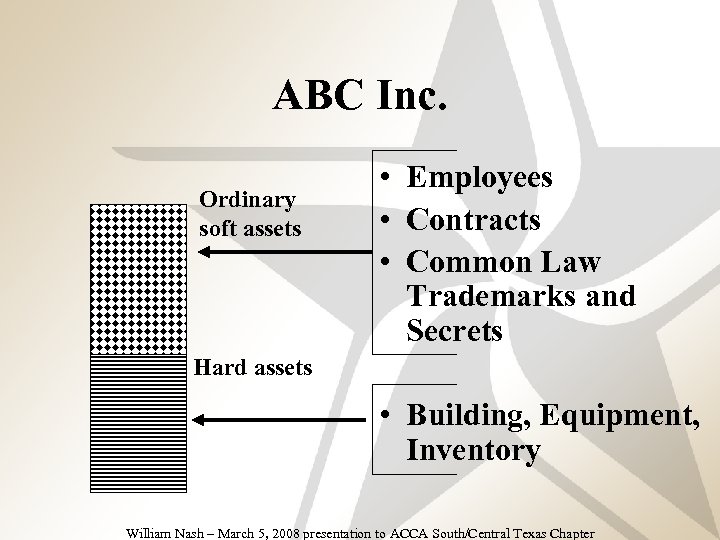
ABC Inc. • Employees Ordinary • Contracts soft assets –Fourth level • Common Law » Fifth level Trademarks and Secrets Hard assets • Building, Equipment, Inventory William Nash – March 5, 2008 presentation to ACCA South/Central Texas Chapter
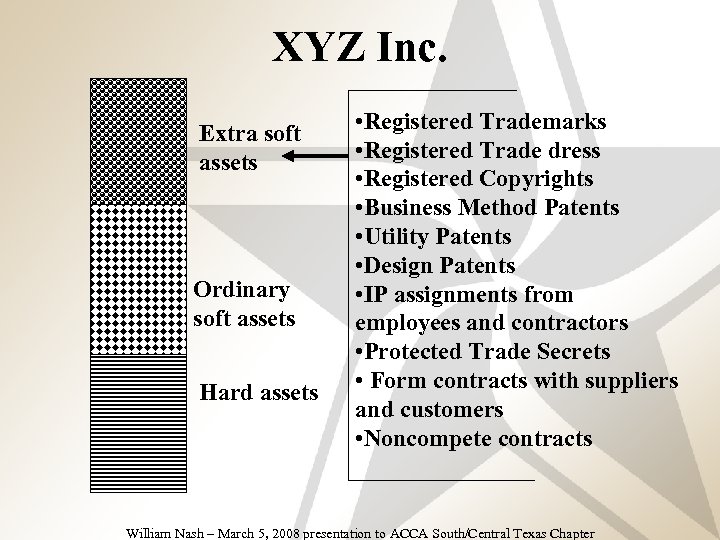
XYZ Inc. • Registered Trademarks • Registered Trade dress • Registered Copyrights • Business Method Patents • Utility Patents –Fourth level • Design Patents » Fifth level Ordinary • IP assignments from soft assets employees and contractors • Protected Trade Secrets • Form contracts with suppliers Hard assets and customers • Noncompete contracts Extra soft assets William Nash – March 5, 2008 presentation to ACCA South/Central Texas Chapter
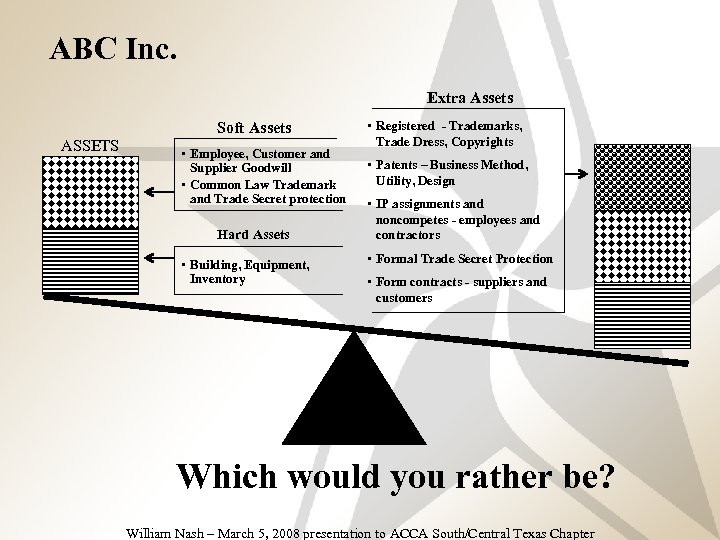
ABC Inc. XYZ Inc. Extra Assets Soft Assets ASSETS • Employee, Customer and Supplier Goodwill • Common Law Trademark and Trade Secret protection Hard Assets • Registered - Trademarks, Trade Dress, Copyrights ASSETS • Patents – Business Method, Utility, Design • IP assignments and noncompetes - employees and contractors –Fourth level Trade Secret Protection • Formal • Building, Equipment, Inventory • Form contracts - suppliers and » Fifth level customers Which would you rather be? William Nash – March 5, 2008 presentation to ACCA South/Central Texas Chapter
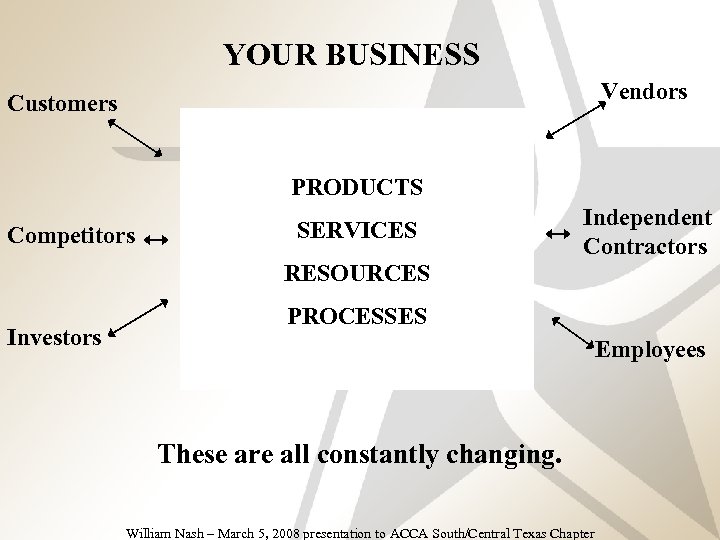
YOUR BUSINESS Vendors Customers PRODUCTS Competitors SERVICES –Fourth level Independent Contractors RESOURCES » Fifth level Investors PROCESSES Employees These are all constantly changing. William Nash – March 5, 2008 presentation to ACCA South/Central Texas Chapter
Steps to Conduct IP Audit of Company’s –Fourth level » Fifth level Intellectual Capital William Nash – March 5, 2008 presentation to ACCA South/Central Texas Chapter
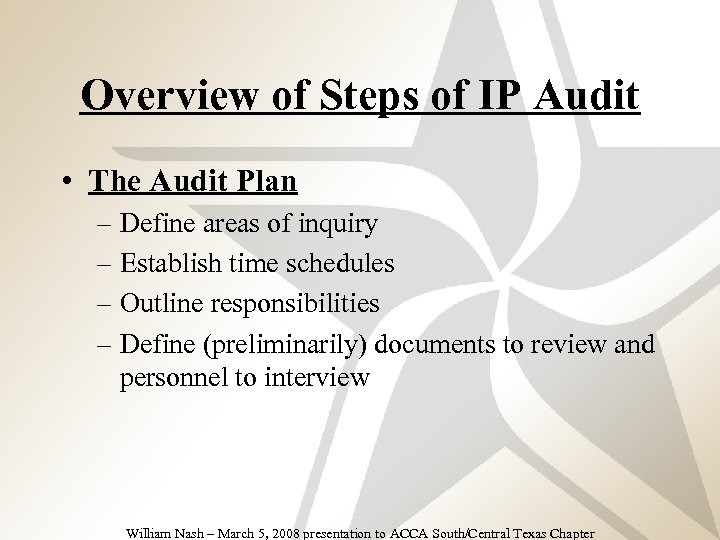
Overview of Steps of IP Audit • The Audit Plan – Define areas of inquiry –Fourth level – Establish time schedules » Fifth level – Outline responsibilities – Define (preliminarily) documents to review and personnel to interview William Nash – March 5, 2008 presentation to ACCA South/Central Texas Chapter
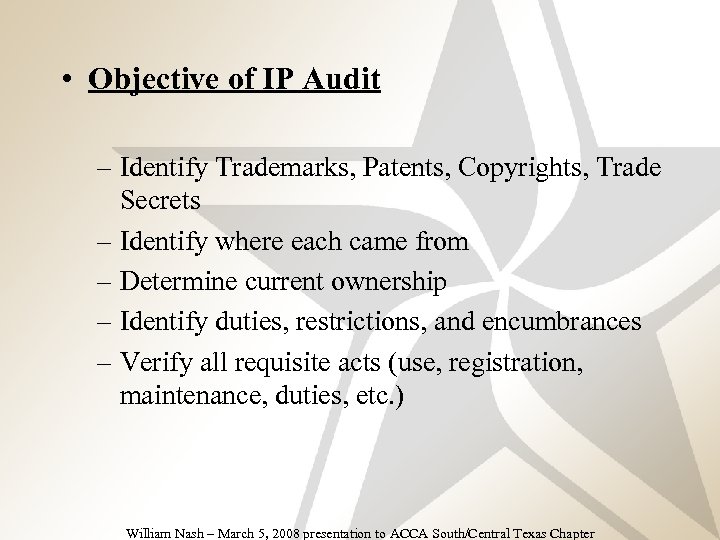
• Objective of IP Audit – Identify Trademarks, Patents, Copyrights, Trade Secrets – Identify where each came from –Fourth level – Determine current ownership » Fifth level – Identify duties, restrictions, and encumbrances – Verify all requisite acts (use, registration, maintenance, duties, etc. ) William Nash – March 5, 2008 presentation to ACCA South/Central Texas Chapter
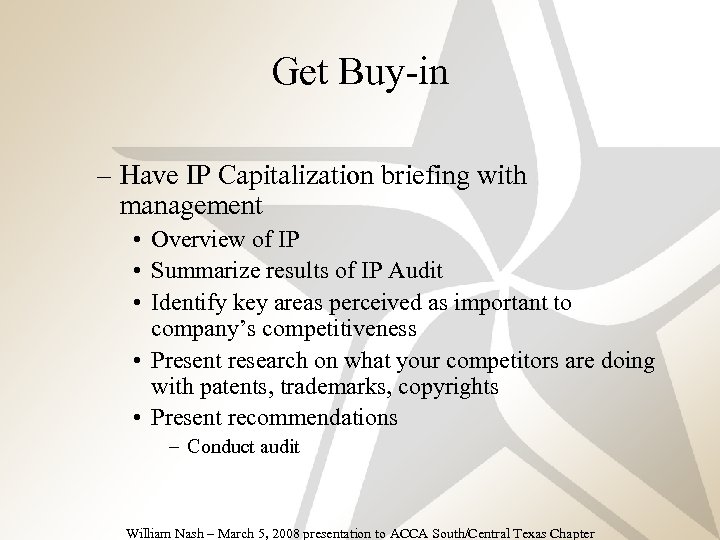
Get Buy-in – Have IP Capitalization briefing with management • Overview of IP –Fourth level • Summarize results of IP Audit » Fifth level • Identify key areas perceived as important to company’s competitiveness • Present research on what your competitors are doing with patents, trademarks, copyrights • Present recommendations – Conduct audit William Nash – March 5, 2008 presentation to ACCA South/Central Texas Chapter
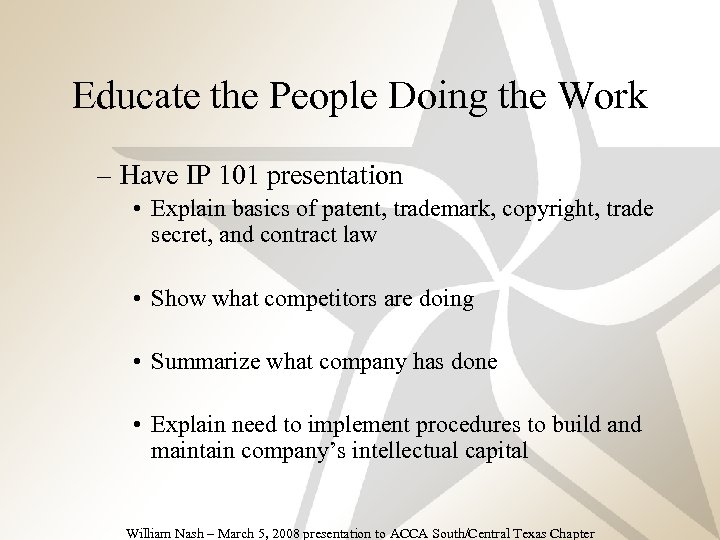
Educate the People Doing the Work – Have IP 101 presentation • Explain basics of patent, trademark, copyright, trade secret, and contract law –Fourth level » Fifth level • Show what competitors are doing • Summarize what company has done • Explain need to implement procedures to build and maintain company’s intellectual capital William Nash – March 5, 2008 presentation to ACCA South/Central Texas Chapter
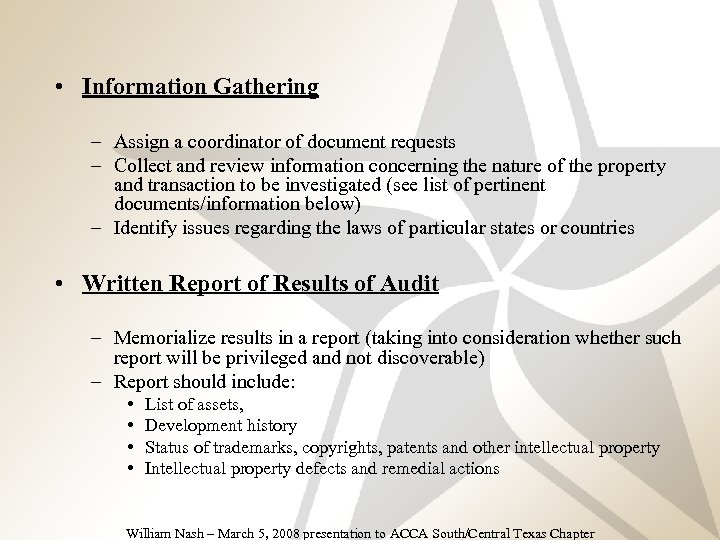
• Information Gathering – Assign a coordinator of document requests – Collect and review information concerning the nature of the property and transaction to be investigated (see list of pertinent documents/information below) – Identify issues regarding the laws of particular states or countries –Fourth level • Written Report of Results of Audit » Fifth level – Memorialize results in a report (taking into consideration whether such report will be privileged and not discoverable) – Report should include: • • List of assets, Development history Status of trademarks, copyrights, patents and other intellectual property Intellectual property defects and remedial actions William Nash – March 5, 2008 presentation to ACCA South/Central Texas Chapter
Procedure for IP Audit • Give key people in each department an IP Brainstorming Checklist –Fourth level » Fifth level • Give a limited amount of time to complete – Don’t make it too complex • Provide incentive for completion William Nash – March 5, 2008 presentation to ACCA South/Central Texas Chapter
Patent/Trade Secret Questions • Considering mission statements, core values and key result areas, list programs or projects that Company has invested in, or spent significant resources on, over the last year that: – have produced or contributed, or we expect to produce or contribute, a beneficial unique product or service. –Fourth level – add significant value to Company. – have never been seen before. » Fifth level • List programs or projects that: – over the past 3 years have cost a considerable amount of time, effort or expense. – have been initiated or implemented in the past 3 years to provide innovative, quality products and services. • Name what Company has done over the last few years to make itself more efficient, successful, or competitive. • Identify the most valuable or noteworthy improvement to Company’s processes in the last 3 years. William Nash – March 5, 2008 presentation to ACCA South/Central Texas Chapter
Patent/Trade Secret Questions • Predict the most valuable or noteworthy improvements to Company’s processes, products or services in the next 3 years. • Describe the most significant challenges from Company’s competitors. –Fourth level • List inventions, processes, or improvements that you most fear » Fifth level Company’s competitors implementing. • List what Company should do to meet competitors’ challenges now or within the next 5 years. • List what Company does in your department that is different from competitors. William Nash – March 5, 2008 presentation to ACCA South/Central Texas Chapter
Trademark Questions • List Company’s most recognizable and important names, logos, or images. • Describe any instances of competitors copying Company’s names, –Fourth level logos, images, products, or processes. » Fifth level • List competitors most effective trademarks, logos, and images (describe why they are effective). • List names, logos, or images that could help Company make more money if adopted. • Specify Company text, images or graphic art that competitors should not copy. William Nash – March 5, 2008 presentation to ACCA South/Central Texas Chapter
Copyright Questions • List important project(s) that Company has sent out a bid or Request For Proposal. • List any projects or programs that Company has invested in –Fourth level or spent significant amount of resources on over the last » Fifth level year, which had design specifications sent to an outside vendor. • List projects or programs under development that have, or will have, design specifications sent to an outside vendor. • Specify any third party developed improvements currently used by Company. William Nash – March 5, 2008 presentation to ACCA South/Central Texas Chapter
Copyright Questions • Determine any computer code written by third parties per Company’s direction (specify if Company owns the code). –Fourth level » Fifth level • List any Company developed computer code based in whole, or in part, on computer code written by third parties. • Describe instances where Company may use images or textual material created by third parties. William Nash – March 5, 2008 presentation to ACCA South/Central Texas Chapter
Steps to Build and Maximize Company’s –Fourth level » Fifth level Intellectual Capital William Nash – March 5, 2008 presentation to ACCA South/Central Texas Chapter
Employee Agreements • Prepare and have all knowledge employees sign short agreements –Fourth level – assigning their IP rights to company, » Fifth level – agreeing to keep company’s trade secrets secret and agreeing to not use – agreeing to not compete or raid company when they move on, and – to arbitrate all disputes with company William Nash – March 5, 2008 presentation to ACCA South/Central Texas Chapter
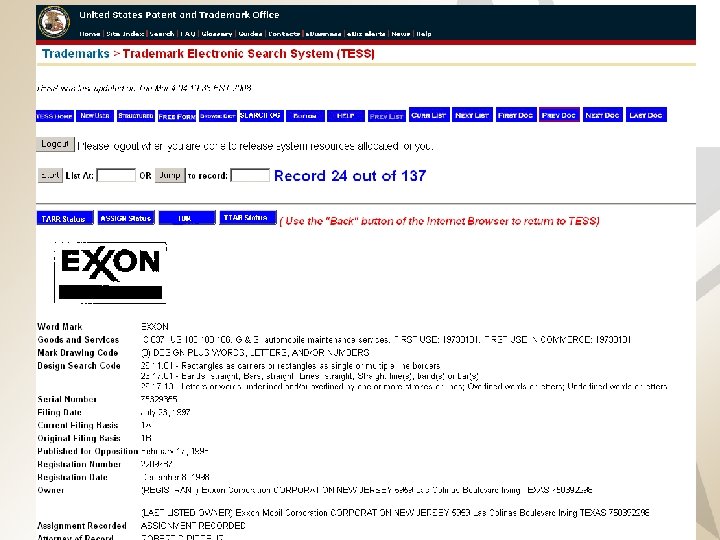
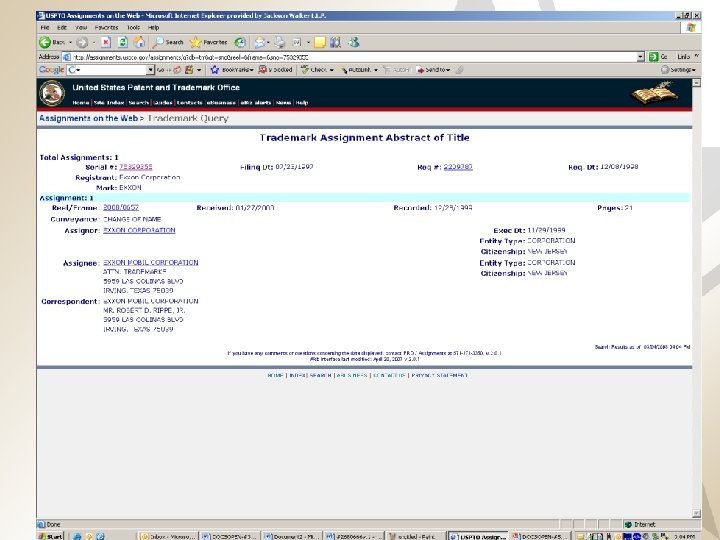
Trademarks • Select protectable mark – Generic, Descriptive, Suggestive, Arbitrary, Fanciful • Conduct TM search before adopting and using mark –Fourth level – $1, 500 to $2, 000 – Or for free at www. uspto. gov» Fifth level • Ensure proper trademark notice being used – ® , ™ • File trademark applications – Federal – ITU or actual use – State – International – EU, Canada, Mexico William Nash – March 5, 2008 presentation to ACCA South/Central Texas Chapter
–Fourth level » Fifth level
–Fourth level » Fifth level
Trademarks • Must have your trademark registrations docketed –Fourth level – Failure to renew or file declarations results in abandonment of registration » Fifth level • Between 5 th and 6 th year • Every 10 years • Hire trademark watch service to protect us from others getting registrations in our relevant jurisdictions • Monthly Google searches – free! William Nash – March 5, 2008 presentation to ACCA South/Central Texas Chapter
Trademark - Remedies • Under the Lanham Act, remedies for trademark infringement of a registered mark include: –Fourth level – The defendant’s profits – only have to prove defendant’s sales. The defendant must prove all claimed elements of cost or » Fifth level deduction. – Damages sustained by plaintiff, up to treble damages when appropriate. – Court costs and Injunctive relief. – Attorney’s fees in exceptional cases. – Destruction of infringing articles bearing infringing trademarks. • Prevent importation of infringing goods William Nash – March 5, 2008 presentation to ACCA South/Central Texas Chapter
Copyrights • Copyrights exist upon the moment of creation –Fourth level – Do not use another’s or online material without » Fifth level verifying okay to use • Ensure Copyright notices are used on all company owned materials – © 2008 Jackson Walker, All Rights Reserved William Nash – March 5, 2008 presentation to ACCA South/Central Texas Chapter
Copyrights • Register significant materials with US Copyright Office to be able to recover – Attorneys’ fees –Fourth level – Statutory damages » Fifth level – Prevent importation of infringing goods • Copyright registration – Life of author plus 70 years – Company- 95 years after 1 st publication or 120 years after creation William Nash – March 5, 2008 presentation to ACCA South/Central Texas Chapter
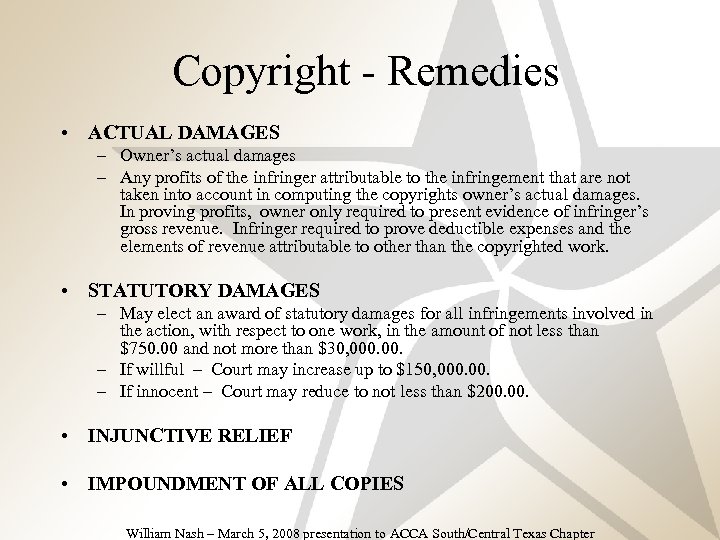
Copyright - Remedies • ACTUAL DAMAGES – Owner’s actual damages – Any profits of the infringer attributable to the infringement that are not taken into account in computing the copyrights owner’s actual damages. In proving profits, owner only required to present evidence of infringer’s gross revenue. Infringer required to prove deductible expenses and the elements of revenue attributable to other than the copyrighted work. –Fourth level • STATUTORY DAMAGES » Fifth level – May elect an award of statutory damages for all infringements involved in the action, with respect to one work, in the amount of not less than $750. 00 and not more than $30, 000. – If willful – Court may increase up to $150, 000. – If innocent – Court may reduce to not less than $200. • INJUNCTIVE RELIEF • IMPOUNDMENT OF ALL COPIES William Nash – March 5, 2008 presentation to ACCA South/Central Texas Chapter
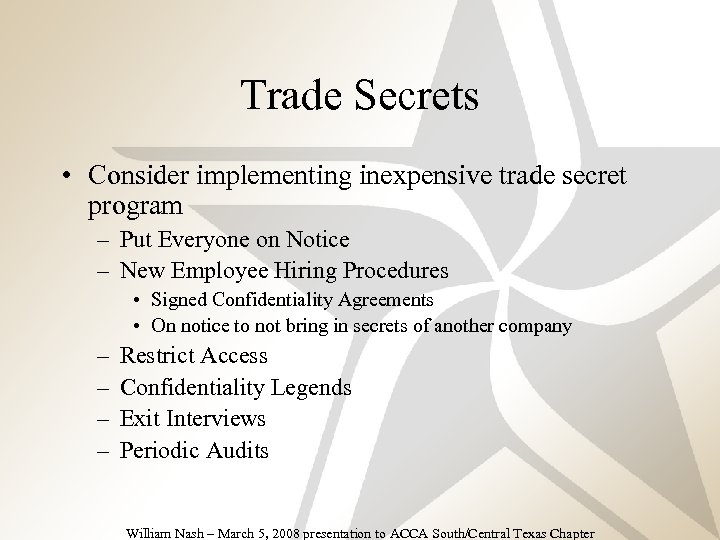
Trade Secrets • Consider implementing inexpensive trade secret program – Put Everyone on Notice –Fourth level – New Employee Hiring Procedures » Fifth level • Signed Confidentiality Agreements • On notice to not bring in secrets of another company – – Restrict Access Confidentiality Legends Exit Interviews Periodic Audits William Nash – March 5, 2008 presentation to ACCA South/Central Texas Chapter
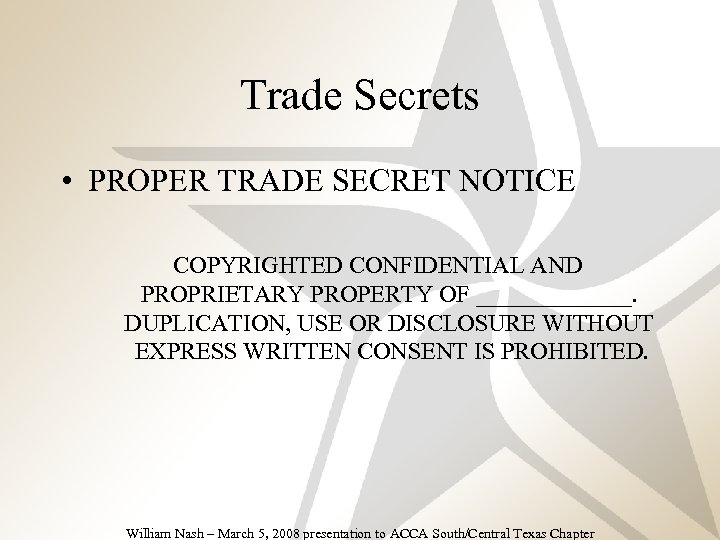
Trade Secrets • PROPER TRADE SECRET NOTICE –Fourth level COPYRIGHTED CONFIDENTIAL AND » Fifth level PROPRIETARY PROPERTY OF _______. DUPLICATION, USE OR DISCLOSURE WITHOUT EXPRESS WRITTEN CONSENT IS PROHIBITED. William Nash – March 5, 2008 presentation to ACCA South/Central Texas Chapter
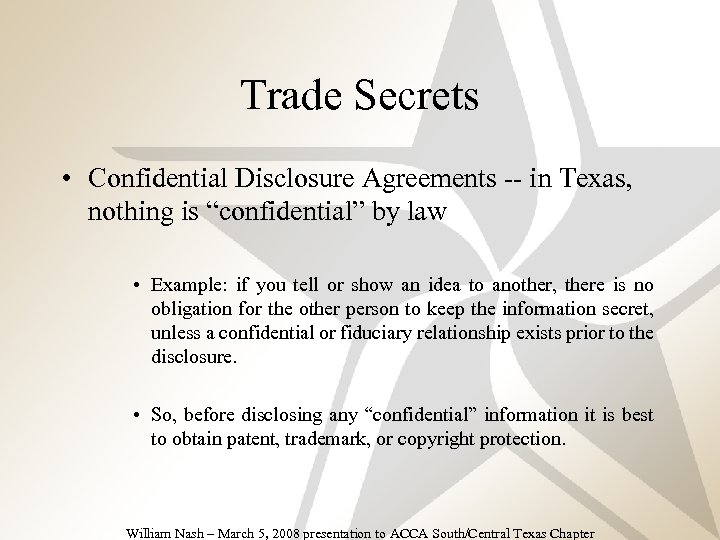
Trade Secrets • Confidential Disclosure Agreements -- in Texas, nothing is “confidential” by law –Fourth level • Example: if you tell or show an idea to another, there is no » Fifth level obligation for the other person to keep the information secret, unless a confidential or fiduciary relationship exists prior to the disclosure. • So, before disclosing any “confidential” information it is best to obtain patent, trademark, or copyright protection. William Nash – March 5, 2008 presentation to ACCA South/Central Texas Chapter
Trade Secret - Remedies • As US economy on trend downward, IP attorneys are gearing up in anticipation of –Fourth level more work heading their way » Fifth level William Nash – March 5, 2008 presentation to ACCA South/Central Texas Chapter
Contracts • Put all technology agreements in writing – Need to be specific –Fourth level – Define deliverables through a detailed statement » Fifth level of work – When new features are requested be certain to document the changes and results of the changes William Nash – March 5, 2008 presentation to ACCA South/Central Texas Chapter
Remedial Action Summary • Undertake any necessary federal, state and international filings/recordations –Fourth level • Execute ownership documents (i. e. , assignments) » Fifth level • Pursue infringers/correct infringements • Define prospective legal, marketing and research strategy • Clarify employee/consultant ownership rights William Nash – March 5, 2008 presentation to ACCA South/Central Texas Chapter
Recent Developments In –Fourth level » Fifth level Patent Law William Nash – March 5, 2008 presentation to ACCA South/Central Texas Chapter
Seagate and Willful Infringement • In re Seagate Technology LLC, 497 F. 3 d 1360 (Fed. Cir. 2007) (en banc), cert denied, (Feb. 25, 2008) -- intertwining issues of willful infringement, advice of counsel defense, and attorney client privilege. –Fourth level – Seagate was charged with willful infringement and asserted an advice of counsel defense. During discovery, plaintiffs requested work product relating to the opinion letter, including the trial counsel's work product. » Fifth level The district court determined that Seagate had completely waived the attorney client privilege by asserting the advice of counsel defense and issued an order to compel discovery. – In past, following an accusation of patent infringement companies would typically obtain an opinion letter regarding the potential infringement from "opinion counsel. " During trial, company could waive privilege and rely on the opinion letter in court to defend against the claim of willful infringement. William Nash – March 5, 2008 presentation to ACCA South/Central Texas Chapter
In re Seagate Technology LLC • CAFC overrules Underwater Devices, Inc. v. Morrison. Knudsen Co. , 717 F. 2 d 1380 (Fed. Cir. 1983), and sets out three points of law. –Fourth level – First, the court set an "objective recklessness" standard for willful » Fifth level infringement where a patentee must show by clear and convincing evidence that the infringer acted despite an objectively high likelihood that its actions comprised infringement. – Second, the court held that a potential infringer does not have an affirmative duty to acquire an opinion letter. – Third, the court established that when an alleged infringer waives its attorney client privilege with respect to opinion counsel, waiver does not extend to trial counsel. William Nash – March 5, 2008 presentation to ACCA South/Central Texas Chapter
In re Seagate Technology LLC • Thus, court held the state of mind of the accused infringer is not relevant to the –Fourth level objective inquiry. » Fifth level • It also held there is no affirmative obligation to obtain opinions of counsel. William Nash – March 5, 2008 presentation to ACCA South/Central Texas Chapter
Med. Immune and DJ Jurisdiction • Med. Immune v. Genentech et al. , 764 (2007) (8 -1 decision). – Licensee can file DJ to invalidate patent even without being in breach – Following Med. Immune, Fed. Cir. found jurisdiction over a DJ –Fourth level claim in Sony Electronics Inc. v. Guardian Media Technologies, » Fifth level Ltd. , 497 F. 3 d 1271 (Fed. Cir. 2007), where the parties, after failed licensing negotiations, had not even entered a license agreement. • CAFC may abolish or change the reasonable apprehension of immediate suit test – Be careful sending letters to potential infringers • “Thought you should know …” • “If interested please call to discuss …” William Nash – March 5, 2008 presentation to ACCA South/Central Texas Chapter
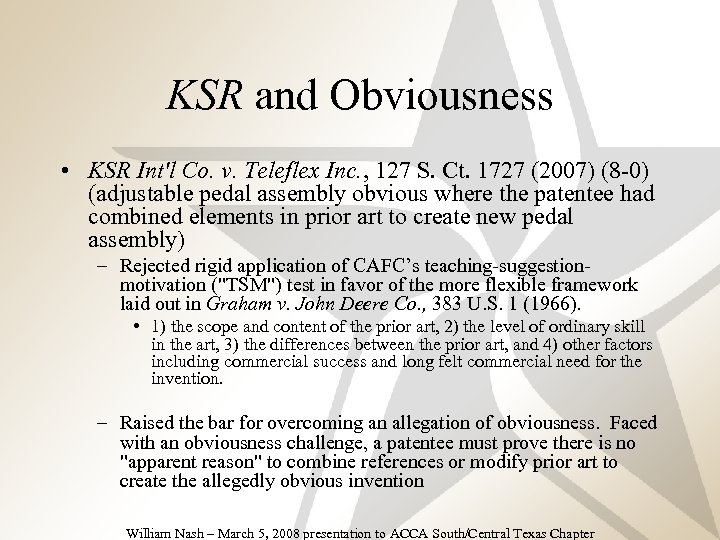
KSR and Obviousness • KSR Int'l Co. v. Teleflex Inc. , 127 S. Ct. 1727 (2007) (8 -0) (adjustable pedal assembly obvious where the patentee had combined elements in prior art to create new pedal assembly) –Fourth level – Rejected rigid application of CAFC’s teaching-suggestionmotivation ("TSM") test in favor of the more flexible framework » Fifth level laid out in Graham v. John Deere Co. , 383 U. S. 1 (1966). • 1) the scope and content of the prior art, 2) the level of ordinary skill in the art, 3) the differences between the prior art, and 4) other factors including commercial success and long felt commercial need for the invention. – Raised the bar for overcoming an allegation of obviousness. Faced with an obviousness challenge, a patentee must prove there is no "apparent reason" to combine references or modify prior art to create the allegedly obvious invention William Nash – March 5, 2008 presentation to ACCA South/Central Texas Chapter
US Patent Office Enjoined !!! • On Aug. 21, 2007, the USPTO issued final administrative rule changes affecting the patent application process, which were set to take effect on Nov. 1, 2007. –Fourth level • The proposed rule changes would have limited the number » Fifth level of claims permitted within each patent application as well as capped the total number of related patent applications that can be filed. The USPTO referred to this as the “ 5/25” rule, allowing five independent claims and 25 total claims in each application. William Nash – March 5, 2008 presentation to ACCA South/Central Texas Chapter
• On October 31, 2007, Eastern District of Virginia enjoined the USPTO from implementing the revised Final Patent Rules ("Final Rules"). • The Court noted at the outset that the Patent Office does not possess any substantive rule-making power and that Glaxo Smith Kline raised a "colorable question" as to –Fourth level whether the Final Rules are "truly substantive. " » Fifth level • The Court also found that GSK raised "serious concerns" as to whether the Final Rules comport with the Patent Act. – In particular, the Court considered GSK’s concerns over the limitations on the number of continuing applications, – requests for continued examinations (RCEs), and – number of claims – as well as retroactivity of the Rules and the requirements for examination support documents (ESDs). William Nash – March 5, 2008 presentation to ACCA South/Central Texas Chapter
International Trade Commission Investigations of Patent –Fourth level » Fifth level Infringement Claims William Nash – March 5, 2008 presentation to ACCA South/Central Texas Chapter
What is a 337 ITC action? • International Trade Commission – Not a court of law –Fourth level • Do imports injure a US industry? » Fifth level – IP protection – Anti-dumping – Surging imports William Nash – March 5, 2008 presentation to ACCA South/Central Texas Chapter
Why a 337 ITC action? • Section 337 – “Unfair methods of competition and unfair acts –Fourth level in the importation of articles. . . into the United » Fifth level States” William Nash – March 5, 2008 presentation to ACCA South/Central Texas Chapter
Recovery in 337 ITC action • Order prohibiting entry –Fourth level • Cease and desist order » Fifth level • No monetary damages William Nash – March 5, 2008 presentation to ACCA South/Central Texas Chapter
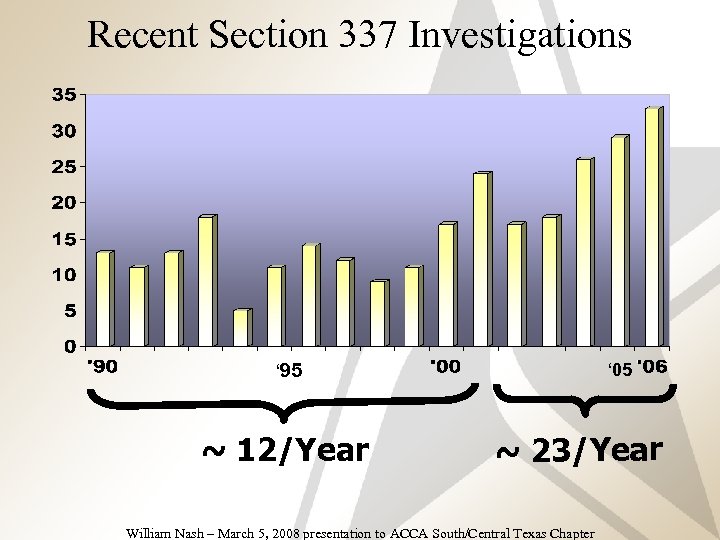
Recent Section 337 Investigations –Fourth level » Fifth level ‘ 95 ~ 12/Year ‘ 05 ~ 23/Year William Nash – March 5, 2008 presentation to ACCA South/Central Texas Chapter
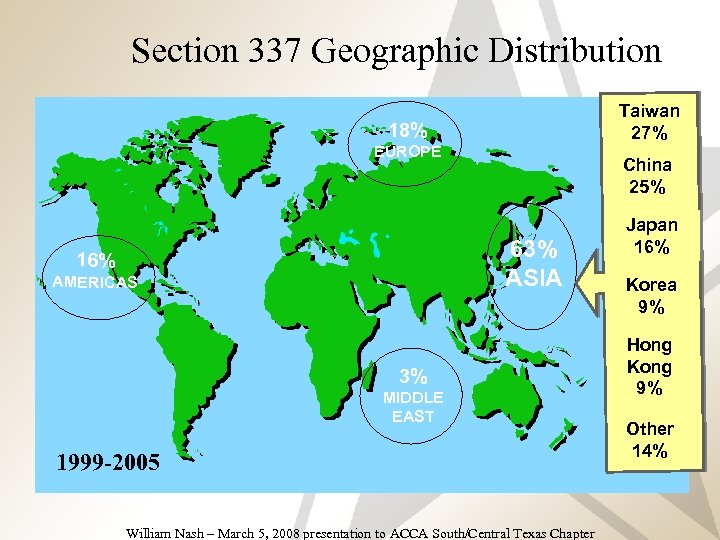
Section 337 Geographic Distribution Taiwan 27% 18% EUROPE –Fourth level 16% AMERICAS » Fifth level China 25% 63% ASIA 3% MIDDLE EAST 1999 -2005 William Nash – March 5, 2008 presentation to ACCA South/Central Texas Chapter Japan 16% Korea 9% Hong Kong 9% Other 14%
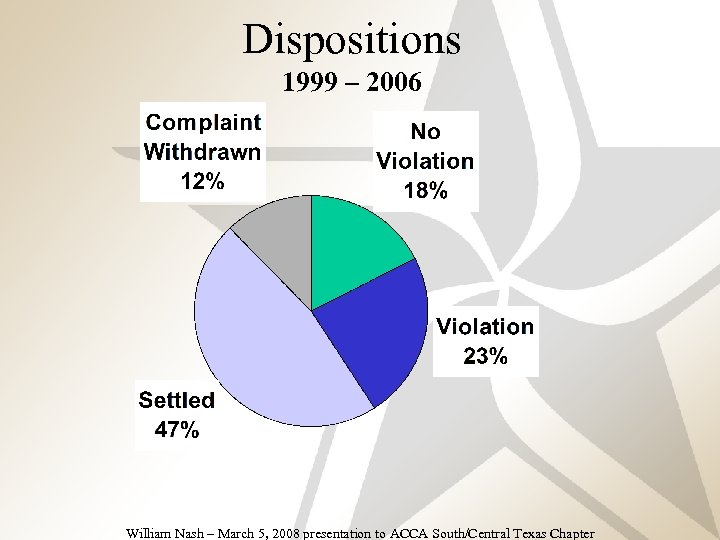
Dispositions 1999 – 2006 –Fourth level » Fifth level William Nash – March 5, 2008 presentation to ACCA South/Central Texas Chapter
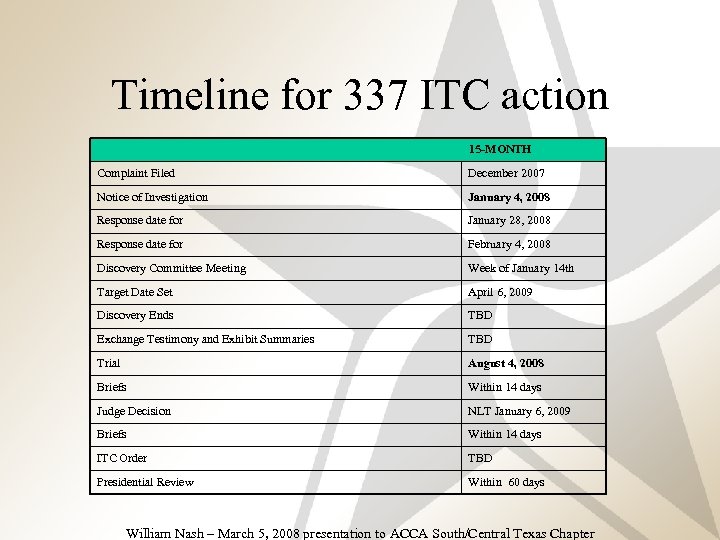
Timeline for 337 ITC action 15 -MONTH Complaint Filed December 2007 Notice of Investigation January 4, 2008 Response date for January 28, 2008 Response date for Discovery Committee Meeting –Fourth level Target Date Set » Fifth level February 4, 2008 Week of January 14 th April 6, 2009 Discovery Ends TBD Exchange Testimony and Exhibit Summaries TBD Trial August 4, 2008 Briefs Within 14 days Judge Decision NLT January 6, 2009 Briefs Within 14 days ITC Order TBD Presidential Review Within 60 days William Nash – March 5, 2008 presentation to ACCA South/Central Texas Chapter
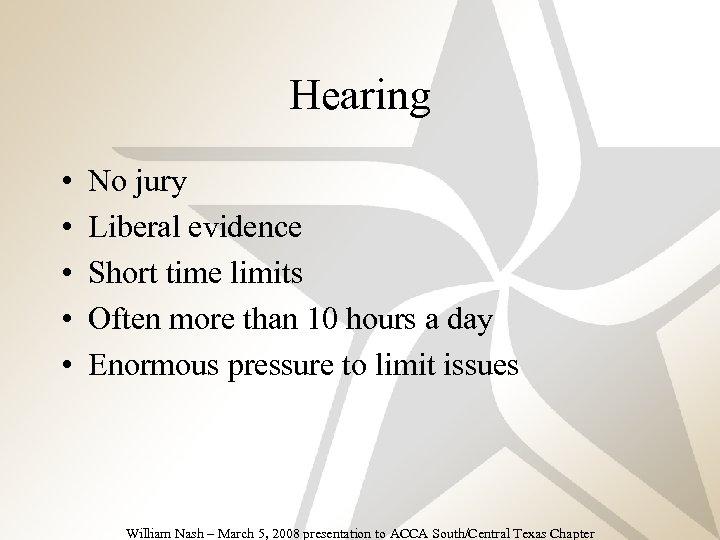
Hearing • • • No jury Liberal evidence –Fourth level Short time limits » Fifth level Often more than 10 hours a day Enormous pressure to limit issues William Nash – March 5, 2008 presentation to ACCA South/Central Texas Chapter
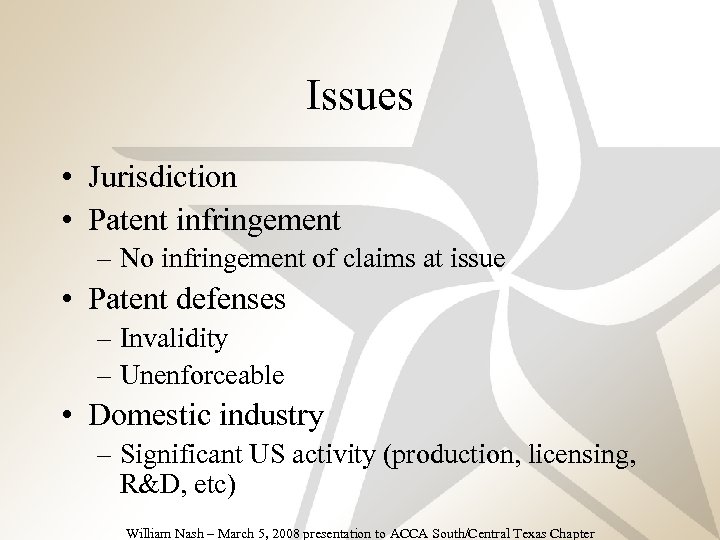
Issues • Jurisdiction • Patent infringement –Fourth level – No infringement of claims at issue • Patent defenses » Fifth level – Invalidity – Unenforceable • Domestic industry – Significant US activity (production, licensing, R&D, etc) William Nash – March 5, 2008 presentation to ACCA South/Central Texas Chapter
QUESTIONS? • William B. Nash • Partner Registered Patent Attorney –Fourth level (210) 978 -7764 » Fifth level bnash@jw. com Jackson Walker L. L. P. www. jw. com Austin Dallas Fort Worth Houston Richardson San Angelo San Antonio
Скачать презентацию HOW TO BUILD MANAGE MAXIMIZE YOUR INTELLECTUAL
7f9da80e5542912ea91b61bf9c823f52.ppt