


 Скачать презентацию How to Access R D Tax Dollars Jane Drummond
0a3ca085c1e4fcf635328f50c8e92b62.ppt
- Количество слайдов: 41

 How to Access R&D Tax Dollars Jane Drummond – MJA Senior Manager Tony Partridge – MJA Associate
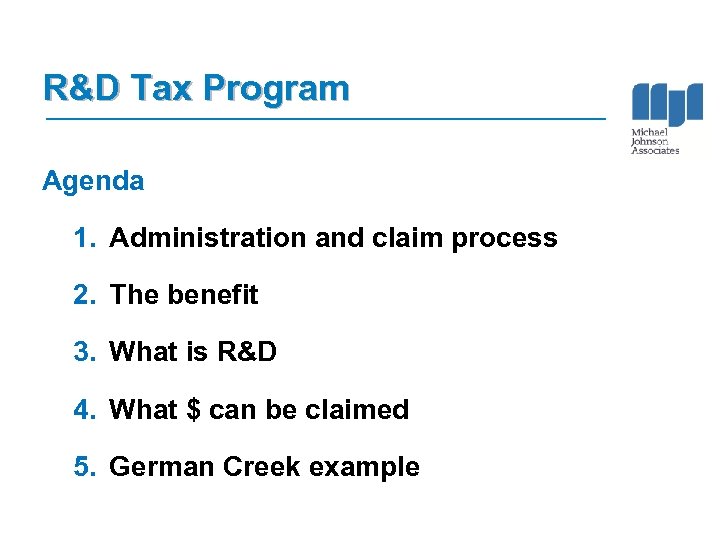 R&D Tax Program Agenda 1. Administration and claim process 2. The benefit 3. What is R&D 4. What $ can be claimed 5. German Creek example
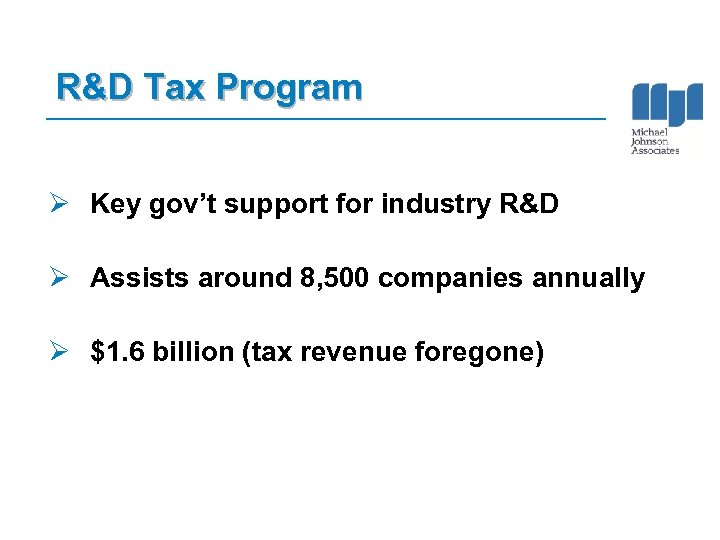 R&D Tax Program Ø Key gov’t support for industry R&D Ø Assists around 8, 500 companies annually Ø $1. 6 billion (tax revenue foregone)
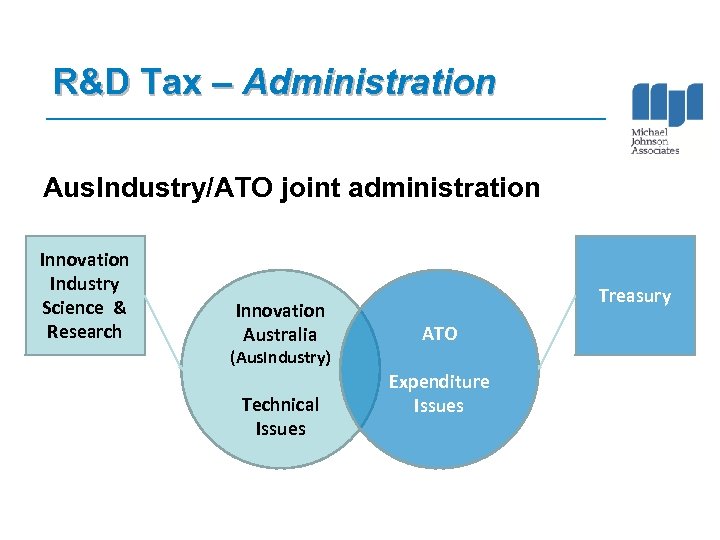 R&D Tax – Administration Aus. Industry/ATO joint administration Innovation Industry Science & Research Innovation Australia Treasury ATO (Aus. Industry) Technical Issues Expenditure Issues
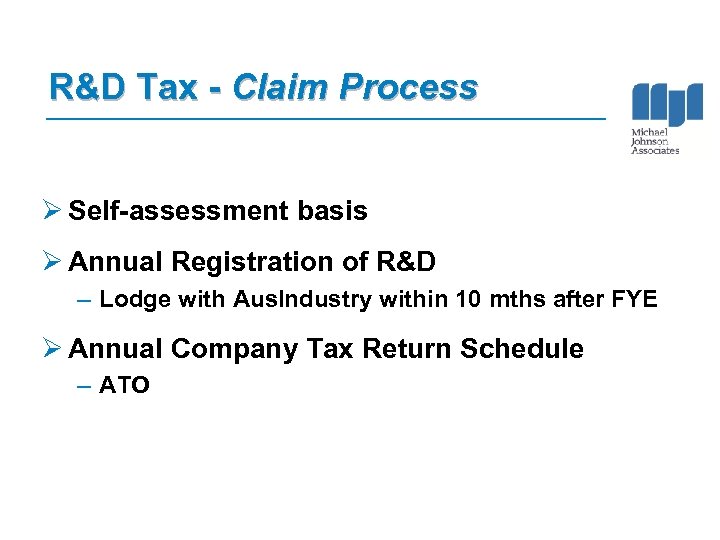 R&D Tax - Claim Process Ø Self-assessment basis Ø Annual Registration of R&D – Lodge with Aus. Industry within 10 mths after FYE Ø Annual Company Tax Return Schedule – ATO
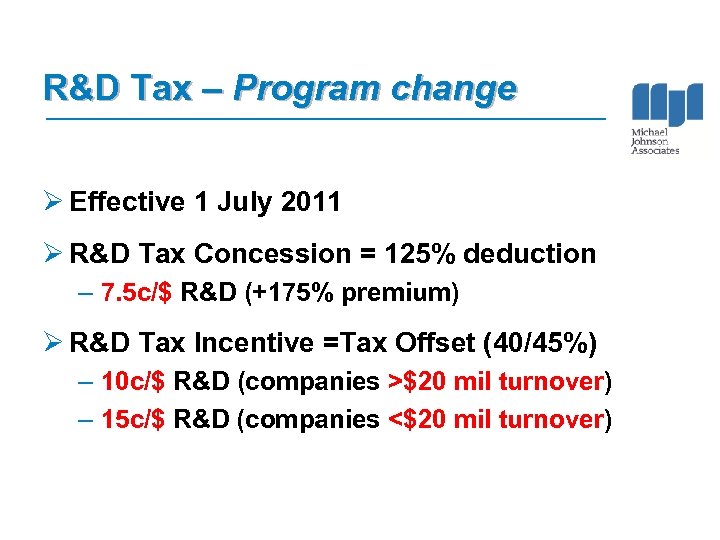 R&D Tax – Program change Ø Effective 1 July 2011 Ø R&D Tax Concession = 125% deduction – 7. 5 c/$ R&D (+175% premium) Ø R&D Tax Incentive =Tax Offset (40/45%) – 10 c/$ R&D (companies >$20 mil turnover) – 15 c/$ R&D (companies <$20 mil turnover)
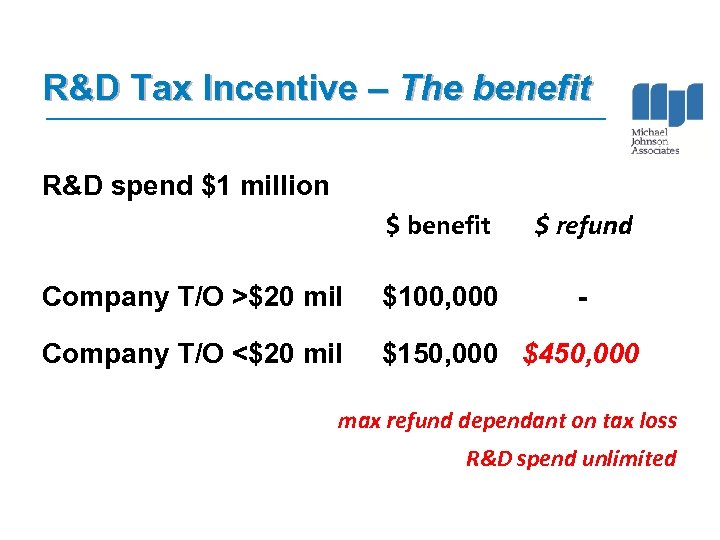 R&D Tax Incentive – The benefit R&D spend $1 million $ benefit $ refund Company T/O >$20 mil $100, 000 - Company T/O <$20 mil $150, 000 $450, 000 max refund dependant on tax loss R&D spend unlimited
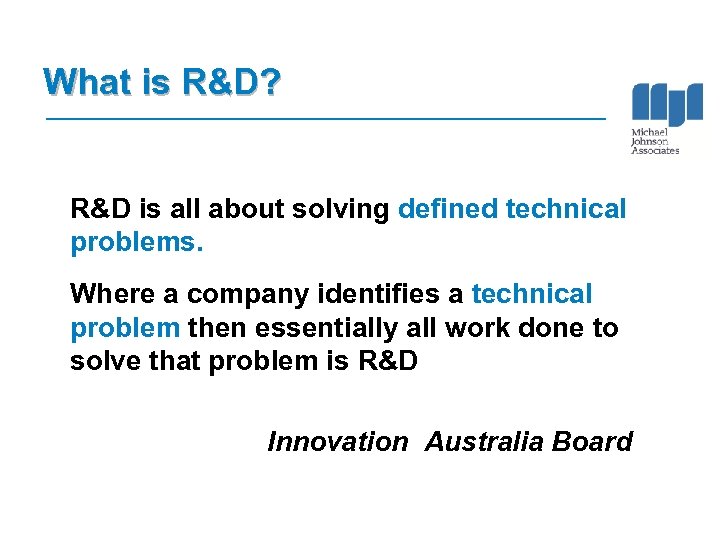 What is R&D? R&D is all about solving defined technical problems. Where a company identifies a technical problem then essentially all work done to solve that problem is R&D Innovation Australia Board
 What is R&D – Legislation Ø R&D claimed on a project basis Ø R&D activities defined as • Core – must be experimental • Supporting – must be directly related
 What is R&D – Definition Core (experimental) activity (a) Whose outcome cannot be known or determined in advance on the basis of current knowledge, information or experience, but can only be determined by applying a systematic progression of work that: – Is based on principles of established science;
 What is R&D – Definition cont – Proceeds from hypothesis to experiment, observation and evaluation, and leads to logical conclusions; and. . . (b)That are conducted for the purpose of generating new knowledge (including new knowledge in the form of new or improved materials, products, devices, processes or services).
 What is R&D – Project examples Ø New/improved processes for higher efficiency, safety, productivity • New plant and/or process design Ø New/improved products • New market requirements Ø Not R&D • Supplier trials (on whose behalf? )
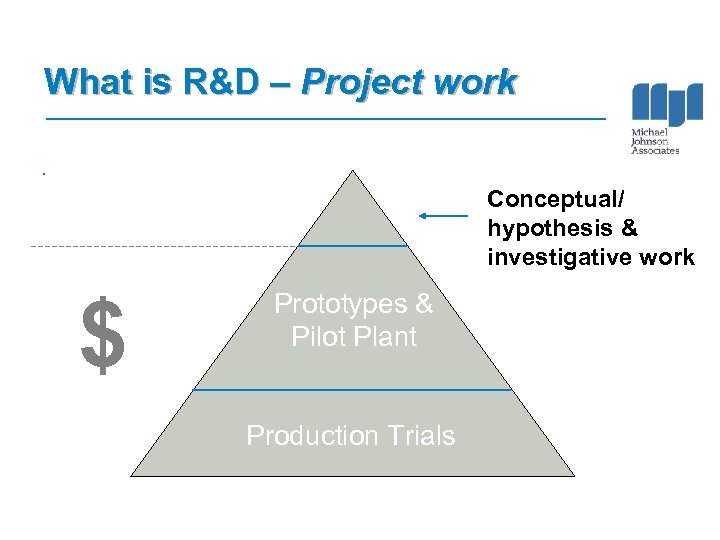 What is R&D – Project work. Conceptual/ hypothesis & investigative work $ Prototypes & Pilot Plant Production Trials
 What is R&D – Production trials R&D can involve production activities (even when product is sold) Ø Claim restricted to portion of plant/ process that R&D relates Ø Trial period defined by minimum time • • technical improvements being sought and/or KPIs met
 What is R&D – Production trials Evidence that supports the case of experimentation Ø Additional non- routine procedures eg heightened monitoring Ø Factors such as production disruption
 What $ can be claimed? Ø Ø Ø Salaries Contracts to RSPs eg Uni’s, CSIRO Other: • • • Ø Ø Contractors Hire of equipment Travel Overheads (direct/allocated) Operation/production trial costs Plant & pilot plant (tax deprec. only) Feedstock
 Case Study: German Creek mine q Premium open-cut coking coal operation q Opened in 1981 q Raw coal stockpile and reclaim q Friable coal (HGI ~ 100)
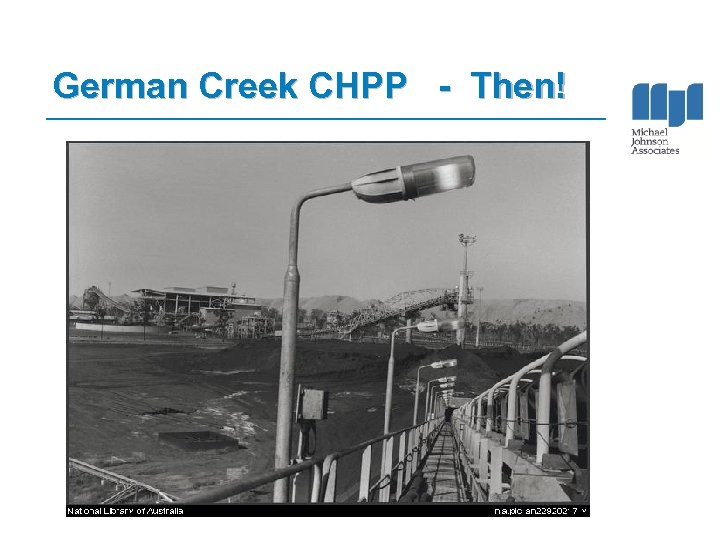 German Creek CHPP - Then!
 Original CHPP (1981 -1983) Key features. . . • Rotary breaker to 50 mm • Screened at ~ 0. 7 mm (0. 5 mm wedge wire) • 4 DMCs and two-stage Flotation (4 banks primary, 2 banks secondary) • 900 tph nominal capacity
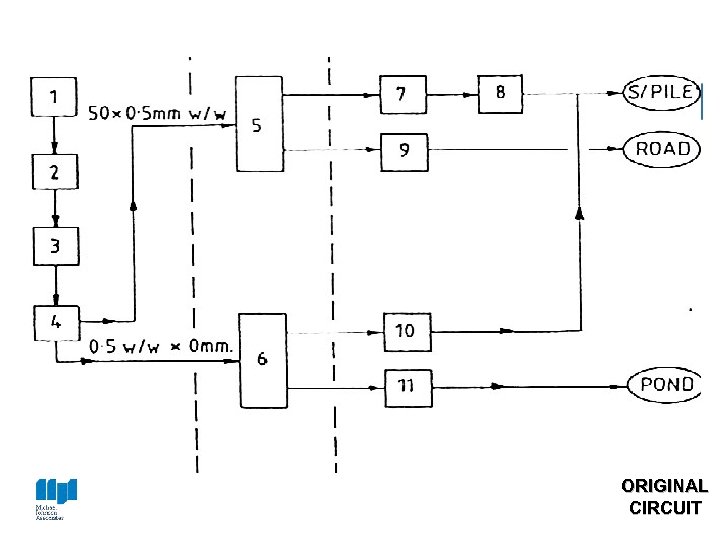 ORIGINAL CIRCUIT
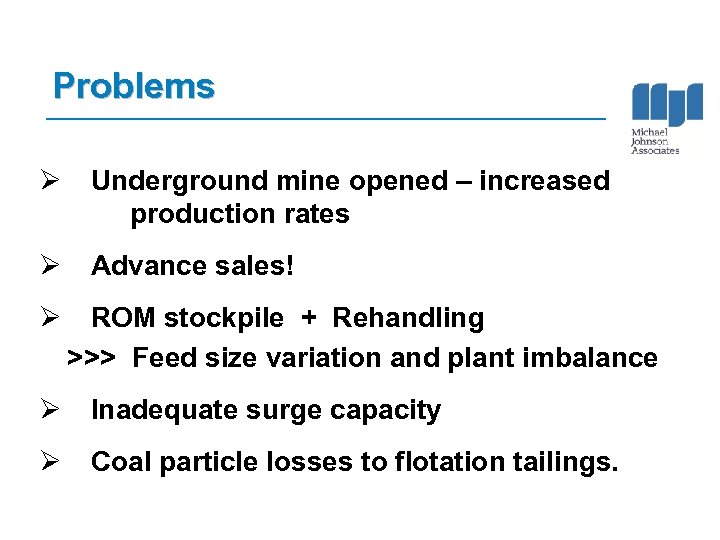 Problems Ø Underground mine opened – increased production rates Ø Advance sales! Ø ROM stockpile + Rehandling >>> Feed size variation and plant imbalance Ø Inadequate surge capacity Ø Coal particle losses to flotation tailings.
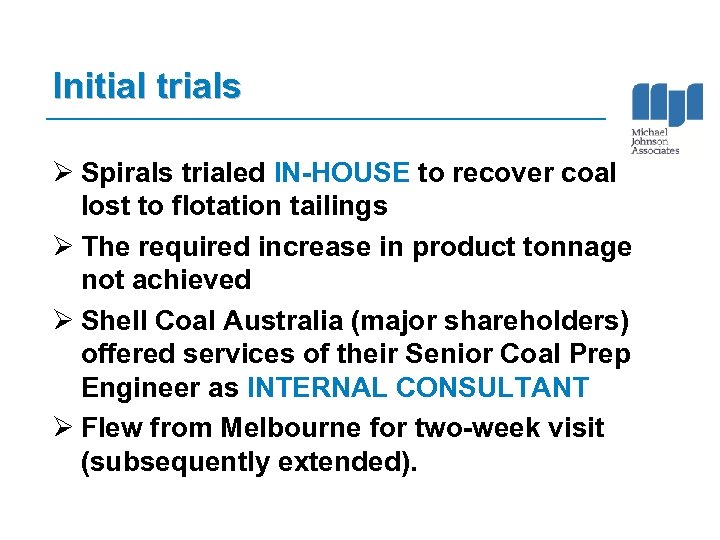 Initial trials Ø Spirals trialed IN-HOUSE to recover coal lost to flotation tailings Ø The required increase in product tonnage not achieved Ø Shell Coal Australia (major shareholders) offered services of their Senior Coal Prep Engineer as INTERNAL CONSULTANT Ø Flew from Melbourne for two-week visit (subsequently extended).
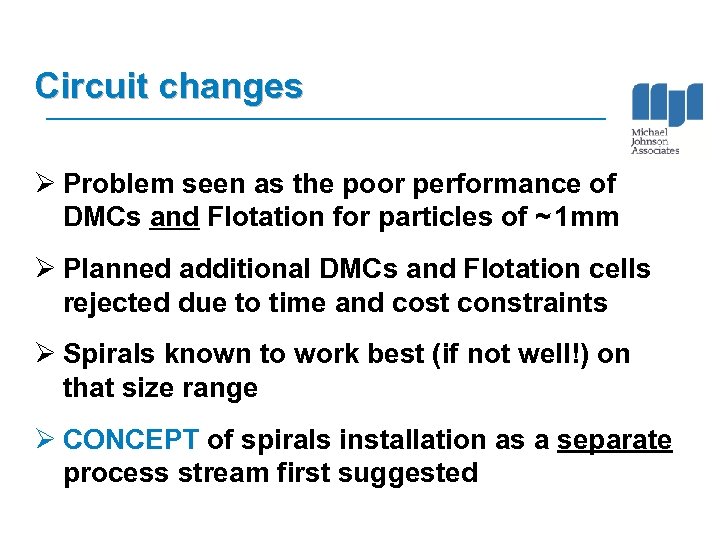 Circuit changes Ø Problem seen as the poor performance of DMCs and Flotation for particles of ~ 1 mm Ø Planned additional DMCs and Flotation cells rejected due to time and cost constraints Ø Spirals known to work best (if not well!) on that size range Ø CONCEPT of spirals installation as a separate process stream first suggested
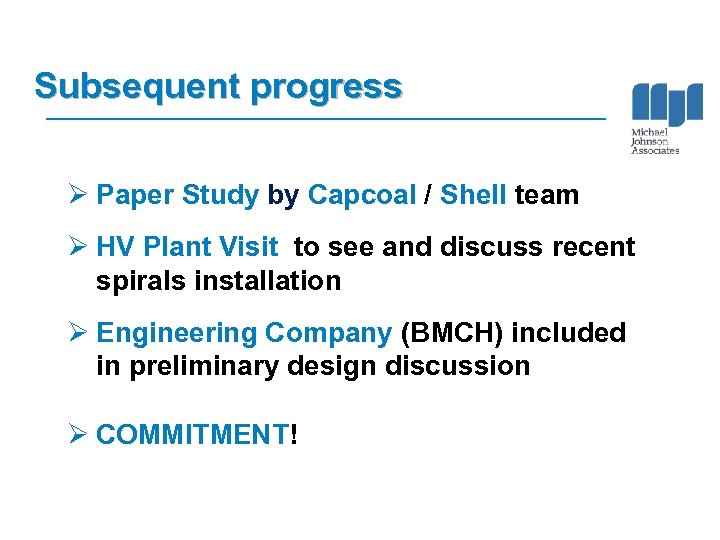 Subsequent progress Ø Paper Study by Capcoal / Shell team Ø HV Plant Visit to see and discuss recent spirals installation Ø Engineering Company (BMCH) included in preliminary design discussion Ø COMMITMENT!
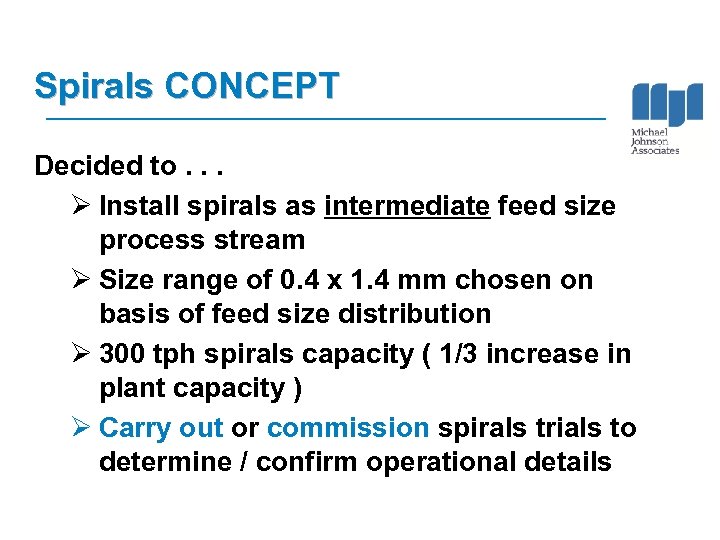 Spirals CONCEPT Decided to. . . Ø Install spirals as intermediate feed size process stream Ø Size range of 0. 4 x 1. 4 mm chosen on basis of feed size distribution Ø 300 tph spirals capacity ( 1/3 increase in plant capacity ) Ø Carry out or commission spirals trials to determine / confirm operational details
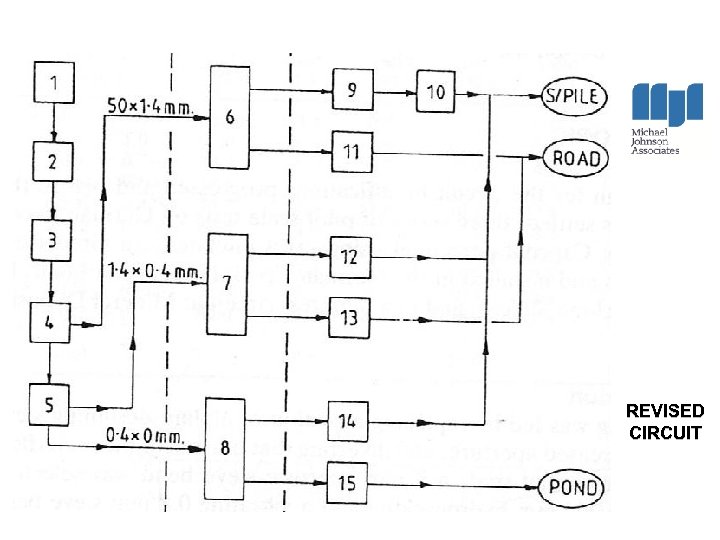 REVISED CIRCUIT
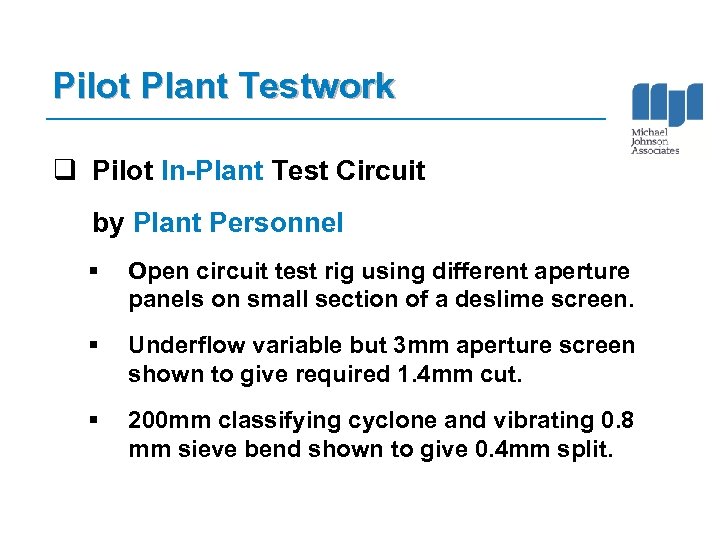 Pilot Plant Testwork q Pilot In-Plant Test Circuit by Plant Personnel § Open circuit test rig using different aperture panels on small section of a deslime screen. § Underflow variable but 3 mm aperture screen shown to give required 1. 4 mm cut. § 200 mm classifying cyclone and vibrating 0. 8 mm sieve bend shown to give 0. 4 mm split.
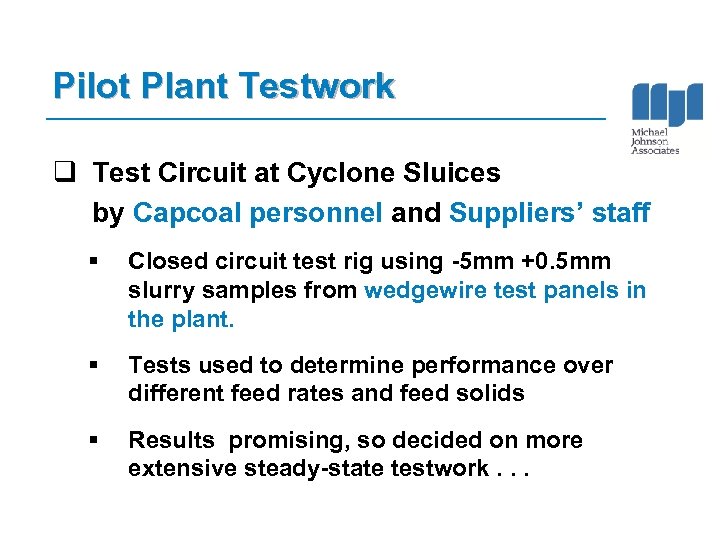 Pilot Plant Testwork q Test Circuit at Cyclone Sluices by Capcoal personnel and Suppliers’ staff § Closed circuit test rig using -5 mm +0. 5 mm slurry samples from wedgewire test panels in the plant. § Tests used to determine performance over different feed rates and feed solids § Results promising, so decided on more extensive steady-state testwork. . .
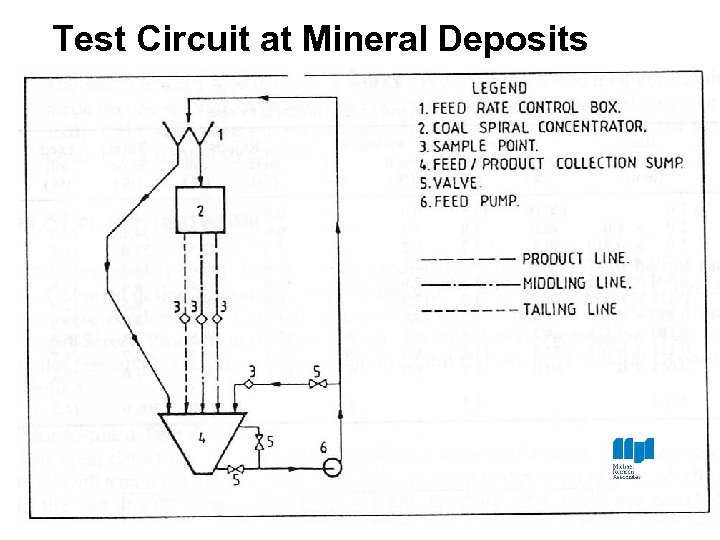
 Pilot Plant Testwork q Test Circuit at Mineral Deposits by Capcoal personnel and Suppliers’ staff § § Similar test rig to previous tests but with improved sampling system. Tests covered higher feed solids concentrations and higher feedrates Determination of relationships between cut point, efficiency and feed conditions Evaluation of minor spiral modifications
 Test Circuit at Mineral Deposits Excluded Activities that are not core R&D activities include: Ø Routine quality control Ø Prospecting/exploring/drilling for minerals, oil or gas Ø Management studies or efficiency surveys Ø Collection of information to comply with statutory requirements Ø Reverse engineering Note: some of these activities may qualify, in a limited sense, as directly related activities.
 Conclusions q Spirals would provide acceptable performance on the selected size range q Relationships between the process variables provided the basis for process optimisation q Middlings recycle and product desliming would be necessary to achieve the required yield and ash values
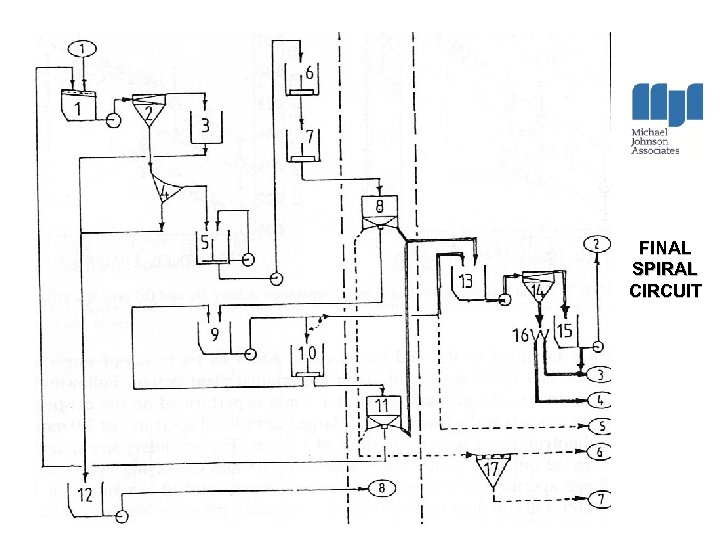 FINAL SPIRAL CIRCUIT
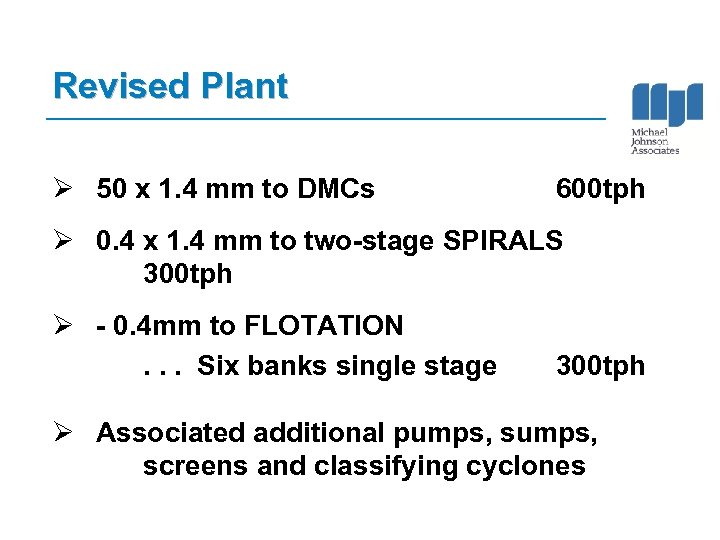 Revised Plant Ø 50 x 1. 4 mm to DMCs 600 tph Ø 0. 4 x 1. 4 mm to two-stage SPIRALS 300 tph Ø - 0. 4 mm to FLOTATION. . . Six banks single stage 300 tph Ø Associated additional pumps, screens and classifying cyclones
 Plant Optimisation and Control Six weeks of in-plant trials by Plant Staff Ø To establish steady state operation Ø To establish control strategy and operating philosophy Finally. . . Ø The installation of flowmeters and variable speed drives to enable optimum control
 Summary – R&D Project Technical problem (defined ) • Fines problem due to high friability and lack of surge capacity Technical objective (new knowledge ) • Investigation of the use of spirals as a separate parallel process
 Summary – R&D Claim R&D activities (experimental ) Ø Preliminary studies (spirals on tailings) $ salaries Ø Concept development (spirals as parallel process stream) $ salaries and consultant costs Ø Preliminary test-work on site (1 spiral) $ salaries, plant costs
 Summary – R&D activities cont. Ø Pilot scale test-work off site (2 trials at 2 locations) $ salaries, travel, contractor/lab costs Ø Design review (iterative feedback R&D) – 2 stage process requirement identified $ salaries Ø Full Scale Plant trial (6 weeks) $ salaries, Plant op costs (>$1 mil)
 Summary – R&D claim Project cost approx $ 2 million Claim value = $ 200, 000
 Last word – Evidence Ø You need supporting documents eg: - Records of technical issues Approvals for process/product changes Project plans/scope of works Trial plans, sheets/logs, reports, photographs Consultant/contractor reports Additional testing/monitoring systems Presentations and publications
 Thanks for your time - questions?