


 Скачать презентацию How Taiwan Education Pursues Equity in Excellence Chuing
622c9c5c013c5438fceaf0166014a299.ppt
- Количество слайдов: 21
 How Taiwan Education Pursues Equity in Excellence Chuing Prudence Chou (周祝瑛) National Chengchi University (NCCU), Taiwan NIE & HEAD, Singapore, May 10 -12, 2016
 Outline 1. Taiwan’s Paradoxes 2. Social Challenges and Context 3. Basic Educational Structure 4. Education Reform for Equity in Excellence 5. Four core values, one special emphasis 6. K-12 and Higher Education 7. Challenges 2
 3
3
 INTERNATIONAL MATHEMATICAL OLYMPIAD, PISA, TIMSS • ALWAYS HAVE GOOD RECORDS • BUT DISCRAPANCY BETWEEN STUDENTS BASED ON REGION, SCHOOL DISTRICT, AND FAMILY SES CONTINUES TO PLAY A MAIN ROLE IN EDUCATIONAL ACHIEVEMENT 4
 ICT Coverage Rate and Education • 63. 80% of Taiwanese are frequent uses of internet in 2013. • 100 % of schools and governments have internet access. • All the 24 -hour chain stores have Wi Fi access nation-wide • Within top 10 in the world according to WEF/NRI Ranking agencies 5
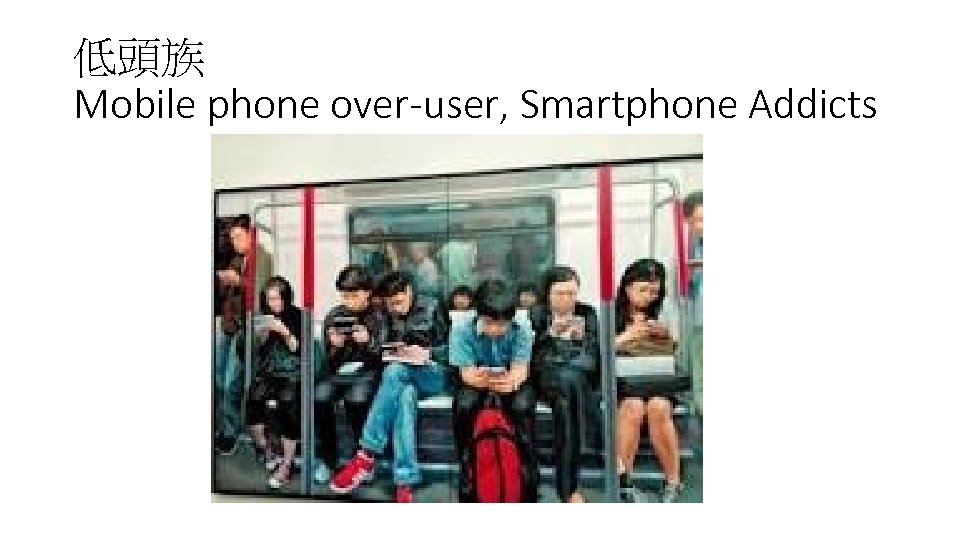 低頭族 Mobile phone over-user, Smartphone Addicts
 Taiwan’s Paradoxes • Exemplar • High-performing education system. • Pupil performance ranks highly (PISA, TIMSS, IMSO, etc. ) • Warning • • • Pressure from exam-based system. ‘Shadow’ education/cramming. Gang violence, drug abuse, bullying and indiscipline on the increase. Pupils show no interest in exploring science or outside reading. Increasingly institutionalised social inequality.
 Social Challenges and Context • Birthrate decline. • dropped, from 410, 000 newborn babies in 1981, 270, 000 in 1998, 191, 000 in 2009, to 210, 830 in 2014 Ageing society/workforce imbalance. Rapid transition to globally-focussed economy. Internet addiction/online subculture. Increasing marginalisation of disadvantaged groups (poor, single-parent, ethnic minority, etc. ) • Increasing disengagement by teenagers from society. • • • International Civic and Citizenship Education Study (ICCS). • Problems of national identity • What/who is ‘Taiwanese’? • The Cross-Straits Question.
 Basic Structure of Education in Taiwan • Elementary – 6 years (Compulsory). • Junior High School – 3 years (Compulsory, non-selective from 1968). • Senior High School – 3 years (as basic education from 2014). • University/college – 4 years (Non-compulsory, selective).
 Education Reform for Equity in Excellence • Transition from authoritarian, centralised model to democratic, market-driven one. • Highly-competitive, elite-access model to widened, more universal mass-access one. • Academic excellence as sole criteria replaced by more contextual criteria. • Broadened and diversified admissions channels. • Facilitated by rapid expansion of private education (particularly HEIs).
 Reform Principles • Master Plan for Education Reform Report • 1) deregulating governmental control over education, • 2) exempting education sectors from unrelated regulation and constraints, • 3) protecting students basic learning rights, • Education Basic Law (1999) • Minorities • Female education rights • 4) respecting parental right of choice on education patterns and paths for their children, • 5) guaranteeing teachers' professional autonomy and quality.
 Equity agenda • Minorities • Aboriginal education funding guaranteed • Education Act for Indigenous Peoples (2004) • Aboriginal Education Law (2013) • Low Socio-Economic Status (SES) • Foreign spouses/children • Immigrants. • Female education rights • Cabinet-level Commission on Women's Rights Promotion • Ministry of Education Gender Equality Education Committee
 Four core values, one special emphasis • Delicacy • Innovation • Justice • Sustainability • “Respect and Care for Diverse and Vulnerable Groups”
 Equity in Higher Education Expansion • Mass higher education hoped to open up new opportunities to traditionally disadvantaged groups. • Transition from elite preserve to mass education system. • Reflects global trend. • Opportunities created but access to resources and funding controlled by market forces. • Favouring wealthy/social capital-rich. • Expansion driven by growth in non-elite HEIs in private sector. • • ‘Lower quality’ education. Lower entry requirements. Higher fees. ‘Class reproduction. ’
 Good intentions, incomplete results • The learning gap between rural and urban students still exists. • The distribution of educational resources remains uneven. • Excessive pressure remains to pass entrance exams for secondary schools and universities. • Public/Private, Elite/Non-elite gap still exists. • Disadvantage still exists,
 Inequality in accessing public resources • Funding mechanisms substantially changed • THEN - HEI budgets allocated by government equally. • NOW – HEI budgets mixed public/private funds. • Public funds vary with formalised assessment results. • Private funds largely from donations and tuition fees. • Funding substantially reduced. • overall budget allocated to public HEIs has declined • this deficit accounts for one third of the current funding shortfall • Expanded educational opportunities created at the bottom, not the top.
 Discussion • Conflict between equity and excellence is a global issue. • Equity conflicts with public thirst for elite status? • Widening participation risks ‘lowest common denominator’? • Can university admissions be objective and fair? • Can a publicly-accepted balance be struck between equity and excellence?
 Concluding remarks • Taiwan’s HEI enrolment rate is one of the world’s highest. • Constrained budgets led to market allocation of resources. • Sector expansion led by private institutions. • Disadvantaged groups made absolute gains but not relative ones. • ‘Class reproduction’ and lowered social mobility have resulted.
 Thank you. Questions and Comments: Chuing Prudence Chou (周祝瑛) National Chengchi University iaezcpc@gmail. com Website: www 3. nccu. edu. tw/~iaezcpc/en/
 Chou’s Work… • Chou, C. P. ; Spangler, J. (eds. ). (2016). Chinese Education Models in a Global Age. Singapore: Springer. • Chou, C. P. (Ed) (2014). The SSCI Syndrome in Higher Education: A Local or Global Phenomenon. Netherland: Sense Publishers. • Chou, C. P. ; Ching, Gregory S. (2012). Taiwan Education at the Crossroad: When Globalization Meets Localization. International and Development Education. New York: Palgrave Macmillan. • 周祝瑛(2008)。台灣教育怎麼辦?臺北:心理。 • 周祝瑛(2003)。誰捉弄了台灣改?臺北:心理。
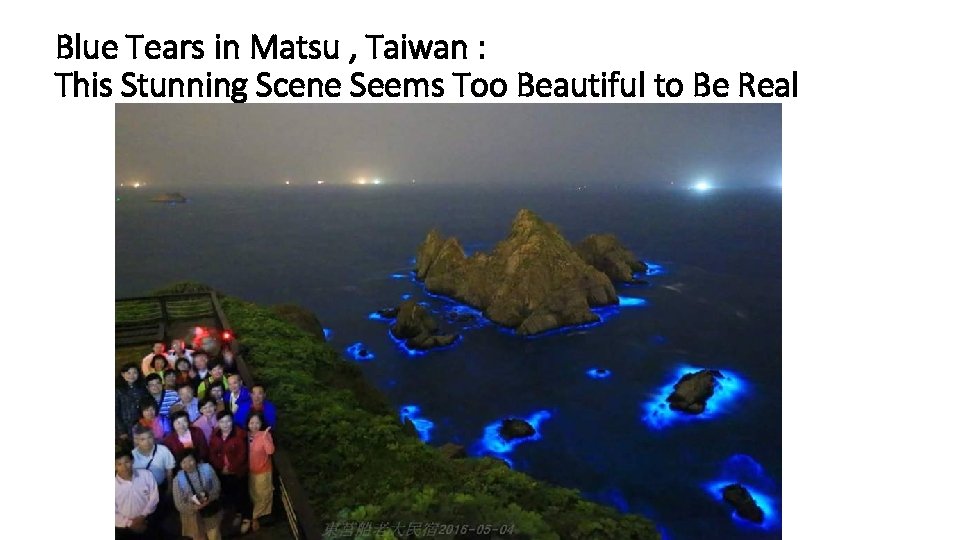 Blue Tears in Matsu , Taiwan : This Stunning Scene Seems Too Beautiful to Be Real