 Скачать презентацию How tablet devices can help with mixed ability
Methodology_Tablet_devices_317_group.pptx
- Количество слайдов: 14



How tablet devices can help with mixed ability classes Done by: Kusanova S. Kurarbek E. Sergalieva A. Kadyrbek A. Kanat N. Makulbek A. Checked by: Senior Teacher Ph. D Orang Shabdiz
Content Mixed ability classes How tablets help in education Listening skills Pronunciation How tablet devices can help teachers Conclusion
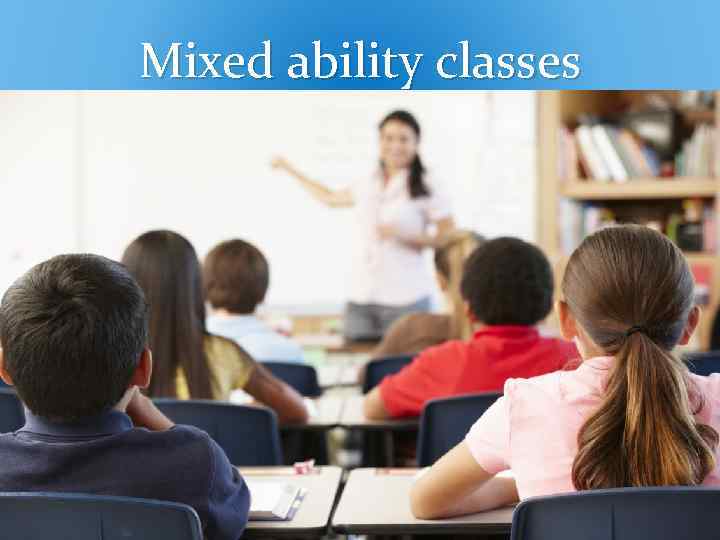
Mixed ability classes
Mixed ability classes bring with them a whole manner of challenges for teachers to overcome. Students who perceive themselves as weak, the ones that are too shy to ask, the ones that don’t ask for the listening exercise to be played again and the ones who feel the pace of the lesson is too fast for them are often the ones that go unnoticed. Of course, teacher should try and slow it down then those who are more confident complain the pace is too slow. Teachers should always be creative in finding ways to overcome the mixed ability issue. Be it through adjustment of course materials by subtle adaptations and grading or imaginative regroupings during exercises.
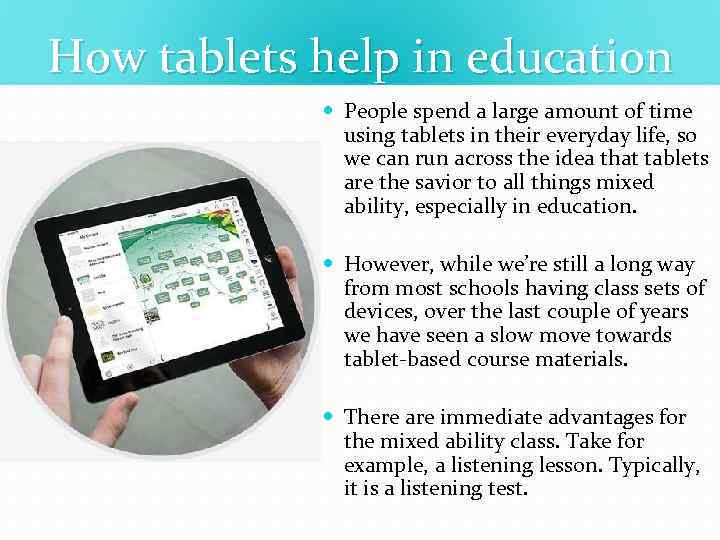
How tablets help in education People spend a large amount of time using tablets in their everyday life, so we can run across the idea that tablets are the savior to all things mixed ability, especially in education. However, while we’re still a long way from most schools having class sets of devices, over the last couple of years we have seen a slow move towards tablet-based course materials. There are immediate advantages for the mixed ability class. Take for example, a listening lesson. Typically, it is a listening test.
Improving listening skills with the help of tablet
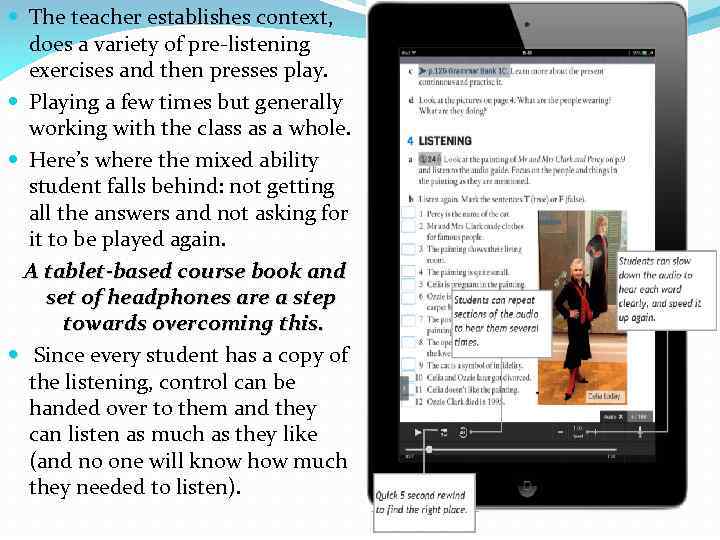
The teacher establishes context, does a variety of pre-listening exercises and then presses play. Playing a few times but generally working with the class as a whole. Here’s where the mixed ability student falls behind: not getting all the answers and not asking for it to be played again. A tablet-based course book and set of headphones are a step towards overcoming this. Since every student has a copy of the listening, control can be handed over to them and they can listen as much as they like (and no one will know how much they needed to listen).
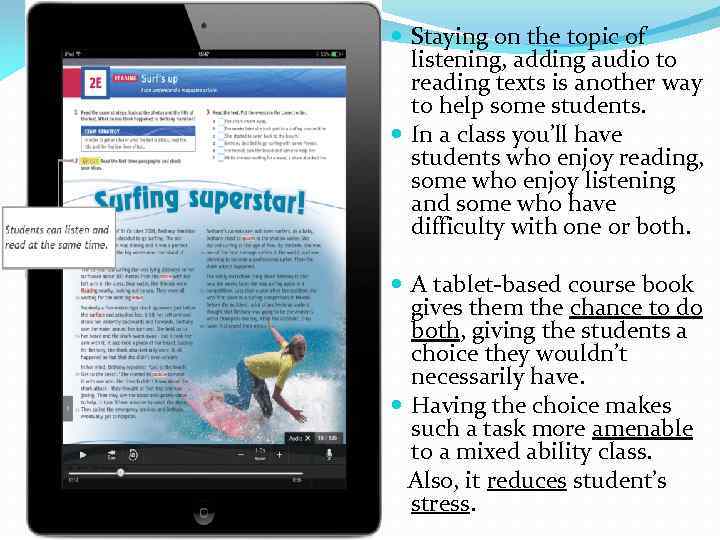
Staying on the topic of listening, adding audio to reading texts is another way to help some students. In a class you’ll have students who enjoy reading, some who enjoy listening and some who have difficulty with one or both. A tablet-based course book gives them the chance to do both, giving the students a choice they wouldn’t necessarily have. Having the choice makes such a task more amenable to a mixed ability class. Also, it reduces student’s stress.
Pronunciation In a large class, it is difficult for a teacher to be able to hear and react to everyone. A tablet-based course book also gives every student a voice when it comes to working with pronunciation. ü The students at appropriate times can record themselves and listen to their own pronunciation when compared to a model. ü Recording also builds the student’s confidence as it acts as rehearsal time, so if they are then asked to say something in front of the class they feel more able to speak.
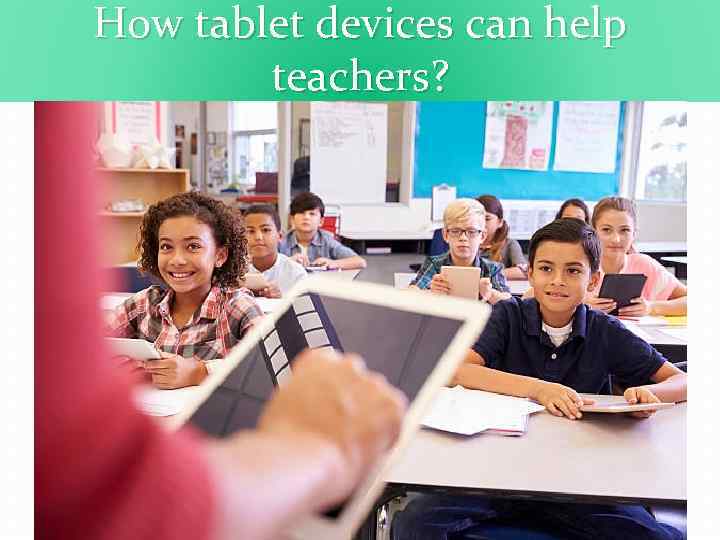
How tablet devices can help teachers?
There a number of apps that can be used on a tablet to achieve this:
Socrative (a student response system) is an app that allows a teacher to create exercises, quizzes and games that they can then get each student to do on their device. As they do it, Socrative gives feedback on each student and how they are doing. It provides the digital equivalent of ‘Do you understand? ’. However, unlike when asking the question to the whole class, feedback is telling you exactly how each student is doing. Or to put it another way, the shy struggling student is not put on the spot in front of everyone.
In a similar vein, an app such as Nearpod allows a teacher to create presentations that cater for a mixed ability classroom, creating lessons that include listening, video and presentations. The presentation is sent to the students’ device and while they are working the teacher can get instant feedback on how the student is doing. Once a teacher has this feedback, they know who needs what help and where. They perhaps then can use a tablet’s screen recording ability to produce personalized instruction.
Conclusion As it is mentioned above, working with tablets can help teacher control every students in a mixed ability classes. Also, shy students can fully demonstrate their abilities. We think that if each student will work with the tablet individually, it will be much more effective than the usual standard lesson. We also think that all educational institutions should switch to such a method of teaching.
Скачать презентацию How tablet devices can help with mixed ability
Methodology_Tablet_devices_317_group.pptx