 Скачать презентацию How Significant was Catholic Emancipation By Mr RJ
f06c48b91757fc2d92085b58602c3de8.ppt
- Количество слайдов: 26



How Significant was Catholic Emancipation? By Mr RJ Huggins
Act of Union 1800 ¨ The Act of Union of 1800, The Act of Union also created the Union Jack that we know today! Old Flag created the United Kingdom of Great Britain and united the Dublin and Westminster Parliaments together. ¨ As part of the deal Catholics in Ireland were promised that the laws in England would be changed so that Catholics would be allowed to become MPs and hold public office. ¨ By 1829, the Tories had still failed to keep this promise!
Status and Position of Catholics ¨ In 1820, Catholic landowners and 40 shilling freeholders in Ireland were allowed to vote. ¨ However, laws dating back to 1688 prevented Catholics in Britain from being an MP, holding public office, becoming a civil servant or an officer in the Army. ¨ Catholics in England, Wales and Scotland were also not allowed to vote. ¨ Catholics made up 95% of the population of Ireland, whilst the population in England was small in was growing.
Lord Liverpool’s Premiership ¨ Lord Liverpool’s ministry was opposed to RIP Castlereagh 1822 Parliamentary Reform. ¨ He even refused to allow anyone in his cabinet to discuss issue of Catholic Emancipation. ¨ However, the modernisers or liberals within the Tory party, led by George Canning wanted to introduce Catholic Emancipation. ¨ When Castlereagh died in 1822, he only allowed the popular Canning and his supporters known as the Canningnites, into the cabinet so long as the issue of Catholic Emancipation was not discussed.
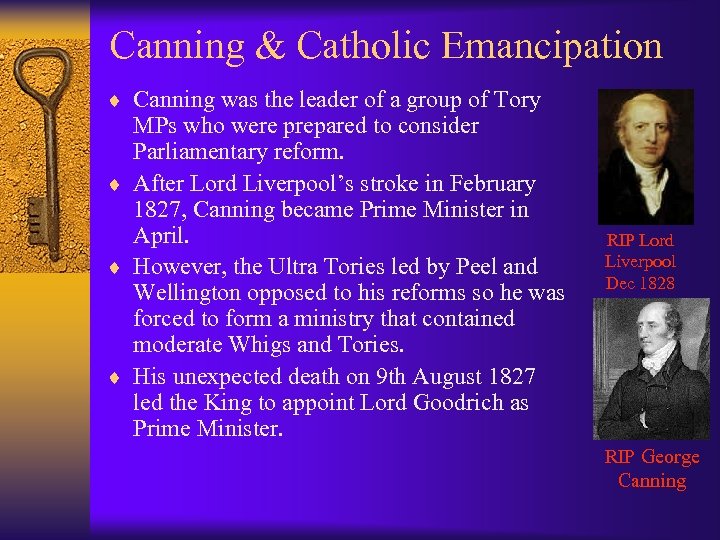
Canning & Catholic Emancipation ¨ Canning was the leader of a group of Tory MPs who were prepared to consider Parliamentary reform. ¨ After Lord Liverpool’s stroke in February 1827, Canning became Prime Minister in April. ¨ However, the Ultra Tories led by Peel and Wellington opposed to his reforms so he was forced to form a ministry that contained moderate Whigs and Tories. ¨ His unexpected death on 9 th August 1827 led the King to appoint Lord Goodrich as Prime Minister. RIP Lord Liverpool Dec 1828 RIP George Canning
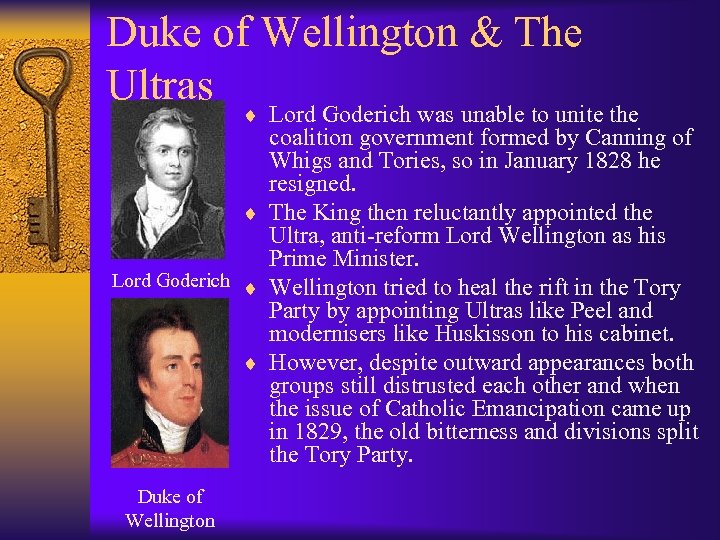
Duke of Wellington & The Ultras ¨ Lord Goderich was unable to unite the coalition government formed by Canning of Whigs and Tories, so in January 1828 he resigned. ¨ The King then reluctantly appointed the Ultra, anti-reform Lord Wellington as his Prime Minister. Lord Goderich ¨ Wellington tried to heal the rift in the Tory Party by appointing Ultras like Peel and modernisers like Huskisson to his cabinet. ¨ However, despite outward appearances both groups still distrusted each other and when the issue of Catholic Emancipation came up in 1829, the old bitterness and divisions split the Tory Party. Duke of Wellington
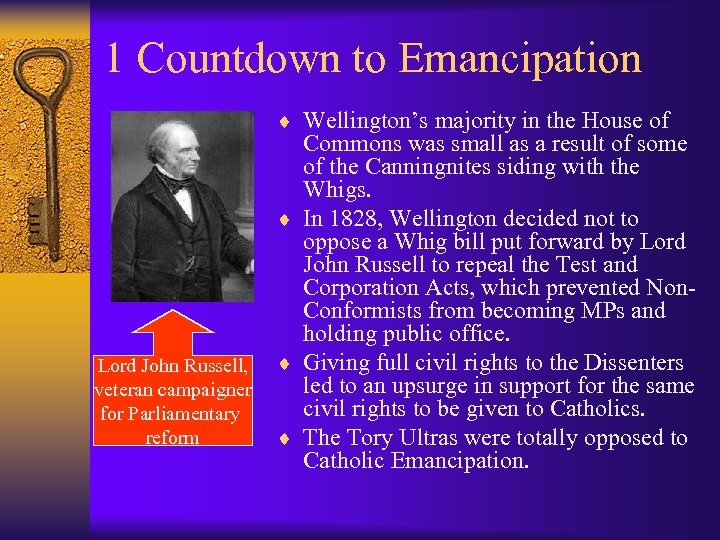
1 Countdown to Emancipation ¨ Wellington’s majority in the House of Lord John Russell, veteran campaigner for Parliamentary reform Commons was small as a result of some of the Canningnites siding with the Whigs. ¨ In 1828, Wellington decided not to oppose a Whig bill put forward by Lord John Russell to repeal the Test and Corporation Acts, which prevented Non. Conformists from becoming MPs and holding public office. ¨ Giving full civil rights to the Dissenters led to an upsurge in support for the same civil rights to be given to Catholics. ¨ The Tory Ultras were totally opposed to Catholic Emancipation.
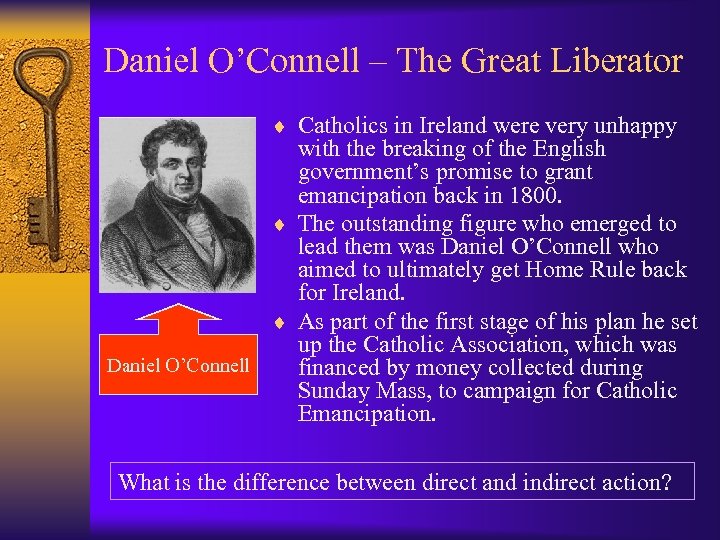
Daniel O’Connell – The Great Liberator ¨ Catholics in Ireland were very unhappy with the breaking of the English government’s promise to grant emancipation back in 1800. ¨ The outstanding figure who emerged to lead them was Daniel O’Connell who aimed to ultimately get Home Rule back for Ireland. ¨ As part of the first stage of his plan he set up the Catholic Association, which was Daniel O’Connell financed by money collected during Sunday Mass, to campaign for Catholic Emancipation. What is the difference between direct and indirect action?
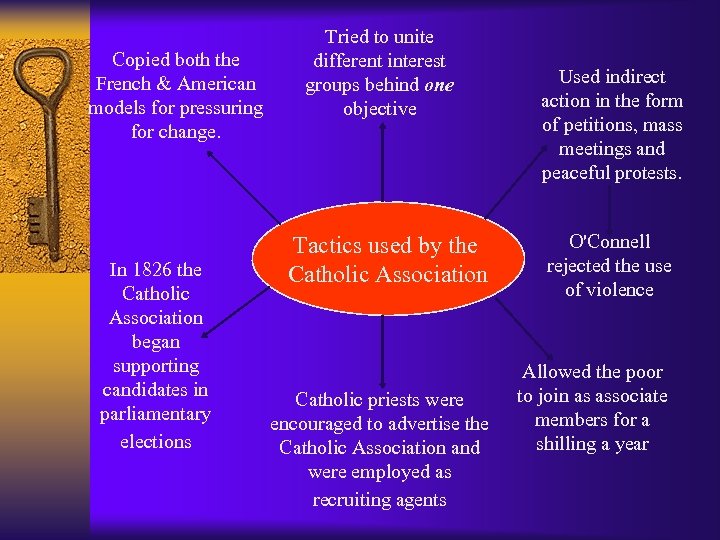
Copied both the French & American models for pressuring for change. In 1826 the Catholic Association began supporting candidates in parliamentary elections Tried to unite different interest groups behind one objective Tactics used by the Catholic Association Catholic priests were encouraged to advertise the Catholic Association and were employed as recruiting agents Used indirect action in the form of petitions, mass meetings and peaceful protests. O'Connell rejected the use of violence Allowed the poor to join as associate members for a shilling a year
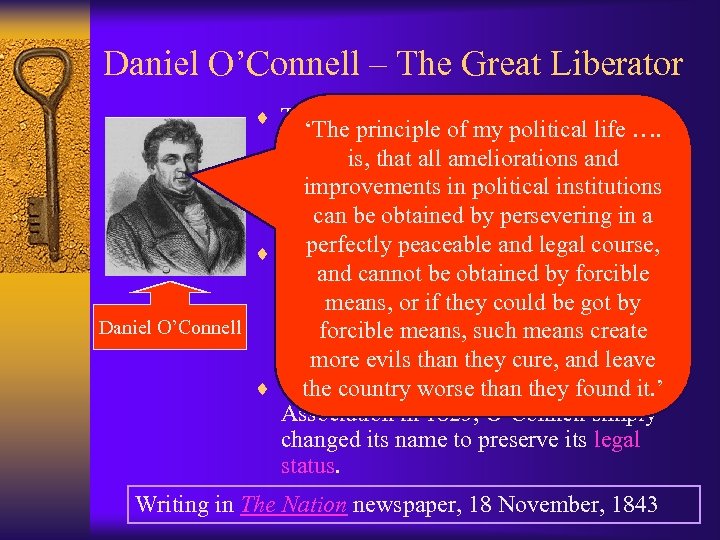
Daniel O’Connell – The Great Liberator ¨ The Catholic Association campaigned for ‘The principle of my political life …. the repeal of the Act of Union, the end of is, that all ameliorations suffrage the Irish tithe system, universal and improvements in political institutions and a secret ballot for parliamentary can be elections. obtained by persevering in a perfectly peaceable and legal course, ¨ Crucially, although O'Connell rejected the use and cannot be obtained bywarned the of violence he constantly forcible means, or if they could be got by British government that if reform did not Daniel O’Connell takeforciblethe Irish such means create place, means, masses would start listening evils than they cure, and leave more to the "counsels of violent men". ¨ Whencountry worse than they found it. ’ the authorities tried to ban the Association in 1825, O’Connell simply changed its name to preserve its legal status. Writing in The Nation newspaper, 18 November, 1843
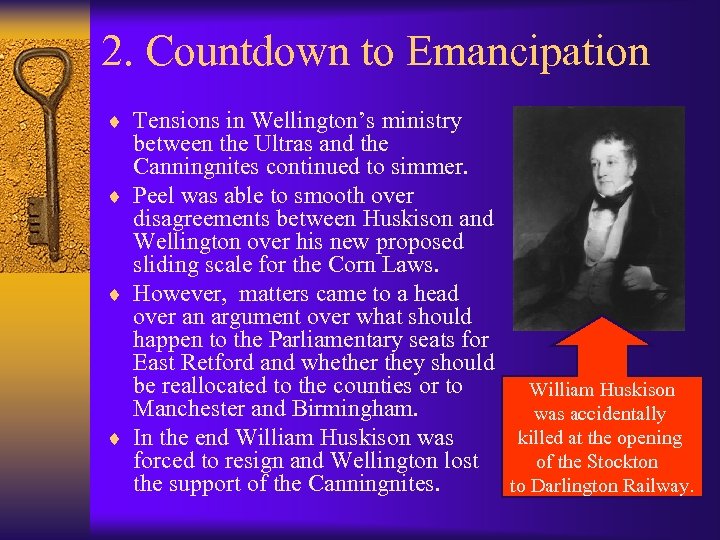
2. Countdown to Emancipation ¨ Tensions in Wellington’s ministry between the Ultras and the Canningnites continued to simmer. ¨ Peel was able to smooth over disagreements between Huskison and Wellington over his new proposed sliding scale for the Corn Laws. ¨ However, matters came to a head over an argument over what should happen to the Parliamentary seats for East Retford and whether they should be reallocated to the counties or to William Huskison Manchester and Birmingham. was accidentally killed at the opening ¨ In the end William Huskison was of the Stockton forced to resign and Wellington lost the support of the Canningnites. to Darlington Railway.
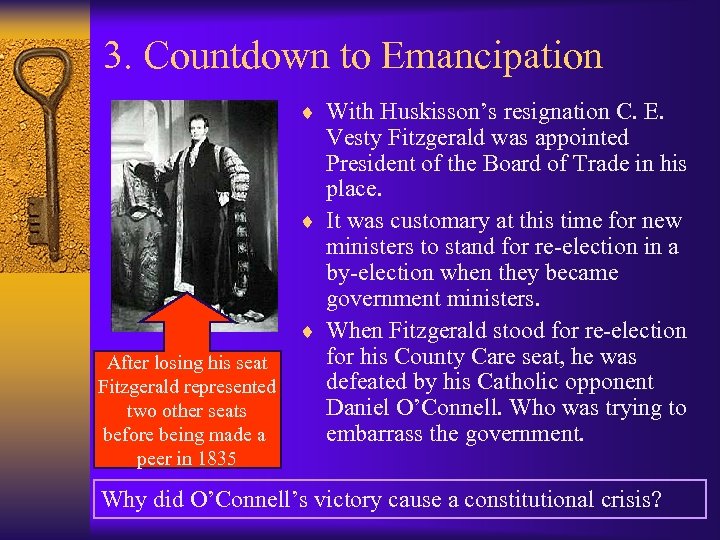
3. Countdown to Emancipation ¨ With Huskisson’s resignation C. E. Vesty Fitzgerald was appointed President of the Board of Trade in his place. ¨ It was customary at this time for new ministers to stand for re-election in a by-election when they became government ministers. ¨ When Fitzgerald stood for re-election for his County Care seat, he was After losing his seat defeated by his Catholic opponent Fitzgerald represented Daniel O’Connell. Who was trying to two other seats before being made a embarrass the government. peer in 1835 Why did O’Connell’s victory cause a constitutional crisis?
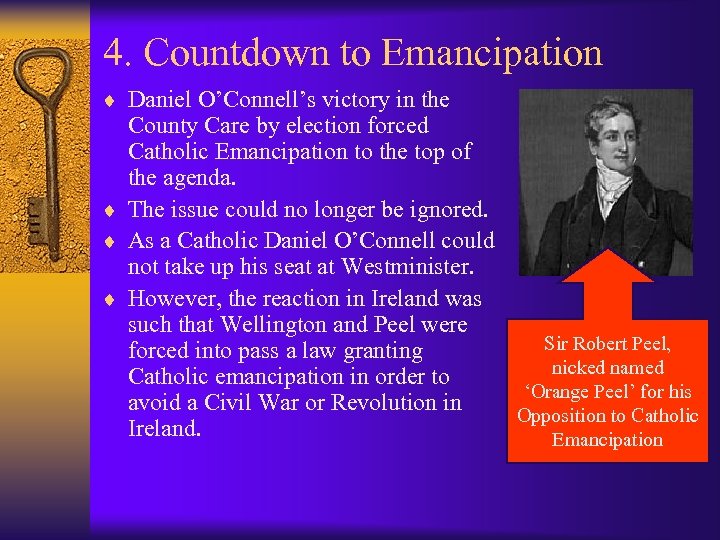
4. Countdown to Emancipation ¨ Daniel O’Connell’s victory in the County Care by election forced Catholic Emancipation to the top of the agenda. ¨ The issue could no longer be ignored. ¨ As a Catholic Daniel O’Connell could not take up his seat at Westminister. ¨ However, the reaction in Ireland was such that Wellington and Peel were Sir Robert Peel, forced into pass a law granting nicked named Catholic emancipation in order to ‘Orange Peel’ for his avoid a Civil War or Revolution in Opposition to Catholic Ireland. Emancipation
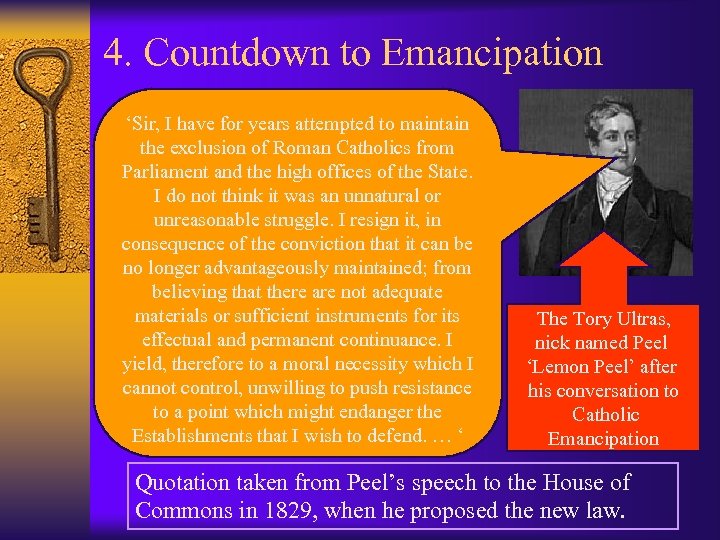
4. Countdown to Emancipation ‘Sir, I have for years attempted to maintain the exclusion of Roman Catholics from Parliament and the high offices of the State. I do not think it was an unnatural or unreasonable struggle. I resign it, in consequence of the conviction that it can be no longer advantageously maintained; from believing that there are not adequate materials or sufficient instruments for its effectual and permanent continuance. I yield, therefore to a moral necessity which I cannot control, unwilling to push resistance to a point which might endanger the Establishments that I wish to defend. … ‘ The Tory Ultras, nick named Peel ‘Lemon Peel’ after his conversation to Catholic Emancipation Quotation taken from Peel’s speech to the House of Commons in 1829, when he proposed the new law.
The Emancipation Legislation ¨ Three measures made up the package ¨ The Emancipation Act, which removed all civil disabilities and enabled Roman Catholics to hold public office. ¨ The 40 Shilling freeholder in Irish counties were disenfranchised – lost the vote! ¨ This reduced the number if Catholic voters in Ireland was intended to protect the electoral interests of the Protestant landlords. Was Catholic Emancipation a complete victory?
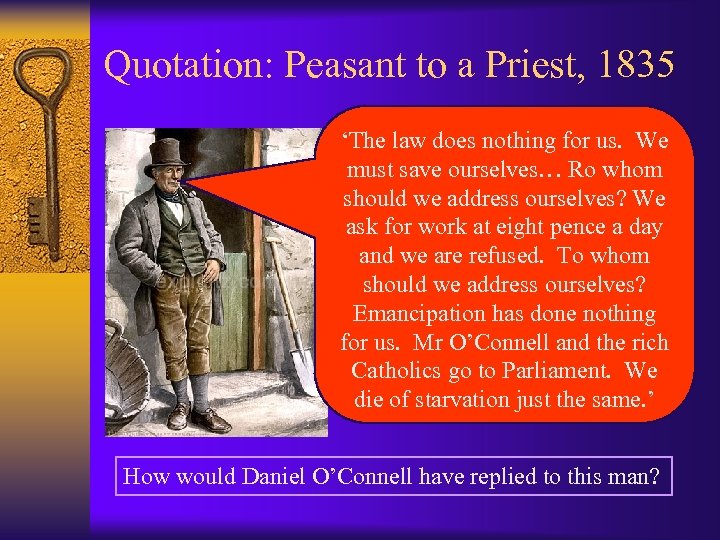
Quotation: Peasant to a Priest, 1835 ‘The law does nothing for us. We must save ourselves… Ro whom should we address ourselves? We ask for work at eight pence a day and we are refused. To whom should we address ourselves? Emancipation has done nothing for us. Mr O’Connell and the rich Catholics go to Parliament. We die of starvation just the same. ’ How would Daniel O’Connell have replied to this man?
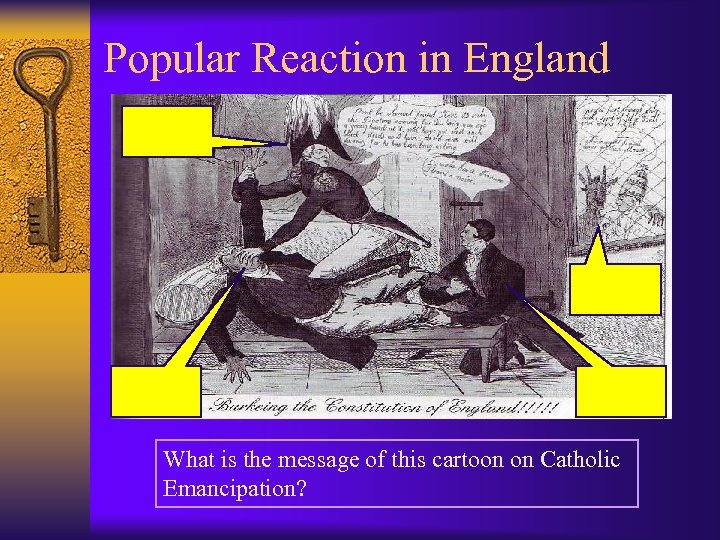
Popular Reaction in England What is the message of this cartoon on Catholic Emancipation?
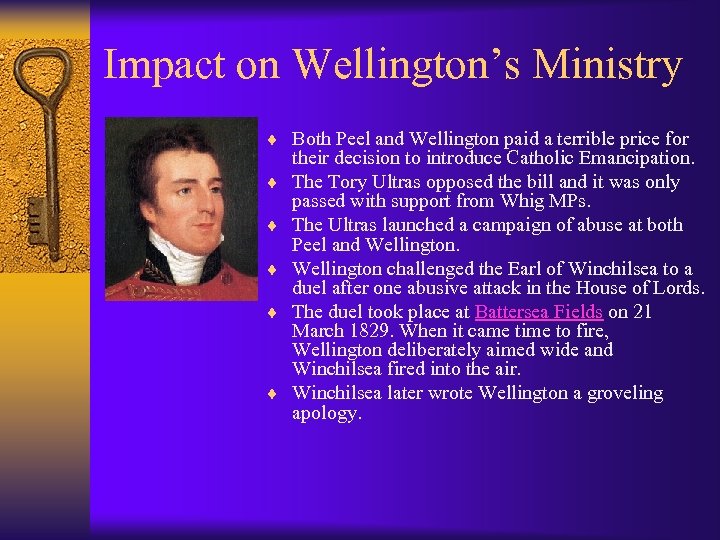
Impact on Wellington’s Ministry ¨ Both Peel and Wellington paid a terrible price for ¨ ¨ ¨ their decision to introduce Catholic Emancipation. The Tory Ultras opposed the bill and it was only passed with support from Whig MPs. The Ultras launched a campaign of abuse at both Peel and Wellington challenged the Earl of Winchilsea to a duel after one abusive attack in the House of Lords. The duel took place at Battersea Fields on 21 March 1829. When it came time to fire, Wellington deliberately aimed wide and Winchilsea fired into the air. Winchilsea later wrote Wellington a groveling apology.
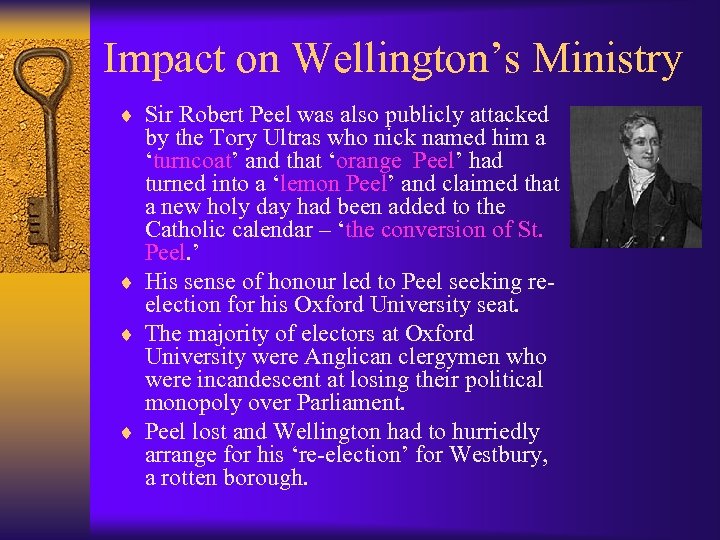
Impact on Wellington’s Ministry ¨ Sir Robert Peel was also publicly attacked by the Tory Ultras who nick named him a ‘turncoat’ and that ‘orange Peel’ had turned into a ‘lemon Peel’ and claimed that a new holy day had been added to the Catholic calendar – ‘the conversion of St. Peel. ’ ¨ His sense of honour led to Peel seeking reelection for his Oxford University seat. ¨ The majority of electors at Oxford University were Anglican clergymen who were incandescent at losing their political monopoly over Parliament. ¨ Peel lost and Wellington had to hurriedly arrange for his ‘re-election’ for Westbury, a rotten borough.
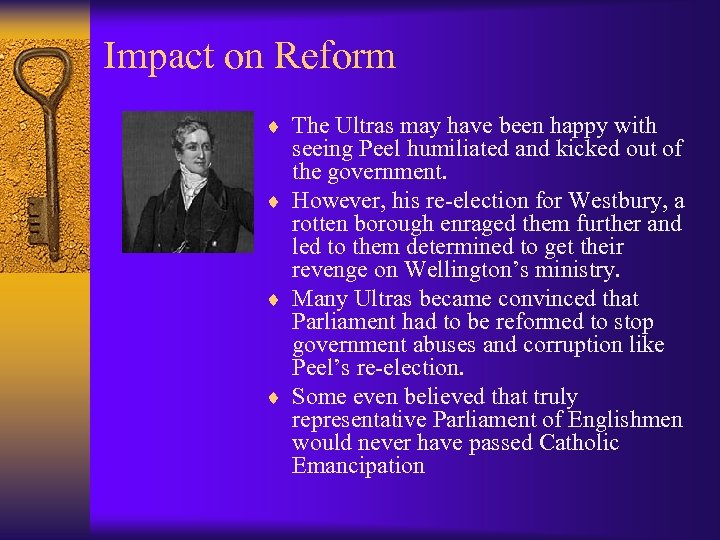
Impact on Reform ¨ The Ultras may have been happy with seeing Peel humiliated and kicked out of the government. ¨ However, his re-election for Westbury, a rotten borough enraged them further and led to them determined to get their revenge on Wellington’s ministry. ¨ Many Ultras became convinced that Parliament had to be reformed to stop government abuses and corruption like Peel’s re-election. ¨ Some even believed that truly representative Parliament of Englishmen would never have passed Catholic Emancipation
Impact on Reform: Stephen J Lee ‘The Ultras had strangely espoused the cause of parliamentary reform, largely because they wanted to reduce the number of sears available through patronage and thus hit back at the governments power held by Wellington and Peel. This showed that the ultras were concerned less about the prospect of parliamrntary reform than the implications of religious changes. ’ Aspects of British Political History, page 34, 1994
Impact on Reform: Howard Martin ‘Some Ultras were converted to reform, arguing that a truly representative House of Commons would not have passed the Emanciption Act. Its success, they alleged, was due to the votes of MPs from rotten boroughs. The unseemly sight of peel’s hurried return for Westbury merely underlined the corruption of the unreformed system. ’ Britain in the 19 th Century, page 76, 1996
Impact on Wellington’s Ministry ¨ Wellington then made his final mistake by trying to win ¨ ¨ ¨ back the support of the Ultras by making an ill-advised speech against parliamentary reform. This speech alienated both wings of his party. The Canningites were upset because Wellington appeared to be ruling out any future reforms. Whilst the Ultras on the other hand were not convinced by his speech. Thee Ultras switched their loyalty to the Whigs who were promising a package of Parliamentary reforms and voted against the Civil List bill. This forced Wellington to resign and led to a general Election in 1830, which as a result of the divisions amongst the Tories, the Whigs under Earl Grey won. The extent to which the Canningites were upset is shown by the fact that four of them served in Grey’s cabinet in 1830.
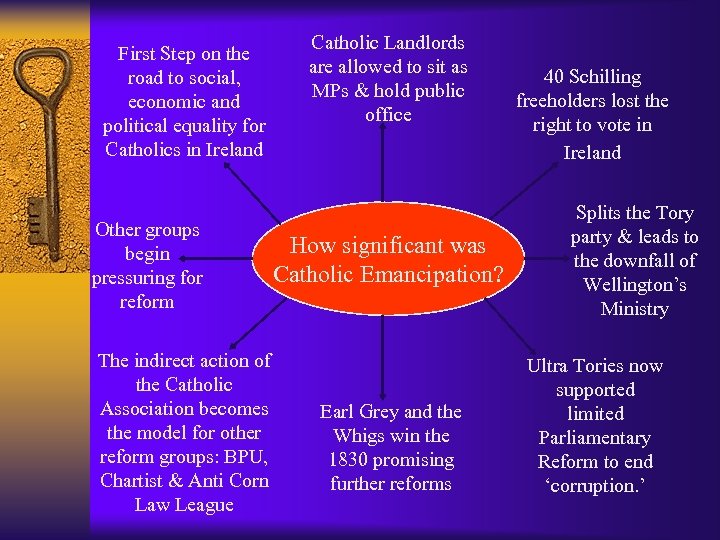
First Step on the road to social, economic and political equality for Catholics in Ireland Other groups begin pressuring for reform The indirect action of the Catholic Association becomes the model for other reform groups: BPU, Chartist & Anti Corn Law League Catholic Landlords are allowed to sit as MPs & hold public office How significant was Catholic Emancipation? Earl Grey and the Whigs win the 1830 promising further reforms 40 Schilling freeholders lost the right to vote in Ireland Splits the Tory party & leads to the downfall of Wellington’s Ministry Ultra Tories now supported limited Parliamentary Reform to end ‘corruption. ’
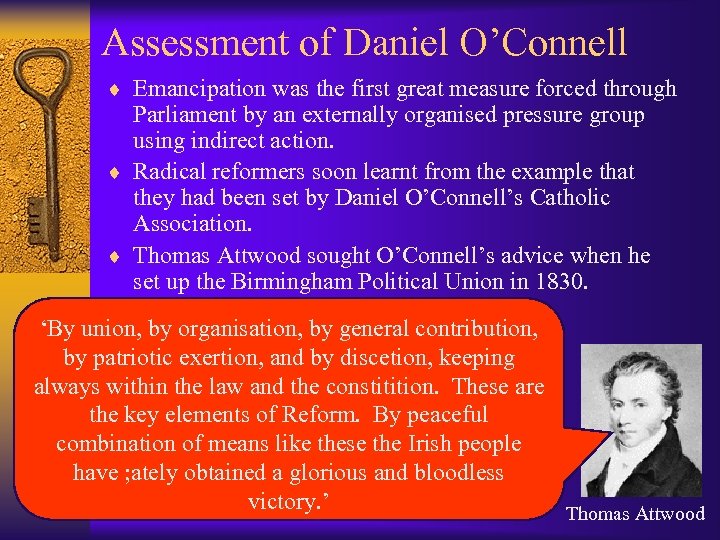
Assessment of Daniel O’Connell ¨ Emancipation was the first great measure forced through Parliament by an externally organised pressure group using indirect action. ¨ Radical reformers soon learnt from the example that they had been set by Daniel O’Connell’s Catholic Association. ¨ Thomas Attwood sought O’Connell’s advice when he set up the Birmingham Political Union in 1830. ‘By union, by organisation, by general contribution, by patriotic exertion, and by discetion, keeping always within the law and the constitition. These are the key elements of Reform. By peaceful combination of means like these the Irish people have ; ately obtained a glorious and bloodless victory. ’ Thomas Attwood
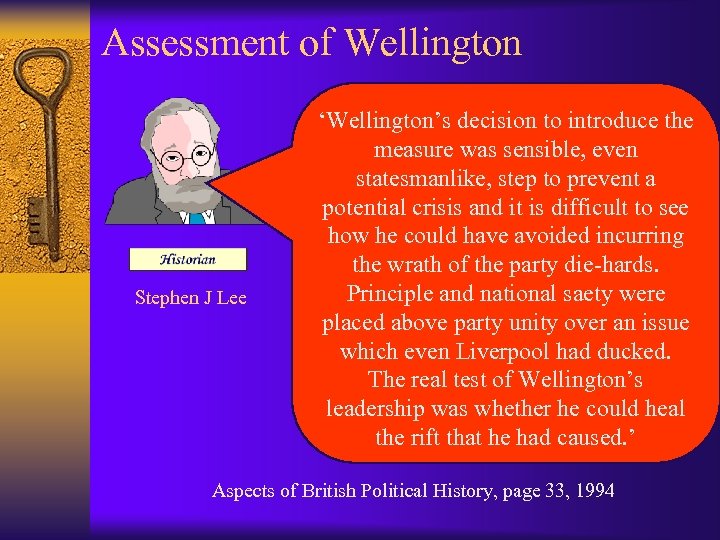
Assessment of Wellington Stephen J Lee ‘Wellington’s decision to introduce the measure was sensible, even statesmanlike, step to prevent a potential crisis and it is difficult to see how he could have avoided incurring the wrath of the party die-hards. Principle and national saety were placed above party unity over an issue which even Liverpool had ducked. The real test of Wellington’s leadership was whether he could heal the rift that he had caused. ’ Aspects of British Political History, page 33, 1994
Скачать презентацию How Significant was Catholic Emancipation By Mr RJ
f06c48b91757fc2d92085b58602c3de8.ppt