


 Скачать презентацию How SEAs and IHEs can work together to
5eb7e10c9d8bc48b40469e2967a65d61.ppt
- Количество слайдов: 33
 How SEAs and IHEs can work together to tackle the challenge of helping special education teachers to connect their instruction to the common core standards. Dr. Neal Kingston Center for Educational Testing and Evaluation University of Kansas
 …helping colleges help special educators connect instruction to the common core Dr. Neal Kingston Center for Educational Testing and Evaluation University of Kansas
 How many of have worked at an institution of higher education? a. I currently teach at an IHE. b. I have taught at an IHE in the past. c. I have worked at an IHE in a noninstructional position.
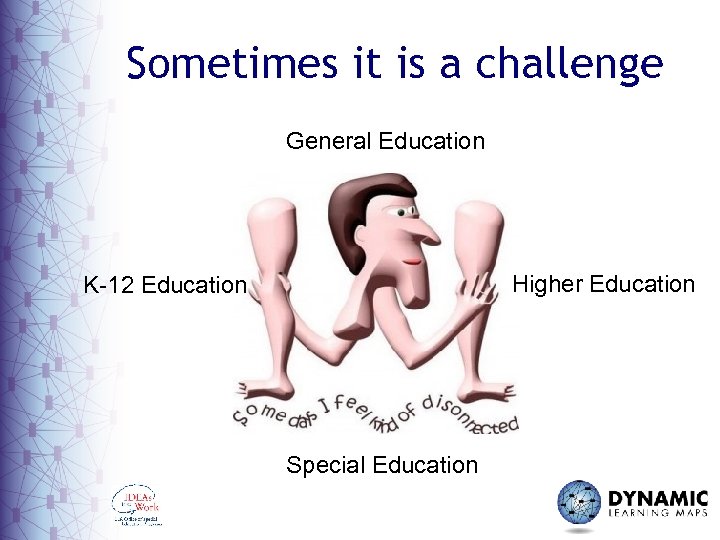 Sometimes it is a challenge General Education Higher Education K-12 Education Special Education
 In your state do you see any of these disconnects? a. Usually b. Sometimes c. Not often
 How fast and well do college education courses reflect new directions in you state? a. Within a year and very well b. Within a few years and perhaps not with enough depth c. Most of our colleges do not pay much attention to state initiatives d. I have no idea
 How knowledgeable are new education graduates regarding the common core state standards? a. b. c. d. Most have a great depth of knowledge Most have had some exposure to them Most have little knowledge of them I have no idea
 Why is it a challenge? • Student population is vulnerable and requires individualized and often unique instruction. • Special Education has not always been invited or included in decisions. • A history of parallel instruction, assessment and curriculum. • IEP goals and objectives were not aligned with standards.
 To Meet the Challenge • Ensure students with significant cognitive disabilities (SCD) in K-12 are: • • Provided with rigorous instruction, content and curriculum. Provided with the needed educational supports to enable learning. Included in the accountability system. Provided access to the general education curriculum – all aspects.
 To Meet the Challenge • US Department of Education invested in the formation of five consortia: – Smarter Balanced Assessment Consortium (SBAC) – Partnership for the Assessment of Readiness for College and Career (PARCC) – National Center and State Collaborative (NCSC) – Dynamic Learning Maps Alternate Assessment Consortium (DLM) – World-Class Instructional Design and Assessment (ASSETS)
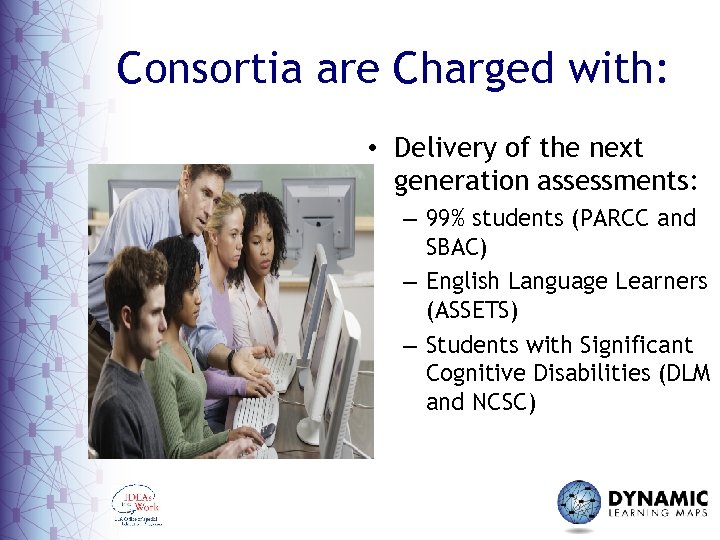 Consortia are Charged with: • Delivery of the next generation assessments: – 99% students (PARCC and SBAC) – English Language Learners (ASSETS) – Students with Significant Cognitive Disabilities (DLM and NCSC)
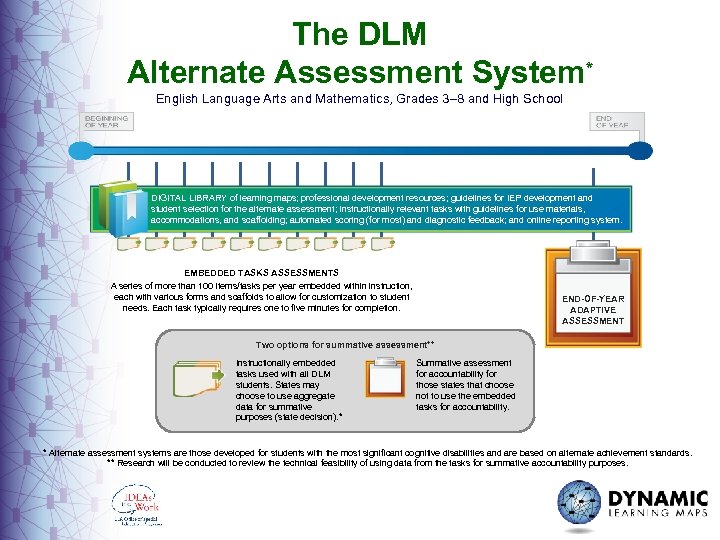 The DLM Alternate Assessment System* English Language Arts and Mathematics, Grades 3– 8 and High School DIGITAL LIBRARY of learning maps; professional development resources; guidelines for IEP development and student selection for the alternate assessment; instructionally relevant tasks with guidelines for use materials, accommodations, and scaffolding; automated scoring (for most) and diagnostic feedback; and online reporting system. EMBEDDED TASKS ASSESSMENTS A series of more than 100 items/tasks per year embedded within instruction, each with various forms and scaffolds to allow for customization to student needs. Each task typically requires one to five minutes for completion. END-OF-YEAR ADAPTIVE ASSESSMENT Two options for summative assessment** Instructionally embedded tasks used with all DLM students. States may choose to use aggregate data for summative purposes (state decision). * Summative assessment for accountability for those states that choose not to use the embedded tasks for accountability. * Alternate assessment systems are those developed for students with the most significant cognitive disabilities and are based on alternate achievement standards. ** Research will be conducted to review the technical feasibility of using data from the tasks for summative accountability purposes.
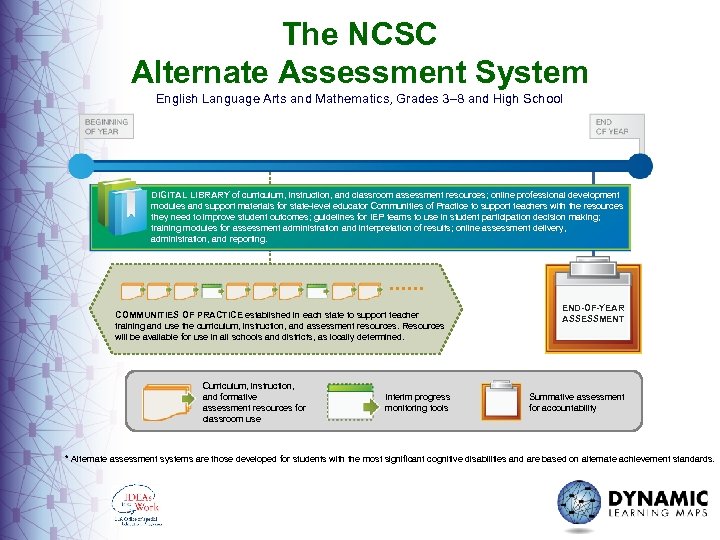 The NCSC Alternate Assessment System English Language Arts and Mathematics, Grades 3– 8 and High School DIGITAL LIBRARY of curriculum, instruction, and classroom assessment resources; online professional development modules and support materials for state-level educator Communities of Practice to support teachers with the resources they need to improve student outcomes; guidelines for IEP teams to use in student participation decision making; training modules for assessment administration and interpretation of results; online assessment delivery, administration, and reporting. COMMUNITIES OF PRACTICE established in each state to support teacher training and use the curriculum, instruction, and assessment resources. Resources will be available for use in all schools and districts, as locally determined. Curriculum, instruction, and formative assessment resources for classroom use Interim progress monitoring tools END-OF-YEAR ASSESSMENT Summative assessment for accountability * Alternate assessment systems are those developed for students with the most significant cognitive disabilities and are based on alternate achievement standards.
 To Meet the Challenge • We must overcome the inertia of higher education • • HE must be invited to the table HE cannot lag behind K-12 – we must help lead
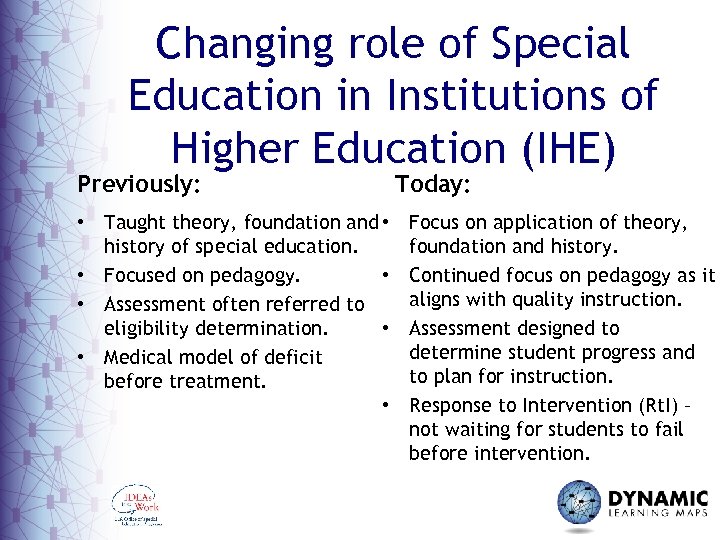 Changing role of Special Education in Institutions of Higher Education (IHE) Previously: • Taught theory, foundation and • history of special education. • Focused on pedagogy. • • Assessment often referred to eligibility determination. • • Medical model of deficit before treatment. • Today: Focus on application of theory, foundation and history. Continued focus on pedagogy as it aligns with quality instruction. Assessment designed to determine student progress and to plan for instruction. Response to Intervention (Rt. I) – not waiting for students to fail before intervention.
 Also on the Radar of IHE: • Retention of potential special educators entering post secondary education. • Recruiting of highly skilled individuals to be special educators. • Meeting the needs of potential special educators who enter higher education without the prerequisite skills and requiring remediation. • Working with individuals who may be returning to college/university for additional training or a career change.
 To meet the challenges and improve results for students with disabilities, we must work together!!
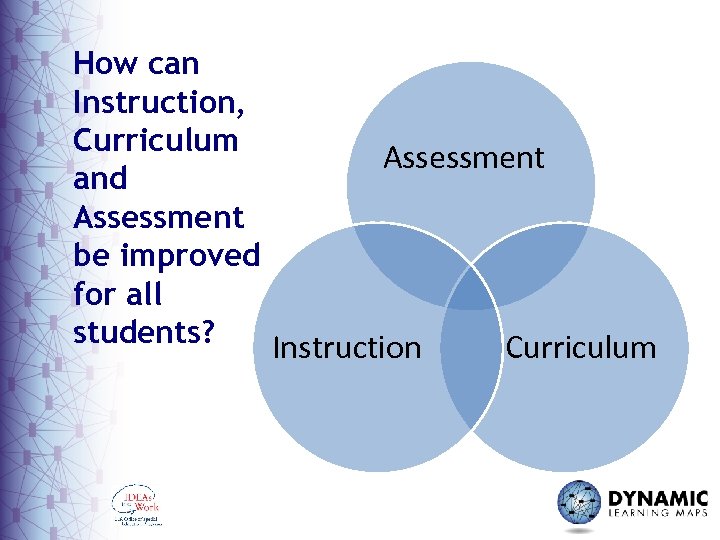 How can Instruction, Curriculum Assessment and Assessment be improved for all students? Instruction Curriculum
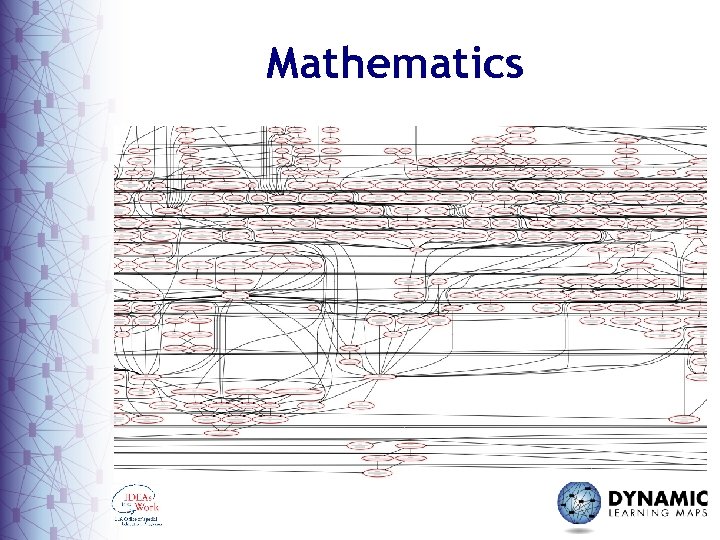
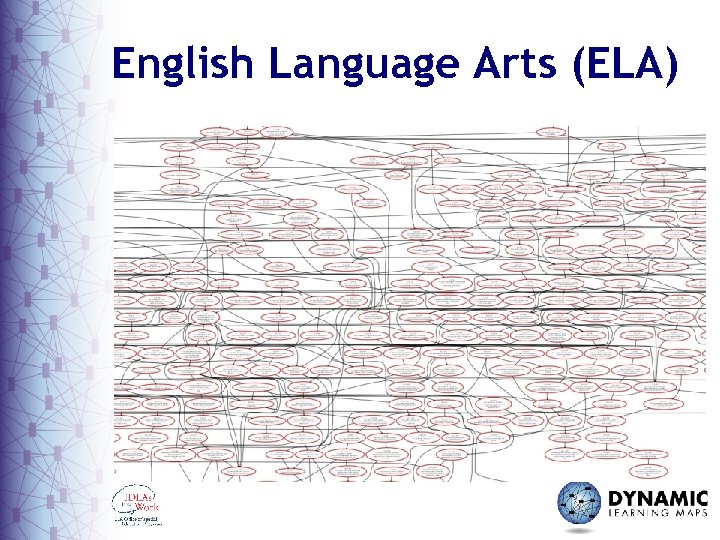
 Dynamic Learning Maps
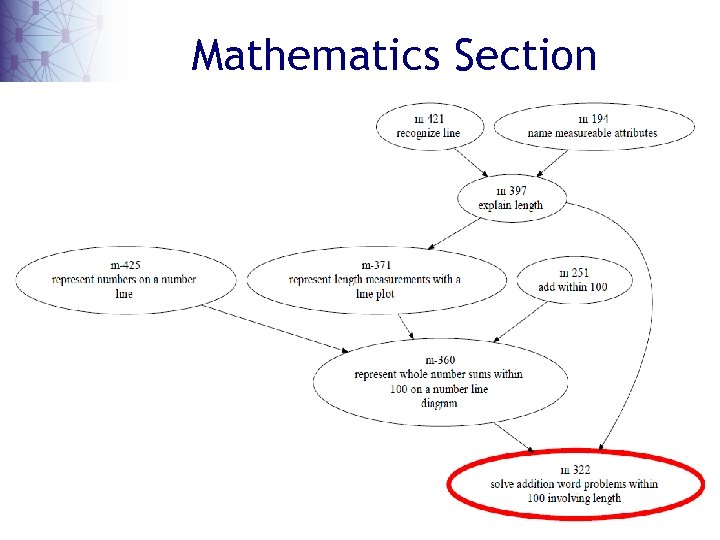
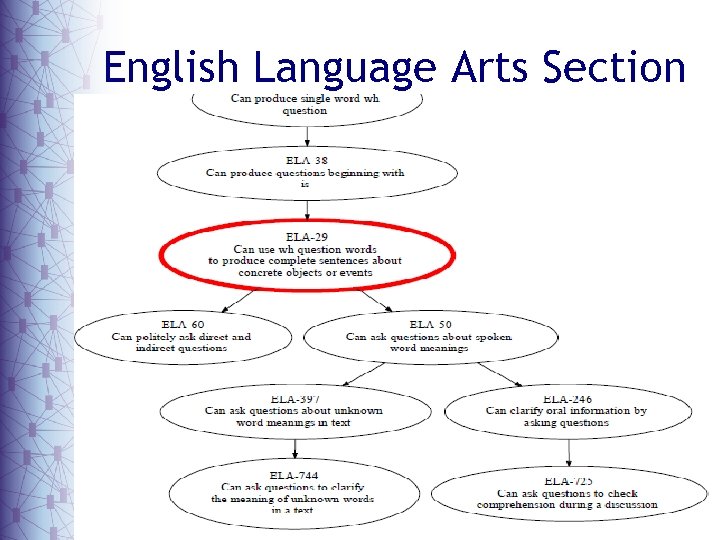
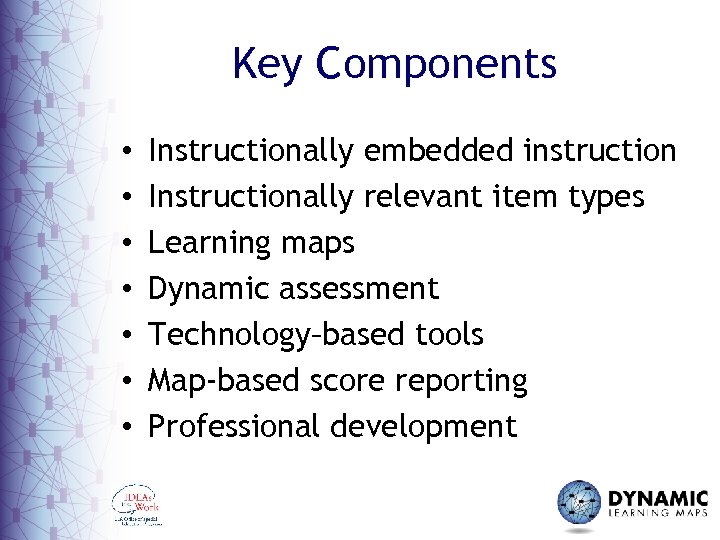 Key Components • • Instructionally embedded instruction Instructionally relevant item types Learning maps Dynamic assessment Technology–based tools Map-based score reporting Professional development
 Mathematics
 Mathematics Section
 English Language Arts (ELA)
 English Language Arts Section
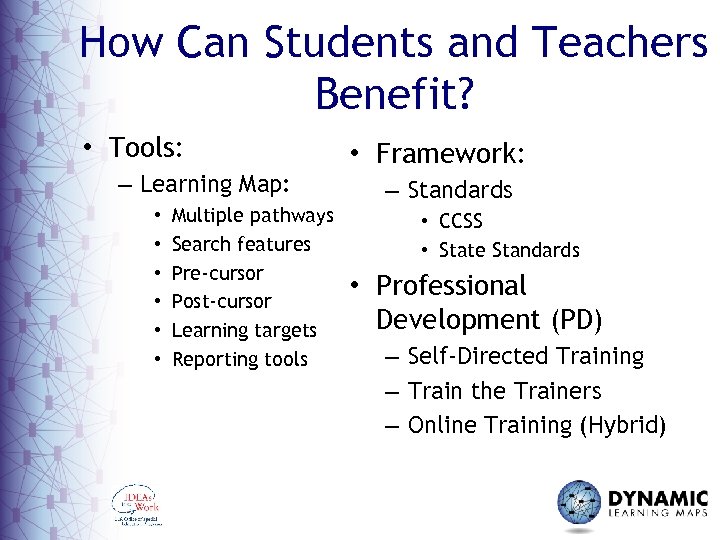 How Can Students and Teachers Benefit? • Tools: – Learning Map: • • • Multiple pathways Search features Pre-cursor Post-cursor Learning targets Reporting tools • Framework: – Standards • CCSS • State Standards • Professional Development (PD) – Self-Directed Training – Train the Trainers – Online Training (Hybrid)
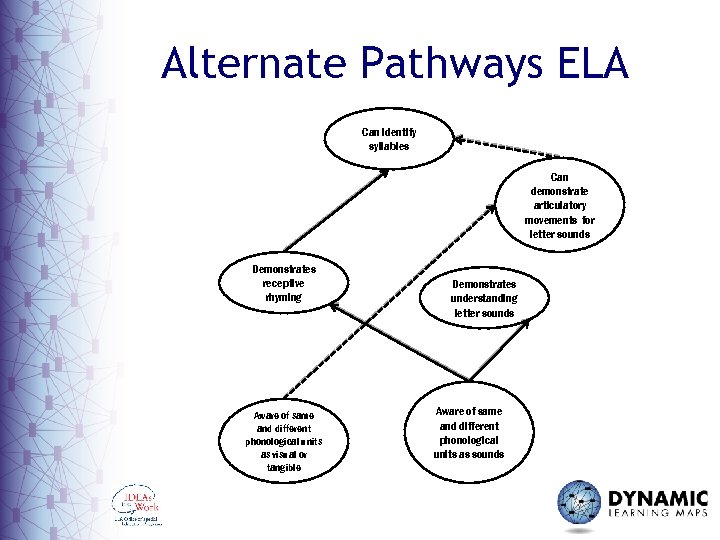 Alternate Pathways ELA Can identify syllables Can demonstrate articulatory movements for letter sounds Demonstrates receptive rhyming Aware of same and different phonological units as visual or tangible Demonstrates understanding letter sounds Aware of same and different phonological units as sounds
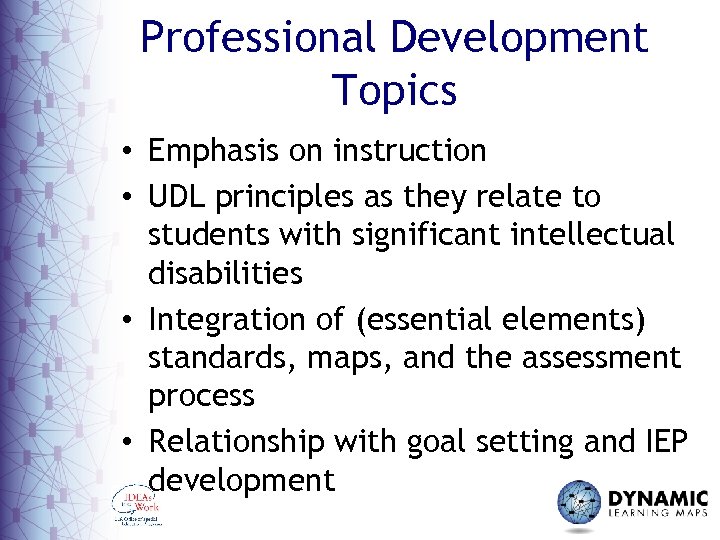 Professional Development Topics • Emphasis on instruction • UDL principles as they relate to students with significant intellectual disabilities • Integration of (essential elements) standards, maps, and the assessment process • Relationship with goal setting and IEP development
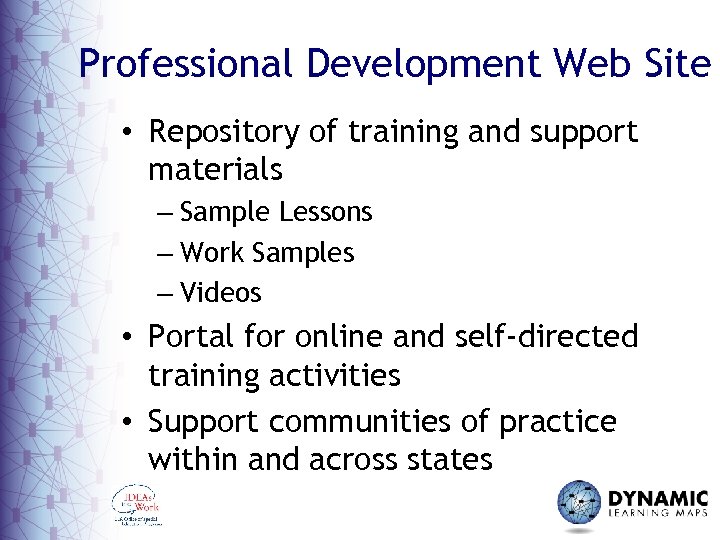 Professional Development Web Site • Repository of training and support materials – Sample Lessons – Work Samples – Videos • Portal for online and self-directed training activities • Support communities of practice within and across states
 How can the work of DLM assist IHEs? • Faculty and staff participate in the PD opportunities. • Member states will have full access to the tools/materials and can include IHEs. • Awareness of the work that is being done through state and national presentations. • Multiple research projects and manuscripts currently under development.
 Connecting the work of DLM to coursework: • Teach to the CCSS and the Alternate Assessment Essential Elements (AA – EEs) and Instructional Achievement Level Descriptors (IALDs): – Methods courses – Assessment courses (tests and measurement) • Address multiple pathways as a belief system. • Incorporate the tools and PD into courses. • Least Dangerous Assumption – better to assume a student CAN LEARN and be wrong than the opposite.
 How can the work of DLM assist State Education Agencies? • Access to tools and PD to use with the map. • Materials can be used for training (re-tooling) teachers currently in the field. • Common language among educators. • Data and reports that can be used to drive instruction.
 A Relationship that Improves Instruction, Curriculum and Assessment for ALL students!
 THANK YOU! For more information, please contact: dlm@ku. edu or Go to: www. dynamiclearningmaps. us The present publication was developed under grant 84. 373 X 100001 from the U. S. Department of Education, Office of Special Education Programs. The views expressed herein are solely those of the author(s), and no official endorsement by the U. S. Department should be inferred.