


 Скачать презентацию How official national inventory data is used as
45877586d6df04b99862e60f4ccf718f.ppt
- Количество слайдов: 29
 How official national inventory data is used as input data for EMEP models Katarina Mareckova, Robert Wankmueller CEIP - Centre on Emission Inventories and Projections GMES workshop 10 -11 Oct 2011
 CEIP – Centre on Emission Inventories and Projections n CEIP is hosted by the Umweltbundesamt Gmb. H in Vienna since January 2008 (http: //www. ceip. at) n The main tasks are: ¨ ¨ ¨ Collection of emissions and projections of acidifying air pollutants, heavy metals, particulate matter and photochemical oxidants from Parties to the LRTAP Convention. Review of submitted data Assistance of Parties in improving the quality of national inventories Publication of emission inventories Support to the UNECE/CLRTAP secretariat Expert adjustments and preparation of submitted emission data for long-range transport models ( gap filling and gridding)
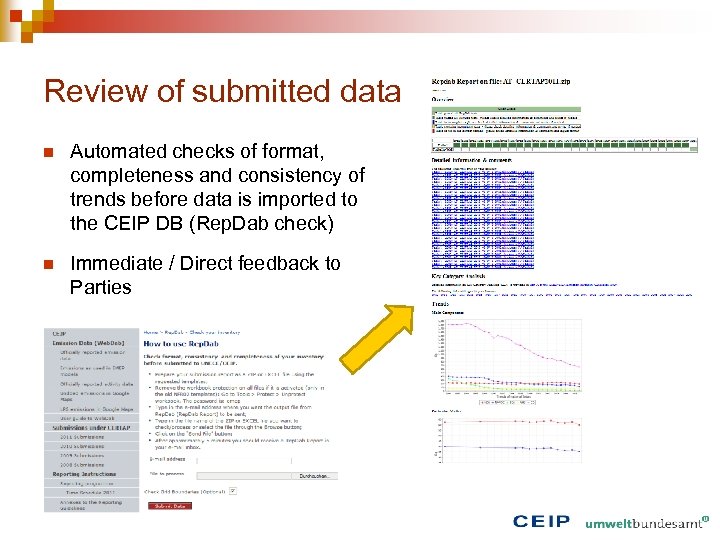 Review of submitted data n Automated checks of format, completeness and consistency of trends before data is imported to the CEIP DB (Rep. Dab check) n Immediate / Direct feedback to Parties
 Review of inventories under CLRTAP n Methods and procedures for the technical review of air pollutant emission inventories reported under the Convention and its protocols (EB. AIR/GE. 1/2007/16) ¨ ¨ Stage 2 – Synthesis and assessment tests, country data is published annually (31 May) on the CEIP website ¨ n Stage 1 – automated tests, country reports are published annually (during March) on the CEIP website Stage 3 – Centralised in-depth review, 10 Parties are reviewed each year A summary of the S 1 and S 2 findings is published in the annual Inventory Review Reports http: //www. ceip. at/review-process/review-2011
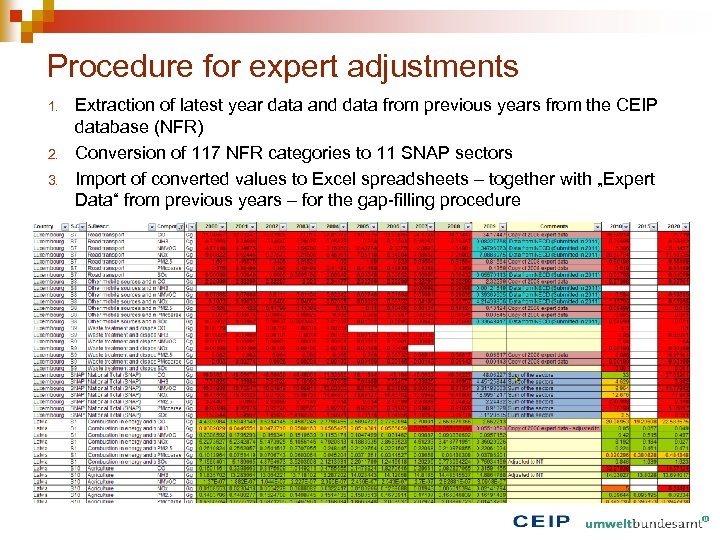 Procedure for expert adjustments 1. 2. 3. Extraction of latest year data and data from previous years from the CEIP database (NFR) Conversion of 117 NFR categories to 11 SNAP sectors Import of converted values to Excel spreadsheets – together with „Expert Data“ from previous years – for the gap-filling procedure
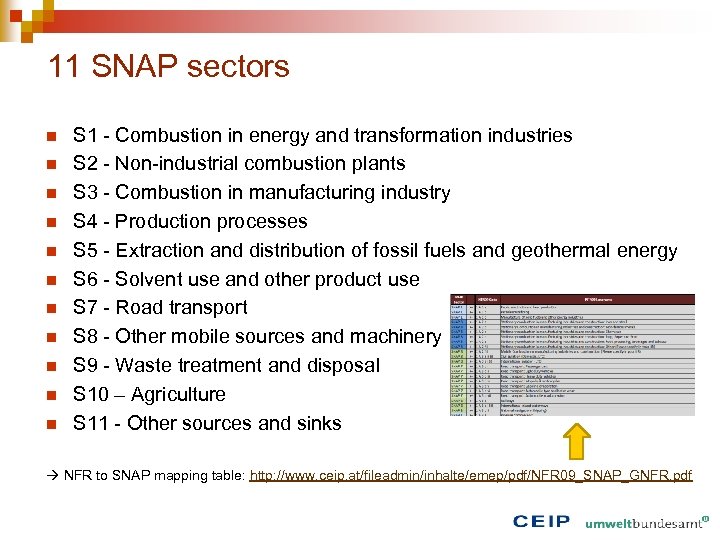 11 SNAP sectors n n n S 1 - Combustion in energy and transformation industries S 2 - Non-industrial combustion plants S 3 - Combustion in manufacturing industry S 4 - Production processes S 5 - Extraction and distribution of fossil fuels and geothermal energy S 6 - Solvent use and other product use S 7 - Road transport S 8 - Other mobile sources and machinery S 9 - Waste treatment and disposal S 10 – Agriculture S 11 - Other sources and sinks NFR to SNAP mapping table: http: //www. ceip. at/fileadmin/inhalte/emep/pdf/NFR 09_SNAP_GNFR. pdf
 Methods used for gap-filling n Use of other officialy available data (NECD, UNFCCC, IIASA, MSC-W, MSC-E, ENTEC, …) n Linear extrapolation of officially submitted data or expert data n Copy of expert data from the previous year n Shipping emissions IIASA/ENTEC estimates Import of gap-filled data to the CEIP database
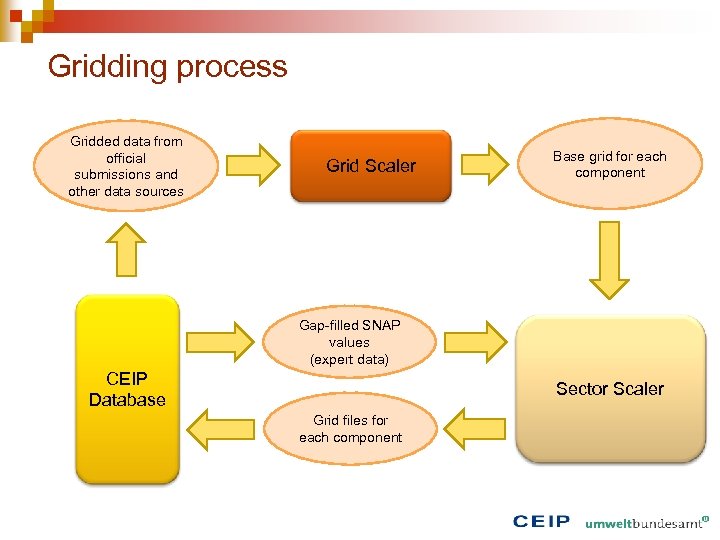 Gridding process Gridded data from official submissions and other data sources Grid Scaler Base grid for each component Gap-filled SNAP values (expert data) CEIP Database Sector Scaler Grid files for each component
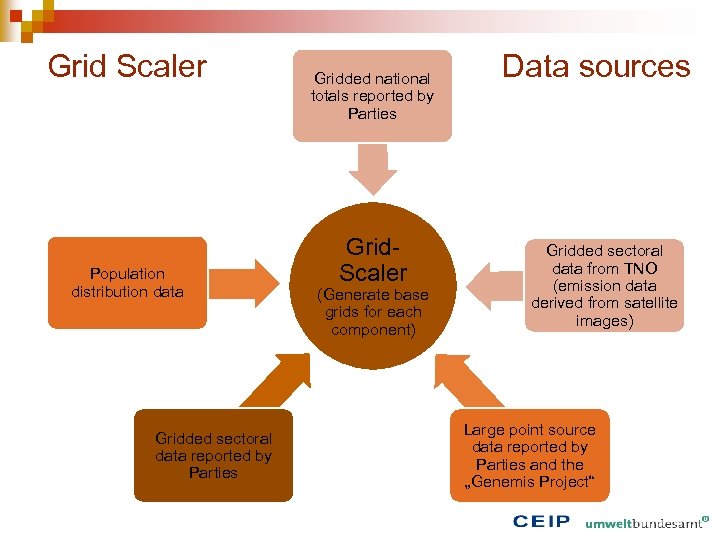 Grid Scaler Population distribution data Gridded sectoral data reported by Parties Gridded national totals reported by Parties Grid. Scaler (Generate base grids for each component) Data sources Gridded sectoral data from TNO (emission data derived from satellite images) Large point source data reported by Parties and the „Genemis Project“
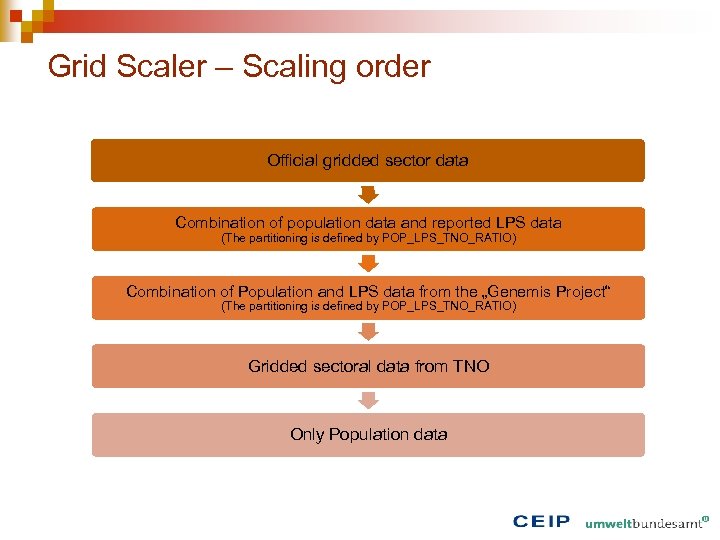 Grid Scaler – Scaling order Official gridded sector data Combination of population data and reported LPS data (The partitioning is defined by POP_LPS_TNO_RATIO) Combination of Population and LPS data from the „Genemis Project“ (The partitioning is defined by POP_LPS_TNO_RATIO) Gridded sectoral data from TNO Only Population data
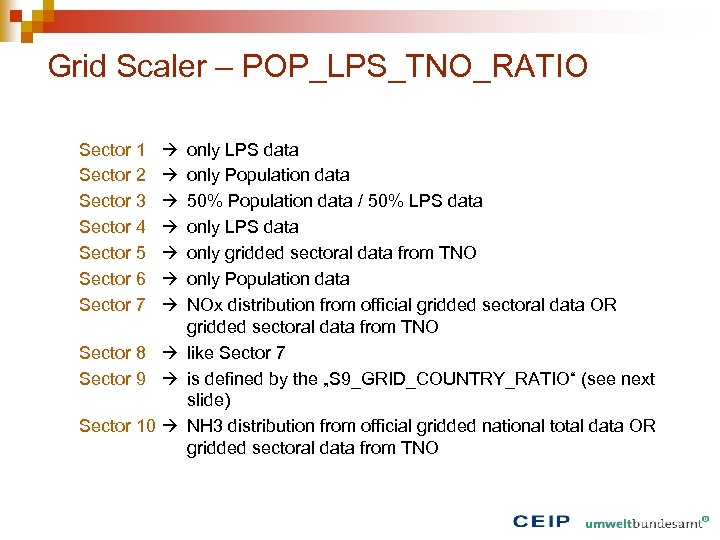 Grid Scaler – POP_LPS_TNO_RATIO Sector 1 Sector 2 Sector 3 Sector 4 Sector 5 Sector 6 Sector 7 only LPS data only Population data 50% Population data / 50% LPS data only gridded sectoral data from TNO only Population data NOx distribution from official gridded sectoral data OR gridded sectoral data from TNO Sector 8 like Sector 7 Sector 9 is defined by the „S 9_GRID_COUNTRY_RATIO“ (see next slide) Sector 10 NH 3 distribution from official gridded national total data OR gridded sectoral data from TNO
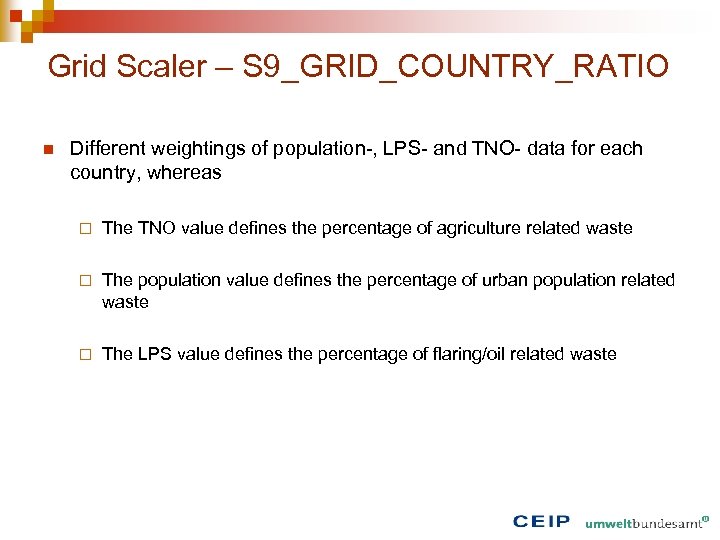 Grid Scaler – S 9_GRID_COUNTRY_RATIO n Different weightings of population-, LPS- and TNO- data for each country, whereas ¨ The TNO value defines the percentage of agriculture related waste ¨ The population value defines the percentage of urban population related waste ¨ The LPS value defines the percentage of flaring/oil related waste
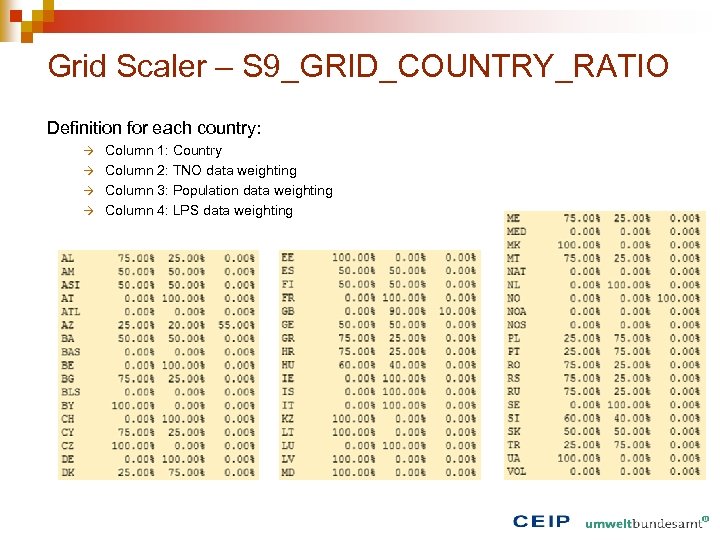 Grid Scaler – S 9_GRID_COUNTRY_RATIO Definition for each country: Column 1: Country Column 2: TNO data weighting Column 3: Population data weighting Column 4: LPS data weighting
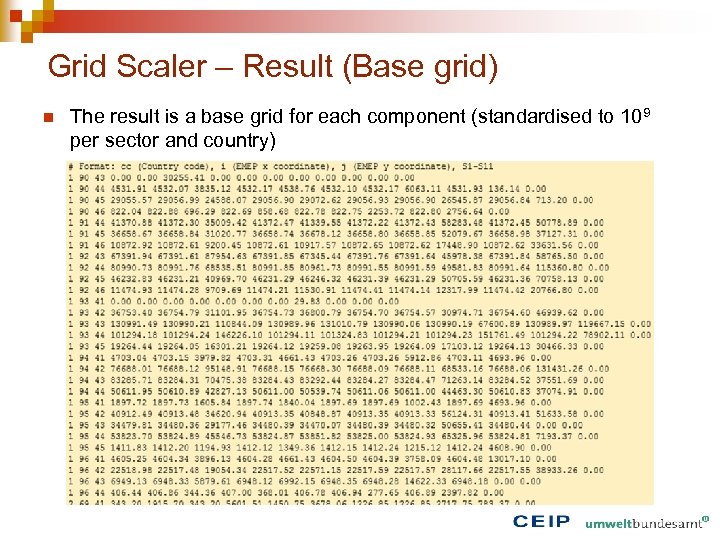 Grid Scaler – Result (Base grid) n The result is a base grid for each component (standardised to 109 per sector and country)
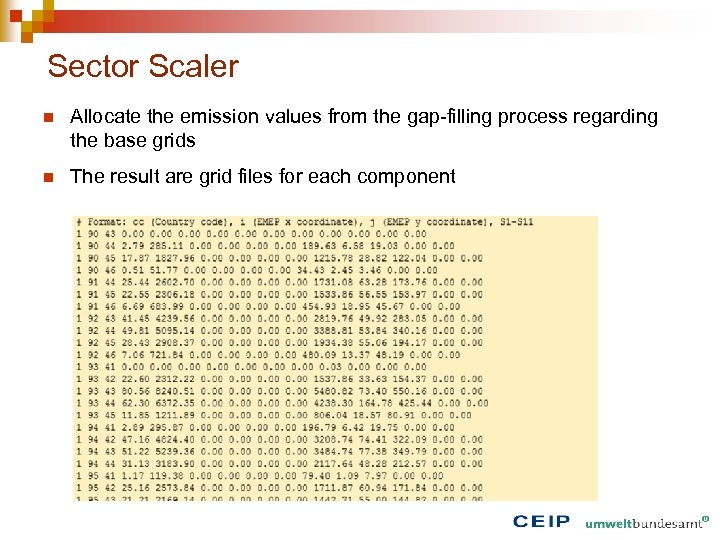 Sector Scaler n Allocate the emission values from the gap-filling process regarding the base grids n The result are grid files for each component
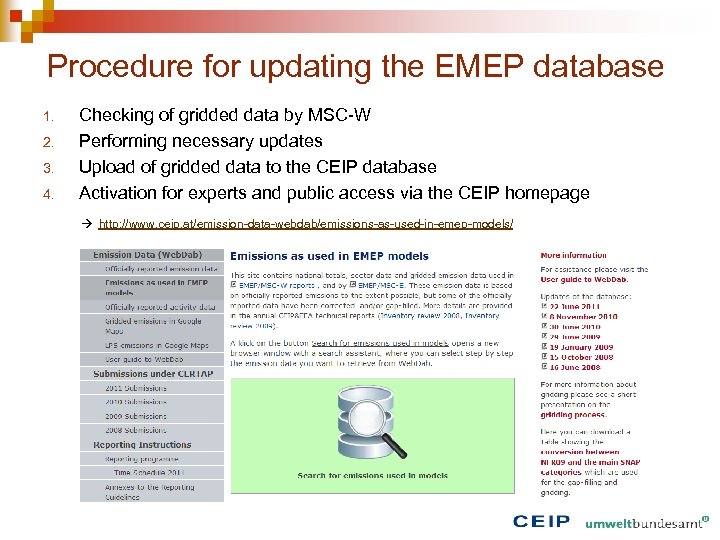 Procedure for updating the EMEP database 1. 2. 3. 4. Checking of gridded data by MSC-W Performing necessary updates Upload of gridded data to the CEIP database Activation for experts and public access via the CEIP homepage http: //www. ceip. at/emission-data-webdab/emissions-as-used-in-emep-models/
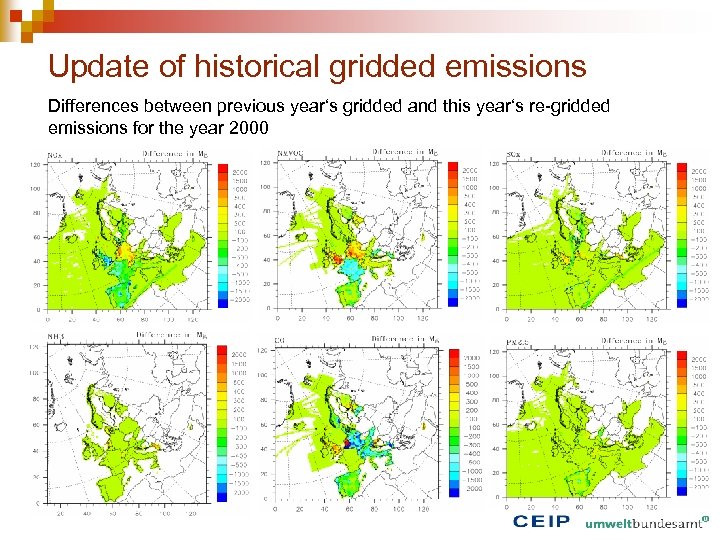 Update of historical gridded emissions Differences between previous year‘s gridded and this year‘s re-gridded emissions for the year 2000
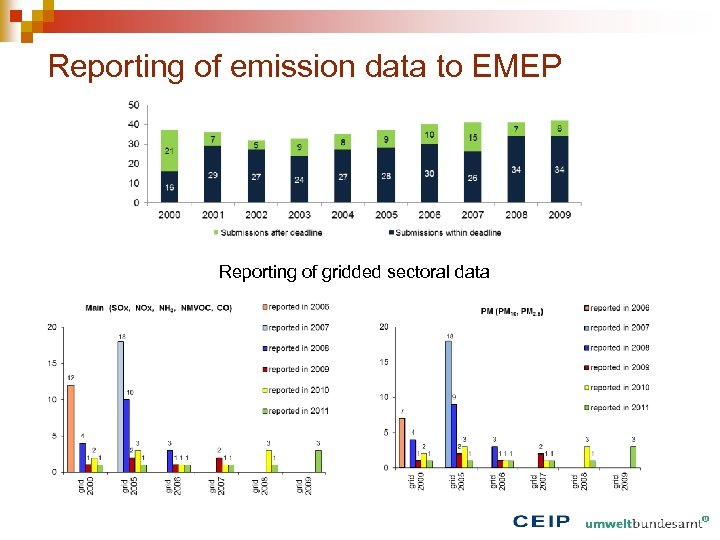 Reporting of emission data to EMEP Reporting of gridded sectoral data
 Upcoming changes to the EMEP grid Katarina Mareckova, Robert Wankmueller CEIP - Centre on Emission Inventories and Projections GMES workshop 10 -11 Oct 2011
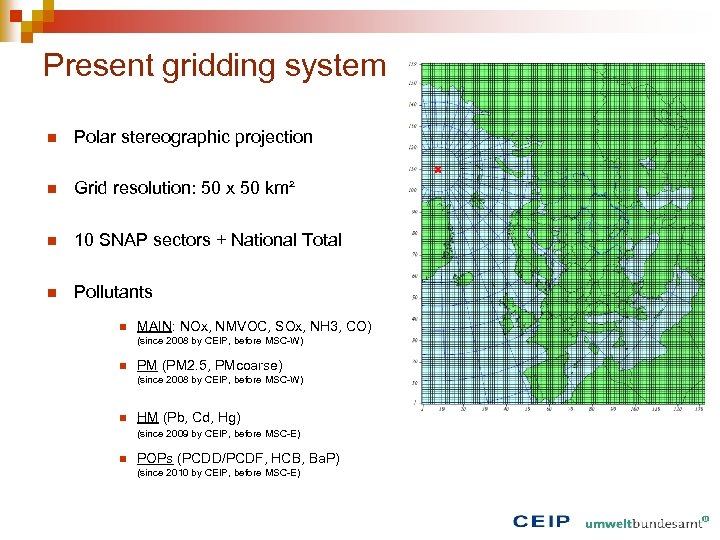 Present gridding system n Polar stereographic projection n Grid resolution: 50 x 50 km² n 10 SNAP sectors + National Total n Pollutants n MAIN: NOx, NMVOC, SOx, NH 3, CO) (since 2008 by CEIP, before MSC-W) n PM (PM 2. 5, PMcoarse) (since 2008 by CEIP, before MSC-W) n HM (Pb, Cd, Hg) (since 2009 by CEIP, before MSC-E) n POPs (PCDD/PCDF, HCB, Ba. P) (since 2010 by CEIP, before MSC-E)
 Discussed further modifications to the EMEP grid n Change of the grid projection from the current polar-stereographic (PS) grid to geographical coordinates (latitude-longitude grid) n Increase of the grid resolution (0. 1° x 0. 1° or even less) n Optional: Reduce only grid size and keep PS projection (10 x 10 km² or 5 x 5 km²) n Gridding in GNFR sectors (introduced in 2009 with the new NFR reporting templates) instead of 10 SNAP sectors
 Next steps in the development of a new EMEP grid n Revision of the Reporting Guidelines n Decision of the EB on future reporting of gridded data n Definition of the requirements to a new gridding system (What is essential and what is nice to have) n Timeframe for the development n Grid definition for sea areas and the extended domain (Where should be the new grid domain borders? ) n Agreement on GNFR sectors used for gridding
 Next steps in the development of a new EMEP grid n Definition of new „proxy base grids“ (Derived from digitised maps, e. g. road network, shipping routes, airports, etc. ) n Definition of new „base grids“ for the emission distribution of each pollutant and sector Derived from „proxy base grids“ and other spatial data (e. g. LPS data) n Transition phase between „old“ and „new“ EMEP grid (data comparability, data migration, re-gridding, etc. ) n Gridding procedure until the new system is available (Convert reported GNFR grids to SNAP sectors) n Specification and implementation of a new gridding software
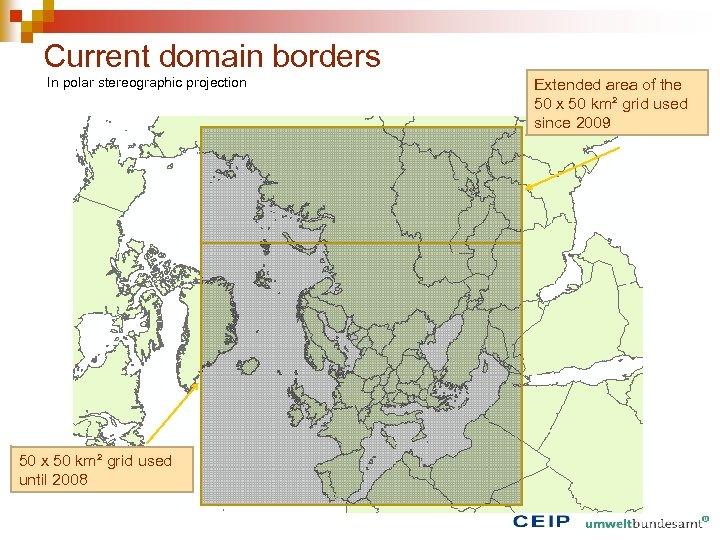 Current domain borders In polar stereographic projection 50 x 50 km² grid used until 2008 Extended area of the 50 x 50 km² grid used since 2009
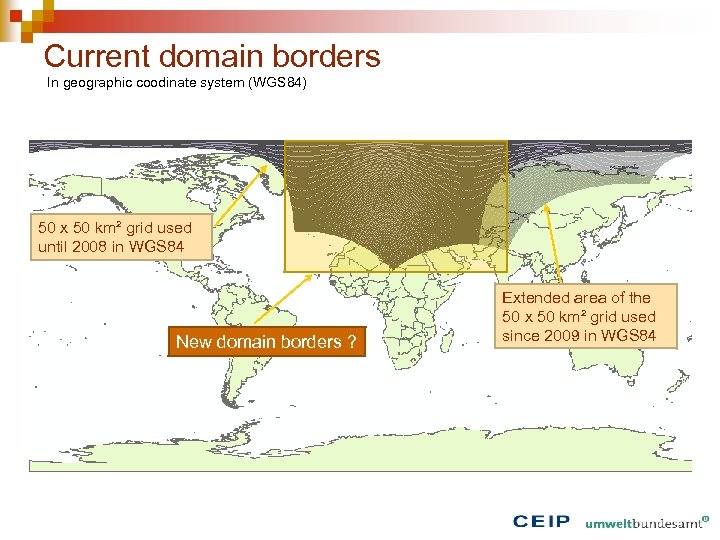 Current domain borders In geographic coodinate system (WGS 84) 50 x 50 km² grid used until 2008 in WGS 84 New domain borders ? Extended area of the 50 x 50 km² grid used since 2009 in WGS 84
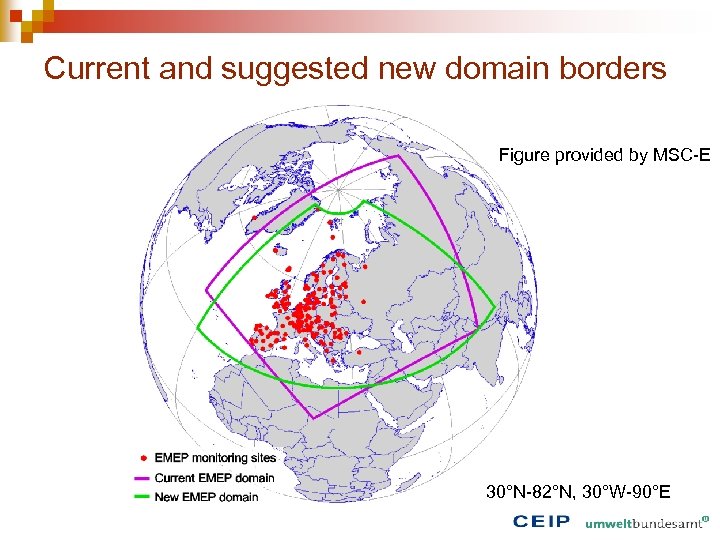 Current and suggested new domain borders Figure provided by MSC-E 30°N-82°N, 30°W-90°E
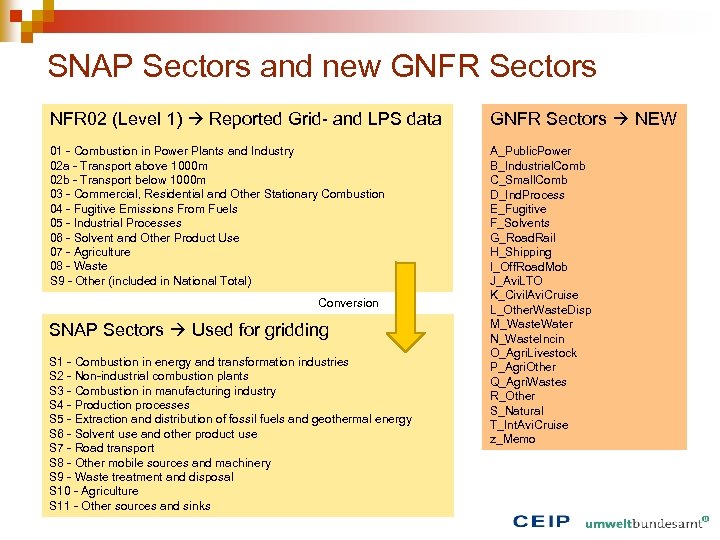 SNAP Sectors and new GNFR Sectors NFR 02 (Level 1) Reported Grid- and LPS data GNFR Sectors NEW 01 - Combustion in Power Plants and Industry 02 a - Transport above 1000 m 02 b - Transport below 1000 m 03 - Commercial, Residential and Other Stationary Combustion 04 - Fugitive Emissions From Fuels 05 - Industrial Processes 06 - Solvent and Other Product Use 07 - Agriculture 08 - Waste S 9 - Other (included in National Total) A_Public. Power B_Industrial. Comb C_Small. Comb D_Ind. Process E_Fugitive F_Solvents G_Road. Rail H_Shipping I_Off. Road. Mob J_Avi. LTO K_Civil. Avi. Cruise L_Other. Waste. Disp M_Waste. Water N_Waste. Incin O_Agri. Livestock P_Agri. Other Q_Agri. Wastes R_Other S_Natural T_Int. Avi. Cruise z_Memo Conversion SNAP Sectors Used for gridding S 1 - Combustion in energy and transformation industries S 2 - Non-industrial combustion plants S 3 - Combustion in manufacturing industry S 4 - Production processes S 5 - Extraction and distribution of fossil fuels and geothermal energy S 6 - Solvent use and other product use S 7 - Road transport S 8 - Other mobile sources and machinery S 9 - Waste treatment and disposal S 10 - Agriculture S 11 - Other sources and sinks
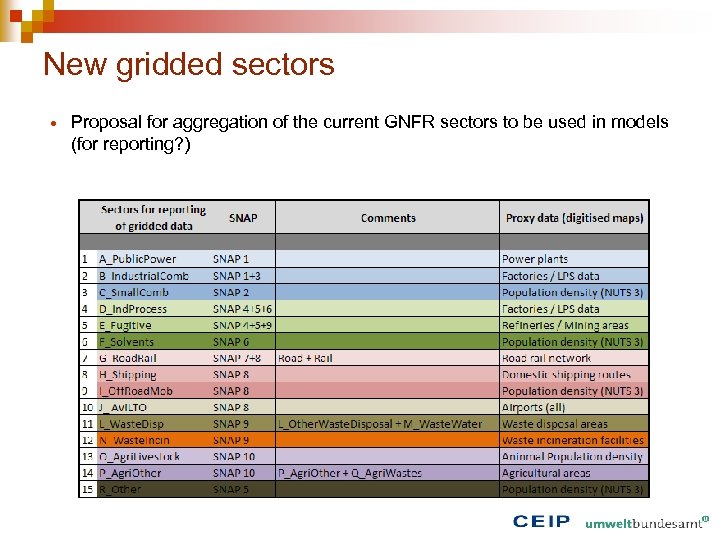 New gridded sectors Proposal for aggregation of the current GNFR sectors to be used in models (for reporting? )
 Thank you very much for your attention http: //www. ceip. at