


 Скачать презентацию How Nicotine Causes Addiction Mechanisms of Nicotine Addiction
7bc3d185940dac99bd6fad4dbca87340.ppt
- Количество слайдов: 17
 How Nicotine Causes Addiction (Mechanisms of Nicotine Addiction) MD Arthur E. Pitchenik Presented at NCVH International Conference. New Orleans La. June 7, 2013
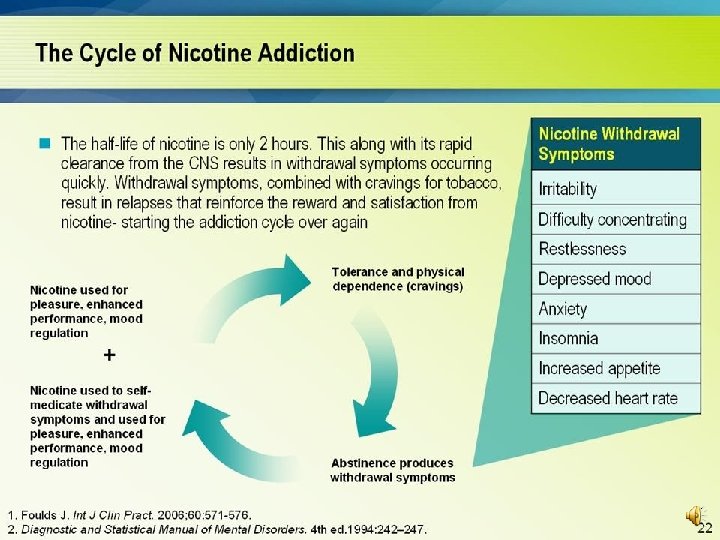
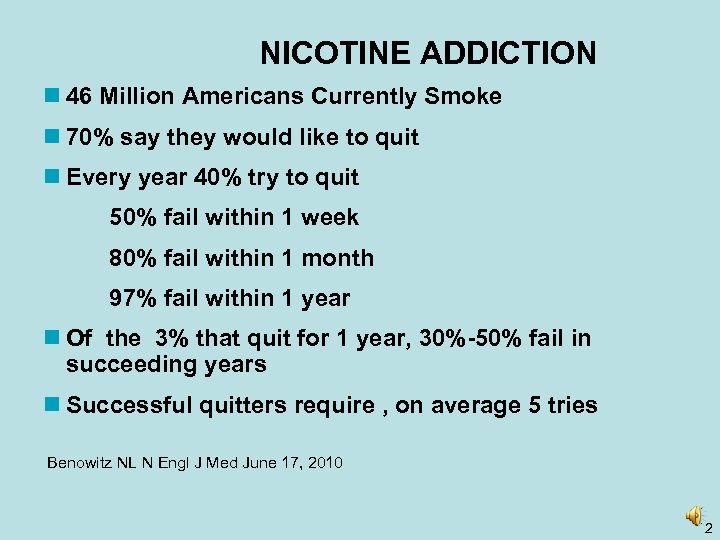 NICOTINE ADDICTION n 46 Million Americans Currently Smoke n 70% say they would like to quit n Every year 40% try to quit 50% fail within 1 week 80% fail within 1 month 97% fail within 1 year n Of the 3% that quit for 1 year, 30%-50% fail in succeeding years n Successful quitters require , on average 5 tries Benowitz NL N Engl J Med June 17, 2010 2
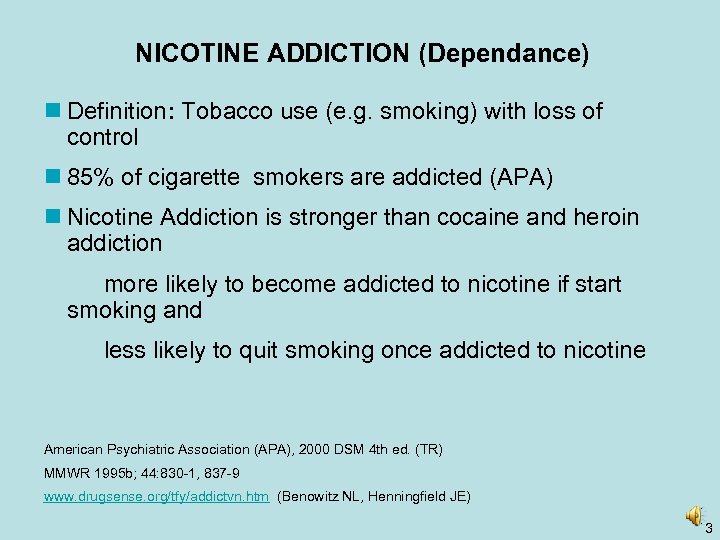 NICOTINE ADDICTION (Dependance) n Definition: Tobacco use (e. g. smoking) with loss of control n 85% of cigarette smokers are addicted (APA) n Nicotine Addiction is stronger than cocaine and heroin addiction more likely to become addicted to nicotine if start smoking and less likely to quit smoking once addicted to nicotine American Psychiatric Association (APA), 2000 DSM 4 th ed. (TR) MMWR 1995 b; 44: 830 -1, 837 -9 www. drugsense. org/tfy/addictvn. htm (Benowitz NL, Henningfield JE) 3
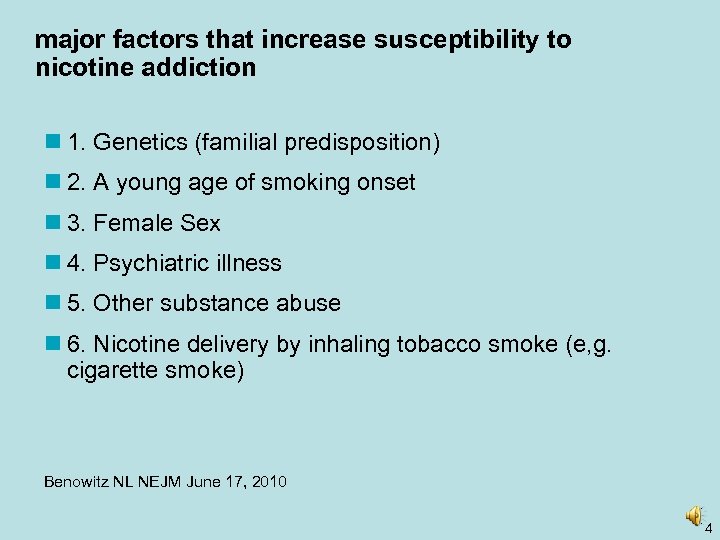 major factors that increase susceptibility to nicotine addiction n 1. Genetics (familial predisposition) n 2. A young age of smoking onset n 3. Female Sex n 4. Psychiatric illness n 5. Other substance abuse n 6. Nicotine delivery by inhaling tobacco smoke (e, g. cigarette smoke) Benowitz NL NEJM June 17, 2010 4
 Three Major Mechanisms of Nicotine Addiction 1. The addictive property of nicotine is related to the rate of delivery of nicotine to the brain (inhalation of cigarette smoke rapidly and repeatedly delivers arterial spikes of nicotine to the brain ) 5
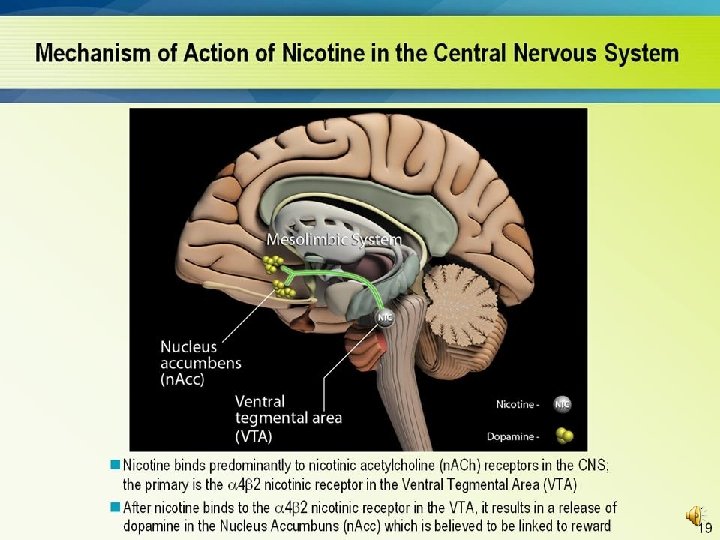
 Three Major Mechanisms of Nicotine Addiction 2. Nicotine releases gratification chemicals in the brain (dopamine, nor-epinephrine, glutamate, serotonin, beta endorphin) 6
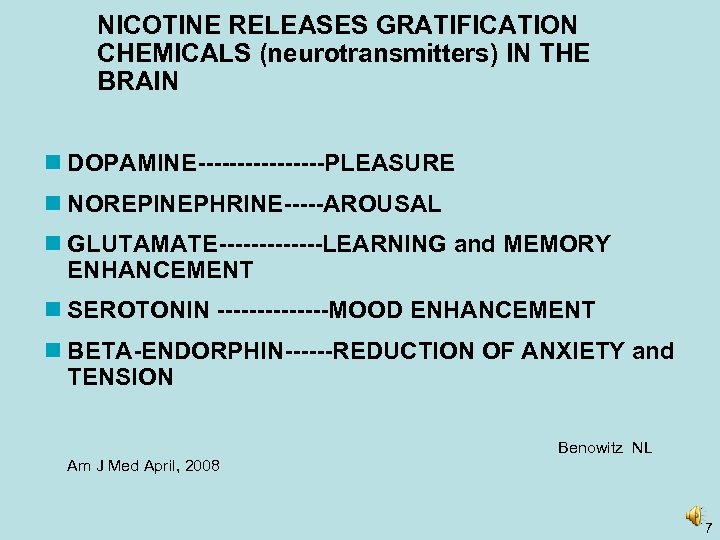 NICOTINE RELEASES GRATIFICATION CHEMICALS (neurotransmitters) IN THE BRAIN n DOPAMINE--------PLEASURE n NOREPINEPHRINE-----AROUSAL n GLUTAMATE-------LEARNING and MEMORY ENHANCEMENT n SEROTONIN -------MOOD ENHANCEMENT n BETA-ENDORPHIN------REDUCTION OF ANXIETY and TENSION Am J Med April, 2008 Benowitz NL 7
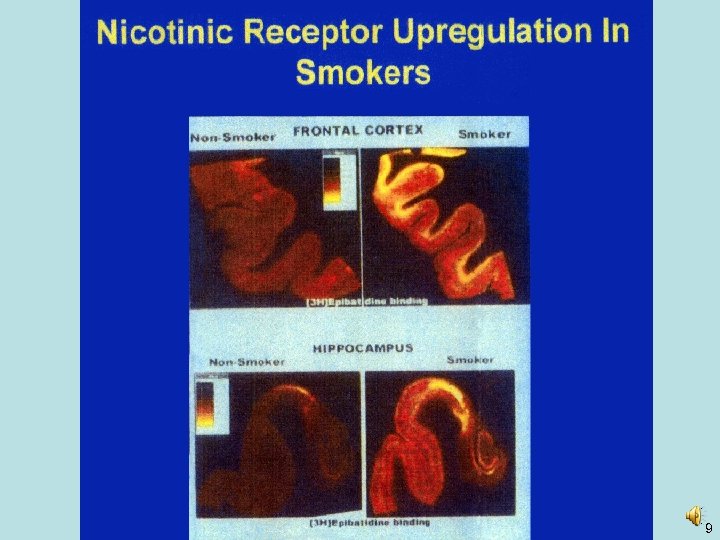
 Three Major Mechanisms of Nicotine Addiction 3. Long term use of nicotine produces functional and structural changes in the brain Nicotine receptors over time become desensitized and then increase in number and density. In addition, neuronal memory circuits are established in the cerebral cortex which sub-serve memory where external cues call forth nicotine cravings. Benowitz NL. Nicotine Addiction; NEJM June 17, 2010 8
 9
9
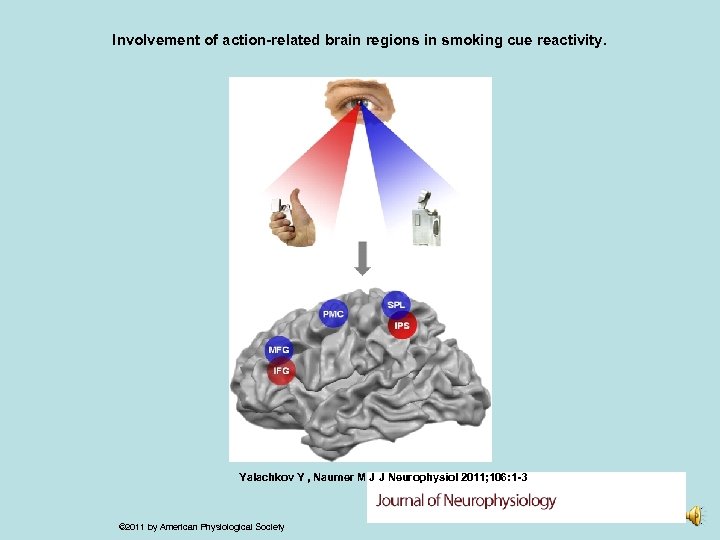 Involvement of action-related brain regions in smoking cue reactivity. Yalachkov Y , Naumer M J J Neurophysiol 2011; 106: 1 -3 © 2011 by American Physiological Society
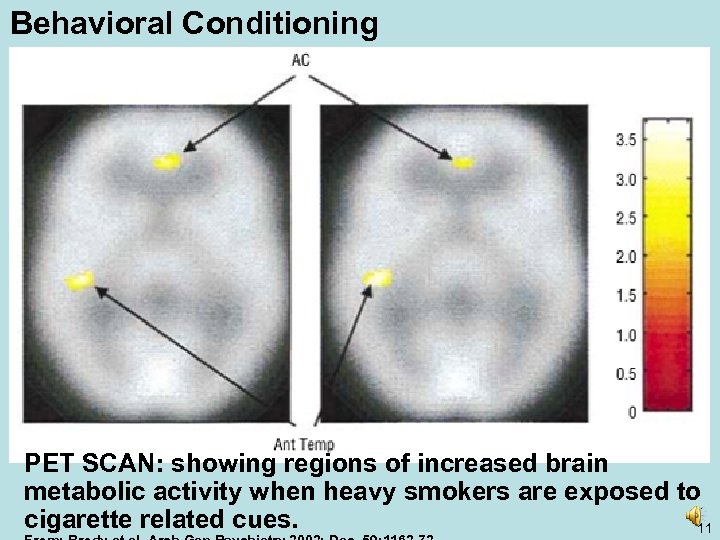 Behavioral Conditioning PET SCAN: showing regions of increased brain metabolic activity when heavy smokers are exposed to cigarette related cues. 11
 12
12
 13
13
 NICOTINE ADDICTION n NICOTINE ADDICTION (use of tobacco with loss of control) IS THE OUTWARD MANIFESTATION OF A FUNCTIONAL AND STRUCTURAL DISEASE OF THE BRAIN! n IT IS NOT SIMPLY A BEHAVIORAL PROBLEM OF WEAK WILLED PEOPLE n (Surgeon General, NIDA, NIH, CDC, AMA, APA) 14
 NICOTINE ADDICTION IS A CHRONIC DISEASE Virtually every Major Health Agency now classifies Nicotine Addiction as a chronic disease such as diabetes and vascular disease and it therefore must be treated with the same diligence and on-going care! In diabetes the pathology is in the pancreas. In vascular disease it’s in the blood vessel wall. In nicotine addiction the pathology is in the brain! (Surgeon General, NIDA, NIH, CDC, AMA. APA) 15
 Nicotine Addiction (which drives compulsive smoking) is the worlds deadliest chronic medical disease! A non-profit public service presentation MD Arthur E. Pitchenik 16
 17
17