


 Скачать презентацию How Emerging Trends and Technologies Will Affect the
e8f6b887d348a64d94ebd0d90e2e3cd6.ppt
- Количество слайдов: 34
 How Emerging Trends and Technologies Will Affect the Library John Burke ALAO SSIG Spring Workshop May 8 -9, 2003
 Coping and keeping up n Where’s the wind blowing? n What’s new? How do I prepare? Will I be working in a library in 10 years? 5? n Contrasting examples; stories that teach n A list of lessons learned and steps to follow
 Library technology truths n n n n Dual technology needs: streamline our workflow and serve the public Add popular technologies both by demand proactively We create our own systems on occasion Budget pressures often slow changes New items both replace and complement Both products and processes Computers are a key technology today, but not the only crucial one
 Truth #1: Not all technology works as expected
 Failure – the Rudolph Indexer n View 175 catalog cards at once n 12, 000+ cards in single indexer n Too expensive; never caught on
 Success – Shared cataloging n MARC records n OCLC n Cooperation continues
 Technologies on the rise n n n n Handhelds – Palm Pilots, Pocket PCs, Cell phones, Tablet PCs Wireless networking Open source software MP 3 s DVDs E-books Full-text reference books and periodicals
 What can we learn? n Three possibilities for each new technology: ¨ ¨ ¨ n Essential technologies that last (DDC, OPAC, etc. ) “Flashes in the pan” that never materialize (Rudolph Indexer, bubble memory, etc. ) Transitional technologies that have shorter lifespans (8 -track tapes, records, etc. ) We hope to choose 1 early, accept 3 before it’s too late, and avoid 2 altogether
 Truth #2: It’s hard to know what patrons will want or need
 Trends in society n n n 66% of Americans use computers at home or work (over 54% use the Internet) Reading habits: more “scanning” 90% of children and teens use computers 50% of homes have DVD players 42% of U. S. adults are not Internet users (Pew Internet Study)
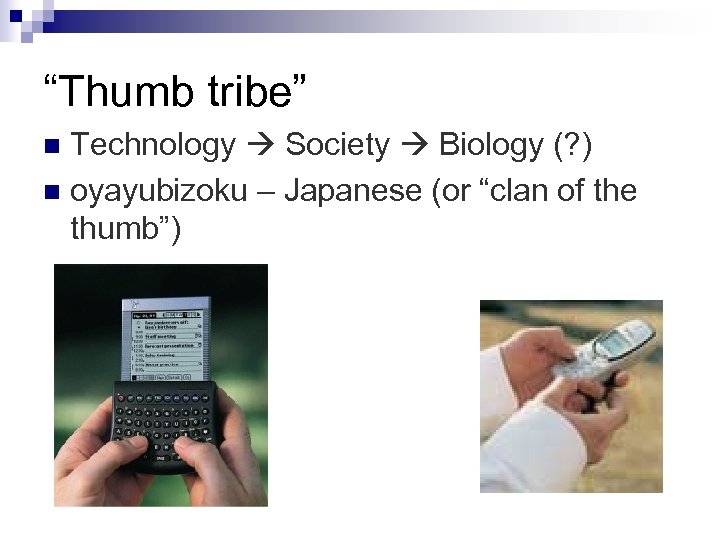 “Thumb tribe” Technology Society Biology (? ) n oyayubizoku – Japanese (or “clan of the thumb”) n
 How do we adjust to the trends? n Mixed bag n Stress customer service n Patrons want self-suffiency n Patrons need guides and helpers n We need to be flexible – alter workflow, policies
 Truth #3: Libraries face many concerns and choices
 Trends in libraries n n n n n Nearly universal Internet access in public libraries Graying of profession (63% of librarians are > 45) Less spending on books, but higher circulation Budget cutbacks More and bigger electronic resources to buy Audiovisual spending is growing 24/7/365 access and assistance Buildings – need flexible, tech-friendly spaces Digital reference – chat, email Focus on adaptive devices and web design
 Major issues to solve n n n n n Copyright Confidentiality – USA Patriot Act, etc. Access – “digital divide” Library budgets Archiving of digital resources (& long-term access) One-stop access to resources – easy interfaces More fee, less free resources Spam, cyberterrorism, and the regulated Internet Marketing the library, finding niches Cooperation among libraries
 Where to turn? n It’s always been this way to some degree n Libraries must have a voice in solutions n Stay in communication n Stay a little behind, but still see who’s up front n Be informed (Technology Awareness Resources handout at www. users. muohio. edu/burkejj/)
 Truth #4: Not every library needs the same technologies
 A tale of two libraries n Cerritos Library, Cerritos, CA (cml. ci. cerritos. ca. us/static. htm) n Oscar Johnson Memorial Library, Silverhill, AL (www. gulftel. com/bclc/bclibraries/silverhill. html)
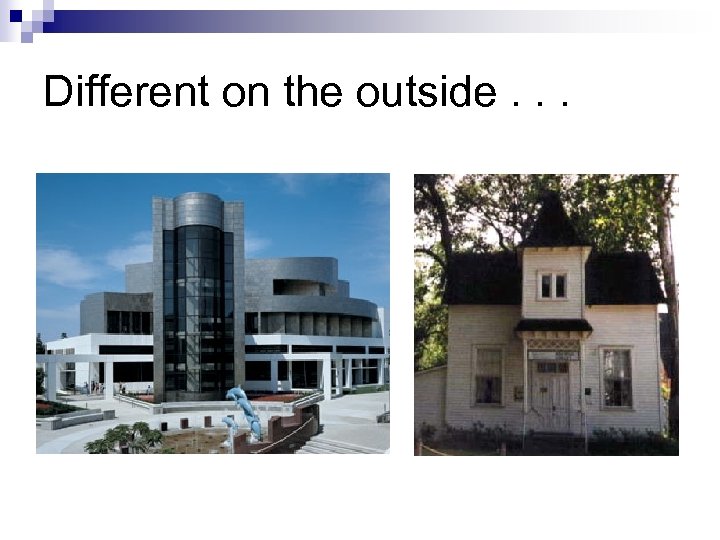 Different on the outside. . .
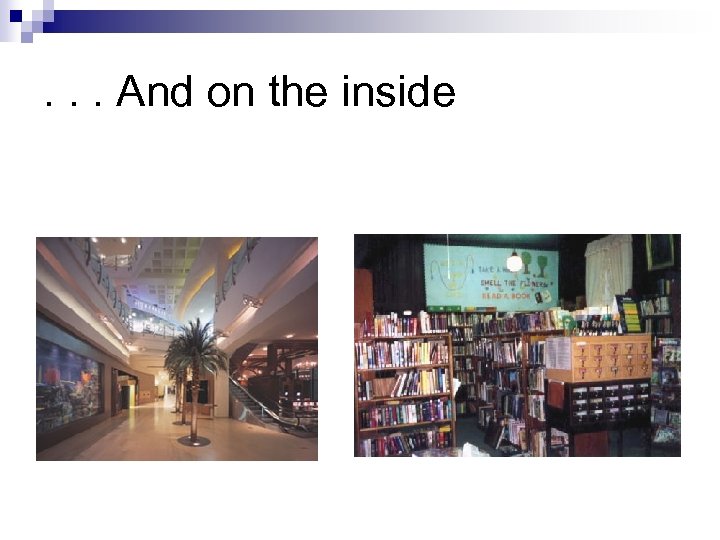 . . . And on the inside
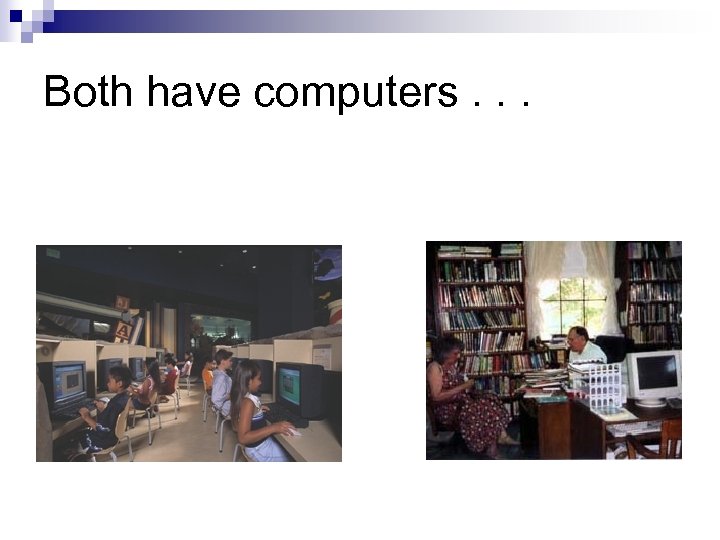 Both have computers. . .
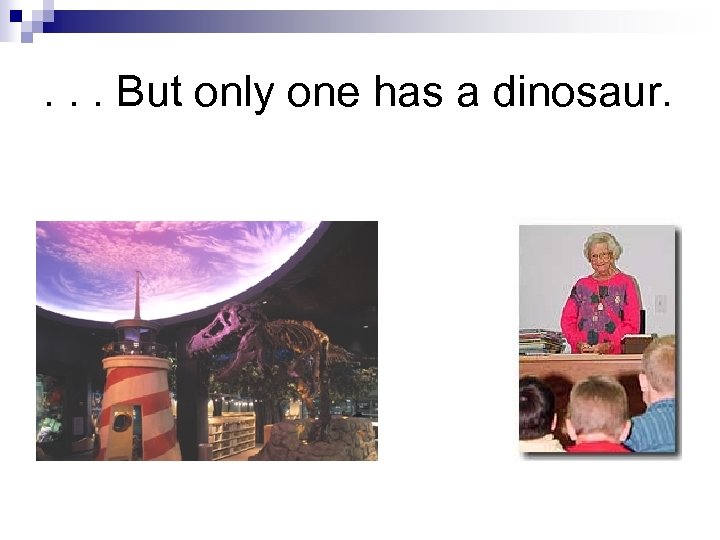 . . . But only one has a dinosaur.
 What does our library need? n Know thy community n Consider the budget n Don’t fear change n Remember Truth #1 n Take a few leaps of faith
 Truth #5: All visions are imperfect, but we need them
 Visions of the Future: Yesterday n n n Charles Ammi Cutter (1883) The Buffalo Public Library in 1983 Guessed wrong: ¨ Sprawling, many floored library ¨ An army of uniformed pages ¨ Scrupulously clean and dust free ¨ Multiple “reading rooms” n Guessed right: ¨ Fax machines, interlibrary loan, photocopying ¨ Mass electric power n Based his thoughts on what he could see
 Visions of the future: Today n n Raymond Kurzweil (2000) The “Terminator” future ¨ 2009 – wearable computers ¨ 2019 – books are rarely used ¨ 2029 – implants connect us to the Internet n n n Libraries fade away Unabated development of technology We’ll have to wait and see
 Vision #1: “It’s Alive!” n n n Primary access to information is electronic Most users access materials remotely Private companies offer content and access equal to and beyond that of libraries – competition and outsourcing Our interaction with the Internet and networked information sources becomes a single interface, perhaps voice responsive Library cannot compete as a public space – home becomes central
 Vision #2: Ozymandias n n n n Things fall apart: current tech cannot be sustained Bleeding edge stops bleeding Archival issues end e-resource use Declining funds push libraries to print only Terrorism makes networks unworkable Libraries survive as they always have, and grow as centers of information and learning A step back, or a step ahead?
 Vision #3: Today & tomorrow n n n n Public, academic, school, & special libraries Near-universal Internet access (thanks to us) Many electronic resources Declining periodical collections Growth of e-books and other publications on handheld devices Remote access to resources is available, and growing in use Library is still a vital spot for the community
 The future for support staff n n n Jobs increasing (66% of library workers now) Workload shift continues (more formerly MLSonly duties) Entry requirements increasing (in places) “Graying” & retention issues Opportunities to seek MLS (if desired) Pay may rise, but slowly
 Lessons Learned 1. 2. 3. 4. 5. n Not all technology works as expected It’s hard to know what patrons will want or need Libraries face many concerns and choices Not every library needs the same technologies All visions are imperfect, but we need them Consider the essentials of our work as you innovate
 Five New Laws of Library Science 1. 2. 3. 4. 5. Libraries serve humanity. Respect all forms by which knowledge is communicated. Use technology intelligently to enhance service. Protect free access to knowledge. Honor the past and create the future. n Revised: Walt Crawford and Michael Gorman
 Further reading n Gorman, Michael. Our Enduring Values. Chicago: American Library Association, 2000. n Wisconsin Library Services. New Tech News. (www. wils. wisc. edu/pubs/ntn/) n Burke, John. Neal-Schuman Library Technology Primer. New York: Neal-Schuman Publishers, Inc. , 2000.
 Questions or Comments? John J. Burke, MSLS Assistant Library Director Gardner-Harvey Library Miami University Middletown (513) 727 -3293 burkejj@muohio. edu http: //www. users. muohio. edu/burkejj/