Скачать презентацию How East Asians View Democracy East Asia
e20957261890c7ab217619fd5cc9642a.ppt
- Количество слайдов: 72
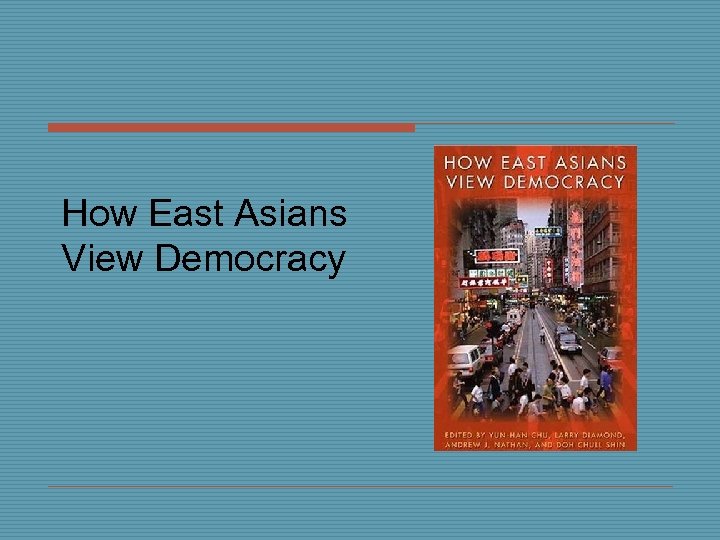 How East Asians View Democracy
 East Asia Barometer A Comparative Survey of Democratization and Value Change, 2001 -2003 o o o First systematic comparative survey of attitudes and values toward politics, governance, democracy and reform, and citizens’ political actions in East Asia Standardized survey instruments designed around a common research framework Federated country-team structure, coordinated by Yun-han Chu, National Taiwan University, with international steering committee Funded by Taiwan Ministry of Education, Henry Luce Foundation, World Bank, foundations in some of the countries, and other sources Allows for nested comparisons: three Chinese societies, five “Confucian” societies, developed/developing, democratic/non-democratic; within-society educational, gender, occupational, ethnic, religious, and other groups Later changed its name to Asian Barometer Surveys. Web address: www. asianbarometer. org
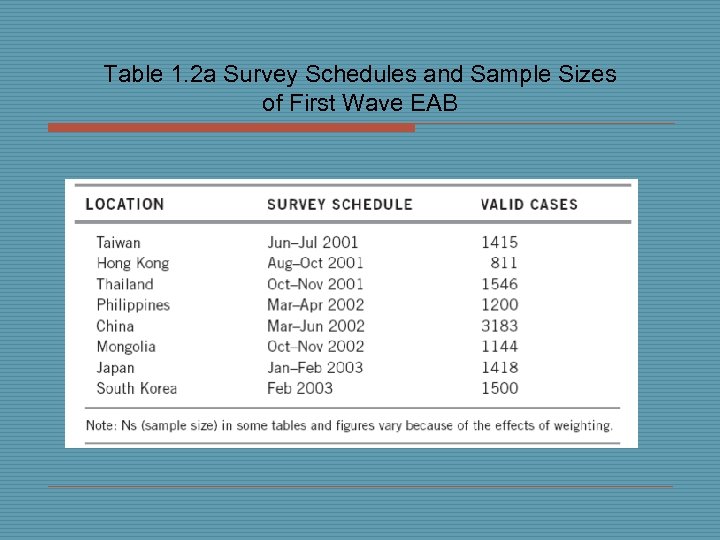 Table 1. 2 a Survey Schedules and Sample Sizes of First Wave EAB
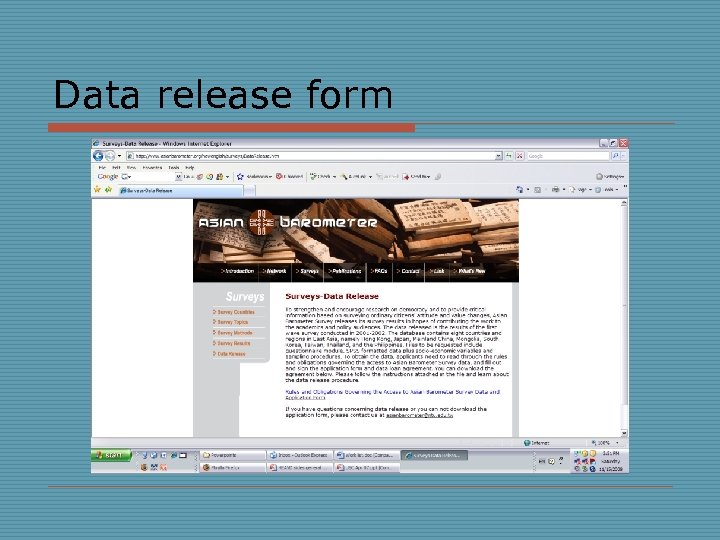 Data release form
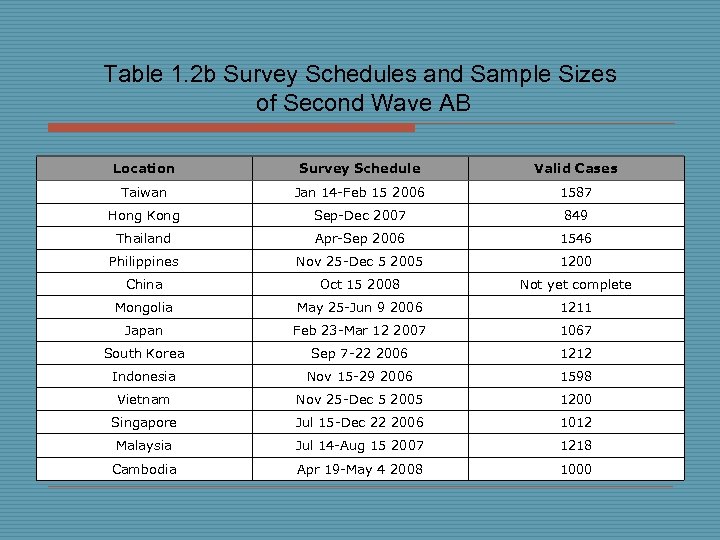 Table 1. 2 b Survey Schedules and Sample Sizes of Second Wave AB Location Survey Schedule Valid Cases Taiwan Jan 14 -Feb 15 2006 1587 Hong Kong Sep-Dec 2007 849 Thailand Apr-Sep 2006 1546 Philippines Nov 25 -Dec 5 2005 1200 China Oct 15 2008 Not yet complete Mongolia May 25 -Jun 9 2006 1211 Japan Feb 23 -Mar 12 2007 1067 South Korea Sep 7 -22 2006 1212 Indonesia Nov 15 -29 2006 1598 Vietnam Nov 25 -Dec 5 2005 1200 Singapore Jul 15 -Dec 22 2006 1012 Malaysia Jul 14 -Aug 15 2007 1218 Cambodia Apr 19 -May 4 2008 1000
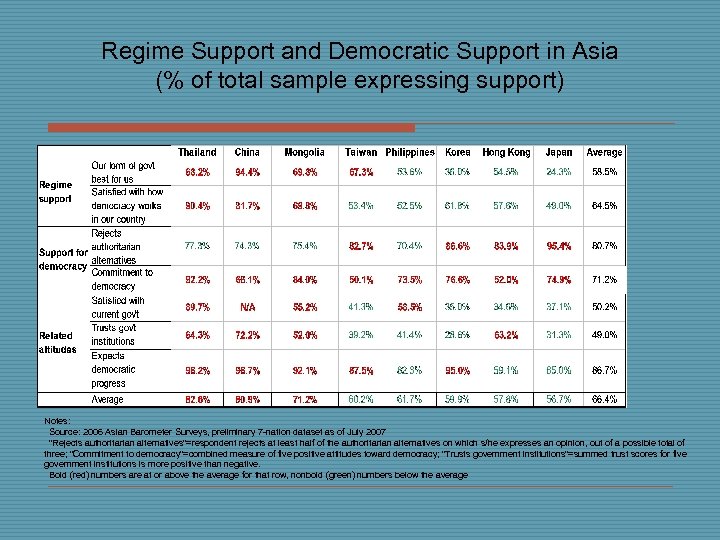 Regime Support and Democratic Support in Asia (% of total sample expressing support) Notes: Source: 2006 Asian Barometer Surveys, preliminary 7 -nation dataset as of July 2007 "Rejects authoritarian alternatives"=respondent rejects at least half of the authoritarian alternatives on which s/he expresses an opinion, out of a possible total of three; "Commitment to democracy"=combined measure of five positive attitudes toward democracy; "Trusts government institutions"=summed trust scores for five government institutions is more positive than negative. Bold (red) numbers are at or above the average for that row, nonbold (green) numbers below the average
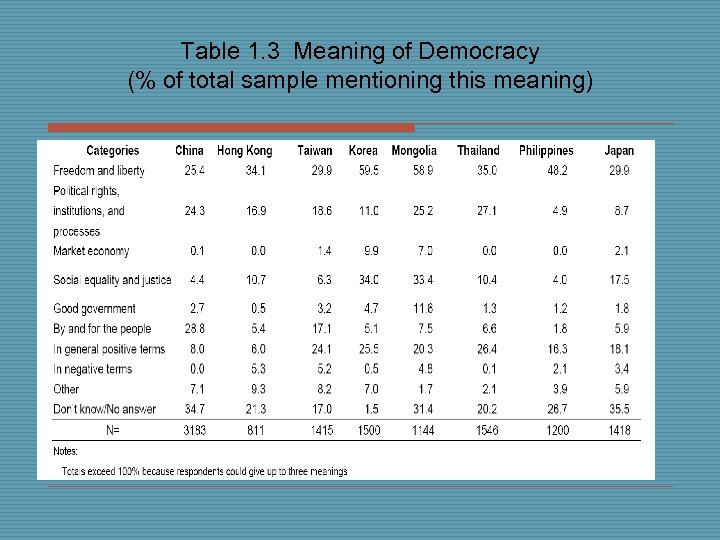 Table 1. 3 Meaning of Democracy (% of total sample mentioning this meaning)
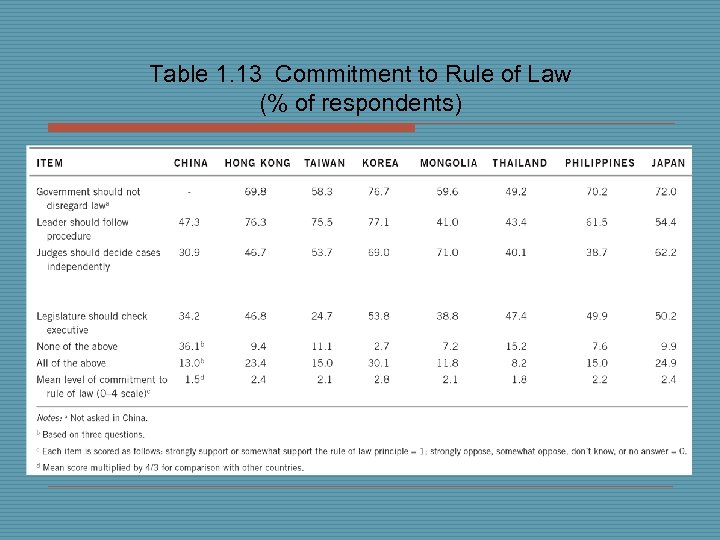 Table 1. 13 Commitment to Rule of Law (% of respondents)
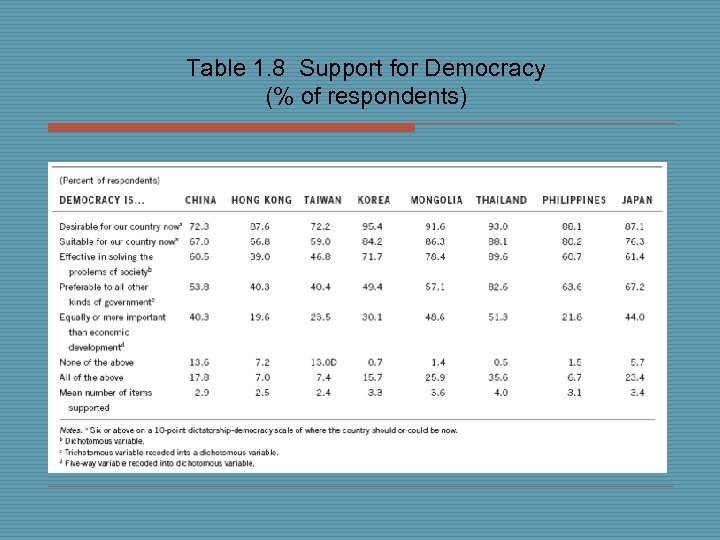 Table 1. 8 Support for Democracy (% of respondents)
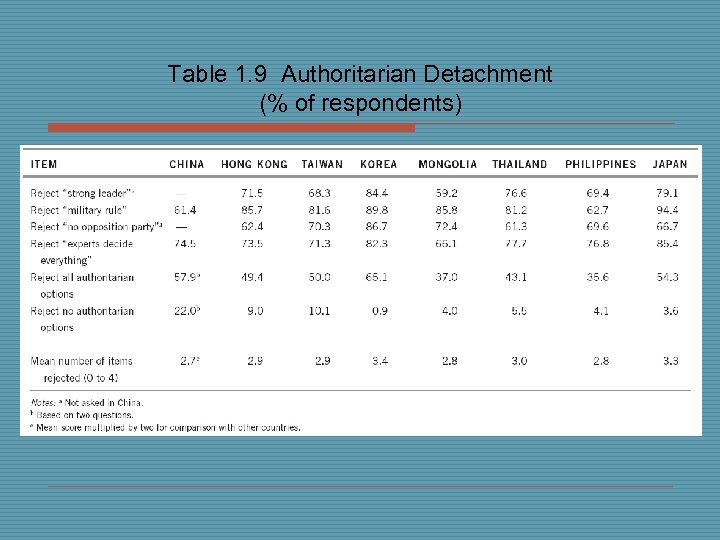 Table 1. 9 Authoritarian Detachment (% of respondents)
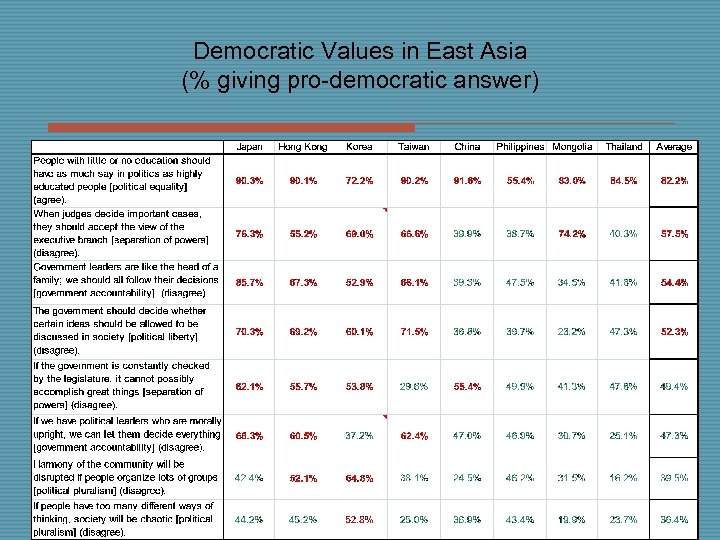 Democratic Values in East Asia (% giving pro-democratic answer)
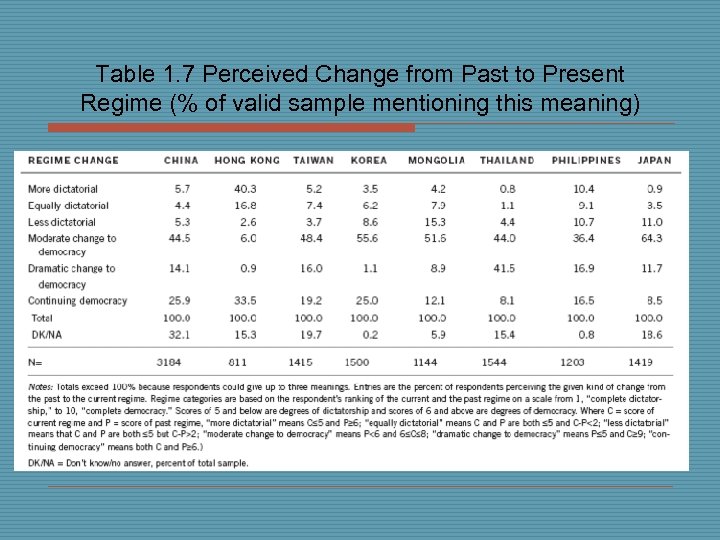 Table 1. 7 Perceived Change from Past to Present Regime (% of valid sample mentioning this meaning)
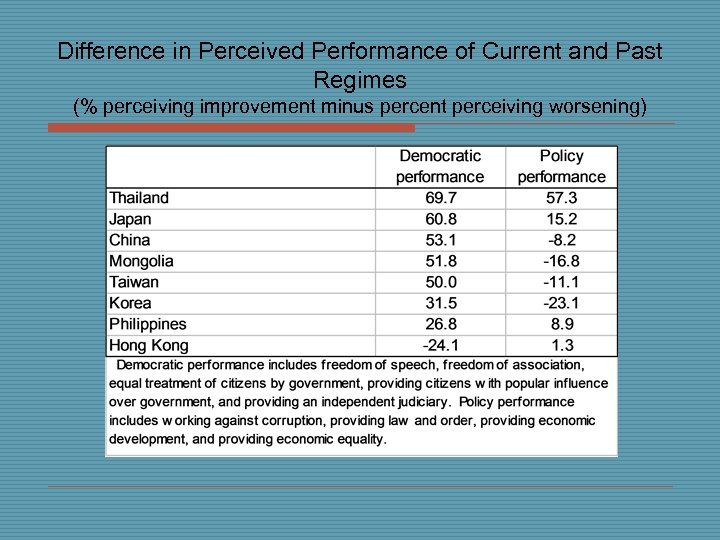 Difference in Perceived Performance of Current and Past Regimes (% perceiving improvement minus percent perceiving worsening)
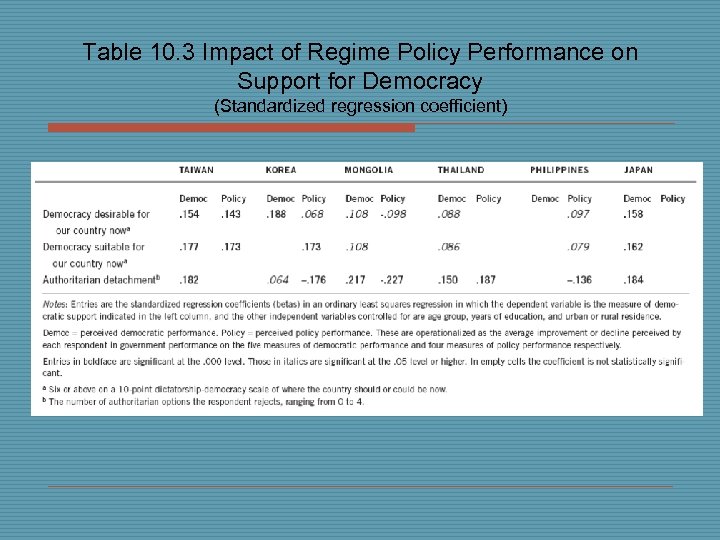 Table 10. 3 Impact of Regime Policy Performance on Support for Democracy (Standardized regression coefficient)
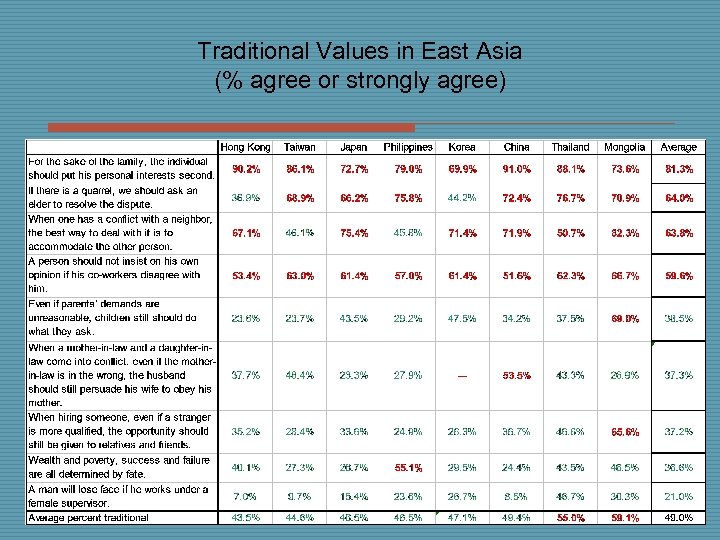 Traditional Values in East Asia (% agree or strongly agree)
 First and Second Wave Comparison
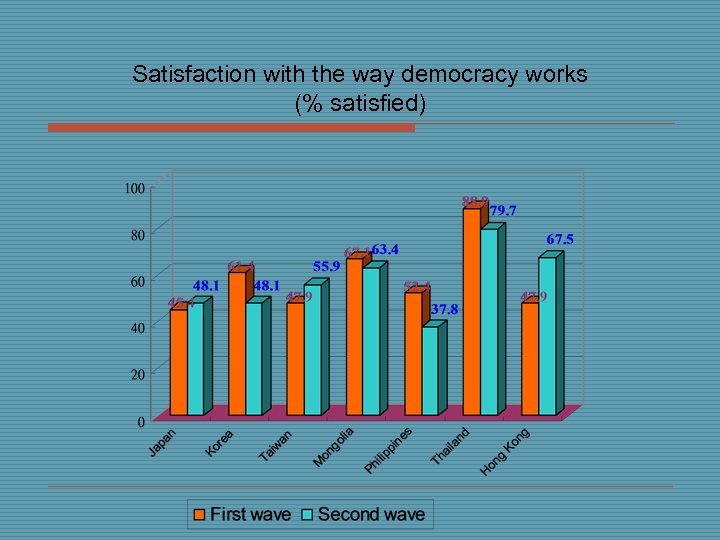 Satisfaction with the way democracy works (% satisfied)
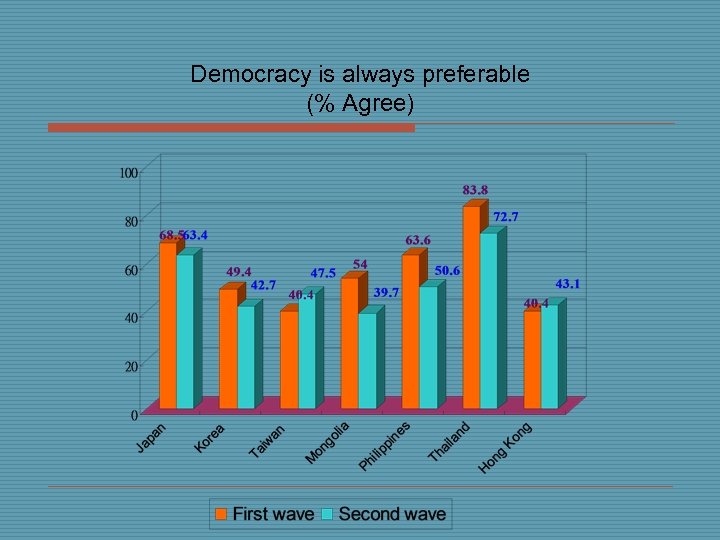 Democracy is always preferable (% Agree)
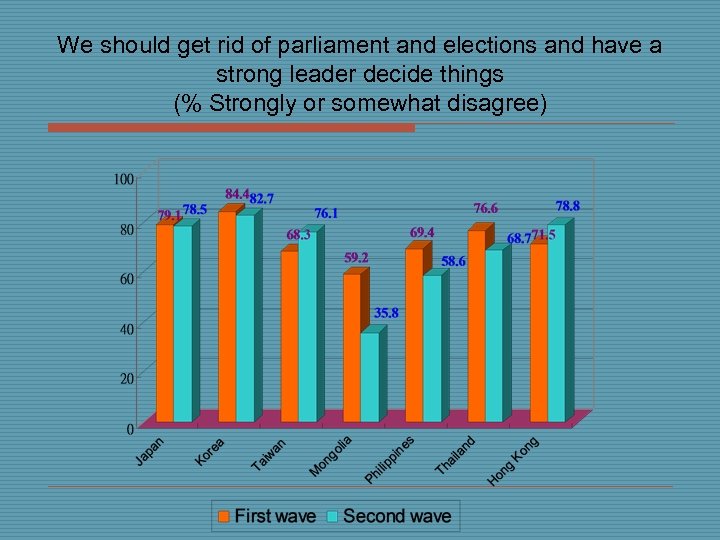 We should get rid of parliament and elections and have a strong leader decide things (% Strongly or somewhat disagree)
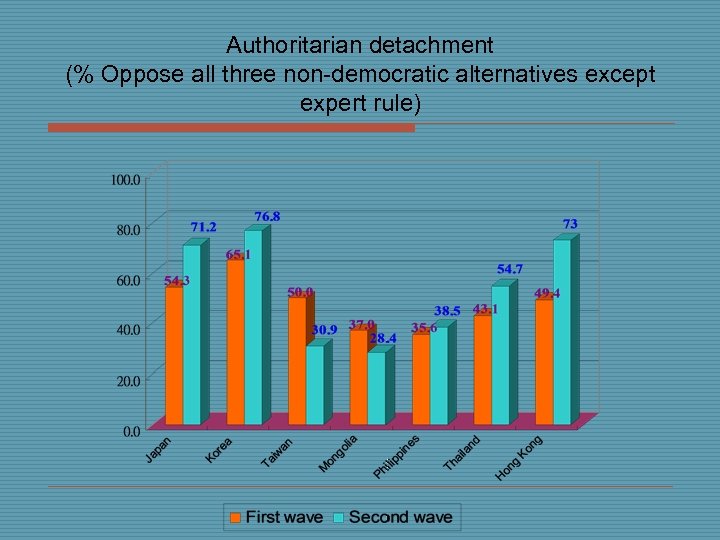 Authoritarian detachment (% Oppose all three non-democratic alternatives except expert rule)
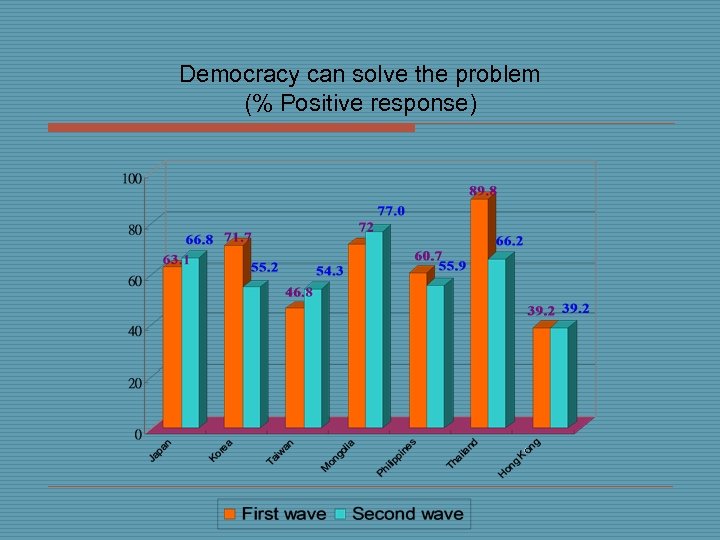 Democracy can solve the problem (% Positive response)
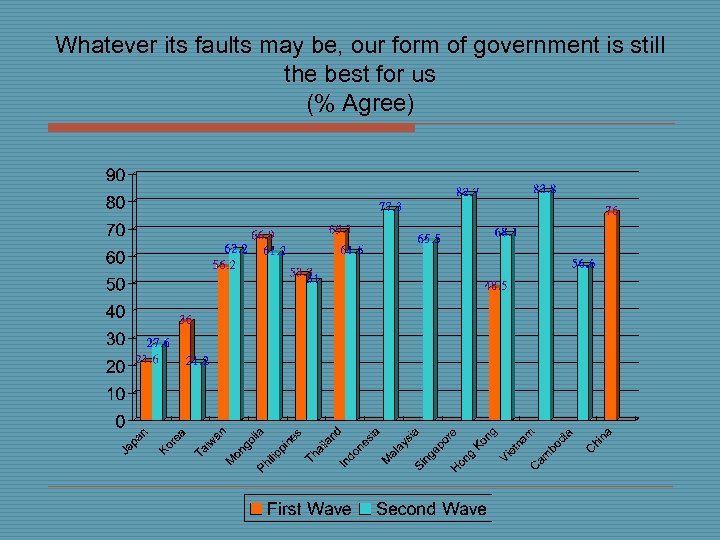 Whatever its faults may be, our form of government is still the best for us (% Agree)
 Second Wave
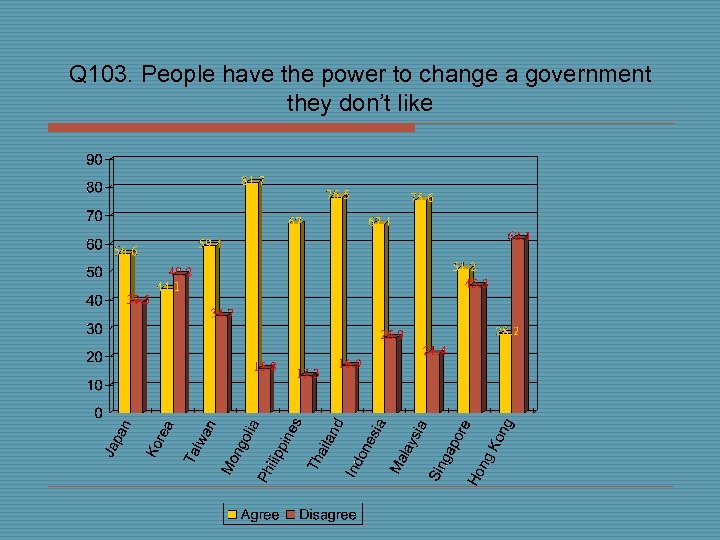 Q 103. People have the power to change a government they don’t like
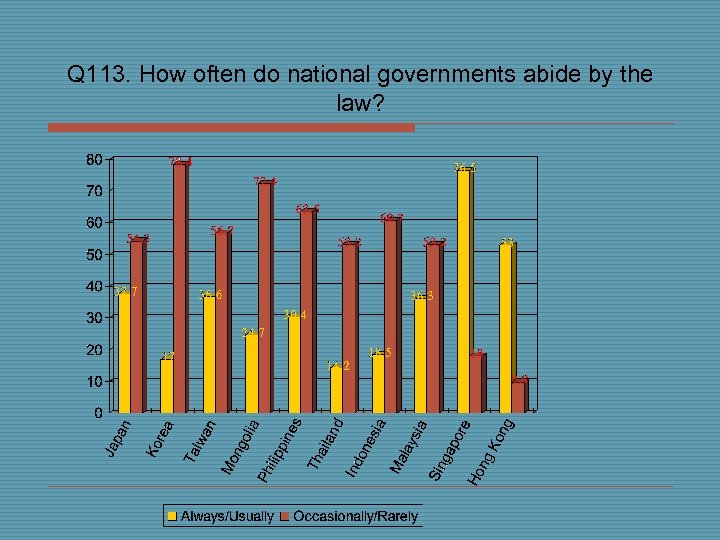 Q 113. How often do national governments abide by the law?
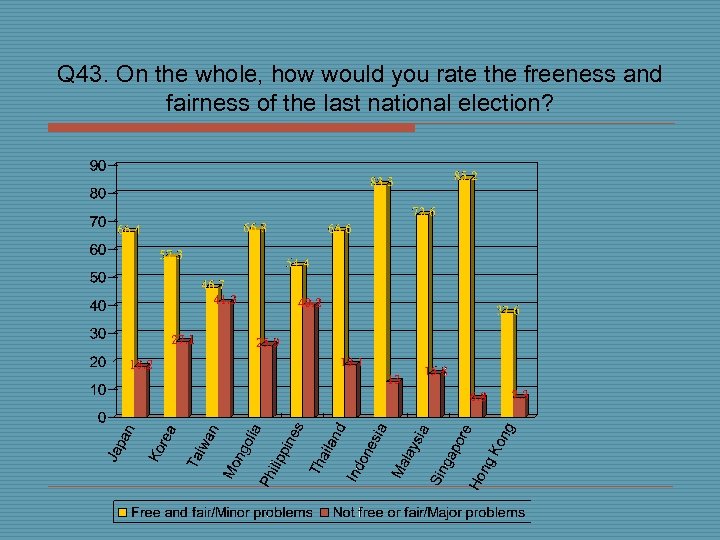 Q 43. On the whole, how would you rate the freeness and fairness of the last national election?
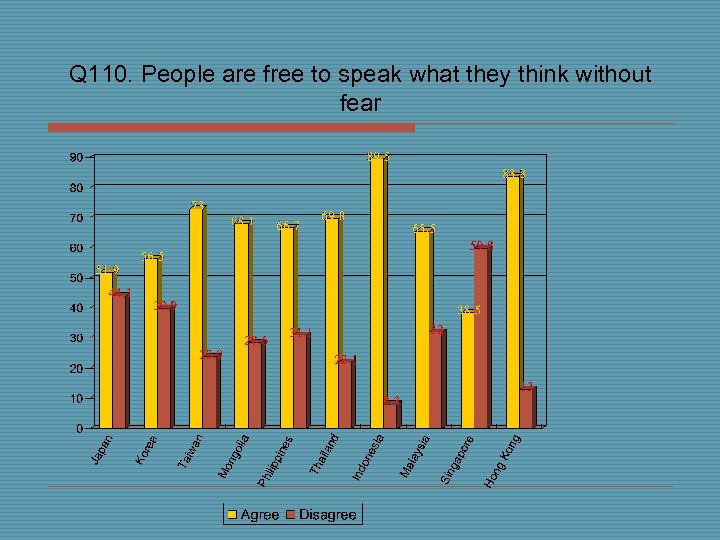 Q 110. People are free to speak what they think without fear
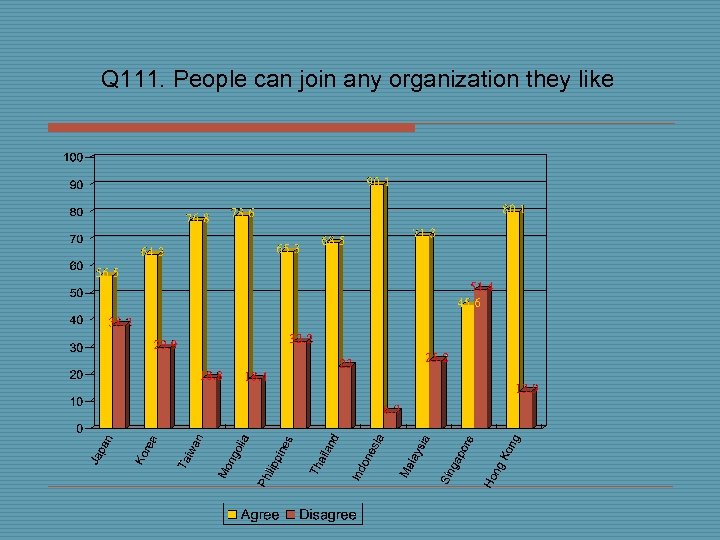 Q 111. People can join any organization they like
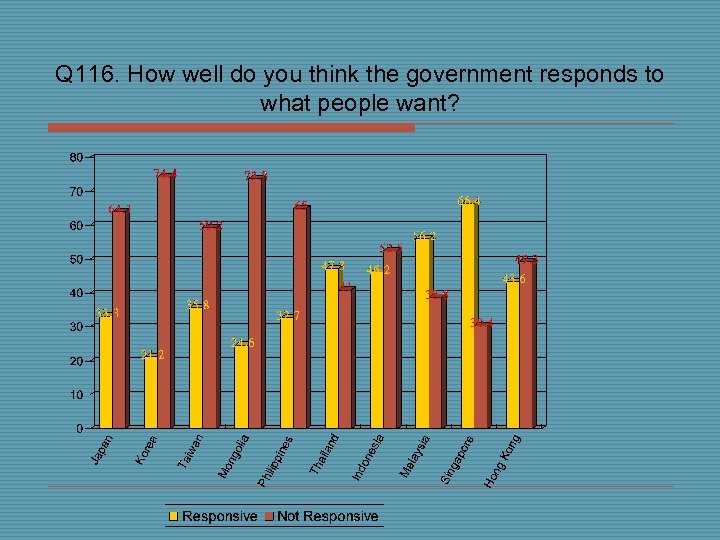 Q 116. How well do you think the government responds to what people want?
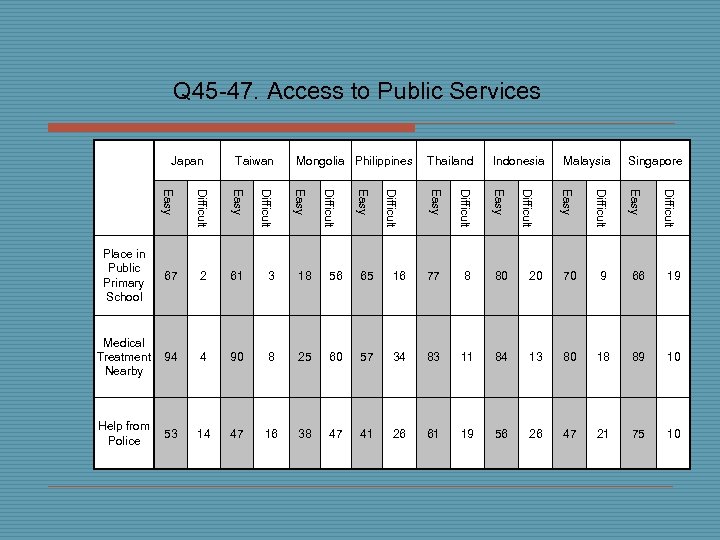 Q 45 -47. Access to Public Services Japan Taiwan Mongolia Philippines Thailand Indonesia Malaysia Singapore Easy Difficult 56 65 16 77 8 80 20 70 9 66 19 Medical Treatment 94 Nearby 4 90 8 25 60 57 34 83 11 84 13 80 18 89 10 Help from 53 Police 14 47 16 38 47 41 26 61 19 56 26 47 21 75 10 Difficult Easy 18 Difficult 3 Easy 61 Difficult 2 Easy 67 Place in Public Primary School
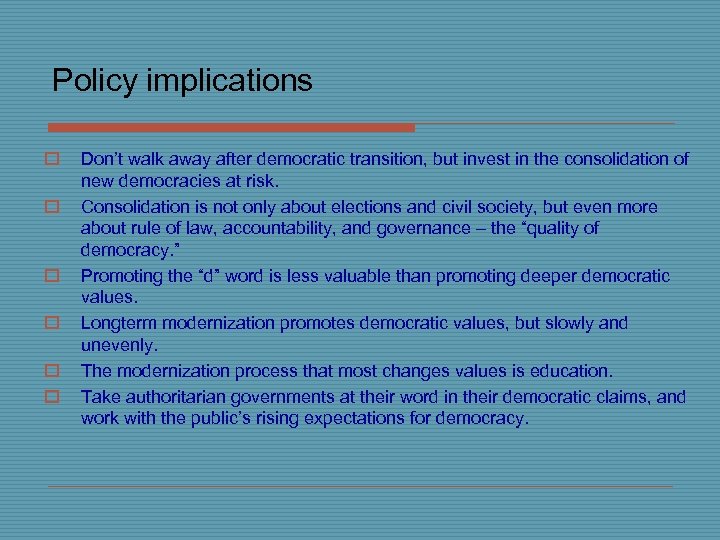 Policy implications o o o Don’t walk away after democratic transition, but invest in the consolidation of new democracies at risk. Consolidation is not only about elections and civil society, but even more about rule of law, accountability, and governance – the “quality of democracy. ” Promoting the “d” word is less valuable than promoting deeper democratic values. Longterm modernization promotes democratic values, but slowly and unevenly. The modernization process that most changes values is education. Take authoritarian governments at their word in their democratic claims, and work with the public’s rising expectations for democracy.
 Institutionalizing African Democracy: Formal or Informal? Michael Bratton, Michigan State University
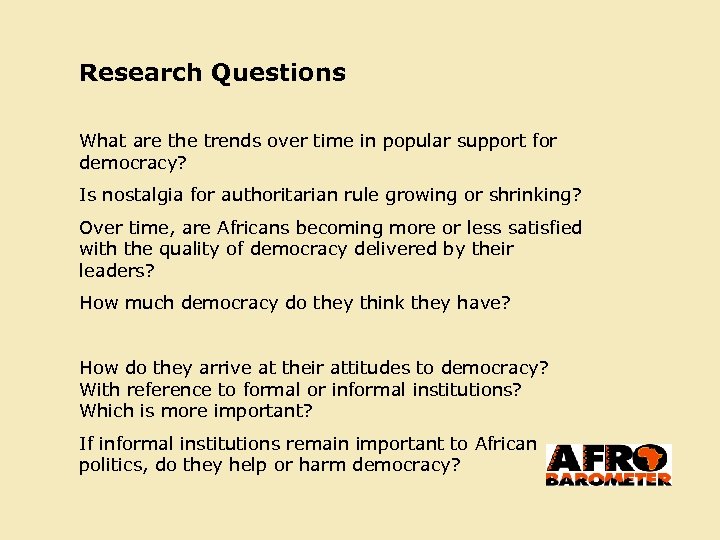 Research Questions What are the trends over time in popular support for democracy? Is nostalgia for authoritarian rule growing or shrinking? Over time, are Africans becoming more or less satisfied with the quality of democracy delivered by their leaders? How much democracy do they think they have? How do they arrive at their attitudes to democracy? With reference to formal or informal institutions? Which is more important? If informal institutions remain important to African politics, do they help or harm democracy?
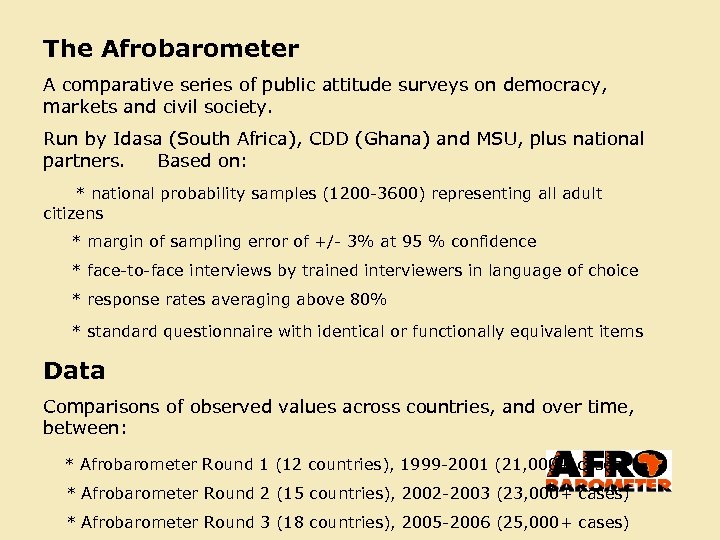 The Afrobarometer A comparative series of public attitude surveys on democracy, markets and civil society. Run by Idasa (South Africa), CDD (Ghana) and MSU, plus national partners. Based on: * national probability samples (1200 -3600) representing all adult citizens * margin of sampling error of +/- 3% at 95 % confidence * face-to-face interviews by trained interviewers in language of choice * response rates averaging above 80% * standard questionnaire with identical or functionally equivalent items Data Comparisons of observed values across countries, and over time, between: * Afrobarometer Round 1 (12 countries), 1999 -2001 (21, 000+ cases) * Afrobarometer Round 2 (15 countries), 2002 -2003 (23, 000+ cases) * Afrobarometer Round 3 (18 countries), 2005 -2006 (25, 000+ cases)
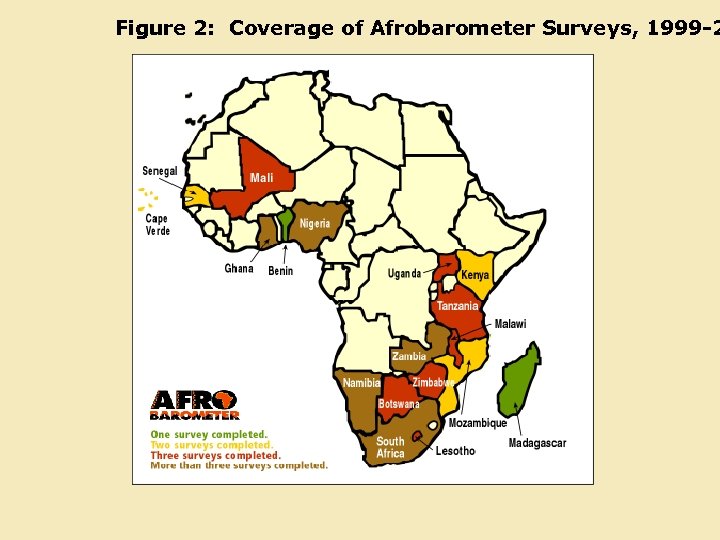 Figure 2: Coverage of Afrobarometer Surveys, 1999 -2 Back to Afrobarometer Countries
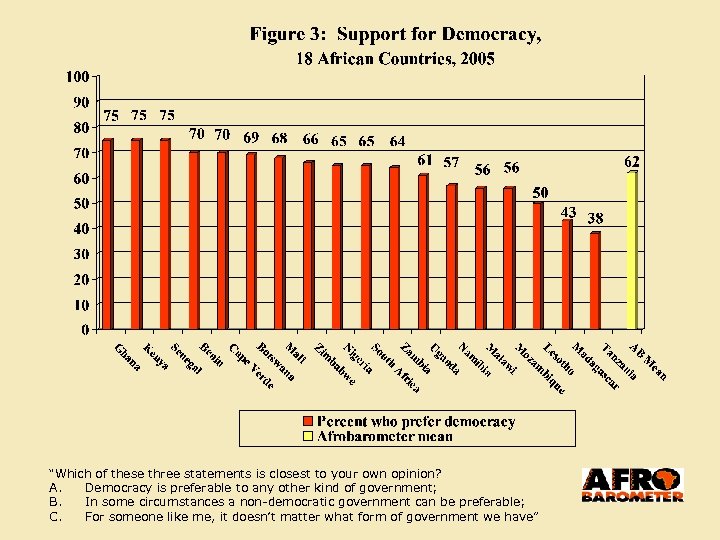 “Which of these three statements is closest to your own opinion? A. Democracy is preferable to any other kind of government; B. In some circumstances a non-democratic government can be preferable; C. For someone like me, it doesn’t matter what form of government we have”
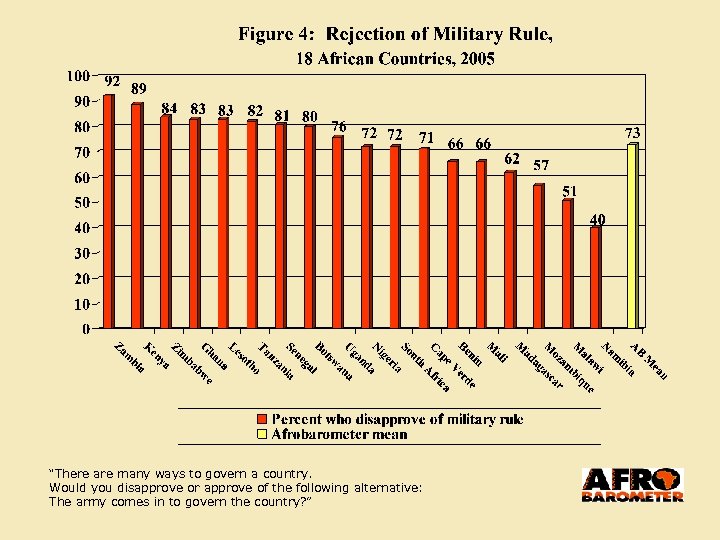 “There are many ways to govern a country. Would you disapprove or approve of the following alternative: The army comes in to govern the country? ”
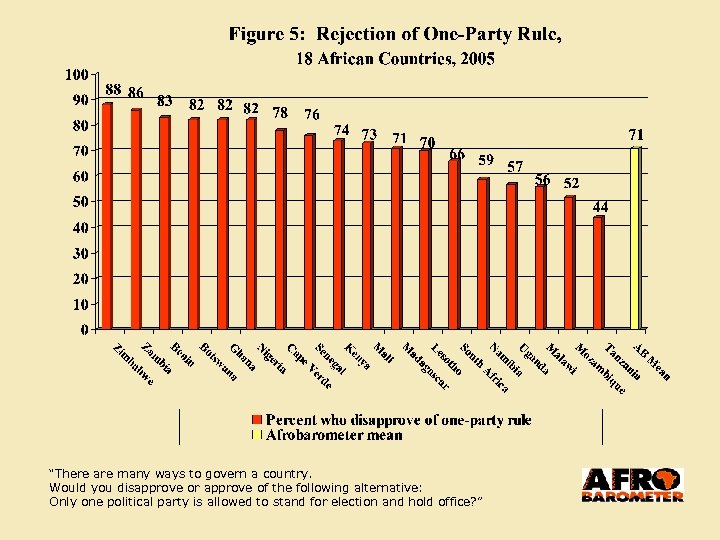 “There are many ways to govern a country. Would you disapprove or approve of the following alternative: Only one political party is allowed to stand for election and hold office? ”
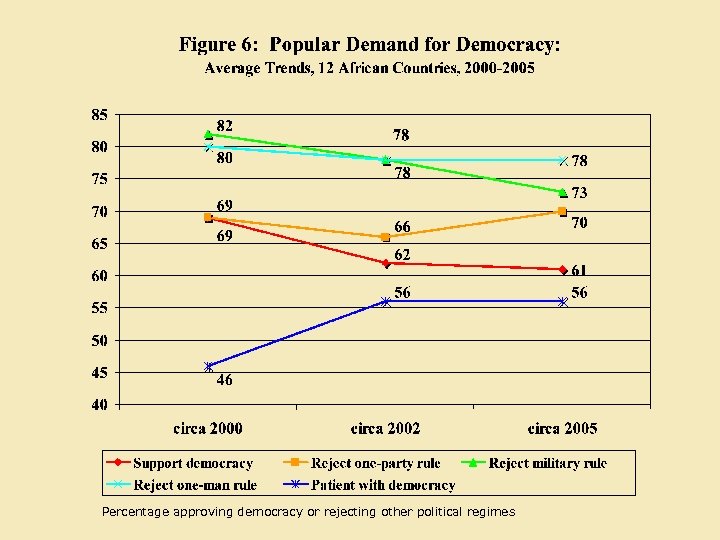
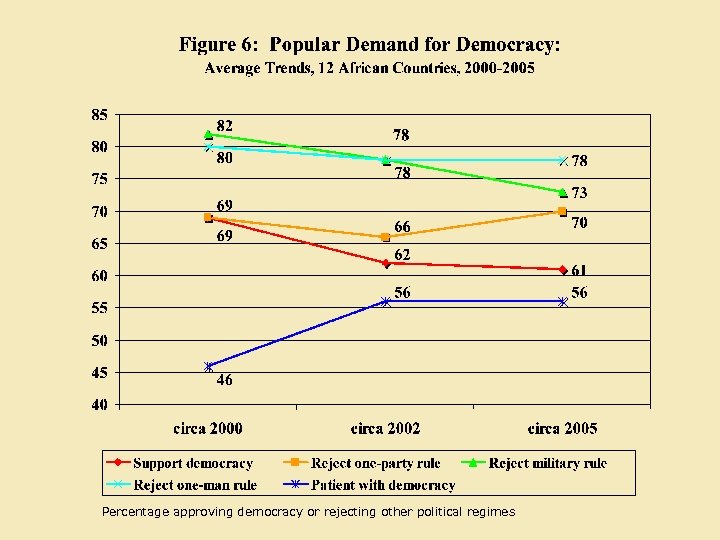 Percentage approving democracy or rejecting other political regimes
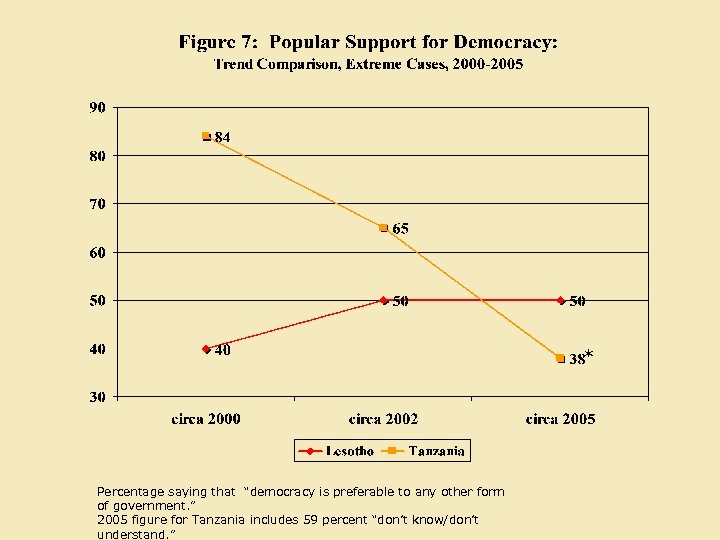 * Percentage saying that “democracy is preferable to any other form of government. ” 2005 figure for Tanzania includes 59 percent “don’t know/don’t understand. ”
 Percentage approving democracy or rejecting other political regimes
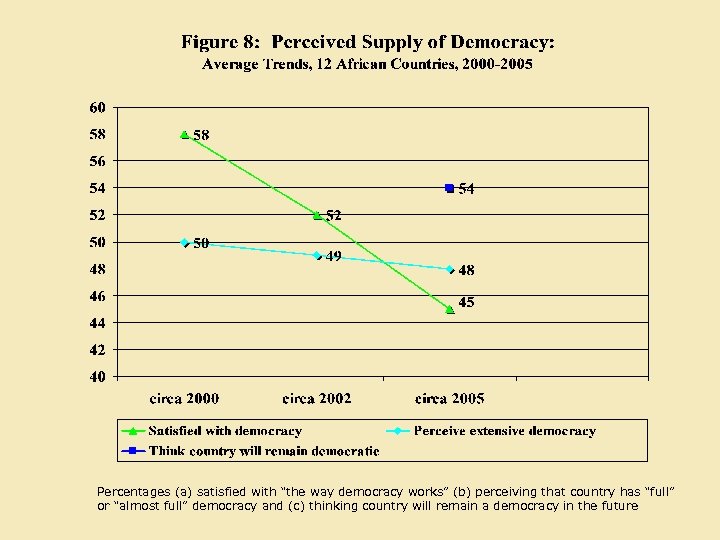 Percentages (a) satisfied with “the way democracy works” (b) perceiving that country has “full” or “almost full” democracy and (c) thinking country will remain a democracy in the future
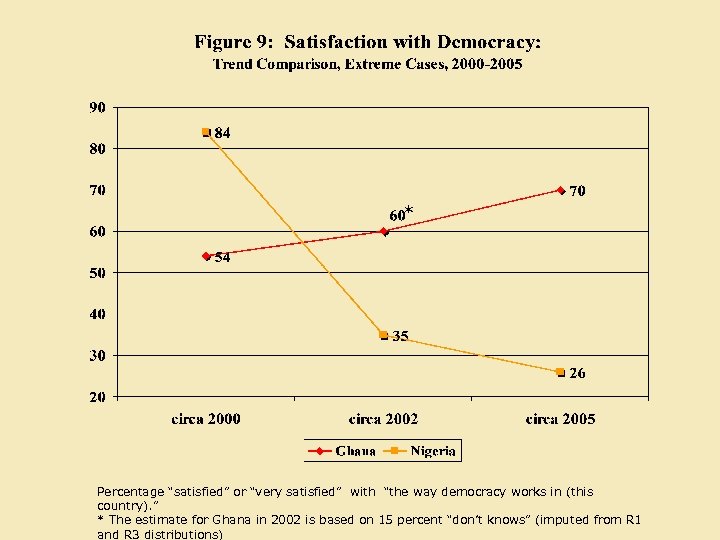 * Percentage “satisfied” or “very satisfied” with “the way democracy works in (this country). ” * The estimate for Ghana in 2002 is based on 15 percent “don’t knows” (imputed from R 1 and R 3 distributions)
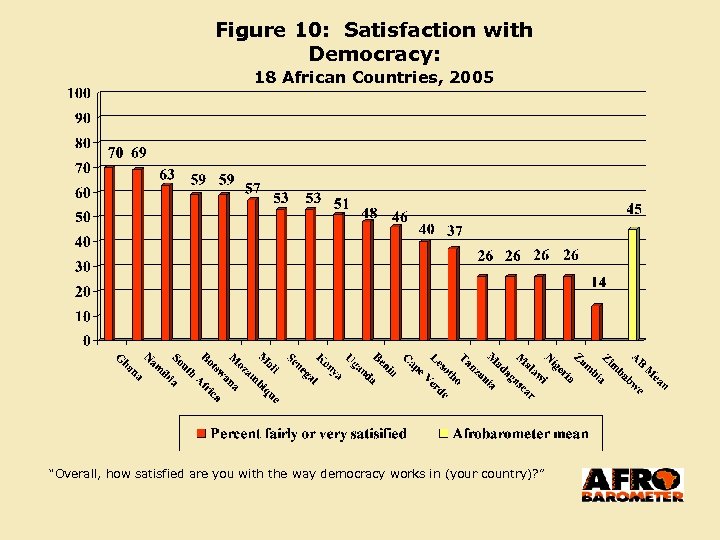 Figure 10: Satisfaction with Democracy: 18 African Countries, 2005 “Overall, how satisfied are you with the way democracy works in (your country)? ”
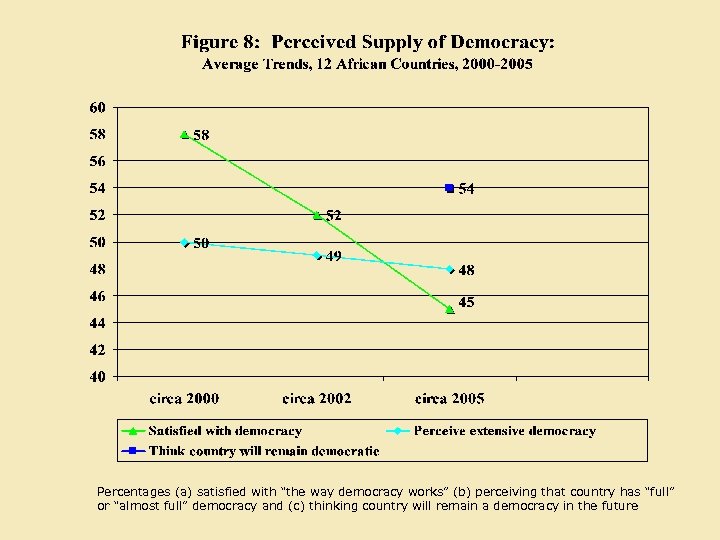 Percentages (a) satisfied with “the way democracy works” (b) perceiving that country has “full” or “almost full” democracy and (c) thinking country will remain a democracy in the future
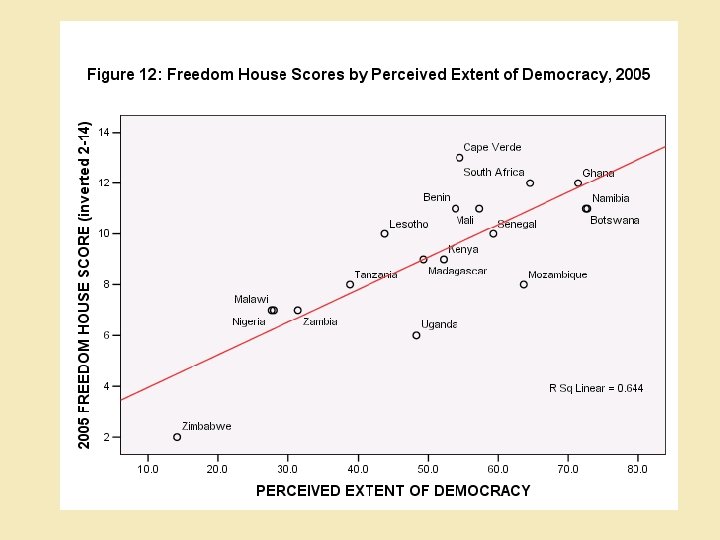
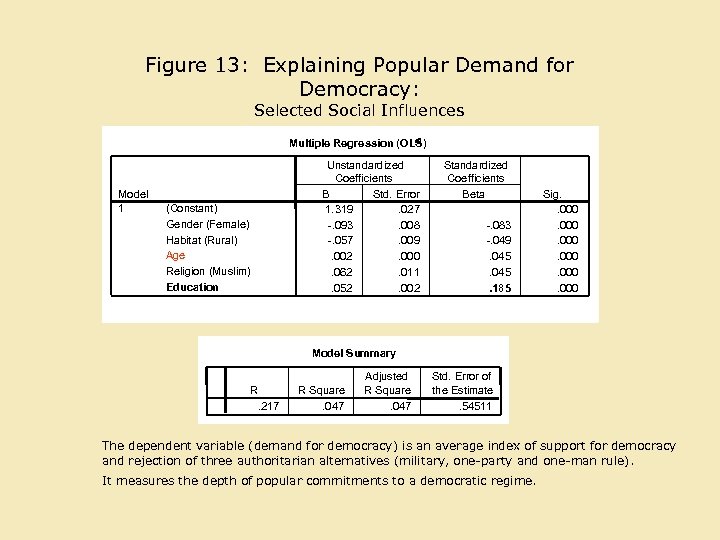 Figure 13: Explaining Popular Demand for Democracy: Selected Social Influences a Multiple Regression (OLS) Model 1 (Constant) Gender (Female) Habitat (Rural) Age Religion (Muslim) Education Unstandardized Coefficients B Std. Error 1. 319. 027 -. 093. 008 -. 057. 009. 002. 000. 062. 011. 052. 002 Standardized Coefficients Beta -. 083 -. 049. 045. 185 Sig. . 000 Model Summary R. 217 R Square. 047 Adjusted R Square. 047 Std. Error of the Estimate. 54511 The dependent variable (demand for democracy) is an average index of support for democracy and rejection of three authoritarian alternatives (military, one-party and one-man rule). It measures the depth of popular commitments to a democratic regime.
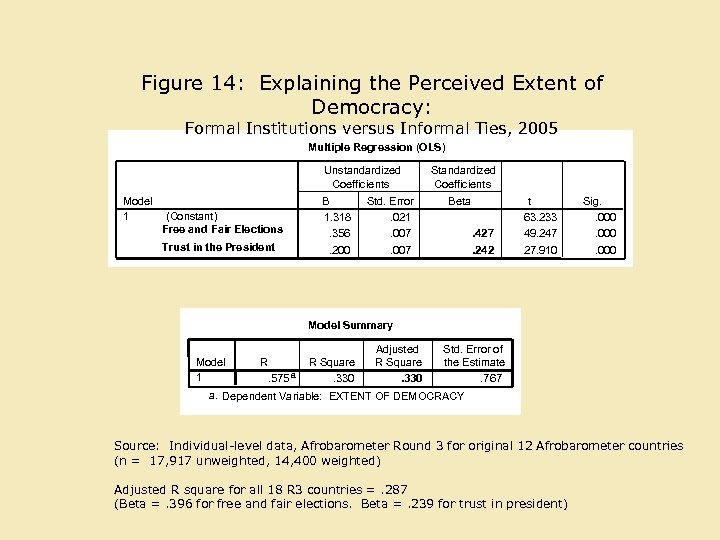 Figure 14: Explaining the Perceived Extent of Democracy: Formal Institutions versus Informal Ties, 2005 Multiple Regression (OLS) Model 1 (Constant) Free and Fair Elections Trust in the President Unstandardized Coefficients B Std. Error 1. 318. 021. 356. 007. 200. 007 Standardized Coefficients Beta. 427. 242 t 63. 233 49. 247 27. 910 Sig. . 000 Model Summary Model 1 R. 575 a R Square. 330 Adjusted R Square. 330 Std. Error of the Estimate. 767 a. Dependent Variable: EXTENT OF DEMOCRACY Source: Individual-level data, Afrobarometer Round 3 for original 12 Afrobarometer countries (n = 17, 917 unweighted, 14, 400 weighted) Adjusted R square for all 18 R 3 countries =. 287 (Beta =. 396 for free and fair elections. Beta =. 239 for trust in president)
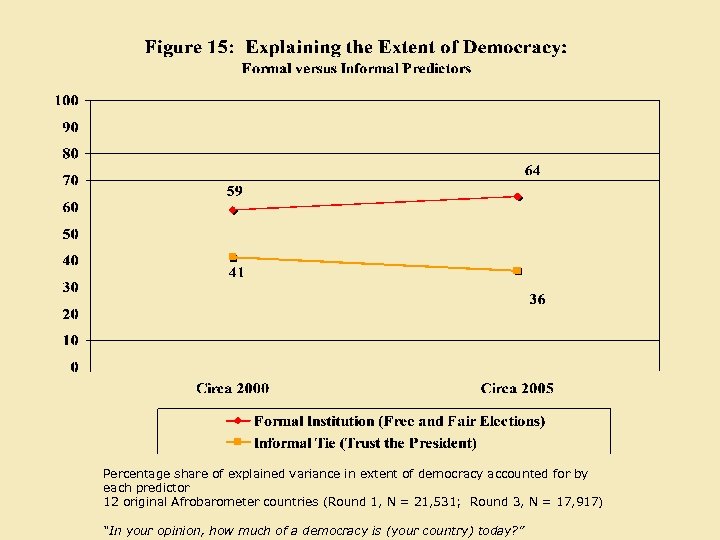 Percentage share of explained variance in extent of democracy accounted for by each predictor 12 original Afrobarometer countries (Round 1, N = 21, 531; Round 3, N = 17, 917) “In your opinion, how much of a democracy is (your country) today? ”
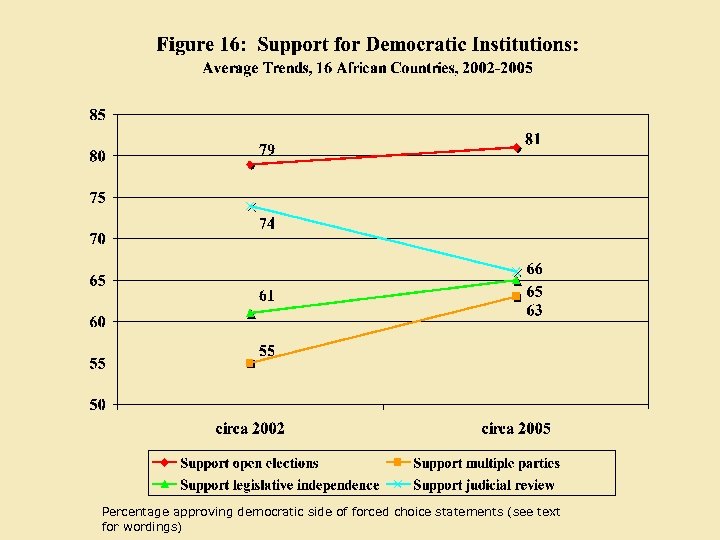 Percentage approving democratic side of forced choice statements (see text for wordings)
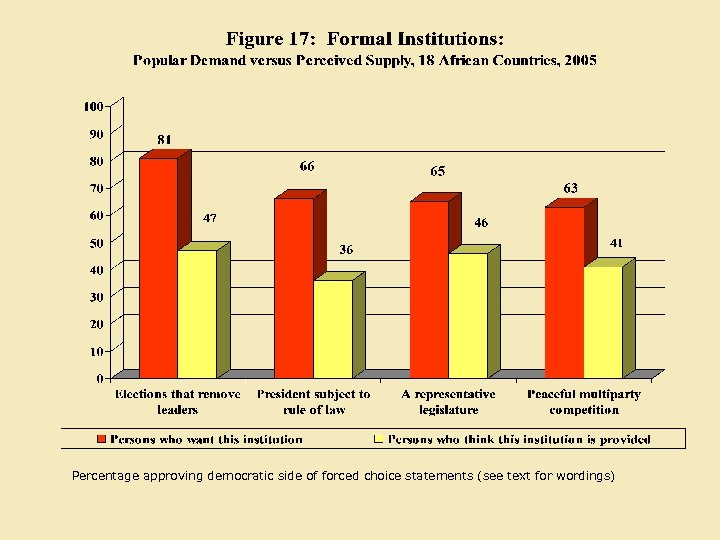 Percentage approving democratic side of forced choice statements (see text for wordings)
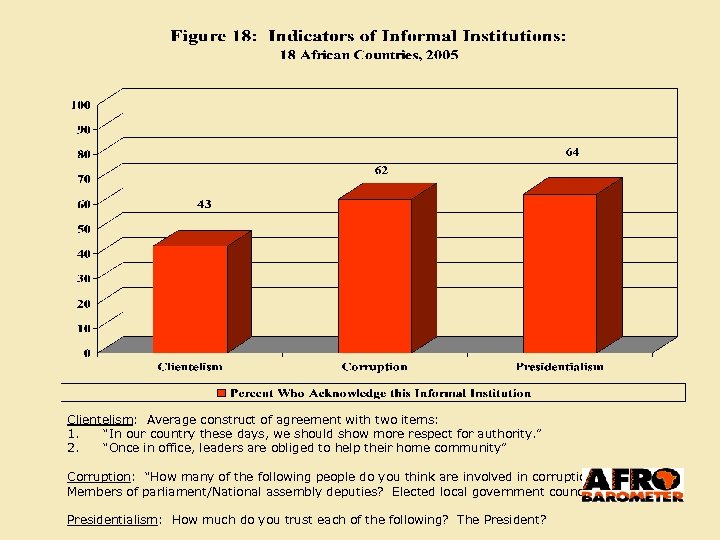 Clientelism: Average construct of agreement with two items: 1. “In our country these days, we should show more respect for authority. ” 2. “Once in office, leaders are obliged to help their home community” Corruption: “How many of the following people do you think are involved in corruption? Members of parliament/National assembly deputies? Elected local government councilors? Presidentialism: How much do you trust each of the following? The President?
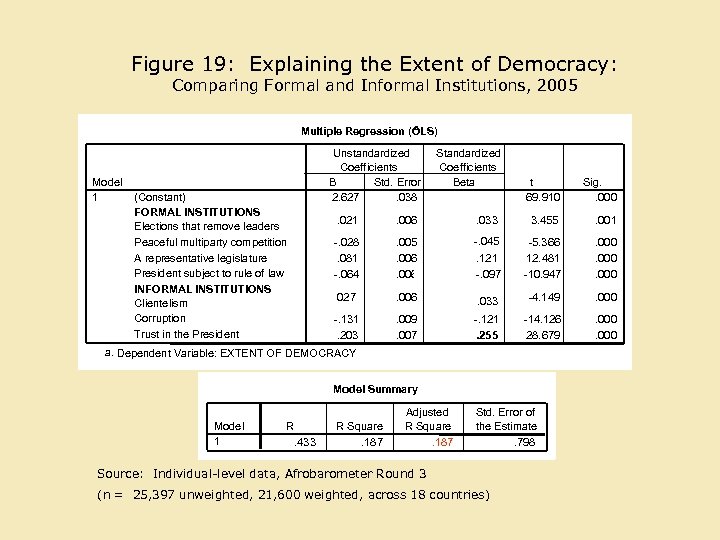 Figure 19: Explaining the Extent of Democracy: Comparing Formal and Informal Institutions, 2005 a Multiple Regression (OLS) Model 1 (Constant) FORMAL INSTITUTIONS Elections that remove leaders Peaceful multiparty competition A representative legislature President subject to rule of law INFORMAL INSTITUTIONS Clientelism Corruption Trust in the President Unstandardized Coefficients B Std. Error 2. 627. 038 Standardized Coefficients Beta t 69. 910 Sig. . 000 . 021 . 006 . 033 3. 455 . 001 -. 028. 081 -. 064 . 005. 006 -. 045. 121 -. 097 -5. 366 12. 481 -10. 947 . 000 027 . 006 . 033 -4. 149 . 000 -. 131. 203 . 009. 007 -. 121. 255 -14. 126 28. 679 . 000 a. Dependent Variable: EXTENT OF DEMOCRACY Model Summary Model 1 R. 433 R Square. 187 Adjusted R Square. 187 Std. Error of the Estimate. 798 Source: Individual-level data, Afrobarometer Round 3 (n = 25, 397 unweighted, 21, 600 weighted, across 18 countries)
 www. afrobarometer. org
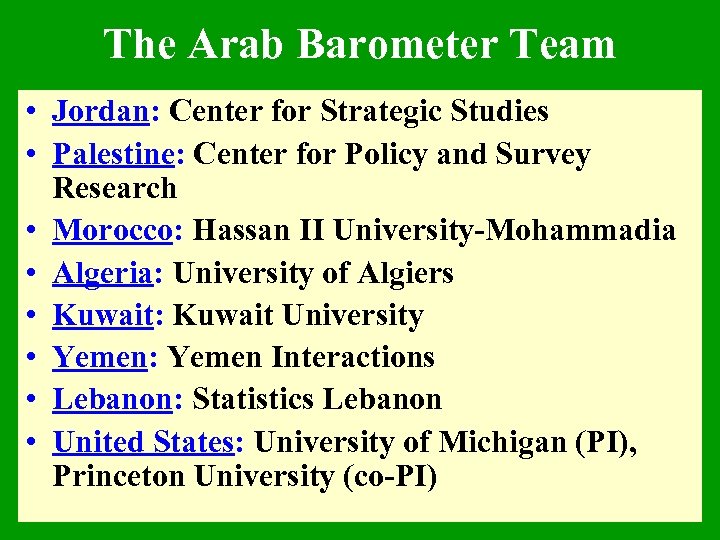 The Arab Barometer Team • Jordan: Center for Strategic Studies • Palestine: Center for Policy and Survey Research • Morocco: Hassan II University-Mohammadia • Algeria: University of Algiers • Kuwait: Kuwait University • Yemen: Yemen Interactions • Lebanon: Statistics Lebanon • United States: University of Michigan (PI), Princeton University (co-PI)
 Thinking about Governance and Democracy in the Arab World 2006 Arab Human Development Report: Deficit of Freedom. “Viewed from the perspective of freedom and good governance, it is difficult to describe subsequent events in the Arab arena as the kind of widespread, thorough-going reform for which the report called…despite the growing winds of protest against governments and the intensifying demands for radical reform around the Arab world. ”
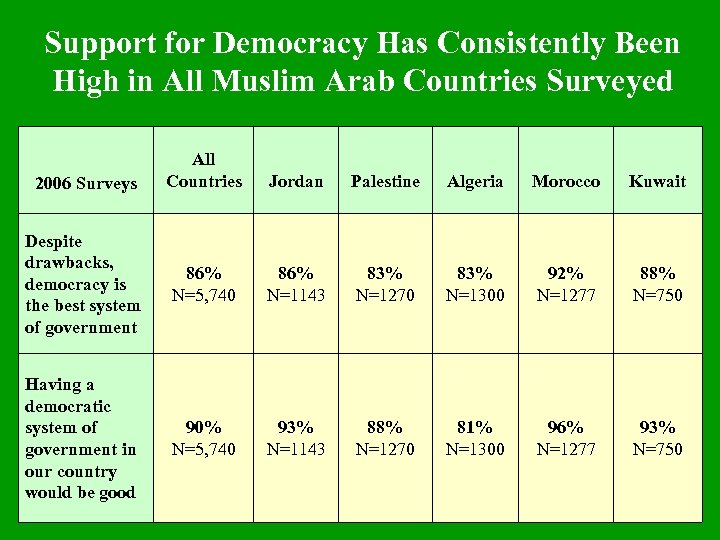 Support for Democracy Has Consistently Been High in All Muslim Arab Countries Surveyed All Countries Jordan Palestine Algeria Morocco Kuwait Despite drawbacks, democracy is the best system of government 86% N=5, 740 86% N=1143 83% N=1270 83% N=1300 92% N=1277 88% N=750 Having a democratic system of government in our country would be good 90% N=5, 740 93% N=1143 88% N=1270 81% N=1300 96% N=1277 93% N=750 2006 Surveys
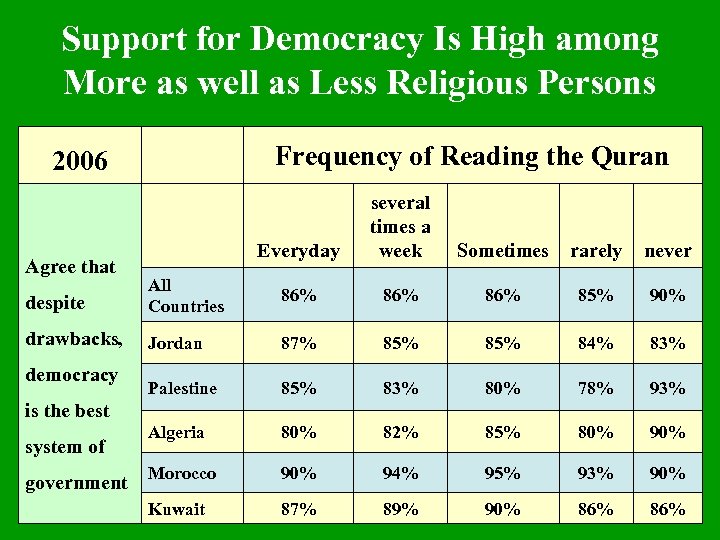 Support for Democracy Is High among More as well as Less Religious Persons Frequency of Reading the Quran 2006 Everyday several times a week Sometimes rarely never despite All Countries 86% 86% 85% 90% drawbacks, Jordan 87% 85% 84% 83% Palestine 85% 83% 80% 78% 93% Algeria 80% 82% 85% 80% 90% Morocco 90% 94% 95% 93% 90% Kuwait 87% 89% 90% 86% Agree that democracy is the best system of government
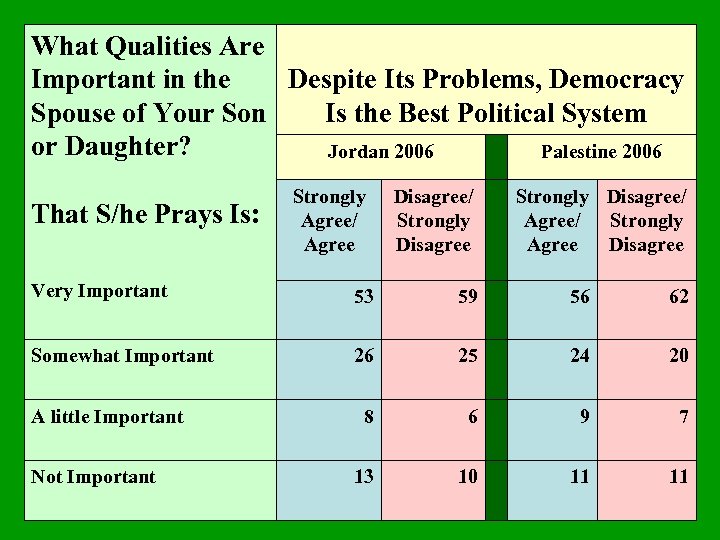 What Qualities Are Important in the Despite Its Problems, Democracy Spouse of Your Son Is the Best Political System or Daughter? Jordan 2006 Palestine 2006 That S/he Prays Is: Strongly Agree/ Agree Disagree/ Strongly Disagree/ Agree/ Strongly Agree Disagree Very Important 53 59 56 62 Somewhat Important 26 25 24 20 8 6 9 7 13 10 11 11 A little Important Not Important
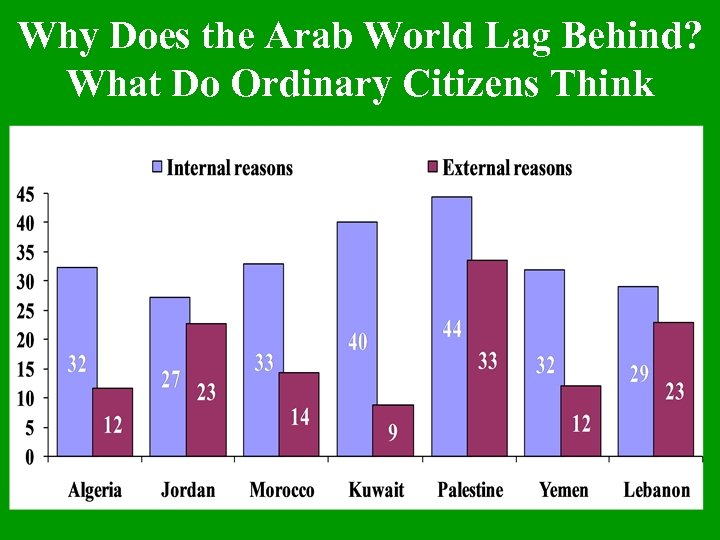 Why Does the Arab World Lag Behind? What Do Ordinary Citizens Think
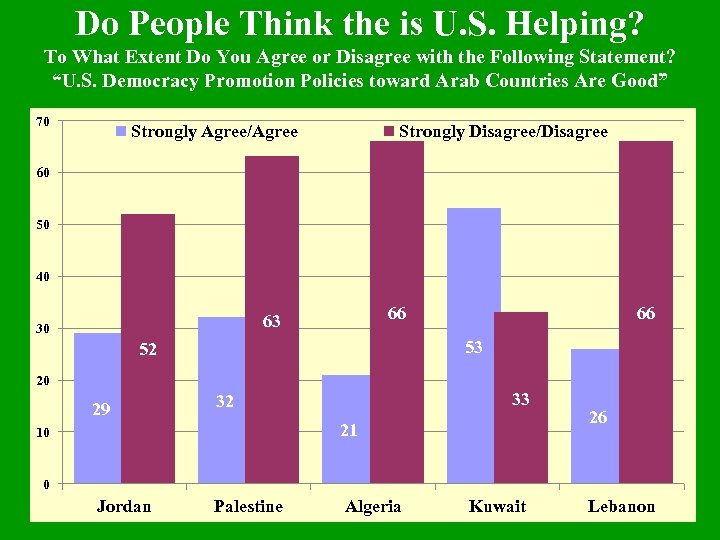 Do People Think the is U. S. Helping? To What Extent Do You Agree or Disagree with the Following Statement? “U. S. Democracy Promotion Policies toward Arab Countries Are Good” 70 Strongly Agree/Agree Strongly Disagree/Disagree 60 50 40 66 63 30 66 53 52 20 29 33 32 21 10 26 0 Jordan Palestine Algeria Kuwait Lebanon
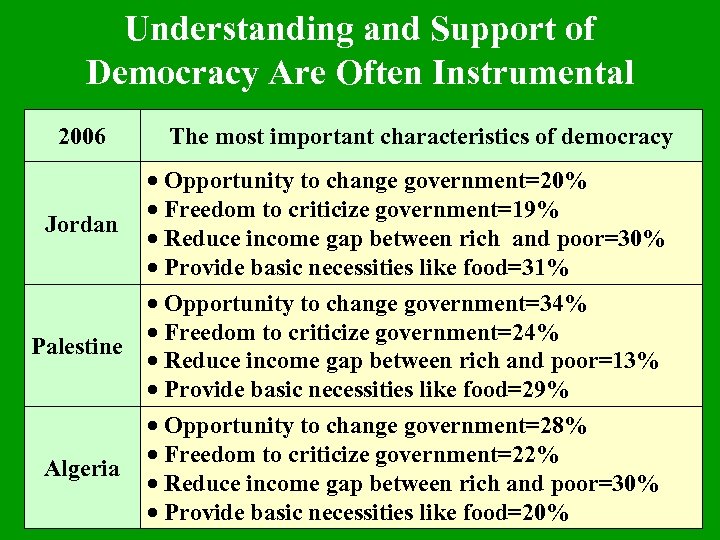 Understanding and Support of Democracy Are Often Instrumental 2006 The most important characteristics of democracy Opportunity to change government=20% Freedom to criticize government=19% Jordan Reduce income gap between rich and poor=30% Provide basic necessities like food=31% Opportunity to change government=34% Freedom to criticize government=24% Palestine Reduce income gap between rich and poor=13% Provide basic necessities like food=29% Opportunity to change government=28% Freedom to criticize government=22% Algeria Reduce income gap between rich and poor=30% Provide basic necessities like food=20%
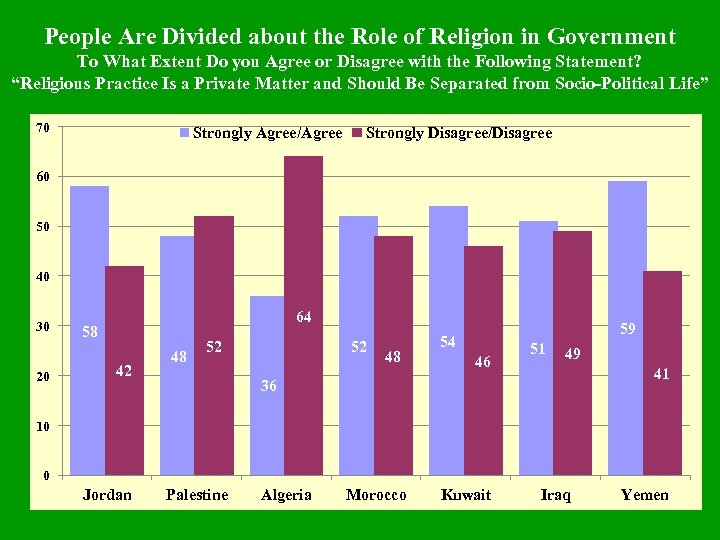 People Are Divided about the Role of Religion in Government To What Extent Do you Agree or Disagree with the Following Statement? “Religious Practice Is a Private Matter and Should Be Separated from Socio-Political Life” 70 Strongly Agree/Agree Strongly Disagree/Disagree 60 50 40 30 20 64 58 42 48 52 52 48 59 54 46 51 49 41 36 10 0 Jordan Palestine Algeria Morocco Kuwait Iraq Yemen
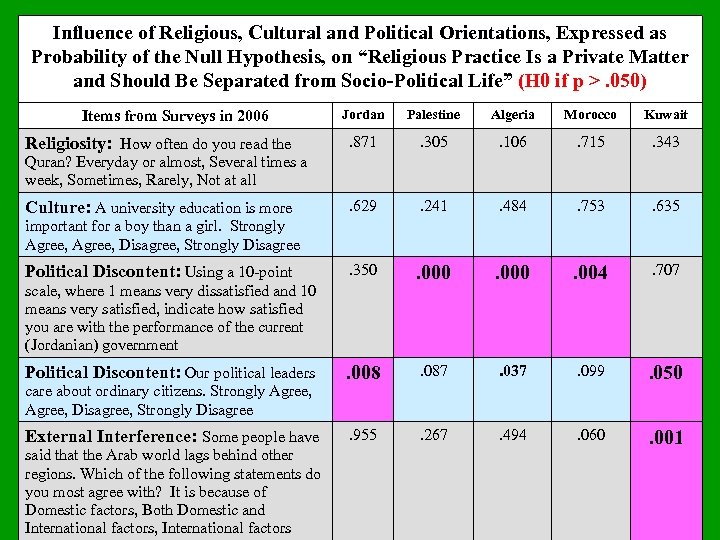 Influence of Religious, Cultural and Political Orientations, Expressed as Probability of the Null Hypothesis, on “Religious Practice Is a Private Matter and Should Be Separated from Socio-Political Life” (H 0 if p >. 050) Items from Surveys in 2006 Religiosity: How often do you read the Jordan Palestine Algeria Morocco Kuwait . 871 . 305 . 106 . 715 . 343 . 629 . 241 . 484 . 753 . 635 . 350 . 000 . 004 . 707 . 008 . 087 . 037 . 099 . 050 . 955 . 267 . 494 . 060 . 001 Quran? Everyday or almost, Several times a week, Sometimes, Rarely, Not at all Culture: A university education is more important for a boy than a girl. Strongly Agree, Disagree, Strongly Disagree Political Discontent: Using a 10 -point scale, where 1 means very dissatisfied and 10 means very satisfied, indicate how satisfied you are with the performance of the current (Jordanian) government Political Discontent: Our political leaders care about ordinary citizens. Strongly Agree, Disagree, Strongly Disagree External Interference: Some people have said that the Arab world lags behind other regions. Which of the following statements do you most agree with? It is because of Domestic factors, Both Domestic and International factors, International factors
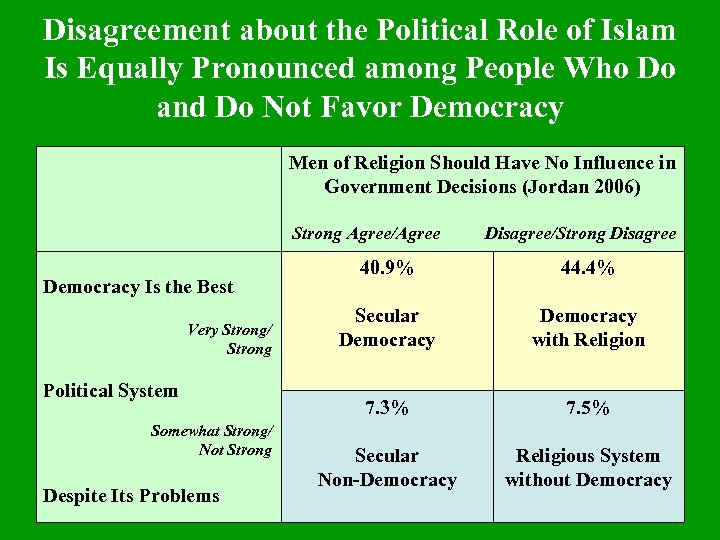 Disagreement about the Political Role of Islam Is Equally Pronounced among People Who Do and Do Not Favor Democracy Men of Religion Should Have No Influence in Government Decisions (Jordan 2006) Strong Agree/Agree Democracy Is the Best Very Strong/ Strong Political System Somewhat Strong/ Not Strong Despite Its Problems Disagree/Strong Disagree 40. 9% 44. 4% Secular Democracy with Religion 7. 3% 7. 5% Secular Non-Democracy Religious System without Democracy
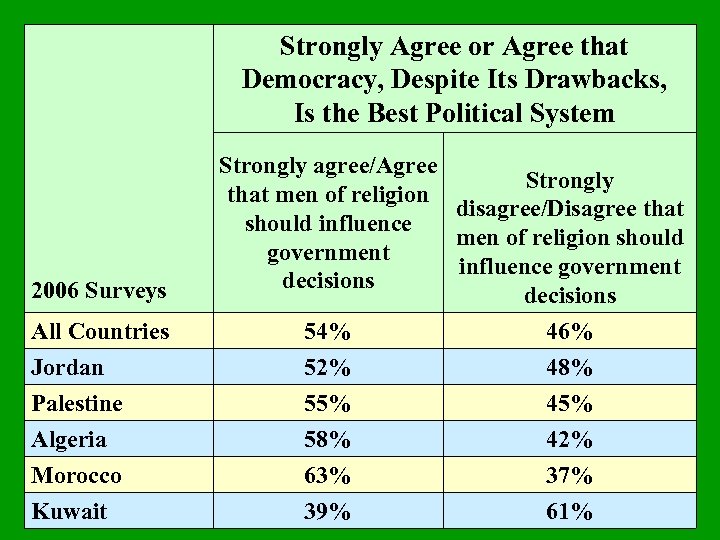 Strongly Agree or Agree that Democracy, Despite Its Drawbacks, Is the Best Political System 2006 Surveys All Countries Jordan Palestine Algeria Morocco Kuwait Strongly agree/Agree Strongly that men of religion disagree/Disagree that should influence men of religion should government influence government decisions 54% 46% 52% 48% 55% 58% 63% 39% 45% 42% 37% 61%
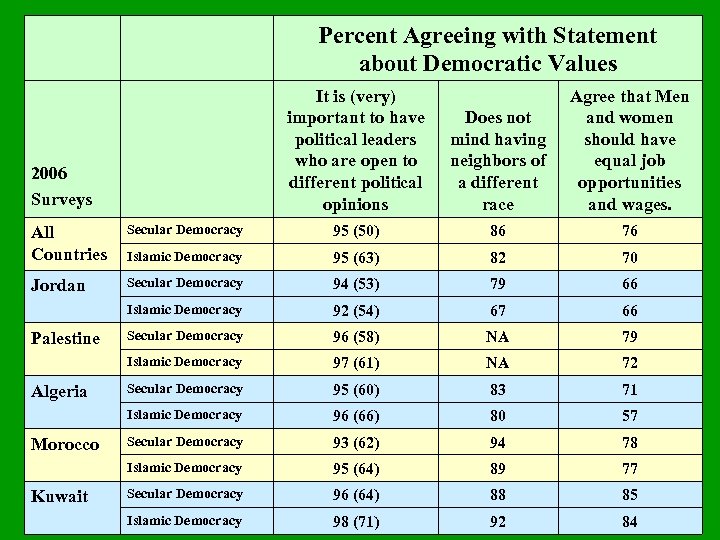 Percent Agreeing with Statement about Democratic Values It is (very) important to have political leaders who are open to different political opinions 2006 Surveys Does not mind having neighbors of a different race Agree that Men and women should have equal job opportunities and wages. All Countries Secular Democracy 95 (50) 86 76 Islamic Democracy 95 (63) 82 70 Jordan Secular Democracy 94 (53) 79 66 Islamic Democracy 92 (54) 67 66 Secular Democracy 96 (58) NA 79 Islamic Democracy 97 (61) NA 72 Secular Democracy 95 (60) 83 71 Islamic Democracy 96 (66) 80 57 Secular Democracy 93 (62) 94 78 Islamic Democracy 95 (64) 89 77 Secular Democracy 96 (64) 88 85 Islamic Democracy 98 (71) 92 84 Palestine Algeria Morocco Kuwait
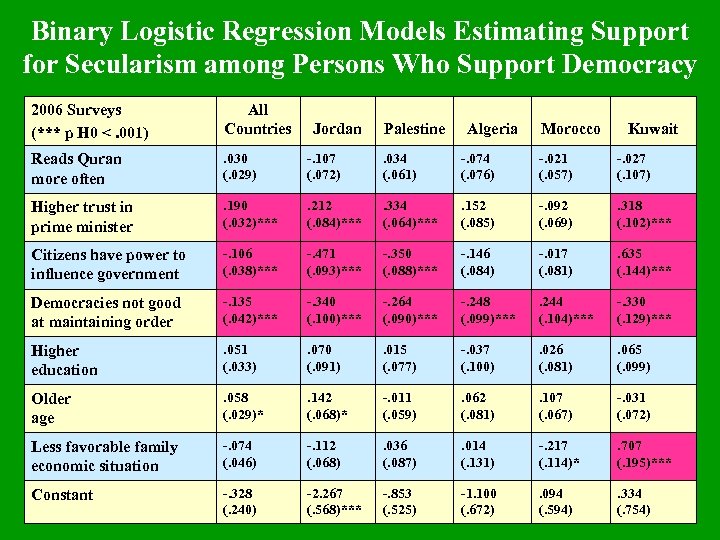 Binary Logistic Regression Models Estimating Support for Secularism among Persons Who Support Democracy 2006 Surveys (*** p H 0 <. 001) All Countries Reads Quran more often . 030 (. 029) -. 107 (. 072) . 034 (. 061) -. 074 (. 076) -. 021 (. 057) -. 027 (. 107) Higher trust in prime minister . 190 (. 032)*** . 212 (. 084)*** . 334 (. 064)*** . 152 (. 085) -. 092 (. 069) . 318 (. 102)*** Citizens have power to influence government -. 106 (. 038)*** -. 471 (. 093)*** -. 350 (. 088)*** -. 146 (. 084) -. 017 (. 081) . 635 (. 144)*** Democracies not good at maintaining order -. 135 (. 042)*** -. 340 (. 100)*** -. 264 (. 090)*** -. 248 (. 099)*** . 244 (. 104)*** -. 330 (. 129)*** Higher education . 051 (. 033) . 070 (. 091) . 015 (. 077) -. 037 (. 100) . 026 (. 081) . 065 (. 099) Older age . 058 (. 029)* . 142 (. 068)* -. 011 (. 059) . 062 (. 081) . 107 (. 067) -. 031 (. 072) Less favorable family economic situation -. 074 (. 046) -. 112 (. 068) . 036 (. 087) . 014 (. 131) -. 217 (. 114)* . 707 (. 195)*** Constant -. 328 (. 240) -2. 267 (. 568)*** -. 853 (. 525) -1. 100 (. 672) . 094 (. 594) . 334 (. 754) Jordan Palestine Algeria Morocco Kuwait
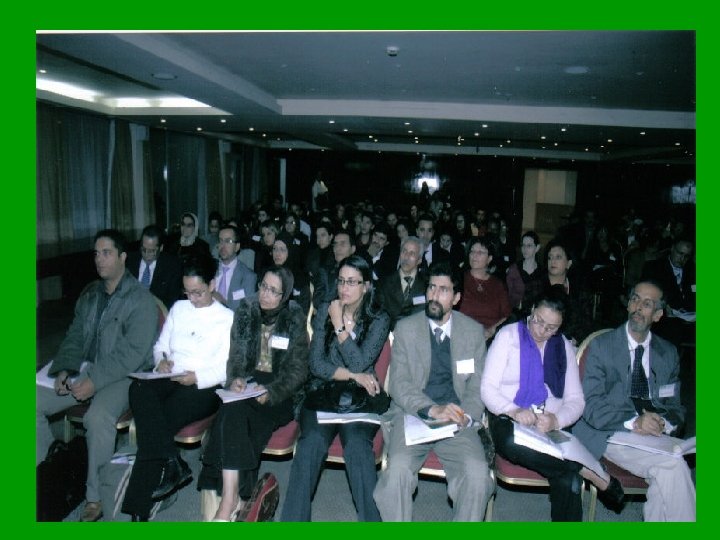
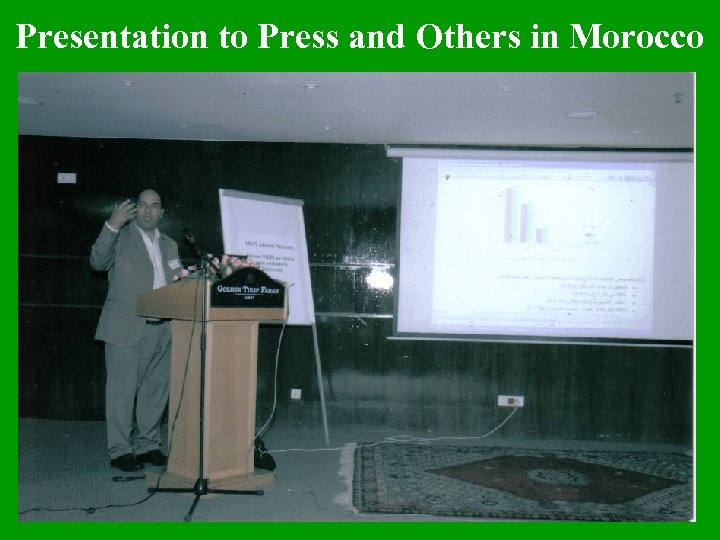 Presentation to Press and Others in Morocco