


 Скачать презентацию How do we do more for less Karen
771b4f31a6ad2e74abb220cbebd22101.ppt
- Количество слайдов: 18
 How do we do more for less? Karen Middleton CBE Chief Health Professions Officer, England 11 September 2012
 Summary § Why more for less? § Health and Social Care Act § Implications for clinical practice and services § Innovation § Act now!
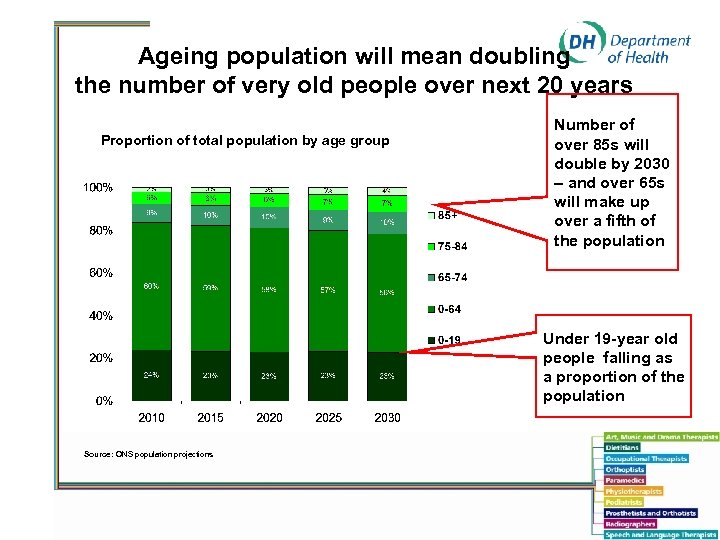 Ageing population will mean doubling the number of very old people over next 20 years Proportion of total population by age group Number of over 85 s will double by 2030 – and over 65 s will make up over a fifth of the population Under 19 -year old people falling as a proportion of the population Source: ONS population projections
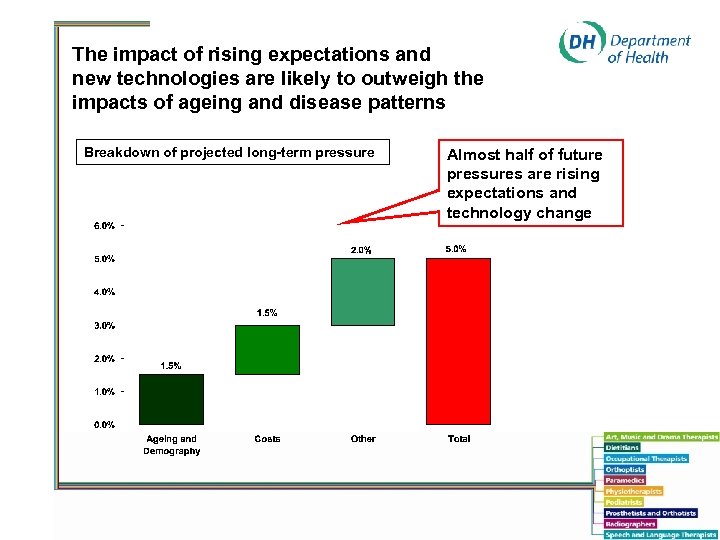 The impact of rising expectations and new technologies are likely to outweigh the impacts of ageing and disease patterns Breakdown of projected long-term pressure Almost half of future pressures are rising expectations and technology change
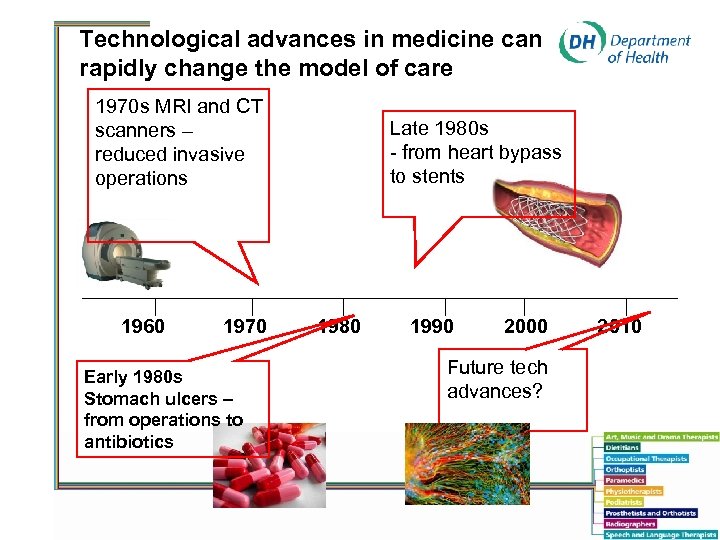 Technological advances in medicine can rapidly change the model of care 1970 s MRI and CT scanners – reduced invasive operations 1960 1970 Early 1980 s Stomach ulcers – from operations to antibiotics Late 1980 s - from heart bypass to stents 1980 1990 2000 Future tech advances? 2010
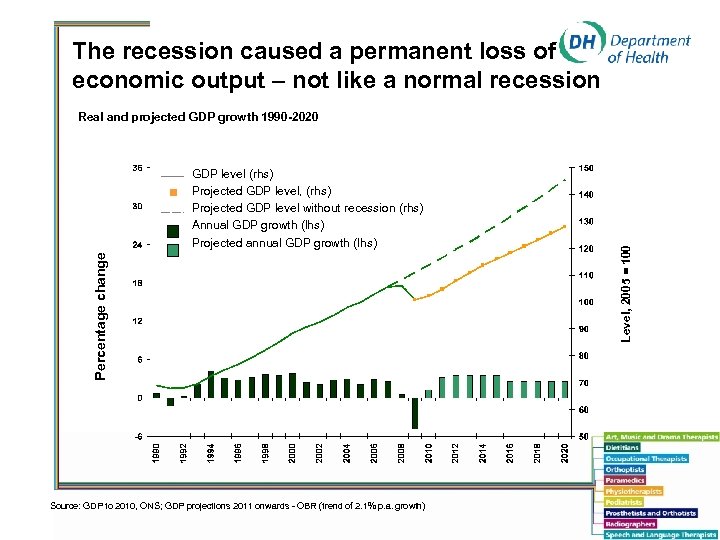 The recession caused a permanent loss of economic output – not like a normal recession Percentage change GDP level (rhs) Projected GDP level, (rhs) Projected GDP level without recession (rhs) Annual GDP growth (lhs) Projected annual GDP growth (lhs) Source: GDP to 2010, ONS; GDP projections 2011 onwards - OBR (trend of 2. 1% p. a. growth) Level, 2005 = 100 Real and projected GDP growth 1990 -2020
 Health and Social Care Act § Nothing about me, without me – Choice, plurality, information, Integration § Improving healthcare outcomes – Outcomes Frameworks, standards, incentives, public health § Empowering clinicians – CCGs, H&WB Boards, networks and senates
 Implications for clinical practice and services Clinical practice and services that – § Are high quality (safe, effective and a good experience) § Reduce demand on the system and promote self-management and independence § Are evidenced-based § Are supported by data and high quality information § Meet local need § Can reduce costs § Are integrated and easy to navigate § Are business-like and perform well (family and friends test) AND are what commissioners want to buy!
 Innovation ‘An idea, service or product, new to the NHS or applied in a way that is new to the NHS, which significantly improves the quality of health and care wherever it is applied’ Innovation, Health and Wealth, 2011
 Innovation § Invention – the originating idea § Adoption – putting the idea into practice § Diffusion – the systematic uptake of the idea
 What makes diffusion happen? • Top down pressures • Horizontal pressures • Bottom up pressures
 Enabling innovation § Reduce variation § Improve metrics and information § Establish a more systemic delivery mechanism § Align incentives § Improve procurement § Develop people to innovate § Strengthen leadership in innovation § Identify and adopt high impact innovations
 The role of clinical leadership ‘Leaders must wake people out of inertia. They must get people excited about something they’ve never seen before, something that does not yet exist’ Rosa Beth Moss Kanter (Leadership for Change: Enduring Skills for Change Masters).
 The role of clinical leadership § A relentless focus on quality (safety, effectiveness, experience) § The self/us/now story – ‘When the tuning fork in clinicians hearts goes off, everyone can feel it’ Denham (2009) § Collaboration and sharing best practice § Productivity is clinical business § Doing the right thing
 How radical do we go? § § Inverting the system Prevention and rehabilitation/reablement Use of technology The role of the allied health professions
 Act now! § Keep informed § Understand what your customers need and want § Understand your business – AQP proforma § What is your offer? (Don’t forget professionalism!) § Develop an influencing strategy § Don’t wait!
 ‘At the end of the day, we must go forward with hope and not backward by fear and division’. Jesse Jackson