 Скачать презентацию How do coral survive on the bottom of
3cf52ad2a20d90b930a3b21638b1c0d4.ppt
- Количество слайдов: 17



How do coral survive on the bottom of the Gulf of Mexico? Understanding Lophelia coral
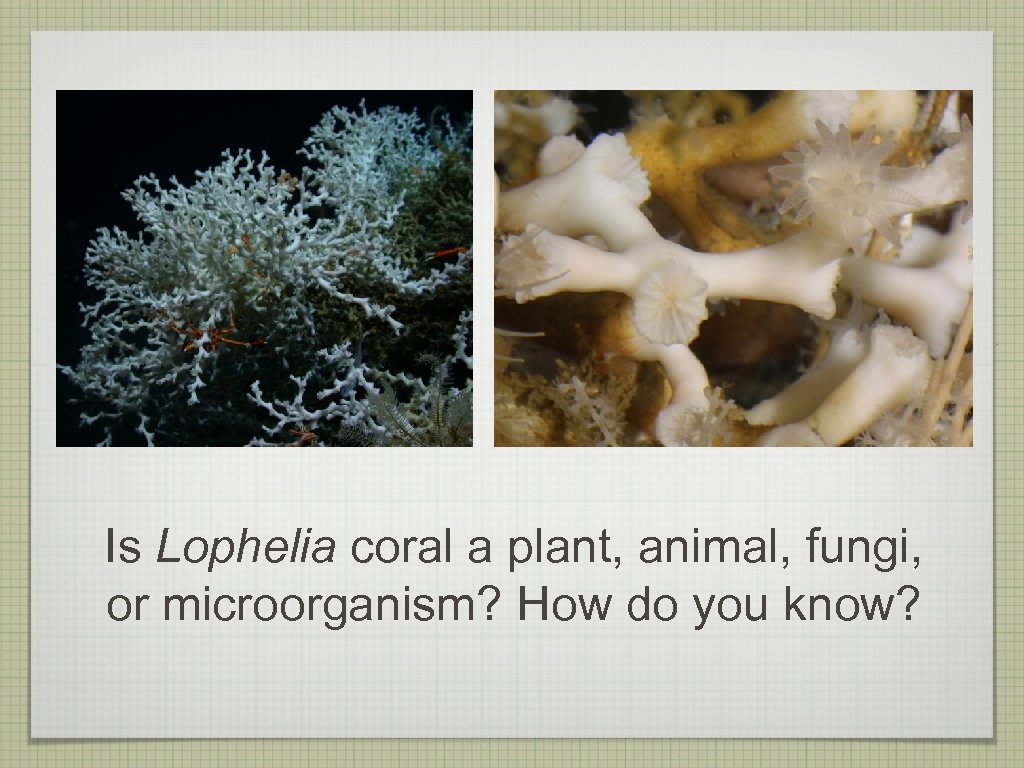
Is Lophelia coral a plant, animal, fungi, or microorganism? How do you know?
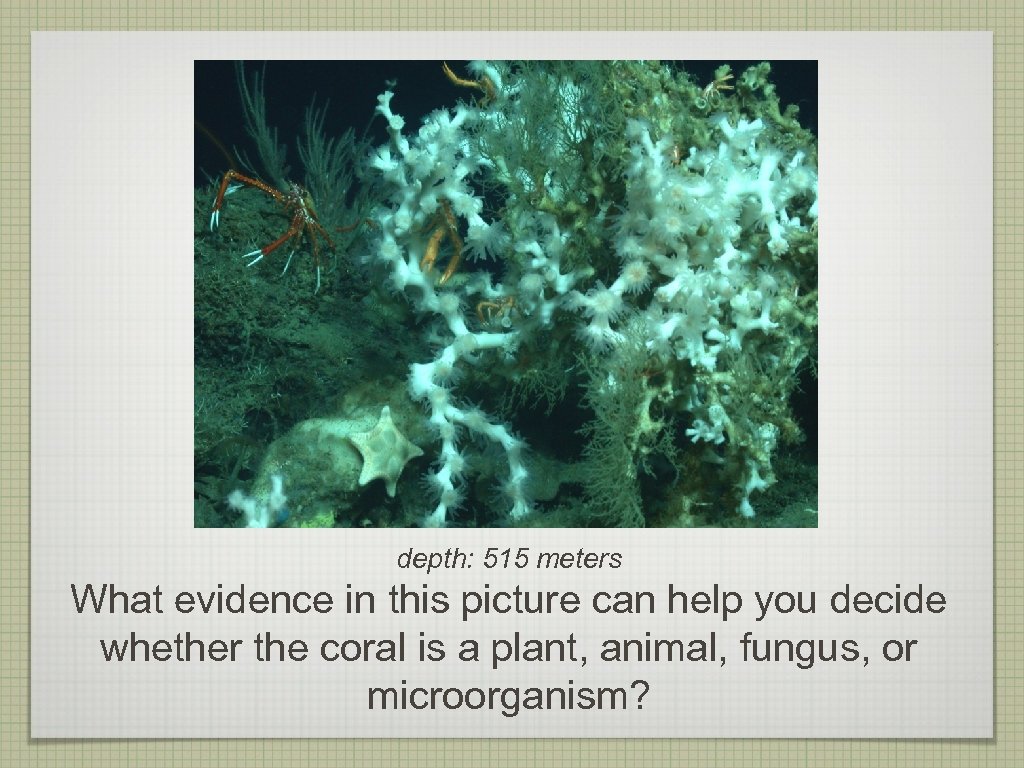
depth: 515 meters What evidence in this picture can help you decide whether the coral is a plant, animal, fungus, or microorganism?
Time to Vote! Plant Animal Fungi Microorganism
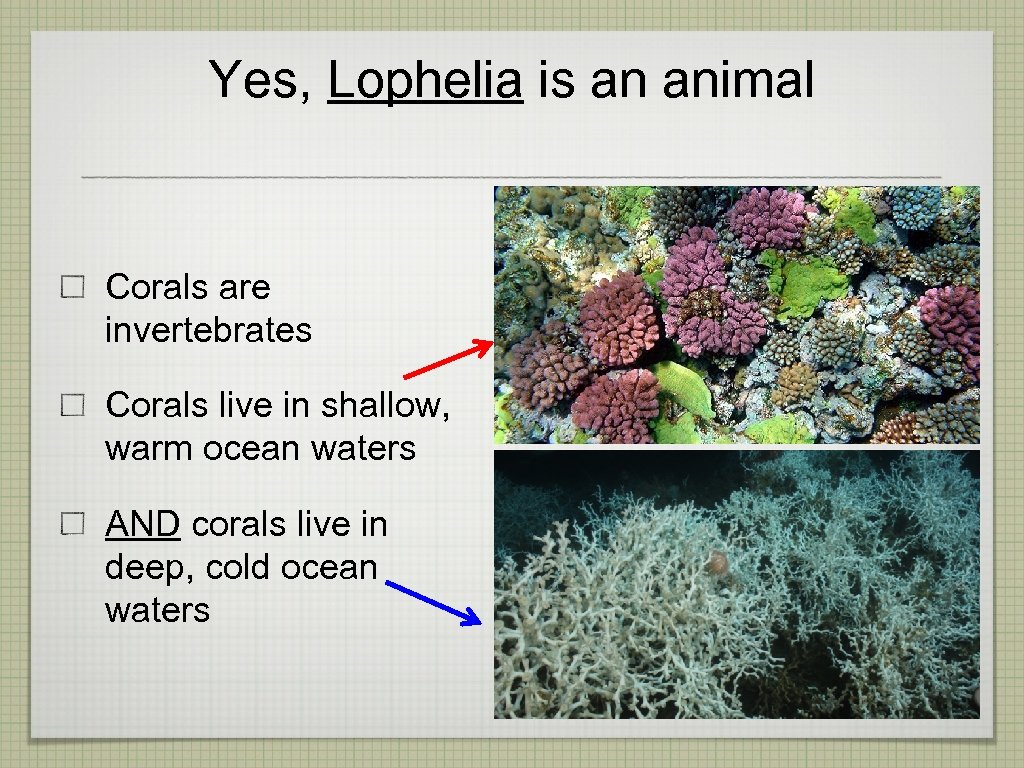
Yes, Lophelia is an animal Corals are invertebrates Corals live in shallow, warm ocean waters AND corals live in deep, cold ocean waters
What do Lophelia (and all living organisms) need to survive?
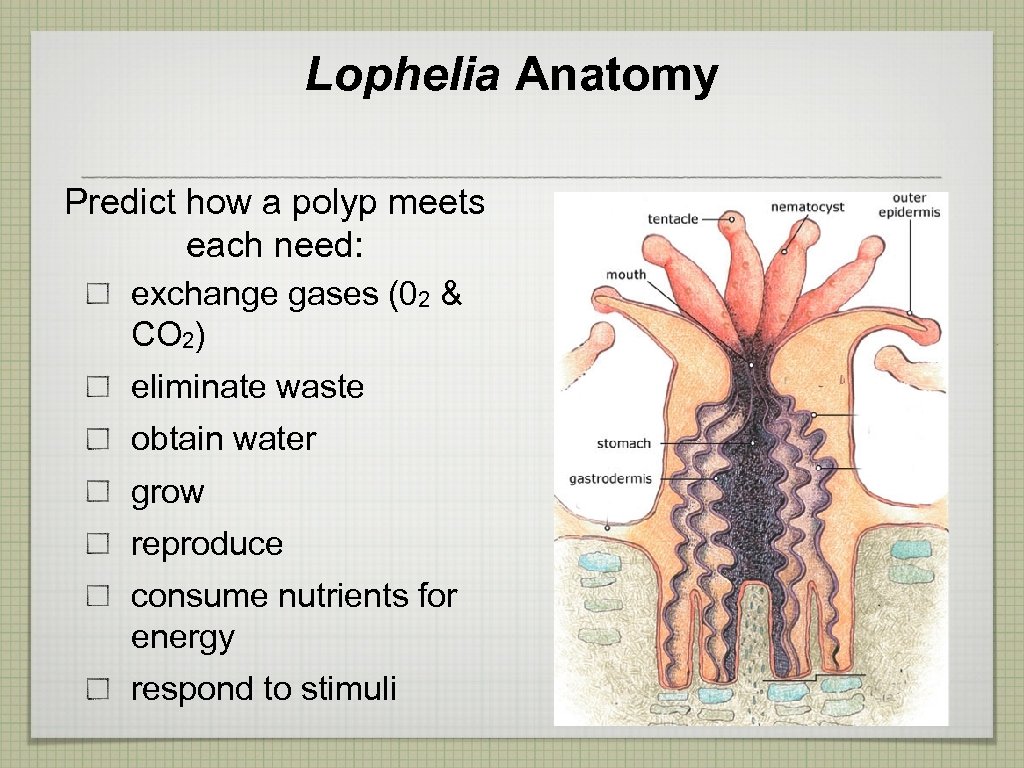
Lophelia Anatomy Predict how a polyp meets each need: exchange gases (02 & CO 2) eliminate waste obtain water grow reproduce consume nutrients for energy respond to stimuli
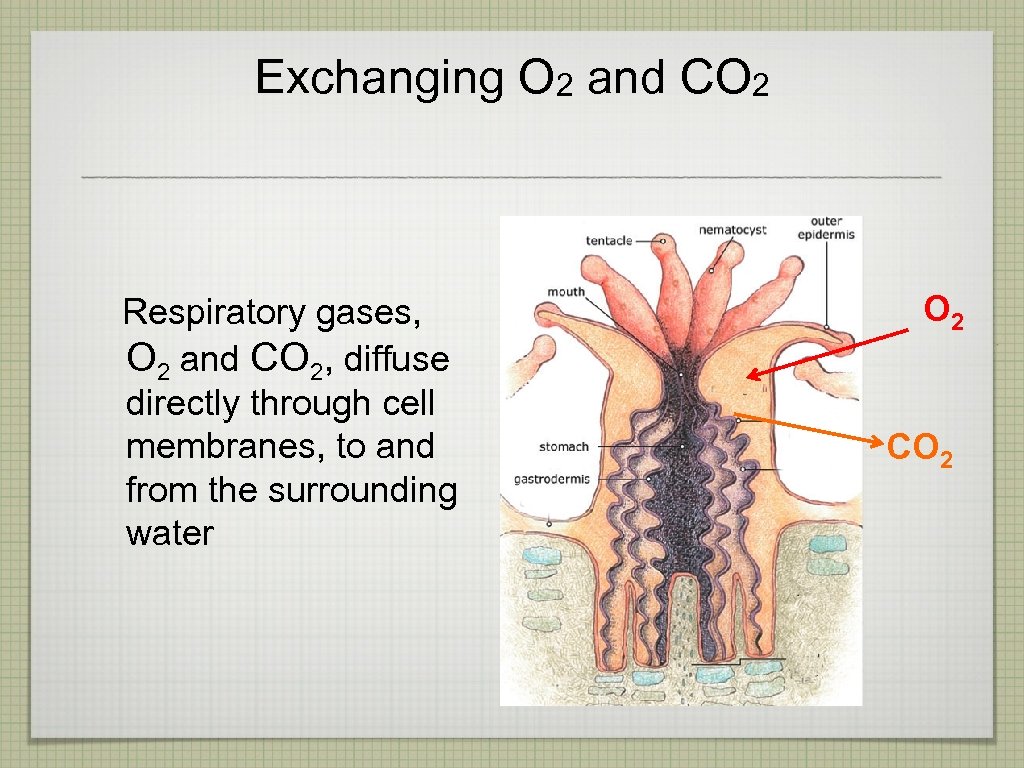
Exchanging O 2 and CO 2 Respiratory gases, O 2 and CO 2, diffuse directly through cell membranes, to and from the surrounding water O 2 CO 2
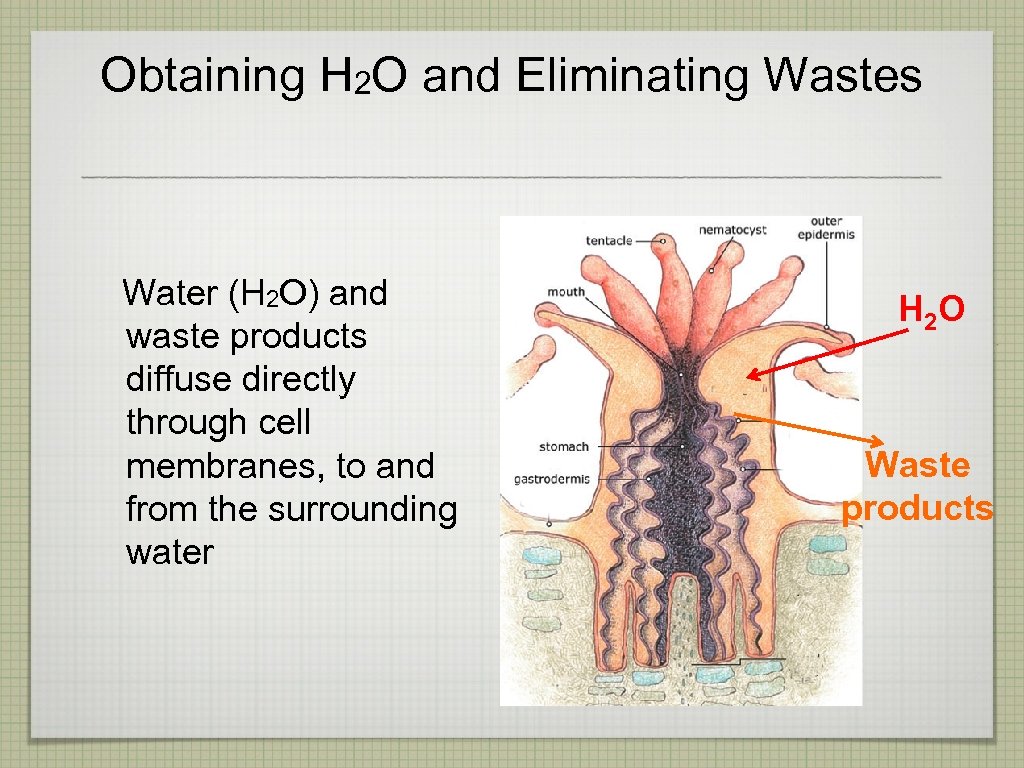
Obtaining H 2 O and Eliminating Wastes Water (H 2 O) and waste products diffuse directly through cell membranes, to and from the surrounding water H 2 O Waste products
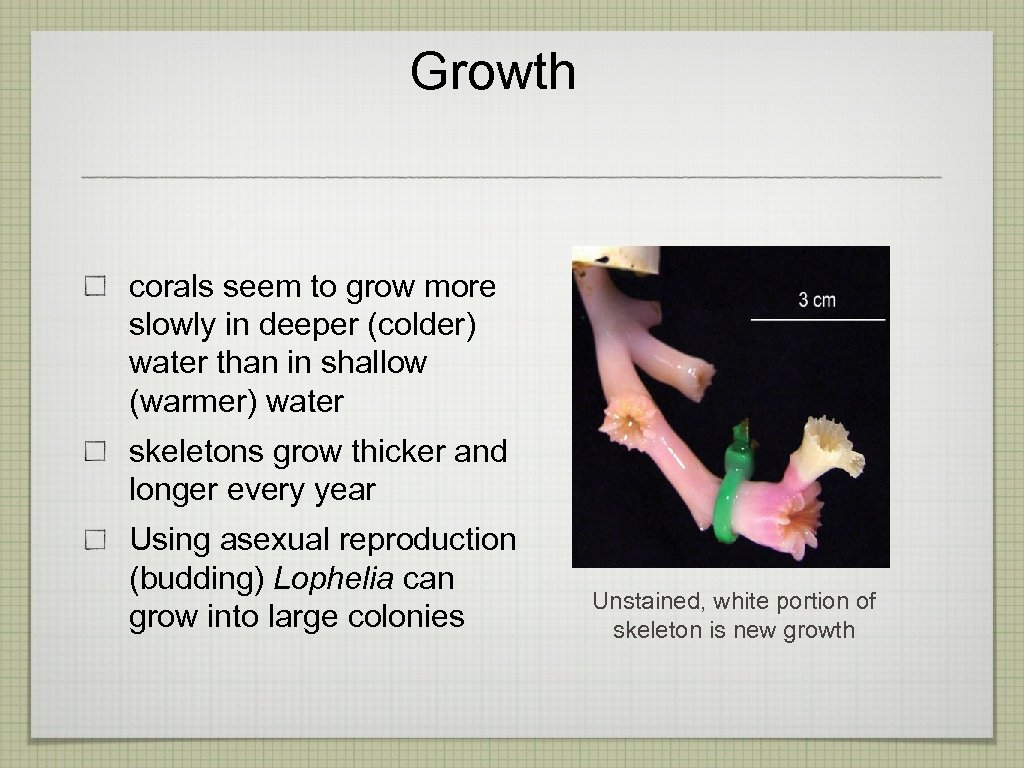
Growth corals seem to grow more slowly in deeper (colder) water than in shallow (warmer) water skeletons grow thicker and longer every year Using asexual reproduction (budding) Lophelia can grow into large colonies Unstained, white portion of skeleton is new growth
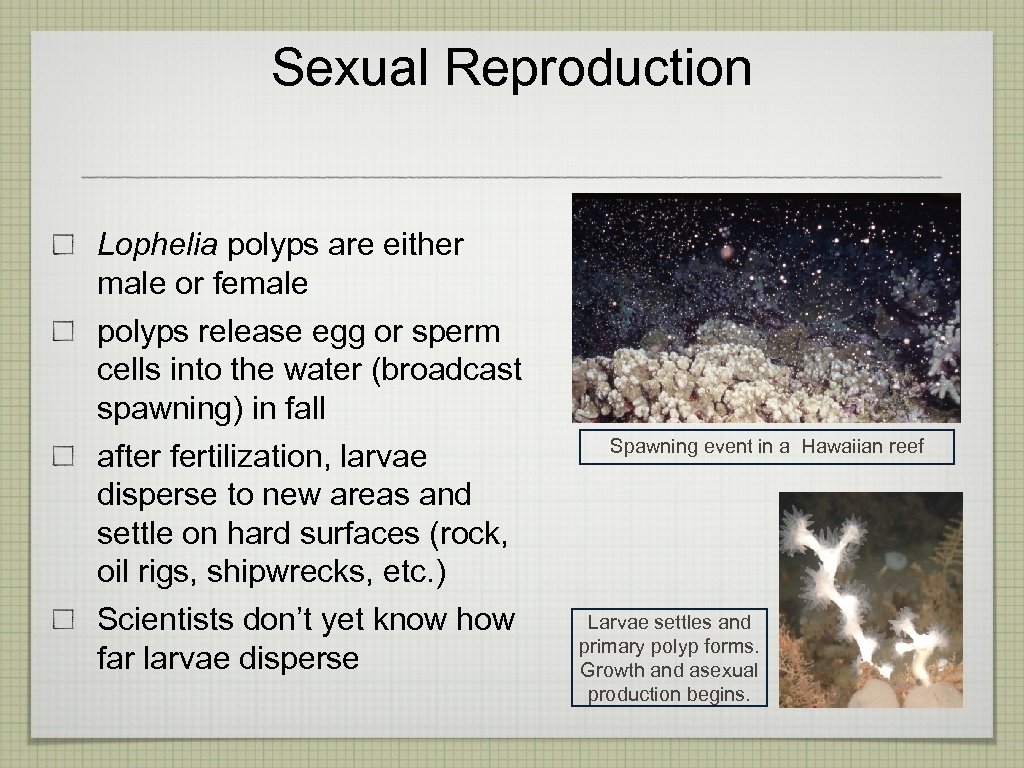
Sexual Reproduction Lophelia polyps are either male or female polyps release egg or sperm cells into the water (broadcast spawning) in fall after fertilization, larvae disperse to new areas and settle on hard surfaces (rock, oil rigs, shipwrecks, etc. ) Scientists don’t yet know how far larvae disperse Spawning event in a Hawaiian reef Larvae settles and primary polyp forms. Growth and asexual production begins.
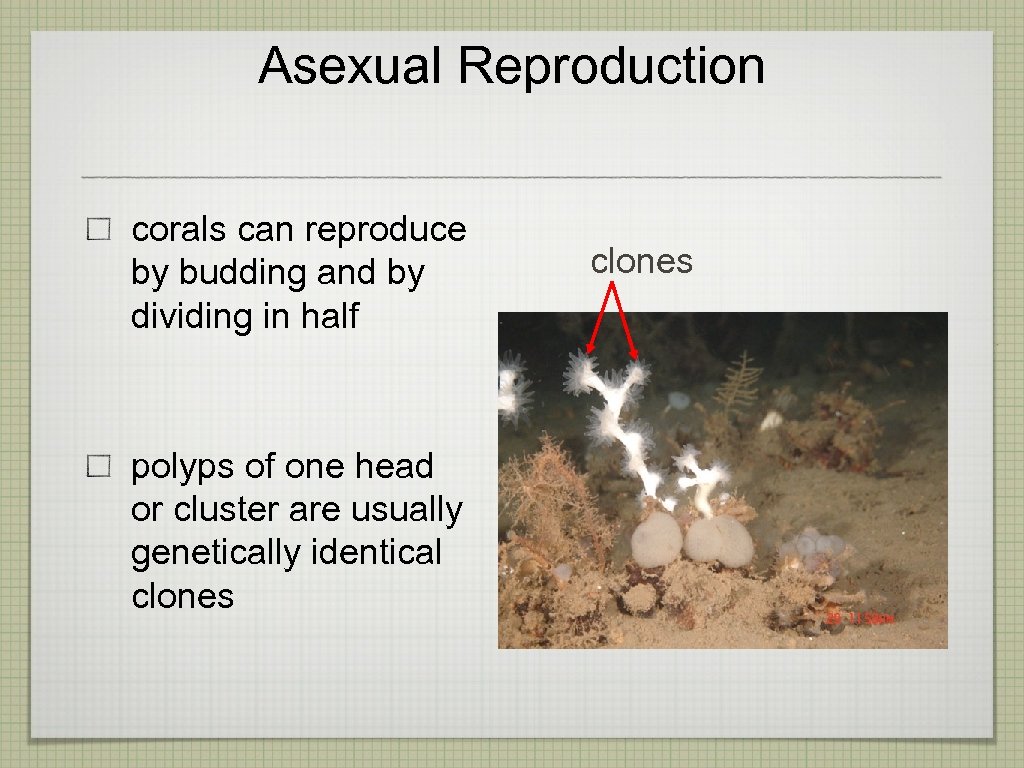
Asexual Reproduction corals can reproduce by budding and by dividing in half polyps of one head or cluster are usually genetically identical clones
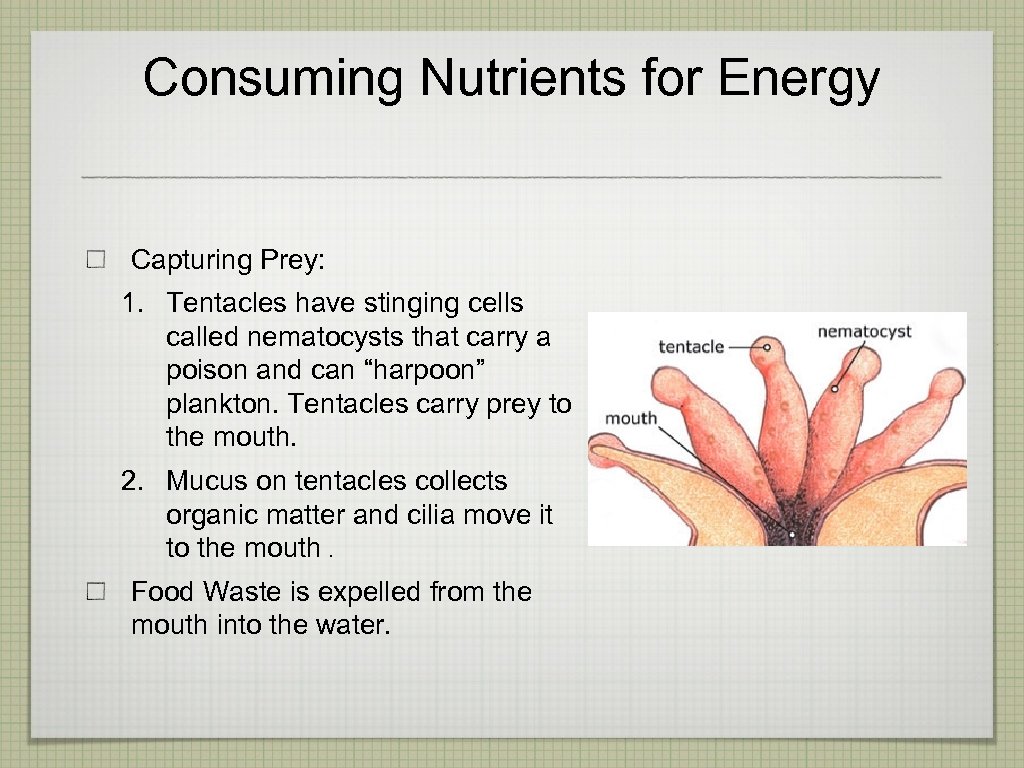
Consuming Nutrients for Energy Capturing Prey: 1. Tentacles have stinging cells called nematocysts that carry a poison and can “harpoon” plankton. Tentacles carry prey to the mouth. 2. Mucus on tentacles collects organic matter and cilia move it to the mouth. Food Waste is expelled from the mouth into the water.
Responding to stimuli Corals use tentacles to sense prey and move to mouth They discharge nematocysts to capture prey They close polyps when predators or other danger is sensed Corals release egg or sperm cells on some unknown cue (seasonal with food input? )
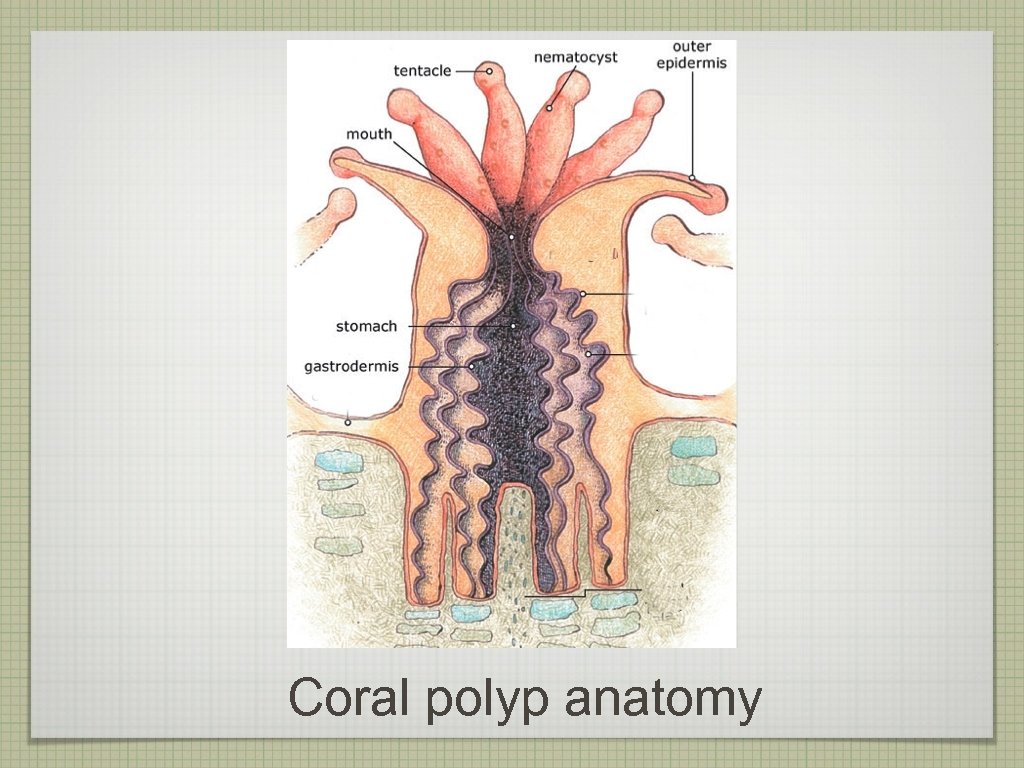
Coral polyp anatomy
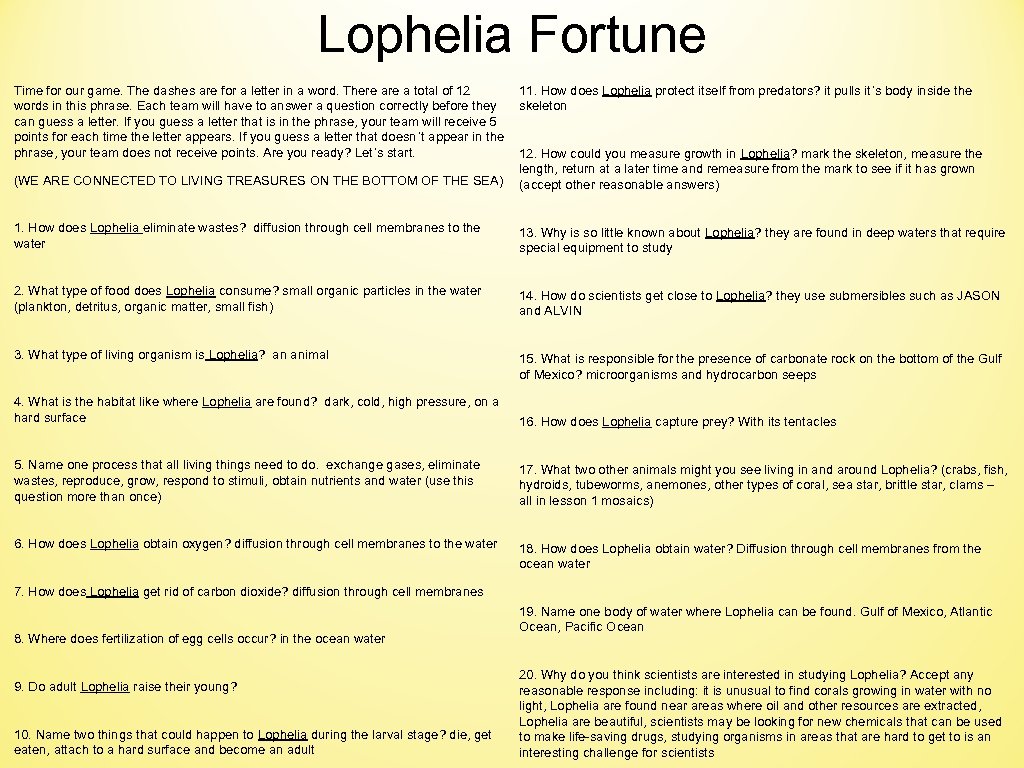
Lophelia Fortune Time for our game. The dashes are for a letter in a word. There a total of 12 words in this phrase. Each team will have to answer a question correctly before they can guess a letter. If you guess a letter that is in the phrase, your team will receive 5 points for each time the letter appears. If you guess a letter that doesn ’t appear in the phrase, your team does not receive points. Are you ready? Let’s start. 11. How does Lophelia protect itself from predators? it pulls it’s body inside the skeleton (WE ARE CONNECTED TO LIVING TREASURES ON THE BOTTOM OF THE SEA) 12. How could you measure growth in Lophelia? mark the skeleton, measure the length, return at a later time and remeasure from the mark to see if it has grown (accept other reasonable answers) 1. How does Lophelia eliminate wastes? diffusion through cell membranes to the water 13. Why is so little known about Lophelia? they are found in deep waters that require special equipment to study 2. What type of food does Lophelia consume? small organic particles in the water (plankton, detritus, organic matter, small fish) 14. How do scientists get close to Lophelia? they use submersibles such as JASON and ALVIN 3. What type of living organism is Lophelia? an animal 15. What is responsible for the presence of carbonate rock on the bottom of the Gulf of Mexico? microorganisms and hydrocarbon seeps 4. What is the habitat like where Lophelia are found? dark, cold, high pressure, on a hard surface 16. How does Lophelia capture prey? With its tentacles 5. Name one process that all living things need to do. exchange gases, eliminate wastes, reproduce, grow, respond to stimuli, obtain nutrients and water (use this question more than once) 17. What two other animals might you see living in and around Lophelia? (crabs, fish, hydroids, tubeworms, anemones, other types of coral, sea star, brittle star, clams – all in lesson 1 mosaics) 6. How does Lophelia obtain oxygen? diffusion through cell membranes to the water 18. How does Lophelia obtain water? Diffusion through cell membranes from the ocean water 7. How does Lophelia get rid of carbon dioxide? diffusion through cell membranes 8. Where does fertilization of egg cells occur? in the ocean water 9. Do adult Lophelia raise their young? 10. Name two things that could happen to Lophelia during the larval stage? die, get eaten, attach to a hard surface and become an adult 19. Name one body of water where Lophelia can be found. Gulf of Mexico, Atlantic Ocean, Pacific Ocean 20. Why do you think scientists are interested in studying Lophelia? Accept any reasonable response including: it is unusual to find corals growing in water with no light, Lophelia are found near areas where oil and other resources are extracted, Lophelia are beautiful, scientists may be looking for new chemicals that can be used to make life-saving drugs, studying organisms in areas that are hard to get to is an interesting challenge for scientists
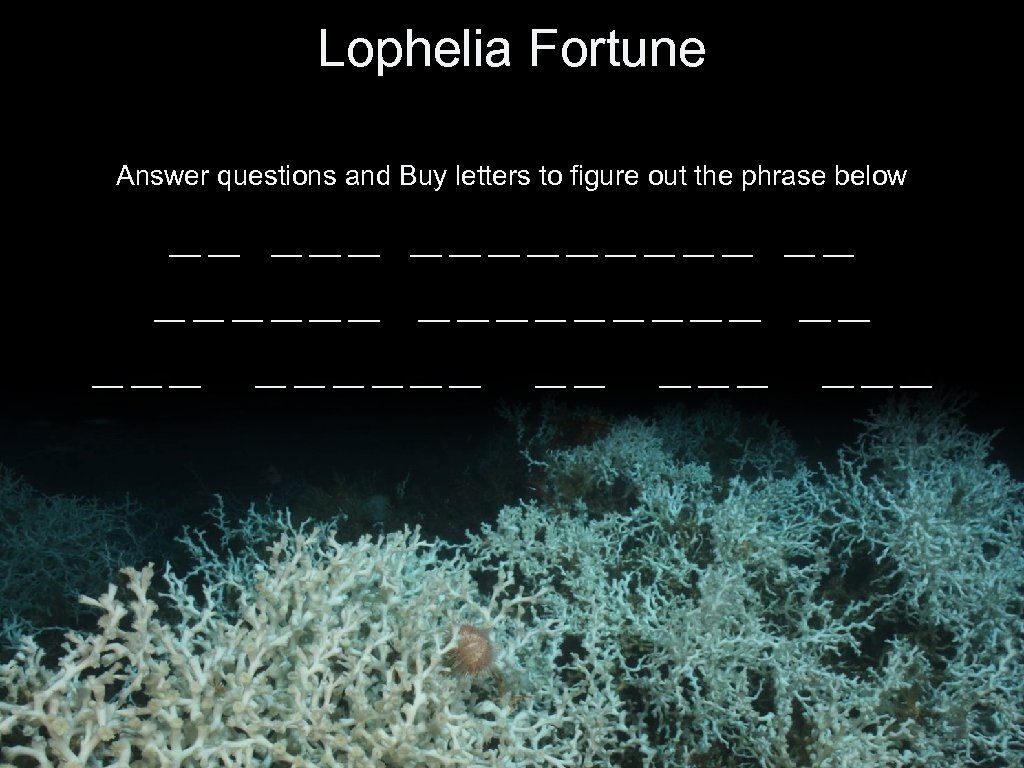
Lophelia Fortune Answer questions and Buy letters to figure out the phrase below __ __ __ __ __ __ __ __ __ __ __ __ __
Скачать презентацию How do coral survive on the bottom of
3cf52ad2a20d90b930a3b21638b1c0d4.ppt