


 Скачать презентацию HOW DO CHILDREN LEARN TO READ WHY DO
0f2749d27a35971a5843cdbbdb82d180.ppt
- Количество слайдов: 47
 HOW DO CHILDREN LEARN TO READ? WHY DO SOME CHILDREN HAVE DIFFICULTIES? HOW CAN WE HELP ALL STUDENTS LEARN TO READ? A presentation to the parents of Albuquerque G. Reid Lyon, Ph. D. President and CEIO Synergistic Education Solutions 1
 WHAT DO KIDS NEED TO KNOW TO READ? A HECK OF A LOT 2
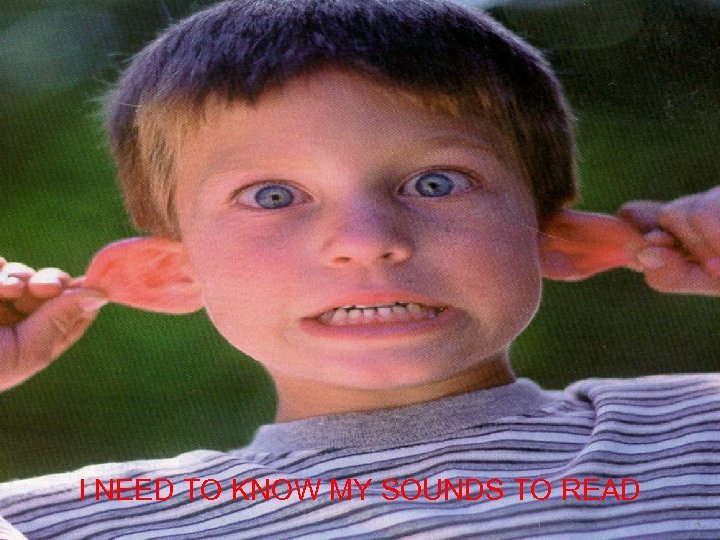 I NEED TO KNOW MY SOUNDS TO READ 3
 How Do Children Learn to Read? Phonological Awareness (PA) • Phonological awareness involves the understanding that spoken words are composed of segments of sounds smaller than a syllable. • It also involves the ability to notice, think about, or manipulate the individual sounds in words. 4
 How Do Children Learn to Read? What is “Phonics”? It is a kind of knowledge. Which letters are used to represent which phonemes? It is a kind of skill. Pronounce these words… blit 5 fratchet
 How Do Children Learn to Read? FLUENCY “Fluency is the ability to read text quickly, accurately, and with proper expression” National Reading Panel 6
 VOCABULARY: • The “ fourth grade reading slump” reflects a language gap as much as a reading gap – Why? • Reading tests (e. g. , NAEP) in 4 th grade are primarily measures of reading comprehension It is impossible to comprehend what is read without the vocabulary relevant to what is being read 7
 HOW VOCABULARY INFLUENCES READING COMPREHENSION • Reading comprehension, at a minimum, depends on decoding/word recognition accuracy and fluency, VOCABULARY, AND BACKGROUND KNOWLEDGE • A student must be able to read correctly approximately 95 percent of the words accurately in text to comprehend what is read • MOREOVER, to comprehend, a student must know the meanings of 90 to 95 percent of the words being read • The unknown 5 to 10 percent can be inferred from text 8
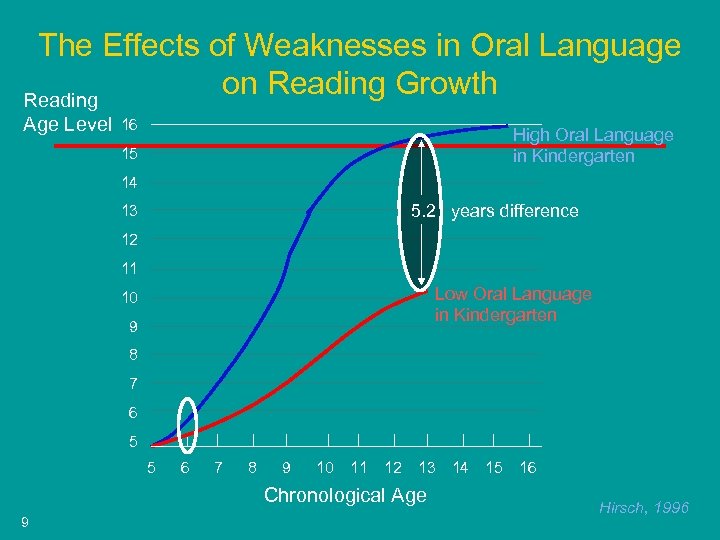 The Effects of Weaknesses in Oral Language on Reading Growth Reading Age Level 16 High Oral Language in Kindergarten 15 14 5. 2 years difference 13 12 11 Low Oral Language in Kindergarten 10 9 8 7 6 5 5 6 7 8 9 10 11 12 13 Chronological Age 9 14 15 16 Hirsch, 1996
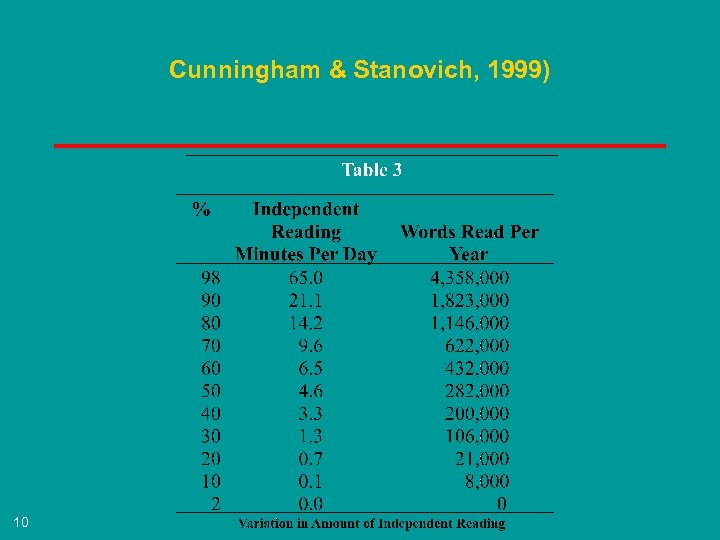 Cunningham & Stanovich, 1999) 10
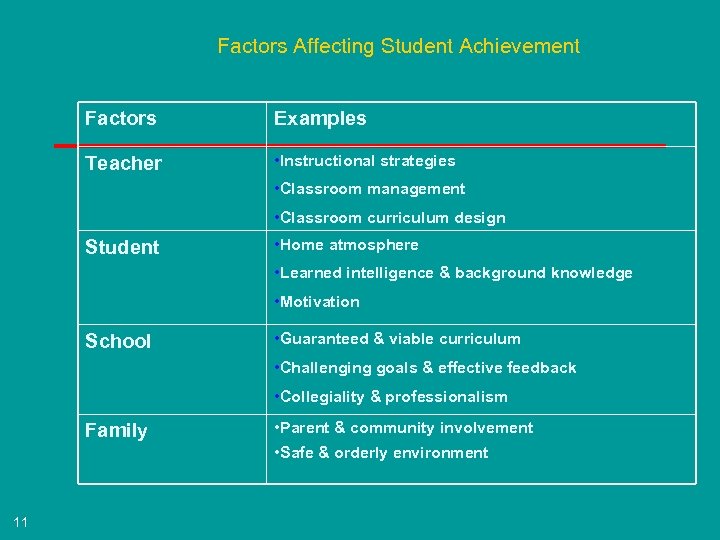 Factors Affecting Student Achievement Factors Examples Teacher • Instructional strategies • Classroom management • Classroom curriculum design Student • Home atmosphere • Learned intelligence & background knowledge • Motivation School • Guaranteed & viable curriculum • Challenging goals & effective feedback • Collegiality & professionalism Family • Parent & community involvement • Safe & orderly environment 11
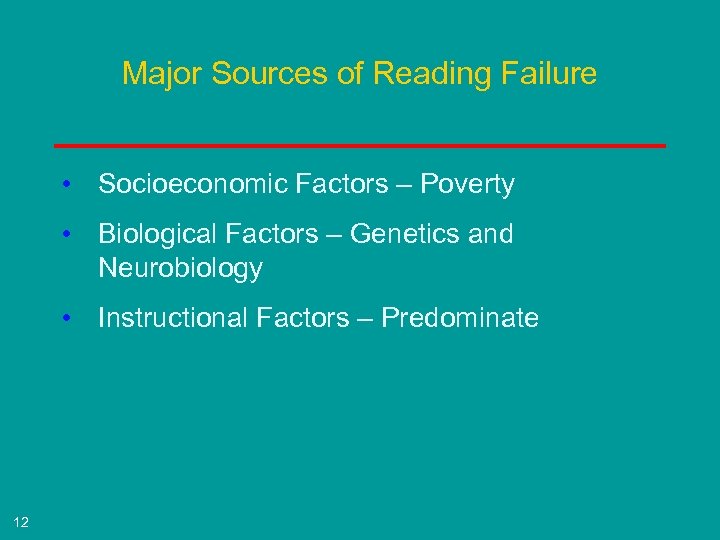 Major Sources of Reading Failure • Socioeconomic Factors – Poverty • Biological Factors – Genetics and Neurobiology • Instructional Factors – Predominate 12
 Environmental Influences • By kindergarten a child from disadvantage typically has twice the vocabulary as a youngster born into poverty • The typical 5 -year-old from an urban environment and disadvantaged home enters kindergarten at the 5 th percentile in vocabulary • By age 16 advantaged children have four times the vocabulary as children born into poverty 13
 What We Hear Many Educators Say: • They’re poor; • Their parents don’t care; • They come to schools without breakfast; • Not enough books • Not enough parents. . . 14
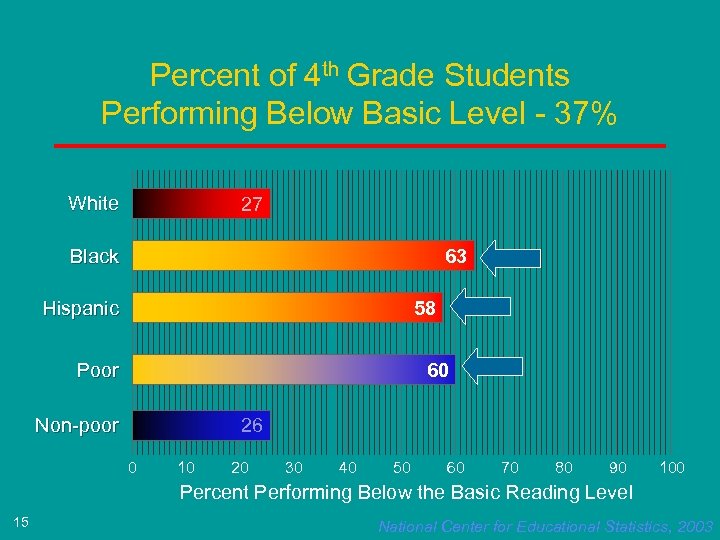 Percent of 4 th Grade Students Performing Below Basic Level - 37% White 27 Black 63 58 Hispanic Poor 60 26 Non-poor 0 10 20 30 40 50 60 70 80 90 100 Percent Performing Below the Basic Reading Level 15 National Center for Educational Statistics, 2003
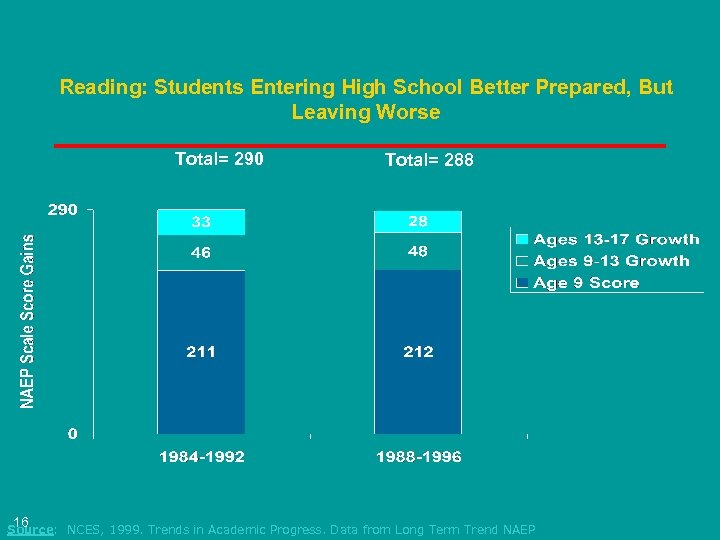 Reading: Students Entering High School Better Prepared, But Leaving Worse Total= 290 16 Total= 288 Source: NCES, 1999. Trends in Academic Progress. Data from Long Term Trend NAEP
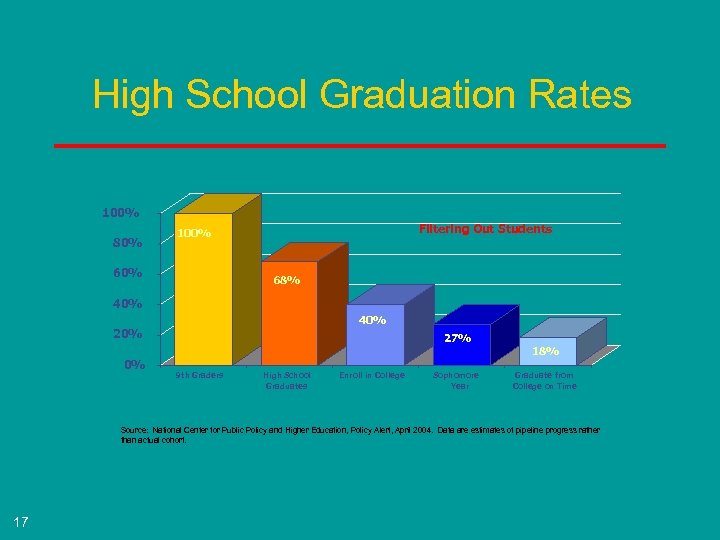 High School Graduation Rates 100% 80% Filtering Out Students 100% 68% 40% 20% 0% 27% 9 th Graders High School Graduates Enroll in College Sophomore Year 18% Graduate from College on Time Source: National Center for Public Policy and Higher Education, Policy Alert, April 2004. Data are estimates of pipeline progress rather than actual cohort. 17
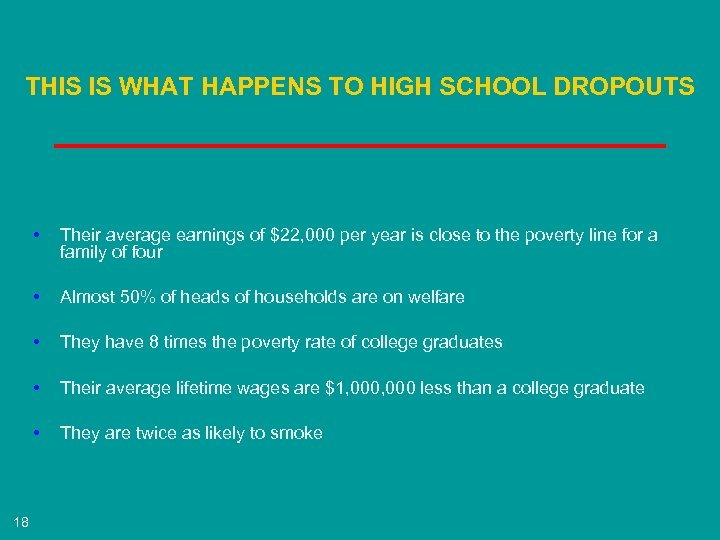 THIS IS WHAT HAPPENS TO HIGH SCHOOL DROPOUTS • • Almost 50% of heads of households are on welfare • They have 8 times the poverty rate of college graduates • Their average lifetime wages are $1, 000 less than a college graduate • 18 Their average earnings of $22, 000 per year is close to the poverty line for a family of four They are twice as likely to smoke
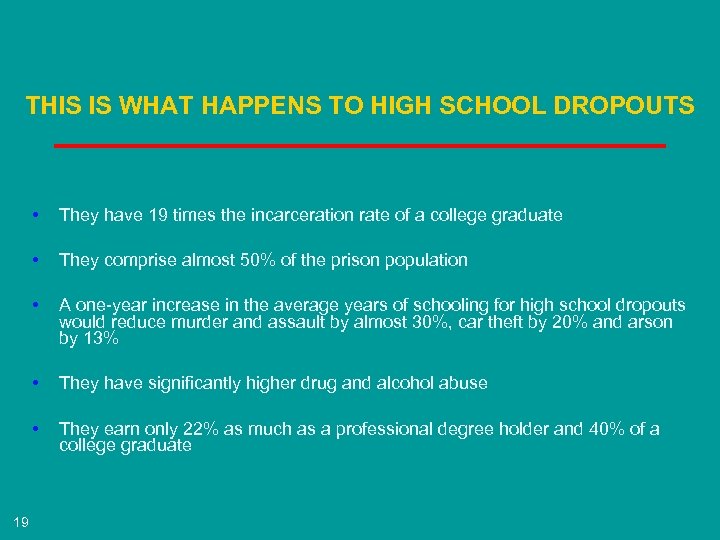 THIS IS WHAT HAPPENS TO HIGH SCHOOL DROPOUTS • • They comprise almost 50% of the prison population • A one-year increase in the average years of schooling for high school dropouts would reduce murder and assault by almost 30%, car theft by 20% and arson by 13% • They have significantly higher drug and alcohol abuse • 19 They have 19 times the incarceration rate of a college graduate They earn only 22% as much as a professional degree holder and 40% of a college graduate
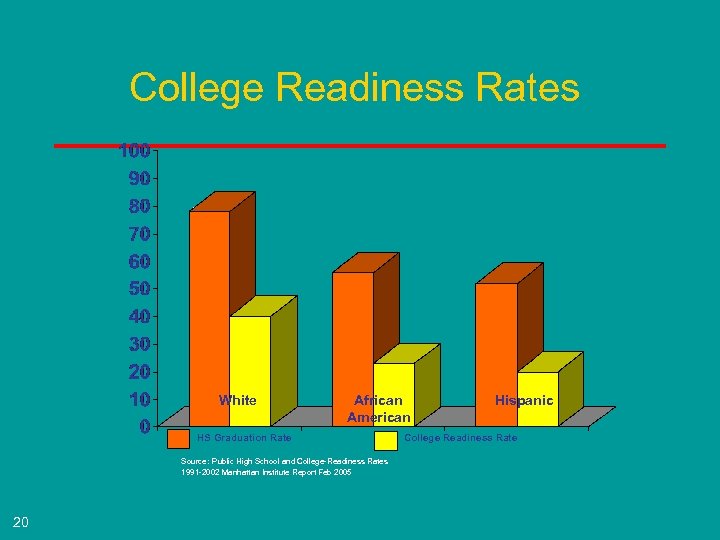 College Readiness Rates White African American HS Graduation Rate Source: Public High School and College-Readiness Rates 1991 -2002 Manhattan Institute Report Feb 2005 20 Hispanic College Readiness Rate
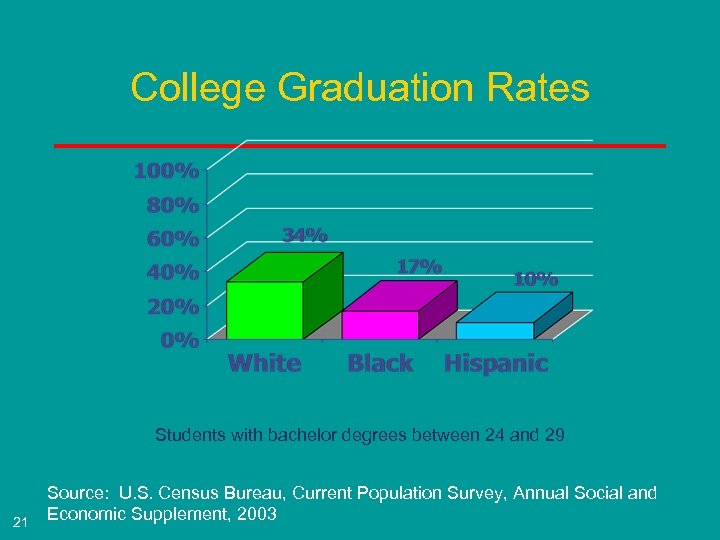 College Graduation Rates Students with bachelor degrees between 24 and 29 21 Source: U. S. Census Bureau, Current Population Survey, Annual Social and Economic Supplement, 2003
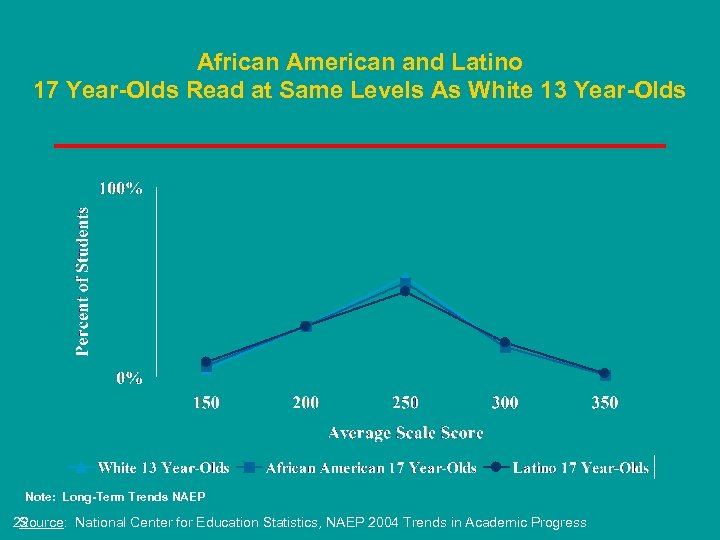 African American and Latino 17 Year-Olds Read at Same Levels As White 13 Year-Olds Note: Long-Term Trends NAEP Source: National Center for Education Statistics, NAEP 2004 Trends in Academic Progress 22
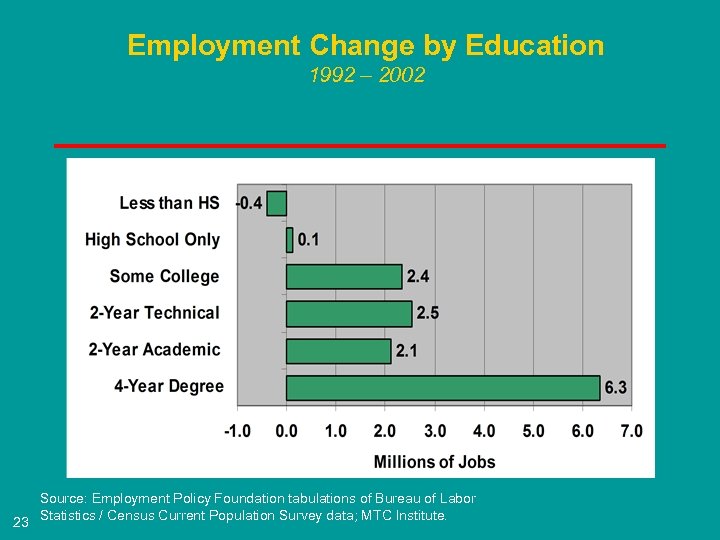 Employment Change by Education 1992 – 2002 23 Source: Employment Policy Foundation tabulations of Bureau of Labor Statistics / Census Current Population Survey data; MTC Institute.
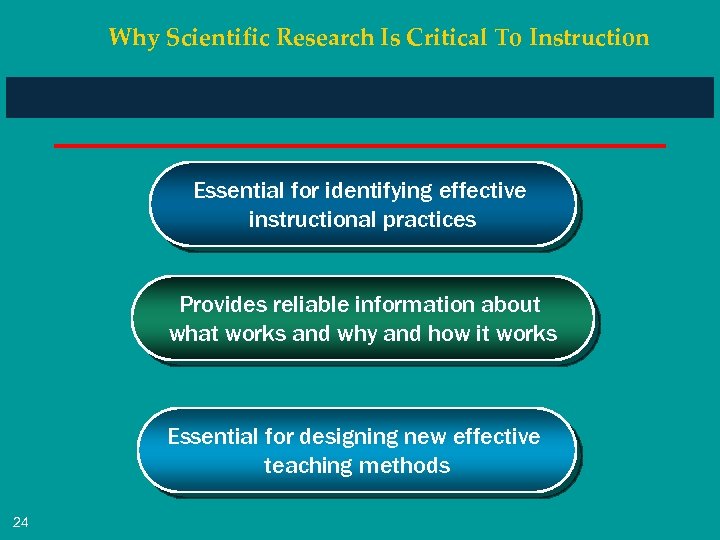 Why Scientific Research Is Critical To Instruction Essential for identifying effective instructional practices Provides reliable information about what works and why and how it works Essential for designing new effective teaching methods 24
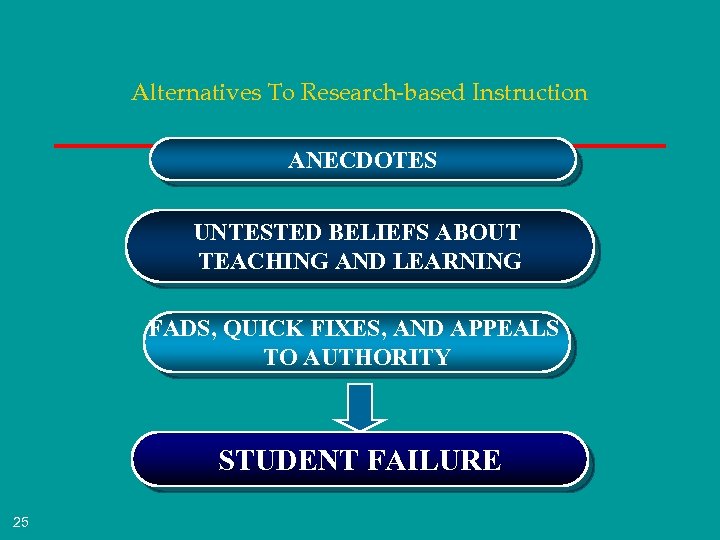 Alternatives To Research-based Instruction ANECDOTES UNTESTED BELIEFS ABOUT TEACHING AND LEARNING FADS, QUICK FIXES, AND APPEALS TO AUTHORITY STUDENT FAILURE 25
 Research Questions • How do children develop language abilities? • How do children develop social competencies? • How can we foster children’s emotional health? • How do children learn to read? • Why do some children have difficulties learning to read? • How can we prevent reading difficulties? • How can we remediate reading difficulties? 26
 Answering Fundamental Questions About Teaching and Learning Through NIH Multidisciplinary Research NIH-NICHD Research Site Composition – Educators – Psychologists – Neuroscientists – Geneticists – Pediatricians – Neurologists – Radiologists – Linguists – Economists – Research Methodologists 27 – Demographers
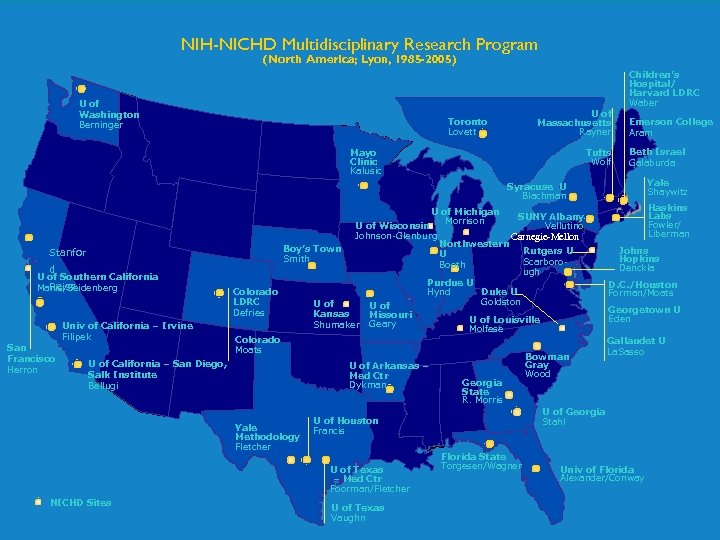 NIH-NICHD Multidisciplinary Research Program (North America; Lyon, 1985 -2005) Children’s Hospital/ Harvard LDRC Waber U of Washington Berninger U of Massachusetts Rayner Toronto Lovett Mayo Clinic Kalusic Tufts Wolf Emerson College Aram Beth Israel Galaburda Yale Shaywitz Syracuse U Blachman Stanfor d U of Southern California Reiss Manis/Seidenberg Univ of California – Irvine Filipek San Francisco Herron U of Michigan SUNY Albany Morrison U of Wisconsin Vellutino Johnson-Glenburg Carnegie-Mellon Northwestern Boy’s Town Rutgers U U Smith Scarboro. Booth ugh Purdue U Colorado Duke U Hynd LDRC Goldston U of Defries Kansas Missouri U of Louisville Shumaker Geary Molfese Colorado Moats U of California – San Diego, Salk Institute Bellugi U of Arkansas – Med Ctr Dykman Yale Methodology Fletcher 28 U of Texas Vaughn Johns Hopkins Denckla D. C. /Houston Forman/Moats Georgetown U Eden Gallaudet U La. Sasso U of Georgia Stahl U of Houston Francis U of Texas – Med Ctr Foorman/Fletcher NICHD Sites Georgia State R. Morris Bowman Gray Wood Haskins Labs Fowler/ Liberman Florida State Torgesen/Wagner Univ of Florida Alexander/Conway
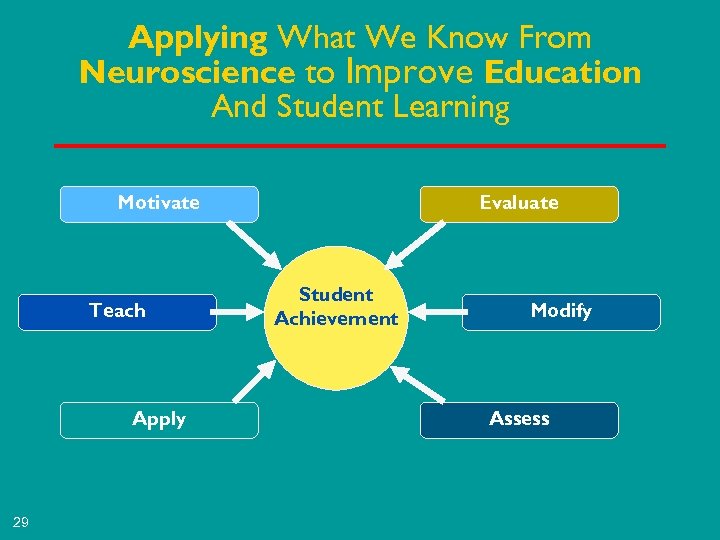 Applying What We Know From Neuroscience to Improve Education And Student Learning Motivate Teach Apply 29 Evaluate Student Achievement Modify Assess
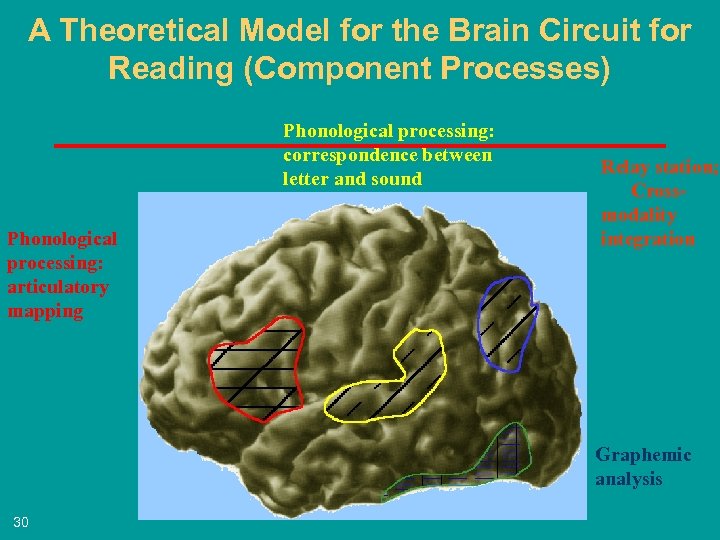 A Theoretical Model for the Brain Circuit for Reading (Component Processes) Phonological processing: correspondence between letter and sound Phonological processing: articulatory mapping Relay station; Crossmodality integration Graphemic analysis 30
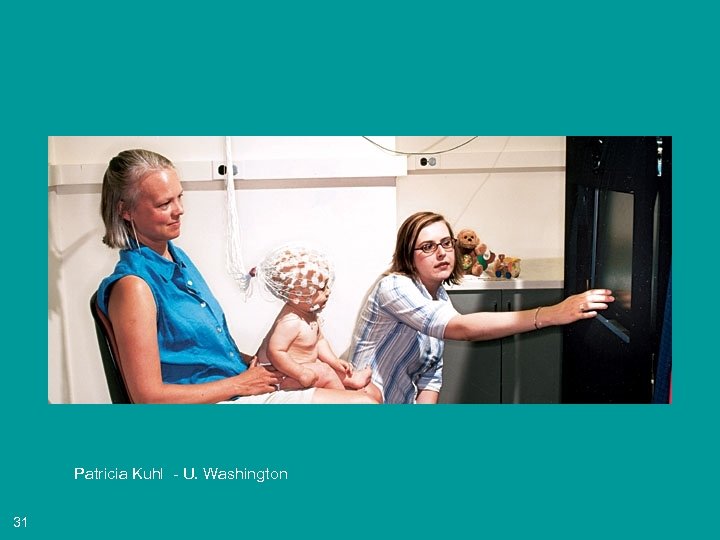 Patricia Kuhl - U. Washington 31
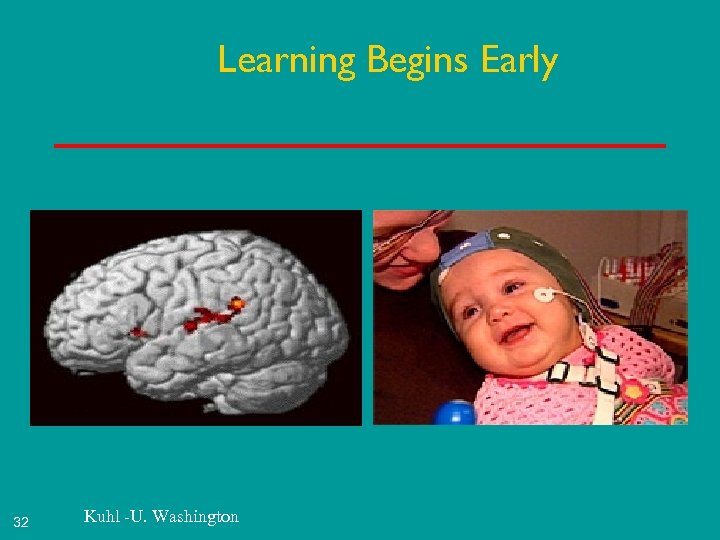 Learning Begins Early 32 Kuhl -U. Washington
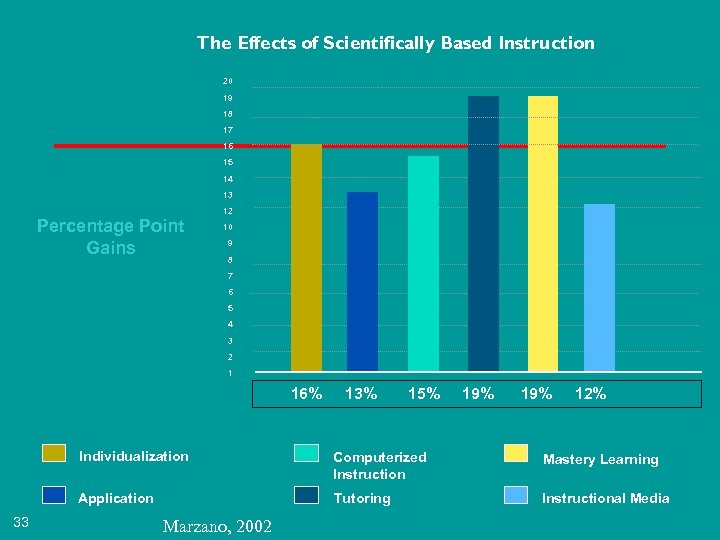 The Effects of Scientifically Based Instruction 20 19 18 17 16 15 14 13 12 Percentage Point Gains 10 9 8 7 6 5 4 3 2 1 16% 13% 15% 19% 12% Individualization Mastery Learning Application 33 Computerized Instruction Tutoring Instructional Media Marzano, 2002
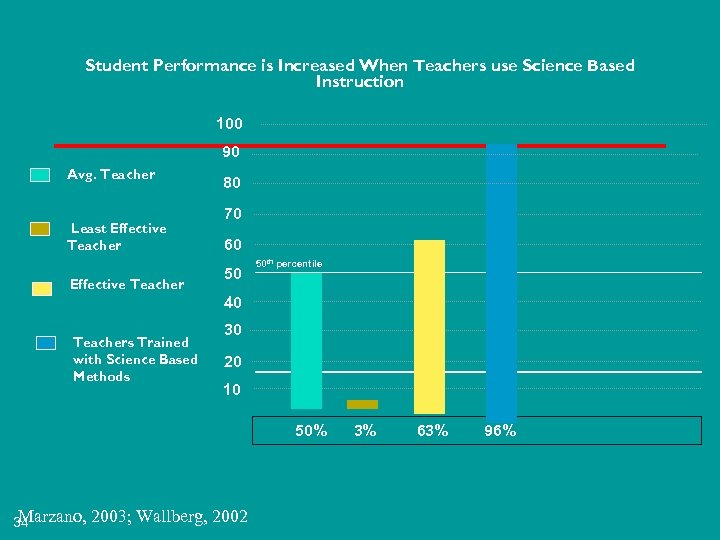 Student Performance is Increased When Teachers use Science Based Instruction 100 90 Avg. Teacher Least Effective Teacher 80 70 60 50 50 th percentile 40 Teachers Trained with Science Based Methods 30 20 10 50% Marzano, 34 2003; Wallberg, 2002 3% 63% 96%
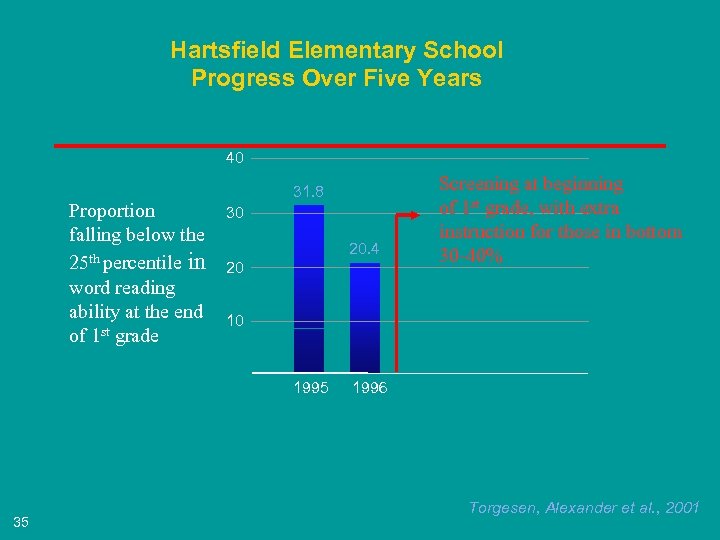 Hartsfield Elementary School Progress Over Five Years 40 Proportion falling below the 25 th percentile in word reading ability at the end of 1 st grade 31. 8 30 20. 4 20 10 1995 35 Screening at beginning of 1 st grade, with extra instruction for those in bottom 30 -40% 1996 Torgesen, Alexander et al. , 2001
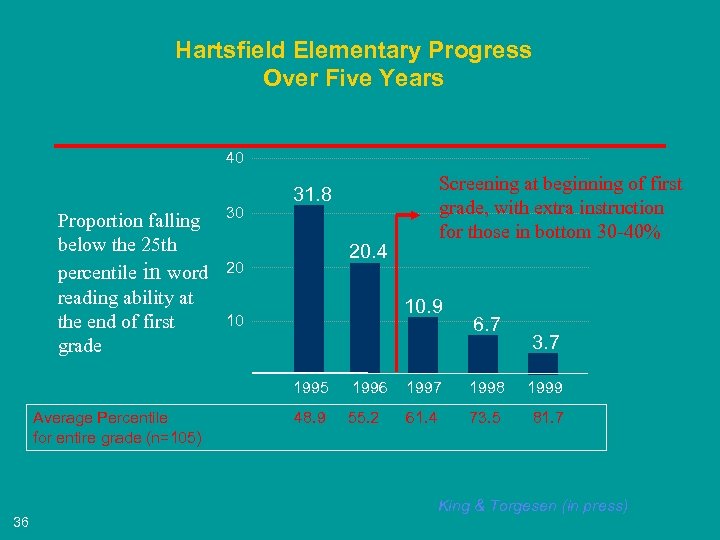 Hartsfield Elementary Progress Over Five Years 40 Proportion falling below the 25 th percentile in word reading ability at the end of first grade 30 Screening at beginning of first grade, with extra instruction for those in bottom 30 -40% 31. 8 20. 4 20 10. 9 10 6. 7 3. 7 1995 Average Percentile for entire grade (n=105) 1996 1997 1998 1999 48. 9 55. 2 61. 4 73. 5 81. 7 King & Torgesen (in press) 36
 WHAT CAN WE DO? 37
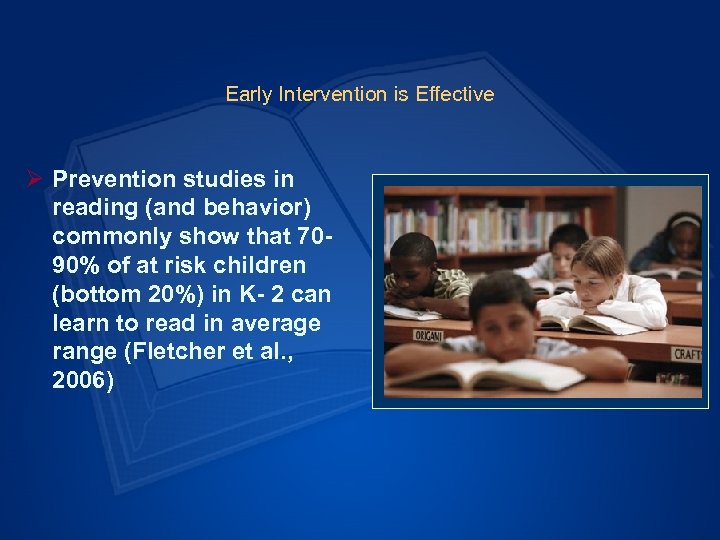 Early Intervention is Effective Ø Prevention studies in reading (and behavior) commonly show that 7090% of at risk children (bottom 20%) in K- 2 can learn to read in average range (Fletcher et al. , 2006)
 THE PREPARATION OF EFFECTIVE TEACHERS AND EDUCATIONAL LEADERS: A NATIONAL IMPERATIVE • Education is the primary prerequisite to our nation’s ability to compete in the global marketplace • Education is the most important factor in obtaining productive employment and supporting a family • The future of our country is in the hands of our nation’s teachers and educational leaders 39
 THE IMPACT OF EFFECTIVE TEACHING ON THE FUTURE OF CHILDREN AND OUR COUNTRY • Teacher effectiveness is the most significant factor in the learning and achievement of students from kindergarten through high school • Effective school leadership adds significant value to the effectiveness of a teacher • The quality of our teachers and educational leaders will determine the quality of life tomorrow 40
 The Effective Teacher: The Most Important Factor in Learning and Achievement • Most effective teachers can improve student academic achievement by over 50 percentile points in one academic year COMPARED TO • • 41 Ineffective teachers have little impact on student achievement: 0 to 14 percentile point gain Average difference in achievement between students with most effective teachers and least effective teachers is 39 percentile points
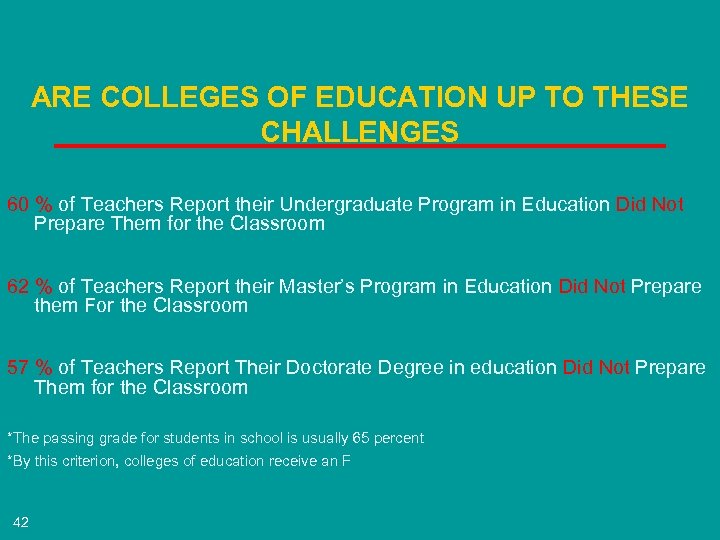 ARE COLLEGES OF EDUCATION UP TO THESE CHALLENGES 60 % of Teachers Report their Undergraduate Program in Education Did Not Prepare Them for the Classroom 62 % of Teachers Report their Master’s Program in Education Did Not Prepare them For the Classroom 57 % of Teachers Report Their Doctorate Degree in education Did Not Prepare Them for the Classroom *The passing grade for students in school is usually 65 percent *By this criterion, colleges of education receive an F 42
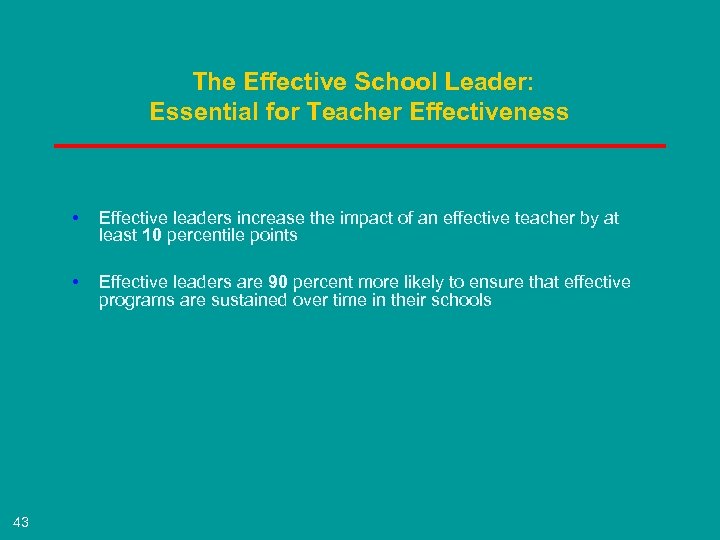 The Effective School Leader: Essential for Teacher Effectiveness • • 43 Effective leaders increase the impact of an effective teacher by at least 10 percentile points Effective leaders are 90 percent more likely to ensure that effective programs are sustained over time in their schools
 Remember The person who says it can not be done should not interrupt the person doing it. --Ancient Chinese Proverb 44
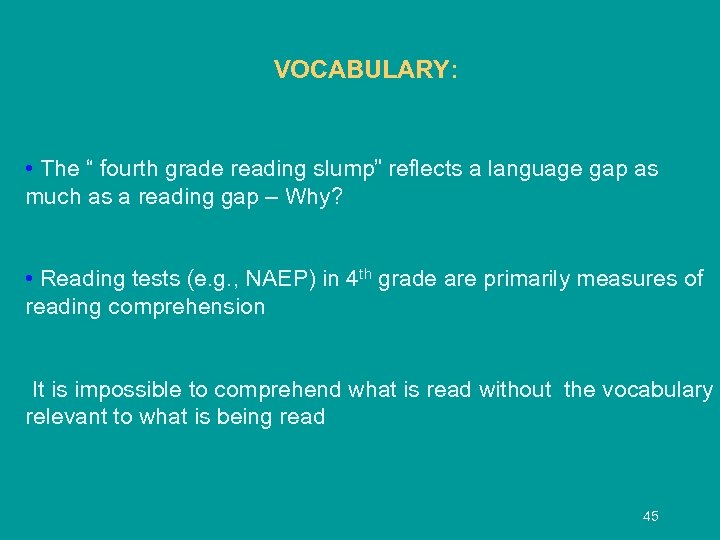 VOCABULARY: • The “ fourth grade reading slump” reflects a language gap as much as a reading gap – Why? • Reading tests (e. g. , NAEP) in 4 th grade are primarily measures of reading comprehension It is impossible to comprehend what is read without the vocabulary relevant to what is being read 45
 Interventions: Reading Comprehension • Teach comprehension strategies explicitly • Work on oral language development, esp. vocabulary • Teach learning adjuncts in content: graphic organizers, summarization • Provide organizational support (works for everyone) 46
 CONSEQUENCS • WHAT HAPPENS WHEN LEADERS DON’T LEAD? • WHAT HAPPENS WHEN TEACHERS ARE NOTPREPARED TO TEACH READING USING SCIENTIFICALLY BASED READING INSTRUCTION? WE SET KIDS UP FOR FAILURE THROUGHOUT THEIR LIFE 47