 Скачать презентацию How Digital will Libraries ever be Musings on
42c0ee68c573f0a04c173b2e1c0cd22d.ppt
- Количество слайдов: 14



How Digital will Libraries ever be? Musings on the limits of a popular metaphor Dr. Stefan Gradmann Virtual Campus Library@Hamburg University computing Centre stefan. gradmann@rrz. uni-hamburg. de How Digital will Libraries ever be?
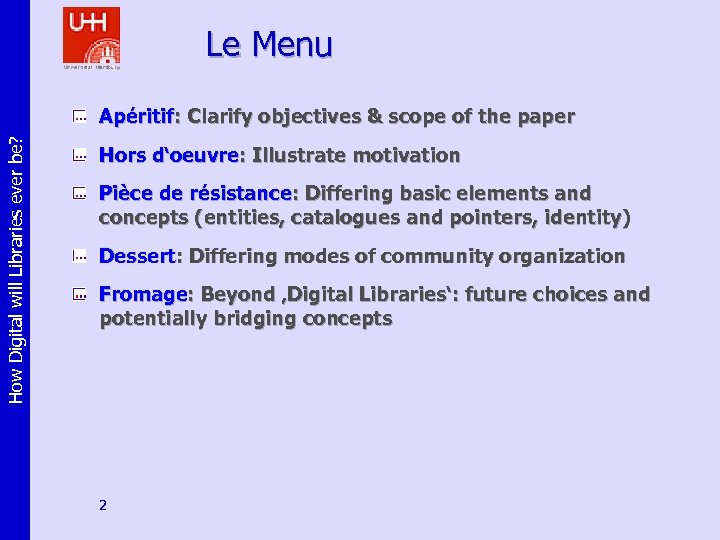
Le Menu How Digital will Libraries ever be? Apéritif: Clarify objectives & scope of the paper Hors d‘oeuvre: Illustrate motivation Pièce de résistance: Differing basic elements and concepts (entities, catalogues and pointers, identity) Dessert: Differing modes of community organization Fromage: Beyond ‚Digital Libraries‘: future choices and potentially bridging concepts 2
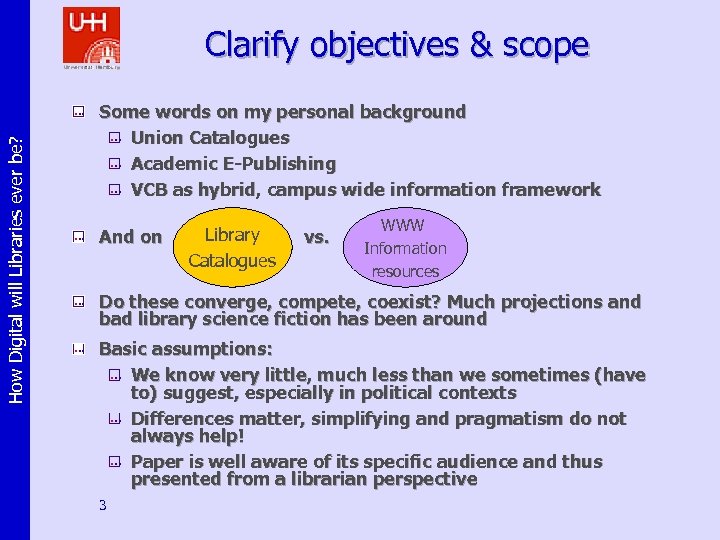
How Digital will Libraries ever be? Clarify objectives & scope Some words on my personal background Union Catalogues Academic E-Publishing VCB as hybrid, campus wide information framework And on Library Catalogues vs. WWW Information resources Do these converge, compete, coexist? Much projections and bad library science fiction has been around Basic assumptions: We know very little, much less than we sometimes (have to) suggest, especially in political contexts Differences matter, simplifying and pragmatism do not always help! Paper is well aware of its specific audience and thus presented from a librarian perspective 3
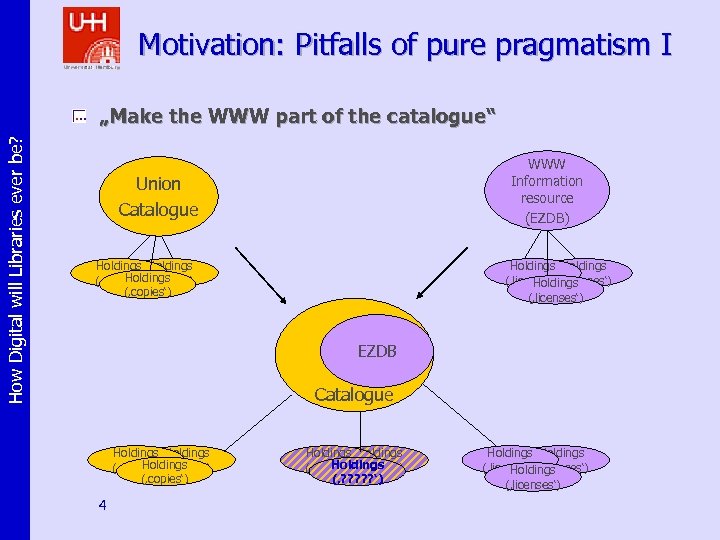
Motivation: Pitfalls of pure pragmatism I How Digital will Libraries ever be? „Make the WWW part of the catalogue“ WWW Information resource (EZDB) Union Catalogue Holdings (‚copies‘) Holdings (‚licenses‘) EZDB Catalogue Holdings (‚copies‘) 4 Holdings (‚copies‘) (‚? ? ? ‘) Holdings (‚licenses‘)
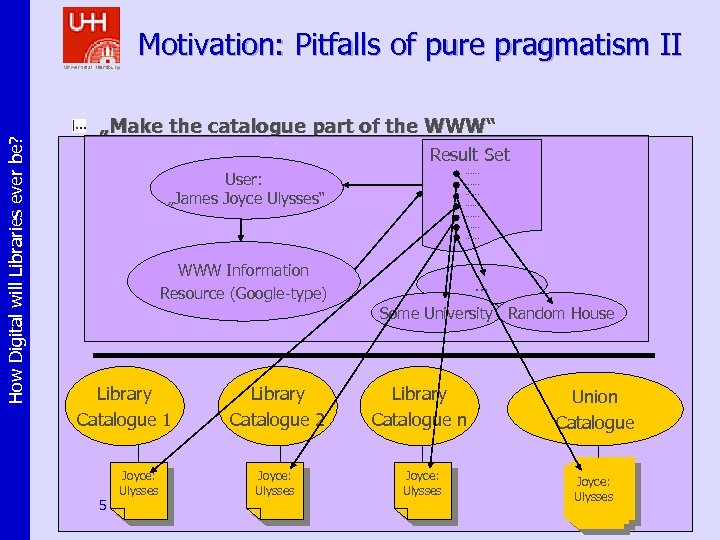
How Digital will Libraries ever be? Motivation: Pitfalls of pure pragmatism II „Make the catalogue part of the WWW“ Result Set …… …… User: „James Joyce Ulysses“ WWW Information Resource (Google-type) … Some University Random House Library Catalogue 1 5 Joyce: Ulysses Library Catalogue 2 Library Catalogue n Union Catalogue Joyce: Ulysses
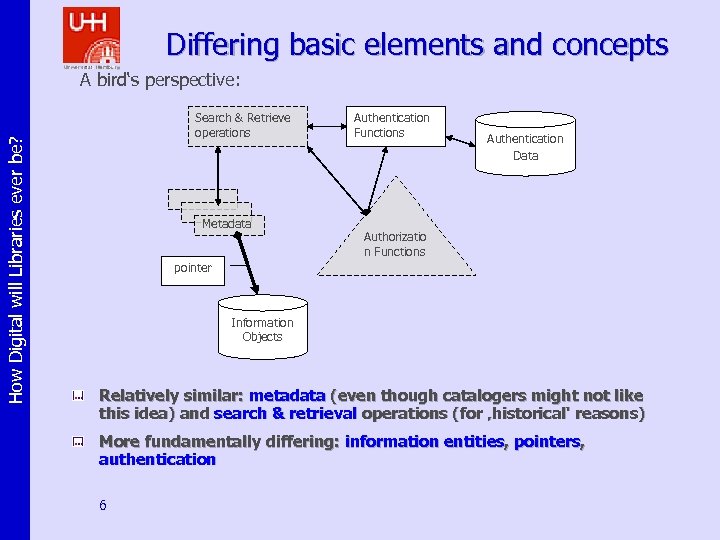
Differing basic elements and concepts How Digital will Libraries ever be? A bird‘s perspective: Search & Retrieve operations Metadata Authentication Functions Authentication Data Authorizatio n Functions ‚pointer’ Information Objects Relatively similar: metadata (even though catalogers might not like this idea) and search & retrieval operations (for ‚historical‘ reasons) More fundamentally differing: information entities, pointers, authentication 6
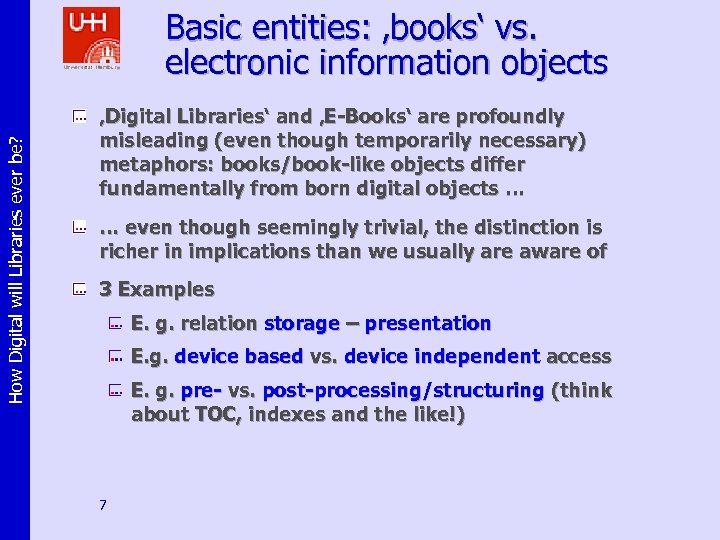
How Digital will Libraries ever be? Basic entities: ‚books‘ vs. electronic information objects ‚Digital Libraries‘ and ‚E-Books‘ are profoundly misleading (even though temporarily necessary) metaphors: books/book-like objects differ fundamentally from born digital objects … … even though seemingly trivial, the distinction is richer in implications than we usually are aware of 3 Examples E. g. relation storage – presentation E. g. device based vs. device independent access E. g. pre- vs. post-processing/structuring (think about TOC, indexes and the like!) 7
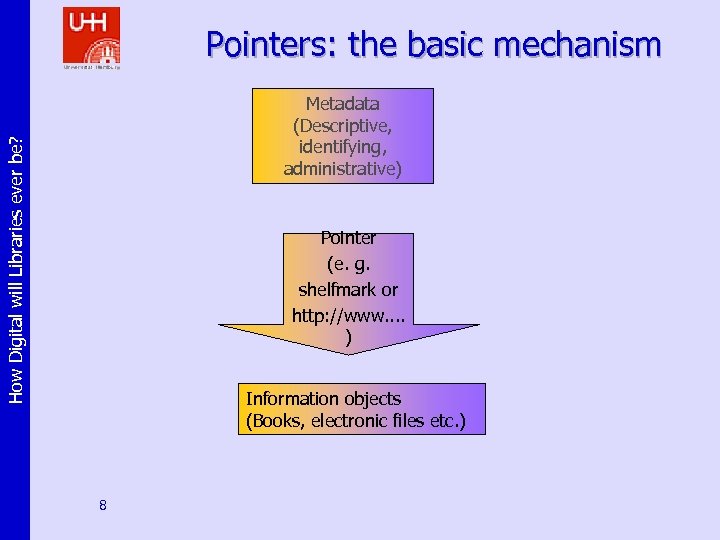
Pointers: the basic mechanism How Digital will Libraries ever be? Metadata (Descriptive, identifying, administrative) Pointer (e. g. shelfmark or http: //www. . ) Information objects (Books, electronic files etc. ) 8
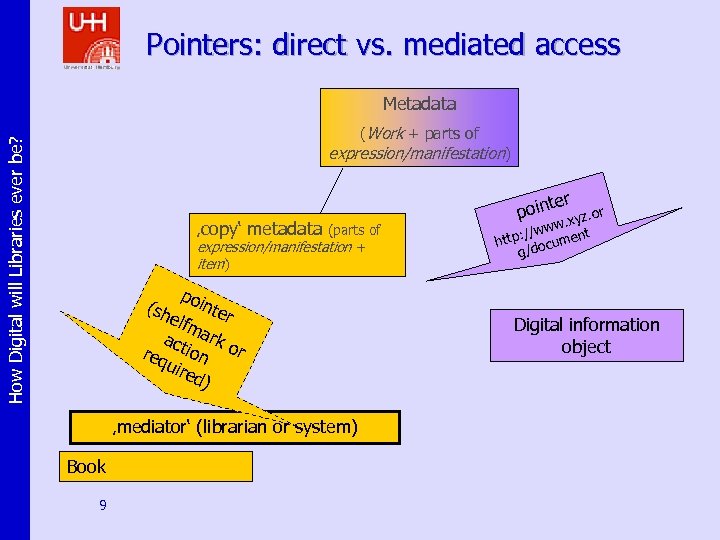
Pointers: direct vs. mediated access Metadata How Digital will Libraries ever be? (Work + parts of expression/manifestation) ‚copy‘ metadata (parts of expression/manifestation + item) poi n ( sh elfm ter act ark o r req ion uir ed) ‚mediator‘ (librarian or system) Book 9 ter poin. xyz. or www tp: // cument ht g / do Digital information object
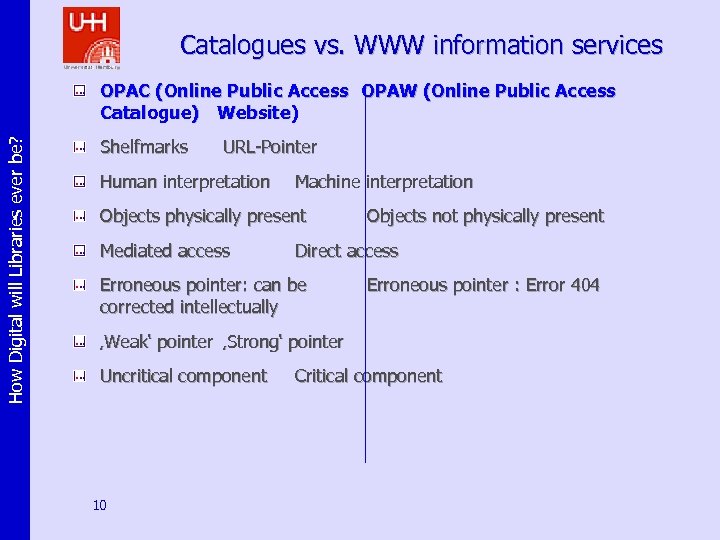
Catalogues vs. WWW information services How Digital will Libraries ever be? OPAC (Online Public Access OPAW (Online Public Access Catalogue) Website) Shelfmarks URL-Pointer Human interpretation Machine interpretation Objects physically present Mediated access Objects not physically present Direct access Erroneous pointer: can be corrected intellectually Erroneous pointer : Error 404 ‚Weak‘ pointer ‚Strong‘ pointer Uncritical component 10 Critical component
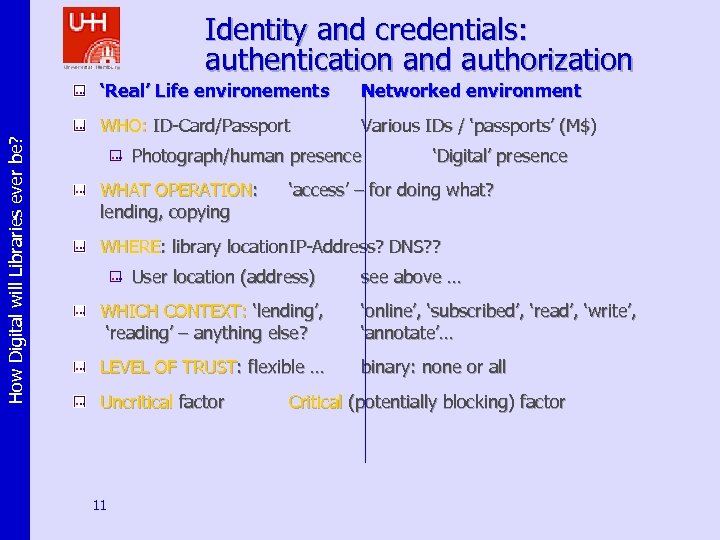
Identity and credentials: authentication and authorization Networked environment WHO: ID-Card/Passport How Digital will Libraries ever be? ‘Real’ Life environements Various IDs / ‘passports’ (M$) Photograph/human presence WHAT OPERATION: lending, copying ‘Digital’ presence ‘access’ – for doing what? WHERE: library location IP-Address? DNS? ? User location (address) see above … WHICH CONTEXT: ‘lending’, ‘reading’ – anything else? ‘online’, ‘subscribed’, ‘read’, ‘write’, ‘annotate’… LEVEL OF TRUST: flexible … binary: none or all Uncritical factor 11 Critical (potentially blocking) factor
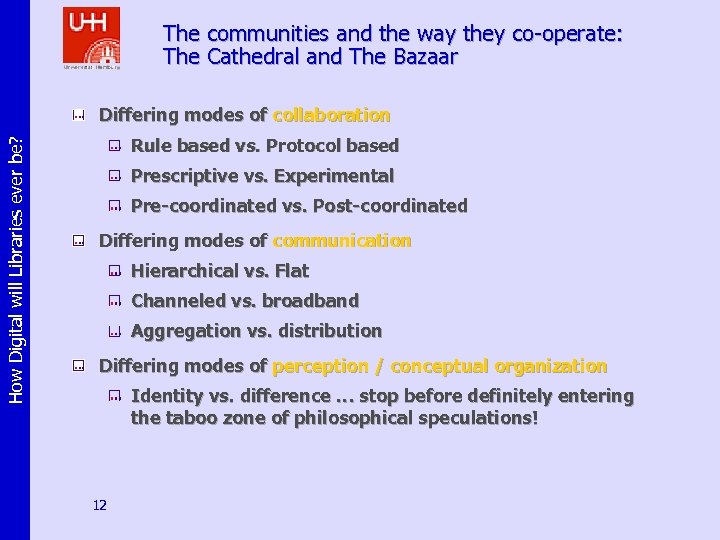
The communities and the way they co-operate: The Cathedral and The Bazaar How Digital will Libraries ever be? Differing modes of collaboration Rule based vs. Protocol based Prescriptive vs. Experimental Pre-coordinated vs. Post-coordinated Differing modes of communication Hierarchical vs. Flat Channeled vs. broadband Aggregation vs. distribution Differing modes of perception / conceptual organization Identity vs. difference … stop before definitely entering the taboo zone of philosophical speculations! 12
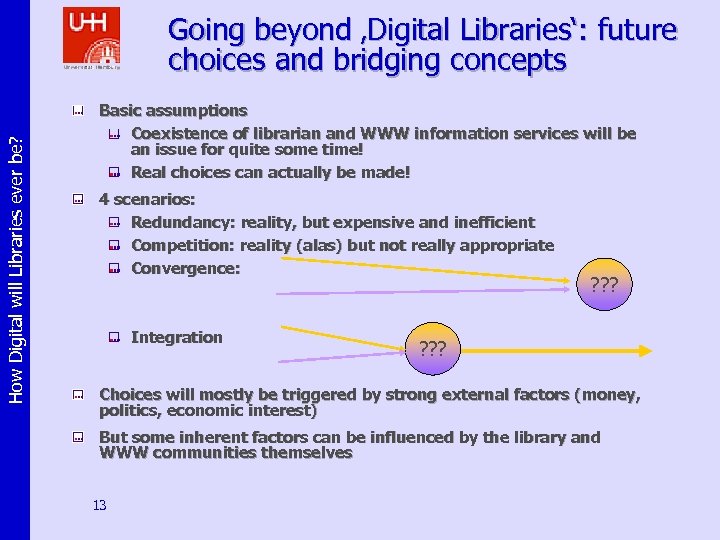
How Digital will Libraries ever be? Going beyond ‚Digital Libraries‘: future choices and bridging concepts Basic assumptions Coexistence of librarian and WWW information services will be an issue for quite some time! Real choices can actually be made! 4 scenarios: Redundancy: reality, but expensive and inefficient Competition: reality (alas) but not really appropriate Convergence: Integration ? ? ? Choices will mostly be triggered by strong external factors (money, politics, economic interest) But some inherent factors can be influenced by the library and WWW communities themselves 13
How Digital will Libraries ever be? Bridging concepts: FRBR and Semantic Web: combine librarian semantic granularity, accuracy and authority control and XML-based automated semantic operations FRBR: Render librarian and internet data structures and pointers compatible by establishing unified concepts of what semantic entities, expressions/manifestations and item derivates are Conclusion: Use the term DL during this conference – but use it carefully: It will have to be replaced some day! Thank you for your patience and attention 14
Скачать презентацию How Digital will Libraries ever be Musings on
42c0ee68c573f0a04c173b2e1c0cd22d.ppt